Introduction
Among the factors that influence the somatic development of children, those related to living conditions have often been reported. The main component of living conditions is socioeconomic status (SES), which can be measured in various ways, but most often includes paternal education, profession and income, as well as family size, size of the apartment/house and place of residence (rural/urban) (Siniarska, Reference Siniarska1996; Bradley & Corwyn, Reference Bradley and Corwyn2002). Many researchers have attempted to determine whether and how SES influences the body build and proportions of children (Barriuso et al., Reference Barriuso, Miqueleiz, Albaladejo, Villanueva, Santos and Regidor2015; Meko et al., Reference Meko, Slabber-Stretch, Walsh, Kruger and Nel2015; Jones, Reference Jones2016). Family income, low level of parental education and a large family size might be associated with greater BMI in children, although not all data confirm this (O’Dea & Caputi, Reference O’Dea and Caputi2001; Alam, Reference Alam2008; Al-Agha et al., Reference Al-Agha, Tatwany, Aiash, Mandourah and Abukhalil2015). It has also been observed that children from poorer neighbourhoods are characterized by lower body heights, body mass indexes (BMIs) and mid-arm circumferences than their richer peers (Jansen & Hazebroek-Kampschreur, Reference Jansen and Hazebroek-Kampschreur1997; Bogin & MacVean, Reference Bogin and MacVean1981; Hakeem, Reference Hakeem2001; Kolekar & Sawant, Reference Kolekar and Sawant2013).
Living conditions have also been shown to be associated with muscular strength test results; however, there is no consensus on this in the literature. For example, Otero et al. (Reference Otero, Cohen, Herrera, Camacho, Bernal and López-Jaramillo2016), in their research in developing countries, found that greater grip strength might be related to lower socioeconomic status. On the other hand, Artaria (Reference Artaria2010) found no differences in grip strength between poor rural and rich urban children in East Java. Puciato et al. (Reference Puciato, Mynarski, Rozpara, Borysiuk and Szyguła2011) showed that, for standing vertical jump height, the influence of SES was unequivocal, and suggested that the better results for this test might be related to body height and adiposity.
The present study aimed to evaluate the relationship between the body structure and muscular strength of school children in Poland and their living conditions. The study data are of particular interest because they relate to a period when Poland was neither a member of NATO nor the European Union and was undergoing profound social and economic transformation (Grzega, Reference Grzega2015).
Methods
Study sample
The research was conducted in 1997. The study population included 400 girls and 341 boys between the ages of 7 and 15 years attending nine randomly selected primary schools in Warsaw. All the children were considered healthy by a paediatrician.
Data
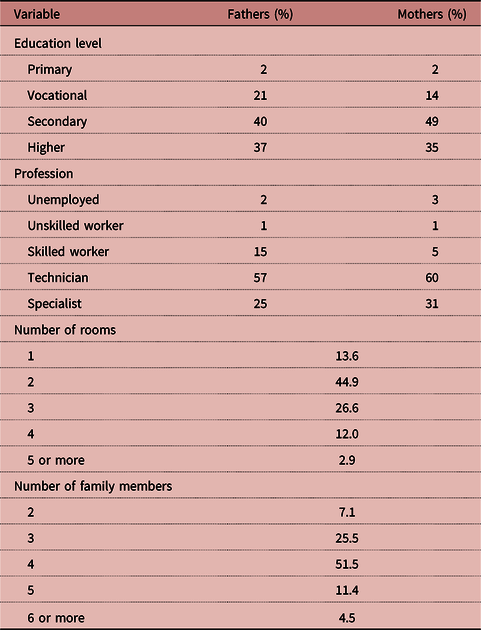
A questionnaire was completed by the parents of the examined children. This asked for: age of the child, father’s education level (primary, vocational, secondary or higher), father’s and mother’s professions (unemployed, unskilled worker, skilled worker, technician or specialist), monthly income of the entire family, number of persons in the family and number of rooms in their apartment/house. Additionally, two indexes were calculated: family income per capita and number of persons per room. The descriptive statistics characterizing the socioeconomic status of the examined children are presented in Table 1.
Descriptive statistics characterizing the living conditions of the examined children aged 7–15, Warsaw, 1997

The following measurements were taken from the children: body height (cm), body weight (kg), chest circumference (cm), arm circumference (cm), grip strengths of the right and left hands (static strength measured by a dynamometer, kg) and vertical jump height (explosive strength of lower extremities, cm). The measurements were performed using commonly used techniques (Martin & Saller, Reference Martin and Saller1957). These measurements were used to calculate BMI (weight (kg)/height (m2)), Marty’s Index ([chest circumference in cm/height in cm]×100) and the Sargent Vertical Jump Index. The centimetre scale was attached to the wall 1.0–2.5 m from the ground. The subject stood with their right or left side to the wall (depending on the dominance of the hand) in the extended upper extremity. Then the subject made the maximum jump to touch the hanging scale as high as possible. The reach of the arm at rest and in jump was noted. The Sargent Vertical Jump Index (explosive strength) was calculated using the following formula: [(hand reach in vertical jump in cm−hand reach when standing in cm)/hand reach when standing]×100.
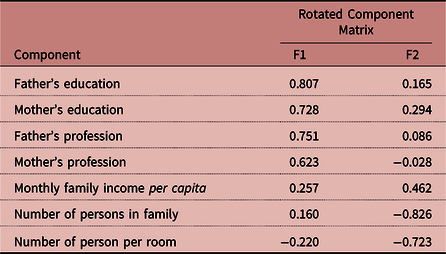
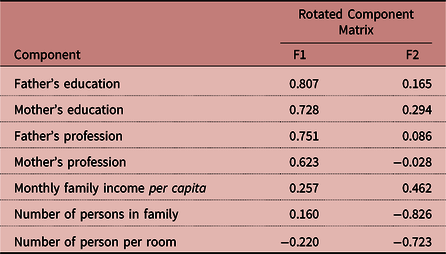
Family characteristics were reduced to two independent factors using PCA with Varimax Rotation, which explained 54.47% of the total variance of all family characteristics. The Rotated Component Matrix extracted two factors, namely ‘socioeconomic status’ (F1), which included parental education and profession, and ‘family size’ (F2), which included the number of family members and the number of persons per room (Table 2).
Rotated Component Matrix for selected family characteristics (independent variables)
Analysis
To eliminate the effects of age differences between the studied children (separately for sex), a z-score was calculated for each measurement, test result and index by normalizing the raw value for each individual to the mean and standard deviation of the variable for the entire study population, corresponding to the subject’s age.
Differences in body structure and muscular strength tests between boys and girls were evaluated using Student’s t-test (significance taken at p<0.05). To reduce the number of living condition characteristics and express their common variation in one or two factors, PCA was used. The relationship between body dimensions and muscular strength, and extracted factors, were evaluated using multiple regression analysis. Statistical analysis was performed using Statistica 13.1.
Results
Sex differences in body structure and muscular strength
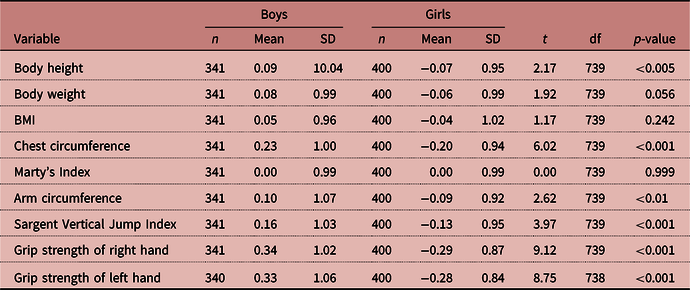
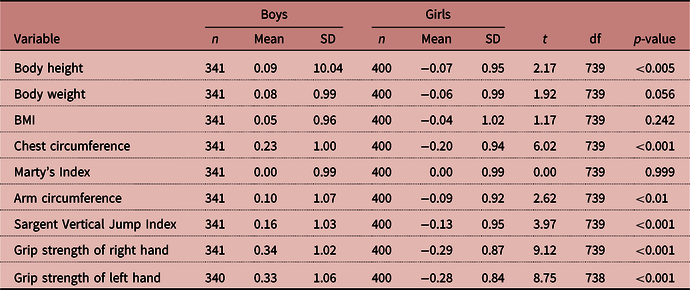
The results of the t-test demonstrated differences between boys and girls in body structure and muscular strength. The variables body height, chest circumference, arm circumference, Sargent Vertical Jump Index and grip strength were found to be statistically significant between boys and girls, being greater for boys than girls (Table 3).
Differences between sexes for somatic variables and muscular strength test results
Effects of family characteristics on body structure and muscular strength
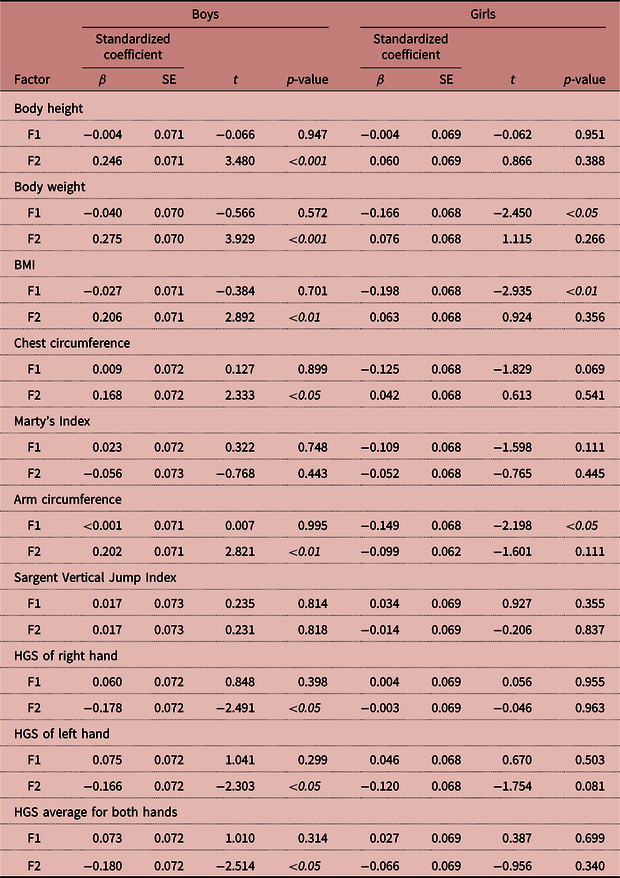
The multiple regression analysis showed that in boys, most of the body structure and muscular strength traits had a statistically significant relationship with family size (F2). In bigger families, boys were, on average, shorter, weighed less and had smaller BMIs and chest and arm circumferences, but their grip strength was greater. For girls, a statistically significant relationship was found between weight, BMI, arm circumference and the socioeconomic factor F1. In families with higher levels of parental education and better professions, girls weighed less and had smaller BMIs and arm circumferences.
No statistically significant relationship was found between Marty’s index and Sargent Vertical Jump Index and the two extracted factors F1 and F2 (Table 4).
Multiple regression analysis showing the association between somatic characteristics, muscular strength test results and studied factors
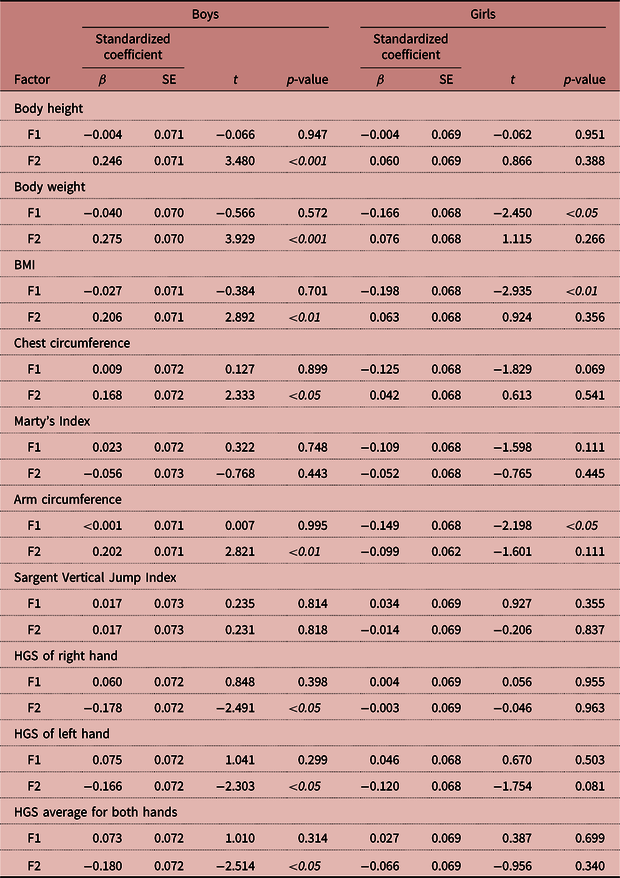
HGS: hand grip strength.
Italic type indicates significant effects.
Discussion
The study results showed that, in the sample boys, body structure and muscular strength were more sensitive to family size than in girls. It should also be noted that the study boys were on average taller with greater chest and arm circumferences, grip strengths, and higher vertical jump height than girls.
Sexual differences in most somatic measurements change with age. Differences in body structure and composition between the sexes have been shown to be small until the onset of puberty (Wells, Reference Wells2007; El Mouzan et al., Reference El Mouzan, Al Herbish, Al Salloum, Foster, Al Omar, Qurachi and Kecojevic2010; Silva et al., Reference Silva, Pelegrini, Petroski and Gaya2010; Thakur & Gautam, Reference Thakur and Gautam2017). Differences in body structure between boys and girls can be explained by the influence of sex hormones during puberty, and this particularly applies to testosterone, which is responsible for the marked growth in boys at puberty (Hurbo, Reference Hurbo2008; Derman, Reference Derman2013; Zhi et al., Reference Zhi, Xi, Gao, Huang, Yang, Dai, Deng and Zhang2015).
The boys and girls in this study also differed in their muscular strength (grip strength and lower extremity strength, as measured by the Sargent Vertical Jump Index). Previous research has concluded that there is no significant difference between the sexes in muscle strength before puberty, but that after puberty the muscle mass in boys is greater and their strength is greater than that of girls (Özdemir et al., Reference Özdemir, Utkualp and Palloş2016; Handelsman et al., Reference Handelsman, Hirschberg and Bermon2018). Two factors might affect motor skill: body build and individual predisposition (which includes age of maturation) and environmental conditions affecting the developmental period (Puciato et al., Reference Puciato, Mynarski, Rozpara, Borysiuk and Szyguła2011).
The relationship of body structure and muscular strength with living conditions presents quite an interesting picture. Monitoring the biological development of children and adolescents during economic and social transformations is extremely important. At the end of the 1990s, after the first decade of transformation, Poland was transformed from a communist state to a state based on a free market economy (Chrzanowska et al., Reference Chrzanowska, Koziel and Ulijaszek2007). Some researchers were convinced that the rapid socioeconomic development of Poland in the 1990s would reduce the differences in the body build (mainly height) of children between Polish cities (Suliga, Reference Suliga2009). The results of the present study indicate that body structure and grip strength in boys are strongly related to family size. In smaller families, boys were found to be taller with greater BMIs and chest and arm circumferences, but they achieved worse results in the grip strength tests. However, for girls, weight, BMI and arm circumferences were associated with the socioeconomic factor (F1), showing that lower weight and BMI, as well as smaller arm circumference, were observed in families with higher parental education and better professions. Of the two factors distinguished in this study, family size (F2) most diversified the boys’ body structure.
Good living conditions and a small family should positively correlate with psychomotor development, which is mainly related to income per family member. Children in smaller families have better access to proper nutrition, additional sports and recreational activities, and better hygiene conditions, and show a lower level of stress (Puciato, Reference Puciato2010). However, in the current study, boys in large families achieved better results in grip strength. Furthermore, the results of some studies indicated that in terms of muscular strength, children from worse living conditions could show better results (Otero et al., Reference Otero, Cohen, Herrera, Camacho, Bernal and López-Jaramillo2016). It has also been argued that children from families with higher SES, and therefore with better living conditions, tend to have more limited physical activity and be characterized by a passive lifestyle (Piko & Keresztes, Reference Piko and Keresztes2008). There is, however, no consensus on whether muscular strength can be modified by living conditions (Ignasiak et al., Reference Ignasiak, Sławińska and Domaradzki2002; Giagazoglou et al., Reference Giagazoglou, Kyparos, Fotiadou and Angelopoluou2007; Mészáros et al., Reference Mészáros, Mészáros, Szmodis, Pampakas, Osváth and Völgyi2008).
The results of studies on the somatic, physiological and psychomotor development of children and adolescents in the years 1976–1987 in different regions of Poland show similar but not identical results to those of the present study. In families with higher parental education, boys were taller with larger chest dimensions and girls had lower body weights, BMIs and chest dimensions (Siniarska Reference Siniarska1996). Both sexes showed better results in psychomotor tests. In families with higher income, both sexes had bigger physiques and worse results in fitness tests. Siniarska (Reference Siniarska1996) showed that children from large dwellings (probably from larger families) had, on average, bigger physiques and better results in static and explosive strength tests.
Reports on the relationship between body structure and family size are ambiguous. Children from small families in the US (mainly one child) have been shown to be more obese than their peers from families with two or more children (Chen & Escarce, Reference Chen and Escarce2014). This indicates that having a large family with several children could reduce the risk of obesity (Al-Agha et al., Reference Al-Agha, Tatwany, Aiash, Mandourah and Abukhalil2015). In 2000, approximately 20% of boys and 11% of girls were obese in Poland (Charzewska et al., Reference Charzewska, Chabros, Jajszczyk, Rogalska-Niedźwiedź, Chwojnowska, Kaczanowski, Bergman, Charzewska and Piechaczek2004). In recent years, a trend has been noted towards overweight and obesity in an increasing number of children and adolescents in the country (Grzelak et al., Reference Grzelak, Nieczuja-Dwojacka, Siniarska and Samul2015). This phenomenon had a similar origin as that observed in Western European countries; however, it occurred with some delay in Central and Eastern Europe (Chrzanowska et al., Reference Chrzanowska, Koziel and Ulijaszek2007).
Methods of assessing nutritional status (malnutrition/undernutrition/overnutrition) include the measurement of arm circumference (Jeyakumar et al., Reference Jeyakumar, Ghugre and Gadhave2013). The current opinion is that children living in families with better living conditions are characterized by greater arm circumferences. The results of the present study showed a relationship between larger arm circumference and smaller family size for boys, and this could be explained by better access to food (Akhtar et al., Reference Akhtar, Bhatty, Sattar and Javed2001).
The present results show that SES significantly differentiated body build. Girls from families with higher SES had smaller weights, BMIs and arm circumferences. These observations are similar to those of other studies conducted a range of countries (Vieweg et al., Reference Vieweg, Johnston, Lanier, Fernandez and Pandurangi2007; Puciato, Reference Puciato2010; Jo, Reference Jo2014; Kowalkowska et al., Reference Kowalkowska, Wadolowska, Wuenstel, Słowińska and Niedźwiedzka2014; Wronka, Reference Wronka2014; Jeannot et al., Reference Jeannot, Mahler, Elia, Cerruti and Chastonnay2015). This phenomenon can be explained in two ways. On the one hand, parents with higher education, profession and income are more aware of the conditions that affect biological development, provide food of better quality, and enable children to participate in non-school sporting activities. In addition, lower SES can lead to more frequent sedentary behaviours such as watching TV, while in families with higher SES, there are conditions that encourage children to be more physically active (Tandon et al. Reference Tandon, Zhou, Sallis, Cain, Frank and Saelens2012). On the other hand, it is worth noting that in the late 1990s, young girls in Poland were exposed to the influence of mass media, where a slim body is promoted (Suka et al., Reference Suka, Sugimori, Yoshida, Kanayama, Sekine, Yamagami and Kagamimori2005; Vigenerova et al., Reference Vigenerova, Humenikova, Brabec, Riedlova and Blaha2007). Perhaps access to cable television could be an additional factor that influences BMI. Uramowska-Zyto and Kozłowska-Wojciechowska (Reference Uramowska-Zyto and Kozłowska-Wojciechowska2003) and Mazur et al. (Reference Mazur, Klimek, Telega, Hejda, Wdowiak and Małecka-Tendera2008) found that SES did not significantly affect the BMI of elementary school children in south-eastern Poland, or the nutritional status of children. They also indicated that in large cities such as Warsaw, SES had a greater effect on the body build of children and adolescents than in towns and rural parts of Poland.
The present study did not show any significant relationship between Marty’s index and the Sargent Vertical Jump Index and the two living condition factors. Moreover, no apparent relationship between these variables has been shown in the literature. However, some studies have suggested a positive effect of high SES on muscular strength; for example, Siniarska (Reference Siniarska1996) found that children in larger families achieved better results in grip strength than their peers from smaller families. However, other studies did not find such a relationship (Freitas et al., Reference Freitas, Maia, Beunen, Claessens, Thomis, Marques and Lefevre2007; Birnie et al., Reference Birnie, Cooper, Martin, Kuh, Sayer, Alvarado and Hardy2011).
Social and cultural changes can affect the somatic and motor development of children and adolescents through changes in diet, medical care, sanitation and physical activity. Longitudinal studies in the UK have indicated how inequalities in SES have changed over time and influenced the body height, weight and BMI of the children. In the years 1946–1970, greater body weight was associated with low SES, while after the year 2000, children from lower SES families were significantly heavier than their peers from richer families. On the other hand, the relationship between body height and SES was different. Taller children always came from families with a higher SES, while the differences between children’s body height and inequalities in SES decreased between generations (Bann et al., Reference Bann, Johnson, Li, Kuh and Hardy2018).
In conclusion, this study in school children in Poland found that most of the somatic characteristic and muscular strength test results had greater values in boys than in girls. Boys were more sensitive (ecosensitive) than girls in terms of the relationship between body structure and grip strength, and the family size. Boys from smaller families were taller, with larger body weights, BMIs and chest and arm circumferences, but with worse results in grip strength. Girls in families with higher SES (parents with better education and professions) had lower weights and smaller BMI and arm circumferences. The results may be useful in examining the effect of living conditions on the somatic and motor development of children against the background of social and economic changes in Central and Eastern Europe in the 1990s.
Funding
This research received no specific grant from any funding agency, commercial entity or not-for-profit organization.
Conflicts of Interest
The authors have no conflicts of interest to declare.
Ethical Approval
The study was conducted in agreement with the Code of Ethics of the World Medical Association for experiments involving humans. Parents and children were informed that they were not obliged to participate in the research and that they could withdraw from the study without giving a reason. The authors assert that all procedures contributing to this work comply with the ethical standards of the relevant national and institutional committees on human experimentation and with the Helsinki Declaration of 1975, as revised in 2008.