INTRODUCTION
In the sea, carbonatic substrates are constantly eroded and/or dissolved both by physical and biological agents. Among the biological agents, sponges are important and widespread bioeroders, especially in tropical reefs (Rützler, Reference Rützler1975).
Several studies have been dedicated to explore the diversity and the role of the Mediterranean excavating sponges (e.g. Futterer, Reference Futterer1974; Rützler, Reference Rützler1974; Rützler & Bromley, Reference Rützler and Bromley1981; Corriero et al., Reference Corriero, Pansini and Sarà1988; Rosell & Uriz, Reference Rosell and Uriz1991; Barbieri et al., Reference Barbieri, Bavestrello and Sarà1995; Bavestrello et al., Reference Bavestrello, Calcinai and Sarà1996, Reference Bavestrello, Calcinai, Cerrano and Sarà1997; Corriero & Scalera-Liaci, Reference Corriero and Scalera-Liaci1997; Calcinai et al., Reference Calcinai, Cerrano, Milanese and Bavestrello2000; Corriero & Nonnis Marzano, Reference Corriero and Nonnis Marzano2006). Regarding the Adriatic Sea this group has mainly been studied in the Rovinj region, in the north-eastern portion of the basin (Schmidt, Reference Schmidt1862; Lendenfeld, Reference Lendenfeld R.1897; Volz, Reference Volz1939; Rützler, Reference Rützler1965, Reference Rützler1967) and in its southern part (Tremiti Islands and Apulian coast) (Sarà, Reference Sarà1961; Corriero et al., Reference Corriero, Scalera Liaci, Ruggiero and Pansini2000).
According to Pansini & Longo (Reference Pansini and Longo2008) 16 excavating sponge species are present in the Adriatic sea, 13 of which, Alectona millari Carter, 1879; Thoosa mollis Volz, Reference Volz1939; Cliona celata Grant, 1826; C. rhodensis Rützler & Bromley, Reference Rützler and Bromley1981; C. schmidti (Ridley, 1881); C. topsenti (Lendenfeld, 1896); C. vermifera Hancock, 1867; C. viridis Schmidt, Reference Schmidt1862; Cliothosa hancocki, (Topsent, 1888); Pione vastifica (Hancock, 1849); Volzia albicans (Volz, 1938); V. rovignensis (Volz, 1938) and Aka labyrinthica (Hancock, 1849), have been recorded in its northern part. A further species for this area, Cliona thoosina Topsent 1888, was recently recorded by Bertolino et al. (Reference Bertolino, Calcinai, Cerrano, Ponti and Mescalchin2008) off Chioggia.
While the impact of boring sponge activity on the coral reefs has been widely studied (e.g. Neumann, Reference Neumann1966; McKenna, Reference McKenna, Lessios and Macintyre1997; Rützler, Reference Rützler2002a; Schönberg, Reference Schönberg2003; Lopez-Victoria & Zea, Reference Lopez-Victoria and Zea2005; Calcinai et al., Reference Calcinai, Azzini, Bavestrello, Gaggero, Cerrano, Custódio, Lóbo-Hadju, Hadju and Muricy2007; Chaves-Fonnegra et al., Reference Chaves-Fonnegra, Zea and Gómez2007) very few data are available for Mediterranean species (Schönberg & Tapanila, Reference Schönberg and Tapanila2006).
To estimate the erosion rate, long-term experiments are necessary (Pari et al., Reference Pari, Peyrot-Clausade, Le Campion-Alsumard, Hutchings, Chazottes, Golubic, Le Campion and Fontaine1998; Schönberg, Reference Schönberg2002; Calcinai et al., Reference Calcinai, Azzini, Bavestrello, Gaggero, Cerrano, Custódio, Lóbo-Hadju, Hadju and Muricy2007, Reference Calcinai, Bavestrello, Cerrano, Gaggero, Wisshal and Tapanila2008). Nevertheless it is possible to evaluate the impact of a sponge species on its substratum by the gross estimation of the average volume of the specimens, considered as the volume of the boring chambers. This approach was applied at the Grand Cayman reef by Rose & Risk (Reference Rose and Risk1985) who recorded an increase in volume of specimens of Cliona delitrix excavating Montastrea cavernosa in habitats prone to faecal pollution. These authors assumed that the biomass of endolithic tissue is supported, for the water supply, by the superficial papillae and consequently the endolithic part cannot overcome the limits of the epilithic portion. Following this assumption, a correlation between epilithic tissue and excavated volume was later recorded in different boring species (Rose & Risk, Reference Rose and Risk1985; Rosell, Reference Rosell1994; Schönberg, Reference Schönberg2001a).
The aims of this work were to study: (1) the diversity of the boring sponges living in the carbonatic substrates of the Conero Promontory on the central, western side of the Adriatic Sea; and (2) the excavating activity of the most widespread species, determining the relationship between its epilithic area and the bored volume.
MATERIALS AND METHODS
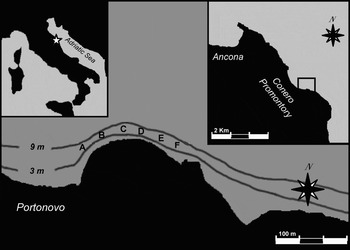
The study was performed at Portonovo (Conero Promontory, Adriatic Sea) (Figure 1) between November 2006 and July 2007. The area of the Conero Promontory is made up of a micritic limestone of the Maiolica Formation (Centamore & Micarelli, Reference Centamore and Micarelli1991).
Map showing the area of study (Conero Promontory) in the Adriatic Sea; upper case letters refer to the parallel transects.

In the studied area, along a transect starting from the coastline, the seabed is composed of a belt of large mobile stones and fixed rocks, ending in the sandy bottoms about 100 m offshore, at a depth of about 9 m. The stones are subjected to rolling under the effect of the waves but their stability increases according to the depth and distance from the seashore. The rolling and wave friction prevent the settlement of epi- and endobiontic species on the rocks until a depth of 3 m.
After this depth the relative stability of the bottom allows the settlement of an assemblage characterized mainly by mussels, oysters, the sea anemone Anemonia sulcata, thin sandy concretions of the polychaete Sabellaria alveolata and several boring organisms, mainly bivalves (Pholas dactylus and Gastrochaena dubia) and excavating sponges.
The specimens collection was performed at a depth of 5–9 m by SCUBA diving visually oriented sampling techniques. Stones and small blocks with evident signs of sponge erosion (presence of coloured papillae) were entirely collected; portions of larger blocks were removed using a hammer and chisel. The material was dry-preserved.
The spicule complement was analysed according to Rützler (Reference Rützler1974). The skeletal architecture was examined both by light and scanning electron microscope (SEM). Spicule size-range, mean and standard deviations were obtained from 100 measurements. For SEM analyses spicule dissociations were transferred onto stubs and sputtered with gold. The SEM studies were carried out using a Philips XL 20 SEM. Sponge identification was also based on the size and shape of the papillae and erosion chambers. Fragments of substratum excavated by C. adriatica were cleaned in sodium hypochlorite solution, washed and dried. The fragments were sputtered with gold and put on stubs for SEM observation. Pit dimensions (maximal diameter) were measured on SEM images using ImageJ 1.37. The holotype is deposited at the Museo Civico di Storia Naturale ‘G. Doria’ of Genoa (MSNG).
During May and June 2007, in order to evaluate the abundance of the most common sponge species in the area, Cliona adriatica sp. nov., we placed six transects, 10 m long, parallel to the coastline (Figure 1), on the carbonatic bottom of the studied area. A frame (50 × 50 cm) partitioned into 25 small quadrates (10 × 10 cm) was placed, each metre along the transects and the presence/absence of C. adriatica in the 25 quadrates of each frame was recorded. The specimens were considered to completely occupy the quadrates where sponge papillae occurred. In this way a surface of 2.5 m2 (250 quadrates 10 × 10 cm) per each transect was carefully mapped. This method, slightly modified, was previously adopted by Acker & Risk (Reference Acker and Risk1985) and Schönberg (2000a) to quantify the distribution of excavating sponges in the Caribbean and on the Great Barrier Reef.
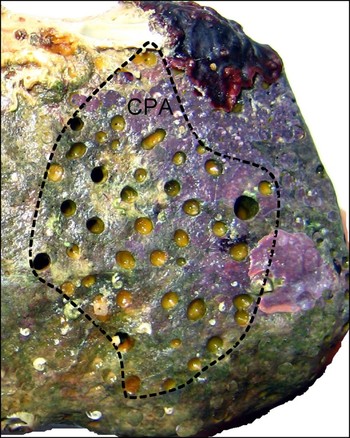
To evaluate the total volume eroded by C. adriatica, 41 rocks of various dimensions excavated by the sponge were collected by SCUBA diving. For each rock the diameter of each papilla was measured. Through these data the number of papillae (PN) of each specimen was obtained, and considering the papillae as circular, the total papillar area (TPA) was obtained. The sponge surface, considered as the rough superficial area by a line connecting the outermost papillae (CPA), was also estimated. This area roughly corresponds to the surface of the rocks affected by the sponge erosion (Figure 2).
Evaluation of the epilithic surface of Cliona adriatica. The total papillar area (TPA) was obtained as the sum of the surface of each papilla. The line connecting the most external papillae defines the rough superficial area of the sponge indicated in the text as circumscribed papillar area (CPA).

The volume of the boring chambers was estimated according to Rose & Risk (Reference Rose and Risk1985). The stones were photographed and the superficial areas with the presence of papillae were measured. Later, the blocks were cut into slabs 1 cm thick. The excavated portions of each slab were measured analysing the slab photograph through ImageJ 1.37.
The excavated areas of the two sides of each slab were averaged and multiplied by slab thickness in order to estimate the excavated volume of each slab. Finally, the total eroded volume (EV) of a single specimen was obtained by the sum of the volumes of all the slabs with boring chambers. The specific gravity of the rocks, determined using a picnometer, was 2.5 g/cm3. This value was used to convert the excavated volume in weight of substratum bored by the sponge (Rose & Risk, Reference Rose and Risk1985). Finally the relationship between the excavated volume and the epilithic portion (TPA and CPA) was obtained.
RESULTS
The species living in the calcareous rocks of the Conero Promontory are Pione vastifica, Cliona lobata, C. viridis and the new species, Cliona adriatica, described here.
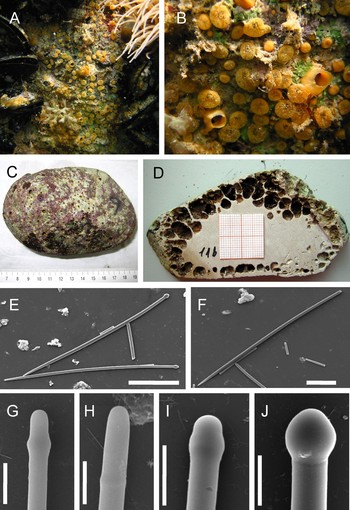
Cliona adriatica sp. nov. (A) Field image of a specimen excavating a large block; (B) magnification of the surface showing inhalant and exhalant papillae; (C) collected stone infested by the sponge; (D) 1 cm thick slab with the large chambers highlighted; (E) scanning electron microscope (SEM) image of the tylostyles (scale bar = 100 µm); (F) SEM image of a style (scale bar = 50 µm); (G–J) magnifications of spicule heads, variable in shape (scale bars = 10 µm).

TYPE MATERIAL
Holotype: (MSNG 55516), specimen 4, 23 November 2006; Portonovo, Conero Promontory. Examined material: blocks 1–10 (November 2006); 11–28 (May 2007); 29–34 (June 2007); 35–41 (July 2007).
DESCRIPTION
Excavating sponge with papillae vivid yellow to dark yellow (Figure 3A–C), clearly distinguishable in inhalant and exhalant in the living specimens. Both inhalant and exhalant papillae are generally large and well-spaced, 0.3–3.8 mm in diameter (mean 1.52 mm; N = 5723). In dried specimens papillae become dark yellow brownish.
Excavated chambers are large and ovoid (Figure 3D); they measure 0.4–15.4 mm (mean 4.9 mm; N = 15123); adjacent chambers are connected by foramina and by short papillar channels with the papillae. The average diameter of the pits produced by this species is 74.7 ± 11.2 µm (N = 113).
In the choanosome spicules are dispersed. In the papillae they are arranged in palisade, with the tips towards the external side. Consequently, the surface of the papillae is clearly hispid.
Spicules: tylostyles in general are very thin and straight; they are sometimes slightly curved in the third distal part. Heads are very variable in shape: irregularly ovoid, trilobated, pin-like; tips are hastate. They measure 215–385 × 2.5–10 µm (mean 289.3 × 6.5 µm; N = 100) in the chambers and 235–375 × 5–12.5 µm (mean 312.3 × 8.3 µm; N = 100) in the papillae.
Styles are straight, slightly thicker in the central part; they are not as common in the preparations as the tylostyles but are more frequent in the papillae. They measure 205–360 × 5–10 µm (mean 277.9 × 6.8 µm; N = 100) in the chambers and 225–350 × 5–10 µm (mean 307–9 µm; N = 100) in the papillae. Subtylostyles are often present, and in the chambers they are generally shorter. There are no microscleres.
ETYMOLOGY
Named after the Adriatic Sea.
REMARKS
Cliona adriatica is the most common and most destructive sponge in the Conero Promontory and it was present in all of the 41 blocks collected. This yellow excavating species is characterized by its large excavation chambers and by its spicule complement consisting of tylostyles and styles. Recently, Barucca et al. (Reference Barucca, Azzini, Bavestrello, Biscotti, Calcinai, Canapa, Cerrano and Olmo2007) have demonstrated by molecular data the specific status of this species also present in the Limski Canal (Northern Adriatic Sea, Croatia).
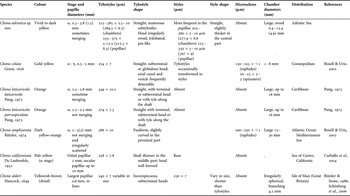
Cliona adriatica can be confused with a group of co-generic sponges characterized by yellow papillae and rarity or lacking of spirasters in their spicular complement. Differences between these species are summarized in Table 1.
Comparison among Cliona adriatica sp. nov. and other Cliona spp. similar to the new species. An exhaustive table on the characteristics of the Cliona spp. with only tylostyles is reported in Schönberg et al. (Reference Schönberg, Grass and Heiermann2006).

In particular C. adriatica differs from C. celata in the size (larger in C. adriatica) and shape of the boring chambers (merging in C. celata, non-merging in C. adriatica) and in the spicule complement (no styles in C. celata). Moreover, in some specimens of C. celata spirasters and raphides were observed (Rützler, Reference Rützler, Hooper and van Soest2002b; Schönberg et al., Reference Schönberg, Grass and Heiermann2006). Finally C. adriatica never reaches the gamma stage.
Other species of the genus Cliona characterized by tylostyles as the prevalent spicules and by the yellow colour are C. alderi Hancock, 1849, C. amplicavata Rützler, Reference Rützler1974, recently recorded in the Mediterranean Sea (Rosell & Uriz, Reference Rosell and Uriz2002), the Caribbean C. laticavicola Pang, Reference Pang1973 and C. californiana De Laubenfels, 1932. Cliona alderi is considered a junior synonym of C. celata (van Soest, Reference van Soest, Van Soest, Boury-Esnault, Hooper, Rützler, de Voogd, Alvarez, Hajdu, Pisera, Vacelet, Manconi, Schoenberg, Janussen, Tabachnick and Klautau2010) even if other authors (Rützler & Stone, Reference Rützler and Stone1986) have suggested considering it a valid species. Cliona alderi is characterized by the presence of styles and tylostyles but differs from C. adriatica in the tylostyles which are shorter and with different head shape. The boring chambers and papillae are also larger in the new species.
Cliona adriatica has smaller chambers and shorter tylostyles than C. amplicavata. Moreover, the presence in this species of numerous raphids allows the distinction of these two species.
Cliona laticavicola is an orange sponge with smaller papillae than in C. adriatica and with tylostyles different in shape. Cliona californiana is a Pacific species which also grows in the beta stage. Its tylostyles are different in shape from those of C. adriatica, and styles have sporadically been recorded (Carballo et al., Reference Carballo, Cruz-Barraza and Gómez2004).
Boring activity of Cliona adriatica
The presence of C. adriatica sp. nov. was detected in 30 ± 5.5 quadrates per transect and, considering as completely occupied the surface of the quadrates where sponge tissue was present, it was possible to estimate that Cliona erosion involves 12 ± 2.2% of the available substratum in the area of the Conero Promontory.
On the 41 examined blocks, 5723 papillae were detected. For each block the number of papillae (PN), the total papillar areas (TPA), the rough superficial areas circumscribed by the papillae (CPA) and the volumes excavated (EV) by C. adriatica were calculated. PN ranges from 30 to 1472 (mean 465 ± 51); TPA ranges from 1 to 31 cm2 (mean 6.5 ± 1 cm2); CPA from 17 to 321 cm2 (mean 129 ± 12 cm2) and EV from 1 to 120 cm3 (mean 23 ± 3.5 cm3). From these data it is possible to infer that 1 cm2 of epilithic tissue corresponds to 1.3–6.2 cm3 (mean 3.5 ± 0.2 cm3) of endolithic choanosome. Assuming that the specific gravity of the substratum is 2.5, the weight of material excavated by C. adriatica per cm2 of epilithic tissue ranges between 2.7 and 15.6 g/cm2 (mean 8.54 ± 0.5 g/cm2).
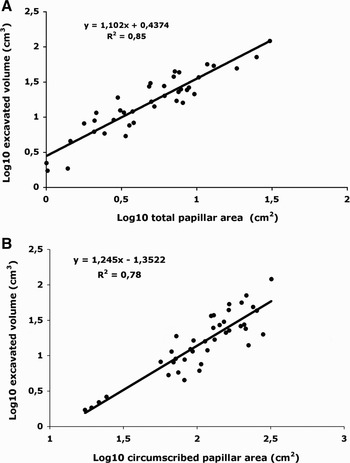
The excavated volume and the epilithic surface, evaluated as TPA and CPA, are strongly correlated (respectively R = 0.92, t (Pearson's correlation) = 14.74, P < 0.01, df = 39 and R = 0.89, t (Pearson's correlation) = 12.89, P < 0.01, df = 39) (Figure 4). Moreover, a strong correlation is shown between the size of the stone occupied by the sponges and the CPA (R = 0.80, t (Pearson's correlation) = 10.41, P < 0.01, df = 39) and between EV and PN (R = 0.82, t (Pearson's correlation) = 10, P < 0.01, df = 39).
Cliona adriatica sp. nov. (A) Correlation between excavated volume (EV) and total papillar area (TPA); (B) correlation between excavated volume (EV) and circumscribed papillar area (CPA). Using the regression analysis, conducted with Log10 transformed data the two equations were obtained which describe the relationships between the indicated parameters.

Using regression analysis, the following equations were obtained which describe the relationships between the eroded volume and the TPA and CPA respectively: y = 1.102 × +0.437 and y = 1.245 × –1.352 (Figure 4). These equations can be used to estimate the volume excavated by C. adriatica inside the substratum by measuring the epilithic portion of the sponge.
DISCUSSION
The main aim of this work was the assessment of boring sponge diversity in the Conero Promontory, a site on the Italian coast of the Adriatic Sea until now unexplored, from this point of view. In this area the number of identified boring sponges reflects the general low diversity of Porifera of the area with only 27 species of demosponges in total recorded (Calcinai et al., Reference Calcinai, Bavestrello, Betti, Bo, Cerrano, Di Camillo, Martinelli, Puce and Tazioli2009). The Conero Promontory represents the most important rocky emergence in a stretch of about 400 km of sandy coastline. The colonization of this area by hard bottom benthic organisms reflects the pattern of colonization of small islands with a few but widely distributed species (Cerrano et al., Reference Cerrano, Azzini, Bavestrello, Calcinai, Pansini, Sarti and Thung2006; Calcinai et al., Reference Calcinai, Bavestrello, Betti, Bo, Cerrano, Di Camillo, Martinelli, Puce and Tazioli2009). This is the case for Cliona adriatica occupying about 12% of all the rocky bottoms in the area.
To study the impact of the intense bioerosion produced by C. adriatica we applied the method proposed by Rose & Risk (Reference Rose and Risk1985) allowing an estimation of the endolithic volume of the specimens on the basis of their epilithic surface. These authors calculated that the sponge Cliona delitrix Pang, Reference Pang1973, dissolved up to 2.9 g of the skeleton of Montastrea cavernosa per cm2 of epilithic tissue (Rose & Risk, Reference Rose and Risk1985). The value obtained during the present study is about three times higher (8.5 g/cm2) due not only to a different boring ability of the two species but also to a lower density of the coral skeleton (Schönberg, Reference Schönberg2002; Calcinai et al., Reference Calcinai, Azzini, Bavestrello, Gaggero, Cerrano, Custódio, Lóbo-Hadju, Hadju and Muricy2007). In fact, in the porous pattern of the coral skeleton, the sponge is able to expand not only by boring the carbonate but also by exploiting the natural cavity of this structure.
Using regression equations a model was developed to predict the excavated volume of C. adriatica inside the substratum on the basis of its epilithic surface. These results can be used in estimating the erosion activity of this species without destroying and removing material from the sea.
The significant correlation between the volume of substratum excavated by C. adriatica and the rough superficial area circumscribed by the papillae (CPA) could be used when only a rough value of the sponge epilithic portions is available, for example in monitoring studies conducted using photographs where the exact diameter of each papilla is difficult to measure (Schönberg, Reference Schönberg2001b).
The linear regression between the epilithic area and the excavated volume clearly indicates the growth strategy of C. adriatica. In this species, substrate erosion increases only through the development of erosion chambers with little or no fusion between them, as shown by Rosell (Reference Rosell1994) for C. lobata and P. vastifica. This strategy is different from both that of C. celata and C. viridis which are able to reach the gamma stage by the merging of boring chambers (Rosell, Reference Rosell1994), and from that of other excavating species growing in the beta stage such as C. orientalis Thiele, 1900. Both data about boring sponge diversity along Conero Promontory and C. adriatica boring activity allow producing a baseline, important for future monitoring.
ACKNOWLEDGEMENTS
This work was partially supported by Polytechnic University of Marche funds to B. Calcinai. We thank Dr Rita Fraboni, Polytechnic University of Marche, for technical support in the determination of specific gravity of rocks.