Sanjay Subrahmanyam has recently pointed out the usefulness of studying the artistic and architectural communication between the early modern Portuguese and Spanish empires in Asia, especially during the period of Iberian Union. According to him, the interpretation of Iberian cultural heritage from the early modern period in Asia has generally been developed from a national perspective.Footnote 1 This may have to do not only with the phenomenon of “obstinate Iberian historiographical separation” but also with problems concerning historical sources, which are now being reduced thanks to international research projects.Footnote 2 Focusing on the architectural history of Iberian settlements in Asia, this paper attempts to provide a transnational view based on previous national research. Three specific questions are given particular attention: First, how fluid was the mobility of the “world of architecture” in this era in terms of the exchange of patrons and artisans? At the heart of this matter lies the problem of mutual borrowing and the imitation of cultural indicators. Second, what output can be identified from this cultural dialogue, and how widely was it spread across these territories? Third, if there was such a shared technical background and a common “world of architecture,” how did this reveal itself in the buildings that were erected, and how can this be linked to the image of the building in the baroque scenario of the city.
To do this, several obstacles had to be overcome. There are not accurately drawn profiles of contemporary buildings from these regions; nor are there preserved examples. Thus, this research relies on travellers’ descriptions and archival information. Fortunately, the features noted by these sources can be seen in several eighteenth-century representations, which shows that these solutions endured a long time after the dissolution of the Iberian Union.
Mobility in the world of architecture in Iberian Asia
The circulation of Spanish and Portuguese missionaries, patrons, and builders among Iberian colonial cities in Asia was significant despite prohibitions aimed at controlling such movement during this period. Various missionaries with expertise in architecture spent part of their time in both Spanish and Portuguese territories. Because Macao belonged to the provinces of a Spanish religious order and was under the Patronato Regio,Footnote 3 responsibility for the construction of the convent of Santo Agostinho, the Clare monastery, and that of Saint Francis and Saint Dominic in Macao lay with the Spanish authorities. As a result, Spaniards were involved in the building of these structures,Footnote 4 even though the city was under Portuguese rule and a dependency of the Viceroy of Goa.Footnote 5
On the other hand, Portuguese patrons also played a significant role in construction projects in Spanish colonial settlements. Pedro de Brito Coutinho, a Portuguese councillor in Manila,Footnote 6 for example, was an important patron of that city’s Convent of San Agustin in Manila in 1592. He had also been involved in the construction of the convent of Santo Agostinho in Macao in 1586.Footnote 7 In addition, he gave a donation to the Society of Jesus in Manila to open its noviciate in 1607Footnote 8 and helped broker the later foundation of the Spanish Franciscans in Macao. The Franciscans had failed to found a convent in the Portuguese city in 1583 and 1584, due to strong opposition from the Portuguese.Footnote 9 In 1588, Pedro Brito returned to Manila after the convent was established thanks to his intervention.Footnote 10 Likewise, the Clare monastery, a Spanish foundation, was built by the Portuguese António da Ressurreiçao in 1634.Footnote 11 As Penalva has shown,Footnote 12 the nuns there created a strong relationship between Macao and Manila. The mobility of patrons, or membership in a common province, may have had to do with the responsibility for overseeing, controlling, and paying for the construction of the buildings.
Several Spanish artists also worked in both Manila and Macao during the period of the reunion of the two crowns. Juan Antonio de Herrera (†1638), a Spanish friar involved in the construction of the San Agustin church in Manila, may have worked as architect of the Santo Agostinho convent in Macao,Footnote 13 while the Dominican friar Alonso Jimenez is said to have worked as an architect in the Convent of Santo Domingo in Manila.Footnote 14 Similarly, the Spanish Jesuit Martin Ochoa (Cáceres, 1525–Cochim, 1576) spent most of his career in the Portuguese empire.Footnote 15 Before working as a sculptor in Lisbon, he travelled to Goa in 1567. His works in the Portuguese settlements in Asia are well known, from the construction of the Jesuit church of Sao Paulo in Velha Goa, to the Jesuit College in Cochin.Footnote 16 Another missionary who served in both Manila and Macao was the Franciscan Martin Ignacio de Loyola (†1606), the nephew of Saint Ignatius of Loyola. After his sojourn in Manila, he was sent to Macao in 1582.Footnote 17 From there, he had to return via India, and later, he was sent to America, where he became the bishop of Rio de la Plata in 1601.Footnote 18 His case not only shows the possibilities available to promising talents afforded by the world-encircling Spanish empire, but also indicates how mutual influences could travel from one territory to another.
The mobility of Spanish and Portuguese architectural specialists in Asia can be attributed to their small number. For the same reason, local construction was carried out almost completely by Asian craftsmen. What most clearly distinguishes the situation in Asia from that in Latin America is that local artisans in Asia provided more than physical labour. They have been found directing the works in the buildings from early on. In Macao and Manila, the manpower was generally Chinese,Footnote 19 while native Indian artisans played a key role in the development of Goa’s architecture.Footnote 20 The circulation of Chinese craftsmen between Macao and Manila was fairly common.Footnote 21 Juan Gil’s recent monograph on the Chinese of Manila has vastly improved our knowledge of that subject.Footnote 22 But Chinese craftsmen were not the only Asian participants. For example, construction workers from the Malabar coast were also involved in the later construction of the cathedral in Manila.Footnote 23 Some authors have even seen the influence of Indian traditions in the colonial buildings of Macao.Footnote 24 As a consequence, it can be said that the basis of all these building processes was local, although there was input from people from all over the Iberian empires. This mobility made architectural knowledge in places remote from one another, although the decision to accept them has to be linked with the promotors of the buildings. Although adaptation can be seen as a normal development of architectural history, it implies an acceptance of change and, thus, the social interpretation of the time.
In an attempt to create a global defence system, King Philip II sent Italian engineers-in-chief to Manila and Goa, as well as to Brazil (Baccio di Filicaia) and the Caribbean (Bautista Antonelli, the elder). Leonardo Turriano, Cristoforo Bernardini, and Diego Giordano, among other Italians, were sent to the Philippines, although only the last two reached the islands. At this time, the lack of military engineers in the Philippines was a big problem, but thanks to their work, the Iberian defence system was updated following the Italian style of fortification. Visual depictions of their defence works were sent to the king in the form of atlases, such as the famous one by António Bocarro.
By way of conclusion, it can be said that this circulation of aesthetic and technical methods was promoted by the Union of the Crowns. It affected only Portuguese and Spanish settlements in Asia, and not other European ports in this area. Even if after sixty years of composite monarchy, exchanges between these cities decreased, many of the solutions achieved during this time endured over the following centuries.
Technical dialogue and architecture in Iberian Asia
Having pointed out the shared background of these architectural projects in Manila and Macao, let us now see how European patrons and artisans cooperated with indigenous Asian craftsmen to create new building processes, and how they took advantage of each other in various ways. Hybridisation in technical matters is a particular feature of the Portuguese and Spanish heritage in Asia.Footnote 25 Building materials that were easily available in Europe and America such as glass, lime, and even wood or stone, were often hard to find in Asia and forced European architects to accept native supplies and techniques. The Portuguese found solutions to these obstacles first in India and later applied them in Macao and Manila. Here follow some examples of techniques that were spread throughout Asia.
Oyster-shell windows
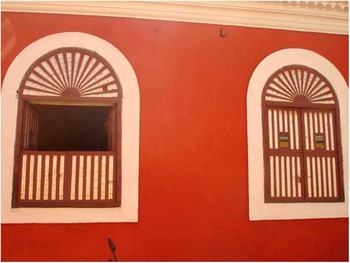
Unfortunately, Spanish and Portuguese archival sources do not describe in detail the techniques and materials used in early colonial architecture. Yet, it is clear that the diffusion of oyster-shell windows from Goa to Manila occurred within a short period. Europeans needed windows, but the fact that was glass virtually unavailable required finding other solutions. Those used by local traditions and even the windows used in European settlements in the Americas were not useful probably due to climatological differences. Windows in South Asia were built from wood and covered with rattan or bamboo curtains, but these solutions were not good enough for the big windows that the Portuguese, and later the Spaniards, required.Footnote 26 Asian houses in India and China typically had only a few small windows in their façades.Footnote 27 This was diametrically opposed to concepts of privacy held by Iberians, who gave balconies and windows a significant role in the social life of the city. For them, the interior of the house was not visible from the street. Ventilation and light usually came from an internal courtyard. The most important reason to open a balcony in the front was to allow the owner’s family to be seen during the festivities. The rest of the time, these structures were designed to maintain privacy along the whole front. Iberians looked for a hybrid solution between their own traditions and those they found in Asia, and finally settled on wooden jalousies fitted with thin plates of oyster shell.Footnote 28 Pyrard de Laval published the first document describing these windows after his travels in Asia between 1601 and 1611; see his Voyage de François Pyrard de Laval. Apparently, such structures were used only in Goa, and were not yet found in other settlements he visited (fig. 1):
Ils [the Goans] n’usent de verre; mais se servent au lieu, d’escailles d’huistres fort tenves, & polies, qu’ils enchassent dans du bois en forme de losanges. Cela est clair comme des chassis de papier, ou des lanternes de corne: car cela n’est pas transparent comme le verre.Footnote 29
Carepa window in a house, India.

Apart from travellers’ reports, archival sources also give much information on the implementation of these solutions, especially in Manila. According to a long report on the houses of Intramuros in 1645, at least twelve houses (8.2 percent of the total) had made changes in their balconies, probably including oyster-shell windows, which are specifically reported in one case.Footnote 30
The same text underscores the fact that this kind of window was strong and durable. It appears that windows of this sort were common in the viceroyal city at that time. Just a bit later, similar oyster shell windows were described in Manila.Footnote 31 According to Aduarte, the plates of the windows of the Dominican Hospital were “tanned” during a fire.Footnote 32 Here again, the text pays little attention to describing the windows and does not help us establish the types of window that might have been common in the city at that time. The arrival of oyster shell windows in Manila probably coincided with the second phase of relations between the Iberian powers in the early 1620s.Footnote 33
Later travellers give more information about the techniques used and the diffusion of this kind of window. For example, Jodocus Gabriel Dellon wrote “The Houses of Goa are generally very handsomely built, but somewhat dark at their windows, being made out of certain oyster-shells very thin cut.”Footnote 34 The importance of the thinness and polishing of the plates was underlined both in Goa and Manila. However, travellers’ writings also show us that these windows were also used in other Portuguese cities such as Baçaim (today Vasai-Virar, India), where “the Fidalgos (for few Artisans are tolerated within the Walls) have stately Dwellings, graced with covered Balconies, and large Windows two Stories high, with Panes of Oister Shell, which is their usual Glazing among them in India.”Footnote 35 Thanks to this information, it can be said that this solution was used mainly by Europeans, both in Portuguese and Spanish territories, and probably not by native communities, who retained their own housing styles.Footnote 36 Unfortunately, no information on Chinese houses in these settlements has been found; the travellers did not describe the houses of every community in depth. Later, however, these windows where used also in Chinese cities such as Canton. The first indication of their use is dated to the early eighteenth century: “But Winter coming on, they secure their dining-rooms, and bed-chambers against the cold with oyster-shells fixt diamond wise in wooden frames, instead of glass, which look something like our small, old fashion’d quarrels [diamond-shaped panes of glass], but afford a worse light than horn.”Footnote 37
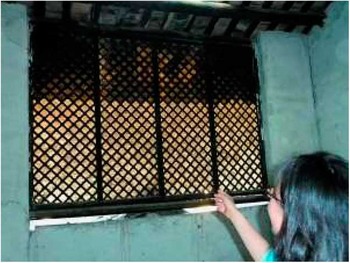
A Chinese origin for these windows may be possible, but primary sources do not describe them earlier. For example, the text on Canton houses and Chinese architecture written by Gaspar da Cruz for the Portuguese king in 1569 does not mention them.Footnote 38 It is clear that the Chinese had adapted this hybrid technique to local needs from foreign patterns. During the summer, the windows were simply covered with reeds (fig. 2).
Mother-of-pearl window in a house, China.

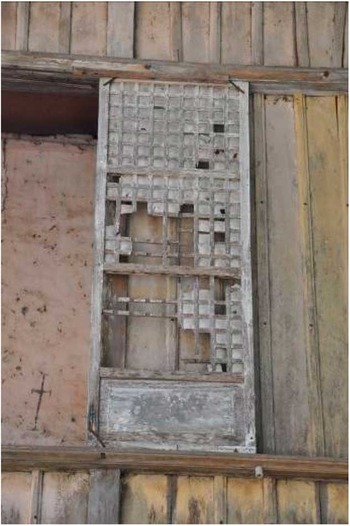
These windows were particularly appropriate for civil architecture, but religious buildings also incorporated them. The church of Santo Agostinho in Macao had themFootnote 39 as did the original Franciscan convent in Manila. A recently published seventeenth-century watercolour also shows oyster-shell windows.Footnote 40 More examples have been found from the eighteenth century onwards, both in Macao and Manila. At this late date, these windows incorporated both oyster-shells and tortoiseshell plates, which would give a distinctive light.Footnote 41 This model was widely incorporated in Catholic architecture in Asia, but by then it was considered an idiosyncratic feature of every city’s architecture, although it was a feature that also could be found in other ports since the period of the Union of the Crowns. The use of oyster-shell windows has been considered an adaptation from Japanese,Footnote 42 Islamic,Footnote 43 or ChineseFootnote 44 traditions. The technique appeared first in Goa and was adapted to local conditions in Macao and Manila (fig. 3). It was a hybrid solution created by cooperation between Portuguese and Indian craftsmen. The combination of both elements was necessary because, as Carita has shown, this type of window does not seem to have been used in other Indian cities such as Surat.Footnote 45 While the Iberian powers and their surrounding Asian communities took advantage of the solution, the Dutch and other European powers seem to have avoided using oyster-shell windows in any of their buildings. Thus, although it can be understood as an example of cultural dialogue, the role of the Iberian Union is noteworthy.
Capiz window in a bahay-na-bato (stone house), Philippines.

Wooden structures
A wooden post called an harigue can also be considered as an example of mutual technical influence in this arquitectura mestiza. This term was proposed by Alzina in 1668 in Manila to point out the changes of the Philippine architecture after the earthquakes of 1645–50. Although the adaptation of building traditions was also obvious in Latin America, the Asian case gave much more prominence to local solutions, which tried to improve resistance to seismic activity. This is particularly obvious in houses, where the wooden structures first in tangal and quite a bit later in molave wood would be most common during the seventeenth-century Manila. According to the mentioned reports of 1645, 72 percent of the houses were built with wood structures and stone walls, while 3 percent of the houses had changed tangal for molave, and at least one was built with harigues.
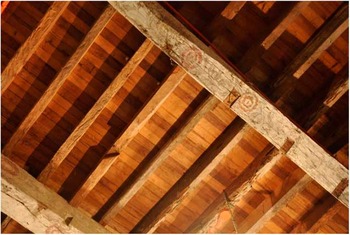
A comparison of churches in Goa and Manila during the Union of the Crowns shows a common use of stone pillars and vaults.Footnote 46 Only some public construction in Manila—the Clare monastery, and the Dominican and Franciscan churches—were built with harigues. At about the same time Macao started the construction of the church of Saint Paul, which was supported by large, wooden, cylindrical pillars.Footnote 47 The Dominicans not only used harigues, but they also proposed a Chinese decoration for the ceiling (fig. 4).Footnote 48 The same happened in the case of the Augustinian church in Macao.Footnote 49 This technique subsequently became popular in Manila after an earthquake in the middle of the seventeenth century thanks to its antiseismic architectural qualities. Several authors have pointed out this change, which they explain as a return to pre-Hispanic traditions.Footnote 50 According to the Jesuit Francisco Alcina in 1668, the combination of stone and wood was called mixed, or mestizo. Although he did not conceive this hybridization of techniques as a combination of the Filipino harigues and Western stone walls, hybridization was just another step along the way in the indigenization of Philippine architecture during the Iberian Union.Footnote 51 These kinds of structures were built by natives in the Philippines due to the lack of skilled European carpenters. Because this solution was spread across not only the Philippines, but also to Macao, it can be deduced that Chinese and Philippine artists must have been working in unison.
Decoration, sacristy ceiling of San Sebastian Church, Lumban, Philippines.

Overhanging balconies and verandas
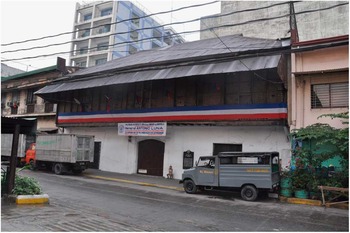
A third element of this arquitectura mestiza is the balcony, an architectural feature closely linked with both oyster-shell windows and wood-and-stone construction. This element was mainly used in the Philippines. In the first decades of seventeenth-century Manila, the usual pattern was a single balcony, probably connected to the main bedroom. During the century, a long balcony that covered the entire second floor of the façade would be created, as many early eighteenth-century examples shows. This was enclosed by a complex wooden grill that both controlled the ventilation of the house and also ensured the family’s privacy. It seems that such features were not used in this way either in Goa or Macao.Footnote 52 Instead, big, screened windows and verandas substituted for such structures (fig. 5). Recent studies have considered the Manila balcony to be a Filipino solution. Although this may seem like a straightforward deduction, the long Spanish tradition in developing these elements should be taken into account. The terminology used in ManilaFootnote 53 can also be found in Lima at the same time. If the Peruvian balconies came straight from the Spanish tradition, something similar likely happened in Manila.Footnote 54 Those ajimeces, or balconies, that were demolished in Andalusia during the last decades of the sixteenth century might have been the basis for those particular balconies developed in the Philippines. Only a later development of this element in the archipelago during the eighteenth century can be considered a local characteristic. If Goa was the place where oyster shell windows first appeared, Manila gave birth to these balconies. Both places were the point of origin for a much wider diffusion to other Asian settlements. Again, as it has been said for the case of oyster-shell windows, this sort of balcony is not seen in views of Dutch cities in Asia. Only the Chinese quarter in the outskirt of Batavia provide interesting examples, which can one lead to consider the Asian role in the diffusion of this solution in the area.
General Antonio Luna House, Manila, Phiippines.

Lime mortar
Another building technique common in both Portuguese and Spanish territories was the use of oyster-shell lime mortar. Examples of this are to be found also in America and Africa, but not on the Iberian Peninsula. None of these territories had direct access to rock lime, thus it was necessary to use oyster-shell lime. The final result was impressive, according to contemporary sources:
The houses [in Goa] were built with only two floors, their walls being made of dried earth and mortar and the blocks placed one upon the other; on the exterior, they are covered and whitened with a mixture made of oyster shells, producing a sort of lime, as white as the snow, so white, in truth, that if one walks through the city during the hours of bright sunlight, the whiteness hurts one’s eyes.Footnote 55
This kind of lime was easier to use and cheaper than limestone, but it was not as consistent. It was usually mixed close to the building site, which was a distinct advantage given the problems of transporting rock lime from the quarry. In both Manila and Macao those who produced this lime were Chinese.Footnote 56 This means that a technical transfer from America to Asia took place via both Portuguese and Spanish intermediaries. Unfortunately, the buildings were not as durable as those built with rock lime. According to primary sources, this was the reason for the bad quality of construction in the Philippines and India. Only some buildings during the eighteenth century could afford the additional expense that came with using quality lime. Information on the composition of lime mortar in the eighteenth century is actually rare, but nineteenth-century treatises by military engineers offer precise data and reveal the different recipes for lime mortars in Manila, Havana, and even China. These differences show particular local technical adaptations. Against this diffusion within the Iberian world, apart from local characteristics, other European powers seem to have paid much less attention to this detail, maybe because they did not use this technique.
The Iberian Union played a key role in this mutual interaction in the architectural sphere. From the sixteenth and seventeenth centuries onwards, other Western colonial polities were also active in Asia and their participation in the intra-Asian trade may also have promoted the diffusion of architectonic novelties.Footnote 57 Curiously, none of the techniques described above can be found in the Dutch colonial city of Batavia. The conflict between the Dutch and the Iberians may be one reason for this.Footnote 58 Although there is little information about the earlier periods, during the eighteenth century, glass was widely used there, as drawings of Jan Brandes show.Footnote 59 In this city, neither the harigue technique nor the long balconies have been documented, although the Chinese population was significant and played a key role in the building techniques.Footnote 60
Many elements of colonial architectural heritage have been wrongly understood as part of national identity in various parts of Asia.Footnote 61 Only a few authors have considered the transnational approach, but they have done so without justifying their conclusions.Footnote 62 The role of Asian artisans, builders, and even architects has hardly been recognized until now.Footnote 63 But as has been recently shown in other fields focusing on the European presence in Asia, a transnational approach to local architecture may lead to a better understanding of the various architectural traditions involved. As I have pointed out, the period of the Union of Crowns was an extraordinarily active architectural period in Goa, Malacca, Macao, and Manila. Religious order provinces, patrons, and even artists developed projects in both Spanish and Portuguese cities. The historical sources of this period have to be interpreted by taking into account information from both Portuguese and Spaniards perspectives, for Portuguese sources mention the involvement of neither Spanish architects nor friars in building projects during this time, although Spanish archival documents do.
Iberian architecture in Asia: Between statecraft and stagecraft
The previous paragraphs confirm that circles of Spanish and Portuguese patrons and architects shared techniques and building materials and gave rise to a common approach to construction; but the structures preserved in Goa, Manila, and Macao are not always similar. Buildings, even if the architect and the patrons are the same, could play different roles in statecraft or stagecraft.Footnote 64 As part of a “built” baroque play or as images of a hierarchical bureaucracy, facades were designed with a distinct vocabulary that has not been widely studied in the context of the European presence in Asia. In attempting to define and categorize this problem, I have organized the architectural heritage of this time into three groups. Local architecture without any visible Western influence can be seen as an important confrontation to outer traditions and a negation of cultural dialogue. A second category is the arquitectura mestiza, in which the circulation of different visual idioms and building techniques is evident. Buildings constructed in this way project a cross-cultural identity.
The third category is that in which the European artistic vocabularies are used in the “correct” way and is thus similar to local architecture types of the first category in that they are “unspoiled” by external influences. These structures can show the “perfection” of Western civilization against the non-academic solutions of indigenous models, or the bastardization of hybrid aesthetics.
Image of the local
Unlike in the American experience, the European presence in Asia had to coexist with other communities well outside their control. As contemporary drawings show, local traditions in house building were preserved on the outskirts of European settlements. The native populations maintained their traditional ways of house construction, avoiding the “civilized” European norms and the theoretical benefits of stone buildings. Wood and palm structures persisted throughout most of the Philippine archipelago, Manila included, as well as in Malacca and Goa.Footnote 65
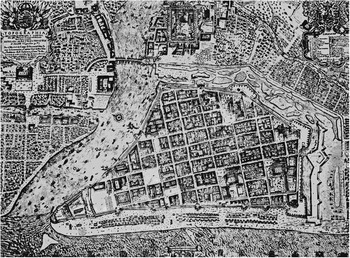
Almost everywhere, European quarters in South and Southeast Asia were smaller than the adjacent indigenous neighbourhoods. At first, Westerners planned only walled cities. Although sources do not give much information on the layout of the European quarters, drawings of Manila, Melaka, and Goa suggest that they were not organized according to an orthogonal grid adapted to the topography.Footnote 66 It was only later that European powers decided to intervene in these areas in order to “civilize” them.
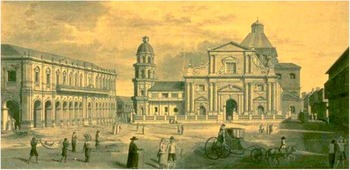
It can be said that during the Iberian Union, colonial administrators were very flexible in their approach to converting their urban settlements into ideal civilized places (fig. 6). Notwithstanding failed attempts at reform by nineteenth-century rulers, local building patterns were preserved until the twentieth century. The suburbs kept the houses of planks and bamboo, both in Bandar Malacca and Bandar Ilhir in Malacca,Footnote 67 and in the Parian in Manila.Footnote 68
Fernando Brambila, La Plaza y Catedral de Manila [Main square and Cathedral in Manila]. Museo Naval, ms. 1724-4.

Image of globalization
While native people generally stuck to their way of housing, wealthy Chinese and Hindu merchants in Manila and Goa started adopting new building solutions that combined Eastern tradition and Western introductions. A clear mixture of influences cannot be easily identified until the eighteenth century. But one aspect seldom underscored is the role of private gardens found in virtually every urban house in these settlements. According to surviving drawings, most properties consisted of a house built along the street with a big orchard or garden at the rear. The outward facing structure usually showed a European façade,Footnote 69 but inside the local tradition continued to exist in the form of a garden. Malacca was characterized as “a place of Abounding in buildings, Land of charm, Attractive gardens”;Footnote 70 and the bird’s-eye view of Manila from the Museo José Luis Bello y González shows a city full of trees in the middle of the seventeenth century.Footnote 71 According to later sources, population growth in the following centuries would force owners to use these garden plots for housing.
The lack of urban gardens in the majority of houses in the European tradition promoted another cultural dialogue. Buildings in Goa, Manila, and Guam incorporated the batalan.Footnote 72 This term refers to an access from the house to the garden, usually through a little covered staircase with columns (fig. 7). The oldest example of a batalan still extant can be found in the reconstruction of the Palace of the Viceroy in Old Goa. Although it is clear that the element was created for civil architecture, during the eighteenth century the batalan was adopted in convents as an access way to courtyards.Footnote 73
Antonio Fernández de Rojas, Vista de Manila. Manila, 1739.

The attempt to merge elements from different traditions can also be found both in the design of the facades and in the spatial organization of the interiors. The exterior of the Church of Saint Paul in Macao is a fine example of merged cultural traditions. Its general design can be considered a classical reinterpretation. However, the stone reliefs are clearly Asian interpretations of Western topics.Footnote 74 The façade of this church should be considered as a juxtaposition of intentions rather than as an example of a deep cultural dialogue. Other examples—the Goan Churches in particular—show a deeper melding of European and Asian traditions.Footnote 75 The Basilica of Bom Jesus in Old Goa is not just an adaptation of the Church of Gesù in Rome, but a meeting point of the “way of building” of the mother church of the Society of Jesus, in Portuguese style.
Façades are not the only examples of cultural dialogue, and it is important to note how this played out in spatial terms. The choice of hall churches, whose naves and side aisles were of equal height, was common in Portugal and India but not in the territory of New Spain.Footnote 76 One-nave structures can be found in different part of the world, but those in Asia have some peculiarities. Most of them, both in India and the Philippines, are narrow and elongated spaces. The lower part of the walls is usually filled with windows, giving the interior a rich light. This solution should not be considered an imposition of a Western model, but an adaptation to local taste. While Iberian religious spaces were usually dark and intimate, here the natural light was welcome. A consequence of having so many windows along the nave is that they did not allow for the installation of altarpieces, which would have blocked the windows. This focused the congregants’ attention on the altar itself.
In addition to permanent structures, we also have to consider festival architecture. In the early modern period, especially in the Iberian territories, these played a key role in the social life of Europeans in Asia.Footnote 77 During the numerous annual festivities held in Manila, such as San Andrés Day or on the arrival of a new governor, the city was adorned with temporary festival structures. These wood-and-paper fronts, temporally substituting for the original stone façades, were meant to refresh the image of the city. The controlled use of these imaginative structures—half European, half local—was important for propagandistic purposes. Perhaps for this reason these structures, both in religious and civil festivities, remind us of Roman references.
Hybridization in religious and rich civil architecture (the latter being mainly houses of merchants) shows how religious persons and wealthy Asian merchants became brokers between two cultures. Although they preserved a recognizable image of their origins, they also tried to make their buildings attractive to the multicultural colonial context. Offering an intermediate solution between local communities and official representation fitted with their objectives to establish a commercial bridge between two worlds.
Images of power
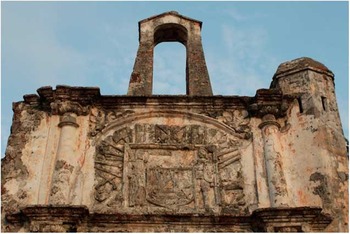
Colonial administrators usually chose Roman references for their official presentation. For this reason, classical vocabulary was used both in Goa and Manila. All these examples have to be understood in terms of the patrons’ aims and the social function of the building, and they should be analysed accordingly. A fine example in this sense is the Arch of the Viceroy in Goa, built in a remarkably pure renaissance style, following Serlio patterns.Footnote 78 The designer was Julio Simao, who signed it in Latin. The Porta de Santiago (Gate of Santiago) of Malacca, probably built much earlier than the formation of the Iberian Union (fig. 8) and the lateral entrance of San Agustin Church in Manila also followed the style of Serlio treatises.
Porta de Santiago [Gate of Santiago], Melaka, Malaysia.

Local administrations’ approaches to urban planning management played a role in the way buildings were configured. Walled colonial cities were usually more rigidly aligned than the outskirts, which presented local organizations systems. Here again the classical Roman influence has to be mentioned as being intrinsic to the way the new empires sought to “civilize” the indigenous people. Although the construction and design of urban houses tended to follow mestizo or native patterns, the rigidity of imperial governments was high. It can be seen as a proof of denial of cultural dialogue; but their objective was to create a recognizable image of the integrity of a world-encircling empire. Such attempts at homogenization were not sustainable in the seventeenth century, and once the Iberian Union came to an end, this shared context with respect to patrons, techniques, and imagery changed radically. From 1640 onwards, the architectonic development of Goa, Melaka, Macao, and Manila, proceeded on separate tracks. The commercial and cultural contacts between these port cities would continue, but neither artists nor architects would again work in both empires until the eighteenth century.Footnote 79 Goa initiated a new period characterized by Italian influence, due to the arrival of the Theatine missionaries in 1639.Footnote 80 In 1641, Melaka fell to the Dutch, who introduced new concepts in architecture and urban planning. Macao experienced a period when construction activity declined. In 1645, Manila suffered one of the most devastating earthquakes in its history and its architecture subsequently became mixed in nature: Buildings originally made completely in stone were replaced by low wood-and-stone structures. These solutions came directly from previous cultural dialogues with the Portuguese world. Yet, the period of the joint monarchy continued to mark the architecture of both territories in some respects. Houses with oyster-shell windows, as well as verandas and balconies, continued to be built. All these elements were adopted as an expression of local identity, unmindful of the fact that other cities in Asia were employing the same styles and materials, and for the same reasons.
Conclusion
The foregoing demonstrates the importance of working on seventeenth-century Southeast Asia in terms of the influence of the Iberian Union. Although it was not a deep coalition, the strength of cultural ties during these years is evident. This is crucial for the arts in this zone, and it can be also relevant for other disciplines, and in other geographical areas such as Brazil and the Iberian Peninsula. Indeed, the Iberian Union made possible the exchange of solutions between territories under different sovereignty and with distinct indigenous traditions. Contrary to what is sometimes argued, the structural heritage developed in cities such as Goa, Macao, and Manila, is not a simple hybridization process between imposing Western colonial powers and local Eastern culture. Any kind of heritage produced in Asia during the early modern period should be analysed from a transnational perspective, as this article has attempted to do. Architectonic idioms that can be identified as Indo-Portuguese in origin, such as oyster-shell windows, can also be found in balconies built in Manila by Chinese craftsmen. The practice of using shell lime is a comparable example of a non-European technique developed in the Americas and Africa and controlled in Asia by the Chinese. What must be noted is that the groundwork for these mutual influences and connections took part during the sixty years of the Iberian Union.
Future research in this topic should address two questions. First, how the hybrid origins of these solutions were changed by the idea of local contribution, and thus, became features of identity, as they are understood today. And second, how other Asian traditions such as Chinese or Japanese subtly adopted these new techniques in the eighteenth and nineteenth century, and with what purpose. From these two views, it would be possible to better understand the behaviour of hybrid techniques created by processes of cultural dialogue, which is likely to have important consequences for our understanding of contemporary societies.