1. Introduction
Gali and Monacelli (Reference Gali and Monacelli2016) (GM) find that (i) the effectiveness of labor cost adjustments on employment is much smaller in a currency union and (ii) an increase in wage flexibility often reduces welfare, more likely so in an economy that is part of a currency union. While we support their first finding, even if there is an endogenous fiscal policy rule, such as the Bohn rule advocated by Bohn (Reference Bohn1998) with a government budget constraint, we cannot necessarily support their second finding as long as there is an endogenous fiscal policy rule, such as the Bohn rule with a government budget constraint. At the very least, an increase in wage flexibility increases welfare in an economy that is part of a currency union as long as wage rigidity is high enough if there is an endogenous fiscal policy rule like the Bohn rule with government budget constraints. Their argument leaves room for a discussion of the ways in which wage flexibility may be beneficial in an economy that is part of a currency union.
Gains from wage flexibility have been discussed since Gali (Reference Gali2013) examined the role of wages in employment determination in John Maynard Keynes’ landmark work The General Theory of Employment, Interest, and Money (Keynes (Reference Keynes1936)) based on New Keynesian models. By interpreting Keynes (Reference Keynes1936), Gali (Reference Gali2013) shows that employment does not depend on wage adjustments and that the volatility of wage inflation increases when wages become more flexible in the New Keynesian models. In addition, Gali (Reference Gali2013) shows that wage flexibility does not always improve welfare, and in this manner, casts doubts on researchers’ and policymakers’ beliefs that wage flexibility is desirable. Like Gali (Reference Gali2013), Bhattarai et al. (Reference Bhattarai, Eggertsson and Schoenle2018) show that more flexible wages often reduce welfare under an optimal monetary policy.Footnote 1 GM, who provide an important research question for this study, developed a small open economy model based on Gali and Monacelli (Reference Gali and Monacelli2005) and compared a small open economy adopting a flexible exchange rate or inflation targeting with a small open economy adopting a fixed exchange rate or one that is part of a currency union. They presented the two findings mentioned above. They extended their baseline model to a medium-scale dynamic stochastic general equilibrium (DSGE) model and showed that both their findings are still applicable. More recently, Billi and Gali (Reference Billi and Gali2020) show that a zero lower bound (ZLB) constraint on the nominal interest rate generally amplifies the adverse effects of greater wage flexibility on welfare when the central bank follows a conventional Taylor rule. Their finding is consistent with that of Eggertsson et al. (Reference Eggertsson, Ferrero and Raffo2014), who show that structural reforms that increase competition in labor markets, coinciding with reducing wage rigidity, do not support economic activity in the short run as long as the nominal interest rate hits the ZLB.Footnote 2
Researchers appear to be increasingly accepting that wage flexibility does not necessarily improve welfare not only in an economy that is part of a currency union but also in a closed economy. However, previous studies do not consider the interaction between monetary and fiscal policies. Considering this interaction is not trivial. Leeper and Leith (Reference Leeper, Leith, Leeper and Leith2016) mention that it is always the joint behavior of monetary and fiscal policies that determines inflation (and stabilizes debt). In addition, Mario Draghi, then-President of the European Central Bank (ECB), made the following remark in his speech in December 2018 (Draghi (2018)):
But national budgets will never lose their function as the main stabilization tool during crises. In the euro area, around 50% of an unemployment shock is absorbed through the automatic stabilizers in national public budgets, significantly more than in the United States. […] Yet national fiscal policies also need a complement at the European level.
As long as this remains the ECB’s policy stance, the ways in which fiscal policy, especially national-level fiscal policy, which is viewed as another important stabilization tool, affects a currency union, along with monetary policy, should be discussed. Some researchers are aware of the importance of considering the interaction between monetary and fiscal policies in a currency union, and introducing an endogenous fiscal policy to analyze monetary policy in a currency union is not novel. Gali and Monacelli (Reference Gali and Monacelli2008) analyzed the optimal monetary and fiscal policies and clarified the importance of fiscal policy in a small open economy that is part of a currency union. Ferrero (Reference Ferrero2009) derived monetary and fiscal policy rules in a currency union that achieved approximately optimal allocation, and Okano (Reference Okano2014) showed that there are no additional welfare gains from cooperative monetary and fiscal policy in a currency union, even if there are non-tradable goods. However, these researchers did not introduce wage rigidity into their models and did not have present policy implications regarding whether wage flexibility enhances welfare.
Thus, we introduce an endogenous fiscal policy rule similar to the Bohn rule with a government budget constraint–namely, the government financing its deficit by issuing debt and running fiscal surpluses to repay the debt–into the baseline GM model to investigate GM’s two findings. First, we developed our baseline model, which is similar to that of GM, except for steady-state efficiency. Our steady state is distorted because monopolistic competitive power remains, similar to the work of De Paoli (Reference de Paoli2009) who derived a class of DSGE models by assuming a small open economy with a distorted steady state. Using this baseline model (referred to as the distorted steady-state model), we compare a small open economy adopting a flexible exchange rate or inflation targeting with a small open economy that is part of a currency union. We replicate GM’s two findings using the distorted steady-state model, meaning that GM’s findings remain applicable even if the steady state is distorted.
Next, we introduce an endogenous fiscal policy rule, similar to the Bohn rule, with a government budget constraint in the distorted steady-state model. We designate this model as the incorporating government budget constraint (IGBC) model. Like GM, we show the dynamic responses to a one-percent decrease in the tax rate. Even in the IGBC model, the effect of labor cost adjustments on employment is much smaller in a small open economy that is part of a currency union. That is, GM’s first finding is still applicable to the IGBC model. Furthermore, we calculate the welfare loss function of a small open economy that is a part of a currency union in that model. GM showed that an increase in wage flexibility often reduced welfare in an economy that has been part of a currency union. Our results show that an increase in wage flexibility almost always reduces welfare losses. However, if wage rigidity is sufficiently high, wage flexibility reduces welfare losses. Wage rigidity is not necessarily favorable in an economy that is part of a currency union. This finding is almost opposite to GM’s second finding.
The reason for our finding is the introduction of an endogenous fiscal policy rule similar to the Bohn rule to close the IGBC model. The Bohn rule implies that the government secures a fiscal surplus to repay its debt and has procyclical characteristics. In our setting, the tax is effectively levied on output, which is identical to employment taxation, provided that productivity remains constant. In other words, the Bohn rule is accompanied by distortionary taxation. Moreover, the tax gap (the difference between the tax rate and its steady-state value) is a policy instrument and varies with changes in the amount of government debt on issue. The tax gap also reacts to change in employment. The tax gap increases when employment is stagnant to achieve the fiscal surplus necessary to repay debt (provided that productivity remains the same). In contrast, the tax gap decreases when employment increases because there is sufficient fiscal surplus to repay debt (as long as productivity remains the same). Thus, the tax gap is negatively related to employment. In other words, stagnant output increases fiscal surplus and an increase in output decreases fiscal revenue, thus tending to raise government debt. This aspect, caused by the Bohn rule with distortionary taxation, produces our findings. Furthermore, when employment sufficiently increases, the tax gap decreases, as does the marginal cost of production. However, an increase in employment also places upward pressure on marginal costs. Thus, while an increase in marginal costs places upward pressure on domestic price inflation, downward pressure is also exerted on domestic price inflation through the Bohn rule even if employment increases. The pressure to increase domestic price inflation is reduced by the procyclicality of the Bohn rule.
Reducing the pressure on domestic price inflation through a decrease in the tax gap means that introducing the Bohn rule makes domestic price inflation inelastic to changes in the employment gap. Indeed, introducing the Bohn rule flattens the slope of the aggregate supply curve, the so-called New Keynesian Phillips curve (NKPC). A flatter NKPC indicates that domestic price inflation is inelastic to employment changes. In other words, employment is elastic to changes in domestic price inflation. As wage rigidity increases, the wage markup decreases and workers increase their hours worked to offset the stagnation in the nominal wage in response to a demand shock. Combined with the flatter slope of the NKPC associated with the procyclicality of the Bohn rule, which makes employment more elastic with respect to domestic price inflation, the welfare loss associated with the employment gap fluctuation increases drastically as wage rigidity increases. Thus, an increase in wage rigidity negatively affects welfare in the IGBC model.
Although GM’s model is closely followed in the derivation of this model, some model assumptions and the nature of the monetary regime differ slightly from those in GM’s model (Table 1). In contrast to GM’s model, this model assumes a distorted steady-state, constant returns to scale, imperfect substitution between domestic and foreign goods, and consumer price index (CPI) inflation targeting. GM’s model assumes an efficient steady state, decreasing returns to scale, perfect substitution between domestic and foreign goods, and domestic price (index) inflation targeting. Although we slightly modified GM’s New Keynesian small open economy model, we could replicate GM’s two GM findings in our distorted steady-state model. Thus, this modification supported GM’s findings. We introduce a distorted steady state to clarify how the introduction of an endogenous fiscal policy rule, such as the Bohn rule with a government budget constraint, changes GM’s two findings. In the IGBC model, the government levies a tax on firm sales that distorts the steady state. Thus, we introduce the assumption of a distorted steady state to clarify that the differences in the results do not depend on the distorted steady state, and to examine how the introduction of an endogenous fiscal policy rule, such as the Bohn rule with a government budget constraint, changes GM’s two findings. Note that owing to the distorted steady state, the employment gap in welfare criteria differs from that in GM. In GM, the employment gap for evaluating welfare is the gap between (actual) employment and natural employment. However, owing to the distorted steady state, the employment gap for evaluating welfare is the gap between (actual) employment and efficient employment, which is the target level of employment in the distorted steady state.
Set-up differences

Another difference is that we assume constant returns to scale. If we adopt decreasing returns to scale, as in GM’s model, we cannot obtain welfare criteria that do not have cross terms of the endogenous variables because of the distorted steady state. Instead, welfare should be evaluated using the method developed by Schmitt-Grohe and Uribe (Reference Schmitt-Grohe and Uribe2004); we cannot find the welfare (loss) component that comprises total welfare (loss) and is a decomposition sorted by the source of welfare (loss). GM’s model clarifies which distortions, such as the employment gap, domestic price inflation, and wage inflation, generate welfare losses that vary according to the degree of wage rigidity. That is, GM clarifies not only how the degree of wage rigidity affects total welfare losses, but also how it affects each welfare component, using welfare criteria without the cross terms of the endogenous variables by a second-order approximation of the utility function. To examine the welfare components, as in GM’s model, we must assume constant returns to scale, although this modification does not affect our findings because we can replicate GM’s two findings in the distorted steady-state model.
Although GM assume the Armington form of consumption index, which implies perfect substitution between domestic and foreign goods, Obstfeld and Rogoff (Reference Obstfeld and Rogoff1998) argued that the elasticity of substitution between domestic and foreign goods should be 3 to 6; thus, we assume imperfect substitution between domestic and foreign goods. To check the robustness of the results, GM also select 2 as the elasticity of substitution between domestic and foreign goods for calibration. Therefore, while we assume imperfect substitution between domestic and foreign goods, we choose 2 to calibrate (thus, we do not violate GM’s setup because 2 is selected similarly to GM).
Furthermore, in contrast to GM’s adoption of domestic price inflation targeting, we adopted CPI inflation targeting. Our setting is more plausible than GM’s setting. It is well known that the ECB targets a harmonized index of 2% consumer price inflation rates. We use CPI inflation targeting, which is closer to the ECB’s strategy than the inflation targeting in GM’s model. In contrast, GM chooses domestic inflation targetingFootnote 3 Note that, although we choose CPI inflation targeting when we analyze the distorted steady-state model, our findings are consistent with GM’s two GM findings. This means that GM’s findings are robust even if a more plausible inflation rate is chosen as the target.
Importantly, we can replicate GM’s two findings even if we slightly modify their setting, whereas we achieve almost opposite results by introducing an endogenous fiscal policy rule, such as the Bohn rule, with a government budget constraint in a model of a small open economy that is part of a currency union. If we use an endogenous fiscal policy rule, such as the Bohn rule, with a government budget constraint in an economy that is part of a currency union, we cannot entirely replicate GM’s second finding. Wage flexibility may reduce welfare loss under several assumptions that were not made by GM, and it is necessary to discuss how wage flexibility reduces welfare loss in various settings.
The remainder of this paper is organized as follows: Section 2 presents our baseline model, namely, the distorted steady-state model. Section 3 presents the welfare criteria and equilibrium of the benchmark model. Section 4 examines the effectiveness of labor cost reductions and discusses wage flexibility and welfare in a currency union using a distorted steady-state model. In Section 5, the IGBC model is described. Section 6 discusses the welfare criteria and equilibria in the IGBC model. Section 7 examines the effectiveness of labor cost reduction and discusses wage flexibility and welfare in the IGBC model. Section 8 describes our robustness exercise. Finally, section 9 concludes the study. The Appendix provides details on the derivation of an equality that helps convince readers of the results.
2. Distorted steady-state model: introducing a distorted steady state to gm’s new keynesian small open economy model
Our baseline model, namely, the distorted steady-state model, is similar to GM’s New Keynesian small open economy model, apart from the distorted steady state and constant returns to scale, as mentioned in Section 1.Footnote 4 Another difference relates to the CES aggregator of consumption indices because we allow imperfect substitution between domestic and foreign goods.Footnote 5 The presentation of the model and its notation closely parallels that of GM’s model.
2.1 Households
Similar to GM’s model, there is a representative household in a small open economy. The household has a continuum of members indexed by
 $ j \in \left [ 0,1 \right ]$
and specializes in a differentiated occupation supplying labor services of amount
 $ \mathcal{N}_t \!\left ( j \right )$
.
The household’s utility function is given by
 \begin{eqnarray} \sum ^\infty _{t=0} \beta ^t \textrm{E}_0 \!\left [ U \!\left ( C_t, \left \{ \mathcal{N}_t \!\left ( j \right ) \right \}; Z_t \right ) \right ], \end{eqnarray}
where
 $ C_t$
denotes the consumption index,
 $ Z_t$
denotes the exogenous preference shifter,
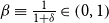 $ \beta \equiv \frac{1}{1 + \delta } \in \left ( 0, 1 \right )$
denotes the subjective discount factor, and
 $ \delta$
denotes the rate of time preference.
The period utility is given by:
 \begin{eqnarray*} U \!\left ( C_t, \left \{ \mathcal{N}_t \!\left ( j \right ) \right \}; Z_t \right ) \equiv \left ( \ln C_t - \frac{1}{1 + \varphi } \int ^{1}_0 \mathcal{N}_t \!\left ( j \right )^{1+\varphi } dj \right ) Z_t, \end{eqnarray*}
with the consumption index
 \begin{eqnarray} C_t \equiv \left [ \left ( 1 - \upsilon \right ) ^{\frac{1}{\eta }} C_{H,t}^{\frac{\eta - 1}{\eta }} + \upsilon ^{\frac{1}{\eta }} C_{F,t}^{\frac{\eta - 1}{\eta }} \right ] ^{\frac{\eta }{\eta -1}}, \end{eqnarray}
where
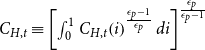 $ C_{H,t} \equiv \left [ \int ^1_0 C_{H,t} \!\left ( i \right ) ^{\frac{\epsilon _p -1}{\epsilon _p}} di \right ]^{\frac{\epsilon _p}{\epsilon _p - 1}}$
denotes an index of domestic goods consumption,
 $ C_{F,t}$
denotes quantity consumed of a composite foreign good,
 $ \epsilon _p$
denotes the elasticity of substitution across goods produced domestically,
 $ \upsilon \in \left [ 0,1 \right ]$
denotes a measure of openness,
 $ \varphi$
denotes the inverse of the elasticity of wage to labor supply and
 $ \eta \gt 0$
denotes the elasticity of substitution between the domestic and the imported consumption bundle.
The (log) preference shifter is assumed to follow the following exogenous AR(1) process:
 \begin{eqnarray*} z_t = \rho _z z_{t-1} + \varepsilon ^z_t, \end{eqnarray*}
where the lowercase letters denote the percentage deviations from the steady-state values of the original variables.
The sequence of budget constraints takes the following form:
 \begin{eqnarray} \int ^1_0 P_{H,t} \!\left ( i \right ) C_{H,t} \!\left ( i \right ) di + P_{F,t} C_{F,t} + \mathrm{E}_t \!\left ( Q_{t,t+1} D^n_{t+1} \right ) \le D^n_t + \int ^1_0 W_t \!\left ( j \right ) \mathcal{N}_t \!\left ( j \right )dj + TR_t + PR_t, \end{eqnarray}
where
 $ D^n_{t+1}$
denotes the nominal payoff in period
 $ t + 1$
of the portfolio held at the end of period
 $ t$
,
 $ Q_{t,t+1}$
denotes the stochastic discount factor which suffices
 $ \mathrm{E}_t \!\left ( Q_{t,t+1} \right ) = \left ( 1 + r_t \right )^{-1}$
,
 $ r_t$
denotes the nominal interest rate,
 $ P_{H,t} \!\left ( i \right )$
denotes the price of domestic variety
 $ i$
,
 $ P_{F,t}$
denotes the price of imported goods in terms of domestic currency and
 $ W_t \!\left ( j \right )$
denotes the nominal wage for type
 $ j$
labor,
 $ TR_t$
denotes the lump-sum transfer and
 $ PR_t$
denotes the nominal profits from the ownership of the firms.
Households maximize Eq. (1), and subject to Eq. (3), and the Euler equation is given by
 \begin{eqnarray} 1 = \beta \!\left ( 1 + r_t \right ) \mathrm{E}_t \!\left ( \frac{P_t C_t}{P_{t+1} C_{t+1}} \frac{Z_{t+1}}{Z_t} \right ), \end{eqnarray}
where
 \begin{eqnarray} P_t \equiv \left [ \left ( 1 - \upsilon \right ) P_{H,t}^{1 - \eta } + \upsilon P_{F,t}^{1 - \eta } \right ] ^{\frac{1}{1 - \eta }}, \end{eqnarray}
denotes the CPI,
 $ P_{H,t} \equiv \left [ \int ^1_0 P_{H,t} \!\left ( i \right ) ^{1 - \epsilon _p} di \right ] ^{\frac{1}{1 - \epsilon _p}}$
denotes the domestic price index, and
 $ P_{F,t}$
denotes the price of imported goods in terms of the domestic currency.
Under the assumption of complete international financial markets, the equilibrium price (in terms of domestic currency) of a riskless bond denominated in foreign currency is given by
 $ \mathcal{E}_t \!\left ( 1 + r^*_t \right ) ^{-1} = \mathrm{E}_t \!\left ( Q_{t,t+1} \mathcal{E}_{t+1} \right )$
where
 $ \mathcal{E}_t$
denotes the nominal exchange rate, which is the price of foreign currency in terms of domestic currency, and
 $ r^*_t$
denotes the nominal world interest rate. We can combine the previous pricing equation with the domestic bond pricing equation
 $ \left ( 1 + r_t \right )^{-1} = \mathrm{E}_t \!\left ( Q_{t,t+1} \right )$
to obtain a version of the uncovered interest parity condition:
 \begin{eqnarray*} \mathrm{E}_t \!\left \{Q_{t,t+1} \!\left [ \left ( 1 + r_t \right ) - \left ( 1 + r^*_t \right ) \left ( \frac{\mathcal{E}_{t+1}}{\mathcal{E}_t} \right ) \right ] \right \} = 0. \end{eqnarray*}
By log-linearizing the previous expression, we obtain:
 \begin{eqnarray} r_t = r^*_t + \mathrm{E}_t \!\left ( e_{t+1} \right ) - e_t, \end{eqnarray}
where
 $ e_t \equiv \textrm{ln} \mathcal{E}_t$
,
We assume that the law of one price (LOOP) is applied and that there is a relationship between the price of imported goods in terms of domestic currency and the foreign price level as follows:
 \begin{align*} P_{F,t} = \mathcal{E}_t P^*_t, \end{align*}
where
 $ P^*_t = 1$
is applied, as in GM’s model, for all
 $ t$
.
Workers specializing in each occupation (or the union representing them) set the corresponding nominal wage subject to an isoelastic demand function for their service. In each period, only a fraction
 $ 1 - \theta _w$
with
 $ \theta _w \in \left [ 0,1 \right ]$
of labor types drawn randomly from the corresponding population have their nominal wages reset. This is done in a manner consistent with household utility maximization, while taking the average wage, price level, and other aggregate variables as given. The remaining fraction
 $ \theta _w$
of labor types keeps their nominal wages unchanged.
2.2 Firms
2.2.1 Technology, FONC, and steady state
A continuum of firms indexed as
 $ i \in \left [ 0,1 \right ]$
is assumed to operate in the home economy. A typical domestic firm produces a differential good by using the following technology:
 \begin{eqnarray*} Y_t \!\left ( i \right ) = A_t N_t \!\left ( i \right ), \end{eqnarray*}
where
 $ Y_t \!\left ( i \right )$
is output and
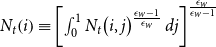 $ N_t \!\left ( i \right ) \equiv \left [ \int ^1_0 N_t \!\left ( i,j \right ) ^{\frac{\epsilon _w - 1}{\epsilon _w}} dj \right ] ^{\frac{\epsilon _w}{\epsilon _w - 1}}$
is a CES function of the quantities
 $ N_t \!\left ( i,j \right )$
of the different types of labor services
 $ j$
and
 $ A_t$
is a stochastic technology parameter. Note that an index for aggregate domestic output is given by
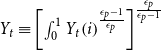 $ Y_t \equiv \left [ \int ^1_0 Y_t \!\left ( i \right ) ^{\frac{\epsilon _p - 1}{\epsilon _p}} \right ] ^{\frac{\epsilon _p}{\epsilon _p -1}}$
. The logarithm of technology follows an exogenous AR(1) process as follows:
 \begin{eqnarray*} a_t = \rho _a a_{t-1} + \varepsilon ^a_t. \end{eqnarray*}
As mentioned previously, we assume constant returns to scale, whereas GM assume decreasing returns to scale.
In each period, a subset of firms measuring
 $ 1 - \theta _p$
, with
 $ \theta _p \in \left [ 0,1 \right ]$
as an index of price rigidities drawn randomly from the population, reoptimizes the price of their good, subject to a sequence of isoelastic demand schedules for the latter. The remaining fraction
 $ \theta _p$
remains unchanged. Prices are set in the domestic currency and are the same for both domestic and export markets, and LOOP is also applied for exports.
A tax is levied on firms’ sales, and the (real) marginal cost is given by
 \begin{eqnarray} MC_t \equiv \frac{W_t}{\left ( 1 - \tau _t \right ) P_{H,t} A_t}, \end{eqnarray}
where
 $ MC_t$
is the (real) marginal cost and
 $ \tau _t$
the tax rate. Because the firm’s marginal cost depends on the number of units of the composite labor input,
 $ N_t \!\left ( i \right )$
, it employs, whose price is
 $ W_t$
, and index
 $ j$
is subtracted from Eq. (7). In Eq. (7), the tax rate appears in the denominator on the right-hand side and the sign is negative. Thus, the higher the tax rate, the higher the marginal cost, and vice versa.
However, the (real) marginal cost in GM’s model can be inferred as follows:
 \begin{eqnarray} MC_t = \frac{W_t \!\left ( 1 + \tau _t \right )}{P_{H,t} A_t}. \end{eqnarray}
In Eq. (8), the tax rate appears in the numerator on the right-hand side. Thus, the higher the tax rate, the higher the marginal cost, and vice versa. Essentially, there is no difference between the effects of tax changes on the marginal cost in Eqs. (7) and (8), respectively
The difference between Eqs. (7) and (8) appear in steady state. Eq. (7) implies that the steady-state wedge between the marginal utilities of consumption and labor is given by
 \begin{eqnarray*} 1 - \Phi = \frac{1 - \tau }{ \frac{\epsilon _p}{\epsilon _p -1} \frac{\epsilon _w}{\epsilon _w - 1}}, \end{eqnarray*}
where
 $ 1 - \Phi \equiv - \frac{U_N}{U_C}$
denotes the steady-state wedge between the marginal utilities of consumption and labor and
 $ \Phi$
denotes the parameter measuring efficiency in the steady state. When
 $ \Phi = 0$
, monopolistically competitive power disappears in the steady state. Note that
 $ \frac{\epsilon _p}{\epsilon _p -1} \gt 1$
and
 $ \frac{\epsilon _w}{\epsilon _w - 1} \gt 1$
are the constant markups on domestic prices and wages. Because
 $ \frac{\epsilon _p}{\epsilon _p -1} \gt 1$
and
 $ \frac{\epsilon _w}{\epsilon _w - 1} \gt 1$
and
 $ \tau \ge 0$
, we cannot obtain an efficient steady state, and there is monopolistically competitive power because
 $ \Phi \gt 0$
.
Eq. (8), however, implies that the steady-state wedge between the marginal utilities of consumption and labor is given by
 \begin{eqnarray*} 1 - \Phi = \frac{1}{ \frac{\epsilon _p}{\epsilon _p -1} \frac{\epsilon _w}{\epsilon _w - 1} \left ( 1 + \tau \right )}. \end{eqnarray*}
GM’s model assumes
 $ \tau \lt 0$
in the steady state, which should be interpreted as an employment subsidy, and implicitly assumes that
 $ \Phi = 0$
. This implies that an efficient steady state, where there is no competitive monopolistic power (competitive monopolistic power completely disappears by choosing a suitable negative value of
 $ \tau$
).
Although
 $ \Phi = 0$
in GM’s model,
 $ \Phi \gt 0$
in the distorted steady-state model implies that the steady state is distorted and inefficient. This difference makes our welfare criteria different from those in GM’s baseline model. However, this difference itself is not important, and we introduce a distorted steady state to clarify how introducing an endogenous fiscal policy rule such as the Bohn rule with a government budget constraint changes GM’s findings, because the IGBC model incorporates a distorted steady state. Even in the IGBC model, tax is levied on firm sales, and the (real) marginal cost is given by Eq. (7), similar to the distorted steady-state model.
2.2.2 International risk sharing
Households can access international financial markets and the international risk-sharing condition is applied as follows:
 \begin{eqnarray} C_t = C^*_t \mathcal{Q}_t \!\left ( \frac{Z_t}{Z^*_t} \right ), \end{eqnarray}
where
 $ \mathcal{Q}_t \equiv \frac{\mathcal{E}_t P^*_t}{P_t}$
denotes the real exchange rate,
 $ C^*_t$
denotes (per capita) world consumption, and
 $ Z^*_t$
denotes a discount factor shock for the rest of the world.
2.3 Demand for exports and global shocks
The demand for exports of domestic good
 $ i$
is given by
 \begin{eqnarray*} X_t \!\left ( i \right ) = \left ( \frac{P_{H,t} \!\left ( i \right )}{P_{H,t}} \right ) ^{- \epsilon _p} X_t, \end{eqnarray*}
where
 $ X_t$
is the aggregate export index. The latter is assumed to be given by
 \begin{eqnarray} X_t = \upsilon \mathcal{S}_t ^\eta Y^*_t, \end{eqnarray}
where
 $ Y^*_t$
denotes (per capita) world output and
 $ \mathcal{S}_t \equiv \frac{P_{F,t}}{P_{H,t}}$
denotes the terms of trade (TOT). In equilibrium, world output equals world consumption,
 $ C^*_t$
, and, because of the symmetric steady state,
 $ \mathcal{S} = 1$
and
 $ C = C^* = Y^*$
are applicable. Note that
 $ X_t = \upsilon \mathcal{S}_t Y^*_t$
, implying perfect substitution between the home and foreign goods, was applied to the baseline GM model.
There are two global shocks, similar to those in GM’s model: an export shock and a world interest rate shock. An export shock shifts the export function Eq. (10) and leaving the (real) world interest rate unchanged: The world interest rate shock changes the (real) world interest rate while leaving global output unchanged. These variables are endogenous, and GM examine their respective effects on the domestic economy by considering them in isolation. We follow GM and assume that the discount factor shifter for foreign households is given by
 \begin{eqnarray*} Z^*_t = Z^*_{1,t} Z^*_{2,t}, \end{eqnarray*}
where
 $ Z^*_{1,t}$
and
 $ Z^*_{2,t}$
denote the export shock and world interest rate shock, respectively. These shocks follow the exogenous AR(1) process:
 \begin{eqnarray*} z^*_{1,t} &=& \rho ^*_1 z_{1,t} + \varepsilon ^*_{1,t},\\ z^*_{2,t} &=& \rho ^*_2 z_{2,t} + \varepsilon ^*_{2,t}. \end{eqnarray*}
Assuming that foreign households have a Euler equation analogous to Eq. (4). That is,
 \begin{eqnarray} 1 = \beta \!\left ( 1 + r^*_t \right ) \mathrm{E}_t \!\left ( \frac{Y^*_t}{Y^*_{t+1}} \frac{Z^*_{t+1}}{Z^*_t} \right ), \end{eqnarray}
it follows from the assumptions above and the global market-clearing condition
 $ C^*_t = Y^*_t$
that
 \begin{eqnarray} Y^*_t = Z^*_{1,t}, \end{eqnarray}
which implies that Eq. (9) can be rewritten as follows:
 \begin{eqnarray} C_t = \mathcal{Q}_t \frac{Z_t}{Z^*_{2,t}}. \end{eqnarray}
The behavior of the world interest rate implied by the above assumption is given by
 \begin{eqnarray*} r^*_t = \delta + \left ( 1 - \rho ^*_2 \right ) z^*_{2,t}. \end{eqnarray*}
Thus, the
 $ z^*_{1,t}$
shock affects global output, shifting the demand for domestic exports Eq. (10). By contrast,
 $ z^*_{2,t}$
alters the world real interest rate and shifts the risk-sharing condition Eq. (13). These shocks affect aggregate exports only through their possible effects on the real exchange rate. This justifies our labeling of these shocks as export and world interest rate shocks, respectively.
2.4 Market-Clearing Condition
The market-clearing condition is given by
 \begin{eqnarray} Y_t \!\left ( i \right ) = C_{H,t} \!\left ( i \right ) + X_t \!\left ( i \right ). \end{eqnarray}
3. Welfare criteria, equilibrium, monetary regimes, and calibration on the distorted steady-state model
While GM show equilibrium in the baseline model before deriving the welfare criteria, we first derive the welfare criteria for the distorted steady-state model. As the steady state in the distorted steady-state model is literally distorted, the target level of output equals the natural rate of output in GM, whereas it equals the efficient level of output in this study.Footnote 6 GM’s model depicts equilibrium using the employment gap (and other gaps, such as the consumption gap, TOT gap, and real wage gap), which we adopt in our model by obtaining the target level of output using the welfare criteria. Thus, we first derive the welfare criteria.
3.1 Welfare criteria
Our welfare criteria stem from the second-order approximated utility function and the linear terms that generate welfare reversal are appropriately eliminated, following Benigno and Woodford (Reference Benigno and Woodford2005) and De Paoli (Reference de Paoli2009). Our welfare criteria in the distorted steady-state model are given by
 \begin{eqnarray} \mathcal{L} \sim \frac{1}{2} \!\left [ \Lambda _n \textrm{var} \!\left ( \hat n_t \right ) + \Lambda _p \textrm{var} \!\left ( \pi _{H,t} \right ) + \Lambda _w \textrm{var} \!\left ( \pi ^w_t \right ) \right ], \end{eqnarray}
where
 $ \hat n_t \equiv n_t - n^e_t$
denotes the welfare relevant employment gap,
 $ n_t^e$
denotes the efficient level of employment,
 $ \pi _{H,t}$
denotes (domestic) price inflation,
 $ \pi ^w_t$
denotes wage inflation,
 $ \Lambda _n \equiv \frac{2 \Omega _0}{\gamma _\upsilon ^2}$
,
 $ \Lambda _p \equiv \frac{\epsilon _p \!\left [ \left ( 1 - \Phi \right ) - \Theta _2 \!\left ( \lambda _p + \varphi \right ) \right ]}{\lambda _p}$
and
 $ \Lambda _w \equiv \frac{\epsilon _w \!\left [ \left ( 1 + \epsilon _w \varphi \right ) \left ( 1 - \Phi \right ) - \Theta _2 \!\left ( 1 + \varphi \right ) \lambda _w \right ]}{\lambda _w}$
denote the weights on the variances of the welfare relevant employment gap, (domestic) price inflation and wage inflation, respectively,
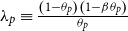 $ \lambda _p \equiv \frac{\left ( 1 - \theta _p \right ) \left ( 1 - \beta \theta _p \right )}{\theta _p}$
and
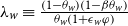 $ \lambda _w \equiv \frac{\left ( 1 - \theta _w \right ) \left ( 1 - \beta \theta _w \right )}{\theta _w \left ( 1 + \epsilon _w \varphi \right )}$
are slopes of the NKPC and the wage Phillips curve, respectively, and
 $ \Omega _0$
and
 $ \gamma _\upsilon$
are composite blocks of parameters. The definition of the efficient level of output, (domestic) price inflation, and wage inflation are shown in Section 3.2.
3.2 Equilibrium in the distorted steady-state mmodel
Combined with the market-clearing conditions and after log-linearization around the zero-inflation steady state, the optimality conditions can be used to determine the set of conditions characterizing the equilibrium of the small open economy. This equilibrium can be represented by the following system of differential equations: While the welfare criteria are different from those of GM’s model, our equilibrium in the distorted steady-state model is almost the same as GM’s except that (i) the welfare-relevant employment gap replaces the standard employment gap; (ii) the cost push shock, which comprises the efficient level of employment, the efficient level of TOT, the demand shock, the export shock, and the world interest rate shock appear in the NKPC; and (iii) the elasticity of substitution between domestic and imported goods and the parameter measuring returns to scale disappear because of constant returns to scale.
Aggregate demand block
 \begin{eqnarray} y_t &=& \left ( 1 - \upsilon \right ) c_t + \eta \upsilon \!\left ( 2 - \upsilon \right ) s_t + \upsilon z^*_{1,t}, \end{eqnarray}
 \begin{eqnarray} c_t &=& \left ( 1 - \upsilon \right ) s_t + z_t - z^*_{2,t}, \end{eqnarray}
 \begin{eqnarray} c_t &=& \mathrm{E}_t \!\left ( c_{t+1} \right ) - \left [ r_t - \mathrm{E}_t \!\left ( \pi _{t+1} \right ) \right ] + \left ( 1 - \rho _z \right ) z_t + \delta, \end{eqnarray}
 \begin{eqnarray} s_t &=& e_t - p_{H,t}, \end{eqnarray}
 \begin{eqnarray} n_t &=& y_t - a_t, \end{eqnarray}
Aggregate supply block
 \begin{eqnarray} \pi _{H,t} &=& \beta \mathrm{E}_t \!\left ( \pi _{H,t+1} \right ) + \lambda _p mc_t, \end{eqnarray}
 \begin{eqnarray} mc_t &=& \hat \omega _t + \hat y_t + \left \{ \upsilon \!\left [ 1 - \left ( \eta - 1 \right ) \left ( 2 - \upsilon \right ) \right ] + 1 \right \} \hat s_t + \frac{1}{1 - \tau } \tau _t + \nu _{p,t} - \frac{1}{1 - \tau } \tau, \end{eqnarray}
 \begin{eqnarray} \pi _{H,t} &\equiv & p_{H,t} - p_{H,t-1}, \end{eqnarray}
 \begin{eqnarray} \pi _t &\equiv & p_t - p_{t-1}, \end{eqnarray}
 \begin{eqnarray} p_t &=& p_{H,t} + \upsilon s_t, \end{eqnarray}
 \begin{eqnarray} \pi ^w_t &=& \beta \mathrm{E}_t \!\left ( \pi ^w_{t+1} \right ) - \lambda _w \mu ^w_t, \end{eqnarray}
 \begin{eqnarray} \mu ^w_t &=& \hat \omega _t - \varphi \hat n_t - \hat c_t, \end{eqnarray}
 \begin{eqnarray} \pi ^w_t &\equiv & w_t - w_{t-1}, \end{eqnarray}
 \begin{eqnarray} \omega _t &\equiv & w_t - p_t, \end{eqnarray}
with
 $ s_t \equiv \textrm{ln} \mathcal{S}_t$
and
 $ \nu _{p,t} \equiv \frac{1 + \gamma _\upsilon \!\left ( 1 + \varphi \right )}{\gamma _\upsilon } n^e_t - \left [ \left ( \eta - 1 \right ) \upsilon \!\left ( 2 - \upsilon \right ) + 1 \right ] s^e_t + \frac{\upsilon \!\left [ \eta \!\left ( 2 - \upsilon \right ) ^2 - \gamma _\upsilon \right ] - \gamma _\upsilon \!\left ( 1 - \upsilon \right ) ^2}{\gamma _\upsilon \!\left ( 1 - \upsilon \right )} \left ( z_t - z^*_{2,t} \right ) - \frac{\upsilon \!\left ( 1 + \gamma _\upsilon \right )}{\gamma _\upsilon } z^*_{1,t}$
being the cost push shock where
 $ \hat \omega _t \equiv \omega _t - \omega ^e_t$
,
 $ \hat y_t \equiv y_t - y^e_t$
,
 $ \hat s_t \equiv s_t - s^e_t$
and
 $ \hat c_t \equiv c_t - c^e_t$
denote the welfare relevant real (consumption) wage gap, welfare relevant output gap, welfare relevant TOT gap and welfare relevant consumption gap which are deviations from their efficient level,
 $ \omega ^e_t$
,
 $ y^e_t$
,
 $ s^e_t$
and
 $ c^e_t$
, respectively.
The aggregate demand block comprises Eq. (16), which determines output as a function of aggregate demand, the international risk-sharing condition Eq. (17), the Euler equation Eq. (18), the definition of the TOT Eqs. (19), and (20), which determines employment as a function of aggregate output given the technology. The aggregate supply block consists of the NKPC determining inflation dynamics Eq. (21), the wage Phillips curve Eq. (26), the relationship between the CPI and the domestic price, Eq. (25) and the definitions of domestic price inflation
 $ \pi _{H,t}$
Eq. (23), CPI inflation
 $ \pi _t$
Eq. (24), the wage inflation
 $ \pi ^w_t$
Eq. (28), and the real (consumption) wage
 $ \omega _t$
Eq. (29). In addition, there are two equalities: Eqs. (22) and (27), which show that the marginal cost is a function of the welfare-relevant real (consumption) wage gap, welfare-relevant output gap, welfare-relevant TOT gap, and tax rate and varies with changes in the price shock, and shows that the wage markup
 $ \mu ^w_t$
is a function of the welfare-relevant real (consumption) wage gap, welfare-relevant employment gap, and welfare-relevant consumption gap, respectively. In contrast to GM’s model, we present these two equalities separately in Eqs. (21) and (26) to show how introducing an endogenous fiscal policy rule, such as the Bohn rule with a government budget constraint, changes GM’s findings.
The efficient levels of employment, output, TOT, consumption, and real wages are given by
 \begin{eqnarray*} n^e_t &\equiv & \Omega _1 z_t + \upsilon \Omega _2 z^*_{1,t} + \Omega _3 z^*_{2,t} + \Omega _5 a_t, \\[5pt] y^e_t &\equiv & n^e_t + a_t, \\[5pt] s^e_t &\equiv & \frac{1}{\gamma _\upsilon } n^e_t + \frac{1}{\gamma _\upsilon } a_t + \frac{\eta \upsilon \!\left ( 2 - \upsilon \right ) - \gamma _\upsilon }{\left ( 1 - \upsilon \right ) \gamma _\upsilon } z_t - \frac{\upsilon }{\gamma _\upsilon } z^*_{1,t} - \frac{\eta \upsilon \!\left ( 2 - \upsilon \right ) - \gamma _\upsilon }{\left ( 1 - \upsilon \right ) \gamma _\upsilon } z^*_{2,t}, \\[5pt] c^e_t &\equiv & \frac{1 - \upsilon }{\gamma _\upsilon } n^e_t + \frac{1 - \upsilon }{\gamma _\upsilon } a_t + \frac{\eta \upsilon \!\left ( 2 - \upsilon \right )}{\gamma _\upsilon } z_t - \frac{\upsilon \!\left ( 1 - \upsilon \right )}{\gamma _\upsilon } z^*_{1,t} - \frac{\eta \upsilon \!\left ( 2 - \upsilon \right )}{\gamma _\upsilon } z^*_{2,t}, \\[5pt] \omega ^e_t &\equiv & \frac{\varphi \gamma _\upsilon + 1 - \upsilon }{\gamma _\upsilon } n^e_t + \frac{1 - \upsilon }{\gamma _\upsilon } a_t + \frac{\eta \upsilon \!\left ( 2 - \upsilon \right )}{\gamma _\upsilon } z_t - \frac{\upsilon \!\left ( 1 - \upsilon \right )}{\gamma _\upsilon } z^*_{1,t} - \frac{\eta \upsilon \!\left ( 2 - \upsilon \right )}{\gamma _\upsilon } z^*_{2,t}, \end{eqnarray*}
where
 $ \Omega _1$
,
 $ \Omega _2$
,
 $ \Omega _3$
, and
 $ \Omega _5$
are the composite blocks of the parameters.
3.3 Monetary regimes
The system consists of aggregate demand and supply blocks and is closed by monetary regime equations. Following GM, we analyze two monetary regimes: inflation targeting, in which a small open economy adopts inflation targeting (or a flexible exchange rate), and currency union, in which a small open economy is part of a currency union. Under the first regime, inflation targeting, the central bank focuses on stabilizing CPI inflation. Formally, we assume:
 \begin{eqnarray} \pi _t = 0, \end{eqnarray}
for all
 $ t$
while the exchange rate can fluctuate freely. Note that GM assume
 $ \pi _{H,t} = 0$
for all
 $ t$
, which means that the central bank focuses on stabilizing domestic price inflation, which differs from the current model.
Under the second regime, namely the currency union, the domestic economy is part of a world currency union. Alternatively, it is assumed that the exchange rate is indefinitely and credibly pegged to the world currency. In either case, we assume that
 \begin{eqnarray} e_t = 0, \end{eqnarray}
for all
 $ t$
. Note that the domestic nominal interest rate moves one-for-one with the world interest rate independent of domestic economic conditions.
3.4 Calibration
Table 2 lists the benchmark parameterizations used to simulate the distorted steady-state model. Our parameterization is almost consistent with that of GM, although some exceptions exist. As previously mentioned, we assume constant returns to scale, while GM assumes decreasing returns to scale with 0.26 as the degree of decreasing returns to scale. In other words, we choose zero as the degree of decreasing returns to scale instead of 0.26. In addition, we set the trade elasticity of substitution
 $ \eta$
to 2, while GM assumes an Armington-form consumption index, which implies that elasticity is unity. However, GM set the elasticity in their medium-scale DSGE model to 2 to verify the robustness of their findings.Footnote 7 Thus, our choice is not necessarily inconsistent with the parametrization. Rather, our choice is closer to De Paoli (Reference de Paoli2009), who choose 3, and Eaton et al. (Reference Eaton, Kortum and Neiman2016), who choose 6 following Obstfeld and Rogoff (Reference Obstfeld and Rogoff2001).
Parameterization

4. Effectiveness of labor cost reduction, wage flexibility, exchange rate policy, and welfare in the distorted steady-state model
4.1 Effectiveness of labor cost reduction
We assume that the tax gap in the distorted steady-state model is
 \begin{eqnarray} \hat \tau _t = \psi _t, \end{eqnarray}
 \begin{eqnarray} \psi _t \!\left \{ \begin{array}{l@{\quad}l@{\quad}l} = \psi _0 & \mathrm{if} & t = 0 \\ = 0 & \mathrm{if} & t = 1,2,\cdots, \end{array} \right . \end{eqnarray}
where
 $ \hat \tau _t \equiv \tau _t - \tau$
denotes the tax gap, which is the percentage deviation of the tax rate from its steady-state value and
 $ \psi _t$
with
 $ \psi _0 \lt 0$
denotes an exogenous tax shifter that provides pressure to reduce the tax gap (or tax rate). The tax gap is endogenized following the Bohn rule in the IGBC model, which is derived in Section 5, and has government budget constraints and the Bohn rule to close that model Eq. (33), which implies that there is no persistence in the tax shifter introduced into both the distorted steady-state and IGBC models, while
 $ \psi _t = \rho _\tau ^t \tau _0,$
which implies that there is persistence in the tax shifter, is implicitly assumed in GM’s model.Footnote 8 If we use GM’s model settings that accompany the persistence of the tax shifter, there would be differences in the dynamic path of the tax gap between the distorted steady-state model, in which the tax gap is exogenous, and the IGBC model, in which the tax gap is endogenous and follows the Bohn rule. Therefore, it is inappropriate to compare the dynamic responses to tax cuts in the distorted steady-state model with those in the IGBC model. As such, Eq. (33) is introduced to compare the dynamic responses of the distorted steady-state and IGBC models. Ferrero (Reference Ferrero2009) also chose no persistency in exogenous processes, similar to this study, to simplify the impulse response functions (IRFs).
Figure 1 shows the responses of employment, nominal and real (consumption) interest rates, TOT and tax gap to a one-percent decrease in the exogenous tax shifter
 $ \psi _0$
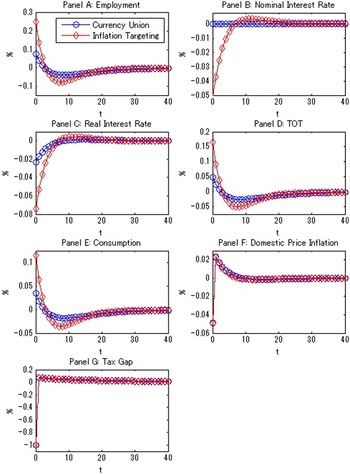
. Similar to GM’s model shown in Figure 1, the red lines with diamonds are the responses under inflation targeting, while the blue lines with circle are the responses under a currency union. While our inflation targeting is not domestic price inflation targeting but rather CPI inflation targeting, which is different from GM’s model, our findings are consistent with GM’s first finding: the effectiveness of tax cuts as a means to stimulate employment is much weaker under a currency union compared with the case of an autonomous monetary policy focused on price stability, namely, inflation targeting. As Panel C shows, the reduction in the real interest rate in the currency union is much smaller than that under inflation targeting. In addition, as shown in Panels D and E, the increases in TOT and consumption in the currency union are much smaller than those under inflation targeting. These results support GM’s first findings.
Dynamic response to one-percent decrease in the tax rate in the distorted S.S. Model.

To understand the previous results, similar to GM’s model, we obtain the following two equalities:
 \begin{eqnarray} c_t &=& - \left ( 1 - \upsilon \right ) \sum ^\infty _{k=0} \mathrm{E}_t \!\left ( r_{H,t+k} \right ) + \lim _{k \to \infty } \mathrm{E}_t \!\left ( c_{t+k} \right ), \end{eqnarray}
 \begin{eqnarray} s_t &=& - \sum ^\infty _{k=0} \mathrm{E}_t \!\left ( r_{H,t+k} \right ) + \lim _{k \to \infty } \mathrm{E}_t \!\left ( s_{t+k} \right ), \end{eqnarray}
where
 $ r_{H,t} \equiv r_t - \mathrm{E}_t \!\left ( \pi _{H,t+1} \right )$
denotes the real interest rate (and where
 $ \lim _{k \to \infty } \mathrm{E}_t \!\left ( c_{t+k} \right ) = 0$
and
 $ \lim _{k \to \infty } \mathrm{E}_t \!\left ( s_{t+k} \right ) = 0$
in deviation from steady state). Note that we ignore the constants and exogenous shifters in Eqs.(34) and (35), respectively: Eq. (34) is derived by iterating Eqs. (18), and (35) is derived by iterating Eq. (6). Eqs. (34) and (35) show that consumption and TOT are negatively related to the sum of expected future real interest rates and are also derived from GM’s model. Eqs. (34) and (35) imply that the smaller the reduction in the real interest rate, the smaller the increase in consumption and TOT, and vice versa. Thus, GM’s first finding is applicable to the distorted steady-state model. Notice that Eqs. (34) and (35) are consistent with the international risk-sharing conditions Eq. (17), which shows that consumption is positively related to TOT.
While we can replicate GM’s first finding, the following comment regarding this finding is necessary because a distorted steady state is introduced. The strength of the central bank’s response to variations in inflation is referred to as the “endogenous policy channel,” while the resulting reductions in marginal costs and prices that make domestic firms more competitive are referred to as the “competitiveness channel” in GM’s model.Footnote 9 GM state that while the “endogenous policy channel” is muted, the employment stimulus only relies on the “competitiveness channel” in the currency union. However, in our case, this statement does not apply to the currency union. As shown in Panels A and C in Figure 1, employment increases while the real interest rate decreases in the currency union (blue line with circles). This phenomenon implies the existence of an “endogenous policy channel.” GM’s model shows that while the real interest rate increases, employment and TOT only increase slightly. In a currency union, because the nominal interest rate is constant, a decrease in (expected) domestic price inflation increases the real interest rate. Although GM’s model does not show a dynamic response of domestic price inflation to the tax cut, it admits that domestic price inflation declines. As shown in Panel F of Figures 1, however, while domestic price inflation declines after a one-percent decrease in the tax gap, this decline lasts for only one period and inflation becomes positive after that. Thus, the real interest rate declines after a one-percent decrease in the tax gap, which differs from the results of GM’s model. This result depends on whether the tax gap decreases successively. A consecutive decrease in the tax gap occurred in GM’s model, and this consecutive decrease in the tax rate caused a consecutive decrease in domestic price inflation. Thus, the real interest rate increased slightly. In our case, a decrease in the tax rate is not consecutive but ends after one period. The real interest rate decreased due to the increase in domestic price inflation after the first period. Thus, the “endogenous policy channel” exists in the current model.
However, it can be said that both the “endogenous policy channel” and “competitiveness channel” have weaker effects on employment fluctuations under the currency union. This is shown in Panels D and E of Figures 1 in which both the responses of TOT and consumption under the currency union are weaker than those under inflation targeting.
In Section 7.1, we analyze the effectiveness of labor cost reductions in the IGBC model, where the tax gap is determined endogenously, as in the Bohn rule. Similar to Figure 1, Figure 2 shows the dynamic response to a one-percent decrease in the tax rate in the IGBC model. As Panel G shows, the dynamic path of the tax gap is no longer a simple one-period reduction. Instead, the dynamic path of the tax gap is now the same as that in the IGBC model, where the tax gap is endogenous and increases slightly after an initial decline to satisfy the Bohn rule, which tends to secure a fiscal surplus to repay government debt. Even when the tax gap path is altered, the results remain unchanged. As shown in Panels A, C, D, and E of Figure 2, the reduction in the real interest rate in the currency union is much smaller than under inflation targeting, while the increases in employment, TOT and consumption are much smaller in the currency union than under inflation targeting. Despite the altered dynamic path of the tax gap, GM’s first finding remains applicable.
Dynamic response to one-percent decrease in the tax rate in the distorted S.S. Model (Under the dynamic path of tax gap which is identical to it under IGBC model with bohn rule).

4.2 Wage flexibility and welfare in a currency union
Figure 3 shows the average welfare loss for a small open economy in a currency union as a function of the degree of wage stickiness,
 $ \theta _w$
, and conditional on each of the four exogenous driving forces introduced above, namely, two domestic shocks (technology and demand) and two external shocks (exports and world interest rate), which follows GM’s model. In each case, welfare losses are expressed as the ratio of those under the benchmark setting
 $ \theta _w = 0.8$
, which also follows GM’s model.
Wage rigidities and welfare in a currency union.

As Figure 3 shows, the relationship between the welfare loss and the degree of wage rigidity is nonmonotonic, and this result is independent of the driving forces, as in GM’s model. The loss functions were half-moon-shaped, as in GM’s model, although there were some exceptions. Starting from a value of
 $ \theta _w$
close to unity, a reduction in this parameter value increases the welfare loss. However, if wages are sufficiently flexible, a further increase in wage flexibility leads to a decline in welfare losses. Although these results are not found for an intermediate degree of wage stickiness following a technology shock, they are found as long as wage rigidity is sufficiently close to unity or zero. An increase in wage flexibility may raise or lower welfare, depending on the initial degree of wage rigidity, as GM’s model shows. Similar to GM’s model, the shape of the welfare loss function varies considerably with the type of shock. The maximum is attained for different values of wage rigidity in both their model and ours. Although the loss function appears somewhat monotonic in the case of a technology shock, it is highly monotonic in the case of an export shock in GM’s model.
Figure 4 shows the welfare losses associated with the demand shocks together with the three components of the welfare loss function, each being associated with Eq. (15), which is similar to GM’s model. These three features of the welfare loss function are consistent with GM’s results. Regarding the first component, which is associated with employment gap fluctuations (red line with plus signs), an increase in wage flexibility always reduces the contribution of that component to overall welfare losses, although the size of the reduction is relatively small because of the limited influence of wage adjustments on employment in an economy that belongs to a currency union, as discussed above. Regarding the second component, associated with domestic price inflation (black line with squares), an increase in wage flexibility always raises the volatility of domestic price inflation and thus the contribution of the latter to welfare losses. With regard to the third component, the wage inflation component of welfare losses (magenta line with plus signs) displays the same nonmonotonicity as the overall losses (blue line with circles); thus, its contribution is particularly important to account for the finding in Figure 3. As GM explain, the reason for nonmonotonicity is straightforward. When wage rigidity decreases from close to unity, the variance in wage inflation increases. On the one hand, the weight associated with wage inflation volatility in the loss function
 $ \Lambda _w$
rapidly decreases as wages become more flexible because
 $ \frac{\partial \Lambda _w}{\partial \theta _w} = \frac{\epsilon _w \!\left ( 1 - \Phi \right ) \left ( 1 - \beta \theta _w \right ) \left ( 2 - \theta _w \right )}{\lambda _w^2} \gt 0$
. Thus, the welfare losses associated with wage rigidity decrease when wage rigidity is below a certain level.
Wage rigidities in a currency union: welfare components.

Figure 5 compares the welfare effect of changes in wage flexibility in a small open economy that is part of a currency union with that in a small open economy under inflation targeting. Welfare losses are expressed as a ratio of those under the baseline setting
 $ \theta _w = 0.8$
, as in GM. Similar to GM, the differences between the two regimes were clear. Under inflation targeting, an increase in wage flexibility always improves welfare, independent of the initial degree of wage rigidity and the source of fluctuations (red line with diamonds).
Wage rigidities and welfare: currency union vs inflation targeting.

The qualitative and quantitative differences between the two regimes are clear. In particular, and, as Figure 5 makes clear, under inflation targeting, an increase in wage flexibility is always welfare improving, independent of the initial degree of wage rigidity and the source of fluctuations, except for the case of the world interest rate shock. However, except for an intermediate degree of wage rigidity, wage flexibility improves welfare in the case of the world interest rate shock. Thus, our results regarding the welfare loss function under inflation targeting are almost the same as those of GM. GM’s second finding, that an increase in wage flexibility often reduces welfare, more likely so in an economy that is part of a currency union, can be replicated in the distorted steady-state model.
The analysis above examined the impact of changes in the degree of wage rigidity while keeping the price-rigidity parameter,
 $ \theta _p$
, unchanged at its baseline value of 0.8. Following GM, we analyze how welfare changes if both wages and price rigidity change in the same direction. Figure 6 shows welfare loses under a currency union as a function of the degree of overall nominal rigidities, as captured by variations in a common value for
 $ \theta _w$
and
 $ \theta _p$
(denoted by
 $ \theta$
). Our results are consistent with those obtained by GM. That is, the non-monotonicity that characterizes the welfare loss function under a currency union is shown here when price and wage rigidities vary simultaneously (at a glance, Panel A in Figure 6 shows that as nominal rigidities increase, welfare losses increase but the welfare losses attain the highest values when both rigidities equal 0.975, so that non-monotonicity remains barely preserved).
Nominal rigidities and welfare in a currency union (
 $ \theta _w = \theta _p = \theta$
).

5. IGBC model: introducing the government budget constraint into the distorted steady-state model
This section introduces the government and its budget constraints into the distorted steady-state model. Lump-sum transfers are no longer available, and the government issues debt to finance its deficit and to repay the debt issued in the past.
5.1 Households
Instead of Eq. (3), the sequence of budget constraints is
 \begin{eqnarray} \int ^1_0 P_{H,t} \!\left ( i \right ) C_{H,t} \!\left ( i \right ) di + P_{F,t} C_{F,t} + \mathrm{E}_t \!\left ( Q_{t,t+1} D^n_{t+1} \right ) \le D^n_t + \int ^1_0 W_t \!\left ( j \right ) \mathcal{N}_t \!\left ( j \right )dj + PR_t. \end{eqnarray}
Households maximize Eq. (1), and subject to Eq. (36) instead of Eq. (3). Different from Eq. (3), the lump-sum transfer
 $ TR_t$
disappears in Eq. (36) (Instead of lump-sum transfers, the government levies a tax on firm sales). However, this modification does not change the households’ optimality conditions, and the Euler equation Eq. (4),
5.2 Government
In a small open economy, the government levies taxes on firm sales, purchases generic goods, and issues debt to finance its deficits.
5.2.1 Flow government budget constraint
The flow government budget constraint is
 \begin{eqnarray*} B^n_t = B^n_{t-1} \!\left ( 1 + r_{t-1} \right ) - \int ^1_0 P_{H,t} \!\left ( i \right ) \left ( \tau _t Y_t \!\left ( i \right ) - G_t \!\left ( i \right ) \right ) di, \end{eqnarray*}
where
 $ B^n_t$
denotes the nominal government debt issued by the home country at the end of period
 $ t$
which matures in period
 $ t + 1$
. Note that all households are assumed to be identical, and there is no borrowing or lending among them in equilibrium. Thus, all the private agents’ asset holdings are in the form of government securities.Footnote 10
The previous flow of government budget constraint can be rewritten using the optimal allocation of generic goods as follows:
 \begin{eqnarray} B^n_t = B^n_{t-1} \left ( 1 + r_{t-1} \right ) - P_t SP_t, \end{eqnarray}
where
 \begin{eqnarray} SP_t \equiv \frac{P_{H,t}}{P_t} \left ( \tau _t Y_t - G_t \right ), \end{eqnarray}
denotes the (real) fiscal surplus and
 $ G_t \equiv \left ( \int ^1_0 G_t \!\left ( i \right ) ^{\frac{\epsilon _p -1}{\epsilon }}di \right ) ^{\frac{\epsilon _p}{\epsilon _p -1}}$
denotes the index of government expenditure in a small open economy, analogous to the consumption index. For simplicity, we assume that the government expenditure is fully allocated to domestically produced goods, as in Gali and Monacelli (Reference Gali and Monacelli2008). Government expenditure follows the exogenous AR(1) process.
 \begin{eqnarray*} g_t = \rho _g g_{t-1} + \varepsilon _{g,t}. \end{eqnarray*}
Dividing both sides of Eq. (37) using the CPI yields:
 \begin{eqnarray} B_t = B_{t-1} \left ( 1 + r_{t-1} \right ) \left ( \frac{P_t}{P_{t-1}} \right ) ^{-1} - SP_t, \end{eqnarray}
where
 $ B_t \equiv \frac{B^n_t}{P_t}$
is the real government debt.
Iterating Eq. (39) forward and imposing the appropriate transversality condition for government debt
 $ \mathop{\lim }\limits _{k \to \infty } \beta ^k \mathrm{E}_t \!\left (\frac{B^n_{t+k}}{P_{t+k+1}} \right ) = 0$
, we have
 \begin{eqnarray} 1 = \frac{ \sum ^\infty _{k=0} \beta ^k \mathrm{E}_t \!\left ( C_{t+k}^{-1} Z_{t+k} SP_{t+k} \right )}{C_t^{-1} Z_t B_{t-1} \left ( \frac{P_t}{P_{t-1}} \right ) ^{-1}}, \end{eqnarray}
where we use Eq. (4).
Eq. (40) can be rewritten as a second-order differential equation as follows:
 \begin{eqnarray} \left ( 1 + r_{t-1} \right ) B_{t-1} \!\left ( \frac{P_t}{P_{t-1}} \right ) ^{-1} = SP_t + \beta \mathrm{E}_t \!\left [ \frac{C_t}{C_{t+1}} \frac{Z_{t+1}}{Z_t} \left ( \frac{P_{t+1}}{P_t} \right ) ^{-1} \left ( 1 + r_t \right ) B_t \right ]. \end{eqnarray}
5.3 Market-clearing condition
Because of government expenditure, the market-clearing condition in the IGBC model is given by
 \begin{eqnarray*} Y_t \!\left ( i \right ) = C_{H,t} \!\left ( i \right ) + X_t \!\left ( i \right ) + G_t \!\left ( i \right ), \end{eqnarray*}
instead of Eq. (14).
6. Welfare criteria, equilibrium, monetary and fiscal policy, and calibration of the IGBC model
6.1 Welfare criteria
The inclusion of government budget constraints alters the welfare criteria introduced in Section 3 namely, Eq. (15), and the welfare criterion in the IGBC model is given by:
 \begin{eqnarray} \mathcal{L}^F \sim \frac{1}{2} \left [ \Lambda ^F_n \textrm{var} \!\left ( \hat n_t \right ) + \Lambda ^F_p \textrm{var} \!\left ( \pi _{H,t} \right ) + \Lambda ^F_w \textrm{var} \!\left ( \pi ^w_t \right ) \right ], \end{eqnarray}
where
 $ \Lambda ^F_n \equiv \frac{2 \Omega ^F_0}{\gamma _\upsilon ^2}$
,
 $ \Lambda ^F_p \equiv \frac{\epsilon _p \!\left [ \left ( 1 - \Phi \right ) - \Theta ^F_2 \sigma _C \!\left ( \lambda _p + \varphi \right ) \right ]}{\lambda _p \sigma _C}$
and
 $ \Lambda ^F_w \equiv \frac{\epsilon _w \!\left [ \left ( 1 + \epsilon _w \varphi \right ) \left ( 1 - \Phi \right ) - \Theta ^F_2 \sigma _C \!\left ( 1 + \varphi \right ) \lambda _w \right ]}{\lambda _w \sigma _C}$
denote the weight of the variances of the welfare relevant output gap, (domestic) price inflation and wage inflation, respectively,
 $ \Omega ^F_0$
is the composite blocks of parameters and
 $ \sigma _C \equiv \frac{C}{Y}$
denotes the steady-state ratio of consumption to output. Note that Eq. (42) is derived based on the second-order approximated utility function, following Benigno and Woodford (Reference Benigno and Woodford2003) and Ferrero (Reference Ferrero2009) to eliminate linear terms.
6.2 Equilibrium in the IGBC Model
Using the market-clearing conditions and log-linearization around the zero-inflation steady state, the optimality conditions, government budget constraints, and definition of fiscal surplus can be used to determine the set of conditions characterizing the equilibrium of a small open economy. This equilibrium can be represented by the following system of difference equations, similar to that described in Section 3.
Aggregate demand block (Modified and derived anew only)
 \begin{eqnarray} y_t &=& \left ( 1 - \upsilon \right ) \sigma _C c_t + \eta \sigma _C \upsilon \!\left ( 2 - \upsilon \right ) s_t + \upsilon \sigma _C z^*_{1,t} + \sigma _G g_t, \end{eqnarray}
 \begin{eqnarray} c_t &=& \mathrm{E}_t \!\left ( c_{t+1} \right ) - \left [ r_t - \mathrm{E}_t \!\left ( \pi _{t+1} \right ) \right ] - b_t + \frac{1}{\beta } \left ( r_{t-1} - \pi _t \right ) + \frac{1}{\beta } b_{t-1} - \frac{1 - \beta }{\beta } sp_t \nonumber \\ & &{} + \left ( 1 - \rho _z \right ) z_t + \frac{1 - \beta }{\beta } \delta, \end{eqnarray}
 \begin{eqnarray} sp_t &=& - \upsilon s_t + \frac{\beta }{\left ( 1 - \beta \right ) \sigma _B} \tau _t + \frac{\beta \tau }{\left ( 1 - \beta \right ) \sigma _B} y_t - \frac{\beta \sigma _G}{\left ( 1 - \beta \right ) \sigma _B} g_t - \frac{\beta }{\left ( 1 - \beta \right ) \sigma _B} \tau, \end{eqnarray}
 \begin{eqnarray} b_t &=& \frac{1}{\beta } \left ( r_{t-1} - \pi _t \right ) + \frac{1}{\beta } b_{t-1} - \frac{1 - \beta }{\beta } sp_t - \frac{1}{\beta } \delta, \end{eqnarray}
where
 $ \sigma _G \equiv \frac{G}{Y}$
satisfies
 $ \sigma _G = 1 - \sigma _C$
and denotes the steady-state ratio of government expenditure to output.
In the aggregate demand block of the IGBC model, Eqs. (43) and (44), replace Eqs. (16) and (18) in the distorted steady-state model and Eqs. (45) and (46), which stem from the definition of the fiscal surplus in Eq. (38), and the government budget constraint in Eq. (39) are newly derived. Other equalities, Eqs. (17), (19), and (20) in the demand block are succeeded to the IGBC model. All equalities in the aggregate supply block, as expressed in Eqs. (21)–(29) are succeeded to the IGBC model.Footnote 11
6.3 Monetary and fiscal regimes
We now consider whether GM’s two findings are applicable to a domestic economy that is part of a currency union, in which Eq. (31) is applicable as a monetary regime. Furthermore, we assume that the government of the domestic economy adopts the Bohn rule. Based on Bohn (Reference Bohn1998), Mahdavi (Reference Mahdavi2014) estimated the key coefficient of the Bohn rule using US government data. The US is often regarded as a currency union because the country consists of fifty states that use a common currency, the United States dollar.” Thus, we adopt Mahdavi (Reference Mahdavi2014) fiscal feedback rule, which is a type of Bohn rule.
The fiscal feedback rule in Mahdavi (Reference Mahdavi2014) is given by
 \begin{eqnarray*} \frac{SP_t}{Y_t} = \phi _B \frac{B_{t-1}}{Y_t}, \end{eqnarray*}
where
 $ \phi _B$
is the value estimated by Mahdavi (Reference Mahdavi2014). This expression implies that the government tends to make the ratio of the fiscal surplus to output larger than the ratio of past government debt to current output depending on the value of
 $ \phi _B$
. By dividing both sides by the steady-state value of the fiscal surplus, subtracting one from both sides of that equality, and taking the logarithms, we obtain the logarithmic equality of the fiscal feedback rule in Mahdavi (Reference Mahdavi2014) as follows:
 \begin{eqnarray} sp_t = \phi _b b_{t-1} + \left ( \phi _b - 1 \right ), \end{eqnarray}
where
 $ \phi _b \equiv \frac{\phi _B \beta }{1 - \beta }$
denotes the fiscal policy rule coefficient, and is dubbed the Bohn rule coefficient hereafter. We assume that the tax gap is a fiscal policy instrument. Substituting Eq. (45) in the previous expression, we obtain
 \begin{eqnarray} \hat \tau _ t = \frac{\upsilon \!\left ( 1- \beta \right ) \sigma _B}{\beta } s_t - \tau y_t + \frac{\left ( 1 - \beta \right ) \sigma _B \phi _b}{\beta } b_{t-1} + \sigma _G g_t + \frac{\left ( 1 - \beta \right ) \sigma _B \left ( \phi _b - 1 \right )}{\beta }, \end{eqnarray}
which is a fiscal policy rule based on Mahdavi (Reference Mahdavi2014).
Although the equation derived by combining Eqs.(44) and (46) is identical to Eq. (18), which is a log-linearized Euler equation (i.e., the Euler equation is the same in the distorted steady-state and IGBC models), the IGBC model is still distinct from the distorted steady-state model. This is due to the endogenous fiscal policy rule in Eq. (47), which can be rewritten as Eq. (48) is introduced into the IGBC model.
6.4 Calibration
Table 2 lists the parameterizations of the IGBC model used for the simulation exercises. Parameterization in the distorted steady-state model is succeeded in the IGBC model. Additional parameterization is necessary because of the introduction of a government that issues government debt and levies taxes, as shown in lines 14–18 of Table 2. We set
 $ \tau = 0.3$
following Ferrero (Reference Ferrero2009) who analyzed the monetary and fiscal policy rules in a currency union. We set
 $ \sigma _B = 4.543$
and
 $ \sigma _G = 0.477$
based on Eurostat data. From 2008 to 2019, the ratios of government debt to GDP in Greece, Italy, Portugal, and Spain (GIPS) was 1.1358. The model was based on quarterly data; therefore, this number must be multiplied by four. Similarly, the ratio of government expenditure to GDP in GIPS was 0.477. We set
 $ \phi _b = 6.5$
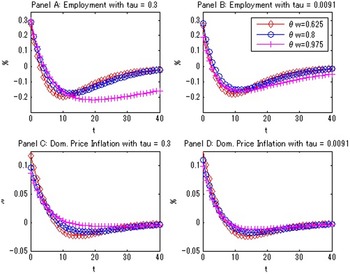
following the estimation results of Mahdavi (Reference Mahdavi2014), who estimated several models with results varying from 0.045 to 0.085, corresponding to 4.455-8.415 in our setting. Thus, we selected 6.5, which is a moderate benchmark value.Footnote 12 We simulate not only 6.5, but also 4.5, and 8.5, as robustness checks in Section 8. While GM’s model does not set the value of
 $ \rho _g$
, which is the persistence of the exogenous process of government expenditure because there is no government in their model, we set
 $ \rho _g = 0.9$
following the persistence of the exogenous process of demand and so forth.
7. Effectiveness of labor cost reduction, wage flexibility, exchange rate policy, and welfare in the igbc model
7.1 Effectiveness of labor cost reduction
We assume that the fiscal policy rule in the IGBC model is
 \begin{eqnarray} \hat \tau _t = \frac{\upsilon \!\left ( 1- \beta \right ) \sigma _B}{\beta } s_t - \tau y_t + \frac{\left ( 1 - \beta \right ) \sigma _B \phi _b}{\beta } b_{t-1} + \sigma _G g_t + \frac{\left ( 1 - \beta \right ) \sigma _B \!\left ( \phi _b - 1 \right )}{\beta } + \psi _t. \end{eqnarray}
In Eq. (49), the exogenous tax shifter,
 $ \psi _t$
, which follows Eq. (33) is added to Eq. (48) to analyze the effectiveness of the labor cost reduction, as in Section 4.1.
Next, we discuss the dynamic responses to a temporary one-percent decrease in the tax gap. The tax gap is now endogenous and a one-percent decrease in
 $ \psi _0$
does not reduce the tax gap by one percent because there is bidirectional causality between the tax gap, TOT, and output. In other words, a change in the tax gap affects both TOT and output, and changes in both TOT and output affect the tax gap. We find that
 $ \psi _0 \simeq - 0.989\%$
results in a one-percent decrease in the tax gap. Therefore, we use this setting.Footnote 13
Dynamic response to one-percent decrease in the tax rate in the IGBC model.

Similar to Figure 2, Figure 7 shows the responses of employment, nominal and real interest rates, TOT, consumption, domestic price inflation, tax gap, government debt and fiscal surplus to a decrease in the exogenous tax shifter which decreases the tax gap by one percent in both the IGBC and distorted steady-state models. The blue lines with circles represent the responses under the distorted steady-state model, and are identical to the blue lines with circles in Figure 2. The magenta lines with plus signs indicate responses to the IGBC model. There are notable differences between the responses for employment, TOT, and consumption in both models (see Panels A, D, and E). After the tax reduction, the increase in employment is smaller than that in the distorted steady-state model, and the responses of TOT and consumption deviate below those in the distorted steady-state model. A decrease in the tax gap reduces the fiscal surplus, whereas government debt increases, as shown in Eqs. (45) and (46). Consequently, consumption decreases more in the IGBC model. In the IGBC model, the government budget constraint (Eq. (46) is introduced and Eq. (46) implies that CPI inflation increases in response to a decrease in the fiscal surplus, which is used to repay government debt issued in the past. Note that the CPI is the weighted average of domestic and imported goods prices, which are constant because the domestic economy is part of a currency union, and we assume
 $ P^*_t = 1$
.Footnote 14 Thus, an increase in the domestic price level causes a decrease in the TOT, as shown in Panel D.
However, employment in the IGBC model (see Panel A) does not increase substantially after the shock and its response does not differ much from that in the distorted steady-state model. The reason for this is the government expenditure. As shown in Eqs. (16) and (43), the sum of consumption and TOT determines the output because of the market-clearing condition, provided that the export shock is ignored. While the steady-state ratio of consumption to output
 $ \sigma _C$
does not appear in Eq. (16), the parameter appears in Eq. (43) because of government expenditure which affects GDP, consumption, and TOT. This parameter is less than unity (our parameterization implies
 $ \sigma _C = 0.523$
). Thus, an increase in employment, which corresponds to output is smaller than its increase under the distorted steady-state model as long as there are no changes in technology under the IGBC model, even if consumption and TOT decline more in the IGBC model.
The employment response in the IGBC model for the currency union is equal to or less than that in the distorted steady-state model for the currency union. Thus, the effectiveness of labor cost adjustments on employment is much smaller in the currency union, even if an endogenous fiscal policy rule such as the Bohn rule is introduced. Thus, our analysis supports GM’s first finding.
7.2 Wage flexibility and welfare in a currency union
Similar to Figure 3, Figure 8 shows the average welfare loss in a small open economy in a currency union as a function of the degree of wage stickiness
 $ \theta _w$
, and conditional on each of not four but five exogenous driving forces, namely the four shocks appearing in the distorted steady-state model and the government expenditure shock. While in the distorted steady-state model the relationship between the welfare loss and degree of wage rigidity is nonmonotonic, as shown in Figure 3, that feature disappears in Figure 8. Except for the demand and world interest rate shocks, welfare losses monotonically increase as wage rigidity increases. In addition, as shown in Panels A and D, which show the response of the welfare loss functions to the demand and world interest rate shocks, respectively, the welfare loss functions are not half-moon shaped but “N” shaped. In other words, an increase in wage flexibility reduces welfare losses if wage rigidity is sufficiently high. Thus, an increase in wage rigidity does not necessarily reduce the welfare losses for all shocks.
Wage rigidities and welfare in a currency union: IGBC model.

Figure 9, similar to Figure 4, shows the welfare loss associated with the demand shock together with the three components of the welfare loss function, each of which is associated with Eq. (42). For the first component, the welfare loss associated with employment gap fluctuations (red line with diamonds) always exceeds the welfare loss associated with wage inflation fluctuations (magenta line with plus signs), and this loss increases drastically with an increase in wage rigidity when it exceeds 0.875. In Figure 4, the welfare loss associated with the employment gap fluctuations is smaller and that loss does not exceed the welfare loss associated with wage inflation fluctuations until wage rigidity reaches 0.75 starting from close to zero and the increase in the welfare loss associated with the employment gap fluctuations is smaller. It is obvious that the nonmonotonic relationship between welfare loss and wage rigidity is eliminated by changes in the welfare loss function associated with employment gap fluctuations, and those changes make the total welfare function (blue line with circles) “N” shaped.
Wage rigidities in a currency union in the IGBC model: welfare components.

In conclusion, introducing an endogenous fiscal policy rule such as the Bohn rule, that is, introducing Eq. (47), causes fluctuations in the employment gap. The Bohn rule implies that the government achieves a sufficient fiscal surplus to repay government debt and that the rule has procyclicality. To increase the fiscal surplus, an increase in output, which is identical to employment as long as productivity remains unchanged, as shown in Eq. (20), or an increase in the tax gap is required if government expenditure and TOT do not change. In our setting, the tax gap is a policy instrument that reacts to past government debt. The tax gap also affects employment. The tax gap increases when employment stagnates to secure the fiscal surplus required to repay government debt (provided that productivity remains unchanged). By contrast, the tax gap decreases when employment increases because there is sufficient fiscal surplus to repay the debt (as long as productivity is unchanged). Thus, the tax gap is negatively related to employment, and procyclicality exists in the Bohn rule. The sign of the second term on the right side of Eq. (49) is negative, which implies that the tax gap decreases when employment increases and vice versa. Furthermore, when employment increases sufficiently, the tax gap decreases, which reduces the marginal cost, although the marginal cost will come under pressure to increase because of the increase in employment. Thus, while an increase in marginal cost increases domestic price inflation, there is a downward pressure on domestic price inflation through the Bohn rule, even if employment increases. The potential procyclicality of the Bohn rule reduces the pressure to increase domestic price inflation.
Reducing the upward pressure on domestic price inflation by decreasing the tax gap means that introducing the Bohn rule makes domestic price inflation inelastic to changes in the employment gap. Introducing the Bohn rule makes the slope of the (implied) NKPC flatter in the IGBC model than in the distorted steady-state model. By combining Eqs. (21), (22), (27), and (32), we obtain
 \begin{eqnarray} \pi _{H,t} = \beta \mathrm{E}_t \!\left ( \pi _{H,t+1} \right ) + \lambda _p \!\left ( \sigma _\varsigma + \varphi \right ) \hat n_t + \lambda _p \mu ^w_t, \end{eqnarray}
where
 $ \sigma _\varsigma \equiv \left [ \left ( \eta - 1 \right ) \upsilon \left ( 2 - \upsilon \right ) + 1 \right ] ^{-1}$
, Eq. (50) expresses the (implied) NKPC in the distorted steady-state model. By combining Eqs. (21), (22), and (27) and iterating them using Eqs. (44), (46), and (49), we obtain:
 \begin{eqnarray} \pi _{H,t} &=& \beta \mathrm{E}_t \!\left ( \pi _{H,t+1} \right ) + \lambda _p \!\left [ \left ( \sigma _\varsigma + \varphi \right ) - \frac{\beta \tau - \upsilon \!\left ( 1 - \beta \right ) \sigma _B \sigma _\varsigma }{\left ( 1 - \tau \right ) \beta } \right ] \hat n_t \nonumber \\ & & - \frac{\lambda _p}{\beta } \left [ \left ( \sigma _\varsigma + \varphi \right ) - \frac{\beta \tau - \upsilon \!\left ( 1 - \beta \right ) \sigma _B \sigma _\varsigma }{\left ( 1 - \tau \right ) \beta } \right ] \hat n_{t-1} + \lambda _p \mu ^w_t - \frac{\lambda _p}{\beta } \mu ^w_{t-1} + \frac{\lambda _p}{\beta } mc_{t-1}, \end{eqnarray}
which is the (implied) NKPC in the IGBC model. The exogenous shifters and constants are ignored in Eqs. (50) and (51), respectively. Note that the tax gap
 $ \hat \tau _t$
is eliminated in Eqs. (50) and (51) because Eq. (32) is substituted into Eqs. (50), and (49) is substituted into Eq. (51) to show how an endogenous fiscal policy such as the Bohn rule affects the slope of the (implied) NKPC.Footnote
15
“Implied” is highlighted because Eqs. (50) and (51) are not used in the distorted steady-state model or the IGBC model and are not used to solve these models.
Eqs. (50) and (51) show that domestic price inflation in both models is affected by both the employment gap and the wage markup. In addition, these equalities show that the slope of the NKPC in the IGBC model is
 $ \lambda _p \!\left [ \frac{\beta \tau - \upsilon \!\left ( 1 - \beta \right ) \sigma _B \sigma _\varsigma }{\left ( 1 - \tau \right ) \beta } \right ]$
, which corresponds to the second term in the squared parentheses in the second term in Eq. (51) multiplied by
 $ - 1$
and is flatter (or smaller) than it is in the distorted steady-state model, with the vertical axis measuring domestic price inflation and the horizontal axis measuring the employment gap. Under the parameterization in Table 2, the slope of the (implied) NKPC in the distorted steady-state model is 0.1929, whereas it is 0.1722 in the IGBC model. A one-percent change in the employment gap causes a 0.1929 percent change in domestic price inflation in the distorted steady-state model, while a one-percent change in the employment gap causes a 0.1722 percent change in domestic price inflation in the IGBC model as long as no other variables change.
These slopes imply that a one-percent change in domestic price inflation changes the employment gap by
 $ \frac{1}{0.1929}$
percent, which is about 5.18 percent in the distorted steady-state model, while it changes the employment gap by
 $ \frac{1}{0.1722}$
percent, which is 5.81 percent in the IGBC model. That is, the flatter the slope of the (implied) NKPC, the more elastic or sensitive the employment gap is to changes in domestic price inflation. As a result, the red line with diamonds that shows the welfare loss associated with employment gap fluctuations shifts upward and always exceeds the magenta line with plus signs that shows the welfare loss associated with wage inflation fluctuations in Figure 9, while the red line with diamonds lies at the bottom in Figure 4. Following an increase in demand shock, the higher the wage rigidity, the larger the decrease in the wage markup, and vice versa. This is because the nominal wage experiences stagnation and employment increases to offset stagnation when wage rigidity is high. Combined with the flatter slope of the (implied) NKPC, which is associated with the procyclicality of the Bohn rule and makes employment more elastic to domestic price inflation, the welfare loss associated with employment gap fluctuations increases substantially as wage rigidity increases. Thus, an increase in wage rigidity reduces welfare in the IGBC model.
The blue line with circles showing total welfare loss is not half-moon shaped but “N” shaped in Figure 9, which is different from the line in Figure 4. As long as it is sufficiently high, an increase in wage rigidity reduces welfare loss in the distorted steady-state model. However, this result is not applicable to the IGBC models. Even if it is sufficiently high, an increase in wage rigidity no longer reduces welfare loss in the IGBC model. Rather, wage rigidity is harmful in reducing welfare loss. The red line with diamonds, which represents the welfare loss associated with employment gap fluctuations, is parallel to the black line with squares, which represents the welfare loss associated with domestic price inflation fluctuations in Figure 9 until wage rigidity reaches a value of 0.825 starting from close to zero because the employment gap is elastic or more sensitive to changes in domestic price inflation, as mentioned.
Figure 10 shows the IRFs of employment and domestic price inflation to the demand shock in both the distorted steady-state and IGBC models. The red line with diamonds, blue line with circles, and magenta line with plus signs represent the IRFs under
 $ \theta _w = 0.625$
, 0.8, and 0.975, respectively. As Panels A and C show, there are no notable differences in the IRFs even if wage rigidity
 $ \theta _w$
varies in the distorted steady-state model. Panel D shows that domestic price inflation is more stable as wage rigidity increases in the IGBC model. However, as Panel B shows, the magenta line with plus signs, which is the IRF of employment, flattens, implying that stabilization is postponed for
 $ \theta _w = 0.975$
in the IGBC model. This implies that employment becomes elastic or sensitive to changes in domestic inflation as wage rigidity increases.
IRFs to demand shock in the distorted steady state and the IGBC model.

Figure 11 compares the welfare effect of changes in wage flexibility in the IGBC model with that in the distorted steady-state model. Welfare losses are expressed as a ratio of those under the baseline setting
 $ \theta _w = 0.8$
, as shown in Figure 5. In Figure 11, the blue line with circles is identical to that in Figure 5, while the magenta line with plus signs is identical to that in Figure 8. As observed, the differences between the two models are clear. Under the IGBC model, an increase in wage flexibility improves welfare, independent of the initial degree of rigidity and the source of fluctuations, except for the response to demand shocks. In addition, as long as wage rigidity is sufficiently high, an increase in wage flexibility reduces welfare loss, even under demand shocks.
Wage rigidities and welfare in a currency union: the IGBC model vs distorted steady-state model.

GM’s second finding is that an increase in wage flexibility often reduces welfare, which is more likely in an economy that is part of a currency union. However, as shown in Panels B, C, and D of Figures 8 and 11, welfare loss increases as wage rigidity increases. Additionally, as long as the degree of wage rigidity is sufficiently high, an increase in wage flexibility reduces welfare losses, as shown in Panel A of Figures 8 and 11. GM’s second finding is not necessarily applicable to the IGBC model in which there is an endogenous fiscal policy rule, such as the Bohn rule, with a government budget constraint. Druant et al. (Reference Druant, Fabiani, Kezdi, Lamo, Martins and Sabbatini2012) and Knell (Reference Knell2013) show that the frequency of changes in wages is once in 4.967 quarters (once in 14.9 months) in Europe based on survey data. Based on Calvo’s pricing, this result implies
 $ \theta _w = 0.8$
, which is identical to our benchmark parameterization.Footnote 16
 $ \theta _w = 0.8$
is not necessarily extremely high; however, as shown in Panels B, C, and E of Figure 8, a decrease in nominal wage rigidity at
 $ \theta _w = 0.8$
improves welfare losses from technology, export, and government expenditure shocks. Indeed, welfare losses may be mitigated by decreasing wage rigidity.
Finally, we show how welfare changes if both wage and price rigidities change in the same direction and analyze them following GM. Similar to Figure 6, Figure 12 shows welfare losses under a currency union as a function of the degree of overall nominal rigidities, as captured by variations in a common value for
 $ \theta _w$
and
 $ \theta _p$
. Our results are consistent with those obtained by GM, as well as with those in Subsection 4.2. The non-monotonicity that characterizes the welfare loss function under a currency union is shown here even when both price and wage rigidities vary simultaneously.
Nominal rigidities and welfare in a currency union in the IGBC model (
 $ \theta _w = \theta _p = \theta$
).

7.3 Replicating GM’s second finding
As mentioned above, an endogenous fiscal policy rule such as the Bohn rule makes the slope of the (implied) NKPC flatter and makes employment more sensitive or elastic to changes in domestic price inflation. The slope of the (implied) NKPC in the IGBC model is
 $ \lambda _p \!\left [ \frac{\beta \tau - \upsilon \!\left ( 1 - \beta \right ) \sigma _B \sigma _\varsigma }{\left ( 1 - \tau \right ) \beta } \right ]$
, which is smaller than that in the distorted steady-state model. Two important fiscal parameters, the steady-state tax rate
 $ \tau$
and steady-state ratio of government debt to output
 $ \sigma _B$
, are related to the difference in the slope of the (implied) NKPC. We can make the slope of the (implied) NKPC in the IGBC model the same as that in the distorted steady-state model by choosing these important fiscal parameters as follows:
 \begin{eqnarray*} \tau = \frac{\upsilon \!\left ( 1 - \beta \right ) \sigma _B \sigma _\varsigma }{\beta } \quad \textrm{or} \quad \sigma _B = \frac{\beta \tau }{\upsilon \!\left ( 1 - \beta \right ) \sigma _\varsigma }. \end{eqnarray*}
Substituting any of the equalities from the previous expression into Eq. (51), we obtain
 \begin{eqnarray*} \pi _{H,t} = \beta \mathrm{E}_t \!\left ( \pi _{H,t+1} \right ) + \lambda _p \!\left ( \sigma _\varsigma + \varphi \right ) \hat n_t - \frac{\lambda _p \!\left ( \sigma _\varsigma + \varphi \right )}{\beta } \hat n_{t-1} + \lambda _p \mu ^w_t - \frac{\lambda _p}{\beta } \mu ^w_{t-1} + \frac{\lambda _p}{\beta } mc_{t-1}, \end{eqnarray*}
where the slope is the same as that of the (implied) NKPC in the distorted steady-state model in Eq. (50)
 $ \lambda _p \!\left ( \sigma _\varsigma + \varphi \right )$
, which corresponds to Eq. (50) except for the lagged variables.
GM’s second finding is not necessarily applicable in the IGBC model because we introduce the Bohn rule, which has latent procyclicality and flattens the slope of the (implied) NKPC flatter than that in the distorted steady-state model. By choosing either
 $ \tau = \frac{\upsilon \!\left ( 1 - \beta \right ) \sigma _B \sigma _\varsigma }{\beta }$
or
 $ \sigma _B = \frac{\beta \tau }{\upsilon \!\left ( 1 - \beta \right ) \sigma _\varsigma }$
and calibrating the model, we can verify whether our explanation is appropriate. Although there are two options, we choose
 $ \tau = \frac{\upsilon \!\left ( 1 - \beta \right ) \sigma _B \sigma _\varsigma }{\beta }$
, which implies that the steady-state tax rate is 0.0091 under our parameterization, as shown in Table 2. There is also the option of choosing
 $ \sigma _B = \frac{\beta \tau }{\upsilon \!\left ( 1 - \beta \right ) \sigma _\varsigma }$
, which implies that the balance of government debt is 37.3725 times higher than output under our parameterization.Footnote 17 From 2008 to 2019, the minimum (annual) ratio of government debt to output was 0.79 in 2008 and reached a maximum of 1.25 in 2014 in the GIPS; thus, 37.3725 is too inconsistent with the data. Although setting the steady-state tax rate to 0.0091 is not plausible, this may be better than setting
 $ \sigma _B = \frac{\beta \tau }{\upsilon \!\left ( 1 - \beta \right ) \sigma _\varsigma }$
.Footnote
18
Figure 13 shows the IRFs of employment and domestic price inflation to a demand shock under various degrees of wage rigidity
 $ \theta _w \in \left \{ 0.625, 0.8, 0.975 \right \}$
and how setting
 $ \tau = \frac{\upsilon \!\left ( 1 - \beta \right ) \sigma _B \sigma _\varsigma }{\beta }$
, which makes the slope of the (implied) NKPC in the IGBC the same as in the distorted steady state, contributes to stabilizing employment even if the degree of wage rigidity is very high. In Figure 13, the red line with diamonds, the blue line with circles, and the magenta line with plus signs show the IRFs to a demand shock under
 $ \theta _w = 0.625$
, 0.8 and 0.975, respectively. In Panel A, which shows the IRFs under
 $ \tau = 0.3$
, the IRF of employment with
 $ \theta _w = 0.975$
(the magenta line with plus signs) deviates from the IRFs under lower wage rigidity, implying that stabilizing the employment gap takes a substantial amount of time if the wage rigidity is high. However, in Panel B, which shows the IRFs under
 $ \tau = \frac{\upsilon \!\left ( 1 - \beta \right ) \sigma _B \sigma _\varsigma }{\beta }$
, the IRF of employment under
 $ \theta _w = 0.975$
(magenta line with plus signs) is close to the other lines, implying that even if wage rigidity is high, the time taken to stabilize employment is not significantly different from that under lower wage rigidity. These results imply that a flatter slope of the (implied) NKPC in the IGBC model makes the employment gap more volatile.
IRFs to demand shock in the IGBC model: variation in the steady-state tax rate.

Figure 14 compares the welfare effect of changes in wage flexibility in the IGBC model and shows how the steady-state tax rate
 $ \tau = \frac{\upsilon \!\left ( 1 - \beta \right ) \sigma _B \sigma _\varsigma }{\beta }$
replicates GM’s second finding. In Figure 14, the magenta line with plus signs shows the welfare loss for
 $ \tau = 0.3$
, which is identical to the magenta line with plus signs in Figure 11 and the black line with squares shows the welfare loss for
 $ \tau = \frac{\upsilon \!\left ( 1 - \beta \right ) \sigma _B \sigma _\varsigma }{\beta }$
. Contrary to the welfare loss at
 $ \tau = 0.3$
,
 $ \tau = \frac{\upsilon \!\left ( 1 - \beta \right ) \sigma _B \sigma _\varsigma }{\beta }$
is not necessarily a monotonically increasing function of wage rigidity. In particular, for a demand shock, the welfare loss under
 $ \tau = \frac{\upsilon \!\left ( 1 - \beta \right ) \sigma _B \sigma _\varsigma }{\beta }$
is not “N” shaped, but half-moon shaped. As long as
 $ \tau = \frac{\upsilon \!\left ( 1 - \beta \right ) \sigma _B \sigma _\varsigma }{\beta }$
, wage rigidity often contributes to reducing welfare loss, and GM’s second finding is applicable and cannot be denied, even if there is an endogenous fiscal policy rule, such as the Bohn rule with a government budget constraint. In other words, an endogenous fiscal policy rule, such as the Bohn rule with a government budget constraint, eliminates the nonmonotonicity (or half-moon shape) of the welfare loss functions and hinders the realization of GM’s second finding.
Wage rigidities and welfare in a currency union: variation in the steady-state tax rate.

8. Robustness exercise on the Bohn rule
8.1 Robustness Exercise on the Bohn-Rule Coefficient
This section presents robustness exercises across three different values of the Bohn rule coefficient,
 $ \phi _b$
in Eq. (47) and shows that a variation in the Bohn rule coefficient does not necessarily result in nontrivial findings as long as the Bohn rule coefficient falls within a range of the values estimated by Mahdavi (Reference Mahdavi2014).
Figure 15 shows how changes in the Bohn rule coefficient
 $ \phi _b$
affect the dynamic responses to a one-percent decrease in the tax gap. Based on Mahdavi (Reference Mahdavi2014),
 $ \phi _b$
ranges from 4.455 to 8.415; thus, we analyzed not only the case of
 $ \phi _b = 6.5$
, which is our benchmark, but also the cases of
 $ \phi _b = 4.5$
and
 $ 8.5$
.Footnote 19,
Footnote 20
Dynamic response to one-percent decrease in the tax rate in the IGBC model: role of bohn rule coefficient.

In Figure 15, the blue line with circles that is identical to the magenta line with plus signs in Figure 7, which shows the dynamic response to a one-percent decrease in the tax gap with benchmark parameterization, that is, the Bohn rule coefficient
 $ \phi _b$
, is set to 6.5. The red line with diamonds and the magenta lines with plus signs show the dynamic responses to a one-percent decrease in the tax gap with
 $ \phi _b = 4.5$
and 8.5, respectively. As Panels I and J show, the increase in the fiscal surplus after the shock increases occurs alongside a rise in
 $ \phi _b$
. This result is consistent with the Bohn rule Eq. (47), implying that the larger the value of
 $ \phi _b$
, the more secure the fiscal surplus with which to repay debt, and vice versa. Consequently, as shown in Panel E, the decrease in consumption increases as
 $ \phi _b$
increases. Owing to the international risk-sharing conditions, Eq. (17), the TOT is positively related to consumption. Thus, similar to the consumption response shown in Panel D, the decrease in TOT increases as
 $ \phi _b$
increases.
To understand the consumption and TOT responses, we derive two equalities, similar to Eqs. (34) and (35), respectively: By iterating Eq. (44), using Eqs. (45), (46), and (48), we obtain:
 \begin{eqnarray} c_t = - \frac{\left ( 1 - \beta \right ) \left ( \phi _b - 1 \right )}{\beta } \sum ^\infty _{k=0} \mathrm{E}_t \!\left ( b_{t+k} \right ) + b_t - \lim _{k \to \infty } \mathrm{E}_t \!\left ( b_{t+k} \right ) + \lim _{k \to \infty } \mathrm{E}_t \!\left ( c_{t+k} \right ), \end{eqnarray}
while substituting Eq. (17) into Eq. (52) yields
 \begin{eqnarray} s_t = - \frac{\left ( 1 - \beta \right ) \left ( \phi _b - 1 \right )}{\beta \!\left ( 1 - \upsilon \right )} \sum ^\infty _{k=0} \mathrm{E}_t \!\left ( b_{t+k} \right ) + \frac{1}{1 - \upsilon } b_t - \lim _{k \to \infty } \frac{1}{1 - \upsilon } \mathrm{E}_t \!\left ( b_{t+k} \right ) + \lim _{k \to \infty } \mathrm{E}_t \!\left ( c_{t+k} \right )\!, \end{eqnarray}
while ignoring the constants and exogenous shifters, where
 $ \lim _{k \to \infty } \mathrm{E}_t \!\left ( c_{t+k} \right ) = 0$
and
 $ \lim _{k \to \infty } \mathrm{E}_t \!\left ( b_{t+k} \right ) = 0$
(in terms of deviations from the steady state) for a tax cut. Eqs. (52) and (53) imply that consumption and TOT are negatively related to the sum of the expected future government debt and that the larger the value of
 $ \phi _b$
, the stronger the relationship between both consumption and TOT and the sum of government debt, and vice versa. Thus, it can be said that the faster the repayment of debt, the faster the increase in consumption and TOT, and vice versa. In fact, Panel H shows that the lines shift downward as
 $ \phi _b$
increases. This means that the higher the value of
 $ \phi _b$
, the faster the repayment of government debt. As a result, the higher the value of
 $ \phi _b$
, the faster consumption is stabilized. Similarly, the higher the value of
 $ \phi _b$
, the faster the TOT is stabilized. While Panels D and E do not clearly show how a larger value of
 $ \phi _b$
makes consumption and TOT stabilize faster, the percentage deviations of consumption from the steady state (vertical axis of Panel E) under
 $ \phi _b = 4.5$
, 6.5, and 8.5 are -0.0105, -0.0084, and 0.0064, respectively, in period 30. Indeed, the higher the value of
 $ \phi _b$
, the faster consumption is stabilized. To summarize these results, it can be said that the higher the value of
 $ \phi _b$
, the larger the decrease in consumption and TOT, the larger the value of
 $ \phi _b$
, and the faster consumption and TOT are stabilized.
Because of Eq. (43), which implies that employment is the weighted average of both consumption and TOT (through the technology function); the above-mentioned findings apply to employment. That is, the larger the value of
 $ \phi _b$
, the larger the decrease in employment and the faster the stabilization of employment (Panel A in Figure 15).
This relationship between government debt and employment affects the relationship between wage rigidity and welfare. Figure 16 shows wage rigidities and welfare under
 $ \phi _b \in \left \{ 4.5, 6.5, 8.5 \right \}$
. In each panel, there are no notable differences among the three lines: the red line with diamonds, the blue line with circles, and the magenta line with plus signs show welfare losses under
 $ \phi _b = 4.5$
, 6.5, and 8.5, respectively. The reason for this is clear: the higher the value of
 $\phi _b$
, the larger the decrease in employment and the faster the stabilization of employment. Thus, changes in
 $ \phi _b$
neither improve nor worsen welfare as long as its value is within the range of estimated values.
Wage rigidities and welfare in a currency union: variation in the coefficient in the bohn rule.

8.2 Robustness exercise on the Bohn rule with tax smoothing
According to the standard tax smoothing theory (Barro (Reference Barro1979) and Barro (Reference Barro1984)), when the level of output is temporarily low because of a recession, the timely increase in tax rates necessary to guarantee a balanced budget would cause unnecessary economic distortions by influencing agents’ choices of optimal time paths for labor, production, and consumption. Under these circumstances, to avoid welfare-decreasing distortions, the government finds it optimal to let the primary surplus-GDP ratio decrease and, consequently, let the debt-GDP ratio increase. In other words, the primary-surplus rule in Eq. (47) should include a countercyclical component that depends on the output gap. The primary surplus rule of Bohn (Reference Bohn1998), Bohn (Reference Bohn and Bohn2008) and Mahdavi (Reference Mahdavi2014) includes an output gap.
To test the robustness of our results, we examine the Bohn rule, including the output gap. Following Mahdavi (Reference Mahdavi2014), we set the fiscal policy rule
 \begin{eqnarray*} \frac{SP_t}{Y_t} = \phi _B \frac{B_{t-1}}{Y_t} + \phi _X \!\left ( \frac{Y_t - Y^n_t}{Y_t} \right ), \end{eqnarray*}
where
 $ \phi _X$
is the tax-smoothing coefficient and
 $ Y^n_t$
is the natural rate of output. By dividing both sides by the steady-state value of the fiscal surplus, subtracting one from both sides of the equality, and taking a first-order approximation, we obtain the logarithmic equality of the fiscal feedback rule:
 \begin{eqnarray} sp_t = \phi _b b_{t-1} + \phi _x x_t, \end{eqnarray}
with
 $ \phi _x \equiv \frac{\beta \phi _X}{\left ( 1 - \beta \right ) \sigma _B}$
,
 $ y^n_t \equiv \frac{\left ( 1 + \varphi \right ) \left ( 1 + \upsilon \Psi _1 \right )}{\Psi _2} a_t - \frac{\upsilon \!\left ( \upsilon + \Psi _1 \right )}{\Psi _2} z_t + \frac{\upsilon \!\left ( 1 + \upsilon \right )}{\Psi _2} z^*_{1,t} + \frac{\upsilon \!\left ( \upsilon + \Psi _1 \right )}{\Psi _2} z^*_{2,t} - \frac{1 + \upsilon \Psi _1}{\Psi _2 \!\left ( 1 - \tau \right )} \hat \tau _t$
,
 $ \Psi _1 \equiv \left ( \eta - 1 \right ) \left ( 2 - \upsilon \right )$
and
 $ \Psi _2 \equiv \left ( 1 + \varphi \right ) + \upsilon \!\left ( 1 + \varphi \Psi _1 \right )$
where
 $ x_t \equiv y_t - y^n_t$
denotes the output gap.
Substituting Eq. (45) into Eq. (54), we obtain
 \begin{eqnarray} \hat \tau _t = \frac{\upsilon \!\left ( 1 - \beta \right ) \sigma _B}{\beta } s_t - \left [ \tau - \frac{\left ( 1 - \beta \right ) \sigma _B \phi _x}{\beta } \right ] x_t - \tau y^n_t + \frac{\phi _b \left ( 1 - \beta \right ) \sigma _B}{\beta } b_{t-1} + \sigma _G g_t - \tau . \end{eqnarray}
This is a fiscal policy rule with tax smoothing. By comparing Eq. (48) with Eq. (55), it can be understood that the tax-smoothing parameter,
 $ \phi _x$
, mitigates procyclicality. Eq. (47) implies that the government achieves a fiscal surplus sufficient to repay its debt and ensures that the rule has procyclicality. Considering the definition of
 $ x_t \equiv y_t - y^n_t$
, the coefficient of the output gap in the tax gap is
 $ - \tau$
in Eq. (47), whereas Eq. (55), the coefficient is
 $ - \left [ \tau - \frac{\left ( 1 - \beta \right ) \sigma _B \phi _x}{\beta } \right ]$
. This finding suggests that procyclicality, which contradicts GM’s second finding Gali and Monacelli (Reference Gali and Monacelli2016) in the IGBC model, is mitigated as the tax-smoothing parameter
 $ \phi _X$
increases.
Next, we choose the value of the tax-smoothing parameter to calibrate the model. Mahdavi (Reference Mahdavi2014) reported a value of almost zero, and Bohn (Reference Bohn and Bohn2008) reported a value of 0.088, based on US data. Our estimated
 $ \phi _X$
based on data on eleven small open economies in the Eurozone (Cyprus, Estonia, Finland, Greece, Latvia, Lithuania, Luxembourg, Malta, Portugal, Slovakia, and Slovenia) from 2007 to 2022 is 0.027.Footnote
21
Among the results reported by the authors above, 0.088, which corresponds to
 $ \phi _x = 1.92$
, was the highest, and we set
 $ \phi _x = 1.92$
to calibrate the model.
Dynamic response to one-percent decrease in the tax rate in the IGBC model: role of tax smoothing.

Figure 17 shows how the tax-smoothing parameter,
 $ \phi _x$
, changes the dynamic responses to a one-percent decrease in the tax gap. In Figure 17, the blue line with circles, which is identical to the magenta line with plus signs in Figure 7, shows the dynamic response to a one-percent decrease in the tax gap with benchmark parameterization with no tax smoothing (
 $ \phi _x = 0$
). The magenta line with plus signs shows the dynamic response to a one-percent decrease in the tax gap under tax smoothing (
 $ \phi _x = 1.92$
). As shown in each panel, there is no noticeable difference between the blue line with circles and the magenta line with plus signs. This result implies that tax smoothing does not mitigate the procyclicality caused by the Bohn rule.
Wage rigidities and welfare in a currency union: role of tax smoothing.

Figure 18 shows wage rigidities and welfare under
 $ \phi _x \in \left \{ 0, 1.92 \right \}$
. In each panel, there are no noticeable differences between the blue line with circles, indicating welfare losses without tax smoothing (benchmark
 $ \phi _x = 0$
), and the magenta line with plus signs, indicating welfare losses with tax smoothing (
 $ \phi _x = 1.92$
). This result suggests that GM’s second finding does not necessarily hold even if tax smoothing is incorporated into the Bohn rule. The fiscal policy rules in Eq. (55) implies that tax smoothing mitigates procyclicality. However, the actual tax-smoothing policy implied by the empirical results does not change our results. Indeed, even if the tax-smoothing parameter
 $ \phi _x$
is set to 1.92, the absolute value of the coefficient of the ratio of the output gap to the tax gap
 $ - \left [ \tau - \frac{\left ( 1 - \beta \right ) \sigma _B \phi _x}{\beta } \right ]$
is 0.212. Although this value is less than 0.3, which is the absolute value of the coefficient of the output gap to the tax gap under the benchmark fiscal policy rule, Eq. (48), the sign of the coefficient remains negative, and the actual tax-smoothing policy is not sufficient to mitigate procyclicality. Thus, tax smoothing does not change our results, and GM’s second finding does not necessarily hold. Wage flexibility may contribute to reducing welfare losses even if tax smoothing is introduced.
9. Conclusion
In this study, we investigated GM’s two findings using a small open economy model. As long as an endogenous fiscal policy, such as the Bohn rule, is adopted in an economy that is part of a currency union, GM’s second finding does not necessarily hold. Owing to the Bohn rule with distortionary taxation, an increase in output decreases fiscal revenue, thus tending to raise government debt. This aspect, caused by the Bohn rule and distortionary taxation, led to our findings. Wage flexibility may contribute to reducing welfare losses; how wage flexibility reduces welfare losses in various settings should be examined further.
For example, stability and growth action (SGP) should be considered. Under SGP, a currency union member faces two constraints. That is, the ratio of fiscal deficit to GDP must be below 3% and the ratio of government debt to GDP must be below 60%. The analysis would be difficult if these two constraints were introduced into our model, and the results of the analysis would be beneficial to the European Monetary Union. Another example is the introduction of heterogeneous agents. As in Debortoli and Gali (Reference Debortoli and Gali2018), the existence of heterogeneous agents increases the real interest rate elasticity of output. In a currency union, our findings support GM’s first finding, that the effectiveness of labor cost adjustments on employment is much smaller. Because of the high interest rate elasticity of output in a New Keynesian economy with heterogeneous agents, the effectiveness of labor cost adjustments on employment could be larger, and this phenomenon could change our results.
Finally, the fact that the analysis does not consider the cost of behavioral changes to participate in a currency union should be noted. Inflation targeting was compared to a currency union, irrespective of the cost. Further discussion of this cost is necessary.
Appendix
A. Derivation of Eq. (51)
Eq. (22) can be rewritten as
 \begin{eqnarray*} mc_t = \frac{1}{1 - \tau } \tau _t + \mu ^w_t + \left ( \sigma _\varsigma + \varphi \right ) \hat n_t, \end{eqnarray*}
where the exogenous shocks and constants are excluded. Substituting Eq. (48) in the previous expression, we obtain
 \begin{eqnarray*} mc_t = \left [ \left ( \sigma _\varsigma + \varphi \right ) - \frac{\beta \tau - \upsilon \!\left ( 1 - \beta \right ) \sigma _B \sigma _\varsigma }{\left ( 1 - \tau \right )\beta } \right ] \hat n_t + \frac{\left ( 1 - \beta \right ) \sigma _B \phi _b}{\left ( 1 - \tau \right ) \beta } b_{t-1} + \mu ^w_t. \end{eqnarray*}
By iterating the previous expression, we obtain:
 \begin{align*} mc_{t+k} & = \left [ \left ( \sigma _\varsigma + \varphi \right ) - \frac{\beta \tau - \upsilon \!\left ( 1 - \beta \right ) \sigma _B \sigma _\varsigma }{\left ( 1 - \tau \right )\beta } \right ] \hat n_{t+k} + \frac{\left ( 1 - \beta \right ) \sigma _B \phi _b}{\left ( 1 - \tau \right ) \beta } \sum ^{k-1}_{h=0} \beta ^{- \left ( k - h \right )} \mathrm{E}_t \!\left ( r_{t+h-1} - \pi _{t+h} \right )\\ & \quad - \frac{\left ( 1 - \beta \right ) ^2 \sigma _B \phi _b}{\left ( 1 - \tau \right ) \beta } \sum ^{k -1}_{h=0} \beta ^{- \left ( k - h \right )} \mathrm{E}_t \!\left ( sp _{t+h} \right ) + \mu ^w_{t+k}. \end{align*}
Multiplying by
 $ \beta ^k$
on both sides of the previous expression yields
 \begin{align} \beta ^k mc_{t+k} & = \beta ^k \left [ \left ( \sigma _\varsigma + \varphi \right ) - \frac{\beta \tau - \upsilon \!\left ( 1 - \beta \right ) \sigma _B \sigma _\varsigma }{\left ( 1 - \tau \right )\beta } \right ] \hat n_{t+k} + \frac{\left ( 1 - \beta \right ) \sigma _B \phi _b}{\left ( 1 - \tau \right ) \beta } \sum ^{k-1}_{h=0} \beta ^h \mathrm{E}_t \!\left ( r_{t+h-1} - \pi _{t+h} \right ) \nonumber \\ & \quad - \frac{\left ( 1 - \beta \right ) ^2 \sigma _B \phi _b}{\left ( 1 - \tau \right ) \beta } \sum ^{k -1}_{h=0} \beta ^h \mathrm{E}_t \!\left ( sp _{t+h} \right ) + \beta ^k \mu ^w_{t+k}. \end{align}
Combining Eqs. (44) and (46) yields
 \begin{eqnarray*} r_{t-1} - \pi _t = c_t - c_{t-1}, \end{eqnarray*}
where we ignore the exogenous shocks and constant. By substituting the previous expression into Eq. (A.1), we obtain
 \begin{align} \beta ^k mc_{t+k} & = \beta ^k \!\left [ \left ( \sigma _\varsigma + \varphi \right ) - \frac{\beta \tau - \upsilon \!\left ( 1 - \beta \right ) \sigma _B \sigma _\varsigma }{\left ( 1 - \tau \right )\beta } \right ] \hat n_{t+k} + \frac{\left ( 1 - \beta \right ) \sigma _B \phi _b}{\left ( 1 - \tau \right ) \beta } \mathrm{E}_t \!\left [ \beta ^{k-1} \!\left ( c_{t+k-1} - c_{t+k-2} \right ) \right . \nonumber \\ & \quad \left . + \beta ^{k-2} \left ( c_{t+k-2} - c_{t+k-3} \right ) + \cdots + \beta \!\left ( c_{t+1} - c_t \right ) + \left ( c_t - c_{t-1} \right ) \right ] \nonumber \\ &\quad - \frac{\left ( 1 - \beta \right ) ^2 \sigma _B \phi _b}{\left ( 1 - \tau \right ) \beta } \sum ^{k -1}_{h=0} \beta ^h \mathrm{E}_t \!\left ( sp _{t+h} \right ) + \beta ^k \mu ^w_{t+k} \nonumber \\ & \quad = \beta ^k \!\left [ \left ( \sigma _\varsigma + \varphi \right ) - \frac{\beta \tau - \upsilon \!\left ( 1 - \beta \right ) \sigma _B \sigma _\varsigma }{\left ( 1 - \tau \right )\beta } \right ] \hat n_{t+k} \nonumber \\ & \quad + \frac{\left ( 1 - \beta \right ) \sigma _B \phi _b}{\left ( 1 - \tau \right ) \beta } \sum ^{k-1}_{h = 0} \beta ^h \mathrm{E}_t \!\left ( c_{t+h} - c_{t+h-1} \right ) - \frac{\left ( 1 - \beta \right ) ^2 \sigma _B \phi _b}{\left ( 1 - \tau \right ) \beta } \sum ^{k -1}_{h=0} \beta ^h \mathrm{E}_t \!\left ( sp _{t+h} \right ) \nonumber \\ & \quad + \beta ^k \mu ^w_{t+k}. \end{align}
By bringing Eq. (A.2) backward periods, we obtain
 \begin{eqnarray*} \beta ^{k-1} mc_{t+k-1} &=& \beta ^{k-1} \!\left [ \left ( \sigma _\varsigma + \varphi \right ) - \frac{\beta \tau - \upsilon \!\left ( 1 - \beta \right ) \sigma _B \sigma _\varsigma }{\left ( 1 - \tau \right )\beta } \right ] \hat n_{t+k-1} \\ & &{} + \frac{\left ( 1 - \beta \right ) \sigma _B \phi _b}{\left ( 1 - \tau \right ) \beta } \sum ^{k-1}_{h = 0} \beta ^{h-1} \mathrm{E}_t \!\left ( c_{t+h-1} - c_{t+h-2} \right ) \\ & &{} - \frac{\left ( 1 - \beta \right ) ^2 \sigma _B \phi _b}{\left ( 1 - \tau \right ) \beta } \sum ^{k -1}_{h=0} \beta ^{h-1} \mathrm{E}_t \!\left ( sp _{t+h-1} \right ) + \beta ^{k-1} \mu ^w_{t+k-1}, \end{eqnarray*}
in which both sides are multiplied by
 $ \beta ^{-1}$
. By substituting the previous expression into Eq. (A.2), we obtain
 \begin{eqnarray*} \beta ^k mc_{t+k} &=& \beta ^k \!\left [ \left ( \sigma _\varsigma + \varphi \right ) - \frac{\beta \tau - \upsilon \!\left ( 1 - \beta \right ) \sigma _B \sigma _\varsigma }{\left ( 1 - \tau \right )\beta } \right ] \hat n_{t+k} + \beta ^{k-1} \mathrm{E}_t \!\left ( mc _{t+k-1} \right ) + \beta ^k \mathrm{E}_t \!\left ( \mu ^w_{t+k} \right ) \\ & &{} - \frac{\left ( 1 - \beta \right ) \sigma _B \phi _b}{\left ( 1 - \tau \right ) \beta } \beta ^{-1} \!\left [ c_{t-1} - c_{t-2} - \left ( 1 - \beta \right ) sp _{t-1} \right ] \\ & &{} + \beta ^{k-1} \!\left [ \left ( \sigma _\varsigma + \varphi \right ) - \frac{\beta \tau - \upsilon \!\left ( 1 - \beta \right ) \sigma _B \sigma _\varsigma }{\left ( 1 - \tau \right )\beta } \right ] \hat n_{t+k-1} - \beta ^{k-1} \mathrm{E}_t \!\left ( \mu ^w_{t+k-1} \right ) \\ & &{} + \frac{\left ( 1 - \beta \right ) \sigma _B \phi _b}{\left ( 1 - \tau \right ) \beta } \beta ^{k-1} \!\left [ c_{t+k-1} - c_{t+k-2} - \left ( 1 - \beta \right ) sp _{t+k-1} \right ]. \end{eqnarray*}
Substituting
 $ k = 0$
into the previous expression yields
 \begin{eqnarray*} mc_t &=& \left [ \left ( \sigma _\varsigma + \varphi \right ) - \frac{\beta \tau - \upsilon \!\left ( 1 - \beta \right ) \sigma _B \sigma _\varsigma }{\left ( 1 - \tau \right ) \beta } \right ] \hat n_t - \frac{1}{\beta } \left [ \left ( \sigma _\varsigma + \varphi \right ) - \frac{\beta \tau - \upsilon \!\left ( 1 - \beta \right ) \sigma _B \sigma _\varsigma }{\left ( 1 - \tau \right ) \beta } \right ] \hat n_{t-1} + \mu ^w_t \\ & &{} - \frac{1}{\beta } \mu ^w_{t-1} + \frac{1}{\beta } mc_{t-1}. \end{eqnarray*}
By substituting the previous expression into Eq. (21), we obtain
 \begin{eqnarray*} \pi _{H,t} &=& \beta \mathrm{E}_t \!\left ( \pi _{H,t+1} \right ) + \lambda _p \!\left [ \left ( \sigma _\varsigma + \varphi \right ) - \frac{\beta \tau - \upsilon \!\left ( 1 - \beta \right ) \sigma _B \sigma _\varsigma }{\left ( 1 - \tau \right ) \beta } \right ] \hat n_t \\ & & - \frac{\lambda _p}{\beta } \left [ \left ( \sigma _\varsigma + \varphi \right ) - \frac{\beta \tau - \upsilon \!\left ( 1 - \beta \right ) \sigma _B \sigma _\varsigma }{\left ( 1 - \tau \right ) \beta } \right ] \hat n_{t-1} + \lambda _p \mu ^w_t - \frac{\lambda _p}{\beta } \mu ^w_{t-1} + \frac{\lambda _p}{\beta } mc_{t-1}, \end{eqnarray*}
which is Eq. (51),