Introduction
There has long been controversy regarding the place of schizo-affective disorder within a categorical diagnostic framework. Although the disorder's criteria were operationalized in 1980, the level of diagnostic reliability for schizo-affective disorder has proven to be weak relative to other major psychiatric disorders (Nurnberger et al. Reference Nurnberger, Blehar, Kaufmann, York-Cooler, Simpson, Harkavy-Friedman, Severe, Malaspina and Reich1994; Maj et al. Reference Maj, Pirozzi, Formicola, Bartoli and Bucci2000; Schwartz et al. Reference Schwartz, Fennig, Tanenberg-Karant, Carlson, Craig, Galambos, Lavelle and Bromet2000). Furthermore, studies examining potential pathophysiological markers have not provided robust differentiation of schizo-affective disorder from either schizophrenia or primary mood disorders (Malhi et al. Reference Malhi, Green, Fagiolini, Peselow and Kumari2008; Heckers, Reference Heckers2009). One area being examined with increasing frequency is cognitive function, partly because of the growing understanding of the central role of cognition in functional outcome in psychosis (Green, Reference Green1996; Velligan et al. Reference Velligan, Mahurin, Diamond, Hazleton, Eckert and Miller1997; Green et al. Reference Green, Kern and Heaton2004) and evidence that some cognitive impairments may be endophenotypes associated with psychosis (Barch, Reference Barch2009). This emphasis on cognition also parallels newer considerations in psychiatric nosology introduced by the Research Domain Criteria (RDoC) initiative involving the use of neurobiological, genetic and behavioral information as a way to better define classifications of psychopathology and treatments (Insel et al. Reference Insel, Cuthbert, Garvey, Heinssen, Pine, Quinn, Sanislow and Wang2010; Sanislow et al. Reference Sanislow, Pine, Quinn, Kozak, Garvey, Heinssen, Wang and Cuthbert2010; Morris & Cuthbert, Reference Morris and Cuthbert2012).
Standard neuropsychological measures have not shown consistent findings regarding similarities or differences in neurocognitive performance between schizophrenia and schizo-affective disorder (Abrams et al. Reference Abrams, Rojas and Arciniegas2008; Barch, Reference Barch2009; Bora et al. Reference Bora, Yucel and Pantelis2009; Smith et al. Reference Smith, Barch and Csernansky2009; Kantrowitz & Citrome, Reference Kantrowitz and Citrome2011). Some studies with small sample sizes suggest specific areas of more preserved cognition in schizo-affective disorder compared to schizophrenia (Goldstein et al. Reference Goldstein, Shemansky and Allen2005; Stip et al. Reference Stip, Sepehry, Prouteau, Briand, Nicole, Lalonde and Lesage2005); another reported similar impairments in processing speed in both groups, but abnormal P300 amplitude deficits only in schizophrenia (Mathalon et al. Reference Mathalon, Hoffman, Watson, Miller, Roach and Ford2010).
Larger studies have also shown mixed results. A study of 199 individuals with schizophrenia and 73 with schizo-affective disorder found no significant group differences in verbal and non-verbal memory, executive functioning and processing speed, although social cognition was worse in schizophrenia (Fiszdon et al. Reference Fiszdon, Richardson, Greig and Bell2007). Similarly, a study comparing 94 individuals with schizophrenia, 15 with schizo-affective disorder, 78 with psychotic bipolar disorder and 48 with psychotic major depression found greater rates of neuropsychological impairment in schizophrenia and schizo-affective disorder compared to both psychotic mood disorders, but no significant differences between schizophrenia and schizo-affective disorder (Reichenberg et al. Reference Reichenberg, Harvey, Bowie, Mojtabai, Rabinowitz, Heaton and Bromet2009). Another study comparing 45 individuals with schizophrenia, 26 with schizo-affective disorder, 51 with bipolar disorder and 65 controls found similar impairments among the patient groups compared to controls on the Wechsler Memory Scale (Amann et al. Reference Amann, Gomar, Ortiz-Gil, McKenna, Sans-Sansa, Sarro, Moro, Madre, Landin-Romero, Vieta, Giokolea, Salvador and Pomarol-Clotet2012). By contrast, Heinrichs et al. (Reference Heinrichs, Ammari, McDermid Vaz and Miles2008) reported significant differences between 103 people with schizophrenia and 48 with schizo-affective disorder in processing speed, executive function, verbal episodic memory and working memory. However, there was substantial overlap between the groups and thus diagnosis could not be predicted on the basis of cognitive performance. In summary, the majority of the large-scale studies comparing individuals with schizophrenia and schizo-affective disorder using standard neuropsychological batteries find either few significant differences or substantial overlap between diagnoses.
One reason for lack of consistency across studies may be that cognitive function was evaluated with clinical neuropsychological tests that might be sensitive to multiple sources of impairment (Strauss & Summerfelt, Reference Strauss and Summerfelt1994), including non-specific factors such as motivation. Thus, it is possible that the similarities or differences between schizophrenia and schizo-affective disorder would be more obvious or clearly interpretable if cognitive function were examined using finer-grained measures that allowed selective examination of specific cognitive mechanisms. The Cognitive Neuroscience Test Reliability and Clinical Applications for Schizophrenia (CNTRACS) Consortium initiative recently optimized a set of four paradigms specifically designed to examine different cognitive domains: (1) the Dot Probe Expectancy (DPX) task as a measure of goal maintenance in working memory (Henderson et al. Reference Henderson, Poppe, Barch, Carter, Gold, Ragland, Silverstein, Strauss and MacDonald2012); (2) the Relational and Item-Specific Encoding (RISE) task as a measure of relational encoding and retrieval in episodic memory (Ragland et al. Reference Ragland, Ranganath, Barch, Gold, Haley, MacDonald, Silverstein, Strauss, Yonelinas and Carter2012); (3) the Jittered Orientation Visual Integration (JOVI) task as a measure of visual integration in early perceptual processing (Silverstein et al. Reference Silverstein, Keane, Barch, Carter, Gold, Kovacs, MacDonald, Ragland and Strauss2012); and (4) the Contrast–Contrast Effect (CCE) task for gain control in visual processing (Barch et al. Reference Barch, Carter, Dakin, Gold, Luck, MacDonald, Ragland, Silverstein and Strauss2012). Our prior work showed that the CCE was minimally sensitive to impairment in schizophrenia and that off-task performance (attention lapses) was a major contributor to deficits in stable chronic out-patients with schizophrenia (Barch et al. Reference Barch, Carter, Dakin, Gold, Luck, MacDonald, Ragland, Silverstein and Strauss2012). Therefore, because we do not recommend the CCE for clinical trials of schizophrenia using typical inclusion criteria, we do not report further analyses of the task here. The remaining cognitive paradigms probe domains found to be relevant to understanding pathophysiology and function in schizophrenia (Barch et al. Reference Barch, Carter, Arnsten, Buchanan, Cohen, Geyer, Green, Krystal, Nuechterlein, Robbins, Silverstein, Smith, Strauss, Wykes and Heinssen2009; Green et al. Reference Green, Butler, Chen, Geyer, Silverstein, Wynn, Yoon and Zemon2009; Ragland et al. Reference Ragland, Cools, Frank, Pizzagalli, Preston, Ranganath and Wagner2009). In task development, attention was paid to issues related to generalized performance deficits and, where possible, the tasks were designed to distinguish specific from generalized cognitive deficits (Knight & Silverstein, Reference Knight and Silverstein2001). In previous work we found that the aforementioned paradigms had minimal intercorrelation with each other, suggesting that each is in fact assessing distinct facets of cognition (Gold et al. Reference Gold, Barch, Carter, Dakin, Luck, MacDonald, Ragland, Ranganath, Kovacs, Silverstein and Strauss2012).
Our aim in the current study was to examine performance in these three tasks in a large sample of individuals with schizophrenia and schizo-affective disorder. Performance in these specific aspects of cognition has not previously been examined in schizo-affective disorder. Our interpretation of the growing literature on schizophrenia and schizo-affective disorder is that there are no clear nosological distinctions between the two. Thus, we predicted similar patterns of impairment across the disorders in these domains. Furthermore, we predicted that poorer cognitive performance in both groups would be associated with greater negative and disorganization symptoms.
Method
Participants
Participants (n = 519) were recruited as part of two separate studies conducted by the CNTRACS Consortium across five sites: University of California, Davis; Maryland Psychiatric Research Center, University of Maryland; University of Medicine and Dentistry of New Jersey; University of Minnesota, Twin Cities; and Washington University in St Louis. Recruitment was through referral from out-patient psychiatric clinics, local advertisements and community centers. Written consent was obtained from all participants and the study was approved by the Institutional Review Boards at all sites. The sample included individuals with schizophrenia (n = 188), schizo-affective disorder (n = 63) and controls (n = 268). Diagnostic assessments were conducted or supervised by a masters-level clinician using the Structured Clinical Interview for DSM-IV-TR Axis I Disorders, Research Version, Non-Patient Edition (SCID-I/NP; First et al. Reference First, Spitzer, Miriam and Williams2002) and the 24-item Brief Psychiatric Rating Scale (BPRS; Overall & Gorham, Reference Overall and Gorham1962; Ventura et al. Reference Ventura, Green, Shaner and Liberman1993a,Reference Ventura, Lukoff, Nuechterlein, Liberman, Green and Shanerb). For details on training, reliability of diagnostic assessments and inclusion/exclusion criteria, see the online Supplementary Material and Henderson et al. (Reference Henderson, Poppe, Barch, Carter, Gold, Ragland, Silverstein, Strauss and MacDonald2012). We used a relatively strict definition of schizo-affective disorder, requiring that participants met full-episode criteria for depressive or manic episodes used to make the diagnosis of schizo-affective disorder, along with a clear 2 weeks of psychosis in the absence of meeting criteria for mania or depression. We used informant reports on the Specific Levels of Functioning Scale (SLOF; Schneider & Struening, Reference Schneider and Struening1983) and the University of California, San Diego (UCSD) Performance-based Skills Assessment – Brief (UPSA-B; Patterson et al. Reference Patterson, Goldman, McKibbin, Hughs and Jeste2001; Twamley et al. Reference Twamley, Doshi, Nayak, Palmer, Golshan, Heaton, Patterson and Jeste2002; Harvey et al. Reference Harvey, Velligan and Bellack2007) as measures of functioning.
Procedure
Each participant was administered the cognitive tests as part of one of two studies. The results of the first study (combining schizophrenia and schizo-affective patients) were presented in an earlier series of articles (Barch et al. Reference Barch, Carter, Dakin, Gold, Luck, MacDonald, Ragland, Silverstein and Strauss2012; Henderson et al. Reference Henderson, Poppe, Barch, Carter, Gold, Ragland, Silverstein, Strauss and MacDonald2012; Ragland et al. Reference Ragland, Ranganath, Barch, Gold, Haley, MacDonald, Silverstein, Strauss, Yonelinas and Carter2012; Silverstein et al. Reference Silverstein, Keane, Barch, Carter, Gold, Kovacs, MacDonald, Ragland and Strauss2012). In the first study (n = 283), participants were administered multiple versions of each task, and the results were used to identify the ‘optimal’ version for each. These versions were then used in a second study (n = 236) that examined test–retest reliability. Here we focus on data from the individuals who completed these optimized versions in either study 1 or study 2; the optimized versions were directly comparable between studies, with only minor changes as described below.
DPX
The DPX task (Henderson et al. Reference Henderson, Poppe, Barch, Carter, Gold, Ragland, Silverstein, Strauss and MacDonald2012) was patterned after the conceptually similar letter-based Continuous Performance Test AX-CPT (Servan-Schreiber et al. Reference Servan-Schreiber, Cohen and Steingard1996; Cohen et al. Reference Cohen, Barch, Carter and Servan-Schreiber1999; MacDonald, Reference MacDonald2008) but uses visually rendered Braille patterns instead of letters. Like the original AX-CPT, the DPX task was designed to assess goal maintenance in working memory, as participants need to maintain a cue in working memory to decide how to respond to a subsequent probe. Participants were shown a series of visual dot patterns in pairs (one at a time on a computer screen) with the first stimulus a cue and the second the probe. Subjects were instructed to give a ‘target’ response when a valid probe (‘X’) followed a valid cue (‘A’) and a ‘non-target’ response in all other scenarios. There were four different trial types and error rates were assessed for each: ‘A-X’ trials, ‘B-X’ trials (16), ‘A-Y’ trials (16), and ‘B-Y’ trials (8), where ‘B’ and ‘Y’ are incorrect cues and probes respectively. Intact goal maintenance is thought to lead to more AY than BX errors whereas impaired goal maintenance should lead to more BX than AY errors (MacDonald, Reference MacDonald2008). Changes between studies 1 and 2 were: (1) the visual stimuli were modified slightly in study 2 to make them more visually distinct and (2) the number of AX trials was increased in study 2 from 88 (68.75%) to 104 (72%) to increase pre-potency effects.
RISE
In the RISE, participants were shown visual object stimuli and asked to encode them in one of two ways. For ‘item encoding’, participants were asked to determine whether a series of presented objects were living or non-living. For ‘relational encoding’, participants were presented with pairs of objects and asked whether one object could fit inside the other. The participants were then given two types of recognition tests: first, an old/new ‘item recognition’ test that contained all items presented in both the item and relational encoding trials, in addition to an equal number of visual matched foils; and second, an ‘associative recognition’ task during which participants were asked to decide whether each pair of items had been presented together previously or not during relational encoding. Half of the item pairs were identical to those that had been studied, and half were ‘rearranged’ by combining items from different study trials. Because all items were familiar, recollection was required to perform the task correctly (Ragland et al. Reference Ragland, Ranganath, Barch, Gold, Haley, MacDonald, Silverstein, Strauss, Yonelinas and Carter2012). In both studies there were three parallel versions of the tasks with different stimuli and similar psychometric characteristics to control for potential practice effects.
JOVI
The JOVI test was used to assess contour integration, a form of perceptual organization (Field et al. Reference Field, Hayes and Hess1993) that is known to be impaired in schizophrenia (Silverstein & Keane, Reference Silverstein and Keane2011). Participants were asked to determine whether a subset of Gabor elements presented among a field of randomly oriented Gabors formed a leftward- or rightward-pointing oval (egg) shape. Blocks of trials differed in the degree of orientational jitter applied to the elements of the shape contour: as jitter was increased, the tangent vectors of the contour elements became increasingly de-correlated, thereby placing a greater burden on perceptual organization processes and making shape perception and the task more difficult. The jitter levels included in both studies were ± 7–8°, 9–10°, 11–12°, 13–14° and 15–16°. Study 2 also included a 0° jitter level as an orientation to the task (Silverstein et al. Reference Silverstein, Keane, Barch, Carter, Gold, Kovacs, MacDonald, Ragland and Strauss2012).
Data analysis
In the primary analyses, group (control, schizophrenia and schizo-affective) and study (1 v. 2) were included as between-subject factors. In secondary analyses, the schizo-affective group was divided into bipolar and depressed subtypes. Post-hoc analysis to follow up on any main effects of group used Tukey's honestly significant difference (HSD) test.
Results
Demographic information
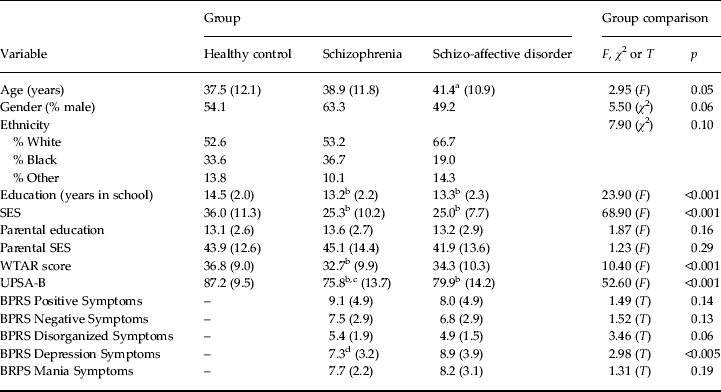
The schizophrenia and schizo-affective groups did not differ in age, personal socio-economic status (SES), parental SES, or education (see Table 1 for means, standard deviations and statistics). There was a higher proportion of men in the schizophrenia compared to the schizo-affective group (χ 2 = 3.90, p < 0.05), but no significant difference in gender between controls and either diagnostic group. On the Wechsler Test of Adult Reading (WTAR), the schizophrenia participants differed from controls, although there was no significant difference between the diagnostic groups. UPSA-B scores were lower for both patient groups compared to controls, and the schizophrenia group performed more poorly than the schizo-affective group. Those with schizo-affective disorder had higher depression subscale scores on the BPRS compared to schizophrenia but the two groups did not differ significantly on positive, negative or disorganization symptoms. Information on medication use is provided in the online Supplementary Table S1.
Clinical and demographic characteristics of the groups

SES, Socio-economic status; WTAR, Wechsler Test of Adult Reading; UPSA-B, University of California, San Diego (UCSD) Performance-based Skills Assessment – Brief; BPRS, Brief Psychiatric Rating Scale.
Values are given as mean (standard deviation) or percentage.
a Significantly different from control group (p < 0.05).
b Significantly different from control group (p < 0.01).
c Significantly different from schizo-affective group (p < 0.05).
d Significantly different from schizo-affective group (p < 0.01).
Cognitive task performance
DPX
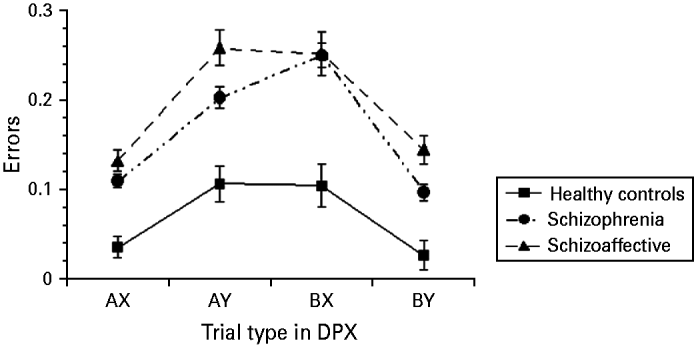
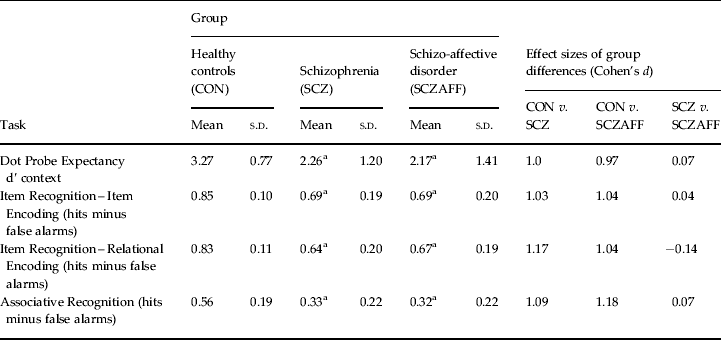
As shown in Table 2, an ANOVA with d-prime (d′) context as the dependent variable indicated a main effect of group (F 2,492 = 60.8, p < 0.001), but no significant main effect of study (F 1,492 = 0.544, p = 0.46) or group × study interaction (F 2,492 = 1.29, p = 0.28). Planned contrasts indicated that both the schizophrenia and schizo-affective groups had significantly lower d′ context scores than controls, but did not differ significantly from each other. An ANOVA with trial type as a within-subject factor (AX, AY, BX, BY) and group and study as between-subject factors (see Fig. 1) revealed a significant main effect of trial type (F 3,1476 = 107.1, p < 0.001) and a significant group × trial type interaction (F 6,1476 = 6.84, p < 0.001), but no interaction between group, trial type and study (F 6,1476 = 1.43, p = 0.198). Further analysis showed a significant group × trial type interaction when comparing controls and schizophrenia (F 3,1299 = 13.0, p < 0.001) and controls and schizo-affective disorder (F 3,957 = 4.06, p < 0.01), but no significant interaction between schizophrenia and schizo-affective participants (F 3,696 = 1.75, p = 0.156). The effect sizes for the group differences between controls and both schizophrenia and schizo-affective patients were very similar (Table 2). The controls showed similar error rates for BX and AY trials (Fig. 1), with the schizophrenia group showing more BX than AY errors (p < 0.05), although both error types were elevated compared to those of controls (p's < 0.05). The schizo-affective patients also showed elevated BX and AY error rates compared to controls (p's < 0.05) but, unlike the schizophrenia patients, they did not make more BX than AY errors. The schizo-affective group showed significant correlations between BX–AY error rate and disorganization (r = 0.33, p < 0.02) and negative symptoms (r = 0.28, p < 0.04), although these correlations were not significant in the schizophrenia group. Neither group showed a relationship with UPSA-B scores.
Performance on the Dot Probe Expectancy (DPX) task with number of errors for each of the four trial types (AX, AY, BX, BY). Error bars are standard errors.
Cognitive differences across diagnostic groups
s.d., Standard deviation.
a Significantly different from healthy controls (p < 0.001).
RISE
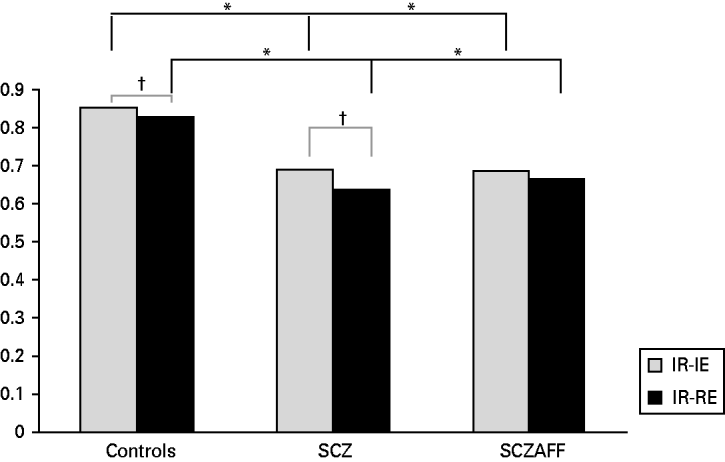
An ANOVA with accuracy (hits minus false alarms) as the dependent variable and encoding condition as a within-subject factor indicated a significant main effect of encoding condition (F 1,369 = 81.8, p < 0.001) and significant interactions for condition × group (F 2,369 = 10.2, p < 0.001) and condition × group × study (F 2,369 = 5.03, p < 0.01). For both studies (Fig. 2), both the schizophrenia and schizo-affective patients showed significantly impaired recognition performance compared to controls for both encoding conditions. In study 1, all three groups showed significantly worse recognition performance for items encoded in the relational compared to the item-encoding condition (p's < 0.01). The schizophrenia patients (p < 0.001) showed a significantly greater difference between item recognition for items in the relational versus item-encoding condition compared to controls. The same pattern was present for the schizo-affective patients but the difference from controls was not significant (p = 0.14). In study 2, only the schizophrenia patients and controls showed significantly poorer recognition performance for items encoded in the relational compared to the item-encoding condition (p's < 0.001); this was not seen in the schizo-affective patients (p = 0.75). The schizophrenia patients in study 2 again showed a significantly greater difference in performance between item recognition for items in the relational versus item-encoding condition compared to controls (p < 0.001). Thus, both patient groups showed significantly impaired item recognition performance compared to controls, but only the schizophrenia patients showed clear evidence of a relatively greater impairment in recognition of items following relational versus item encoding. Nonetheless, as shown in Table 2, the effect sizes for the group differences between controls and both schizophrenia and schizo-affective patients for each of the task conditions were very similar, and the effect sizes for differences between the schizophrenia and schizo-affective patients were very small.
Performance in both encoding conditions of the item recognition portion of the Relational and Item-Specific Encoding (RISE) task: IR-IE, item recognition – item encoding; IR-RE, item recognition – relational encoding; SCZ, schizophrenia; SCZAFF, schizo-affective disorder; * significantly different from Control values (p < 0.001); † significantly different (p < 0.001).
An ANOVA for associative recognition performance indicated a main effect of diagnostic group (F 2,369 = 60.2, p < 0.001), but no significant main effect of study (F 1,369 = 1.65, p = 0.20) and no significant group × study interaction (F 2,369 = 1.15, p = 0.32). Post-hoc analysis (Table 2) revealed significant difference between participants in both the schizophrenia and schizo-affective groups and controls, but not between the two patient groups.
JOVI
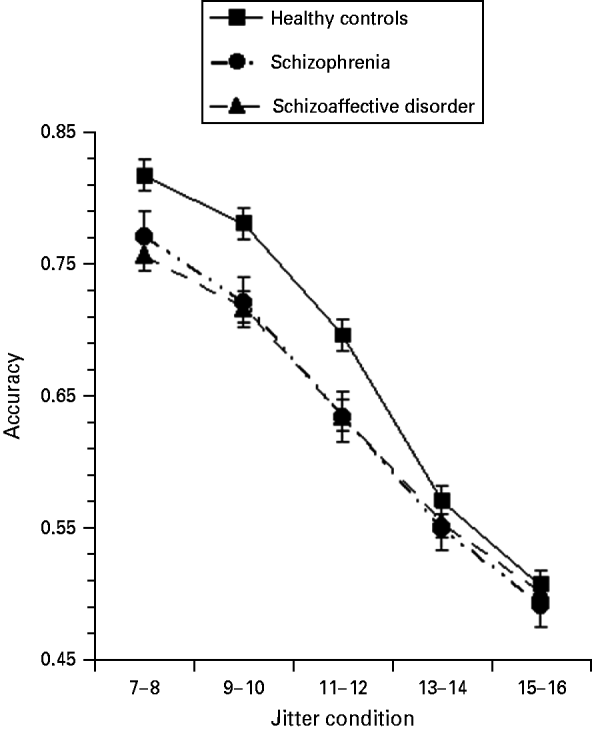
An ANOVA (see Fig. 3) on accuracy level data, with jitter condition as a within-subject factor, revealed a significant main effect of jitter condition (F 4,1312 = 479.2, p < 0.001) and a significant interaction of condition and group (F 8,1312 = 5.36, p < 0.001). However, the interaction of condition × group × study was not significant (F 8,1312 = 1.16, p = 0.33). Follow-up analysis indicated that both the main effects of group and the group × condition interactions remained significant when comparing the schizophrenia patients to the controls (p's < 0.05) and the schizo-affective patients to the controls (p's < 0.05). However, there was no significant main effect of group (F 1,141 = 0.02, p = 0.90) and no significant group × condition interaction (F 4,564 = 0.41, p = 0.80) when comparing the schizophrenia and schizo-affective groups. Because raw accuracy data can be confounded by motivational and attentional factors, we also fit the accuracy data across each jitter level with a sigmoidal (cumulative logistic) function that could vary in shape along three free parameters: threshold, slope (degree of sensitivity to the jitter manipulation), and upper asymptote (assumed to reflect primarily attention lapse errors), as recommended by Wichmann & Hill (Reference Wichmann and Hill2001). Threshold corresponds to the amount of orientation jitter needed to produce accuracy halfway between upper asymptote (typically near 1.0 proportion correct) and chance (0.50 proportion correct). The higher the threshold, the greater the jitter that can be tolerated, indicating better visual integration. Measured thresholds were 10.46° for controls, 9.58° for schizophrenia and 8.54° for the schizo-affective group. Significant threshold differences were not found between the two patient groups or between controls and schizophrenia; controls performed better than schizo-affective patients (p = 0.013).
Graph of mean accuracy scores across different jitter degree conditions of the Jittered Orientation Visual Integration (JOVI) task. Error bars are standard errors.
Schizo-affective disorder subtypes
We also examined whether dividing the schizo-affective group into bipolar and depressive subtypes altered the results. These results are presented in Table S2 and do not suggest consistent differences among subtypes.
Relationship between cognitive performance, symptoms and function
We looked at relationships between cognitive performance and positive, negative, disorganization, depression and mania factors from the BPRS (Ventura et al. Reference Ventura, Nuechterlein, Subotnik, Gutkind and Gilbert2000). These results are provided in Table S3. Consistent with prior literature, there were no relationships between cognitive performance and positive, depressed or mania symptoms. However, d′ context from the DPX was negatively correlated with both disorganization and negative symptoms with no interaction with group. We conducted similar analyses for the UPSA-B and the SLOF informant total score; the results of these regressions are shown in Table S4. UPSA-B scores were positively associated with d′ context from the DPX, item recognition for both relational and item encoding, and JOVI accuracy. SLOF informant reports were positively associated with d′ context from the DPX. As with symptoms, none of these relationships showed interaction with participant group. Detailed information and results on these comparisons are provided in the online Supplementary Material.
Discussion
The aim of the current study was to determine whether the use of disorder-relevant paradigms derived from cognitive neuroscience could reveal clear and interpretable evidence for different patterns of cognitive impairment across schizophrenia and schizo-affective disorder. We predicted that we would see similar patterns of impairment in the three domains. Furthermore, we predicted that worse cognitive performance in both diagnostic groups would be associated with greater negative and disorganization symptoms. The participants with schizophrenia were slightly more impaired on the general measures of cognition and function, including pre-morbid IQ and community function, although both patient groups had clearly impaired community functioning compared to controls. On the majority of the CNTRACS measures, the individuals with schizophrenia and schizo-affective disorder were impaired compared to controls and performed similarly, both qualitatively and quantitatively. Furthermore, we found generally similar relationships between cognitive function, clinical symptoms and functional capacity/outcome in both groups. However, there were a few specific differences between the diagnostic groups as discussed in the following sections.
Goal maintenance (DPX)
Although impairment on various measures of executive function in schizo-affective disorder has been reported (Fiszdon et al. Reference Fiszdon, Richardson, Greig and Bell2007; Heinrichs et al. Reference Heinrichs, Ammari, McDermid Vaz and Miles2008; Reichenberg et al. Reference Reichenberg, Harvey, Bowie, Mojtabai, Rabinowitz, Heaton and Bromet2009), prior research had not examined specific measures of goal maintenance. Both of the patient groups in the current study showed significant impaired d′-context performance compared to controls. Furthermore, both groups showed similar relationships between d′ context and both negative and disorganization symptoms, results consistent with prior work (Barch et al. Reference Barch, Carter, MacDonald, Braver and Cohen2003; Smith et al. Reference Smith, Barch and Csernansky2009; Jones et al. Reference Jones, Sponheim and MacDonald2010). In addition, both groups showed similar relationships between d′ context and both a proxy measure of function (UPSA-B) and informant reports of function (SLOF). However, the analysis of the individual error types did suggest some differences between the patient groups. Although both groups demonstrated significantly elevated BX errors compared to controls, only the individuals with schizophrenia showed significantly greater BX than AY errors, the pattern most consistent with impairment in goal maintenance. The schizo-affective patients showed equally high AY as BX errors, both in analyses of the group as a whole and when broken down by subtype. Thus, the schizo-affective patients showed greater evidence of a generalized deficit on top of difficulty with the representation and maintenance of context seen in both groups; such differential expression of deficit may be further parsed, however, depending on the presence of particular symptom complexes (i.e. disorganization and negativism) for the schizo-affective group.
Relational encoding and retrieval
The distinction between (and performance in) relational and item encoding has not previously been examined in schizo-affective disorder. In our study, both patient groups showed impaired relational encoding performance compared to controls. Furthermore, both groups were impaired on item recognition for items from both the relational and item-encoding conditions. Additionally, both groups showed similar relationships between item recognition for both item and relational encoding and a proxy measure of function (UPSA-B). Similar to our earlier findings in a subset of these participants (Ragland et al. Reference Ragland, Ranganath, Barch, Gold, Haley, MacDonald, Silverstein, Strauss, Yonelinas and Carter2012), only the individuals with schizophrenia showed evidence of relatively greater impairment on item recognition for relationally encoded items. The schizo-affective patients were equally impaired on item recognition for both encoding types. Thus, similar to the DPX results, schizophrenia patients showed somewhat greater evidence of a more specific deficit (greater impairment in relational encoding and retrieval) whereas the schizo-affective patients showed more evidence of a generalized deficit (equal impairment on all types of recognition).
Visual processing
To our knowledge, visual integration has not previously been examined in a separate group of schizo-affective patients [only in people with this diagnosis who were part of a mixed-diagnosis psychiatric control group of psychotic disorders other than schizophrenia (e.g. Silverstein et al. Reference Silverstein, Knight, Schwarzkopf, West, Osborn and Kamin1996; Uhlhaas et al. Reference Uhlhaas, Phillips, Mitchell and Silverstein2006)]. Examination of visual processing in our study also revealed similarities between the two disorders. On the JOVI, both patient groups were impaired on accuracy in performance compared to controls. This result held even when the schizo-affective subgroups were examined separately. Furthermore, both groups showed similar relationships between accuracy and the UPSA-B. These results suggest that deficits in visual integration are present to a similar degree in individuals with schizophrenia and in those with schizo-affective disorder.
In many ways, our results are consistent with several studies that have compared individuals with schizophrenia and schizo-affective disorders on batteries of neuropsychological tasks. As in previous studies (Abrams et al. Reference Abrams, Rojas and Arciniegas2008; Smith et al. Reference Smith, Barch and Csernansky2009; Kantrowitz & Citrome, Reference Kantrowitz and Citrome2011), we found that both individuals with schizophrenia and schizo-affective disorder were impaired compared to controls across several different cognitive domains and showed no significant differences from each other. However, we have significantly extended prior work by showing that this pattern was true for cognitive tasks designed to isolate specific cognitive deficits (i.e. goal maintenance, relational encoding and retrieval, visual integration) from generalized dysfunction. Thus, our data add to the growing literature suggesting more similarities than differences between schizophrenia and schizo-affective disorder and that the nosological distinction between these two disorders may not be valid. This interpretation is consistent with a growing body of research suggesting similar genetic and neurobiological contributions to these putatively different disorders (Abrams et al. Reference Abrams, Rojas and Arciniegas2008; Cheniaux et al. Reference Cheniaux, Landeira-Fernandez, Lessa Telles, Lessa, Dias, Duncan and Versiani2008; Heckers, Reference Heckers2009), although other work does suggest that there may be some unique genetic contributions to cases of mixed mood and psychotic symptoms (Craddock et al. Reference Craddock, O'Donovan and Owen2009).
Of note, the pattern of performance across these tasks suggests that, although both patient groups are clearly impaired and not significantly different from each other, there may be a slightly greater generalized deficit in the schizo-affective group compared to the schizophrenia group. It is important to emphasize that the ‘general’ or ‘specific’ nature of cognitive deficit does not refer to the severity of said deficit, but rather to the general or specific nature of the factors influencing the pattern of impairment. One speculative possibility is that the affective symptoms experienced more strongly by the schizo-affective patients, and/or the additional medications used to treat these, may add a level of generalized deficits such as diminished motivation or fatigue on top of any specific deficits in goal maintenance or relational encoding and retrieval associated with schizophrenia. However, we did not find any significant relationships between cognitive performance and depression or mania in our patient samples. Additionally, we found differences between patient groups in UPSA-B scores, although in the direction of somewhat better, albeit still impaired, performance in the schizo-affective group versus schizophrenia. This suggests that, although the UPSA-B has been found to relate to cognitive performance, it may be tapping into a facet of function that is somewhat less impaired in the schizo-affective patients, although it is not entirely clear why that might be, given the similar impairments of the diagnostic groups on the other cognitive measures. One possibility is that the assessment of telephone/communication skills and financial know-how in the UPSA-B measures somewhat more malleable skills other than the specific cognitive paradigms measured in this study (Vesterager et al. Reference Vesterager, Christensen, Olsen, Krarup, Melau, Forchhammer and Nordentoft2012). Additional work with even more clinically heterogeneous samples will be required to more clearly address the added contribution of affective symptoms to patterns of cognitive impairment.
There are several limitations to the current study. First, all of the patients were taking psychotropic medications. This could be influencing the pattern of cognitive deficits and may in some way have contributed to our findings of similar deficits across patient groups. Second, even though we had a very large sample of patients, the sample sizes for the subtypes of schizo-affective disorder were still relatively small. Thus, we may have missed important differences between subtypes that might have been apparent with the added power afforded by even larger sample sizes.
Overall, the results of our current study are most consistent with a pattern of similarity in cognitive performance in clinically relevant domains between schizophrenia and schizo-affective disorder. Thus, these diagnoses may not differ categorically in some of the major markers of dysfunction (particularly that of cognitive impairment), at least in patients at the level of symptom severity (mild-moderate) that we studied. As cognition is increasingly being understood as a major core feature of psychotic disorder and an important factor that affects overall symptom course, lack of major differences in cognition between schizophrenia and schizo-affective disorder furthers the idea that the two diagnostic categories are more similar than distinct.
Supplementary material
For supplementary material accompanying this paper, please visit http://dx.doi.org/10.1017/S0033291713000536.
Acknowledgments
We thank the staff at each of the CNTRACS sites for their hard work, and our participants for their time, energy and cooperation. This research was supported by National Institutes of Health (NIH) grants MH084840, MH084826, MH084828, MH084861, MH08482 and MH059883.
Declaration of Interest
Dr Owoso is currently supported by an NIH T32 Training Grant. Dr Carter has received research grants from the National Institute of Mental Health (NIMH), the National Institute on Drug Abuse (NIDA), the Robert Wood Johnson Foundation and Glaxo Smith Kline and has been an external consultant for Roche, Servier, Lilly, Merck and Pfizer. Dr Gold has received grants from NIMH, receives royalty payments from the BACS, and has consulted with Pfizer, Merck, AstraZeneca, Solvay and Glaxo Smith Kline. Dr MacDonald has received research grants from the NIMH. Dr Ragland has received research grants from the NIH, the National Alliance for Research on Schizophrenia and Depression (NARSAD) and the Robert Wood Johnson Foundation. Dr Silverstein has received research grants from NIMH, Pfizer and AstraZeneca. Dr Strauss has no currently active grant or contract support from private or public sources. Dr Barch has received grants from the NIMH, NIA, NARSAD, Allon, Novartis and the McDonnell Center for Systems Neuroscience.