Introduction
Eggplant (Solanum melangena Linnaeus; Solanaceae) is known as brinjal or “aubergine” in South Asia, Southeast Asia, and South Africa. India is one of the largest producers of eggplant in the world with 71 100 ha plantation and production around 56 300 tonnes (National Horticulture Board 2014). It is an important cash crop for poor farmers, who cultivate two or three crops per year. Farmers start harvesting fruits at about 60 days after planting and continue to harvest until 90–120 days after planting, thereby providing a steady supply of food for the family and stable income for most of the year. The major constraint for eggplant cultivation and production is the brinjal fruit and shoot borer, Leucinodes orbonalis (Guenée) (Lepidoptera: Crambidae), which is the most serious and destructive pest causing yield loss of 70–92% of the total production (Roy and Pande Reference Roy and Pande1994; Dhamdhere et al. Reference Dhamdhere, Dhamdhere and Mathur1995; Rahman Reference Rahman1997; Haseeb et al. Reference Haseeb, Sharma and Qamar2009).
Damage to the eggplant due to L. orbonalis starts in the nursery, and the first symptom of infestation is the appearance of wilted and drooping shoot (shoot damage). At the initial stage, when eggplant fruits have not yet developed, larvae bore into the tender shoots, feed inside, and then tunnel downwards, killing growing points in the process. Larvae also feed on flowers, reducing fruit set and yield. The damaged flower buds drop without blossoming and fruits show visible circular exit holes. The infestation continues until the last harvest is carried on in a subsequent season.
The management practices for control of L. orbonalis include the host-plant resistance, mechanical control, biological control, spraying sex pheromone, and insecticides. Insecticides such as bio-pesticides, botanicals, and chitin synthesis inhibitors have been evaluated against L. orbonalis (Chatterjee and Roy Reference Chatterjee and Roy2004; Sharma et al. Reference Sharma, Nagreta and Nath2004; Mishra and Dash Reference Mishra and Dash2007) and are being used in some regions of India besides the conventional insecticides. An average of 4.6 kg of insecticide (active ingredient) per hectare per season is sprayed on eggplant at a cost of US$179.60/ha; which is the highest quantity applied to any vegetable crop in India (Choudhary and Gaur Reference Choudhary and Gaur2009). Despite the application of insecticides the eggplant fruits sold in the market are still of inferior quality, because of the infestation of L. orbonalis larvae. This approach of increased dependence on pesticides and calendar-based sprays lead to higher costs of production but has not resulted in adequate control of the pest.
Although field management issues have been known for a long time, insecticide resistance in L. orbonalis has not been studied and reported. Ali (Reference Ali1994) reported resistance to pyrethroid insecticides in L. orbonalis in Bangladesh. Resistance to carbamate and pyrethroid insecticides in L. orbonalis was reported in two districts of Bangladesh by Rahman and Rahman (Reference Rahman and Rahman2009). Currently, information on insecticide susceptibility/resistance in Indian populations of L. orbonalis is scant, though insecticides belonging to different groups are being used on eggplant crop across India. The objective of our study was to study development of resistance in field-collected field populations of L. orbonalis to six conventional insecticides belonging to different groups: carbamate (carbaryl), cyclodiene (endosulfan), organophosphorus (chlorpyriphos and profenofos), and synthetic Pyrethroid insecticides (deltamethrin and fenvalerate).
Materials and methods
Insect rearing
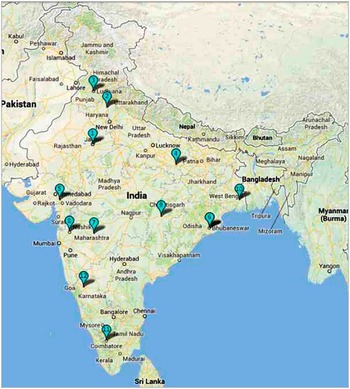
The study was carried out for two years during 2009–2010 and 2010–2011. The larvae (second and third instar) of L. orbonalis were collected from different locations in northern, central, and southern India, where brinjal is grown as a major crop (Fig. 1). The larvae collected from the field were reared on the modified semi-synthetic diet in the laboratory following standardised procedures at 25±1 °C, 65±5% relative humidity, and 9:15 (light:dark) photoperiod until pupation (Anand Reference Anand2003). Healthy pupae were stored in plastic vials (4 cm diameter and 5 cm height) with a filter paper disc at the bottom and a lid with a mesh window. The emerged adults were released in the sex ratio of 1:1 in the breeding cages (35 cm height and 15 cm diameter) containing purple paper and wire mesh for egg laying and fed with 10% honey solution and vitamins (Asian Vegetable Research and Development Center 1999). Eggs laid on the purple paper and wire mesh were transferred to plastic containers (9 cm height and 8 cm diameter) and were placed in an incubator at 28±1 °C. The neonates that emerged from eggs were allowed to develop until their third instar and used for insecticide assay. The laboratory susceptible colony used in the study was kept under laboratory conditions for 36 generations.
Leucinodes orbonalis study localities in India. Location names are followed by state name in parentheses or brackets. Northern India: 1 – Jaipur (Rajasthan), 2 – Karnal (Haryana), 3 – Ludhiana (Punjab), 4 – Varanasi (Uttar Pradesh). Central India: 5 – Anand (Gujarat), 6 – Bhubaneshwar (Orissa), 7 – Jalna (Maharashtra), 8 – Nasik (Maharashtra), 9 – Raipur (Chhattisgarh), 10 – 24 Parganas (West Bengal). Southern India: 11 – Coimbatore (Tamil Nadu), 12 – Dharwad (Karnataka).

Insecticides
The following technical grade insecticides were used for bioassays of L. orbonalis: carbaryl (90% w/w), chlorpyriphos (90% w/w), deltamethrin (90% w/w), endosulfan (94% w/w), fenvalerate (90% w/w), and profenofos (90% w/w). These insecticides were purchased from AccuStandard (New Haven, Connecticut, United States of America).
Assay procedure
Initially, the larvae of L. orbonalis were collected from Jalna, India considering its proximity to the laboratory and availability of infestation. This population was tested with different doses of each insecticide to establish the concentration range where mortality was between 10% and 100% and based on the results obtained seven to eight concentrations of each insecticide were fixed for the bioassays. One microlitre of acetone-based insecticide dilution was manually applied on the dorsal mesothorax of individual using a Hamilton syringe (Hamilton, Reno, Nevada, United States of America) starting from a lower to a higher concentration (Armes et al. Reference Armes, Jadhav and King1992). Third instars were used in the bioassays and the treated larvae were placed on fresh artificial diet in 25-well insect rearing trays at a temperature of 26±1 °C, humidity of 60±5% and 10:14 (light:dark) hours. At least three replicates with 10 larvae/concentration of each insecticide were used and a total of 210 insects were used per insecticide. Acetone alone was used in untreated control with three replicates. Larval mortality was assessed after five days of the topical application of the insecticide. Larvae were considered dead if they were unable to move in a coordinated manner when prodded with a blunt needle.
Data analysis
Data from the replicates were pooled and dose-mortality, LD50, and their fiducial limits were computed by probit analysis using POLO-PC (Finney Reference Finney1971). Resistance ratio (RR) was calculated using the following formula:
 $${\rm Resistance}\,{\rm ratio}\,\left( {{\rm RR}_{{50}} } \right){\equals}{{{\rm LD}_{{50}} \,{\rm of}\,{\rm the}\,{\rm field}\,{\rm strain}} \over {{\rm LD}_{{50}} \,{\rm of}\,{\rm the}\,{\rm susceptible}\,{\rm strain}}}$$
Results
Carbaryl
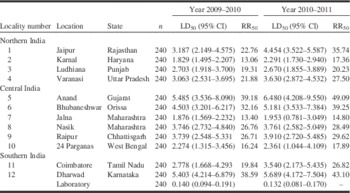
The LD50 values for the populations of L. orbonalis collected from different locations of India were between 1.829–6.480 μg/larva (Table 1). The highest LD50 value was observed in the population collected from Anand, India, and the lowest LD50s were from in the populations collected from Karnal and Jalna, India, during 2009–2010 and 2010–2011. The RR was found to be highest (39.18 and 49.09-fold) in the population collected from Anand and the lowest RR was observed in the population collected from Karnal, during 2009–2010 and 2010–2011 (Table 1).
Response of Leucinodes orbonalis larval populations to carbaryl during 2009–2010 and 2010–2011.

χ a , chi-square goodness-of-fit as determined using POLO-PC and departures from an expected model based on heterogeneity factor >1.0; CI, confidence intervals at 95% level; RR50, resistance ratio=LD50 value of population/LD50 value of susceptible (laboratory) population; n, total number of larvae used during the bioassay; LD, lethal dose expresses in µg/larva.
Chlorpyriphos
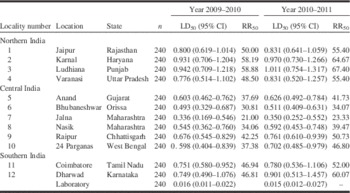
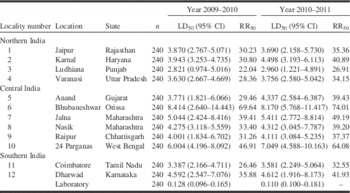
The assays with populations collected from Ludhiana, India exhibited the highest chlorpyriphos LD50 and the Jalna population exhibited the lowest LD50 during 2009–2010 and 2010–2011, respectively (Table 2). The populations of L. orbonalis showed varying levels of RRs in the chlorpyriphos assays during 2009–2010 and 2010–2011, respectively. The highest RRs (RR50) of 58.88 and 67.40-fold were observed in the population collected from Ludhiana, and the lowest RR was in the population collected from Jalna (Table 2).
Response of Leucinodes orbonalis larval populations to chlorpyriphos during 2009–2010 and 2010–2011.

χ a , chi-square goodness-of-fit as determined using POLO-PC and departures from an expected model based on heterogeneity factor >1.0; CI, confidence intervals at 95% level; RR50, resistance ratio=LD50 value of population/LD50 value of susceptible (laboratory) population; n, total number of larvae used during the bioassay; LD, lethal dose expresses in µg/larva.
Deltamethrin
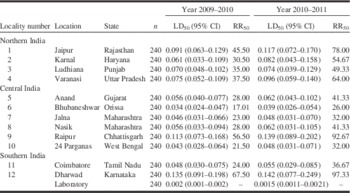
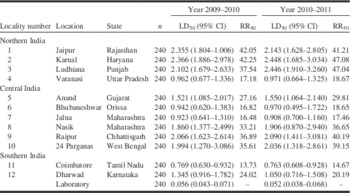
The LD50 values for different populations exposed to deltamethrin were between 0.034–0.135 μg/larva (Table 3). The maximum LD50 value of was observed in the assays done with the population collected from Dharwad, India. During 2010–2011, the LD50 values followed similar trends as observed during 2009–2010. During 2009–2010 and 2010–2011, the RR was highest for the population collected from Dharwad followed by populations collected from Raipur, Jaipur, and Varanasi, India (Table 3).
Response of Leucinodes orbonalis larval populations to deltamethrin during 2009–2010 and 2010–2011.

χ a , chi-square goodness-of-fit as determined using POLO-PC and departures from an expected model based on heterogeneity factor >1.0; CI, confidence intervals at 95% level; RR50, resistance ratio=LD50 value of population/LD50 value of susceptible (laboratory) population; n, total number of larvae used during the bioassay; LD, lethal dose expresses in µg/larva.
Endosulfan
During 2009–2010 and 2010–2011, the highest LD50 value was observed in the population of L. orbonalis collected from Bhubaneshwar, India, followed by assay results of populations collected from 24 Parganas, Jalna, and Dharwad, India (Table 4). The lowest LD50 value was observed in the assays with populations collected from Ludhiana, during 2009–2010 and 2010–2011. When the LD50 values were compared with the LD50 value of susceptible laboratory colony, the RR was found to be highest for the population collected from Bhubaneshwar, India (69.64 and 74.01-fold) followed by 24 Parganas, Jalna, and Dharwad, during 2009–2010 and 2010–2011, respectively (Table 4).
Response of Leucinodes orbonalis larval populations to endosulfan during 2009–2010 and 2010–2011.

χ a , chi-square goodness-of-fit as determined using POLO-PC and departures from an expected model based on heterogeneity factor >1.0; CI, confidence intervals at 95% level; RR50, resistance ratio=LD50 value of population/LD50 value of susceptible (laboratory) population; n, total number of larvae used during the bioassay; LD, Lethal dose expresses in µg/larva.
Fenvalerate
The bioassays with fenvalerate indicated that the RRs were in the range of 13.73–42.25 and 14.67–47.08-fold when the LD50s of field-collected populations were compared with LD50 of the laboratory population, during 2009–2010 and 2010–2011 (Table 5). During 2009–2010, the population from Karnal had the highest LD50 and the lowest LD50 value was observed in the population collected from Coimbatore, India followed by Jalna and Bhubaneshwar (Table 5).
Response of Leucinodes orbonalis larval populations to fenvalerate during 2009–2010 and 2010–2011.

χ a , chi-square goodness-of-fit as determined using POLO-PC and departures from an expected model based on heterogeneity factor >1.0; CI, confidence intervals at 95% level; RR50, resistance ratio=LD50 value of population/LD50 value of susceptible (laboratory) population; n, total number of larvae used during the bioassay; LD, lethal dose expresses in µg/larva.
Profenofos
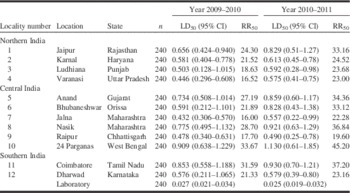
The highest LD50 value of profenofos was observed in the population collected from 24 Parganas and the lowest observed LD50 was in Jalna population (Table 6). The RR values were 16.0–33.67 and 22.28–45.20-fold higher when LD50 values of field-collected populations were compared with the LD50 of the laboratory colony (Table 6).
Response of Leucinodes orbonalis larval populations to profenofos during 2009–2010 and 2010–2011

χ a , chi-square goodness-of-fit as determined using POLO-PC and departures from an expected model based on heterogeneity factor >1.0; CI, confidence intervals at 95% level; RR50, resistance ratio=LD50 value of population/LD50 value of susceptible (laboratory) population; n, total number of larvae used during the bioassay; LD, lethal dose expresses in µg/larva.
Discussion
Understanding the susceptibility of insect populations to insecticides plays a key role in insecticide resistance management and for developing new strategies for pest control. Evolution of resistance to insecticides can drive the development and application of new chemical control measures in pest management. Although there are several studies that demonstrate field efficacy of against L. orbonalis, there are no reports available in literature on insecticide resistance in populations of L. orbonalis from India. Most commonly used insecticides in India, such as carbaryl, chlorpyriphos, endosulfan deltamethrin, fenvalerate, and profenofos were used in the assays of this study. The topical assays were conducted with populations collected during 2009–2010 and 2010–2011. The assay data of populations when compared with the susceptibility data of laboratory colony demonstrated RRs of 13–97-fold across insecticides. The RRs were higher than 40-fold in fenvalerate, deltamethrin, and chlorpyriphos assays done with populations from northern India. The higher levels of resistance in populations from northern India may be due to high use of pesticides in the northern states of Punjab, Haryana, Uttar Pradesh, and Rajasthan. The data on state-wise insecticide use in on eggplant are not available, but these four northern states accounted for more than 50% of national pesticide consumption, every year from 2005 to 2010 (http://ppqs.gov.in/PMD.htm). In a survey conducted in three intensively eggplant growing villages of Uttar Pradesh, it was observed that quinalphos, cypermethrin, and endosulfan are the most preferred insecticides by eggplant growers (Shivalingaswamy et al. Reference Shivalingaswamy, Rai, Wahundeniya, Cork, Ammaranan and Talekar2003). This survey is indicative of the fact that these groups of insecticides are most preferred among eggplant growers across northern India.
When the RRs were compared between the years 2009–2010 and 2010–2011, no shifts were observed in the assays conducted with carbaryl, chlorpyriphos, endosulfan fenvalerate, and profenofos. However, there was an increase in RRs of few populations in assays conducted with deltamethrin. This could be due to the fact that these populations may not have been collected from same physical location or the use of deltamethrin may have increased in these specific locations during past two to three seasons.
The assays clearly demonstrated that the L. orbonalis populations have decreased susceptibility to commonly used insecticides. Our study reported here is the first report from India that provides a comprehensive analysis of the susceptibility of L. orbonalis populations to commonly used insecticides. Ali (Reference Ali1994) reported resistance to pyrethroid insecticides in Helicoverpa armigera (Hübner) (Lepidoptera: Noctuidae) and L. orbonalis populations from Bangladesh and concluded that adequate control of L. orbonalis was not observed with pyrethroids due to their continuous use. Though no other information is available on insecticide resistance among populations of L. orbonalis in India, there are several published reports on insecticide resistance in polyphagous pests such as Helicoverpa armigera and Spodoptera litura (Fabricius) (Lepidoptera: Noctuidae). Resistance to endosulfan in populations of H. armigera was reported by Kapoor et al. (Reference Kapoor, Singh, Russell, Singh and Kalra2002), Ramasubramanian and Regupathy (Reference Ramasubramanian and Regupathy2004), and Bhosale et al. (Reference Bhosale, Suryawanshi and Bhede2008). In our study the assays with chlorpyriphos and profenofos demonstrated RRs of up to 63- and 40-fold, respectively, during 2009–2010 and 2010–2011. Similar observations were reported in by Chaturvedi (Reference Chaturvedi2004) in H. armigera populations. Field-collected populations of H. armigera also exhibited resistance to deltamethrin (Dhingra et al. Reference Dhingra, Phokela and Mehrotra1988; Kranthi et al. Reference Kranthi, Kranthi, Behere, Dhawad, Wadaskar and Banerjee2004; Ishtiaq et al. Reference Ishtiaq, Mushtaq, Saleem and Razaq2012) and fenvalerate (Venkataiah et al. Reference Venkataiah, Subrarathnam and Rosaiah1990; Lal Reference Lal1998; Borad et al. Reference Borad, Patel, Patel and Chavda2001). Resistance to insecticides such as was also reported in populations of S. litura by Rao and Dhingra (Reference Rao and Dhingra1996), Armes et al. (Reference Armes, Wightman, Jadhav and Rao.1997), Shafiq Ansari et al. (Reference Shafiq Ansari, Asif and Azizur Rahaman2002), Sahoo et al. (Reference Sahoo, Kapoor and Singh2007), and Venkateswarlu et al. (Reference Venkateswarlu, Madhumathi and Rao2005). These studies indicate that widespread resistance to these insecticides is prevalent in the insect populations.
In our study, a high level of resistance was observed to synthetic pyrethroids followed by Organochlorine. This may be due to proportionately heavy use of synthetic pyrethroids in eggplant. The results obtained from this study provide baseline information on susceptibility to some commonly used insecticides in eggplant. The information can be used for developing or modifying existing pest management modules in eggplant for effective management of fruit and shoot borer, which can be used with cultural practices, pheromone traps, and technologies such as Bt eggplant. Most importantly, it strongly suggests us that these insecticides need to be discouraged for pest management in eggplant.
Acknowledgements
The authors are thankful to the Chief Technology Officer, Mahyco Research Center, Jalna, for providing facility and resources to undertake this study.