Introduction
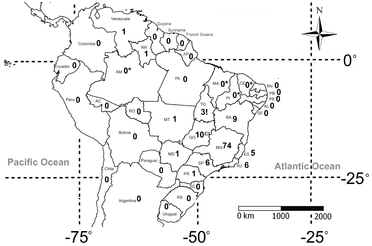
Barbacenia Vand. (Velloziaceae) is a Neotropical genus comprising approximately 100 currently accepted species from Brazil (Mello-Silva, Reference Mello-Silva2014, Reference Mello-Silva2015), with B. celiae Maguire also occurring in Venezuela (Miller & Berry, Reference Miller, Berry, Berry, Yatskievych and Holst2005; Funk et al., Reference Funk, Berry, Alexander, Hollowell and Kelloff2007: p. 178). The genus is most diverse in the campos rupestres, a vegetation mosaic associated with quartzite outcrops and most common in the Cerrado floristic province (Alves et al., Reference Alves, Silva, Oliveira and Medeiros2014b). The largest numbers of species of Barbacenia are known from Minas Gerais, Goiás and Bahia (Fig. 1), while none have previously been described from Tocantins.
Numbers of known species of Barbacenia in South America and the states of Brazil. Data for Distrito Federal (DF) were included in those for Goiás (GO). Asterisks indicate as-yet undetermined collections. AC, Acre; AL, Alagoas; AM, Amazonas; AP, Amapá; BA, Bahia; CE, Ceará; ES, Espírito Santo; MA, Maranhão; MG, Minas Gerais; MS, Mato Grosso do Sul; MT, Mato Grosso; PA, Pará; PB, Paraíba; PE, Pernambuco; PI, Piauí; PR, Paraná; RJ, Rio de Janeiro; RN, Rio Grande do Norte; RO, Rondônia; RR, Roraima; RS, Rio Grande do Sul; SC, Santa Catarina; SE, Sergipe; SP, São Paulo; TO, Tocantins.

Material and Methods
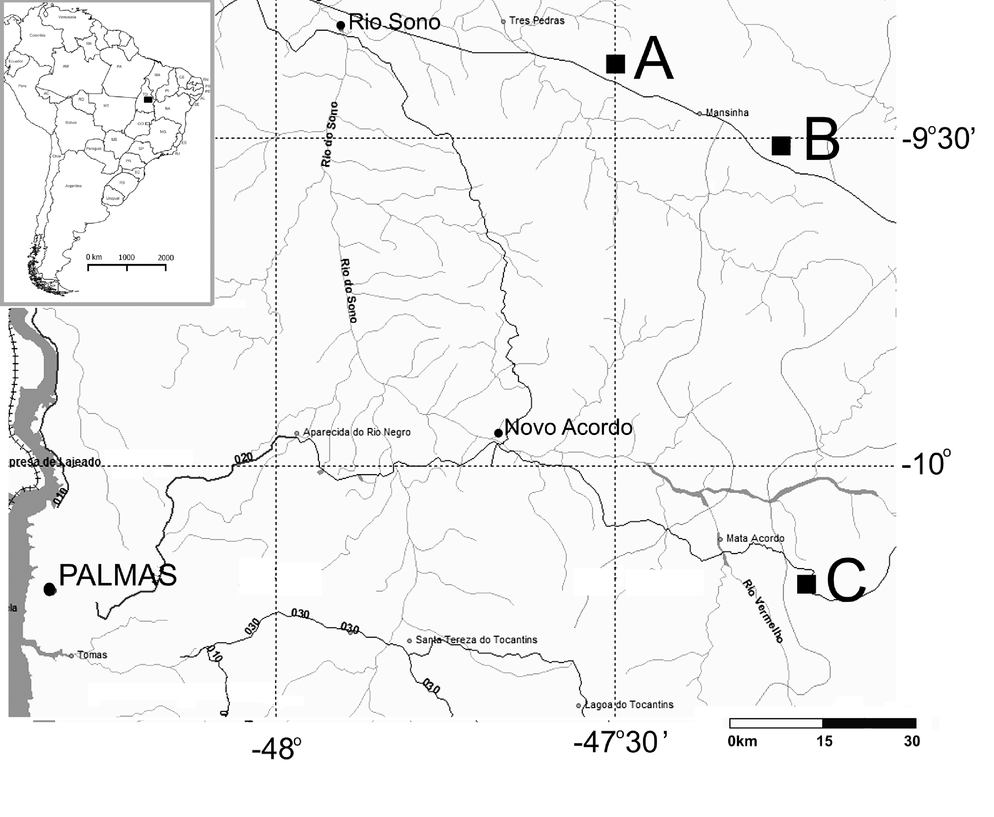
All three species of Barbacenia described herein were collected during a single expedition in April 2017 focused on open outcrop vegetation (Fig. 2). The recognition of their novelty is based on an extensive literature search (e.g. Smith & Ayensu, Reference Smith and Ayensu1976; Mello-Silva, Reference Mello-Silva, Milliken, Klitgård and Baracat2009, Reference Mello-Silva2015), examination of specimens (R, HUTO) and study of online voucher images from ALCB, BM, CEN, CEPEC, E, ESA, FLOR, HPL, HST, HTSA, HUEFS, HUESB, HUNEB, HURB, HVASF, INPA, IPA, MBM, MBML, MO, NY, SP, SPF, TEPB, UB, UEC, UFG, UFP and US (SpeciesLink, continuously updated; accessed 4 August 2017). Figure 1 was created in QGIS 2.18 by Tamara A. F. Vieira. Figure 2 was created in Trackmaker Pro and edited in the Corel Draw Graphics Suite X3 by Ruy J. V. Alves. Field photographs and morphology illustrations are by Ruy J. V. Alves. Alessandra R. Guimarães carried out the anatomical studies and provided the photographs and descriptions of the sections.
Collection sites of the three Barbacenia species described herein: A, B. arachnoidea; B, B. tocantinensis; and C, B. areniticola. For definitions of state abbreviations, see Figure 1.

Results
Barbacenia arachnoidea R.J.V.Alves & N.G.Silva, sp. nov.
Barbacenia arachnoidea differs from all known species in the genus by the curvature of the lateral sepals and petals, which confers on the flowers a slight bilateral symmetry during anthesis, and from B. areniticola (described herein) by linear, recurved petals and sepals and horizontally positioned flowers. – Type: Brasil, Tocantins, Município do Rio Sono, 09°23′23.74′′S, 47°29′33.01′′W, 9 iv 2017, R.J.V. Alves 12633, N.G. Silva & M. Lira (holo R [consisting of three plants, 2 fl., 1 fr.]; iso RB, HUTO). Figs 3, 4.
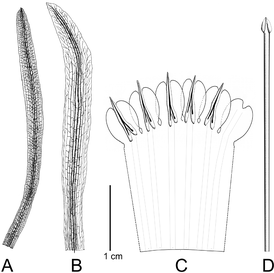
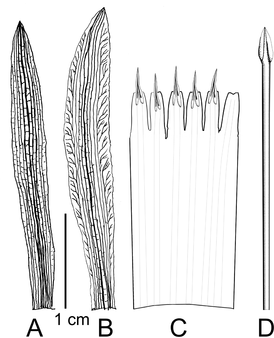
Barbacenia arachnoidea R.J.V.Alves & N.G.Silva. A, Flattened lateral sepal; B, flattened lateral petal; C, flattened corona showing anther insertion (the last anther was removed to reveal the shape of the lacinium); D, style with stigma. Drawn from R.J.V. Alves 12633, N.G. Silva & M. Lira (R) by Ruy J. V. Alves.

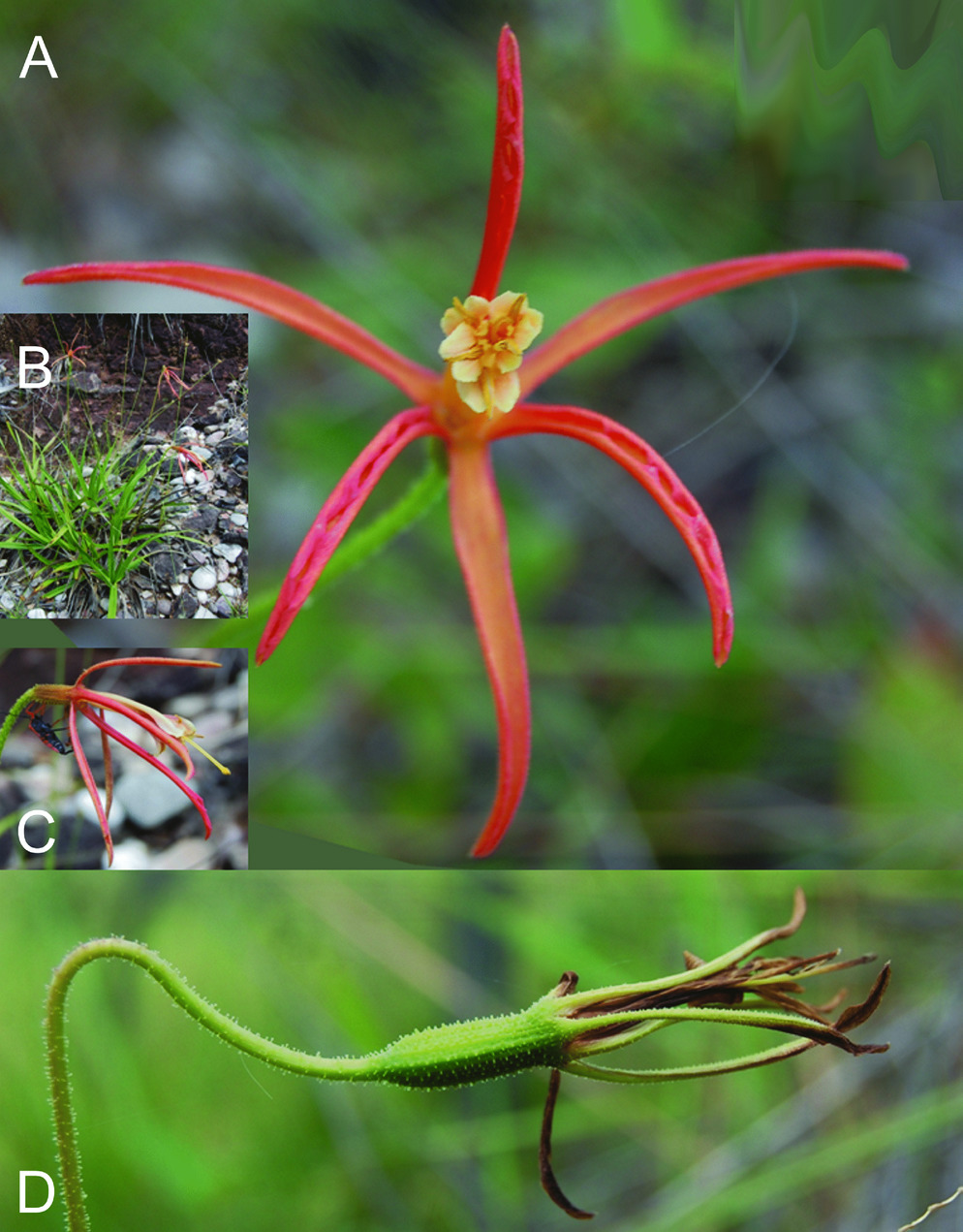
Barbacenia arachnoidea R.J.V.Alves & N.G.Silva. A, Frontal view of flower (note bilateral symmetry of lateral petals); B, flowering plant in habitat; C, lateral view of flower; D, detail of nodding distal portion of the pedicel of wilting flower. R.J.V. Alves 12633, N. G. Silva & M. Lira (R). (Photographs: Ruy J. V. Alves.)
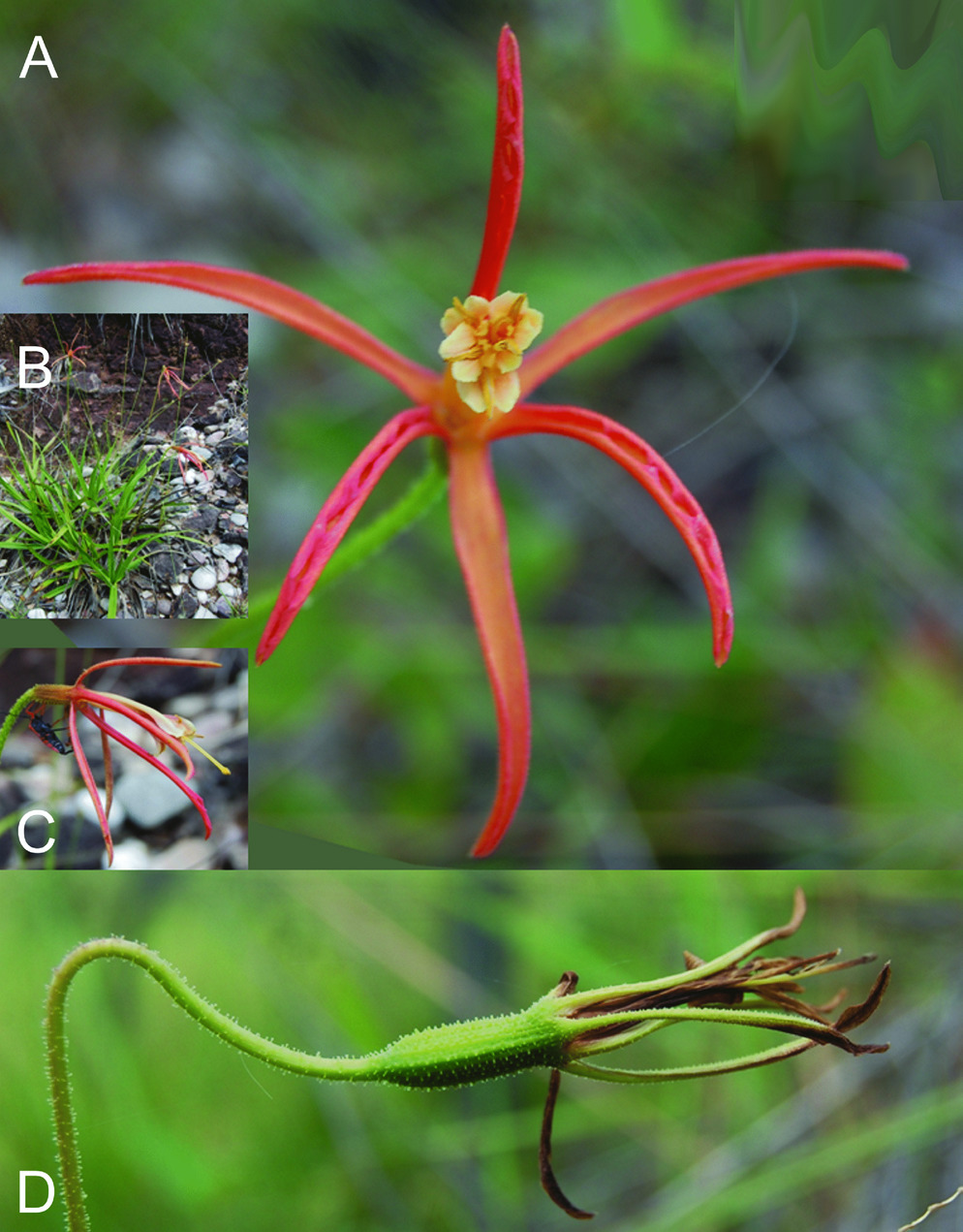
Erect cespitose plants. Caudices branched, c.5 cm tall. Leaves tristichous, linear-lanceolate, slightly arched, 18–30 cm long, 12–14 mm wide at base, abaxially keeled, midvein adaxially sunken, texture parchment-like, glabrous on both surfaces except for margins and keel which are obscurely serrulate at base to densely serrulate towards the acuminate apex, wilted blades reflexed and persistent, after blades are shed leaf sheaths 2.5 cm long with obtuse apices. Pedicels solitary in each rosette, 25–30 cm long, 2 mm in diameter, suberect with the apical 2–3 cm nodding, obscurely terete-trigonous, longitudinally grooved-costate, laxly vestite with short, hyaline, stalked-capitate projections. Flowers horizontal or nearly so, 45 ± 4 mm long, 55 ± 5 mm wide. Hypanthium oblong, slightly constricted near apex, terete-trigonous, 10–12 mm long, 3–4 mm wide, longitudinally 15-costate, light green to mauve, with short stalked-capitate, hyaline oil-resin glands in a single line along each costa. Ovary entirely fused with the hypanthium. Perianth in two whorls, soon involute and arched backwards, conferring an arachnoid aspect on the flower (each whorl consisting of one symmetric and two slightly asymmetric mirror-image curved petals and sepals), basally connate < 1 mm, linearly lanceolate, scarlet, in ageing flowers the sepals fleshy and turning green, sepals inferior and lateral (in contrast to orchids), canaliculately involute, 40 mm long, 2 mm wide when flattened out, with short hyaline stalked-capitate oil-resin glands sparse over entire abaxial surface, petals superior and lateral (in contrast to orchids), tubularly involute, the margins partly touching each other, 40 mm long, 3 mm wide when flattened out, abaxially with short hyaline stalked-capitate oil-resin glands sparsely distributed along the midvein. Corona forming a tube 30 mm long, trumpet-shaped, diameter 2.2 mm at base, 12 mm at apex, externally pinkish cream-coloured, coronal laciniae with superimposing margins and obcordate apices, 10 ± 2 mm long, 4 ± 1 mm wide, cream-coloured. Stamens 6, filaments entirely connate with the inner surface of the corona, anthers 8–10 mm long, recurved, basally thickened, attached 1–2 mm under the apices of the coronal laciniae, exserted 1 mm, thecae yellow, connetives cream-coloured. Style c.0.5 mm in diameter, cylindrical, yellow, c.40 mm long. Stigma exceeding anthers by 1.5 cm, 3-lobed, clavate, c.1 mm in diameter, lobes apically confluent, cream-coloured. Capsule oblong, 10 mm long, 5 mm wide, longitudinally costate, with 15 rounded longitudinal costae, dehiscing longitudinally between the costae. Seeds 1 mm long, linearly prismatic, numerous, angulous, with hyaline brown corrugated testae, black at one end.
Distribution
Known only from the type collection.
Habitat
Forming lax clumps in crevices of south-oriented outcrops of sandstone conglomerate near streamside.
Etymology
The epithet means ‘spiderlike’, referring to the slender, recurved tepals, resembling those of spider orchids such as Caladenia concolor Fitzg. or Cattleya sanguiloba (Withner) Van den Berg.
Barbacenia areniticola R.J.V.Alves & N.G.Silva, sp. nov.
Barbacernia areniticola differs from B. arachnoidea (described herein) by even slighter floral zygomorphy, forward-projected petals and sepals and semierect flower position during anthesis. – Type: Brasil, Tocantins, Município do Rio Sono, 09°30′54.14′′S, 47°15′30.27′′W, 9 iv 2017, R.J.V. Alves 12714, N.G. Silva & M. Lira, (holo R; iso RB, HUTO). Figs 5, 6.
Barbacenia areniticola R.J.V.Alves & N.G.Silva. A, Flattened upper sepal; B, flattened lateral petal; C, flattened corona showing anther insertion (the last anther was removed to reveal the shape of the lacinium); D, style with stigma. Drawn from R.J.V. Alves 12714, N.G. Silva & M. Lira (R) by Ruy J. V. Alves.

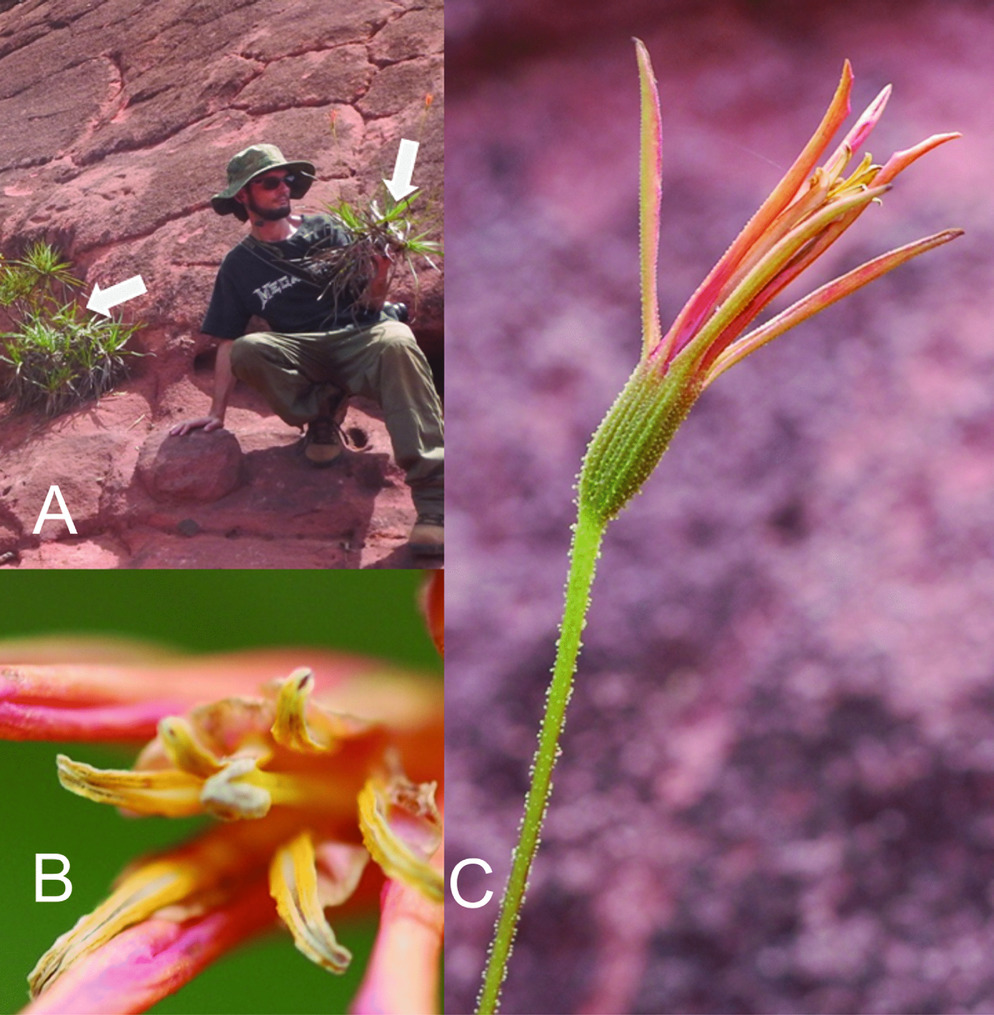
Barbacenia areniticola R.J.V.Alves & N.G.Silva. A, Flowering plant in habitat and being collected (arrows); B, frontal detail of corona with anthers, pedicel and stigma; C, lateral view of flower with part of pedicel. R.J.V. Alves 12714, N.G. Silva & M. Lira. (Photographs: Ruy J. V. Alves.)
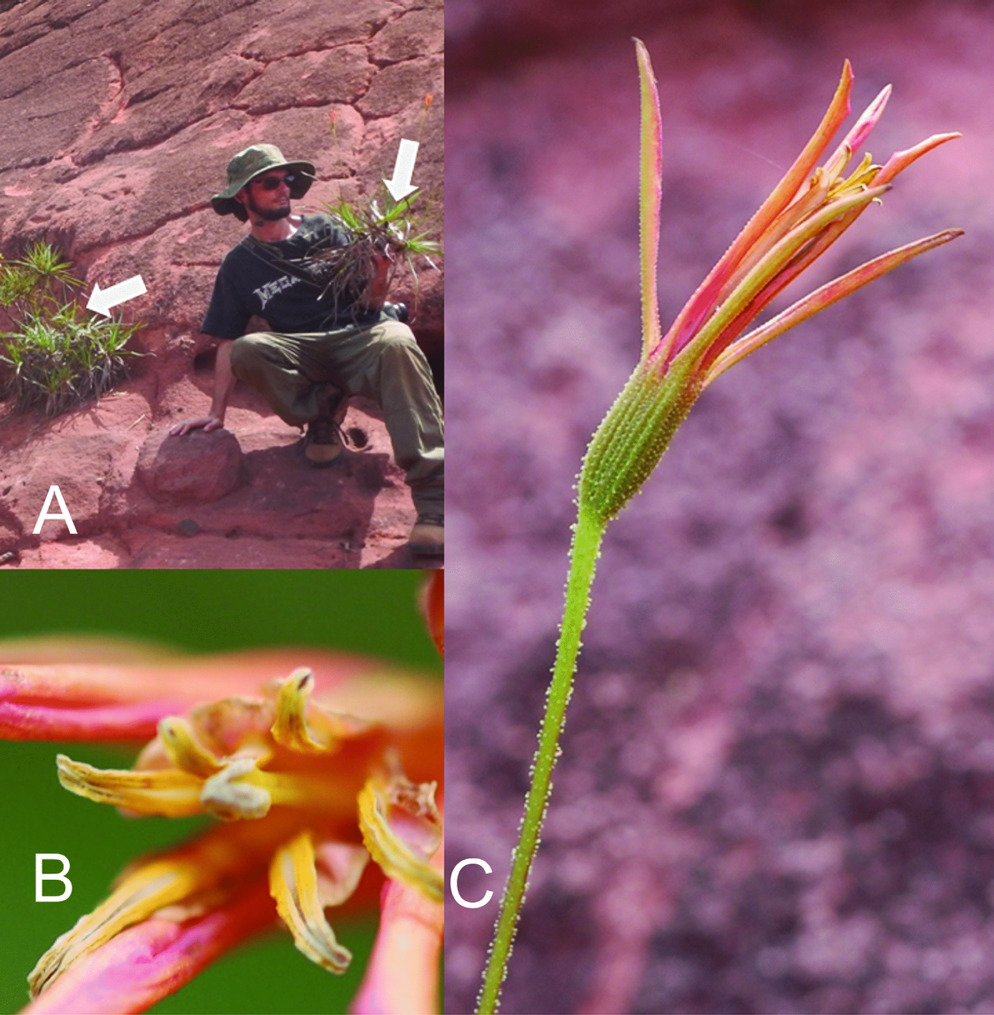
Erect cespitose plants. Caudices branched, c.25 cm tall. Leaves tristichous, linear-lanceolate, slightly arched, 7–30 cm long, 8–10 mm wide at base, abaxially keeled, midvein adaxially sunken, texture parchment-like, glabrous on both surfaces except for margins and keel which are obscurely serrulate at base to densely serrulate towards the acuminate apex, wilted blades reflexed and persistent, after blades are shed leaf sheaths 2 cm long with obtuse apices which divide into coarse fibers. Pedicels solitary in each rosette with the flowers pointing upwards, 25–30 cm long, 2 mm in diameter, suberect, obscurely terete-trigonous, laxly vestite with short, stalked-capitate oil-resin glands. Gland stalks conical, green, heads subspherical, hyaline. Flowers facing upwards or nearly so, 45 ± 4 mm long, 25 ± 5 mm wide, actinomorphic. Hypanthium oblong, terete-trigonous, 14–16 mm long, 3–4 mm wide, longitudinally 15-costate, light green, with short stalked-capitate, hyaline oil-resin glands in three lines along each costa. Ovary entirely fused with the hypanthium. Perianth in two distinct whorls, marcescent, the sepals persisting longer in the green state, the petals wilting sooner. Sepals straight, the lower one symmetric, the lateral ones slightly assymetric, canaliculately involute, diverging from axis by c.40°, fleshy, 33 mm long, 3 mm wide, adaxial surface yellow to green, with sparse short hyaline stalked-capitate oil-resin glands, abaxial surface glabrous, light orange. Petals straight, the lower one symmetric, the lateral ones slightly asymmetric, almost parallel and partly enclosing the corona base, tubularly involute with the margins partly touching each other, 37 mm long, 5 mm wide when flattened out, abaxially glabrous except for short hyaline stalked-capitate oil-resin glands distributed sparsely along the midvein, both surfaces bright orange. Corona forming a tube 25 mm long, 0.6 mm in diameter, yellow to mauve-coloured, laciniae broadly elliptic with superimposing margins, apex slightly retuse, 7 mm long, 5 mm wide. Stamens 6, filaments entirely connate with the inner surface of the corona, anthers 6–8 mm long, attached 1–2 mm under the apices of the coronal laciniae, exserted 2–4 mm, thecae yellow, connetives cream-coloured; Style c.0.5 mm in diameter, cylindrical, yellow, c.30 mm long. Stigma at same height as the anthers, 3-lobed, clavate, c.1 mm in diameter, lobes apically confluent, white. Capsule oblong, 10 mm long, 5 mm wide, longitudinally costate, with 15 rounded longitudinal costae, dehiscing longitudinally between the costae. Seeds 1.5 mm long, < 0.5 mm wide, triangular, numerous, angulous, with opaque brown corrugated testae.
Distribution
Known only from the type collection.
Habitat
Forming clumps in crevices of south-oriented sandstone cliffs.
Etymology
The specific epithet means ‘sandstone-dwelling’.
Barbacenia tocantinensis R.J.V.Alves & N.G.Silva, sp. nov.
Barbacenia tocantinensis is of unknown affinity and morphologically does not resemble any known species. The peltate stigma with three subhorizontally oriented lobes of this species resembles that typical of Vellozia Vand. rather than that of Barbacenia (viz. Menezes, Reference Menezes1971, Reference Menezes, Brickell, Cutler and Gregory1980; Mello-Silva, Reference Mello-Silva2005). However, leaf anatomy and the fully developed corona place this species securely within the former genus. – Type: Brasil, Tocantins, Município do Rio Sono, 10°10′58.76′′S, 47°121′53.72′′W, 13 iv 2017, R.J.V. Alves 12702, N.G. Silva & M. Lira (holo R). Figs 7, 8.
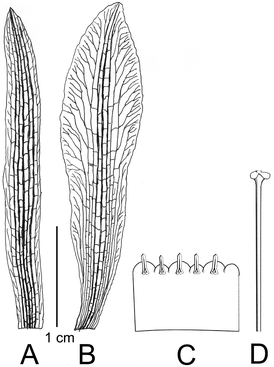
Barbacenia tocantinensis R.J.V.Alves & N.G.Silva. A, Flattened sepal; B, flattened petal; C, flattened corona showing anther insertion (the last anther was removed to reveal the shape of the lacinium); D, style with stigma. Drawn from R.J.V. Alves 12702, N.G. Silva & M. Lira by Ruy J. V. Alves.

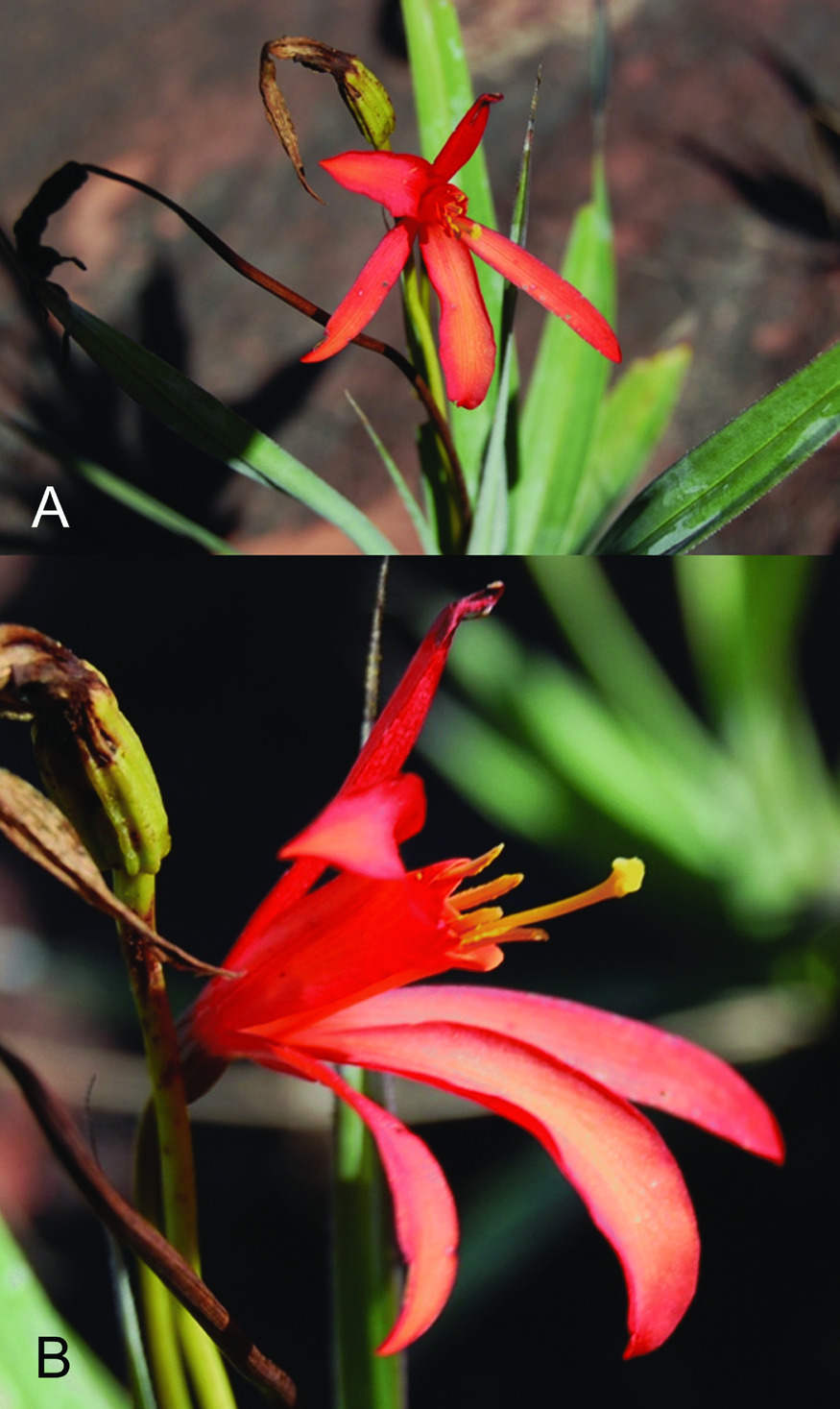
Barbacenia tocantinensis R.J.V.Alves & N.G.Silva. A, Frontal view of flower missing lateral sepal; B, lateral view of flower. R.J.V. Alves 12702, N.G. Silva & M. Lira. (Photographs: R. J. V. Alves.)
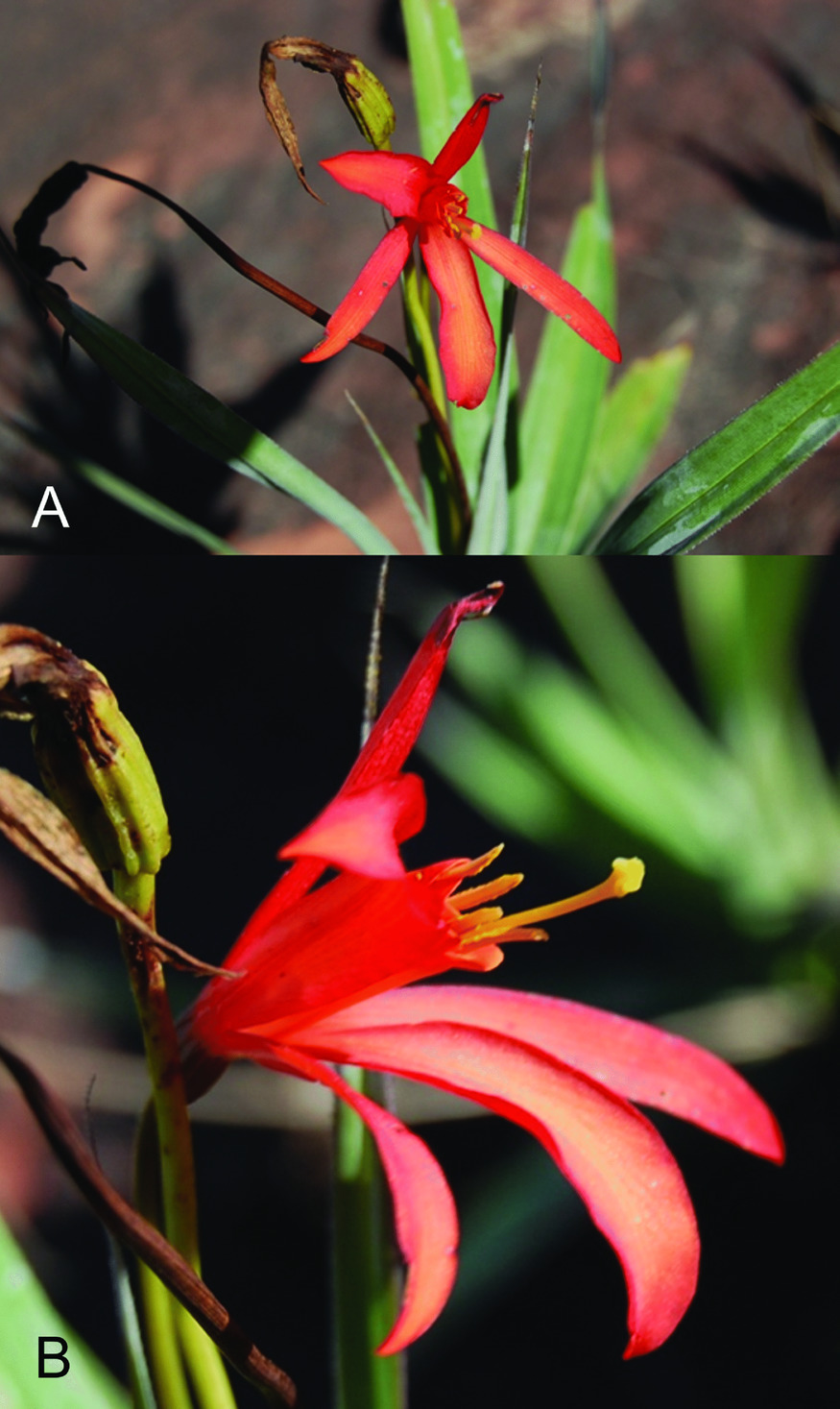
Erect cespitose plants. Caudices sparingly branched, c.5 cm tall. Leaves tristichous, linear-lanceolate, slightly arched, 10–17 cm long, 11 ± 1 mm wide at base, abaxially keeled, midvein adaxially sunken, texture parchment-like, glabrous on both surfaces except for sparsely serrulate margins, wilted blades reflexed and persistent, sheaths absent in material. Flowers three per rosette, opening in succession, pedicels suberect with apices nodding so the flowers are horizontal, 10 ± 1 cm long, 1 ± 0.5 mm in diameter, cylindrical, smooth and glabrous. Flowers 25 ± 5 mm long, 40 ± 5 mm wide, subhorizontally positioned. Hypanthium oblong, terete-trigonous, 10 mm long, 3–4 mm wide, longitudinally obscurely 15-costate, light green, glabrous. Ovary entirely fused with the hypanthium. Perianth in two distinct whorls opening broadly, superior sepal straight, remaining sepals and petals slightly recurved and involute. Sepals oblong, diverging from hypanthium by c.80°, fleshy, 34 mm long, 3 mm wide, crimson. Petals oblong, diverging from hypanthium by c.80°, fleshy, 34 mm long, 6 mm wide, crimson. Corona forming a tube 7 mm long, 7 mm in diameter, crimson, laciniae with elliptic apices, alternating lengths of respectively 2 mm and 1 mm. Stamens 6, filaments entirely connate with the inner surface of the corona, anthers 6–8 mm long, linear, partly exserted, yellow. Style c.< 0.5 mm in diameter, cylindrical, yellow, c.14 mm long, apically thickened. Stigma exceeding anthers by c.6 mm, 3-lobed, yellow, c.1.5 mm in diameter, lobes apically confluent, yellow. Capsule pronouncedly rounded–costate, glabrous.
Distribution
Known only from the type locality.
Habitat
Forming lax clumps in crevices of quartzite outcrops by streamside.
Etymology
The epithet honors the Brazilian state of Tocantins.
Comparative leaf anatomy
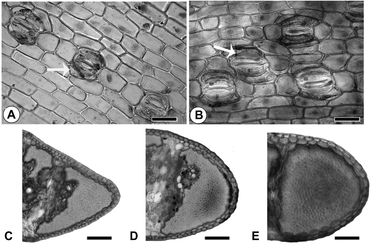
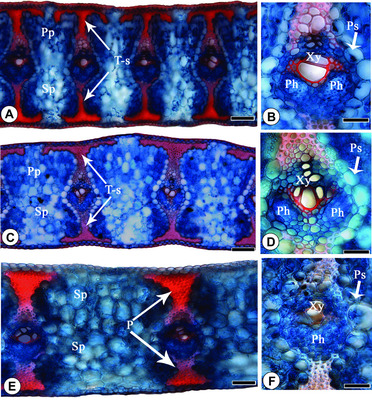
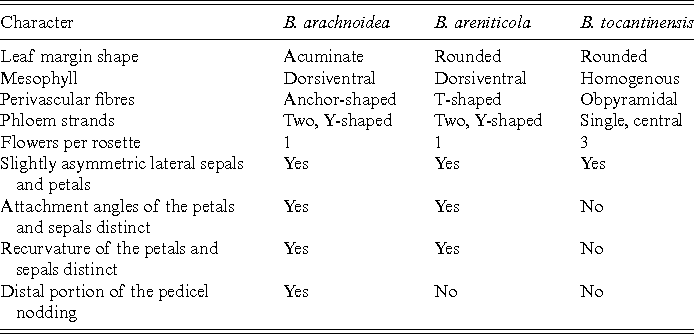
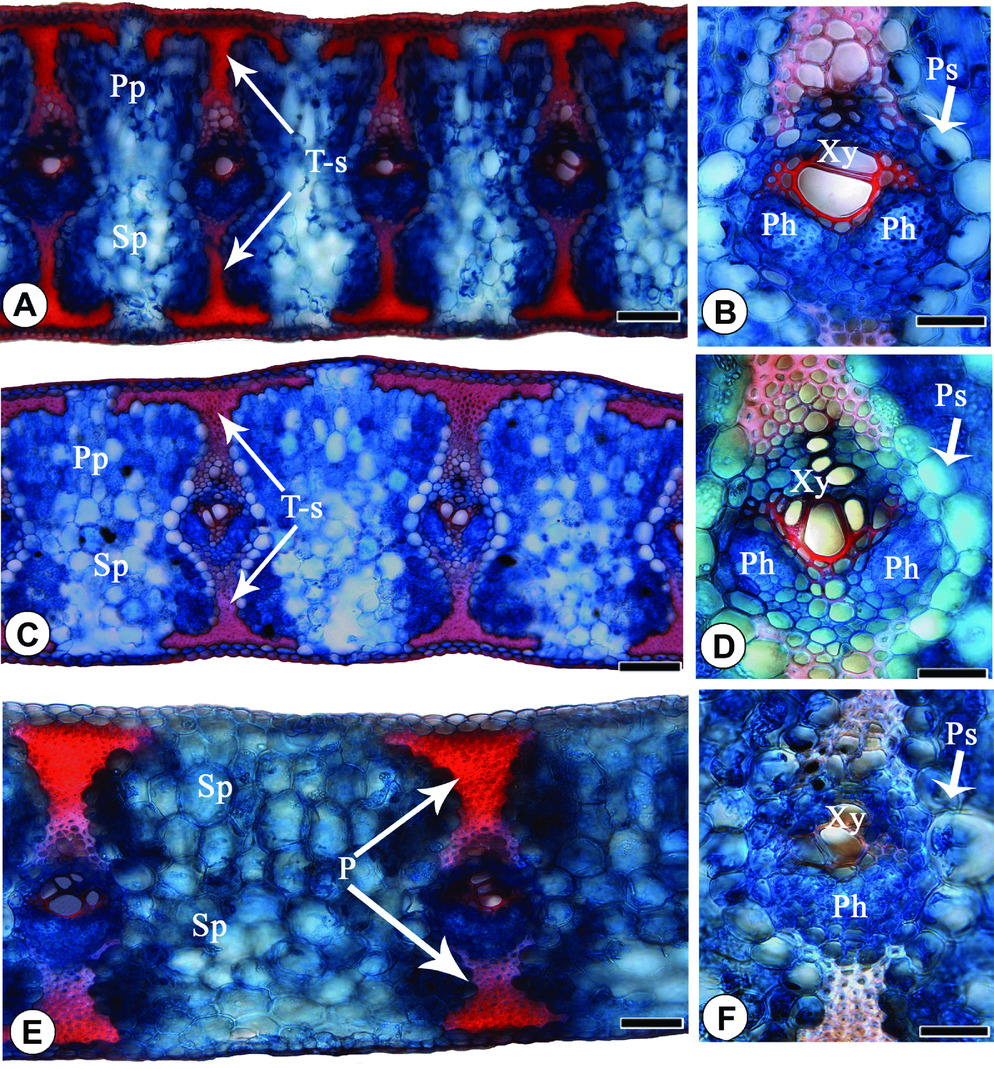
In frontal view, all three species have amphistomatic leaves with tetracytic stomata (e.g. Fig. 9A,B), occurring only along the intervascular intervals. In transverse section, the leaf margins are acuminate in Barbacenia arachnoidea and rounded in B. areniticola and B. tocantinensis (Fig. 9C, D and E, respectively). The epidermis is uniseriate on both faces with straight walls, with a thicker cuticle in Barbacenia areniticola and B. arachnoidea, in which the mesophyll is dorsiventral, consisting of three or four layers of palisade parenchyma and multiple layers of loosely arranged spongy parenchyma (Fig. 10A,C). In Barbacenia tocantinensis the mesophyll is homogenous, consisting of compactly arranged layers of spongy parenchyma (Fig. 10E). In Barbacenia arachnoidea and B. areniticola the vascular system is represented by collateral bundles with two Y–shaped phloem strands flanking the xylem (Fig. 10B,D), while in B. tocantinensis a single central phloem bundle subtends the xylem (Fig. 10F). The vascular bundles of all three species have a parenchyma sheath. Sclerenchyma caps are anchor-shaped in Barbacenia arachnoidea, T–shaped in B. areniticola and obpyramidal in B. tocantinensis, with inverted positions near the abaxial surface (Fig. 10A, C and E, respectively). For main distinctive anatomical features, see Table 1.
Frontal views of the leaf surfaces of Barbacenia arachnoidea with tetracytic stomata (arrows): A, adaxial; B, abaxial. Leaf margins in transverse section: C, Barbacenia arachnoidea; D, Barbacenia areniticola; E, Barbacenia tocantinensis. Scale bars: 10 µm. (Photographs: Alessandra R. Guimarães.)

Median transverse sections of leaf blades. A and B, Barbacenia arachnoidea; C and D, Barbacenia areniticola; E and F, Barbacenia tocantinensis. Dorsiventral mesophyll showing vascular bundles with anchor-shaped and T-shaped sclerenchyma caps (A and C, respectively) and homogenous mesophyll, the vascular bundles with obpyramidal adaxial and pyramidal abaxial sclerenchyma caps (E), details of vascular bundles surrounded by parenchyma sheaths with two Y-shaped phloem strands (B and D) and a single, central, phloem strand (F). P, pyramid-shaped sclerenchyma sheath; Ph, phloem. Pp, palisade parenchyma; Ps, parenchymatic sheath; Sp, spongy parenchyma; T-s, T-shaped sclerenchymal sheath; Xy, xylem; Scale bars: A, C and E, 50 µm; B, D and F, 10 µm. (Photographs: Alessandra R. Guimarães.)
Distinctive leaf anatomical and floral zygomorphy features of the three new species of Barbacenia

Discussion
In the field, when first sighted, the flowers of Barbacenia arachnoidea struck all botanists present as pertaining to orchids due to the somewhat zygomorphic position of the perianth segments and the well-developed labellum-like corona. It seems possible that, at least in Barbacenia arachnoidea, the corona together with the anthers may functionally emulate an orchid labellum during pollination.
The presence of late-developing petal appendages and corona were among synapomorphies proposed by Beaman (Reference Beaman1989; apud Brown & Terry, Reference Brown and Terry1992) to unite the Bromeliaceae and Velloziaceae as sister taxa, although this conclusion is not mentioned in a subsequent publication (Beaman & Judd, Reference Beaman and Judd1996). However, the coronal appendages in Bromeliaceae lack vasculature (Brown & Terry, Reference Brown and Terry1992), while branches of the perianth bundles partly supply the corona of Velloziaceae (Sajo et al., Reference Sajo, Mello-Silva and Rudall2010, and references therein).
Along with the reddish perianth colour, the absence of perceptible odours and the large tubular coronas of all three species suggest hummingbird pollination, corroborating Sazima (Reference Sazima1977), Sazima & Sazima (Reference Sazima and Sazima1978) and subsequent studies (R. Sadala-Castilho, Museu Nacional, unpublished data).
The clear differentiation of sepaline sepals and petaline petals, with distinct sizes and venation patterns, was not attributed to any Pandanales by Dahlgren & Clifford (Reference Dahlgren and Clifford1982). However, this differentiation is not at all uncommon in the Velloziaceae and occurs, for example, in Vellozia kolbekii R.J.V.Alves, V. auriculata Mello-Silva & N.L.Menezes and V. dracaenoides R.J.V.Alves & N.G.Silva (Alves, Reference Alves1992; Mello-Silva & Menezes, Reference Mello-Silva and Menezes1999; Alves et al., Reference Alves, Guimarães, Rezende, Braga, di and Silva2014a).
Barbacenia arachnoidea and B. areniticola have relatively similar leaf anatomical features, differing mainly by the shape of the leaf margins; their sclerenchyma caps somewhat resemble those of B. burle-marxii L.B.Sm. & Ayensu (Smith & Ayensu, Reference Smith and Ayensu1976) from Minas Gerais. The sclerenchyma caps in the leaves of Barbacenia tocantinensis somewhat resemble those of B. andersonii L.B.Sm. & Ayensu from Goiás.
The state of Tocantins (277,720.5 km²) comprised the northernmost part of Goiás until it was emancipated in 1988. The number of angiosperm species listed online for Tocantins are 2446 (Jardim Botânico do Rio de Janeiro, 2017) and 2311, with 1075 determined (SpeciesLink, continuously updated). New species are frequently being discovered in Tocantins (e.g. Mendes et al., Reference Mendes, de Souza and da Silva2017). Owing to the extension of its territory and the still limited collections, the flora of Tocantins requires extensive study. Only six determined species of Velloziaceae are listed for Tocantins, all within the genus Vellozia (Flora do Brasil, 2020 under construction). The occurrence of Barbacenia in Bolivia mentioned by Miller & Berry (Reference Miller, Berry, Berry, Yatskievych and Holst2005) refers to the allied Andean genus Barbaceniopsis.
Acknowledgements
We thank the Lira family for their extraordinary support with field logistics in Palmas, Rio Sono and Lizarda, and Tamara A. F. Vieira for help with confecting Figure 1. Coordenação de Aperfeiçoamento de Pessoal for the scholarship to R.S.