

Introduction
Grain legumes account for about 27% of the world's primary crop production and contribute 33% of the dietary needs of humans (Vance, Reference Vance2001). Of the total area of production, Africa produces nearly 8 million tonnes of grain legume seed from 17.7 million ha (FAO, 2000). In sub-Saharan Africa, agriculture is the most important enterprise and the key to the economic development of each country (Abate et al., Reference Abate, van Huis and Ampofo2000). FAO estimated a world dry pea seed production in 1999–2003 of about 10.5 million tonnes from 6.2 million ha. In Eritrea, over 2780 ha each year is allocated for the cultivation of field pea with a total production of 2025 tonnes (MoA, 2014).
Whole mature dried field pea grain contains water, protein, fat, carbohydrates, fibre, minerals and vitamins (Holland et al., Reference Holland, Widdowson, Unwin, Buss and McCance1991). In Eritrea, the dry seed of field pea is used as different forms of food. The grain is soaked in water to soften it and then it is boiled and consumed as a pulse. It is also consumed as roasted grain. The main dishes of field pea in Eritrea include ‘shiro’ (split pea seed ground and made into a stew), often used during the long fasting period of the Eritrean Coptic Church. Fresh green field pea seeds are also eaten raw. In Malawi and some Asian countries, the young shoots of field pea are used as a leafy vegetable. In Western countries, dry mature field pea seeds are mainly used as animal feed. The haulms or straw after threshing are used as forage for animals and also used in soil fertility restoration as a suitable rotation crop that fixes atmospheric nitrogen (Messiaen et al., Reference Messiaen, Seif, Jarso, Keneni, Brink and Belay2006). Field pea has high levels of the essential amino acids of lysine and tryptophan, which are usually low in cereal grains, and so the crop can supplement the low level of protein present in food and feed processed from cereal grains (Oelke et al., Reference Oelke, Oplinger, Hanson, Davis, Putnam, Fuller and Rosen1991).
According to the Food and Agriculture Organization of the United Nations (FAO, 1985) around 500 million people throughout the world suffer from malnutrition. Following the 2007–2008 global food crisis, the FAO (2000) estimated that, to feed the world's projected population in 2050, agricultural production should increase every year by an average of at least 1%. In addition, storage pests and lack of proper storage methods destroy over 200 million tonnes of grain each year. This illustrates that food shortages in our world can be solved, not only by increasing food production, but also by reducing food losses in storage.
Postharvest losses in food legumes cause the following: loss of nutrients in stored legumes, qualitative deterioration caused by contaminants or biochemical changes rendering legumes unfit for human consumption, loss of seed viability, and changes in taste. Grain storage pests (especially bruchids), can impose loss, principally through grain consumption and contamination with frass and uric acid (Salunkhe et al., Reference Salunkhe, Kadam and Chavan1985; Ahmed and Din, Reference Ahmed and Din2009). The most important bruchid species that contribute to seed damage and weight loss of grain legumes in Africa are the Mexican bean weevil Z. subfasciatus (B.) and the bean seed weevil Acanthoscelides obtectus (Say) (Silim and Ambrose, Reference Silim and Ambrose1993).
Zabrotes subfasciatus is one of the main pests of stored beans, causing qualitative and quantitative losses in grain and seed of legumes, mainly in the warmest regions of the world (Dendy and Credland, Reference Dendy and Credland1991). It sometimes attacks the seed of other legumes, including cowpea (Vigna unguiculata), in Uganda and West Africa. In Tanzania, it has been recorded as a storage pest of Bambara groundnut (Vigna subterranea). In India, it is recorded as a minor pest of Vigna sinensis and Pisum sativum. In Eritrea Z. subfasciatus is a major pest of field pea (Adugna et al., Reference Adugna, Dagnew, Biniam and Biniam2003).
There are many publications on different botanicals used in storage against different storage insect pests (Golob et al., Reference Golob, Moss, Dales, Fidgen and Evans1999). Plant products with insecticidal properties are becoming an attractive alternative to the synthetic, dangerous and more expensive chemical/synthesized insecticides used in many countries (Rajapkse et al., Reference Rajapkse, Senanayake and Ratnasekera1998). Botanical insecticides could provide an underutilized but more effective alternative; and plant-derived materials have the advantage that farmers can grow them at low cost and identify their potential toxicity, because most of them are used as local medicines. In addition, more complex preparations (such as combinations of several substances present in botanicals) are less likely to become ineffective because of the evolution of resistance (Regnault-Roger and Hamraoui, Reference Regnault-Roger and Hamraoui1993; Regnault-Roger et al., Reference Regnault-Roger, Hamraoui, Holeman, Theron and Pinel1993).
Worldwide, a minimum of about 10% of cereals and legumes are lost after harvest (Boxall et al., Reference Boxall, Brice, Taylor, Bancroft, Golob, Farrell and Orchard2002). Destruction of stored grains by insects is a serious problem mainly in developing countries of the tropics, due to favourable climatic conditions and poor storage structures (Kumar et al., Reference Kumar, Shukla, Singh, Singh and Dubey2009). In Eritrea, the germination loss due to the attack of pests on cereals and pulses ranges from 3 to 37% and 4 to 88%, respectively. Similarly, the weight loss for cereals ranges from 4.4 to 14% and for pulses from 9 to 29% (Adugna et al., Reference Adugna, Dagnew, Biniam and Biniam2003). To minimize the losses caused by storage pests, it is essential to study the nature of damage and losses caused by these pests. The search for alternative control methods and materials that are relatively cheaper and less harmful to the user and the environment has, therefore, become essential (Ani, Reference Ani2010).
This research was, therefore, initiated and conducted to: (i) estimate the weight loss and damage of field pea grain due to Z. subfasciatus pest, (ii) evaluate the efficacy of botanical pesticides and table salt on mortality of the adult pest, and (iii) estimate the effect of the botanical pesticides and table salt on germination of field pea seed.
Materials and methods
Preparation of insect free seed and mass rearing of insects
The biopesticidal effect of different plant materials and table salt was studied against the pulse beetle Z. subfasciatus at room temperature of 25 °C and 57% relative humidity at the Eritrean Institute of Technology (EIT). Prior to the study, infested field pea grain, which was not treated with any insecticide, was purchased from farmers in Senafe area. As adopted from Bekele (Reference Bekele2002), the infested grain was put in an oven at 60 °C for four hours to kill all or any storage pest present in the grain, but it was safe for germination of the grain. The insect-free field pea grain was allowed to cool for two hours at an ambient room temperature of 20–25 °C before being used for the study.
Bruchid-infested grain was purchased from the market in Asmara to be used as a source of infestation. To obtain newly emerged Z. subfasciatus beetles of the same generation, 50 pairs of adult bruchids were placed in five glass jars (volume of each jar was 3 litres). In each jar, 2 kg pest-free field pea grain was placed prior to the infestation of the bruchids. The parent beetles were allowed to mate and lay eggs and then were removed 13 days after oviposition. The jar containing the grain was kept at 25 °C in an incubator until emergence of first filial (F1) progeny. The newly emerged bruchid beetles were used for the investigation.
Collection and preparation of plant materials and table salt
Five botanicals (which are less toxic and easily available) and table salt (Table 1), were selected and used for the study. Plant parts (leaf and seed) were collected from natural habitats between September and November 2014. Collection of plant parts was mostly done before noon, to avoid loss of active substances of the plant parts. Leaves of Eucalyptus globulus were collected from Digsa near Segeneity and seeds of Azadirachta indica were collected from Hamelmalo Agricultural College campus. Seeds of Datura stramonium were collected from Mai-nefhi campus. Mature Capscium frutescens fruit and Sesamum indicum oil were purchased from the market in Asmara. The identity of the plant species was confirmed at the EIT biology department herbarium, by comparing them with the already collected specimens. All the collected plant materials were dried for 25 days under shade to avoid loss of active ingredients. After being well dried, the plant materials and table salt were crushed to a fine powder using a mortar and pestle. The resulting powders were sieved using a 0.25 mm mesh sieve, to obtain a fine dust to be used for the study.
Botanical, local and common names, parts of plants, and rate used in the study against Zabrotes subfasciatus in field pea grain at room temperature of 25 °C and 57% relative humidity

Experiment on the management of Zabrotes subfasciatus (B.)
An experiment that consisted of seven treatments was conducted in a completely randomized design (CRD) with three replications. Insect pest-free field pea grain weighing 2 kg was placed in a plastic jar with a capacity of 3 litres. The grains in each glass jar were treated with the respective treatments and rates (Table 1), and three jars that contained untreated grains were used as the control. Each test material was admixed thoroughly and gently in the containers manually until the materials were evenly distributed among the grains, to ensure a homogeneous mixture.
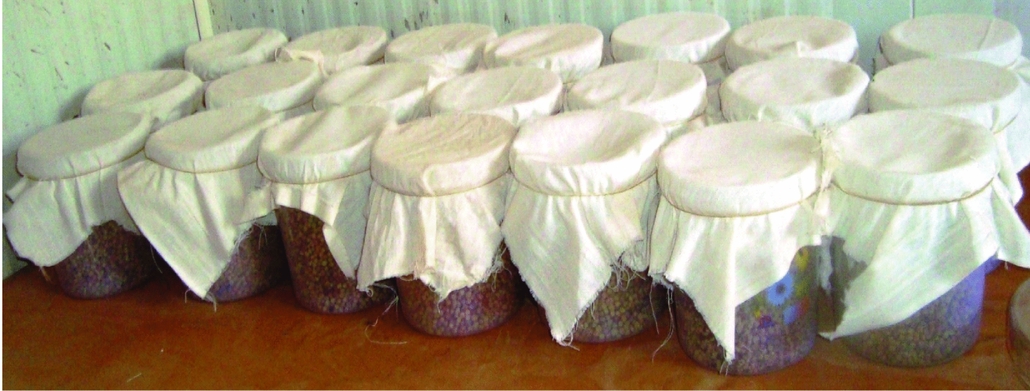
Next, each jar was infested with 20 pairs of newly emerged adult bruchids. Finally, the glass jars were tightly sealed with a muslin cloth and rubber band to prevent the infested insects from escaping from the jars, while allowing enough aeration to the storage pests.
Weight loss and grain damage assessment
Loss assessment was done using the count and weight method as adopted by Gwinner et al. (Reference Gwinner, Harnisch and Mück1996). To determine the rate of grain damage, samples of 100 grains were taken at random from each jar. The number of damaged (grains with characteristic exit hole of Z. subfasciatus) and undamaged grains were counted and weighed every 30 days starting from December to April (five months). Percent weight loss was calculated using the method adapted by FAO (1985b) cited in (Tesfu, Reference Tesfu2011):
 $$\begin{eqnarray*}
{\rm{Percent}}\;{\rm{loss}}\;{\rm{in}}\;{\rm{weight}} \\
\quad = \frac{{{\rm{(Wu}} \times {\rm{Nd)(Wd}} \times {\rm{Nu)}}}}{{{\rm{Wu}} \times {\rm{(Nd}} \times {\rm{Nu)}}}} \times 100
\end{eqnarray*}$$
Where, Wu = weight of undamaged grains, Nu = number of undamaged grain, Wd = weight of damaged grain, and Nd = number of damaged grains.
Germination test assay
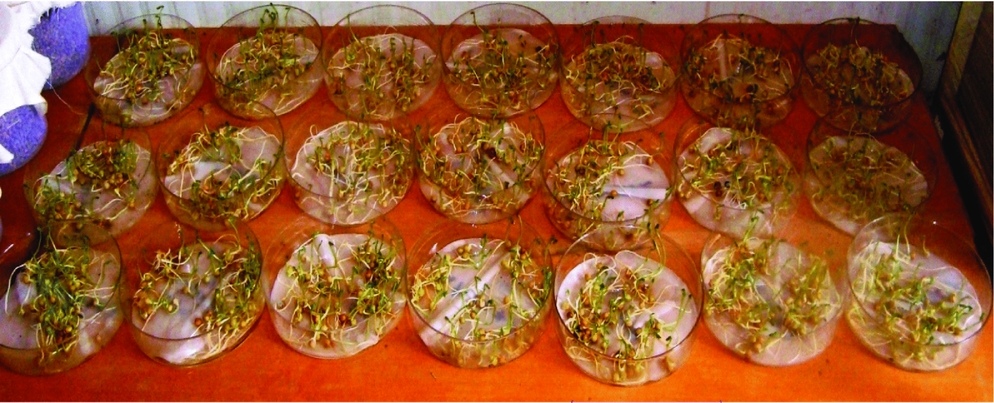
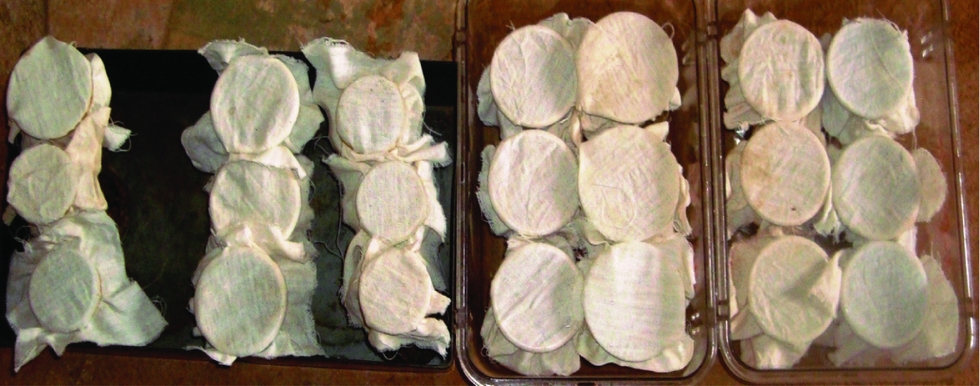
For the seed germination test, 50 seeds of damaged and undamaged grains of composite were taken at random from each container and put in Petri dishes containing moistened filter paper (Fig. 1). The Petri dishes were kept moist and then after seven days the numbers of emerged seedlings in each Petri dish was counted and percent germination computed using the following formula:
 $$\begin{eqnarray*}
{\rm{Germination}}\;{\rm{Percentage}} \\
\quad= \frac{{{\rm{Number}}\;{\rm{of}}\;{\rm{germinated}}\;{\rm{seeds}}}}{{{\rm{Total}}\;{\rm{number}}\;{\rm{of}}\;{\rm{seeds}}}} \times 100
\end{eqnarray*}$$
Grain damage assessment.

Toxicity assessment
An admixture toxicity study was conducted to assess the effect of different treatments on mortality of adult Z. subfasciatus. To achieve this, healthy disinfested field pea grain seeds (100 g) were placed in half litre volume vials and treated with 3 g of each test plant and table salt powders. Untreated grains were used as the control. After treatment application, 12 newly emerged Z. subfasciatus were introduced to each vial of the treated and untreated grains. Each vial was covered with muslin cloth and held in place with a rubber band. The experiment was designed in a CRD in three replications. Mortality was checked one, two and three days after treatment. The vials were emptied onto a plastic sheet to count live and dead insects (an insect was considered dead if it did not move the antenna or the legs when touched twice with tweezers) and then percentage insect mortality was calculated using Abbott's formula (Abbott, Reference Abbott1925):
 $$\begin{equation*}
{\rm{Corrected}}\;\% \;{\rm{mortality}} = (1 - {\rm{Nt}}/{\rm{Nc}}) \times 100
\end{equation*}$$
Where: Nt = number of insects in treated jars, Nc = number of insects in control jars
Data analysis
Data entry and analysis were done using Microsoft Excel and SPSS Version 15, respectively. To observe the effects of treatments on percent mortality, percent weight loss, percent germination and percent grain damage of field pea grain, a one-way analysis of variance (ANOVA) was carried out. When a significant difference was observed, the means were separated using the Student–Newman Keuls test at a 5% level of significance.
Results
The effect of some botanicals and table salt on weight loss of field pea due to infestation of Z. subfasciatus
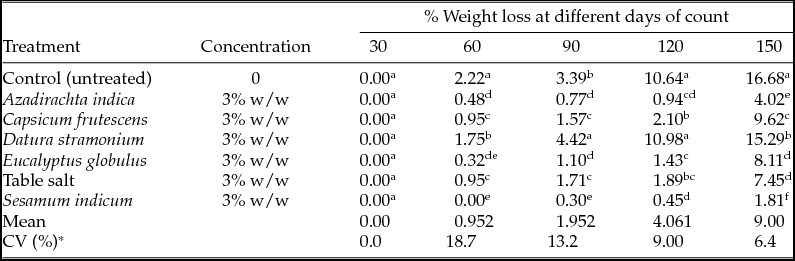
Results on assessment of percent weight loss caused by infestation of Z. subfasciatus to treated and untreated field pea grains are given in Table 2. There was no significant weight loss after one month of grain storage among the treatments used. In the second month of storage, the weight loss of field pea ranged from 0 to 2.22%. The highest weight loss was recorded in the untreated control followed by datura, red pepper, table salt and eucalyptus treated grains. Minimum weight loss was observed in sesame oil and neem treated grains. During the third month of storage the weight loss due to the beetle ranged from 0.30 to 4.42%. The highest weight loss was recorded from jars treated with datura followed by the control. The rest of the treatments gave significantly lower grain damage (P < 0.05). Sesame oil treated jars had the lowest grain damage followed by neem. Weight loss recorded during four months of storage ranged from 0.45 to 10.98% with a mean loss of 4.06%. Higher weight loss was recorded from jars treated with datura (10.98%) and the untreated control (10.64%). All the remaining treatments gave lower grain weight loss compared to the control. The lowest weight losses were recorded from treatment of sesame oil and neem with a loss of 0.45 and 0.98%, respectively. Similarly weight loss taken five months after treatment ranged from 1.81 to 16.68% with a mean loss of 9%. Significantly, lower weight loss was observed from jars treated with neem (4.02%). Maximum grain weight loss was recorded in the untreated control (16.68%) followed by datura (15.29%). Grains treated with red pepper had a weight loss of 9.62, eucalyptus 8.11% and table salt 7.45%.
Mean percentage weight loss caused by Zabrotes subfasciatus on field pea grains admixed with some plant materials and table salt at different storage periods

*CV = Coefficient of Variance; ANOVA followed by Newman–Keul's test performed; different superscripts in the column indicate significant difference at P < 0.05 levels.
Starting from the second month of the study, all the treatments except datura had significantly (P < 0.05) reduced weight loss of the field pea grain compared with the control. The lowest weight loss was observed from treatments of sesame oil followed by neem. The result of the study showed that the mean weight loss increased from 0 to 9% as the storage period increased.
The effect of some botanicals and table salt on grain damage of field pea due to infestation by Z. subfasciatus
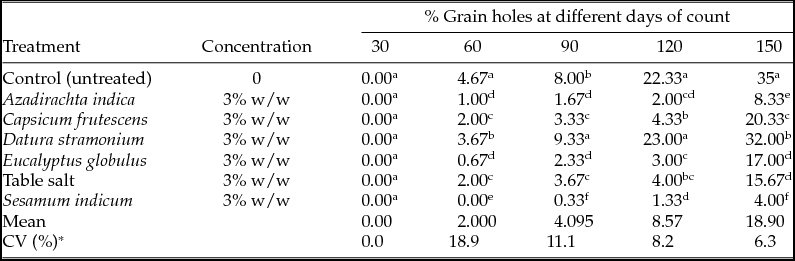
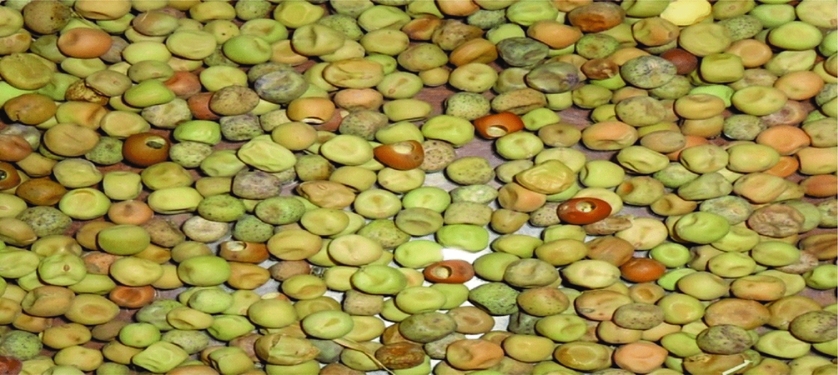
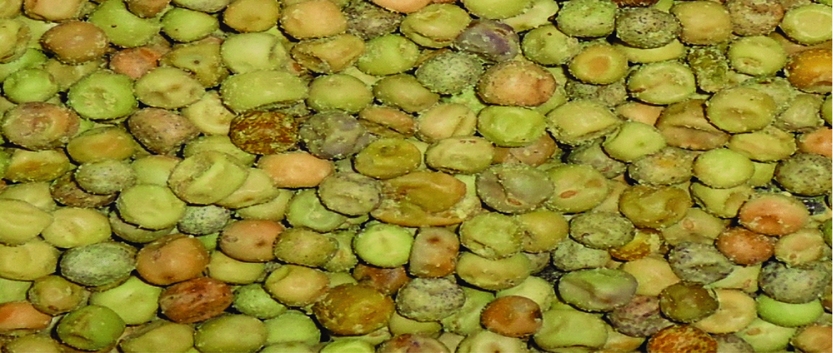
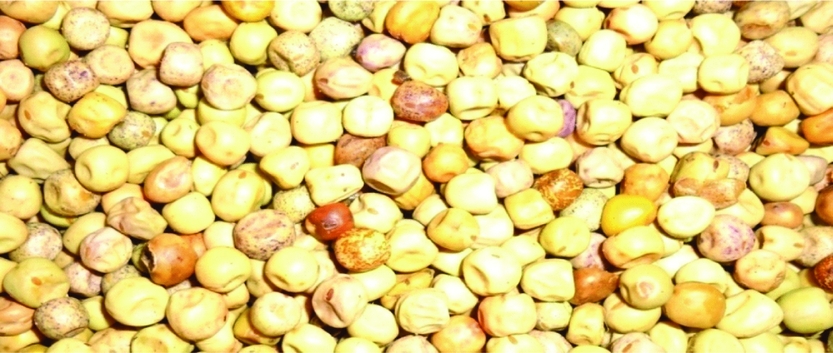
Results on assessment of percent grain damage caused by infestation of Z. subfasciatus to treated and untreated field pea grains are given in Table 3. No grain damage was recorded during the first month of storage in all the treatments used. At the end of the second month, the grain damage ranged from 0 to 4.67% with a mean of 2%. The highest number of grain holes was recorded in the untreated control (4.67%) followed by datura (3.67%). Red pepper, table salt and eucalyptus gave significantly lower percentage damage (P < 0.05). The least number of grain holes was observed in treatments of sesame oil with 0% loss and neem (1%) loss. During the three-month storage period after treatment, grain damage ranged from 0.33 to 9.33% with a mean of 4.095%. The highest level of grain damage was recorded from Datura-treated jars (9.33%) followed by the untreated control (8%). The remaining treatments showed significantly less (P < 0.05) holes compared to the control. Red pepper and table salt failed to show a significant difference in percentage of holes. Similarly, eucalyptus and neem did not give a significant difference in percentage of holes, but both treatments gave a significantly lower (P < 0.05) percentage of holes than red pepper and table salt. Sesame oil gave a significantly lower (P < 0.05) percentage of holes than all the treatments used. Results taken after four months of treatment showed grain holes ranged from 1.33 to 23% with a mean of 8.57%. The highest level of grain damage was recorded from datura (23.0%) treated jars followed by the untreated control (22.33%). Red pepper showed 4.33% grain holes, table salt 4% and eucalyptus 3%. The minimum number of grain holes was observed in sesame oil (1.33%) and neem-treated grains (2%). Similarly, data collected after five months of storage showed that the grain damage ranged from 4 to 35%. Minimum grain damage was observed in jars treated with sesame oil (4%) and neem (8.33%) treatments. Maximum grain damage was observed from the untreated control (35%) followed by datura (32%), red pepper (20.33%), eucalyptus (17%) and table salt (15.67%). The study on grain hole damage showed that the control and datura had significantly higher (P < 0.05) percent grain damage than all the treatments used. The lowest grain damage was recorded from sesame oil followed by neem in all the data collection months (Figs. 2, 3 and 4). In addition the study showed that the mean percent of damage increased with the increase of the storage period from 0 to 18.90%.
Mean percent grain damage caused by Zabrotes subfasciatus on field pea grains admixed with some plant materials and table salt at different storage periods

*CV = Coefficient of Variance; ANOVA followed by Newman–Keul's test performed; different superscripts in the column indicate significant difference at P < 0.05 levels.
Untreated field pea seeds after five months of storage.

Azadirachta indica treated field pea seeds after five months of storage.

Sesamum indicum treated field pea seeds after five months of storage.

The effect of some botanicals and table salt treatments on germination of field pea seeds (Fig. 5)
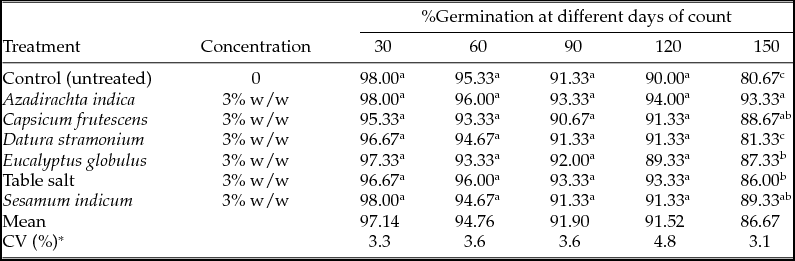
Percent germination of field pea seeds treated with different botanicals and table salt and untreated control are presented in Table 4. There was no significant difference in percentage germination among the different treatments used during the first four months of the study period. However, in the fifth month there were significant differences among the different treatments used. The percentage germination varied from 80.67 to 93.33% with a mean of 86.67%. The highest percentage germination was recorded from jars treated with neem and the least germination was observed from the untreated control. As the storage time increased, mean percentage germination decreased from 97.14 to 86.67%.
Germination test.

Effect of some botanicals and table salt on germination percent of field pea grains during different storage periods

*CV = Coefficient of Variance; ANOVA followed by Newman–Keul's test performed; different superscripts in the column indicate significant difference at P < 0.05 levels.
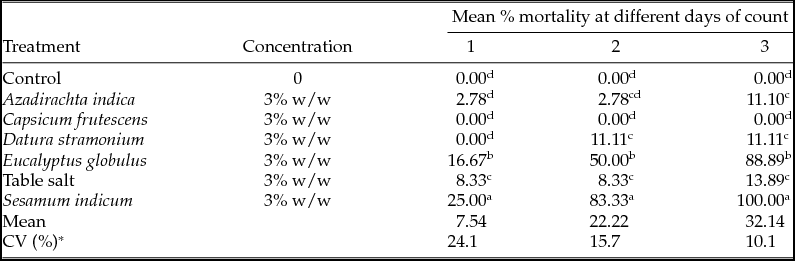
The effect of some botanicals and table salt on mortality of adult Z. subfasciatus (Fig. 6)
Percent mortality of adult Z. subfasciatus in field pea grain treated with different botanicals and table salt is given in Table 5. Compared to the untreated control, no significant mortality was recorded on adult Z. subfasciatus treated with neem, red pepper and datura one day after treatment. On the other hand, table salt, eucalyptus and sesame oil treatments gave significant (P < 0.05) percent mortality after one day of treatment. Data collected after two days of treatment showed that mortality varied from 0 to 83.33% with a mean of 22.22%. The lowest mortality was recorded from the control (0%) and red pepper (0%) followed by neem with 2.78%. Datura caused mortality of 11.11% and table salt 8.33%. Maximum mortality of Z. subfasciatus was observed in grains treated with sesame oil followed by eucalyptus. Results of treatment after three days showed no mortality in control and red pepper-treated grains. Treatments with neem, datura and table salt caused significantly higher mortality (P < 0.05) than the control and red pepper. Treatments of sesame oil and eucalyptus caused significantly higher mortality (P < 0.05) than the other treatments used.
Photograph of mortality test.

Mean mortality percent of pulse beetle (Zabrotes subfasciatus) on field pea grains treated with some botanicals and table salt for three days of exposure

*CV = Coefficient of Variance; ANOVA followed by Newman-Keul's test performed; different superscripts in the column indicate significant difference at P < 0.05 levels.
The highest mortality rates were observed on grain treated with sesame oil (100%) and eucalyptus (88.89%) at the rate of 30 g/kg of grain three days after treatment. The data also showed that the mean mortality increased as the exposure time increased from 7.54 to 32.14%.
Discussion
The laboratory grain storage study of field pea showed that there was no significant difference in grain damage in all the treatments after one month of storage. This could be due to the low pest population and the low temperature during the months of December and January. Similarly, Adugna (Reference Adugna2006) reported that there were no significant differences in the grain damage in all the trials and their respective treatments for up to two months of storage. However, after the second month of storage the pest population gradually increased causing more grain damage. This study showed that after five months of storage, significantly less (P < 0.05) weight loss was observed in the treatment with sesame oil (1.81%) followed by neem (4.02%). A similar report was given by Doharey et al. (Reference Doharey, Katiyar and Singh1990) who explained that sesame oil 0.5 % (w/w) applied to green gram reduced the number of eggs laid by C. maculatus F. and prevented F1 emergence. Like the present finding, neem at the rate of 8.3 kg per 100 kg beans showed few insecticidal properties while the milled seeds at 1.5 kg per 100 kg beans reduced storage pests significantly in the farm trials (below 10% damaged beans four months after application of treatments) (Paul, Reference Paul2007). Akou-Edi (Reference Akou-Edi, Schmutterer and Ascher1985) also investigated the repellency and anti-feedant effect of seed powder of neem on five species of stored product pests.
The effect of botanical pesticides and table salt on seed germination of field pea seeds revealed that no significant harmful effect was observed until the fourth storage month. On the fifth month, there was significant difference in the seed viability of the different treatments. The lowest germination rate was observed in the untreated control followed by datura-treated grains; thus, datura was found to be an ineffective botanical pesticide. In addition, the mean germination percent decreased with an increase in storage time; therefore, the difference in seed viability could be due to insect damage and not to the difference between treatments. This indicated that there was no adverse effect of the different treatments on the germination capacity of field pea seed.
The results of the present laboratory study demonstrate that different treatments show different potencies against Z. subfasciatus. Among the plant materials tested, eucalyptus leaf powder caused 88.89% mortality of Z. subfasciatus and sesame oil 100% mortality. Likewise Ali et al. (Reference Ali, Singh and Mishra1983) reported that sesame oil at 1 ml/100 g applied to green gram caused 100% mortality of adult C. chinensis L. within three days, and completely prevented egg laying and the emergence of F1 adults. Similar to the current finding, França et al. (Reference França, de Oliveira, Esteves Filho and de Oliveira2012) found that E. globulus oil caused 100% mortality of Z. subfasciatus at the rate of 0.5 ml/kg of Phaseolus vulgaris L. six days after treatment. Mulungu et al. (Reference Mulungu, Lupenza, Reuben and Misangu2007) also reported that a farmer in Uganda used a full basin of a mixture of dry eucalyptus leaves in layers with grain in a sack to keep the grain free of pests for a period of six months in a dry place under a leak-proof roof.
The present investigation also showed that table salt was effective in causing mortality of Z. subfasciatus and preventing grain damage; which could be because table salt might have affected the insects through desiccation. Red pepper was found comparably less effective, which is similar to the report of Javier and Morallo-Rejesus (Reference Javier and Morallo-Rejesus1986) who evaluated the effectiveness of C. frutescens on bagged rice and found it effective for no longer than two months. Datura was found even worse than the control in some of the storage periods, but unlike the result of the present study, Shaheen (Reference Shaheen2006) reported that dry leaf powder of datura applied at 3% w/w was efficient in inducing 100% mortality of C. maculatus five days after treatment. This could be because the plant parts have a different toxicity capacity or Z. subfasciatus could be resistant to it.
Law-Ogbomo and Enobakhare (Reference Law-Ogbomo and Enobakhare2007) reported that the insecticidal effect of plant powders may be attributed to properties such as repellency or a stomach poisoning effect, and these powders might reduce insect movement and also cause death through occlusion of their spiracles, thereby preventing respiration via the trachea.
Conclusion and recommendation
The current findings demonstrate that most of the botanicals and table salt tested possess insecticidal properties that can be used in the control of Z. subfasciatus in stored field pea grain. Among botanicals and table salt tested, sesame oil, neem seed powder and eucalyptus leaf powder are effective biopesticides for the management of Z. subfasciatus in storage of field pea at the rate of 30 g/kg of grain. These botanicals are cheap, easily available to farmers and generally safe for the environment, and are recommended for storage pest management.