INTRODUCTION
Resource use and overlap plays a central role in the structuring of vertebrate communities. The mechanisms by which organisms partition resources typically involve differentiation in some combination of habitat use (at both fine and coarse scales), timing of activity and diet. Differences in niche-breadth among competing species are ultimately the result of an evolutionary trade-off between the ability to exploit a wide base of resources and the efficient use of each one (Futuyma & Moreno Reference FUTUYMA and MORENO1988, MacArthur Reference MACARTHUR1972). Although species occur along a continuum of niche breadth, they are often considered simply as specialists or generalists (Clavel et al. Reference CLAVEL, JULLIARD and DEVICTOR2010, Julliard et al. Reference JULLIARD, CLAVEL, DEVICTOR, JIGUET and COUVET2006). These two resource acquisition strategies have been associated with important life-history traits: in general, specialists have lower dispersal capacities (Brouat et al. Reference BROUAT, CHEVALLIER, MEUSNIER, NOBLECOURT and RASPLUS2004), and are more susceptible to stochasticity and environmental change (Clavel et al. Reference CLAVEL, JULLIARD and DEVICTOR2010, Sol et al. Reference SOL, TIMMERMANS and LEFEBVRE2002) than generalists. As a consequence, resource specialists are typically more prone to extinction than generalists, and often the first species to be lost when habitats are modified (Boyles & Storm Reference BOYLES and STORM2007, Dunn et al. Reference DUNN, HARRIS, COLWELL, KOH and SODHI2009, Laurance Reference LAURANCE1991).
Sloths are mid-sized (2.0–4.5 kg) arboreal mammals that spend the majority of their time in forest canopies. The two phylogenetic groups of sloth, two- (Choloepus spp.) and three-toed sloths (Bradypus spp.), diverged roughly 18–40 Mya (Delsuc et al. Reference DELSUC, FRANÇOIS, STANHOPE and DOUZERY2001, Gaudin Reference GAUDIN2004), co-occur across much of their distributional range and are ecologically quite different (Pauli et al. Reference PAULI, MENDOZA, STEFFAN, CAREY, WEIMER and PEERY2014). Although both are arboreal folivores, previous authors have broadly described the two-toed sloth as a generalist, inhabiting a range of habitat types and consuming leaves from a number of species as well as augmenting their diet with non-leaf items (e.g. fruits, flowers and animal matter) and possessing large home ranges; the three-toed sloth is considered more specialized, foraging on only leaves from a small number of tree species to the point that individuals appear capable of surviving on a single or a few tree species (Chiarello Reference CHIARELLO, Vizcaíno and Loughry2008, Gilmore et al. Reference GILMORE, DA COSTA and DUARTE2001, Montgomery & Sunquist Reference MONTGOMERY, SUNQUIST, Golley and Medina1975, Reference MONTGOMERY, SUNQUIST and Montgomery1978; Pauli et al. Reference PAULI, MENDOZA, STEFFAN, CAREY, WEIMER and PEERY2014). Both two- and three-toed sloths use shade-grown agro-ecosystems (Vaughan et al. Reference VAUGHAN, RAMIREZ, HERRERA and GURIES2007) but in one well-studied system, only the two-toed sloth appears capable of maintaining self-sustaining populations in such habitats, while the three-toed sloth is only viable in the face of immigration from surrounding areas (Peery & Pauli Reference PEERY and PAULI2014).
Herein, we determined resource use and overlap for syntopic populations of two- (C. hoffmanni) and three-toed sloth (B. variegatus) in the same shade-grown agro-ecosystem where viability analyses were conducted (Peery & Pauli Reference PEERY and PAULI2014) to explore whether greater habitat and resource specialization by the three-toed sloth could be contributing to its relatively low viability in this altered landscape (Peery & Pauli Reference PEERY and PAULI2014). Specifically, we quantified tree use and macro-habitat selection for both two- and three-toed sloths across a range of different habitats present within the agro-ecosystem. We predicted that diversity of tree species used would be greatest in tropical forests, intermediate in shade-grown cocoa, and lowest in pasture for both species and that the three-toed sloth would exhibit stronger selection for patches of intact forest and greater avoidance of cattle pastures than the two-toed sloth.
METHODS
Study area
Fieldwork was conducted in and around a privately owned organic shade-grown cocoa (Theobroma cacao) farm, in north-eastern Costa Rica (10.32°N, 83.59°W; Figure 1). The region possesses a wet and warm climate featuring a rainy season from mid- or late-April to January, which is briefly interrupted by a dry period in August or September (Holdridge Reference HOLDRIDGE1967, Janzen Reference JANZEN1983). The study area occurs within an agricultural landscape that contains five habitat types: (1) cocoa trees grown under overstorey of native and non-native trees, (2) tropical forest occurring in narrow (~20 m) riparian buffers and small patches, (3) cattle pastures with scattered trees, (4) monocultures of cultivated crops, and (5) human development (i.e. housing) that border the study area. We used 2013 RapidEye satellite imagery (IntraSearch Inc.) with 5-m resolution and five-band multispectral imagery to visually digitize polygons representing these habitat types using ArcGIS 10.1 (ESRI, Redlands, CA, USA).
Capture locations of three-toed sloth (Bradypus variegatus) (n = 34; black circles) and two-toed sloth (Choloepus hoffmanni) (n = 35; grey circles) occurring in study area located in north-eastern Costa Rica from 2010–2013.

Animal captures
For this study we captured adult two-toed (n = 36) and three-toed sloths (n = 32), and subadult sloths (n = 4; n = 8, respectively) by hand from trees from February 2010 to January 2013. Captured individuals were classified as subadults or adults based on body mass described by Peery & Pauli (Reference PEERY and PAULI2014). Each individual was marked with uniquely coded PIT tags (Biomark, Boise, ID) inserted subcutaneously between the shoulder blades. Additionally, adult males of adequate size were fitted with radio-collars (Mod-210, Telonics Inc., Mesa, AZ, USA) to track their movement, and adult females were fitted with uniquely identifiable colour collars. All sloths were relocated every 1–10 d (with a minimum of 24 h between relocations) and the majority (98%) of all sloth relocations occurred during daylight hours.
Tree use
We classified tree use based on the tree species occupied by an individual at the time of relocation and proportion of species used was calculated for each sloth. Tree species were identified with aid of Zuchowski (Reference ZUCHOWSKI2007) and following the nomenclature of Hammel et al. (Reference HAMMEL, GRAYUM, HERRERA and ZAMORA2003). We used a likelihood ratio test for goodness-of-fit to compare tree use between the two sloth species. Using these data, we also characterized the diversity of tree species used by each individual and by all individuals pooled for each species with Simpson's index of diversity.
Habitat selection
We characterized second- and third-order habitat selection to identify habitat characteristics preferred by the two- and the three-toed sloth (Johnson Reference JOHNSON1980). Second-order habitat selection reflects the habitat features that individuals use to select the location of their home range, whereas third-order selection reflects the habitat features that individuals preferentially use within their home range. For this analysis, we only included individuals that had a minimum of 16 relocations and that were not dispersing from their home range. We estimated home ranges using 90% fixed kernel methods for 34 adult resident two-toed sloths (median = 64 relocations; range: 16–179) and 33 (n = 30 adults; n = 3 subadults) three-toed sloths (median = 50 relocations; range = 20–212). Home ranges were delineated using ESRI's ArcGIS 10.1 and the Geospatial Modelling Environment with least-squares cross-validation (LSCV) as the smoothing parameter (Millspaugh & Marzluff Reference MILLSPAUGH and MARZLUFF2001). To evaluate second-order habitat selection, we considered used habitat as the proportion of each habitat type in each sloth's home range. We treated available habitat as the proportion of each habitat type within the Minimum Convex Polygon (MCP) of all sloths relocations of a given species (i.e. pooled across individuals). Within the MCP, we calculated available habitat in two different ways: (1) as the proportion of all five habitats (cocoa, tropical forest, pastures, monocultures and human development) and (2) excluding the least-used habitats (monocultures and human development). Monocultures and human development habitats were excluded from the second analysis as sloths are predominantly observed in cocoa, tropical forest and cattle pastures, and rarely utilize monocultures or human development (Vaughan et al. Reference VAUGHAN, RAMIREZ, HERRERA and GURIES2007). To test for third-order habitat selection, we considered used habitat to be the proportion of relocations that occurred in each habitat. We quantified available habitat by generating random points within each sloth's home range (where the number of points was equal to the number of observed relocations) and calculated the proportion of locations occurring in each habitat type. We used Manly's Alpha preference index to test for habitat selection at both levels across all individuals (Manly et al. Reference MANLY, MCDONALD, THOMAS, MCDONALD and ERICKSON2002). We inferred selection for a particular habitat type if the observed index exceeded the expected value and did not overlap in the 95% CI. Conversely, we inferred that sloths avoided a habitat type if the observed index was less than the expected values and did not overlap in the 95% CI.
RESULTS
Tree use
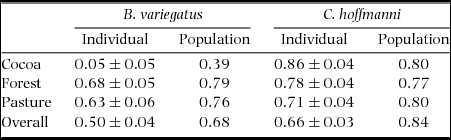
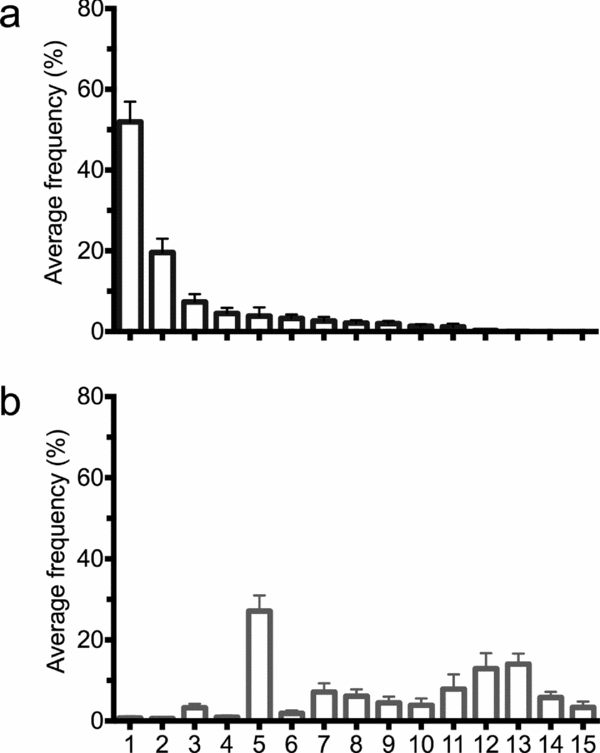
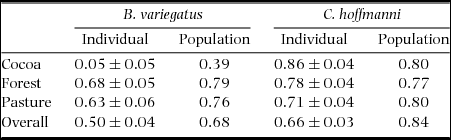
The three-toed sloth heavily utilized only two species – Cecropia obtusifolia and Coussapoa villosa – while the two-toed sloth frequented Inga vera slightly more than the other 14 tree species (Figure 2a, b). The difference in tree use was significantly different between the two species of sloth (χ2 = 2330, df = 14, P < 0.001). Tree-species use differed by habitat type for the three most commonly used habitats (forest, cocoa and pasture) in both three-toed sloth (χ2 = 515, df = 18, P < 0.001) and two-toed sloth (χ2 = 714, df = 28, P < 0.001). The two-toed sloth utilized a greater diversity of trees than the three-toed sloth at both the individual- (t 78 = 2.98, P = 0.004) and population-level (Table 1). The diversity of trees used by the two-toed sloth was also higher within cocoa compared with the three-toed sloth at the individual (t 78 = 5.65, P < 0.001), and population level (Table 1).
Simpson's index of diversity (1-D) of the two-toed sloth (Choloepus hoffmanni) and the three-toed sloth (Bradypus variegatus) at the individual (±1 SE) and population level for different habitat types in our study site in north-eastern Costa Rica.
Tree use by the three-toed sloth (a; Bradypus variegatus; n = 40) and the two-toed sloth (b; Choloepus hoffmanni; n = 40) across the study area in north-eastern Costa Rica from 2010–2013. Plant species include: 1 = Cecropia obtusifolia; 2 = Coussapoa villosa; 3 = Nectandra salicifolia; 4 = Ocotea sinuata; 5 = Inga vera; 6 = Rollinia pittieri; 7 = Sapium laurifolium; 8 = Luehea seemannii; 9 = Pterocarpus officinalis; 10 = Ficus werkleana; 11 = Theobroma cacao; 12 = Erythrina poeppigiana; 13 = Spondias mombin; 14 = Trophis racemosa; 15 = Hura crepitans.
Habitat selection
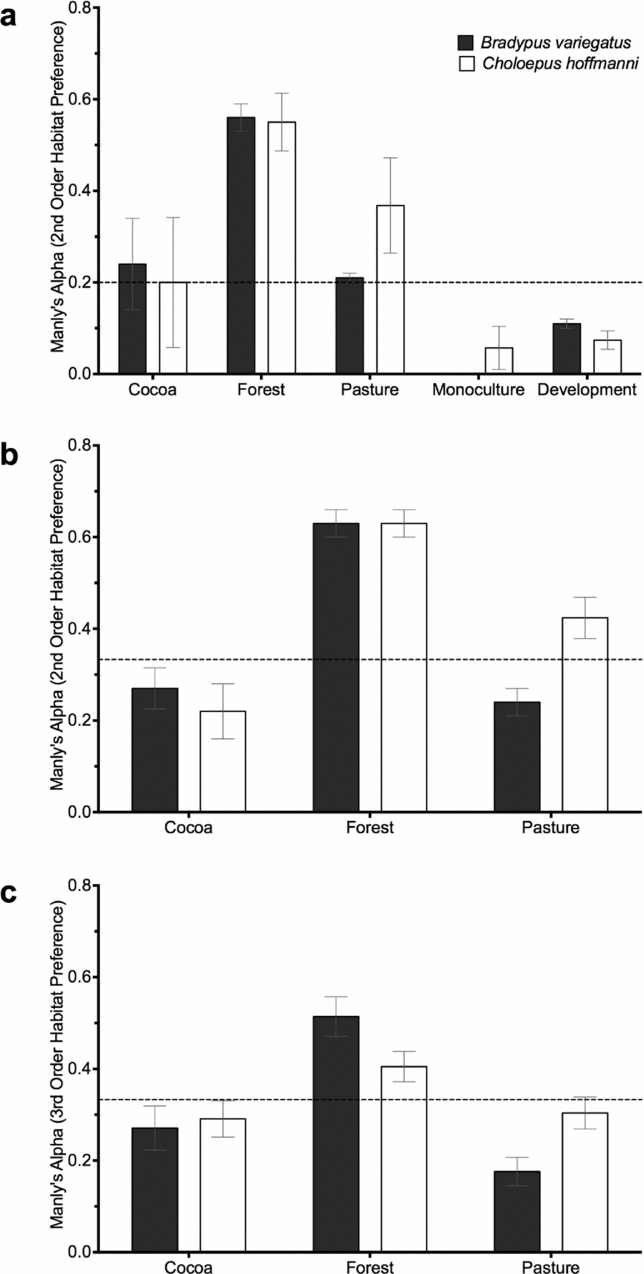
The most abundant habitat types within our study area were cocoa, pastures and monocultures, while tropical forest and human development were the least abundant (Table 2). Median home range size was 7.5 ha (range = 0.6–101.1 ha) and 5.3 ha (range = 0.1–53.3 ha) for the two- and the three-toed sloth, respectively. Both species of sloth exhibited second-order habitat selection for tropical forests and avoided monocultures and human development (Figure 3a). However, the two-toed sloth also selected pastures, while the three-toed sloth avoided this habitat type. When we excluded rarely used monocultures and human development from our analyses, the two-toed sloth selected for tropical forest but avoided cocoa; the three-toed sloth selected for tropical forest, and avoided both cocoa and pastures (Figure 3b). Within home ranges (i.e. third-order habitat selection) both the two- and the three-toed sloth selected for tropical forest (Figure 3c), while the three-toed sloth avoided cocoa and strongly avoided pastures (Figure 3c).
Per cent of habitat type available at our study site in north-eastern Costa Rica, and within the home range of two-toed sloth (Choloepus hoffmanni) and three-toed sloth (Bradypus variegatus).

Manly's alpha preference index (± 95% CI) for the three-toed sloth (Bradypus variegatus) and the two-toed sloth (Choloepus hoffmanni) at second-order habitat selection including all habitats at our study area in north-eastern Costa Rica from 2010–2013 (a; expected value = 0.20) and excluding monocultures and human development (b; expected value = 0.33). Third-order selection of locations within home ranges of the three-toed sloth and the two-toed sloth (expected value = 0.33). Values above the expected value (horizontal dotted line) indicate preference; values below indicate avoidance.
DISCUSSION
As predicted, the two-toed sloth used a greater diversity of tree species and was more plastic in its use of habitats at multiple spatial scales. In contrast, the three-toed sloth exhibited a strong dependence on intact tropical forest and on only two species of tree (Cecropia obtusifolia and Coussapoa villosa). Interestingly, these two tree species were the least used by the two-toed sloth, perhaps a strategy used to avoid interspecific competition. Differences in tree use for the two sloth species appear to depend on the ability of each species to adapt to human modifications; for example, the two-toed sloth generally used the non-native species Erythrina poeppigiana in pastures, while we did not observe any three-toed sloths using this tree species. Overall, the diversity of tree use was somewhat dependent on habitat type, and was similar for both sloth species in riparian forests and pastures, which could be due to the differential availability of trees in the two habitats. On one hand, the richness of trees within intact tropical rain forests is highest and sloths of both species have access to a great number of different tree species. On the other hand, the paucity of tree species within pastures limits the diversity of tree use for both species of sloth. In the habitat where we observed a difference in the diversity of tree use – shade-grown cocoa – the two-toed sloth used a greater diversity of trees compared with the three-toed sloth. This difference is likely due to limited availability of trees preferred by three-toed sloths, especially the scarcity of secondary trees like Nectandra salicifolia and Ocotea sinuata, leading to particularly strong dependence on Cecropia obtusifolia and Coussapoa villosa in shade-grown cocoa (pers. obs).
Both species of sloth selected intact tropical forests, exhibited neutrality or slight avoidance of shade-grown cocoa, and strongly avoided monocultures and human development. These findings are not particularly surprising, as previous researchers have shown that sloths are largely intolerant of monocultures, and select for habitats with structural complexity and intact forest canopies (Rolim & Chiarello Reference ROLIM and CHIARELLO2004, Vaughan et al. Reference VAUGHAN, RAMIREZ, HERRERA and GURIES2007). The neutrality or avoidance (depending on scale and how rarely used habitats were treated) towards shade-grown cocoa was expected for the three-toed sloth but not for the two-toed sloth, especially since the two-toed sloth is frequently observed in cocoa. Vaughan et al. (Reference VAUGHAN, RAMIREZ, HERRERA and GURIES2007) suggested that the three-toed sloth uses shade-grown cocoa in proportion to its availability whereas the two-toed sloth uses it less than expected. A factor that may explain differences of our results from previous studies is that Vaughan et al. (Reference VAUGHAN, RAMIREZ, HERRERA and GURIES2007), quantified living fences (in and around the shade-grown cocoa) as a discrete habitat type, and found sloths selected strongly for the fencerows and avoided the cocoa. We choose to pool cocoa and living fences into a more generalized shade-grown cover type to minimize potential GPS and remote sensing error, especially since living fences are extraordinarily narrow (i.e. 1–5 m), and because we believe that fencerows are an implicit and important component of shade-grown cocoa (Chacón & Harvey Reference CHACÓN and HARVEY2006).
The two-toed sloth used pastures in proportion to availability within their home range, while the three-toed sloth avoided this habitat; we presume that the three-toed sloth avoids pastures due to the lack of closed canopies and a dearth of suitable tree species. Additionally, the three-toed sloth may avoid pastures to evade the risk of predation by coyote (Canis latrans) and domestic dog (Canis lupus familiaris), as this species is more vulnerable to ground predators given its smaller size and more docile behaviour (Peery & Pauli Reference PEERY and PAULI2014). In contrast, the two-toed sloth may be better adapted to pastures since it possesses greater mobility and is able to move on the ground in between trees (Sunquist & Montgomery Reference SUNQUIST and MONTGOMERY1973).
Overall, our findings suggest that the two-toed sloth is flexible in its use of trees and habitat selection compared with the more specialized three-toed sloth. This greater plasticity in two-toed sloth resource use is likely contributing to its enhanced viability within an agro-ecosystem containing shade-grown elements. Conversely, specialization on a few tree species and avoidance of pastures containing isolated trees seems likely to have contributed to the three-toed sloth's reduced viability in an agro-ecosystem containing only a fraction of the original forest.
More broadly, our results indicate that some generalists are more resilient to the conversion of tropical forests to shade-grown agricultural systems than specialists, even in closely related species. Thus, while shade-grown systems, such as those of cocoa or coffee (Coffea spp.), can harbour a greater diversity of animal species across a range of taxa compared with monocultures (Cassano et al. Reference CASSANO, KIERULFF and CHIARELLO2011, Clough et al. Reference CLOUGH, DWI PUTRA, PITOPANG and TJITROSOEDIRDJO2011, Delabie et al. Reference DELABIE, JAHYNY, CARDOSO DO NASCIMENTO, MARIANO, LACAU, CAMPIOLO, PHILPOTT and LEPONCE2007), by themselves they may be insufficient to harbour some resource specialists. Previous studies have shown that the amount of biodiversity retained in shade-grown agro-ecosystems is positively related to tree density, species composition and diversity (Clough et al. Reference CLOUGH, DWI PUTRA, PITOPANG and TJITROSOEDIRDJO2011, Schroth et al. Reference SCHROTH, HARVEY, VINCENT, Schroth, da Fonseca, Harvey, Gascon, Vasconcelos and Izac2004); we suspect that retaining as much of these elements as possible could be particularly beneficial for resource specialists. Moreover, landscape context is likely critical for maintaining sensitive species (Pardini et al. Reference PARDINI, FARIA, ACCACIO, LAPS, MARIANO-NETO, PACIENCIA, DIXO and BAUMGARTEN2009), where the juxtaposition of intact forest to provide a source of immigrants is required to maintaining the full array of species. Our study area, comprised of intact forest, pastures, shade-grown agriculture and monocultures, seems to be a microcosm for much of Costa Rica and Central America (Brown & Lugo Reference BROWN and LUGO1990, Janzen Reference JANZEN1983, Myers Reference MYERS1991, Sader & Joyce Reference SADER and JOYCE1988) and may provide insight into how different forms of human altered landscapes may favour certain species over others.
ACKNOWLEDGEMENTS
We thank the Hermelink family for access for our fieldwork and Shawn Steffan for insightful feedback on an earlier draft. This work was supported by funding from the National Science Foundation (DEB-1257535).