Implications
Beef producers tend to emphasize traits to increase calf weaning weights through increased genetic potential for milk production. Post-weaning growth, feed intake and feed efficiency was determined in beef steers and heifers. Our results indicated that increased milk production of the cow herd decreases feed efficiency of offspring post-weaning.
Introduction
Maximizing profit through genetic selection of growth may have negative consequences for long-term success in the beef industry. These selection traits impact profitability for cow–calf producers; however, calf BW at weaning only accounted for 5% of profitability for the producer in a profit model (Miller et al., Reference Miller, Faulkner, Knipe, Strohbehm, Parrett and Berger2001). However, efficiency from birth to slaughter have not been consistent with increasing milk yield. Increasing milk yield has been reported to decrease (Montaño-Bermudez and Nielsen, Reference Montaño-Bermudez and Nielsen1990) and increase (Brown and Dinkel, Reference Brown and Dinkel1982) beef enterprise efficiency. Selection for increased milk yield results in an increase in maintenance energy requirements for beef cows (Neville and McCullough, Reference Neville and McCullough1969; Ferrell and Jenkins, Reference Ferrell and Jenkins1985; MontañoBermudez and Nielsen, 1990). Thus, improvements in energy utilization and feed conversion efficiency by beef cattle to optimize inputs and outputs would greatly increase production efficiency of the beef industry. Optimum level of milk production in beef cows across differing environments to optimize production efficiency from post-weaning has not been established. Therefore, the objective of this study was to evaluate the effects of maternal milk yield in mature beef cows on dry matter intake (DMI), BW gain and feed efficiency in suckling progeny for a 75-day backgrounding period. The hypothesis was that offspring from Higher milk yield dams will have decreased feed efficiency post-weaning.
Material and methods
The Institutional Animal Care and Use Committee of University of Tennessee, Knoxville approved all described animal handling and experimental procedures.
In a 2-year study, 91 spring-born, weaned Angus steers and heifers from the Plateau Research and Education Center, Crossville, TN, USA were used to determine the influence of daily milk yield on progeny performance and feed efficiency during a 75-day post-weaning backgrounding phase. On ~days 58 and 129 postpartum, cow milk yield was measured using a modified version of weigh-suckle-weigh method utilizing a milking machine as described by Mulliniks et al. (Reference Mulliniks, Kemp, Cox, Hawkins, Cibils, VanLeeuwen and Petersen2011) and Waterman et al. (Reference Waterman, Geary, Petersen and MacNeil2017). Cows were milked using a portable milking machine (Porta-Milker; Coburn Company Inc., Whitewater, WI, USA). On the day of the milking, cows were gathered from their pasture and calves were removed. A period of 10 min before milking, cows were administered an intramuscular injection of oxytocin (20 IU; Vedo Inc., St. Joseph, MO, USA) to facilitate milk letdown. Cows were milked until machine pressure could not extract any additional milk, and milk collected was subsequently discarded. After first milking, cows were kept separate from calves and then milked a second time. Milk weights were recorded to calculate 24-h milk production. After milking, cows were retrospectively classified as one of three milk yield groups: Lower (6.57±1.21 kg), Moderate (9.02±0.60 kg) or Higher (11.97±1.46 kg). A complete description of cow and calf management up to weaning is reported in Edwards et al. (Reference Edwards, Hobbs and Mulliniks2017).
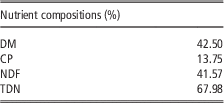
At weaning each year, calves (219±6 days of age; 309±12 kg) were vaccinated against bovine respiratory disease complex (bovine respiratory syncytial virus, infectious bovine rhinotracheitis, bovine viral diarrhea and parainfluenza 3) with Bovi-Shield Gold 5 (Pfizer Animal Health, Exton, PA, USA). Calves were administered a 7-way clostridial vaccine (Ultrabac-7; Pfizer Animal Health) and were vaccinated against Pasteurella (One-Shot; Pfizer Animal Health). A period of 2 weeks after weaning, steers and heifers were acclimated to the GrowSafe feeding system (GrowSafe Systems Ltd, Airdrie, Alberta, Canada) for 10 days before measuring feed intake. Calf BW was measured before the entry into the GrowSafe and again 10 days after to account for the acclimation period to the feeding system. The BW after the acclimation period was considered the initial entry BW and day 0 of the study. After the acclimation period, BW were recorded at a mid-point (35 days post-acclimation) and at the termination of the feeding trail (75 days post-acclimation). During both the acclimation and study period, steers and heifers were provided free-choice access to a corn silage-based ration (Table 1) and individual intake was recorded daily. Three random samples of the corn silage-based ration were collected during each period (days 0 to 35 and days 35 to 75), composited into a single sample for each period, and analyzed in triplicate for nutrient content using wet chemistry procedures at a commercial laboratory (Dairy One Forage Laboratory, Ithaca, NY, USA). Dry matter intake was calculated as the average of the dry matter consumed from the initiation of the study (day 0) to the mid-point (day 35), mid-point (day 35) to termination of the feeding study (d 75), and overall intake from initiation (day 0) to termination (day 75). Average daily gain (ADG) and average DMI for each time point were utilized to calculate a feed conversion ratio (FCR; feed:gain) for individual animals.
Nutrient composition of the corn silage-based ration

DM=dry matter; TDN=total digestible nutrients.
Average daily live weight gain during the residual feed intake (RFI) measurement period for both heifers and steers was calculated as the coefficient of the linear regression of BW (kg) on time (days) using the GLM procedure of SAS 9.3 (SAS Institute Inc., Cary, NC, USA). Mid-point metabolic BW (MBW) was determined as BW0.75 in the middle of the RFI measurement period, which was estimated from the intercept and slope of the regression line after fitting a linear regression line through all metabolic BW (BW0.75) observations. Residual feed intake was calculated for each heifer and steer as the difference between actual DMI and expected DMI from the linear regression of mean DMI on MBW and ADG using the following model:
 $${\rm DMI}\,{\equals}\,\beta _{0} {\plus}\beta _{1} {\times}{\rm mid{\hbox - }test}\,{\rm BW}^{{0.75}} {\plus}\beta _{2} {\times}{\rm ADG}{\plus}\beta _{3} {\times}T{\plus}{\varepsilon}$$
in which β 0 is the y-intercept, β 1 the partial regression coefficient of mid-test BW0.75, β 2 the partial regression coefficient of ADG, β 3×T the fixed effect of year and ɛ the error term.
Normality of the data distribution and equality of variances of measurements were evaluated using PROC UNIVARIATE and the Levene test and White’s test, respectively. Data were analyzed as a complete randomized design, using a mixed procedure of SAS 9.4 (SAS Institute Inc.). Calf was used as the experimental unit with the Kenward–Roger degrees of freedom method. The model included fixed effects of milk yield treatment group, gender of calf, age of dam, year and their interactions. Separation of least squares means was performed by the PDIFF option of SAS when a significant (P⩽0.05) effect of milk production classification was detected. Gender of calf did not interact with milk yield treatment for any measurement and was not discussed in this manuscript.
Results
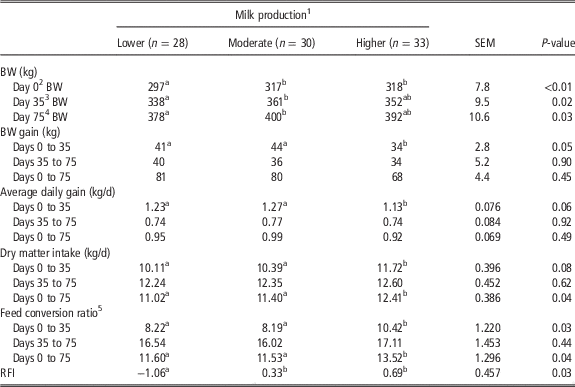
Level of dam’s milk production influenced (P<0.01; Table 2) day 0 BW at the beginning of the 75-day backgrounding phase. Steers and heifers from Moderate and Higher milk yielding cows had similar day 0 with progeny from Lower milking cows having the lightest BW. Moderate and Higher calves maintained greater (P⩽0.03) BW until the end of the backgrounding phase (day 75) in the GrowSafe feeding system.
Effect of dam’s milk production level on progeny’s BW, BW gain, average daily gain, dry matter intake and post-weaning feed efficiency

RFI=residual feed intake.
a,bMeans with differing superscripts differ among milk production groups (P<0.05).
1 Milk production groups: Lower (6.57±1.21 kg), Moderate (9.02±0.60 kg) and Higher (11.97±1.46 kg).
2 Day 0 BW occurred after 10 days acclimation period in the GrowSafe feeding system.
3 Day 35 BW occurred ~35 days after initial BW.
4 Day 75 BW occurred ~75 days after initial BW.
5 Expressed as feed:gain.
Even though calves from Lower milking cows had the lightest BW during the study, calves from Lower milking cows had similar BW gain to calves from Moderate cows and greater (P=0.05; Table 2) BW gain from the day 0 to day 35. However, BW gain was not different (P⩾0.45) among offspring of Lower, Moderate and Higher milk yielding cows from day 35 to day 75.
Dry matter intake from the day 0 to day 35 tended to be lower (P=0.08; Table 2) in calves from Lower and Moderate milk yielding cows than calves from Higher milk yielding cows. From day 35 until day 75 of the 75-day feeding trail, DMI was not different (P=0.62) among treatments. However, overall DMI was greater (P=0.03) in calves from Higher milk yielding dams with no differences between calves from Lower and Moderate milk yielding cows.
With the lower DMI, FCR was lower (P=0.03; Table 2) from day 0 of feeding to day 35 in calves from Lower and Moderate milk yielding dams. From day 35 to day 75 of the 75-day feeding period, FCR was not different (P=0.44) among calves from differing levels of milk yielding dams. However, overall FCR during the 75-day feeding trial was lower (P=0.02) in calves from Lower and Moderate milk yielding dams compared with calves from Higher milk yielding dams. After the 75-day feeding trail, calves from Lower milk yielding dams resulted in lower (P⩽0.04) RFI values than calves from Moderate or Higher milk yielding dams.
Discussion
The continual increase in selection for milk production has resulted in beef cows that are under greater nutritional stress in critical physiological periods, such as early lactation, that will ultimately reduce reproductive traits (Dillon et al., Reference Dillon, Berry, Evan, Buckley and Horan2006; Edwards et al., Reference Edwards, Hobbs and Mulliniks2017). Due to the impact of milk yield on calf weaning weight, cow–calf producers tend to emphasize a selection for increased genetic potential for milk in their suckler cow herds. However, such emphasis may not increase overall efficiency of the entire beef cow industry.
Maternal milk yield influenced post-weaning BW in the current study. Moderate and Higher milk yields had greater BW at the initiation of the backgrounding phase on day 0 in the GrowSafe. However, after 35 days in the study, progeny from Lower milking beef cows had similar BW than progeny from Higher milk yield cows for the rest of the feeding trial. In a simulated model, Bourdon and Brinks (Reference Bourdon and Brinks1987) found that increasing beef cow milk production was favorable when feedlot feed costs were high but not when cow herd feed costs were high. However, this would be dependent on a linear positive relationship between milk yield and feedlot entry weight. Although, BW was significant in this study, increased milk yield did not linearly increase the BW of the offspring. Final BW at day 75 was not different between offspring from Lower and Higher milk yielding dams.
Post-weaning gain did not respond linearly to increase in milk production. Lower and moderate calves had greater BW gain and ADG during the first 35 days of the feeding period; however, this increase in ADG did not continue for the entire feeding period. From day 35 until the termination of the trial on day 75, BW gain and ADG were not different by milk yield of dams. Wang et al. (Reference Wang, Brown, Gao, Wu, Lalman and Liu2009a) illustrated that greater levels of milk yield was associated with decreased post-weaning backgrounding ADG. However, these authors did suggest that this may be dependent on both calf sire breed and post-weaning management (i.e. drylot v. wheat pasture).
Dry matter intake from the initiation of the study until day 35 did tend to decrease with offspring from Moderate and Lower milk yielding cows. In contrast, Miller et al. (Reference Miller, Wilton and Pfeiffer1999) reported that maternal milk yield did not influence post-weaning feedlot DMI of offspring. In contrast, due to a lack of intake difference, Miller et al. (Reference Miller, Wilton and Pfeiffer1999) suggested that offspring from high milk producing cows were more energetically efficient than lower milk yielding cows. In contrast, FCR in the present study was increased for Lower and Moderate offspring from the initiation at day 0 to mid-point at day 35 and overall FCR compared with Higher milk yield offspring. According to Montano-Bermudez and Nielsen (1990), when production efficiency was estimated as weight of calf weaned per unit of energy intake, lower-milking cows were more efficient producers to weaning; the calves retained this efficiency advantage through the feedlot. This efficiency advantage to weaning appears to remain throughout the lifetime production of the lower-milking cows (Davis et al., Reference Davis, Rutledge, Cundiff and Hauser1983a and Reference Davis, Rutledge, Cundiff and Hauser1983b). In agreement, Oijen et al. (Reference Oijen, Montano-Bermudez and Nielsen1993) showed that offspring from moderate and high milk yielding beef cows were ~3% to 4% lower at weaning and 7% lower at slaughter than the offspring from low milk yield cows for biological efficiency.
Residual feed intake across milk production treatments indicated steers and heifers from Lower milk producing dams have an increased feed efficiency during backgrounding. Offspring from Moderate and Higher milk yielding dams both showed to have positive RFI values. Research at the Meat Animal Research Center in Nebraska (Ferrell and Jenkins, Reference Ferrell and Jenkins1984 and Reference Ferrell and Jenkins1985) has reported that efficiency of energy use is reduced in higher-milking beef cows. This research indicated that decrease in efficiency is a result of increased size of visceral organ mass (i.e. heart, liver, kidney, rumen and small and large intestines). Increased feed intake and gut capacity are related to increased visceral organ mass relative to live BW (Wang et al., Reference Wang, Ko, Holligan, McBride, Fan and Swanson2009b). Digestive tract tissue and the liver use ~40% to 50% of total energy expenditure in the beef cow, even though these tissues make up ⩽10% of the animal’s body mass (Ferrell, 1988).
The increase in feed efficiency in Lower calves may be due to rumen development differences. Development of the rumen is an important physiological process for young ruminants. Insufficient rumen development will negatively affect nutrient digestion and absorption (Baldwin et al., Reference Baldwin, Mcleod, Klotz and Heitmann2004). In calves from low milk producing cows, Ansotegui et al. (Reference Ansotegui, Havstad, Wallace and Hallford1991) reported no differences in ADG of calves from low milk producing cows v. high milk producing cows after day 60 postpartum, due to forage intake differences. Buskirk et al. (Reference Buskirk, Faulkner and Ireland1995) indicated that milk consumption was inversely related to forage intake. Likewise, Tedeschi and Fox (Reference Tedeschi and Fox2009) indicated that there is an inverse relationship between milk consumption and forage intake, but milk was prioritized over forage intake if both are readily available. Wyatt et al. (Reference Wyatt, Knori, Gould and Totusek1976) reported that high milk consumption reduced forage intake as much as 50%. Therefore, if milk production is limited, then calves may increase their forage intake. Before weaning for the offspring in the current study, Edwards et al. (Reference Edwards, Hobbs and Mulliniks2017) reported no difference in weaning BW of the offspring with an increase in maternal milk yield. This lack of weaning weight difference may be explained from an increased forage intake before weaning, which may have an influence on rumen development. Forage consumption promotes muscular development of the rumen (Hamada et al. Reference Hamada, Maeda and Kameoka1976) and stimulates rumination and flow of saliva into the rumen (Hodgson, Reference Hodgson, Tayler and Lonsdale1971). In young dairy calves, the addition of forage to a grain starter diet improved feed efficiency (Coverdale et al., Reference Coverdale, Tyler, Quigley and Brumm2004); however, no long-term influences were studied. The possible increase in forage intake pre-weaning may have provided the opportunity to adapt to mixed rations in the GrowSafe feeding system, which may explain the differences the first 35 days of the feeding period.
Conclusion
This study reveals that selecting for Higher milk yield for increased calf growth results in a decreased post-weaning feed efficiency. Coupling RFI and FCR data, offspring from Lower milking beef cows have an increased post-weaning feed efficiency. In addition, cow–calf or backgrounding systems may need to consider cow herd milk production to optimize post-weaning calf production and efficiency. Therefore, balancing genetic potential for milk yield with post-weaning performance of the offspring is necessary to develop efficiency in all beef industry segments.
Acknowledgments
The authors would like to thank the Plateau Research and Education Center for their assistance in data collection.