INTRODUCTION
Pain is one of the most common symptoms experienced by cancer patients (van den Beuken-van Everdingen et al., Reference van den Beuken-van Everdingen, de Rijke and Kessels2007) and one of the symptoms least likely to be adequately treated (Zhao et al., Reference Zhao, Chang and Cleeland2013). Improvements in pain management are needed to help patients manage persistent cancer pain and its impact on their daily activities, relationships, and emotional health (Badr et al., Reference Badr, Laurenceau and Schart2010; Gauthier et al., Reference Gauthier, Young and Dworkin2014; Laird et al., Reference Laird, Boyd and Colvin2009). One way to improve current approaches is to do a better job of meeting the well-recognized need for multimodal pain management strategies that pair pharmacologic pain treatments with behavioral pain interventions. Guidelines (e.g., Chou et al., Reference Chou, Qaseem and Snow2007; Reference Chou, Fanciullo and Fine2009; Raphael et al., Reference Raphael, Ahmedzai and Hester2010; Swarm et al., Reference Swarm, Anghelescu and Benedetti2016) recommend behavioral interventions that educate patients about pain and teach them skills for managing it. Pain coping skills training (PCST) achieves these goals using the principles of cognitive behavioral therapy (CBT). Patients learn how cognitive, behavioral, and emotional responses to pain can increase pain severity and impairment (Sharp, Reference Sharp2001), and then learn skills involving relaxation, distraction (e.g., pleasant imagery, pleasant activity scheduling), cognitive restructuring (to address catastrophizing and other maladaptive cognitive patterns), and pacing activities. Randomized controlled trials have shown that PCST and similar interventions can improve pain caused by osteoarthritis (Keefe et al., Reference Keefe, Caldwell and Williams1990a; Reference Keefe, Caldwell and Williams1990b; Reference Keefe, Blumenthal and Baucom2004), fibromyalgia (Williams et al., Reference Williams, Kuper and Segar2010), and cancer (Porter et al., Reference Porter, Keefe and Garst2011) (see also Porter & Keefe, Reference Porter and Keefe2011; Tatrow & Montgomery, Reference Tatrow and Montgomery2006; Turk et al., Reference Turk, Meichenbaum and Genest1983; Reference Turk, Sist and Okifuji1998); however, these interventions are underused in clinical care (Gaertner & Schiessl, Reference Gaertner and Schiessl2013; Keefe et al., Reference Keefe, Abernethy and Campbell2005). Expanding patients' access to them is consistent with guidelines for managing cancer pain and would be a step toward meeting national goals to reduce the impact of pain on individual and public health (Goldberg & McGee, Reference Goldberg and McGee2011; Institute of Medicine, 2011).
There is growing evidence that CBT-based interventions can be efficacious when delivered via the internet, which also addresses barriers limiting patient access to these interventions (Rini et al., Reference Rini, Williams and Broderick2012). We developed an automated, web-based PCST program for osteoarthritis (OA) joint pain (“PainCOACH”) that included eight interactive 35- to 45-minute sessions designed to retain critical therapeutic features of in-person PCST (Rini et al., Reference Rini, Porter and Somers2014). Our randomized controlled trial demonstrating the program's feasibility, safety, acceptability, and potential efficacy (Rini et al., Reference Rini, Porter and Somers2015) suggests that web-based PCST could be useful for expanding cancer patients' access to this evidence-based pain therapy. Because cancer patients are likely to have different pain management needs and concerns than people with OA, the present study gathered information necessary for adapting web-based PCST for use by cancer patients with persistent pain and integrating this treatment into clinical care. We conducted in-depth interviews to collect feedback from patients who completed the program and focus groups with healthcare providers (physicians and advanced practice providers) to understand their views of current cancer pain treatments, PCST (including web-based PCST), and ways to support its use in clinical care. Our approach was consistent with frameworks guiding systematic adaptation of evidence-based interventions for use in new target populations (Lee et al., Reference Lee, Altschul and Mowbray2008). We began with a strong understanding of the core therapeutic components of web-based PCST (Rini, et al., Reference Rini, Porter and Somers2014) and then gathered data from both patients and providers to address the study goal of investigating patients' pain-related needs, patients' and providers' responses to web-based PCST, and their recommendations for adapting it to meet patients' needs. We therefore expected that our findings would be relevant not only to our program but also to the larger goal of expanding patient access to PCST and similar evidence-based behavioral pain interventions with web-based delivery.
METHODS
Patient Pilot Study
The eligibility criteria for our study included: (1) medically confirmed multiple myeloma or breast or prostate cancer with bone metastases (because pain is common and frequently severe in these patients); (2) moderate to severe bone pain; (3) ≥21 years of age; (4) English-speaking; and (5) living within two hours of the North Carolina Cancer Hospital (NCCH). Patients were excluded if they planned to undergo short-term pain treatment during the study period (e.g., palliative radiotherapy, surgery), were expected to survive <6 months (according to their physician), were cognitively impaired, or did not have wireless internet access at home.
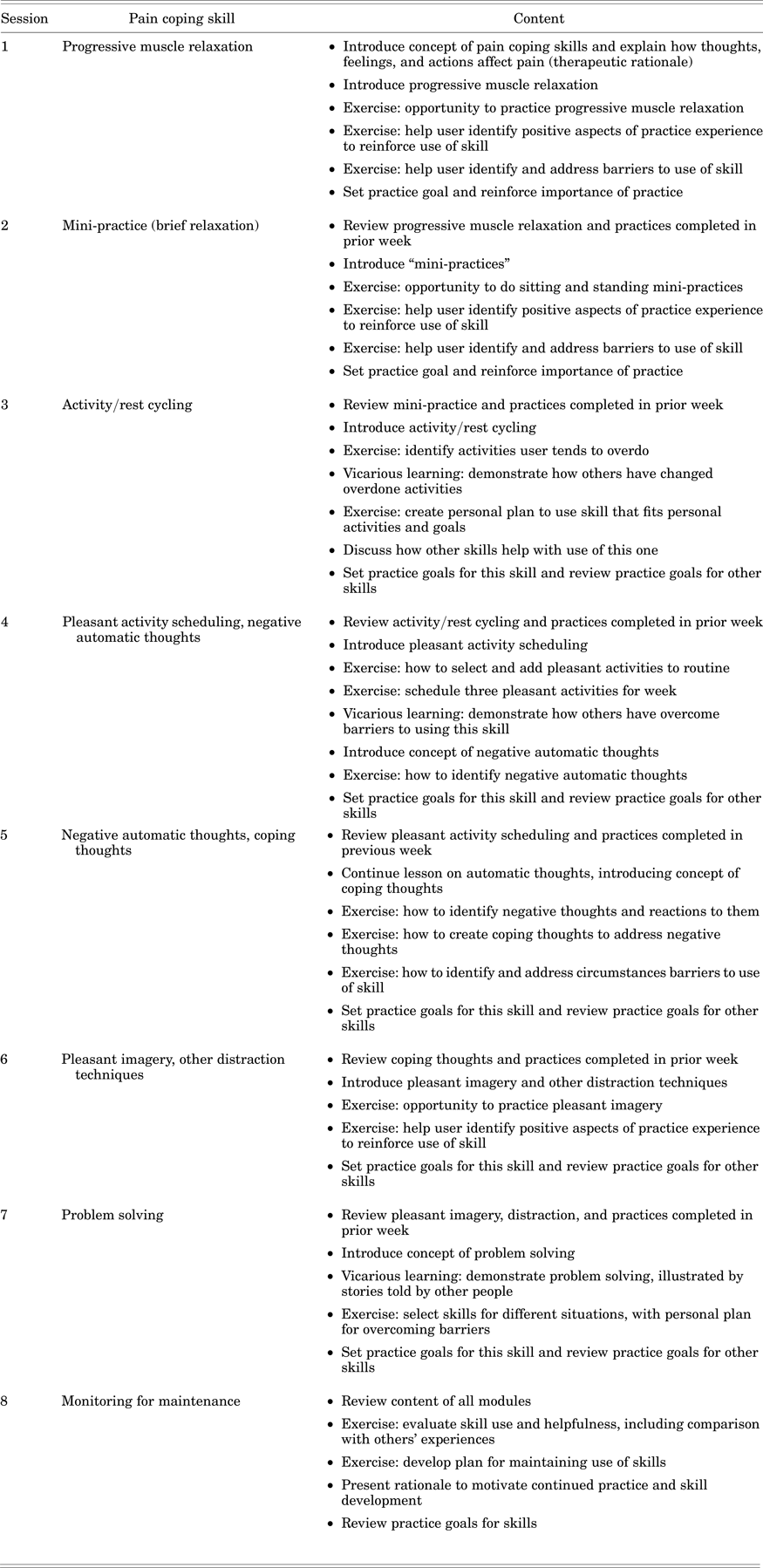
Potential participants were identified by healthcare providers and then called by staff, who completed a screening interview. Eligible patients were scheduled for an in-person baseline visit. After providing informed consent, they received an iPad to access the program, a program workbook, and a journal to make notes about completed sessions. They were asked to complete one session per week over 8 to 10 weeks. Each session provided interactive training on a pain coping skill, as summarized in Table 1 and described in detail elsewhere (Rini, et al., Reference Rini, Porter and Somers2014; Reference Rini, Porter and Somers2015). Session completion was monitored by a staff member, who called participants if more than 10 days elapsed between sessions. After completing the program or ending their participation, participants met with an interviewer in their home or another convenient location for an in-depth, semistructured, 60- to 90-minute interview that assessed their experiences with pain and, using prompts from their journal, solicited their experiences with using web-based PCST and feedback for improving it. Interview questions were developed to address the study goal by a team of cancer clinicians and behavioral scientists with expertise in pain management and behavioral scientists with expertise in qualitative research methods. Questions were not changed after the interviews began. Interviews were audiotaped and transcribed. Participants were paid $200.
Summary of sessions in web-based pain coping skills training program (PainCOACH)

Provider Focus Groups
Physicians or advanced practice providers at NCCH were eligible to participate if they spent at least part of their clinical time treating cancer-related bone pain. They completed a brief screening interview. Eligible providers were scheduled for a focus group meeting for physicians or advanced practice providers, as appropriate. Meetings began with informed consent procedures and a questionnaire gathering demographic and professional/practice data. An experienced moderator used an interview guide to discuss participants' experiences providing care for cancer patients with bone pain and their perception of the meaning of “pain self-management,” defined as including “psychosocial resources that teach patients about their pain and methods for managing it,” such as patient education and use of pain coping skills. After participants were asked about their history of referring patients for these kinds of services, we described PCST and the web-based PCST program, and participants discussed their views about the program, the reasons why they would or would not recommend it to patients, the best timing for its use, and ways to integrate it into clinical care. As with patient interviews, questions were developed to address the study goal by a multidisciplinary research team. These audiotaped discussions lasted 90 minutes, and participants were paid $125.
The procedures for interviews and focus groups were approved by the University of North Carolina at Chapel Hill (UNC) Institutional Review Board. Interviews, focus groups, and analyses were completed by experts in these methods (including M.B.V. and J.C.A.), who are members of the Communication for Health Applications and Interventions (CHAI) Core at the UNC Lineberger Comprehensive Cancer Center.
Analytic Approach
Transcriptions were independently coded by M.B.V. and J.C.A. using a directed content analysis approach (Hsieh & Shannon, Reference Hsieh and Shannon2005) and ATLAS.ti7 software (Scientific Software Development GmbH, Berlin, Germany). Interview questions guided initial codebook development. Codes were interactively revised during analysis to capture all the relevant information provided by participants. Combining deductive and inductive coding allowed for both emergent and anticipated themes. The coders compared results and reconciled discrepancies to reach consensus. Interrater reliability before reconciliation was excellent (Fleiss' κ = 0.89).
RESULTS
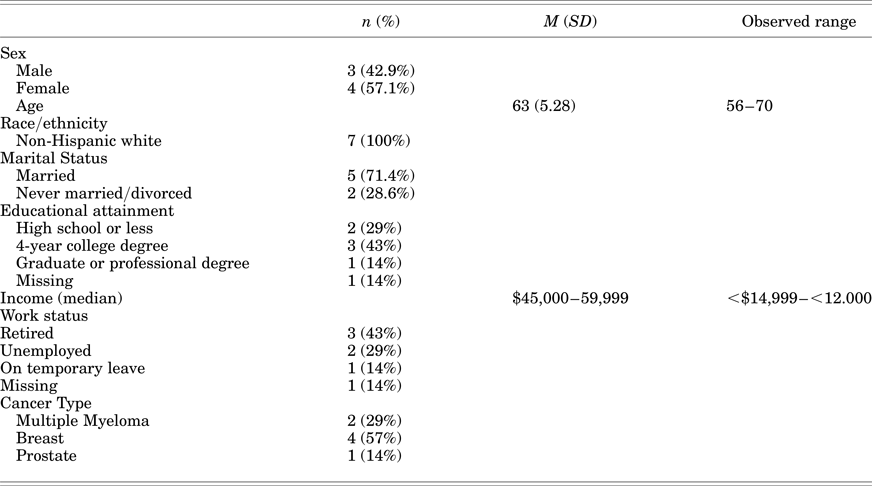
Some 11 patients were approached for the pilot study, 4 of whom declined due to being in another study (n = 1), lack of interest (n = 2), or medical problems (n = 1). Table 2 shows the descriptive statistics for the 7 enrolled patients. All men and women in the study were non-Hispanic white, and most were married and well-educated.
Demographic characteristics of enrolled cancer patients (N = 7)a

a Participants include one woman who was enrolled and completed a single session in the web-based pain coping skills training program but who ended her participation due to technical problems and did not complete a final interview due to scheduling problems. We report her behavior as an enrolled participant, but she did not contribute to the qualitative data.
A total of 12 providers enrolled in focus groups (one group of four oncologists and two groups of advanced practice providers, including four nurse navigators, two nurse practitioners, one physician assistant, and one pharmacist). Eight of the providers (67%) were women. Their mean age was 47 years (SD = 12.45), and they had been in professional practice for 15 years on average (SD = 14.00). They spent an average of 22 hours a week treating cancer pain (SD = 15.44).
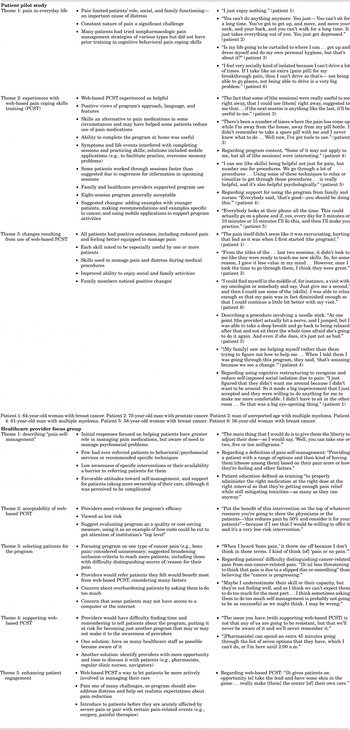
The findings from our analyses are described below and summarized in Table 3.
Summary of findings and representative quotes from the patient pilot study and healthcare provider focus groups

Patient Pilot Study
Pain in Everyday Life
Patients discussed how pain kept them from engaging in work and daily chores and how it limited their ability to enjoy social and leisure activities. Limitations appeared to be more emotionally difficult than pain itself. “Nonstop pain” was a significant challenge. Many patients' pain had been affecting them for years. Most had no formal training in pain coping skills, although a few described trying nonpharmacologic pain management strategies such as walking, relaxation, or heat and ice.
Experiences with Web-Based PCST
Patients described web-based PCST as “helpful” and “useful.” They felt that it would benefit most people if they “stuck with it” and would recommend it to others. They liked being able to use the program from the comfort of their own home: “Of course, it's awfully good to have the tools at home to use when you can find the time. So, it had that advantage.” The fact that it presented an alternative to “pills” was mentioned, as was the fact that the skills could be used away from home, when taking pain medications was not always possible (e.g., because none were on hand).
Pain, other symptoms, disease-related events, and life events sometimes interfered with a patient's ability to complete a session. One described a time when his “numbers shot up out of control” and he had to focus on his “number one fight”—his cancer. Although unable to complete sessions every week, he managed to continue the program, which he found helpful. Cognitive and memory problems led several patients to have difficulty remembering things they learned in the program. As one patient explained,
With me having chemo brain, sometimes I would have to go back and try to remember what I was supposed to do because I would forget it the next day … It wasn't something wrong with the program. It's just the way my brain was working.
All patients required at least one reminder call from study staff when 10 days elapsed since their previous session. Two patients ended their participation after completing one session, one because of personal problems and the other because of difficulties accessing a wireless internet connection. The latter participant did not complete a follow-up interview and thus provided no feedback on the program.
Conversely, a few patients worked through sessions faster than the suggested rate because they were eager for information and tools for addressing their pain. As one patient explained, “like I did number four today. Well, if I can't sleep at night, I'll get up and do number five. That's why I finished it up in a couple of weeks ahead of time.” Some said it was easy to stay motivated through the sessions, in part because each session taught a different skill. Noticing reduced pain and improved ability to engage in valued activities also made patients want to continue. One participant described his motivation thus:
The fact that some of them really were useful to me right away, that I could use right away, suggested to me that […] if the next section's anything like the last, it'll be useful to me, and why shouldn't I go ahead and go forward?
Other people supported patients' use of the program in various ways. Several patients described family members helping with computer use and technical difficulties. Others had spouses with pain and shared information from the program with them. One patient who completed sessions during chemotherapy infusions said his nurses supported his use of the program, as did his family. Patients who told their healthcare providers about the program found them to be interested and encouraging.
Patients generally liked the program's features, including having a virtual coach lead them through the program. As one participant said, “The lady with the brown hair, she gave the presentation. It was really, really good. She had that really soft voice for you to relax and do what she says.” The program illustrated skill use by portraying the experiences of a diverse group of individuals (Rini, et al., Reference Rini, Porter and Somers2014) as they applied the skills. Several patients mentioned that these examples helped them discover meaningful ways to apply their skills.
No patients thought that the 35- to 45-minute sessions were too long, and most viewed the 8-week course of the program favorably. One suggested reducing it to six sessions and another skipped the last session. The explanation for this pattern appeared not to be that the program was too long. Rather, the program's descriptions of the last sessions made them appear as if they were not teaching skills, leading these patients to perceive them as less useful. One patient stated, “From the titles of the last three, last two sessions, it didn't look to me like they were ready to teach me new skills. So, for some reason, I gave it less value in my mind.” This finding highlighted patients' emphasis on gaining skills and not just information.
Patients suggested making photos and examples more relevant to cancer patients (e.g., depicting younger people and emphasizing types of pain and situations experienced by cancer patients). Other suggestions included adding support for practices, incorporating reminders and features to increase motivation, and using mobile technologies to increase access and convenience (e.g., allowing completion of sessions on a smartphone or developing applications to identify challenging situations and provide suggestions for managing them). One patient suggested adding discussion of using skills during painful medical procedures. Similarly, several suggested expanding the program to help patients cope with anxiety about cancer and medical procedures.
Changes Resulting from Using Web-Based PCST
All patients described experiencing benefits from using the program. Each skill was mentioned by one or more patients as being particularly helpful. They noted that they felt better equipped to manage pain. Some described specific instances when the skills helped, such as during a stressful medical visit or painful medical procedure. Many mentioned reduced pain—for example: “It didn't completely go away but brought it down to a level where I can tolerate it. It's just like concentrating on something else.” One patient said that, aside from medication, the pain coping skills were the only things that had helped her manage her pain. Another patient added,
I feel like now I've got a host of tools besides the bottle of pills to deal with the pain because there's been a number of times where the pain has come up while I'm away from the house, away from my pill bottle, I didn't remember to take a spare pill with me, and I never knew what to do. I'm stuck. I'm going to have to suffer through with this before I can get back home to get to my pill bottle. Well now, I've got tools to use.
One patient who said her pain medications kept her from driving said that using the skills “enabled me to be able to get out and see my friends.” Another explained how she continued to benefit from the program: “And, of course, I know it's hurting, but it's not hurting as bad as it was if I had not done these relaxations that I did earlier this morning.”
Another change involved improved social and family interactions. One patient explained how his family saw him helping himself and noticed a change (e.g., his wife noticed him “not [being] a wallflower”). He had gotten into the habit of staying in a separate room at family gatherings because he did not feel well. Cognitive restructuring helped him see his situation in a new light and change it:
I just figured that they didn't want me around because I didn't want to be around. So it made a big improvement that I just accepted, and they were willing to do anything for me to make me more comfortable. I didn't have to sit in the other room. I could join in all the reindeer games, you know?
Healthcare Provider Focus Groups
Describing “Pain Self-Management”
When providers described their views of the term “pain self-management,” their descriptions focused on pain medication (e.g., patients' use of or concerns about medication use), rarely mentioning behavioral strategies. Giving patients control (e.g., over adjusting pain medication doses or choosing among medical pain management options) was a common theme. Patient education was generally agreed to be important for self-management, although this discussion tended to focus on managing medications and their side effects.
Providers realized they were generally unaware of specific behavioral interventions. Few had referred patients to these kinds of services or recommended use of specific techniques. Yet, providers discussed the idea favorably and supported patients taking more ownership of their care:
This is something that could potentially give back a significant chunk of that control if patients feel like they're actively involved in some of the decision-making process especially … if they can do it at home when they're not in clinic, …
although they felt that “it's so incredibly complicated.”
Acceptability of Web-Based PCST
We described web-based PCST and answered questions about it before asking providers whether they thought it would be an acceptable option for their patients. Providers strongly agreed they would need evidence for the program's efficacy:
You need to show, you know, probably a little summary about some of your data and show that it actually has benefit, because if I don't believe that it's going to work for my patient, I don't care what you say, I'm not going to recommend it.
Selecting Patients for the Program
Providers said they would refer patients for web-based PCST by weighing various factors to determine which pain management options would be best for the patient (e.g., age, ability to tolerate treatments, cognitive functioning, costs of treatments/financial burden, side effects, other medications available or being used, pain tolerance and severity).
Providers expressed concern and confusion regarding our focus on cancer-related bone pain, generally agreeing that pain is a problem regardless of cancer type, duration of disease, or treatment. They suggested broadening the inclusion criteria to reach more patients—for instance, “To say only bone pain might limit the availability to reach people who could also benefit.” They discussed how patients are often unable to distinguish between different sources of pain and may think that their pain is not cancer-related even when it is.
There was some concern about asking patients to do more than they were already doing. Furthermore, some providers were concerned that a subgroup of patients may lack a computer or internet access, or that some would not know how to use a tablet computer or get to the website.
Supporting Web-Based PCST in the Clinic
Providers said they would have difficulty finding time and remembering to tell patients about web-based PCST. Yet, they were aware that treatments recommended by providers may be perceived as having more value and suggested having as many healthcare staff as possible discuss the program with patients. They also suggested identifying providers with both opportunity and time to engage with patients. They described pharmacists as being a good contact point because of their focus on pain management and their early and extensive access to patients. Clinic nurses were described as spending significant time reviewing pain medicines with patients and being a very motivated and well-trained, yet underutilized, resource. They felt that nurse navigators could be involved in supporting use of web-based PCST, but it would take time. Some providers said that navigators would give the program traction, although it would be important to address their organizational structure, work responsibilities, and time commitments.
Enhancing Patient Engagement
Providers saw web-based PCST as an opportunity to let patients be more actively engaged in managing their pain to give them a sense of control. Because pain is just one of the challenges that patients face, providers felt that the program should also address such issues as intrusive thoughts, distress, and spiritual health to help patients feel that they were seen as whole people and that their providers were helping them get back to the life they wanted.
Providers suggested introducing the program before patients become acutely affected by severe pain, when “they can't even hear you” and “just want to quit hurting.” Determining the best time to introduce the program would be complicated by patients' diversity, yet providers felt the likelihood of success would be highest if it were offered when patients were “stable-ish” and willing and able to hear about it or, given the incremental nature of pain onset, “in the middle of the trajectory.” They suggested pairing web-based PCST with pain-related events (e.g., before surgery or therapy). They also explained that it would be important to help patients understand that web-based PCST was a part of their care but not the only thing providers would do for them.
DISCUSSION
We gathered feedback about web-based pain coping skills training from seven patients with cancer-related bone pain who had been given access to the training at home, and from healthcare providers who treat them. Our findings suggest strong promise for using a web-based approach in helping patients to manage pain in their daily lives. Patients described profound emotional and physical benefits and offered feedback to make the approach better fit their needs—a critical objective necessary for maximizing adoption and adherence. Providers were supportive of web-based PCST; however, their feedback indicated a need for evidence and education familiarizing them with PCST and addressing their concerns about overburdening patients. Overall, our findings provide valuable guidance for using the technology to increase cancer patients' access to empirically supported behavioral pain interventions with a scalable and cost-effective approach.
It is important that the acceptability of web-based PCST was good among both patients and providers. As expected, adaptations will be needed to improve the extent to which web-based PCST addresses this population's needs. Although 71% of patients completed all sessions (versus 91% in our trial for older adults with OA pain) (Rini, et al., Reference Rini, Porter and Somers2015), all required phone calls to encourage completion. Physical and psychosocial challenges were barriers to initiating and completing the program. Encouragement and help from family were often useful and motivating. Consistent with research showing the benefits of training caregivers to support patients' use of PCST (e.g., Hendrix et al., Reference Hendrix, Bailey and Steinhauser2016; Valeberg et al., Reference Valeberg, Kolstad and Småstuen2013), adding a formal role for family members could enhance adherence to web-based PCST.
Enhancing provider support for program completion is also important, according to behavior change theory (Green & Kreuter, Reference Green and Kreuter1992; Rosenstock, Reference Rosenstock1966) and empirical evidence (Puts et al., Reference Puts, Tapscott and Fitch2015) indicating that patients are more likely to use treatments recommended by their healthcare providers. To gain their support, it will be important to increase their awareness of PCST and address concerns about asking too much of patients. Strategies for having providers support use of web-based PCST must also be sensitive to their limited time availability. Providers suggested having pharmacists or nurses support program use. We note that these findings should be viewed as preliminary because of our small sample size, recruitment at a single site, and lack of data on patient satisfaction and pain characteristics and treatments. The extent to which the foregoing findings generalize to patient populations with varied cancers in different treatment settings requires further investigation.
Our findings also revealed that adaptations will need to address memory problems that hinder completing program sessions, remembering to practice skills, and remembering how to use skills. Cognitive impairment affects many adult cancer patients (Janelsins et al., Reference Janelsins, Kesler and Ahles2014; Wefel et al., Reference Wefel, Kesler and Noll2015). Web-based PCST is well-positioned to address this barrier: it allows at-will review of information and automated and tailored reminders. Functions could also be added to use mobile technologies to recognize challenging situations and to deliver information at key times.
Both patients and providers suggested adding sessions to help patients manage pain-related distress and enhance their use of pain medications. This feedback is consistent with patients' concerns about pain medications (Closs et al., Reference Closs, Chatwin and Bennett2009; Simone et al., Reference Simone, Vapiwala and Hampshire2008; Reference Simone, Vapiwala and Hampshire2012; Valeberg et al., Reference Valeberg, Miaskowski and Paul2015) and evidence that reducing distress helps reduce pain (Wang et al., Reference Wang, Kroenke and Wu2012). Additionally, providers suggested that programs such as web-based PCST should focus broadly on insufficiently controlled pain rather than a particular source of cancer pain (e.g., bone pain). Fortunately, distinguishing between cancer and non-cancer pain is not necessary for treating pain (Turk, Reference Turk2002), and PCST is applicable to various persistent pain conditions.
Several study limitations should be considered in light of possible effects on generalizability. First, the study was conducted at a single institution with a small sample that was non-Hispanic white and mostly well-educated. In a more diverse sample, socioeconomic or ethnic/racial differences could be seen with respect to access to, ability to use, or responses to web-based PCST. Notably, our trial of web-based PCST for OA pain (Rini, et al., Reference Rini, Porter and Somers2015) included ethnic/racial minorities and people with low levels of education and little computer experience. Our findings showed that they were interested in and able to use the program, which was specifically designed to be usable by a broad audience. Moreover, evidence shows a narrowing of racial gaps in internet access and usage, particularly for mobile devices (Smith, Reference Smith2014). Also, cancer patients, who may have limited ability or willingness to attend in-person training, could be especially receptive to the convenience of web-based PCST. These and related factors may minimize socioeconomic and racial/ethnic differences in responses to the program. A critical next step will be to evaluate web-based PCST in a more diverse sample, exploring group differences. Second, patients who complete automated web-based PCST may be more highly motivated than patients who complete in-person PCST, because they must complete the program independently, without therapist contact. This concern may be offset to some extent by recognizing substantial barriers to attending in-person PCST (e.g., the need to travel). Also, extending access to PCST can be achieved with a web-based approach even if some patients lack interest in or would be relatively unlikely to benefit from this approach. Third, future research should assess the features of patients' pain (e.g., its severity and sites) in order to evaluate whether the nature of their pain influences their ability to benefit from web-based PCST.
Taken together, our findings support continued development of web-based PCST for cancer patients, especially in light of the Institute of Medicine's call for programs that enable patients' pain self-management and address current barriers to adequate pain care (Institute of Medicine, 2011). Compared to resource-intensive in-person behavioral interventions, web-based interventions may be an effective way to integrate currently underused behavioral pain interventions into clinical practice. Our findings provide initial feasibility data and feedback supporting this possibility. The next steps will include applying our findings by adapting the program using a standard iterative approach that gathers additional feedback from a larger and more diverse group of patients, and then evaluating the adapted program's efficacy. We will also evaluate whether web-based PCST is acceptable, feasible, and effective across patient subgroups.
DISCLOSURES
The authors hereby declare that they have no conflicts of interest to disclose.
ACKNOWLEDGMENTS
We would like to thank Jermaine Pinckney for his technical and IT assistance during the PainCOACH pilot study, Randall Teal for his assistance with planning and executing the research, and Carey K. Anders, Betsy Blanton, Ellen M.I. Cohen, Frances Collichio, E. Claire Dees, Julie Benbow, Amy L. Garrett, Diane M. Joyal, Anna Kate Owens, Jennie Petruney, and Elizabeth Tita for their advice on the project and assistance with recruitment. This work was funded by a grant from the University of North Carolina Lineberger Comprehensive Cancer Center (PI: C.R.). Work reported in this paper was conducted by CHAI (Communication for Health Applications and Interventions) Core, which is supported in part by a grant from the National Institutes of Health (DK056350) to the University of North Carolina Nutrition Obesity Research Center and from the National Cancer Institute (P30-CA16086) to the UNC Lineberger Comprehensive Cancer Center.