


A fundamental challenge in the design of judicial institutions concerns balancing insulation from external pressures against democratic norms of accountability. The U.S. states, in grabbling with this tension, have developed a variety of systems for selecting and retaining judges. Many states use nonpartisan elections, in which the ballot does not specify the judicial candidates’ partisan affiliations. Some use partisan elections that are no different in structure from the standard legislative or gubernatorial race, while others use “merit” or “commission-retention” systems. In the latter, a commission that includes lawyers submits a set of candidates from which the governor selects an appointee. The appointed judge then faces periodic retention elections, which are not contestable but require a certain percentage of the vote in order to retain office. In yet other states, judges are appointed and reappointed by the legislature and/or governor, in what we call a “reappointment system.”Footnote 1
These differences are not merely a source of intellectual curiosity but also of current policy activity. In recent years North Carolina and Arkansas have altered their systems, and reform movements have gained traction in Nevada, Tennessee, and Wisconsin, among other places. Numerous legal organizations have advocated against contestable elections, particularly partisan elections, and in favor of selecting judges through independent commissions (e.g., American Bar Association 2003; American Judicature Society 2012; National Center for State Courts 2003). The American Bar Association (ABA), for example, is concerned about potential plebiscitary pressures on judges and cautions that “we need judges who will tell us what the law is and how it applies in individual cases without regard to what the results of the latest opinion poll are” (ABA 2003, 2). The ABA has even ranked the state selection systems. Highest among the four standard ones is the commission-retention system that combines commission-based appointment with retention elections. By comparison, the association is openly opposed to contestable elections on the grounds that they invite “the perception that judges are less than independent and impartial” (ABA 2003, ix). Most disdained are partisan elections, which are assumed to engender the greatest plebiscitary pressures.Footnote 2 (To the best of our knowledge, the ABA does not rank reappointment relative to other systems.)
The ABA's disdain for judicial elections receives support from various sources. For instance, the New York Times editorial page has proclaimed that “holding elections to fill important state judgeships is one of those ideas that may sound good in theory but works terribly in practice.”Footnote 3 Similarly, retired U.S. Supreme Court Justice Sandra Day O'Connor advocates commission-based appointment systems over contestable elections, characterizing the latter as “frightening” (Weiss Reference Weiss2009). By comparison, the Federalist Society, Manhattan Institute, and U.S. Chamber of Commerce have sponsored forums that question whether commission-based systems necessarily engender judicial independence.Footnote 4
These debates are not surprising given that judicial campaigns have become increasingly expensive, high profile, and dominated by the participation of out-of-state interest groups. As the Brennan Center documents, television advertising has become a significant feature, with interest groups targeting judges for particular decisions.Footnote 5 Indeed, these developments are so striking that scholars refer to them as the “new-style” judicial campaign (e.g., Gibson Reference Gibson2008; Hojnacki and Baum Reference Hojnacki and Baum1992). Scholars and nonacademics alike have expressed concern that the changes may provide judges with incentives to behave similarly to other elected officials. A particular fear has been that judicial independence will erode, with judges facing greater pressure to cater to public opinion (e.g., Franklin Reference Franklin, Burbank and Friedman2002).
Despite this general apprehension about the new-style judicial campaign, relatively little empirical work investigates how it affects judicial decisions across different types of selection systems, and whether in fact judicial behavior on the bench has changed since its emergence. Multiple analyses provide some support for the ABA's concerns about plebiscitary pressures (e.g., Bonica and Woodruff Reference Bonica and Woodruff2012; Gordon and Huber Reference Gordon and Huber2007; Tabbarok and Helland Reference Tabarrok and Helland1999). By comparison, some work on abortion cases counters the ABA claims (e.g., Caldarone, Canes-Wrone, and Clark Reference Caldarone, Canes-Wrone and Clark2009), and a paper on justices’ willingness to vote against their partisan leanings suggests that the systems are equivalent (Choi, Gulati, and Posner 2010). It is therefore not obvious from the limited literature whether the ABA's arguments are accurate. Moreover, existing studies do not examine whether the impact of selection systems may have changed over time, as the new-style campaign became a more prominent feature of judicial races.
We delineate theoretical predictions on how the selection system should affect judicial decisions in the context of the new-style campaign and test these predictions on a new dataset of death penalty decisions by state courts of last resort. (We refer to these courts generically as state supreme courts, recognizing that their names vary across states.) The decisions span 1980 through 2006 and include over 12,000 votes from over 2,000 cases. The breadth of the data enables investigating questions that previous research on state supreme courts has not. First, we can examine whether the development of the new-style campaign has been associated with changes in judicial behavior. Second, the time span captures numerous types of within-state switches from one system to another, and we can therefore assess across multiple states and systems whether judges who served before and after such a switch altered their behavior; that is, the data facilitate testing whether judicial incentives themselves change, holding constant any impact a system has on the selection of who holds office. Finally, while much of the literature combines different types of electoral systems into one category, these data allow us to examine four types of selection systems across multiple states and decades: partisan elections, contestable nonpartisan elections, commission-retention systems, and reappointment systems.
The analysis suggests that judicial selection mechanisms significantly influence death penalty decisions, and that the new-style campaign has altered judicial incentives in a variety of ways that social science theories predict. First, we find that contrary to the ABA conventional wisdom and most of the literature, nonpartisan elections encourage judges to cater to majority popular support for the death penalty; moreover, this impact is due to the incentives of the system, not merely the selection of different types of judges. The same empirical relationships emerge with respect to retention elections, but the results are less robust than those for nonpartisan elections. Second, we show that in systems with partisan elections or reappointment, the patterns of responsiveness to public opinion are similar to those that scholars have uncovered for other offices with these selection systems. In particular, judges facing reappointment or partisan elections are not particularly responsive to majority opinion, but are highly responsive to increases in the level of public support. Third, we find that the above-described patterns emerge only after the new-style campaign is well established. In other words, the results indicate that the new-style campaign has had significant effects on judicial behavior.
MOTIVATION AND BACKGROUND
Evidence on Judicial Selection Systems
Many studies of the state courts have motivations that do not facilitate comparing the individual systems. For instance, some research accounts for the electoral system and additional political factors within the context of a single composite variable, and consequently cannot discern whether any effects are due to the electoral system (e.g., Gelman et al. Reference Gelman, Liebman, West and Kiss2004). Other scholarship groups together multiple forms of electoral schemes such as all contestable elections (e.g., Brace and Hall Reference Brace and Hall1997; Iaryczower, Lewis and Shum Reference Iaryczower, Lewis and Shum2013). The one relatively consistent finding in this research is that elected judges are more responsive to public opinion than are appointed judges (e.g., Besley and Payne Reference Besley and Payne2013; Brace and Boyea Reference Brace and Boyea2008), particularly on higher salience issues (Cann and Wilhelm Reference Cann and Wilhelm2011).
Among the few studies that do not combine different types of electoral and appointment systems, many support the ABA position that partisan elections produce the greatest plebiscitary pressures. Tabbarok and Helland (Reference Tabarrok and Helland1999) show that judges facing partisan elections issue higher tort awards to in-state plaintiffs facing out-of-state defendants, and interpret this finding to suggest that partisan elections encourage judges to cater to public opinion. Gordon and Huber (Reference Gordon and Huber2007) provide corroboratory evidence by demonstrating that Kansas trial judges facing partisan elections are more punitive than comparable judges facing commission-retention systems. Other scholarship also indicates that partisan election systems create the largest incentives for judges to pander to public opinion (e.g., Bonica and Woodruff Reference Bonica and Woodruff2012; Goelzhauser Reference Goelzhauser2012). Based on these and other studies, literature reviews commonly argue that the available evidence points to partisan elections as engendering the greatest plebiscitary pressures (Bruhl and Leib Reference Bruhl and Leib2012, 1232; Shepherd Reference Shepherd2009, 1605–6).
However, a working paper by Lim, Snyder, and Stromberg (Reference Lim, Snyder and Strömberg2012) finds that trial court judges’ incentives to cater to punitive public opinion do not differ significantly in partisan election versus appointment systems (where the latter combines reappointment and commission-retention systems). In particular, the authors show that media coverage affects judges’ responsiveness to the public similarly in these systems, and significantly more in nonpartisan election systems. Moreover, analysis of abortion decisions by state supreme courts indicates that not only nonpartisan elections but also retention elections encourage greater responsiveness to public opinion than partisan elections do (Caldarone, Canes-Wrone, and Clark Reference Caldarone, Canes-Wrone and Clark2009; Canes-Wrone, Clark, and Park Reference Canes-Wrone, Clark and Park2012). Finally, Choi, Gulati, and Posner (Reference Choi, Gulati and Posner2010) suggest that judicial independence—as measured by a judge's willingness to vote against his/her party—does not vary significantly among reappointment, partisan elections, nonpartisan elections, and commission-retention systems.
In sum, the literature is inconclusive about which judicial selection system creates the greatest plebiscitary pressure. Some of this disagreement presumably derives from the aggregation of different types of systems, and some due to wide variation across studies with respect to the time period, level of court, issues, and conception of responsiveness. Despite this variation, scholarship has been relatively inattentive to how such differences should affect judicial incentives.Footnote 6
In addition to this theoretical gap, existing datasets have not enabled analysis of several key questions. First, many span only a few years in the 1990s (e.g., Brace and Boyea Reference Brace and Boyea2008; Choi, Gulati, and Posner 2010; Iaryczower, Lewis, and Shum Reference Iaryczower, Lewis and Shum2013) and even those that include a wider time frame (e.g., Canes-Wrone, Clark and Park Reference Canes-Wrone, Clark and Park2012) lack the data to compare judicial behavior before and after the emergence of the new style campaign. Likewise, state supreme court studies have not contained data from multiple states that switch from one system to another, and thus have had little ability to distinguish between selection and incentive effects. Finally, scant effort has been expended to understand the effects of reappointment systems.
Development of the New-Style Judicial Campaign
Historically, judicial elections attracted little media attention or voter interest, and it was within this context that progressive reformers hoped nonpartisan and retention elections would encourage voters to choose judges based on merit (Canon Reference Canon1972). While these hopes did not transpire, for most of the 20th century these elections could be considered distinct from those for other major offices due to their lower profile (e.g., Mueller Reference Mueller1970). During the late 1970s and early 1980s, however, anticrime interests began actively participating in judicial elections with the goal of ousting judges perceived as soft on crime. These developments reached a boiling point in 1986, when three California Supreme Court justices, including Chief Justice Rose Bird, were defeated in a statewide retention election after being targeted by an interest group for their death penalty votes. The defeats—the first in which the new-style campaign unseated a supreme court justice—immediately raised concerns that judicial elections had entered a new, more politicized era. The legal community questioned whether “state courts in general have entered an age of greater political vulnerability” (Reidinger Reference Reidinger1987, 52). The June 1987 issue of the ABA Journal contained an entire section of letters raising questions about the broader implications of the 1986 election. Leaders called for reforms to protect the courts from the experience of this election (Marcus Reference Marcus1987).
In subsequent years interest groups began regularly engaging in vigorous campaigns that criticized sitting judges’ records on a variety of issues (e.g., Iyengar Reference Iyengar2002; Streb Reference Streb2007). Not only local but also national interest groups began targeting judges whose decisions did not conform to the groups’ objectives, with notable successes (e.g., Caufield Reference Caufield2005). The races became expensive, with significant expenditures by interest groups and with candidates themselves engaged in fundraising (e.g., Champagne Reference Champagne2001; Sample et al. Reference Sample, Skaggs, Blitzer and Casey2010). By 2009–2010, total expenditures on supreme court elections reached over $38.4 million (Skaggs et al. Reference Skaggs, da Silva, Casey and Hall2011).Footnote 7
New-style judicial campaigns have encompassed a range of hot-button issues, and criminal justice has been especially prominent. For instance, 64% of advertisements paid for by state parties in 2010 focused on the issue of crime (Skaggs et al. Reference Skaggs, da Silva, Casey and Hall2011) and various studies have highlighted judges’ incentives to avoid being labeled “soft on crime” (e.g., Hall Reference Hall2001; Huber and Gordon Reference Huber and Gordon2004). The death penalty, in particular, has repeatedly been a flashpoint of campaigns, emerging in states from Ohio to Florida to California, among others (e.g., Champagne Reference Champagne2001). As Brooks and Raphael (Reference Brooks and Raphael2002, 611) conclude, “When up for re-election, most judges simply cannot afford to ignore popular sentiment about the death penalty.” Consistent with this argument, research suggests that state supreme court decisions are considerably more likely to gain front page coverage in local newspapers if they involve the death penalty, holding other case characteristics constant (Vining and Wilhelm Reference Vining and Wilhelm2010; Yanus 2009).Footnote 8
THEORY AND PREDICTIONS
At least three distinct academic perspectives pertain to the relationship between judicial decisions and selection procedures.
Partisan Signals
Some research theorizes that the lack of partisan labels in nonpartisan and retention elections may increase plebiscitary pressures on judges, at least on hot-button issues (Canes-Wrone and Shotts Reference Canes-Wrone and Shotts2007; Franklin Reference Franklin, Burbank and Friedman2002). The crux of this perspective is that if party labels are missing from the ballot, voters will rely on information from the (new-style) campaign when casting a vote. For example, an ad attacking a judge for overturning a death penalty sentence can be the only information that a voter receives about the candidates. In comparison, partisan ballots, when present, serve as powerful cues that can overwhelm information from the campaign. Thus a Democratic voter may witness attack ads against the Democratic candidate, but value the partisan signals over the information gleaned from the ads. As a result, with nonpartisan elections, judges face greater incentives to avoid decisions that could be fodder for interest group attacks. In keeping with this theory, behavioral studies find that candidates’ partisan affiliations have a uniquely significant impact on voters’ decisions (Iyengar Reference Iyengar2002; Klein and Baum Reference Klein and Baum2001) and that when party labels are absent, voters’ main cues are commonly from interest groups (e.g., Baum Reference Baum2003).
This scholarship suggests that since the emergence of the new-style campaign, judges who face nonpartisan or retention elections should be more likely to issue popular decisions than judges who face partisan elections. Accordingly, when capital punishment is popular, judges in systems with a nonpartisan ballot should be more likely to uphold capital sentences than judges facing partisan elections. In the next section, where we describe the data, it becomes apparent that no death penalty cases occur in states where capital punishment lacks support from at least fifty percent of the public. In most such states the punishment is illegal, but even when it is not, no cases materialize, presumably due to juries’ unwillingness to endorse the sentence and prosecutors’ hesitation in recommending it. As a result, within the dataset the popular decision is always to uphold a capital sentence.
This situation leads to the following hypothesis about judicial behavior on death penalty cases in the context of the new-style campaign:
Partisan Signals Hypothesis. Relative to judges who face partisan elections, judges who face nonpartisan or retention elections will be more likely to uphold death penalty sentences.
The Partisan Signals hypothesis suggests that reversals will be more likely in partisan election systems than in nonpartisan election or commission-retention systems. Likewise, when a state switches from having partisan elections to nonpartisan or retention ones, a judge's likelihood of upholding a capital sentence should increase. Notably, this hypothesis contrasts with the ABA conventional wisdom, which suggests that judges face the greatest pressure to cater to majority sentiment in systems with partisan elections.
One might ask whether the Partisan Signals perspective predicts that judges will always cater to majority opinion in nonpartisan election systems. In the Canes-Wrone and Shotts (Reference Canes-Wrone and Shotts2007) theory, on which the Partisan Signals perspective is based, factors other than public opinion matter as well. For instance, the strength of the judge's preferences is relevant. The level of opinion matters too, but conditionally; in particular, after a certain threshold, increased support provides no additional pressure on the judge's incentives.Footnote 9 The Partisan Signals perspective is therefore more focused on congruence between majority sentiment and judicial decisions than on responsiveness to change in mass opinion.
Dynamic Representation
Erikson, MacKuen, and Stimson (Reference Erikson, Mackuen and Stimson2002a) argue that electoral turnover and politicians’ incentives to retain office generate “dynamic representation,” whereby movement to the left (right) in the public mood causes officials to enact more liberal (conservative) policies. Personal preferences, partisan pressures, and a desire to enact good policy may also influence policymakers. However, if officials go “too far” from public opinion, then the electorate will seek moderation at the ballot box (Erikson, Mackuen, and Stimson Reference Erikson, MacKuen, Stimson, Manza, Cook and Page2002b, 80). Consequently, politicians may get away with ignoring opinion when it is not lopsided, but become increasingly likely to heed it as support increases. As Lax and Phillips (Reference Lax and Phillips2009a, 375) observe, “the responsiveness models show that the slope of policy probability with respect to opinion is steep, but even a steep slope (high responsiveness that sense) can yield noncongruence (a lack of majoritarian responsiveness).”
Erikson, MacKuen, and Stimson empirically examine offices that involve partisan elections. We accordingly expect that in the era of new-style judicial campaigns, dynamic representation occurs in partisan election systems. That is, as the level of public support for a position increases, judges who face partisan elections should become more likely to decide in favor of that position. For death penalty cases, this implies the following:
Dynamic Representation Partisan Elections Hypothesis. As the level of public support for capital punishment increases, judges who face partisan elections should become more likely to uphold death penalty decisions.
The Dynamic Representation theory does not contemplate a role for partisan labels, but as mentioned above, past empirical investigations have been limited to offices with partisan elections. It is therefore possible that partisan labels play an important but unspecified role in the theoretical mechanism and that the predictions would bear out differently in nonpartisan contexts.
Indirect Accountability
To the best of our knowledge, the literature on state courts does not theorize about how legislative or gubernatorial reappointment compares with other judicial selection systems. However, at a conceptual level, the system is analogous to what some scholars have termed “indirect elections,” whereby elected politicians are charged with appointing and reappointing particular officials. Deno and Mehay (Reference Deno and Mehay1987), for instance, suggest a tight linkage between these elected politicians and reappointed officials; specifically, they find that indirectly elected officials are just as responsive to public opinion as are their directly elected monitors. More recently, Vlaicu and Whalley (Reference Vlaicu and Whalley2012) conclude that indirectly elected officials can have incentives to behave similarly to directly elected ones when voters’ policy views are strong. Thus with an issue as salient as the death penalty, we should expect indirectly elected judges to behave similarly to their directly elected counterparts.
For the reappointment systems within the data, the elected politicians who appoint and reappoint the judges face partisan elections. The scholarship on indirect accountability accordingly suggests that in the context of the new-style judicial campaign, judges in reappointment systems will cater to public opinion similarly to officials facing partisan elections. Given that the Dynamic Representation perspective predicts that such officials are responsive to change in the level of public opinion, we should expect judges facing reappointment to exhibit this dynamic responsiveness as well.
Indirect Accountability Hypothesis. As the level of public support for capital punishment increases (declines), judges in reappointment systems should become more likely to affirm (reverse) capital sentences.
Thus regardless of the overall likelihood of a reversal in a reappointment system, the likelihood should vary positively along with public opinion.
The Indirect Accountability perspective suggests the level of congruence should be similar for the reappointed judges and their “re-appointers” (e.g., the legislators and/or governor). However, the perspective offers no prediction about how this level might compare to those judges that directly face partisan elections. As a result, we have no hypothesis regarding the overall likelihood of reversals in the reappointment (or partisan election) systems, merely predictions that change in the level of opinion should alter this likelihood.
DATA
The dataset concerns death penalty decisions issued by state courts of last resort between 1980 and 2006. For purposes of testing the theoretical predictions, these data have multiple advantages. First, as noted, the death penalty has been a major issue in the new-style judicial campaign. Second, death sentences are automatically appealed to the highest state court, which does not have discretion over whether to hear them. Therefore the analysis does not need to account for the impact of a court's decision over whether to grant discretionary review. Finally, state-level public opinion data about the death penalty are readily available.
During the time period under examination, 35 states allowed capital sentences. We included all states in which supreme court judges are selected via a statewide procedure that is comparable to that of at least two other states. The “statewide” criterion was imposed because the public opinion data is at the state level; thus we do not study states with district-based elections. We also excluded Oklahoma because the state constitution requires that each justice reside in a separate district of the state. Only two additional states, Pennsylvania and post-1988 New Mexico, could not be examined due to a lack of comparability.Footnote 10 Because reappointment systems are uncommon, we included all such systems whereby the judges face reappointment by some combination of the legislature and/or governor. For example, in Virginia and South Carolina the reappointment powers reside with the legislature alone, while the governor is involved in New York (with the Senate) and in Connecticut (with both legislative chambers).Footnote 11
For the remaining 25 states and pre-1989 New Mexico, we identified every death sentence appealed to the state's high court between 1980 and 2006. For manageability and in order not to skew the dataset too heavily to particular states, for the few in which the high court heard more than one hundred appeals, we randomly drew 100 cases. In states that switched their judicial selection mechanism at some point during this 27 year period, we allowed for up to 100 cases before the switch and an additional 100 after it.Footnote 12
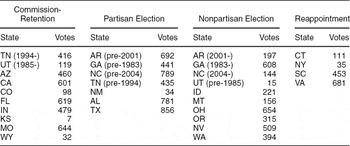
These procedures produced 2,078 cases and 12,777 votes by individual judges. In the different state high courts, there are between five and nine judges and thus a typical case has between five and nine judge votes. We excluded any votes cast by judges who were sitting by designation and thus not regular members of the Court (there were 64 such votes). Table 1 shows the distribution of votes across states, within each system of judicial selection. Each system is associated with at least four states during the time span. Nine had nonpartisan elections during at least some years, nine had commission-retention systems, seven had partisan elections, and four had reappointment systems. As the table depicts, for each system at least six states had over two hundred observations with the exception of reappointment, for which two states dominate the data.Footnote 13 The table also identifies the years in which several of these states switched from one system to another. Other than reappointment all of the systems have multiple “switcher” states. An advantage of the switcher states is that we can evaluate the effect of changing the system within a given state and even for an individual judge. That is, we can assess how a change in selection system alters the decisions of judges who served before as well as after the reform, thereby gaining insight into how the choice of system alters judicial incentives independent of any impact on which judges are selected.
Observations by State and System

Dependent Variable
The dependent variable is a judicial vote, as this is the key piece of information with which the new-style judicial campaign is usually concerned. In death penalty cases at state supreme courts, the vote is about whether a justice supports the defendant's appeal for relief or upholds the lower court imposition of a capital sentence. Accordingly Uphold equals 1 if the judge votes to uphold the lower court decision and 0 if s/he votes to grant relief. Following Blume and Eisenberg (Reference Blume and Eisenberg1999), we define a vote to constitute relief if a judge's position supports a “ruling that precludes imposition of a death sentence unless further action is taken by some court. Therefore, reversals of convictions, remands for hearings on specific issues, vacation of death sentences, and remands for resentencing” all constitute relief. Of the 12,777 judge votes, 73% uphold the death penalty (i.e., do not grant relief). Table 2 provides descriptive statistics for this variable as well as the independent variables, which are described below.
Summary Statistics
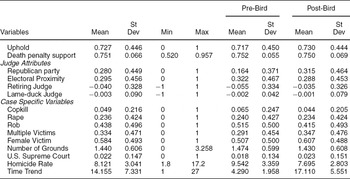
Public Opinion
State-level surveys across all states and over multiple years are rare. Fortunately, multilevel regression with poststratification (Park, Gelman, and Bafumi Reference Park, Gelman and Bafumi2004) can yield reliable estimates of state-level opinion. In multilevel regression with poststratification (MRP), data from national surveys are regressed on the demographic and geographic attributes of the survey respondents, and the predictors are then poststratified by state-level population data. Specifically, in the first stage of MRP, one estimates predicted public opinion for each combination of a set of demographic and geographic characteristics. In the second stage, these estimates are poststratified (weighted) by the proportion of each state's population that possesses the specified demographic and geographic characteristics. Recent research has validated this approach and employed it in a variety of settings (e.g., Lax and Phillips Reference Lax and Phillips2009b, Pacheco Reference Pacheco2011, Warshaw and Rodden Reference Warshaw and Rodden2012).
Shirley and Gelman (Reference Shirley and Gelman2011) perform the first part of MRP (the multilevel regression component) with respect to producing state-level estimates of public opinion on the death penalty; in particular, Shirley and Gelman provide estimates for combinations of geographic and demographic characteristics (e.g., death penalty support among Black women aged 45–64 with a college education in Ohio in 2005). We then perform the second part of MRP, poststratifying the Shirley and Gelman estimates with demographic and population data from the Census and American Community Survey. From these estimates, we take the centered three-year moving average to create the variable Death Penalty Support. Further details on the poststratification procedure and the Shirley and Gelman multi-level regression are given in Online Appendix A.
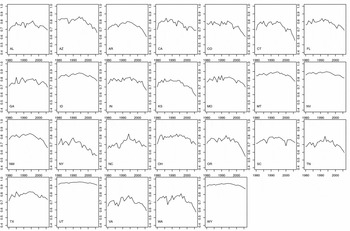
Figure 1 graphs the level of death penalty support, by year, for each state in our dataset.Notably, no death penalty case occurs in a year when a majority of the state's population does not support it. Also apparent is a broader decrease in the popularity of capital punishment over the last decade of the data. The annual mean drops from 80% to 59% over this period within the dataset, and the by-year minimum from 72% (in New York) to 52% (in Oregon).
Estimates of Public Support for the Death Penalty by State
Note: States are organized alphabetically.

Judicial Selection Systems
Each vote is coded for the judicial selection mechanism that was in place in the state at the time the case was decided. We obtained this information from the American Judicature Society “Judicial Selection in the States” website, which documents not only the current selection procedures for each state but also historical changes.Footnote 14 The systems are represented by a set of indicators, each of which equals 1 for that system and 0 otherwise: Nonpartisan Elections, Commission-Retention Systems, Reappointment, and Partisan Elections.
These main effects capture the direct impact of the system on the likelihood of upholding death penalty sentences. Because cases emerge only when at least 50 percent of the public supports capital punishment, this impact reflects the extent to which the system encourages judges to issue popular decisions, as well as any other feature of the system that might encourage capital sentences to be upheld. To examine whether dynamic responsiveness varies according to judicial selection procedures, we also include interactions between each system indicator and Death Penalty Support. It is worth noting that because cases do not emerge when a majority of the public opposes capital punishment, we cannot rule out the possibility that judges are more responsive to punitive public opinion than to nonpunitive opinion (e.g., Huber and Gordon Reference Huber and Gordon2004).
Judge-level controls
Previous research suggests that a judge's ideological disposition affects how she or he votes (e.g., Segal and Spaeth Reference Segal and Spaeth2002) and partisan affiliation is often used as a proxy for state judges’ ideological leanings (e.g., Pinello Reference Pinello1999). Given the major parties’ positions, we anticipate that judges affiliated with the Republican Party will be more likely to uphold a death sentence than those affiliated with the Democratic Party. In states with partisan elections, information on a judge's party is easily obtained through the state “blue books” of election results; however, in other contexts this information is not as readily available. Thus, we attempted to verify independently the partisan affiliation of every judge. For judges who attained their seat through appointment or nonpartisan election, we searched the American Bench biographical directories, local newspapers via Lexis-Nexis, and existing datasets (Canes-Wrone, Clark, and Park Reference Canes-Wrone, Clark and Park2012; Langer Reference Langer2002). If the governor was involved in the initial appointment, which occurs in the commission-retention systems and some reappointment ones, we use the party of the appointing governor as a proxy only if the main sources had no information about the judge.Footnote 15
From these methods, we were able to obtain the partisan affiliation of 534 of the 560 judges. Discarding votes from judges for whom we could not collect this information leaves 12,454 of the 12,777 votes. An alternative approach to controlling for judges’ preferences is the use of fixed effects, which account for each judge's likelihood of reversing a death penalty appeal. Judge-level fixed effects models can include observations for which party affiliation is not available, and some analyses that follow will adopt this approach. The main results are substantively similar whether ideology is accounted for with judge-level fixed effects or via the control for partisan affiliation. This control, Republican Judge, equals 1 for judges affiliated with the Republican Party and 0 otherwise. Only three of the judges were officially identified as Independents.Footnote 16
Prior scholarship suggests that elected officials, including judges, become more responsive to public opinion as an election approaches (e.g., Gordon and Huber Reference Gordon and Huber2007). We account for this effect by Reselection Proximity, which equals 1 if a judge is slated for reelection or reappointment within two years of the decision and 0 otherwise. Using the state blue books, we were able to obtain this information for all judges.
One might similarly expect a judge who is precluded from seeking a subsequent term because of mandatory retirement to exhibit different decision making in his/her final term. Eighteen states in the data prohibit judges from seeking reelection after a specified age.Footnote 17 We accordingly include the variable Retire, which equals 1 if the judge is a Republican and facing mandatory retirement at the end of term, −1 for such Democratic judges, and 0 if the judge does not face mandatory retirement. We similarly include Lame duck to control for justices serving out the remainder of their term after losing an election or having chosen not to seek reelection for a reason other than mandatory retirement. This variable is also set to 1 for Republican lame ducks, −1 for Democratic lame ducks, and 0 otherwise. Our expectation is that Democratic judges will be more disposed to reversing capital sentences if they are a lame duck or facing mandatory retirement and that Republicans will have the opposite incentives.
Legal and Crime-related Factors
Prior scholarship suggests that state supreme court justices are more likely to uphold death penalty sentences if the defendant murdered a police officer, multiple victims, or a female, or if the defendant committed a murder in conjunction with a rape or robbery (e.g., Brace and Hall Reference Brace and Hall1993; Gelman et al. Reference Gelman, Liebman, West and Kiss2004). The binary indicators Cop Kill, Rape, Rob, Multiple Victims, and Female Victim account for each of these case-specific facts, respectively. We coded all of these variables from the 2,078 cases directly.
We have also made efforts to account for the race and ethnicity of the defendant and victim(s). Gathering data on the race and ethnicity of the defendant and, particularly, victims is difficult because unlike the other case-specific facts, this information is not given directly by the case files. Moreover, the cases for which public information on a victim's race is reported by the media are likely to be those for which it is most important, thereby biasing the results. It is presumably for this reason that studies of death penalty decisions in the state courts do not generally control for race. Despite these issues, we have followed the coding procedures of a recent working paper (Alesina and La Ferrara Reference Alesina and La Ferrara2011) for a random sample of 100 cases from each of the four selection systems. Full details on the coding procedures and findings are provided in Online Appendix B. In brief, while minorities are more likely to receive reversals, as one would expect if juries are biased against minorities, this impact does not alter the major findings regarding the selection systems.
In addition to case facts, we account for three additional law-related factors. The first regards appeals based on recent U.S. Supreme Court decisions that establish new legal rules that undermine some aspect of existing capital sentencing procedures in a specific state. Such rulings tend to inspire a wave of successful appeals, as well as some unsuccessful ones; the state court decisions are written with specific reference to that recent decision, and note that the given appeal is a direct consequence of that particular decision. We accordingly code this information directly from the text of the state court opinion. The indicator SCOTUS equals 1 if the state court notes in its opinion that the appeal is based solely on a recent U.S. Supreme Court decision that strikes down some aspect of the capital sentencing procedures that were in place when the defendant was sentenced. In all there were 45 such cases in six states.
A second factor related to the appeals process is the number of grounds upon which an appeal is based. “Kitchen sink” appeals tend to be less meritorious and therefore less likely to succeed (e.g., Poulos Reference Poulos1990). We accordingly expect that the control Grounds, which is the natural log of the number of grounds on which the appeal is based, will be positively related to the likelihood that a judge votes to uphold a capital sentence. Third, the analysis accounts for the possibility that state courts have learned over time what sorts of death penalty cases the U.S. Supreme Court will uphold. After the national moratorium on capital punishment, which began with Furman v. Georgia (1971) and effectively ended with Gregg v. Georgia (1976), some states struggled to institute consistent death penalty procedures that would withstand Eighth Amendment challenges. Assuming the state courts have modified their procedures to increase the likelihood that lower court decisions withstand further scrutiny, one would expect fewer reversals over time (Gelman et al. Reference Gelman, Liebman, West and Kiss2004). To control for this phenomenon, we include a time trend.
Finally, the analysis accounts for the state homicide rate in the year the case was decided. Some research suggests that crime rates affect judicial behavior (e.g., Blume & Eisenberg Reference Blume and Eisenberg1999). To the extent that any such effects occur because of the impact of crime on public opinion, we would not anticipate a significant effect of this control given that public opinion is directly accounted for. We still include Homicide Rate, however, in the event that it affects judicial decisions independently of public opinion.
SPECIFICATIONS AND RESULTS
The text focuses on three main specifications, each with different advantages. First, with judge-level fixed effects, we examine how a switch in the system alters the decisions of judges who serve before and after the reform, holding constant each judge's propensity to affirm death penalty appeals. Second, with fixed effects at the state level, we assess how decisions in the state—not only from judges that served before and after the switch but also judges that served under only one system—changed in association with the reform, holding constant the state's general propensity to affirm death penalty sentences. Each of these fixed effects models leverages the fact that many states reform their system. At the same time, because not all states do so, and no state switches in or out of a reappointment system, we also analyze a model whose identification depends less on the switcher states. In particular, the third main specification includes random intercepts for the states and judges. By including judge- and state-specific error terms, the model allows for the possibility that the variance in decisions may differ across states and judges. As discussed subsequently, we have also estimated a variety of alternative specifications.
The general format of the three main specifications for each judge j on case i in state s is
 $\begin{eqnarray*}
&&\Pr ({\rm Uphold}_{{\rm jis}} = 1)\nonumber\\[-2pt]
&&\quad = \Lambda (\beta _0 + \beta _1 {\rm Nonpartisan}\,{\rm Elections}_{{\rm jis}}\\[-2pt]
&&\qquad +\, \beta _2 {\rm Commission{\hbox{-}}Retention} \, {\rm Systems}_{{\rm jis}} \\[-2pt]
&& \qquad +\, \beta _3 {\rm Reappointment}\,{\rm Systems}_{{\rm jis}} \\[-2pt]
&&\qquad +\, \beta _4 {\rm Nonpartisan}\,{\rm Elections}_{{\rm jis}} \\[-2pt]
&&\qquad \times\, {\rm Death}\,{\rm Penalty } \times {\rm Support}_{{\rm jis}} \\[-2pt]
&&\qquad +\, \beta _5 \hbox{Commission-Retention Systems}_{{\rm jis}} \\[-2pt]
&&\qquad \times\, {\rm Death}\,{\rm Penalty}\,{\rm Support}_{{\rm jis}} \\[-2pt]
&&\qquad +\,\beta _6 {\rm Reappointment}_{{\rm jis}} \times {\rm Death\, Penalty\, Support}_{{\rm jis}}\\[-2pt]
&&\qquad +\, \beta _7 \,{\rm Partisan}\,{\rm Elections}_{{\rm jis}} \times {\rm Death}\,{\rm Penalty } \\[-2pt]
&&\qquad \times\, {\rm Support}_{{\rm jis}} + \psi\, \,{\rm Controls}_{{\rm jis}} + \mu _{\rm j} + \lambda_{\rm s}),
\end{eqnarray*}$
The omitted indicator for the judicial selection systems is Partisan Elections, and thus the main effects of the other systems are estimated in comparison to partisan elections. Accordingly, if the Partisan Signals hypothesis is correct, and judges facing nonpartisan or retention elections are more likely to uphold capital sentences than judges facing partisan elections, β1 and β2 should be significantly positive. If instead the ABA is correct and the plebiscitary pressures are greatest for partisan elections, then β1 and β2 should be significantly negative.
The predictions concerning dynamic responsiveness are directly captured by the coefficients on the interaction terms. (For ease of interpretation, Equation (1) interacts each of the four systems with the public opinion variable, rather than including a main effect for public opinion and interacting it with three of the systems; the two approaches are statistically equivalent.)Footnote 18 In particular, if the Dynamic Representation in Partisan Elections prediction is correct then β7 should be positive and statistically significant. Likewise, if the Indirect Accountability prediction is correct, then β6 should be significantly positive.
Post-Bird Results
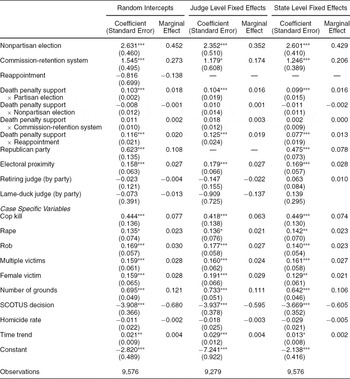
Because the predictions concern the context of the new-style judicial campaign, we first examine a period in which the new-style campaign is well established. Specifically, we analyze cases decided after the year of the high-profile defeat of Rose Bird and other California justices. As noted, the 1986 election was the first in which a new-style campaign unseated a state supreme court judge. Subsequent to this analysis, we compare these “Post-Bird” results to ones from the years preceding her defeat, examine alternative cut points, and analyze trends in judicial behavior. As a starting point, however, specification testing supports the division of the data into the pre- versus post-Bird periods.Footnote 19 Table 3 presents the results for the post-Bird years. In general, the evidence is consistent with the social science perspectives—the Partisan Signals, Dynamic Representation, and Indirect Accountability models—and not with most of the legal community's conventional wisdom. In each model, the coefficient on nonpartisan elections is significantly greater than the base system, partisan elections. These results support the Partisan Signals prediction and contradict the conventional wisdom from the ABA and most previous studies. Judges subject to nonpartisan elections are more, not less, likely to make the popular decision of upholding a death penalty appeal.Footnote 20
Judicial Selection System, Public Opinion, and Death Penalty Decisions

Notes: The dependent variable is Pr(Uphold Death Penalty = 1). ***p < 0.01, **p < 0.05, *p < 0.10, two tailed.
To assess the magnitude of the impact, we first report marginal effects at the means of other independent variables and then turn to predicted probabilities below, in Figure 2. Because the main effect of the system concerns responsiveness to majority opinion, and a separate variable captures dynamic responsiveness, the marginal effect of Nonpartisan Elections should be interpreted as the impact of this system when popular support is a bare majority. At this level, judges in nonpartisan election systems are between 35 and 45 percentage points more likely to uphold a death sentence than judges in partisan election systems. Even in the judge-level fixed effects model, which captures how a typical judge alters his/her behavior when a new system is adopted, the magnitude is substantial; the judge becomes 35 percentage points more likely to uphold capital sentences if the system switches from partisan to nonpartisan elections.Footnote 21
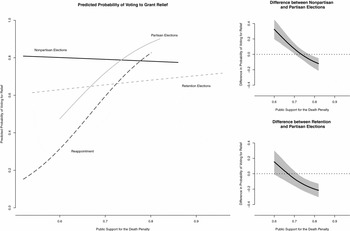
Predicted Probabilities of Upholding Death Penalty Decisions
Note: Estimates calculated using point estimates; all other covariates held at means. In right panels, black lines show point estimate of the differences, and grey regions show 95% confidence interval.

The results on the main effects of commission-retention systems also support the Partisan Signals prediction, albeit less strongly. The coefficients are in the expected direction and always at least marginally significant at p < 0.1, two tailed. The magnitude of the impact is smaller than that for nonpartisan elections, although still notable. In each case, a change from partisan elections to a commission-retention system is associated with an increase in the likelihood of upholding a death sentence by more than 17 percentage points. These findings counter the idea that the commission-retention system insulates judges from the plebiscitary pressures associated with partisan elections. However, the likelihood of affirming death penalty decisions is lower in the commission-retention systems than in the nonpartisan election ones (p < 0.05, two tailed), suggesting that contestability increases judges’ propensity to issue popular decisions when the impact of partisan ballots is held constant.
Turning to the interaction effects, it is immediately clear that they provide support for the Partisan Elections Dynamic Representation prediction; the effect of Partisan Elections × Death Penalty Support is significantly positive in all three specifications. Recall that these estimates reflect the extent to which judges’ likelihood of affirming capital sentences increases as public support rises incrementally. Thus just as Erikson, MacKuen, and Stimson (Reference Erikson, Mackuen and Stimson2002a) find with respect to other officials who face partisan elections, judges who face them become more likely to issue popular decisions as the level of public support for a position increases.
Figure 2 graphs these dynamics for the random intercept specification. The left, main panel shows the predicted probability of voting to uphold a death sentence by system at different levels of public support for the death penalty, holding all other variables at their means. The figure maps the predicted probabilities across the range of public opinion in which a death penalty case is observed. Thus for partisan elections, the figure shows the predicted probabilities from 60%support for capital punishment to 82% support. At only 60% support, the likelihood that a judge affirms a death sentence is barely higher than what one would expect from chance. However, this probability increases dramatically as the popularity of capital punishment rises.Footnote 22
The results for judges facing reappointment are similar, lending support for the Indirect Accountability hypothesis. In fact, as Figure 2 indicates, the slopes of the reappointment and partisan election systems are nearly identical. Specification testing suggests the difference between the coefficients on these interactions is not significant at any conventional level (χ2 (1) = 0.25; p = 0.62). As mentioned previously, most of the observations on reappointment systems are from ones with legislative reappointment, thus they drive the results regarding reappointment.
Figure 2 also highlights the distinction between responsiveness to majority sentiment and responsiveness to change in the level of public opinion. Judges in nonpartisan election systems are highly likely to affirm death penalty appeals at any level of majority support; the predicted probability of upholding a capital sentence is close to 80% regardless of whether a slim majority supports the death penalty or 85% of the public does. On the one hand, this relatively flat line for nonpartisan elections may seem surprising. On the other hand, as previously discussed, the theory that underlies the Partisan Signals perspective predicts a positive slope that then plateaus (Canes-Wrone and Shotts 2009). Consistent with this prediction, if we truncate the data at the mean of Death Penalty Support, which is 0.75, then the slope of nonpartisan elections interacted with death penalty support becomes significantly positive, and the main effect of nonpartisan elections remains significant. Online Appendix C details these results.
The right panels of Figure 2 show how responsiveness to majority opinion in the nonpartisan and retention systems intersects with the dynamic responsiveness of the partisan election and reappointment systems in the multilevel model. The top right panel depicts the difference in the predicted probability between nonpartisan and partisan election systems, with the associated confidence interval. In most of the figure, the difference is significantly positive. It is only significantly negative when public support for the death penalty reaches approximately 80%, a level that encompasses only 5% of the observations in the partisan election systems. Moreover, if we were to graph the results of the judge-level fixed effects model rather than the multilevel estimates, the graph would not show a significant difference even at this level of popular support.
By comparison, affirmations of capital sentences are more likely in commission-retention systems than partisan election systems only when public opinion is relatively divided, as shown in the bottom right panel of Figure 2. When public opinion becomes quite supportive of capital punishment, the difference runs in the other direction. Not pictured for space reasons are the confidence intervals for the differences between commission-retention and nonpartisan election systems, and between reappointment and partisan election systems. As one would expect from Table 3 and the other reported tests, there is no value of public opinion for which a significant difference emerges between the reappointment and partisan election systems. Likewise, in keeping with earlier discussion, the difference between nonpartisan and retention elections is significant until public support for the death penalty is relatively high.
The results for the control variables similarly present few surprises. As detailed in Table 3, partisan affiliation and the electoral calendar significantly influence judicial decision making. The only judge-specific variables that produce an insignificant impact are the controls for lame duck and retirement; however, if we exclude the state and judge effects these variables become significant. The case-specific variables also present few surprises. In fact, all of the various case-specific variables are in the expected direction and statistically significant at conventional levels. Finally, the time trend is significant while the homicide rate is not. The significance of the former suggests that over the years the states have worked out the constitutional kinks in their capital sentencing procedures, while the insignificance of the latter is not particularly surprising given that the analysis accounts for public opinion directly.
We have conducted a number of robustness checks to assess whether the results of Table 3 might change with alternative specifications. These include models that replace the time trend with year indicators, clustering the standard errors by case in the fixed effects models, and cross-classified hierarchical models that account for case-level random intercepts in addition to judge- and state-level ones.Footnote 23 Across these different models, the only substantial change in the findings on selection systems is that the coefficient on commission-retention systems is not always significant at conventional levels; for example, it is not significant in the model with judge-level fixed effects and clustered standard errors. This is one reason we cautioned in the Introduction that the results for retention systems are less robust than those for nonpartisan elections. By comparison, these other findings—on nonpartisan elections, on indirect accountability, and on dynamic responsiveness in partisan elections—all hold at conventional levels of significance in the alternative analyses.Footnote 24 Online Appendix C presents these results.
Pre- versus Post-Bird Results
We have emphasized that many of the dynamics that underlie the hypotheses are driven by contemporary judicial electoral politics, and therefore the effects in Table 3 should not emerge until the new-style judicial campaign became well established. To assess this account, we examine within a single empirical model the difference between the period prior to Rose Bird's defeat (1980–1986) and the subsequent years. Following this analysis, we examine alternative cut points and more gradual trends in judicial behavior.
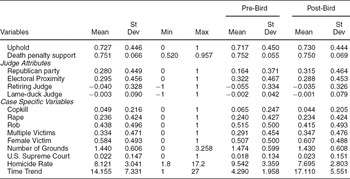
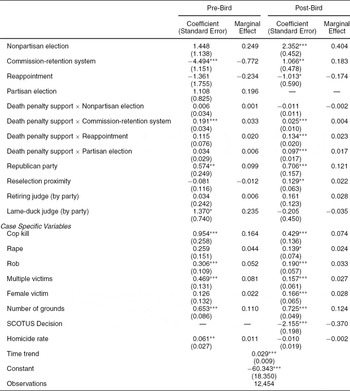
Table 4 reports the estimates produced by a single model, where each variable other than the time trend has been interacted with both a pre- and post-Bird indicator, i.e., 1980–1986 versus 1987–2006. To emphasize the unified nature of the model, we include a unified constant term and therefore do not need to omit the partisan elections main effect in the pre-Bird period. (This specification is statistically equivalent to dropping this main effect and estimating separate constant terms for the pre- and post-Bird periods.) For space reasons, and because the results in Table 3 were consistent across specifications, Table 4 reports the findings only from the random intercepts model; those from the fixed effects models are similar and available upon request. The table divides the results into two columns to highlight any differences between the pre- and post-Bird eras even though the estimates are from a unified model. Most striking is the comparison between the pre- and post-Bird estimates regarding the judicial selection systems. For example, in the period before Justice Bird's defeat, the Partisan Signals prediction is not supported. Indeed, the difference between partisan and nonpartisan election systems in the pre-Bird period is even less significant than it may first appear, as the omitted category for the systems is post-Bird partisan elections; a direct comparison between the estimates on the pre-Bird main effects for partisan and nonpartisan election systems is both small in magnitude (0.340) and not all at significant (p = 0.77, two tailed). Interestingly, however, the ABA conventional wisdom receives corroboration in the pre-Bird period. The likelihood of upholding a death penalty conviction is significantly lower in commission-retention systems than in either partisan or nonpartisan election systems (p < 0.01 in each case). Thus the merit system did reduce plebiscitary pressures before interest groups achieved success by campaigning against justices for their decisions. Only the post-Bird period estimates support the Partisan Signals perspective.
Public Opinion and Death Penalty Decisions, Pre- versus Post- Rose Bird

Notes: All results are from a single model that interacts the pre- and post-Bird indicators with the independent variables. The dependent variable is Pr(Uphold Death Penalty = 1). Analysis conducted with random intercepts for the state- and judge-levels. ***p < 0.01, **p < 0.05, *p < 0.10, two-tailed.
The other systems also have different effects between the two periods. The pre-Bird estimates on the interaction terms between public opinion and each of partisan elections and reappointment are not at all significant, suggesting that the Dynamic Representation Partisan Elections and Indirect Accountability predictions are not corroborated pre-Bird. By comparison, the post-Bird results for these interaction terms are similar to those in Table 3.
A reasonable question is whether this change is as stark as a pre- versus post-Bird distinction. To assess this question, we have conducted a battery of tests. First, building on the model that includes interactions for the pre- and post-Bird periods, we analyzed whether the four variables that test the theoretical predictions—Nonpartisan Elections, Retention Elections, Partisan Elections × Death Penalty Support, and Reappointment × Death Penalty Support—change gradually over time. In particular, these variables are interacted with the time trend, allowing as in Table 4 the possibility that the effects differ between the pre- and post-Bird period. In other words, a three-way interaction among the time trend, the post-Bird indicator, and each of these system variables is included, as is a three-way interaction among the time trend, pre-Bird indicator, and these system variables. (We also include interactions between the time trend and the pre- versus post-Bird periods, so that all two-way interactions and main effects are accounted for.)
Notably, all of the three-way interactions are positive and significant in the post-Bird period, while pre-Bird only the reappointment estimates indicate any sort of gradual change.Footnote 25 These results indicate that the change in the post-Bird years was not a one-time, instantaneous change, but instead began with the Rose Bird election and grew year by year. Prior to the pivotal California election, however, there is no significant trend in the behavior of the judges in the nonpartisan, partisan, and retention systems. As a further attempt to assess whether change might have predated the Rose Bird defeat, we split the pre-Bird data to examine whether judicial behavior in the later years of this period differed fundamentally from the earlier years. Online Appendix Table D shows these results, which corroborate the time-trend analysis by suggesting that judicial incentives were similar across the pre-Bird years. Moreover, given the evidence of gradual change in the post-Bird period, we examined whether the findings in Table 4 would hold in the first half of the post-Bird period if those years were split evenly. As Online Appendix D shows, the findings on nonpartisan and partisan elections—that the former pressure judges to cater to majority sentiment and latter create incentives for dynamic responsiveness—are highly significant in both periods. However, the major results on reappointment systems and retention systems do not emerge until the later years.
Overall, the results on the pre- versus post-Bird periods suggest that the incentives facing judges have changed with the rise of the new-style judicial campaign. In the era before the salient Rose Bird election, the scholarly predictions that presume the existence of a new-style campaign do not receive support. Moreover, the ABA's claims about the insulating nature of commission-retention systems are validated. After the Rose Bird defeat, however, judicial behavior begins following patterns that social science theories predict should occur within the context of the new-style campaign.
CONCLUSION
A central issue in institutional design is how to create the right incentives for governing officials. In the context of judicial institutions, a variety of policy recommendations exist, but there is little evidence about their effects. Moreover, various recommendations are intuitive yet mutually exclusive. This article outlines three major social science perspectives about how different selection mechanisms condition judicial responsiveness to public opinion and empirically evaluates the predictions on the most extensive dataset to date of state-level death penalty decisions. In doing so, the article offers evidence on how recent developments in judicial elections—namely, the rise of the new-style judicial campaign—have changed the way in which politics operates through the four dominant selection and retention methods employed throughout the U.S.
The analysis shows that the rise of expensive, policy-oriented judicial campaigns has created incentives for judges in the most low-information election environments to cater to majority sentiment on the salient campaign issue of the death penalty. Contrary to most of the literature and the conventional wisdom of the legal community, partisan elections do not provide the largest plebiscitary pressures, particularly when opinion is not overwhelmingly strong in a particular direction. Judges are significantly more responsive to majority opinion in nonpartisan than partisan election systems. Moreover, the evidence indicates that this result derives from judicial incentives, not simply differences in the types of judges selected between the systems. Similar effects are found for commission-retention systems, but these findings are less robust than those for nonpartisan elections.
While the plebiscitary pressures to cater to majority opinion are high for the nonpartisan election systems, there are pressures in the other systems, too. With partisan elections or reappointment, judges respond to change in the level of public support for a position. Thus while these judges are not likely to cater to majority sentiment when only a modest majority of voters support a policy, the likelihood rises as an overwhelming majority begins to favor the position. The findings on reappointment systems highlight that appointment in and of itself does not necessarily eliminate public pressures; indeed, the level of dynamic responsiveness in these systems is statistically similar to that in the partisan election systems.
The final major finding is that the new-style judicial campaign has had a significant impact on judicial decision making. Prior to its emergence, the intuitive predictions set forth by the American Bar Association are largely supported. For instance, in the years before the defeat of multiple California Supreme Court justices, commission systems appear to insulate judges. It is only since this watershed election that commission systems became less insulating and that judges began behaving as if their decisions could affect the probability of retaining office within the context of a new-style campaign.
Of course, at the most basic level, the effects reported here are limited to the specific subset of cases we have studied: death penalty cases. However, there is reason to believe that the larger incentives may permeate decision making on a variety of hot-button issues. New-style campaign ads have involved issues ranging from tax policy to same-sex marriage to collective bargaining. The fact that such tactics are used arguably creates incentives for judges to be mindful of public opinion in cases that a group may decide to make the center of a new-style campaign, even if the group's aims involve other issues.Footnote 26
Finally, while this article does not directly make normative claims about the choice of selection systems, we believe that the analysis provides some insight. Many reformers have sought to take the plebiscitary pressures out of judicial selection but lacked empirical evidence of how the political incentives operate in practice. The findings here suggest that some of the efforts have backfired, at least on a hot button issue such as the death penalty. We thus hope that this analysis and ones that build on it can provide a stronger empirical foundation for the continuing debates on judicial selection.
Supplementary materials
To view supplementary material for this article, please visit http://dx.doi.org/10.1017/S0003055413000622




Comments
No Comments have been published for this article.