Significant outcomes
∙ Glucagon-like peptide-1 (GLP-1) agonists are neutral in tests of anxiety and depression after chronic administration.
∙ Tolerance seems not to develop towards corticosterone-releasing effect of GLP-1 receptor agonists.
Limitations
∙ Whether these results are relevant in patients has to be demonstrated in clinical studies.
Introduction
Glucagon-like peptide 1 (GLP-1) receptor agonists are widely used in the treatment of type 2 diabetes (Reference Drucker and Nauck1). GLP-1 is a peptide hormone and transmitter belonging to the group of gut hormones, the incretins. Interestingly, GLP-1 does not only serve as a glucose regulatory endocrine signal in the intestinal-pancreatic axis, but may have many additional physiological functions in the alimentary system, cardiovascular system and brain (Reference Ussher and Drucker2–Reference McKay and Daniels5). Indeed, several lines of evidence suggest that GLP-1 plays multiple roles in the central nervous system (CNS). Likewise, when injected systemically, GLP-1 receptor agonists do not only affect the pancreas and gastrointestinal tract, but probably also the CNS. Thus, the nausea induced by peripheral administration of GLP-1 or exenatide (a GLP-1 agonist) seems to be caused by its direct action in certain brain regions (Reference Kanoski, Rupprecht, Fortin, De Jonghe and Hayes6,Reference Punjabi, Arnold and Rüttimann7); and some effects of the drug are mediated by the vagal afferents (Reference Labouesse, Stadlbauer, Weber, Arnold, Langhans and Pacheco-Lopez8). Moreover, it has been demonstrated several times that peripherally administered GLP-1 receptor agonists may influence memory formation and retrieval (Reference Salcedo, Tweedie, Li and Greig3,Reference During, Cao and Zuzga9), and a recent study demonstrated that a GLP-1 receptor agonist was able to attenuate the reinforcing properties of alcohol in rodents (Reference Egecioglu, Steensland, Fredriksson, Feltmann, Engel and Jerlhag10). Results from animal studies suggest that GLP-1 may also play a role in major psychiatric diseases, namely anxiety and depression (Reference Isacson, Nielsen and Dannaeus11,Reference Moller, Sommer, Thorsell, Rimondini and Heilig12). Chronic treatment of mice with exenatide was shown to exert an antidepressant-like effect in the forced swim test (FST) (Reference Isacson, Nielsen and Dannaeus11), the prototypical screening procedure for determining depression-like behaviours as well as antidepressant treatments in rodents (Reference Porsolt, Bertin and Jalfre13). In contrast, we have previously shown that acute administration of glycemically equipotent doses of the two GLP-1 receptor agonists liraglutide and exenatide did not affect anxiety- or depressive-like behaviours in mice; but it did, however, decrease locomotion in the open field test (Reference Krass, Runkorg, Vasar and Volke14). Nevertheless, the possible antidepressant effect of chronic treatment with these drugs ought to be verified in an experimental model of depression. Another interesting aspect of GLP-1 signalling is its involvement in the neuroendocrine stress response. Several studies have demonstrated that GLP-1 agonists stimulate the hypothalamic–pituitary–adrenal (HPA) axis in rodents and humans (Reference Gil-Lozano, Perez-Tilve and varez-Crespo15,Reference Malendowicz, Neri, Nussdorfer, Nowak, Zyterska and Ziolkowska16), and we have previously shown that glycemically comparable doses of exenatide and liraglutide had similar potency in increasing corticosterone release (Reference Krass, Runkorg, Vasar and Volke14). In addition, GLP-1 receptor knockout mice were found to suffer from impaired behavioural and HPA axis response to stress (Reference MacLusky, Cook and Scrocchi17). While some side effects of the drugs are known to abate with prolonged use (Reference Drucker and Nauck1), this may not be the case as regards the neuroendocrine alterations. A very recent study demonstrated that 8 days of GLP-1 analogue treatment was associated with a profound dysregulation of the HPA axis similar to what is seen in chronic stress (Reference Gil-Lozano, Romani-Perez and Outeirino-Iglesias18). Unfortunately, these animals were not subjected to behavioural tests.
The Flinders Sensitive Line (FSL) rat has been widely described and highly validated as a genetic animal model of depression (Reference Overstreet and Wegener19). These animals present with the characteristic features of depression, and they respond to chronic but not acute antidepressant treatment when examined in the FST. As the data about possible antidepressant-like effect of GLP-1 agonists have been inconsistent, we found it very important to verify the findings in endogenous model of depression.
Based on available evidence, we hypothesised that chronic treatment with GLP-1 receptor agonists may induce antidepressant-like effect.
Thus, the aim of the current study was to examine behavioural and neuroendocrine changes in healthy mice following chronic treatment with exenatide and liraglutide and to verify the possible antidepressant effect of chronic liraglutide treatment in FSL rats, a genetic model of depression.
Materials and methods
Animals
Male C57Bl/6J mice (Harlan, The Netherlands) weighing 25–35 g were used. Mice were kept 10 per cage in an animal house at 20°C with a 12 h light/dark cycle (light on at 07:00 a.m.). Tap water and food pellets were available ad libitum. The animals were kept in the animal colony for at least 2 weeks before starting experiments.
Male FSL rats and corresponding controls, Flinders Resistant Line rats (FRL), supplied by the Translational Neuropsychiatry Unit (Risskov, Denmark), were pair housed at 20°C with a 12 h light/dark cycle (lights on at 07:00 a.m.) with access to tap water and standard chow ad libitum. Mean age of the rats at study initiation was 85 days. The rats were moved to the experimental location 1 day before each separate test in order to allow acclimatisation.
All animal procedures were accepted by the Estonian National Committee for Ethics in Animal Experimentation or Danish Animal Experiments Inspectorate and complied with ‘Principles of laboratory animal care’ (NIH publication 25–28, 1996).
Mouse light–dark compartment test
An exploratory model first described by Crawley and Goodwin (Reference Crawley and Goodwin20) was used. The apparatus consisted of two compartments (20×20×20 cm) connected by a 7.5×7.5 cm opening in the wall. One compartment was painted black and covered with a roof. The other compartment had no roof and was brightly illuminated by a 60-W bulb located 25 cm above the box. An animal was placed into the centre of the dark compartment and the latency of the first transition, number of transitions and time spent in the light compartment were recorded during 5 min.
Mouse FST
The FST was performed as described by Porsolt et al. (Reference Porsolt, Bertin and Jalfre13). Briefly, a glass cylinder 12 cm in diameter was filled with 8 cm of water at 25°C. The animal was gently put into the water, and all of its behaviour was videotaped during 6 min. Subsequently, the immobility time was counted by an observer blind to the treatment protocol during the last 4 min of the 6-min test.
Rat FST
The rat FST was performed with a slightly altered protocol as described previously (Reference Abildgaard, Solskov, Volke, Harvey, Lund and Wegener21). Briefly, as we wanted to confirm the phenotype of the naïve FSL/FRL rats, we performed a pre-test just before study initiation and the test trial near the end of the study. Thus, just before study initiation, rats were individually immersed in a water-filled (25°C) transparent plastic cylinder (height: 54 cm; diameter: 24 cm; water depth: 40 cm) for 10 min. At study day 35, the test trial was carried out in the same way. All sessions were video recorded and the duration of immobility during the last 6 min of the test trial was scored using the prevailing time-sampling technique (Reference Detke, Rickels and Lucki22). All scoring was performed blinded to study groups.
Open field test
Motor activity in mice was measured using an automated system with six chambers (45×45×45 cm) made from transparent acrylic (MOTI, Technical & Scientific Equipment GMBH, Bad Homburg, Germany). The apparatus-naïve mice were put into the chamber and vertical and horizontal activity was counted during a 10-min-test period.
Similarly, the rats were tested immediately before the FST test trial. The animals were individually placed in a video-recorded square box (100×100 cm, wall height: 20 cm) for 8 min, and their movements were subsequently tracked by Noldus EthoVision XT7 software. The total distance travelled (cm) was used as an indicator of locomotor activity.
Experimental design
Mouse studies: Study I: effects of chronic treatment with GLP-1 receptor agonists
Animals (n=10 in all groups) were treated with GLP-1 receptor agonists for 14 days.
Exenatide (Byetta) and liraglutide (Victoza) were diluted with saline and injected subcutaneously in a volume of 0.1 ml/10 g mouse body weight. Exenatide (10 µg/kg) was injected twice daily, liraglutide (1200 µg/kg) once daily with a second injection of saline. The control group received a saline injection twice daily. Doses were selected according to our previous study, demonstrating equipotent effects on blood glucose and corticosterone levels (Reference Krass, Runkorg, Vasar and Volke14). On the last day of the experiment the light–dark compartment test, the measurement of motor activity and the FST were carried out consecutively 60, 70 and 80 min after treatment with the GLP-1 receptor agonist, respectively (Reference Krass, Wegener, Vasar and Volke23). Animals were sacrificed after FST and blood collected for corticosterone measurement.
Mouse studies: Study II: effect of subchronic treatment with exenatide on immobility
The protocol of the previous study reporting an antidepressant-like effect of exenatide (Reference Isacson, Nielsen and Dannaeus11) was replicated. Mice (n=10 in both groups) received either 0.1 μg/kg exenatide or vehicle twice daily for 1 week intraperitoneally. The FST was performed after a 3-day wash-out period at the end of the subchronic treatment as described by Isacson et al. (Reference Isacson, Nielsen and Dannaeus11).
Mouse studies: Study III: comparison of acute and chronic effects of GLP-1 agonists on corticosterone release
Exenatide (10 µg/kg twice daily, n=10), liraglutide (1200 µg/kg once daily with a second injection of saline, n=10), or saline (n=20) was administered during 14 days. On the day of the experiment, 10 animals from the saline group received an injection of exenatide (10 µg/kg). Animals were sacrificed 90 min later and blood was collected for corticosterone measurement.
In a separate experiment the acute effect of exenatide (10 µg/kg) was compared with the effect of exposing the mice to FST.
Rat study
The rat study comprised three groups: FSL rats treated with vehicle (D-PBS buffer; n=8) or liraglutide diluted in D-PBS buffer (n=8), and FRL rats treated with vehicle (n=8). The solutions were injected subcutaneously twice daily for 5 weeks (1 ml/kg/day). The dose of liraglutide was stepwise titrated to 200 µg/kg/day during the first 10 days in order to minimise adverse effects. At study day 35, the open field test and FST were performed.
Measurement of glucose
Mouse blood was obtained by tail bleed after completion of the FST (90 min after injection). The glucose level was measured by a glucometer (Optium Xceed, Abbott Witney, Oxon, UK).
Rat blood was sampled from a tail snip on study day 30 following a 12-h fast (12 h after last injection). Blood glucose level was determined on a Precision Xceed glucose monitor (Abbott Laboratories).
Corticosterone levels
Truncal blood was obtained after decapitation of mice following completion of the FST (Study I) or after completion of the test protocol (Study III). Blood was collected into EDTA-containing (1.8 mg/ml blood) vials and plasma was separated immediately by centrifugation (2700 rpm, 7 min). Corticosterone was analysed by EIA kit (Immunodiagnostic Systems Ltd., Boldon, Tyne & Wear, UK) according to the manufacturer’s instructions.
Statistics
Data were statistically examined using one-way analysis of variance (ANOVA). Post-hoc comparisons between individual groups were performed by Tukey’s HSD test. A t-test was used when appropriate. Data are expressed as the mean values±SEM. Differences were considered to be statistically significant when p was <0.05.
Results
Effects of chronic treatment with GLP-1 receptor agonists on body weight and glucose levels
There was no difference in the body weight of the mice at the beginning of the experiment (saline group 30.8±0.8 g; exenatide 31.1±0.7 g; liraglutide 31.4±0.6 g). Chronic treatment with GLP-1 agonists had effects on weight (F 2,27=6.1; p=0.007) and glucose level (F 2,27=4.9; p=0.015).
Both drugs lowered glucose levels equally (Fig1a; p<0.05 vs. saline) while only liraglutide lowered weight after chronic dosing (Fig 1b; p<0.05).
Effects of chronic treatment (2 weeks) of mice with glucagon-like peptide 1 (GLP-1) agonists on blood glucose (a) and body weight (b). Glucose was measured 90 min after dosing with drug. Body weight was measured after 2 weeks of treatment. Results are expressed as mean±SEM. n=10 in all groups *p<0.05 versus saline (Tukey’s HSD test).

In the rat study, no differences in body weight were seen at study initiation (F 2,21=0.01; p=0.99) or study end (F 2,21=1.07; p=0.36), but weight gain during the study differed significantly (F 2,21=10.6; p=0.001). Liraglutide-treated rats gained less weight (25.9±4.3 g) than both vehicle-treated FSL (49.0±4.3 g; p=0.001) and FRL animals (46.8±3.1 g; p=0.003). Similar to the findings in mice, differences were seen in glucose levels (F 2,21=5.57; p=0.01). Specifically, 4 weeks of liraglutide treatment lowered blood glucose levels in the liraglutide group (4.4±0.2 mmol/l) compared with vehicle-treated sensitive rats (5.3±0.1 mmol/l; p=0.01).
Effects of chronic treatment with GLP-1 receptor agonists on anxiety and depression-related behaviour
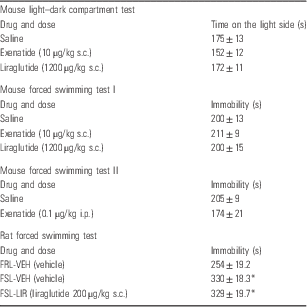
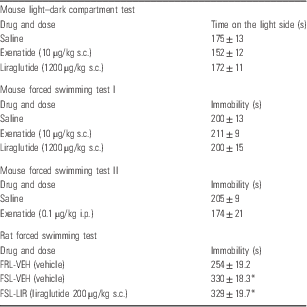
All results are given in Table 1. GLP-1 receptor agonists did not change the anxiety level of mice in the light–dark compartment test (F 2,27=0.95; p=0.4). Treatment was also ineffective in the mouse FST (F 2,27=0.26; p=0.78). Moreover, we did not detect any change in immobility when the exenatide dosing protocol of the previous report (Reference Isacson, Nielsen and Dannaeus11) was followed (p>0.05, t-test).
Behavioural effects of chronic treatment with GLP-1 agonists
GLP-1, glucagon-like peptide 1; FRL, Flinders Resistant Line; FSL, Flinders Sensitive Line.
*p<0.05 compared with FRL-VEH.
We also examined the possible antidepressant effect of liraglutide in FSL rats, a genetic animal model of depression. The differences in the immobility time were statistically close to significance (F 2,21=2.8; p=0.08). As expected, rats from the resistant line spent less time immobile in the test trial compared with rats from the sensitive line (p=0.03) and treatment with liraglutide did not alter the time spent immobile by the sensitive rats (p=0.96).
Effects of chronic treatment with GLP-1 receptor agonists on locomotion
Chronic treatment of mice with GLP-1 receptor agonists had no effect on the distance travelled (Fig 2a; F 2,27=0.2; p=0.82) but the change in the number of rearing was close to significance (F 2,27=3.3; p=0.053). Exenatide (p<0.05) but not liraglutide induced a modest decrease in the number of rearing (Fig 2b).
Effects of chronic treatment of mice with glucagon-like peptide 1 (GLP-1) agonists on distance travelled (a) and number of rearing (b). Results are expressed as mean±SEM. n=10 in all groups. *p<0.05 versus saline (Tukey’s HSD test). ANOVA indicated close-to-significant change (p=0.053) in case of number of rearing.
In the rat study, the distance travelled differed between groups (FRL saline 1877±250 cm; FSL saline 3133±282 cm; FSL liraglutide 3062±359 cm; F 2,21=5.51; p=0.01). Both FSL groups were significantly more active compared with the FRL-VEH group (p<0.03). However, liraglutide did not modify the locomotion of the rats (p=0.99, data not shown).
GLP-1 receptor agonists induce potent and sustained stimulation of corticosterone secretion
After acute administration, exenatide increased corticosterone levels to a similar extent as forced swimming for 6 min (Fig 3a; F 2,27=14; p<0.0001). Whether tolerance develops towards this effect of GLP-1 receptor agonists was further evaluated after chronic dosing both under non-stressed conditions (Fig 3b) and paired with the swimming stress (Fig 3c). In the case of non-stressed mice, chronic treatment induced significant changes in corticosterone levels (F 3,35=17; p<0.0001). Remarkably, exenatide stimulated corticosterone release just as potently after 2 weeks of treatment as after a single dose.
Effects of treatment of mice with glucagon-like peptide 1 (GLP-1) receptor agonists on plasma corticosterone. (a) Corticosterone was measured 90 min after injection with exenatide (10 µg/kg) or immediately after a forced swimming test. (b) Animals were treated for 2 weeks with GLP-1 receptor agonists. Corticosterone was measured 90 min after the last injection with drug. The study included a group receiving chronic saline injections, which was dosed with exenatide only once on the final day of the experiment. (c) Animals were treated 2 weeks with GLP-1 receptor agonists and subjected to a forced swimming test. Corticosterone was measured 90 min after the last injection with drug. Results are expressed as mean±SEM. n=10. *p<0.001 versus saline (Tukey’s HSD test).
Similarly, both GLP-1 receptor agonists significantly stimulated corticosterone release after chronic treatment in combination with swimming stress (F 2,27=14.5; p<0.0001).
Discussion
In this study we aimed to examine and compare the potential behavioural and neuroendocrine alterations induced by chronic treatment with two GLP-1 analogues in mice. In addition, we wanted to test whether prolonged GLP-1 analogue treatment could attenuate depressive-like behaviour in a genetic rat model of depression.
The doses of exenatide and liraglutide were selected according to our previous study where a similar drop in blood glucose was noted after acute administration (Reference Krass, Runkorg, Vasar and Volke14). Likewise, the drugs lowered blood glucose with the same potency after chronic administration in mice and liraglutide had a convincing glucose lowering effect in a rat study. These findings support the notion that clinically relevant doses of the drugs were used. The weight of the mice was decreased only after treatment with liraglutide. Exenatide did not significantly affect the weight of mice after 2 weeks of treatment. This finding may reflect the shorter action of the drug. We found no effect of chronic treatment with GLP-1 receptor agonists on anxiety level in the mice. Previous studies have implicated GLP-1 receptors in the regulation of anxiety (Reference Moller, Sommer, Thorsell, Rimondini and Heilig12,Reference Kinzig, D’Alessio and Herman24). In both those studies, GLP-1 active drugs were injected by the intracerebral route. Thus, it is possible that GLP-1 agonists injected systemically either do not penetrate to the structures where GLP-1 influences anxiety or the concentration in these areas remains too low.
Exenatide has been shown to induce an antidepressant-like effect after subchronic dosing (Reference Isacson, Nielsen and Dannaeus11). This is potentially a very important finding considering the high level of comorbid depression in diabetic patients (Reference Ali, Stone, Peters, Davies and Khunti25). We have performed a comprehensive set of experiments addressing possible antidepressant-like effects after chronic treatment with GLP-1 receptor agonists. First, we evaluated healthy mice exposed to liraglutide or exenatide for 2 weeks, but no behavioural changes were seen in the FST. We also performed a study utilising a genetic animal model of depression, FSL rats. However, 5 weeks of liraglutide treatment did not affect depressive-like behaviour in these rats either. Keeping the signs of HPA axis dysregulation in mind, importantly, no pro-depressant effect of GLP-1 analogues was seen in mice or in rats. Previously, an antidepressant effect in the FST has been attributed to subchronic (1 week), but not acute, exenatide treatment in mice. In that study (Reference Isacson, Nielsen and Dannaeus11), however, exenatide was administered intraperitoneally, whereas we administered the drugs subcutaneously consistent with clinical practice. Thus, we replicated the protocol of the previous study and did not find any effect on the immobility of the mice. Collectively, chronic treatment with GLP-1 agonists does not result in an antidepressant-like effect in the animal models tested.
Assessing locomotor activity demonstrated that hypolocomotion induced by the drugs in mice disappeared after chronic dosing. The number of rearing was not significantly affected by liraglutide, but remained lower after treatment with exenatide. Thus, tolerance developed more rapidly in the case of liraglutide; a similar finding has been reported with respect to gastric motility (Reference Jelsing, Vrang, Hansen, Raun, Tang-Christensen and Knudsen26).
We next evaluated the effects of the drugs on corticosterone levels. To evaluate the magnitude of the stimulatory effect of a GLP-1 agonist, we first compared the effect of acute administration of exenatide with that of swimming stress (6 min of swimming). Exenatide-induced corticosterone release was of the same magnitude as after swimming stress, demonstrating that the GLP-1 receptor agonist induces a biologically significant and potent increase in glucocorticoid levels. We next measured corticosterone release after chronic dosing with liraglutide or exenatide. Both drugs induced similar increases in corticosterone levels after 2 weeks of treatment. The stimulatory effect was present under basal conditions as well as when combined with swimming stress. The most significant finding was that exenatide was as potent a stimulator of corticosterone release after 2 weeks as after acute administration. This finding supports and widens previous reports demonstrating preserved stimulation of corticosterone levels after 1 week of treatment with the GLP-1 receptor agonist in rats (Reference Malendowicz, Neri, Nussdorfer, Nowak, Zyterska and Ziolkowska16,Reference Gil-Lozano, Romani-Perez and Outeirino-Iglesias18). It is difficult to explain why tolerance does not develop towards this particular effect of GLP-1 agonists. We speculate that one possible factor may be the site of action of the drug. The effect on corticosterone level is clearly of CNS origin (Reference Malendowicz, Neri, Nussdorfer, Nowak, Zyterska and Ziolkowska16,Reference Gil-Lozano, Romani-Perez and Outeirino-Iglesias18), and thus, the central effects of the GLP-1 agonists may be less prone to the desensitisation compared with some of the peripheral targets.
Thus, we conclude that the increases in corticosterone release seen after acute exenatide or liraglutide treatment do not abate after 2 weeks of treatment. These findings raise important questions in a clinical context, as increased HPA axis activity may potentially imply an increased risk of developing psychiatric disease and may offset the positive effect of these drugs on glucose homoeostasis. However, no effect on depressive- or anxiety-like behaviour was seen in mice, nor did 5 weeks of liraglutide treatment attenuate the depressive-like behaviour in an inbred rat genetic model of depression.
Acknowledgements
M. Krass, G. Wegener, S. Lund, E. Vasar and V. Volke designed the study; M. Krass, K. Rünkorg, A. Volke, A. Abilgaard, V. Volke performed the experiments. All authors contributed to the analysis of data and writing of manuscript. All authors contributed to and have approved the final manuscript.
Financial Support
M.K., V.V., A.V., E.V., K.R. were supported by the Estonian Science Foundation (grant 8324); Estonian Ministry of Education and Research (SF 0180148s08); Estonian Research Council (IUT-20-41), and the European Regional Development Fund, G.W., S.L. and A.A. were supported by Aarhus University Research Foundation and Danish Medical Research Council.
Conflicts of Interest
V. Volke has received travel grants and lecture honoraria from Novo Nordisk and Astra Zeneca. G. Wegener has received honorarium from H.Lundbeck A/S, Astra Zeneca AB, Servier A/S, and Eli Lilly A/S. All other authors declare that they have no conflicts of interest.
Disclosure
Gregers Wegener is editor-in-chief and Vallo Volke is member of the Editorial Board of Acta Neuropsychiatrica, but they were not involved during the review and decision of this paper.