1. Introduction
The business-cycle theories of today are basically microeconomic optimization models, possibly diverging on the issue of market imperfections but unanimously abandoning the use of macroeconomic notions. Dynamic stochastic general equilibrium (DSGE) models and related studies of shock-propagation mechanisms therefore obscure the possibilities of reinforcing cumulative movements and endogenous turning points, emphasized in business-cycle theories of an earlier date. A structural or institutional dimension is also missing in today's literature on the business cycle. This literature has largely been untouched by the growing concern in other areas of mainstream economics about Schumpeterian competition, innovation networks, development paths, corporate governance, and psychology. The institutional theory of two Swedish economists, Johan Åkerman and Erik Dahmén, provides an alternative to modern business-cycle theories and also to theories completely based on macroeconomic concepts.
Åkerman and Dahmén were followers of Veblen and Schumpeter's methodology and business-cycle analysis. They were particularly inspired by Schumpeter's integrated analysis of economic progress and fluctuations highlighting, like Veblen (Reference Veblen1904), the importance of some industries and firms for the revival or prosperity phase. Like Schumpeter (and Veblen), Åkerman and Dahmén also stressed the impact of endogenous changes in credit supply and of reinforcing cumulative processes, for example the role of mass psychology. The notion of malinvestment (faulty investment) in the Åkerman–Dahmén theory has equivalents in works of Veblen and Schumpeter, although Dahmén had Hayek's theory of malinvestment as a point of departure. But Åkerman and Dahmén put a stronger emphasis on industry composition and the relation between industries and between companies in the business cycle than Schumpeter, Veblen, and Hayek. They emphasized that malinvestments would appear in progressive firms and industries since investments in related firms and industries cannot keep pace, resulting in structural imbalances in the economy. Firm agents and external financiers will, in due course, consider many investments and new establishments as failures. Malinvestments will start a recession, directly or by compelling restrictive monetary measures by commercial and central banks.
The aim of this paper is to pinpoint the unique features of Åkerman and Dahmén's analysis of the business cycle, particularly in relation to Schumpeter's similar analysis, and to evaluate the relevance of their theory. It is difficult to distinguish between the contributions by Åkerman and Dahmén. First, Dahmén was strongly influenced by his mentor Åkerman on methodological issues. Second, Dahmén's theory of malinvestment had a strong impact on Åkerman's analysis of the business cycle. The presentation of the Åkerman–Dahmén theory of the business cycle is primarily based on various works by Åkerman from the late 1930s to the early 1960s and on Dahmén's dissertation from 1950.Footnote 1
The paper will first shed light on the institutional perspective in Åkerman and Dahmén's analysis of economic development (Section 2). Then, it presents the Åkerman–Dahmén theory of the business cycle with a particular eye on its original contribution to the analysis of turning points (Section 3). The subsequent section compares Åkerman and Dahmén's theory of the business cycle to Schumpeter's approach in Business Cycles (Sections 4 and 5). The paper continues with a critical assessment of Åkerman and Dahmén's theory of the business cycle, including a description of reasonable but excluded mechanisms (Section 6). Finally, the paper summarizes the Åkerman–Dahmén theory and the discussion of its uniqueness, validity, and possible shortcomings (Section 7). The Appendix lists the similarities and dissimilarities between Åkerman and Dahmén's and Schumpeter's view of the business cycle.
2. An institutional perspective on economic development
Åkerman maintained that his ‘causal analysis’ departed from the purely deductive approach of classical and neoclassical equilibrium economics. He and Dahmén stressed the similarities between their causal analysis and Veblen's Darwinian analysis of historical sequences. On the other hand, Åkerman and Dahmén argued that theories of cumulative (disequilibrium) developments in the Keynesian and Stockholm-school traditions were not examples of causal analysis. These theories ignore the structural conditions underlying the cumulative process, for example the composition of industries, and endogenous structural changes. Furthermore, by defining structural limits and basic driving forces, Åkerman's (and Dahmén's) causal analysis went beyond time series analysis aimed at distinguishing stable relationships between macroeconomic variables.
Yet, by their use of theoretical concepts and the ambition to perceive repetitive quantitative relations, at least for a limited period, Åkerman and Dahmén's causal analysis deviated from pure economic history.Footnote 2 Åkerman considered multiple regression studies as a natural part of a program for causal analysis.Footnote 3 But he added that econometrics was only a possible starting point for causal analysis and, furthermore, was too often based on deductive-axiomatic thinking. In some programmatic statements, and also in practice, Åkerman and Dahmén leaned towards a more qualitative, case-oriented approach comparing specific time periods and countries to discern unique driving forces and structural preconditions (Åkerman, Reference Åkerman1946: 12, Reference Åkerman1951: 44–45, Reference Åkerman1960: 205; Dahmén, Reference Dahmén1970: 418–419).
Åkerman and Dahmén's structural analysis of economic development focused on industry composition – including the importance of the exposed sector and firm-size distribution – and financial-market conditions including the exchange-rate system and the autonomy of central banks. Furthermore, the structural notion of Åkerman and Dahmén encompassed dominating groups (and their education level) and group relations in various time periods: that is, trade-union strength, functional income distribution, degree of market competition, and ownership concentration.Footnote 4 In Åkerman's works, these structural conditions are mostly synonymous with institutional factors. He further regarded demographic conditions (for example, population growth) and ideologies (for example, attitudes to entrepreneurship) as institutional factors. In some contexts, Åkerman included political conditions in the institutional concept, primarily the variation between war and peace periods and the relation between central government and local governments or the business sector. Footnote 5 By incorporating industry and market structures, historical events (see the outbreak of wars), social structures that cannot be codified (see demographic factors in particular), and also habits of thought (see, e.g., attitudes to entrepreneurship), Åkerman and Dahmén's concept of institutions was more aggregate and broader than that in, for example, Hodgson (Reference Hodgson2006).
Political and (other) institutional factors were pivotal driving forces in Åkerman's causal analysis of the industrial revolution starting in England in the middle of the eighteenth century. Yet, despite his institutional approach, Åkerman considered scientific-driven technological progress to be the ultimate determinant of Western industrialism. Åkerman's institutional, but basically technological, explanation of the cumulative industrial process was similar to Veblen's view.Footnote 6 Inventions are driven by idle curiosity (and other ‘instincts’) in Veblen's works, an idea that Åkerman saw as compatible with his own conclusion that scientific-driven technological progress constituted the prime engine of industrialism.Footnote 7 Åkerman denied that basic inventions had been determined by ‘human motivations, the prevailing institutional order, and prior scientific attainment’ (Åkerman, Reference Åkerman1960: 19). The resemblances between Åkerman's and Veblen's view on the industrial revolution are striking, although some scholars have questioned that Veblen, by referring to the significance of habits of thought, was a clear proponent of ‘technological determinism’ (Brette Reference Brette2003; Hodgson, Reference Hodgson2004: 180–182, 209–210). At the same time, in their analysis of evolutionary processes, Åkerman and Dahmén provided more space than Veblen for the independent role of institutional factors making it possible, at least in principle, to estimate the separate effects of technological and institutional changes on economic development (Dahmén, Reference Dahmén1970: 11, 56–59; Åkerman, Reference Åkerman1960:12).
In their analysis of the business sector, Åkerman and Dahmén draw attention to technological and institutional (including political) factors, but also to the psychology of malinvestment (overconfidence and herd behavior). Furthermore, as in their studies of economic development in the medium term, Åkerman and Dahmén here envisaged the importance of potential development blocks, that is the role of complementarities and positive externalities in the production and innovation process and the associated imbalances between industries and between firms. It might be more legitimate to classify these phenomena as structural-technological rather than institutional. But changes in, for example, industry composition, firm structure, credit-market arrangements, and entrepreneurial skill are both preconditions for and possible consequences of the building and completion of development blocks.
To summarize, Åkerman and Dahmén's causal analysis was institutional through their ambition to disentangle the structural conditions underlying a cumulative process and the overlapping character of their concepts of institutions and structures. They also regarded institutions as independent driving forces in relation to technological factors (and underlying human instincts), for example in the analysis of the formation and completion of development blocks.
3. The Åkerman–Dahmén theory of the business cycle
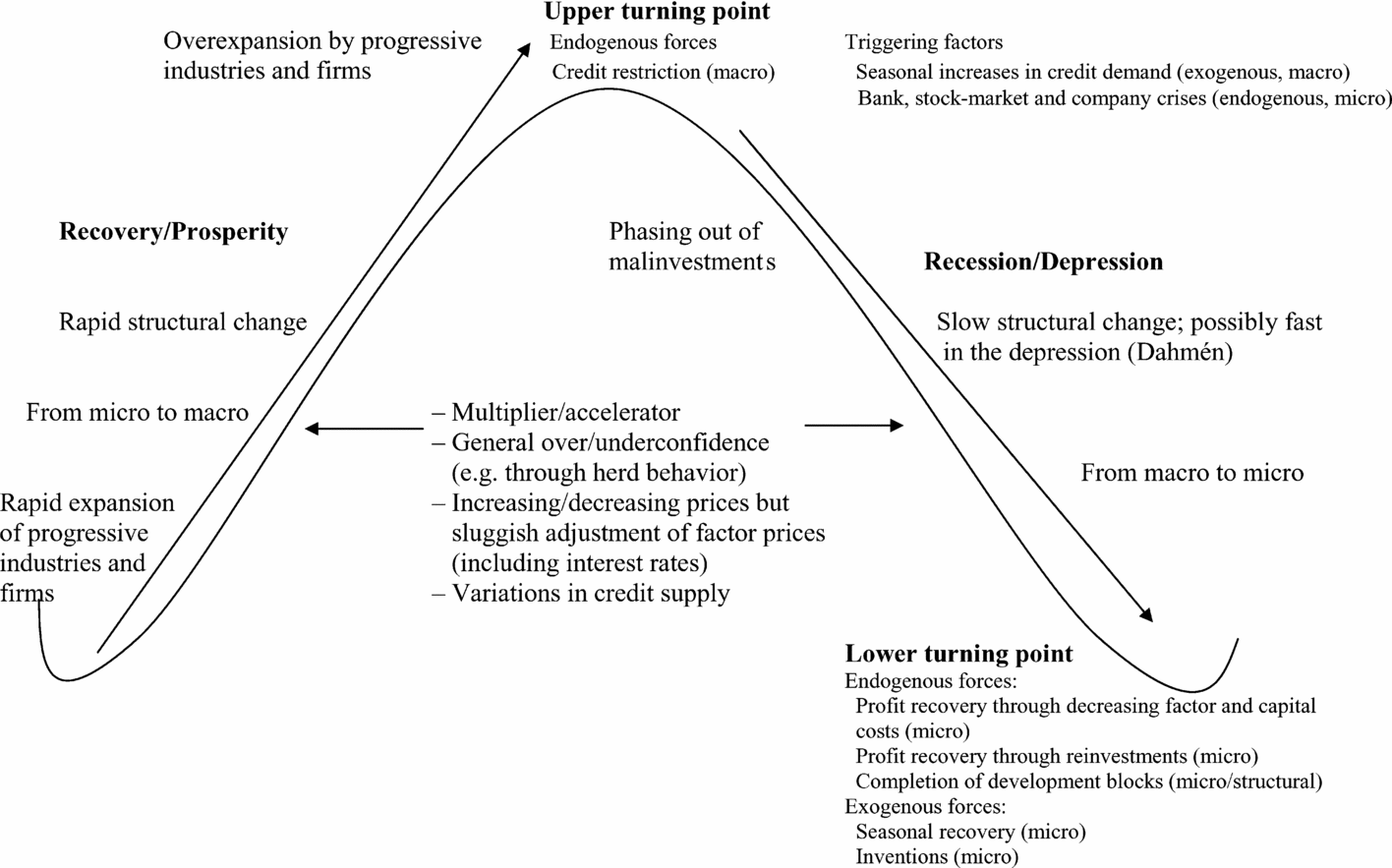
There are mutual benefits, but also clear tensions, in Åkerman and Dahmén's works on the business cycle between their ambition to disentangle regular driving forces and relationships and their emphasis on time- and country-specific institutional characteristics. Both Åkerman and Dahmén questioned the possibility of developing a general theory of the business cycle.Footnote 8 Being skeptical to theories about long waves (see the Kondratieff cycle), they focused on the common business cycle of 8–11 years (the Juglar cycle). At the same time, through their aim at discerning driving forces and relationships shared by more than one cycle, Åkerman and Dahmén wished to keep a distance to pure historical analysis. Åkerman had the intention of devising a theory that was sufficiently general to cover the period of industrialism in Western countries, at least from the early nineteenth century, and simultaneously providing space for unique driving forces and mechanisms in individual countries and periods.Footnote 9 The Åkerman–Dahmén theory of the business cycle is surveyed in Figure 1.
The Åkerman–Dahmén theory of the business cycle
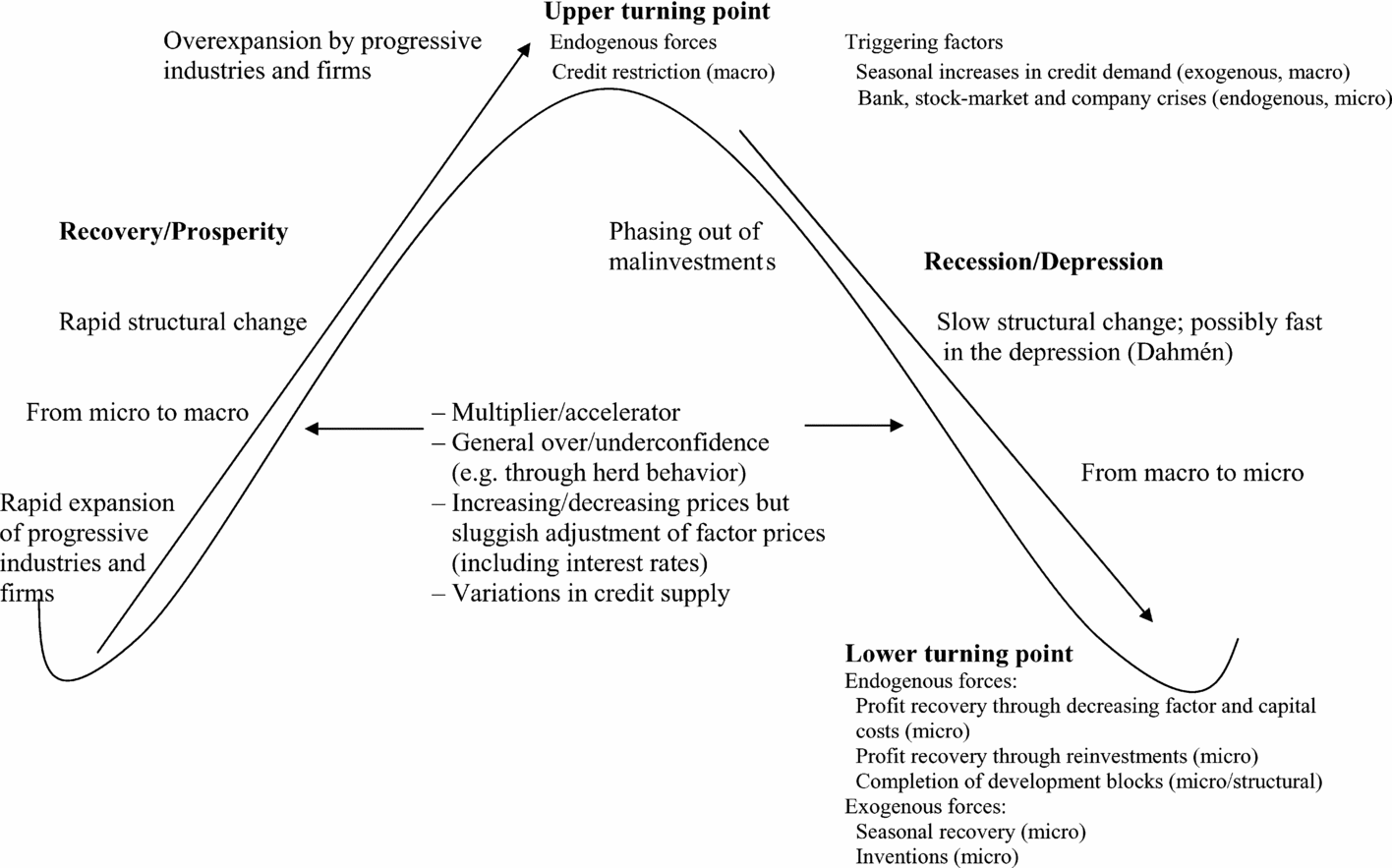
Our account of Åkerman and Dahmén's theory of the business cycle is based on their own synthesis; thus, not on any attempt at filtering out general patterns from their (especially Åkerman's) elaborate analysis of historical cycles. Furthermore, some conventional or superfluous components of their business-cycle theory will be ignored. The first criterion disqualifies Åkerman's hypothesis that the business cycle is formed by the alternation between periods of war and peace. The second criterion excludes his analysis of dominating groups (entrepreneurs, bankers, trade unions, etc.) and changes in income distribution over the business cycle. A presentation of these ideas would have concealed more essential elements of the Åkerman–Dahmén theory.
Moreover, Åkerman and Dahmén's hypothesis about variations in time perspectives in the business cycle will be more exactly defined. They maintained that time horizons in firms are lengthened during the recoveries and then shortened during the recessions, especially in progressive industries. This hypothesis brings the subjective discount rate to the fore. But it seems as if Åkerman and Dahmén primarily referred to changes in risk aversion and profit expectations over the business cycle. They, for example, suggested that profit expectations are increasing and risk aversion decreasing up to the maximum point of prosperity.Footnote 10 This interpretation of Åkerman and Dahmen's hypothesis about variations in time perspectives reduces the room for the notion of subjective discount rates. This notion will be used in the presentation of the Åkerman–Dahmén theory to cover the possibility that firms’ evaluation of the risk of bankruptcies might vary over the business cycle (and between industries) leading to variations in the priority of current profits and profits in the near future (cf. Åkerman, Reference Åkerman1939: 254). The subjective discount rate will increase at the upper turning point and in a recession, thus reflecting that managers and owners have growing fears about firm closure. Firm agents may then, for example, prioritize rationalization, thus boosting immediate profits, rather than research and development investments. An increase in the debt ratio to finance long-run investments (and operating activities) is probably excluded in the Åkerman–Dahmén theory, since external finance is hardly available for firms threatened by bankruptcy. What is more, managers and owners may judge some of their ventures to be too risky to incur external obligations, or they may have fears of losing control over the firms.
Our interpretation of the Åkerman–Dahmén hypothesis about alternating time perspectives in the business cycle underlines the psychological aspects of their theory of malinvestment. More risk-prone attitudes and higher expected rates of return on investment during the upswing may reflect that firm agents become overconfident. They overreact to small samples of high actual profits; thus, they consider the strength of evidence rather than the weight of evidence (see Erixon, Reference Erixon2007: 334–338). But Åkerman and Dahmén's original idea was that all malinvestments are not failures from a longer time perspective. It is the firms themselves and their financiers – not a Bayesian statistical observer – that will in due course declare that investors have been overconfident. Near the peak, firm agents and lenders may actually become underconfident about investments in progressive industries and firms.
3.1 Recovery, malinvestment, and crisis
In Åkerman and Dahmén's theory, the early recovery is industry or firm specific, that is a microeconomic phenomenon using Åkerman's terminology. They provided no exact definition of the industries that will escort the economy out of the recession/depression and throughout the recovery. Åkerman referred to capital-intensive industries such as power-production and communication industries. These industries are favored by long-run profit considerations and reinvestment by other industries. Åkerman also referred to industries with major innovations, industries that might have been born during earlier cycles (Åkerman, Reference Åkerman1944: 43, 238–239). But the revival is not necessarily led by innovative firms but by firms that are cost effective, financially well equipped, and users of modern technologies (Åkerman, Reference Åkerman1960: 142, 154, 189).
We can define a leading sector in Åkerman and Dahmén's theory of the business cycle, encompassing industries and firms that are progressive or whose expansion is a precondition for the growth of progressive industries and firms. Åkerman and Dahmén defined progressive (advanced) industries and firms as those on the positive side of the development (transformation) process; thus, as industries and firms that increase their share of total production over a longer period, that is from cycle to cycle.Footnote 11 They assumed that the increasing weight of these industries and firms is based on innovations or (exogenous) changes in relative demand. Åkerman in particular emphasized that the expansion of progressive industries in the recovery (including the prosperity phase) leads to rapid structural change.
In the Åkerman–Dahmén theory, the building or extension of development blocks is one aspect of the expansion of progressive and related industries in the recovery. Dahmén defined a development block as a complementary relation or a positive externality between industries, firms, and plants where innovations or investments are concerned. Some innovations are not profitable without new innovations or they will, through price signals or informal networks, stimulate the development of new technologies and products. Moreover, investments in a specific plant, firm, or industry are not profitable unless investments are made in other plants, firms, and industries (complementary input–output relations).Footnote 12
Firms and industries pulling the economy out of the recession are more optimistic about future profits, less risk averse, and less afraid of bankruptcy (reducing their priority of current profits) than other firms and industries. But the recovery is reinforced by the multiplier-accelerator mechanism and the growing importance of credits and by herd behavior, turning the cycle from the micro to the macro sphere. In the recovery, not only banks and progressive firms but also firms in general become more optimistic, risk prone, and long-term oriented as concerns investment in the real business sector. Åkerman added that the recovery is augmented by the delayed reaction of wages, material prices, and interest rates – for example, for institutional reasons – to price increases in investment-goods industries. In some works, he also emphasized that the recovery is reinforced by a Fischer–Wicksellian mechanism – consumer price increases in combination with sluggish nominal interest rates will reduce the real rate of interest (Åkerman, Reference Åkerman1944: 141–142, 227–228, Reference Åkerman1960: 142–143).
In the Åkerman–Dahmén theory, potential malinvestments play a strategic role when the economy turns from boom to crisis. Malinvestments will appear, especially through the rapid expansion of progressive firms and industries. The expansion of these firms and industries leads to ‘structural tensions’ (structural imbalances) in the economy – their investment is not matched by corresponding investments by other firms and industries in the same development block. Therefore, in the late recovery phase (prosperity), progressive firms and industries will experience a decline in actual profits or, at least, lower profits than expected. As a consequence, managers, owners, and banks adjust their profit expectations downward. Many investments in progressive industries and firms are considered as faulty despite their having a great possibility of being profitable in the long run.Footnote 13
Åkerman and Dahmén's definition of malinvestments did not only include investments with good future prospects but also investments with no chance of being profitable in the long run. Overconfidence and herd drift, particularly in later stages of the recovery, will lead to investments based on incompetence, low experience, and disregard of available information. Such investments are made in all parts of the economy, but especially in progressive industries and often by new firms. One example is the use of high-cost plants under the cover of price increases during the recovery. The delayed adjustment of wages, material prices, and interest rates to price increases is a necessary condition for many malinvestments of the second type. Inefficient and mismanaged firms, often newly formed, are particularly hit by higher wages and material prices, and also by higher interest rates, in a boom.Footnote 14
In the Åkerman–Dahmén perspective, a prosperity shaped by macroeconomic forces will elicit macroeconomic changes leading to recession. Indications of malinvestment in a boom result in general credit restraints by commercial or central banks. Also firms that are profitable in the long run are facing increasing difficulties in raising credits for their survival or further expansion. Åkerman maintained that a general credit restriction might be triggered by the insolvency and illiquidity of some companies with malinvestments or by other microeconomic phenomena – specific bank crises and stock-market events or speculations in some raw-material markets. The crisis might also be released by macroeconomic phenomena, such as seasonal increases in credit demand. But more importantly, although possibly triggered by microeconomic factors (for example, malinvestments by some firms), the downturn is caused by general credit restraint. Åkerman's macroeconomic explanation of the crisis was basically institutional. Selective monetary restraints are impossible in a liberal economy; thus, his argument was not based on an assumption of asymmetric information.Footnote 15
Åkerman and Dahmén also proposed that malinvestments might generate a recession without any initial restriction of general credits. The recession starts with the retardation (and possible exit) of malinvesting industries and firms and with the decline in new investments in these industries and firms through lower anticipated profits, less risk taking, and higher subjective discount rates. Dahmén, in particular, assumed that firms with malinvestment might also experience increasing difficulties in raising external funds. Private banks are particularly anxious to restrict credits for firms that run a high risk of bankruptcy. In this version of Åkerman and Dahmén's theory, general credit restriction is a reinforcing force in the deflationary process, not the ultimate source of the crisis.Footnote 16
3.2 Recession, depression, and completion of development blocks
In the Åkerman–Dahmén theory, the recession is characterized by the dismantling of malinvestments. Furthermore, new investments are inhibited by credit restrictions in all sectors of the economy. They are also hampered by reductions in expected profits and risk taking and by increases in subjective discount rates. In the recession, the switch from overconfidence to underconfidence about investments is more accentuated in firms and industries that have led the previous recovery. Moreover, prices and price expectations will fall at a faster rate than interest rates, wages, and material prices (see, for example, the Fischer–Wicksell mechanism). The downswing is further deepened by herd behavior and multiplier-accelerator processes. Cumulative deflationary forces may lead the economy into a deep recession (depression). But Åkerman and Dahmén argued that the recession gradually becomes more differentiated; thus, the cycle turns from the macro to the micro sphere. Accordingly, the deepening of a recession leads to a larger spread of prices, costs, and profits between industries and between firms. In fact, favorable costs, financing, and market conditions for some firms and industries near the trough may lay the foundation for the following recovery (see below).Footnote 17
According to Åkerman, the industrial composition is consolidated during the recession/depression. The expansion of progressive industries and firms has now come to a halt. Thus, in Åkerman's work, recessions are not the periods of structural change.Footnote 18 Mergers and acquisitions take place and obsolete firms and plants are eliminated in all parts of the business sector. But Åkerman made few references to the possibility that the freeing of resources would speed up structural change already in the recession/depression. Dahmén added that structural change is delayed by the fact that firms with malinvestments (also in the long run) would tie up production resources for a long time.
On the other hand, Dahmén used Swedish evidence to support the hypothesis that recessions, especially if they are deep, might be characterized by significant changes in industrial composition. Depressions are not only shaped by the dismantling of malinvestments, but also by a large number of bankruptcies by firms hit by earlier innovations. Dahmén referred to the negative side of the development (transformation) process. Consequently, he did not preclude the possibility that structural change is speeded up in a (deep) recession through the elimination of firms in retarding industries (Dahmén, Reference Dahmén, Carlson and Henriksson1991b: 34–35; Henriksson, Reference Henriksson1996: 10).
Åkerman and Dahmén claimed that the explanation of the lower turning point is the weakest point of business–cycle theory (Åkerman, Reference Åkerman1944: 230; Dahmén, Reference Dahmén, Carlson and Henriksson1991b: 28). In his dissertation from 1928, and in his following controversy with Ragnar Frisch, Åkerman presented the original idea of seasonal variations as the source of the turning points, particularly the revival (Boianovsky and Trautwein, Reference Boianovsky and Trautwein2007). Åkerman here referred to seasonal recoveries in trade, construction, and agriculture. Later, he added that a recovery might begin by reinvestments, including restocking, favoring producers of primary, semi-finished, and investment goods. From the mid 1940s, Åkerman stressed the pivotal role of another endogenous factor than reinvestment for the revival – higher profits because of declining production and capital costs would enhance the expansion of some industries and firms. He and Dahmén particularly emphasized that the elimination of plants and firms in the previous recession/depression (for example, through malinvestments) would underpin the expansion of dynamic industries and firms through the consequential freeing of capital. Åkerman also pointed out the importance of industry-specific inventions for the revival.Footnote 19 Furthermore, in the 1940s, Dahmén and Åkerman espoused the novel idea that structural imbalances in the recession would encourage the completion of development blocks.
An incomplete development block may reflect structural tensions through malinvestment in the preceding boom – extensive investments in progressive industries and firms were not matched by investments in affiliated industries and firms. Viable development blocks were then destroyed by the elimination of progressive firms and plants in the recession/depression. This elimination will reduce the structural imbalances in the economy. But some potential development blocks remain or can be re-created. Entrepreneurs, possibly recruited from the group of established managers and owners, are able to put these development blocks together by new investments. Development blocks can be completed (or extended) through investments by individual firms or by mergers and collaboration between independent producers.Footnote 20 For example, mergers in the recessions of the late 1800s and the early 1900s made it possible to complete railway networks and the electrification of these networks in the US. Viable development blocks in these industries had been demolished by the elimination of unprofitable companies (cf. Dahmén, Reference Dahmén, Carlson and Henriksson1991b: 30). However, in some works, Åkerman and Dahmén seemed to lean towards the conclusion that development blocks might only be completed after a positive demand shock, for example through reinvestments, or a looser capital market facilitating the expansion of specific firms and industries.Footnote 21
4. The influence of Schumpeter
In Schumpeter's Business Cycles, innovations are the basic driving forces in the prosperity phase. Åkerman and Dahmén's corresponding idea was that the recovery, as a rule, is formed by firms’ use of new inventions and introduction of new products (see the Appendix).Footnote 22 Moreover, Schumpeter and Åkerman and Dahmén agreed that initial innovations could facilitate new innovations through innovation clusters (Schumpeter) and development blocks (Åkerman and Dahmén). Åkerman and Dahmén shared Schumpeter's supply-side view of innovations.Footnote 23 Even in his analysis of cumulative innovation processes, an important aspect of development blocks, Dahmén downplayed the importance of demand-led innovations.Footnote 24 Schumpeter and Åkerman and Dahmén also embraced the hypothesis that an upswing is reinforced by mass psychology. Schumpeter referred (like Veblen) to speculations about continuous price increases and Åkerman and Dahmén primarily to increasing profit expectations and (explicitly following Veblen) to herd behavior.Footnote 25 Moreover, Åkerman and Dahmén and Schumpeter made common references to multiplier-accelerator mechanisms reinforcing the recovery (the prosperity in Schumpeter's case) and also the recession.Footnote 26 Another resemblance between Åkerman and Dahmén and Schumpeter is that they toned down (in contrast to Veblen) the independent role of financial activities in the business cycle. They emphasized that credits are passively created to finance the expansion of progressive industries and firms. Åkerman and Dahmén also agreed with Schumpeter that financial bubbles (and developments in financial markets in general) reflect the driving forces and reproduce the psychological mechanisms of the ‘real’ business cycle (Schumpeter, Reference Schumpeter1939: 152).
Åkerman and Dahmén and Schumpeter's explanation of the turning point between boom and recession is similar when expressed in general terms. The downswing can be traced back to the expansion of progressive firms and industries during the upswing.Footnote 27 The liquidation of firms that expanded during the prosperity phase will also result in credit freezes (see Schumpeter, Reference Schumpeter1939: 134–150; Åkerman, Reference Åkerman1960, 143–144). Moreover, in some works, Dahmén suggested that recessions are not only induced by malinvestments but also, in line with Schumpeter's view in Business Cycles, by the negative consequences of innovations for established firms and industries (Dahmén, Reference Dahmén, Carlson and Henriksson1991b: 21). In fact, both Dahmén and Schumpeter made a clear distinction between innovations and malinvestments as the source of a profit decline for a specific firm or industry. Dahmén's definition of malinvestment excluded the cases where firms, whatever their reaction, are hit by harder competition through innovations by other firms. Investments that become unprofitable because of (unexpected) innovations by other firms, or (unforeseen) changes in relative demand, cannot be regarded as faulty.Footnote 28 Schumpeter made a similar exclusion in Business Cycles, even if he provided room for the possibility that the reaction by old firms to innovations could be faulty (Schumpeter, Reference Schumpeter1939: 140).
Åkerman and Dahmén and Schumpeter's view of the departure from the lower turning point in the business cycle was similar in some respects – endogenous reductions in wages, raw materials, and interest rates might be necessary for escaping a depression.Footnote 29 They unanimously made the qualification that departure from a trough is a selective (microeconomic) phenomenon, notwithstanding the general reduction in production and capital costs – some industries and firms may pull the economy out of a depression characterized by an increasing spread of prices, costs, and profits (Schumpeter, Reference Schumpeter1939: 153–155). In addition, they emphasized that each trough (Åkerman and Dahmén) and ‘neighborhood of equilibrium’ before prosperity (Schumpeter) is uniquely determined by the history of economic progress.Footnote 30 Finally, neither Åkerman and Dahmén nor Schumpeter assumed that recovery and prosperity are the results of firm renewal enforced by falling profits in the preceding recession/depression (see Section 6).
5. Departures from Schumpeter
Despite the similarities, Åkerman and Dahmén's analysis of the business cycle deviated conspicuously from Schumpeter's approach in Business Cycles. They generally criticized Schumpeter for only making a partial break with equilibrium theory and for failing ‘to build a bridge between equilibrium theory and the structural change of economic development’.Footnote 31 Åkerman and Dahmén opposed Schumpeter's distinction between a revival shaped by adjustment forces in the preceding depression and a prosperity phase started by innovative entrepreneurs in a ‘neighborhood of equilibrium’ (see Schumpeter, Reference Schumpeter1939: 70–71). They saw the upswing as a continuous cumulative process where innovations might also characterize the early phase, thus not only prosperity as in Schumpeter's theory. Furthermore, Åkerman and Dahmén rejected Schumpeter's idea that the business cycle is driven by exogenous innovation cycles, for example by recurring entrepreneurial reincarnations. They inferred that Schumpeter offered no real (endogenous) explanation of prosperity.
Moreover, Åkerman and Dahmén and Schumpeter disagreed about who is the agent of innovation. In Business Cycles, new entrepreneurial firms are the bearers of prosperity (Schumpeter, Reference Schumpeter1939: 93–95). Åkerman and Dahmén maintained that established firms and industries might be the engine of an upswing. What is more, in the Åkerman–Dahmén theory, the expansion of some industries and firms in the recovery is not always based on new innovations such as the corresponding expansion of the primary wave in Business Cycles. The reservation must be made that, by his ‘second approximation’, Schumpeter opened the possibility that the primary wave is shaped by old innovations and firms (Schumpeter, Reference Schumpeter1939: 157).
Åkerman and Dahmén's explanation of a recession in terms of malinvestments departed from Schumpeter's view. Dahmén even questioned that Schumpeter's theory of the business cycle was a theory of malinvestment. Schumpeter did refer to ‘cyclical clusters of errors’ in Business Cycles. Recklessness, fraud, and excesses may characterize the innovative primary wave and, especially, the second wave of prosperity where established firms expand in the wake of the first wave. But Schumpeter actually argued for not focusing on errors of any kind in business-cycle analysis. First, errors are not independent variables but consequences of the innovation and adoption process forming the primary wave. Second, errors are less important in the primary wave and not necessary conditions for a recession. In Schumpeter's theory, it is the ending of an innovation cycle per se, not the errors, that explains why a recession will appear and therefore also why the secondary wave of prosperity will come to an end (Schumpeter, Reference Schumpeter1939: 140, 146, 148).
Schumpeter's two arguments against focusing on malinvestments in business-cycle studies are no serious challenges to Åkerman and Dahmén's theory. First, Åkerman and Dahmén's differentiated view of a recovery made it possible to consider malinvestment as an independent determinant of a recession in relation to innovation – the driving forces of the previous recovery cannot be entirely reduced to a question of new innovations. Second, Åkerman and Dahmén made a broader definition of malinvestment than Schumpeter in Business Cycles. They included investment in progressive industries that are profitable in the long run. This inclusion enlarges the explanatory power of the Åkerman–Dahmén theory, emphasizing the pivotal role of malinvestments for the recession.
The diverging notions of malinvestment in Schumpeter's and Åkerman and Dahmén's works are manifested in their analysis of the turn from boom to recession. In Åkerman and Dahmén's theory, the upper turning point reflects, directly or indirectly, that progressive industries and new firms had expanded too rapidly. In Schumpeter's theory, the downswing reflects that progressive industries and new firms had expanded too little; when innovations eventually cease in the primary wave, older firms are still hit by the competitive effects of previous innovations (price reductions), but they will no longer benefit from the market-extending effects of new innovations.Footnote 32 The expansion of innovative industries and firms has some unsound and excessive aspects, but the recession is basically explained by the interruption, not the scope, of this expansion. Schumpeter's inference in Business Cycles that recessions represent an adjustment to earlier innovation shocks in the absence of new shocks added fuel to Åkerman and Dahmén's argument of the incomplete break with equilibrium theory by their main inspirer.Footnote 33
Åkerman and Dahmén's and Schumpeter's different weight on malinvestments in their explanation of the turning points in the business cycle can be retraced to the difference between the notions of development blocks and innovation clusters. Development blocks can be built, destroyed, and rebuilt through a complementary relationship between investments (for example through network ties), thus not only between innovations. Probably directed against Schumpeter, Åkerman declared that the concept of development blocks builds a bridge between the analysis of structures, cycles, and growth. To exemplify this strategic role of development blocks, Åkerman referred to his and Dahmén's original explanation of the revival. Reinvestments and other recovery forces would stimulate new investments at the microeconomic level leading to the completion of development blocks and the weakening of structural tensions in the business sector developed in the previous peak (Åkerman, Reference Åkerman1960: 209).
Schumpeter and Åkerman and Dahmén also had a deviating view on which firms make malinvestments in the boom. In Business Cycles, it is older firms that expand in the speculative secondary wave of prosperity on basis of expectations of continuing price increases. Many of these firms will contract or vanish when the innovation process dies down. In the Åkerman–Dahmén theory, not only old but also new firms might overexpand at the end of the recovery; new firms are often poor imitators rather than successful innovators.Footnote 34 Furthermore, Schumpeter did not assume, as did Åkerman, that recovery and prosperity are the periods of structural change. He posited that the secondary wave, dominated by firms with older technologies and products, ‘may be and generally are quantitatively more important’ than the innovative primary wave. Schumpeter also suggested that innovations in prosperity might be spread and improved, leading, for example, to new investment opportunities in the recession (Schumpeter, Reference Schumpeter1939: 143, 146–147).
Finally, Dahmén in particular paid more interest to the negative side of innovations and, consequently, to the recessions themselves, than Schumpeter in Business Cycles (Dahmén, Reference Dahmén, Carlson and Henriksson1991b: 31–37; Åkerman, Reference Åkerman1960: 209). Dahmén focused on the rigidities delaying the elimination of doomed firms and plants (financial endowments of large companies, cartels, trade barriers, government subsidies, etc.) and the eventual phasing-out of declining industries leading to structural change. In fact, Dahmén's analysis in the early 1940s of the negative side of the transformation process anticipated Schumpeter's discussion of ‘creative destruction’ in Capitalism, Socialism and Democracy (see Schumpeter, Reference Schumpeter1976: 83–84).
6. Some reflections on the Åkerman–Dahmén theory
Åkerman and Dahmén's great achievement was their integrated analysis of business cycles and economic progress, stressing the importance of development blocks, malinvestment in advanced industries, and structural tensions between industries for the turning points in the business cycle. At the same time, their structural-technological approach to the business cycle was compatible with an analysis of reinforcing psychological mechanisms and underlying institutional conditions (financial-market arrangements, ownership distribution, the age composition of entrepreneurs, etc.). Some ambiguities in the Åkerman and Dahmén theory of the business cycle can be explained by their wish to keep the theory sufficiently open to provide room for specific institutional circumstances in each cycle. This is not to deny that there are some limitations in their theory.
First, Åkerman and Dahmén might have stressed too much that innovations and their diffusion take place in the recoveries. Their theory did not incorporate the idea that the innovation process may be speeded up by a recession or a depression. Following Schumpeter, Åkerman and Dahmén did not suggest that firms (whether they are new or established) would pull themselves together when profits fall by intensifying their search for new markets or by increasing their willingness or capacity to introduce new products and technologies. In Åkerman and Dahmén's theory of the business cycle, there is no enforced firm renewal or entrepreneurial revitalization during the downswing. In their theory, a recovery is possibly prompted by a profit recovery (at the microeconomic level), not by a profit crisis.Footnote 35 The references by Dahmén to the possibility that low profits during recessions/depressions will put pressure on managers and owners to complete development blocks are too few to be incorporated in his theory of the business cycle. Furthermore, despite Dahmén's emphasis on the negative side of economic development, he and Åkerman put too little emphasis in their ‘general’ theory on enforced rationalization in the recessions or depressions. And Åkerman's hypothesis that the increasing weight on progressive industries (and firms) is concentrated to the upswing periods is controversial. In his theory, progressive industries – and maybe also industries that are conditional for the expansion of progressive industries – will increase their shares of total production even in the late recovery phase of reinforcing cumulative forces (see Åkerman, Reference Åkerman1944: 47, Reference Åkerman1960: 247).
Thus, one possible shortcoming of the Åkerman–Dahmén theory is that it excludes the possibility that the downswing will lay the foundations for the subsequent recovery by speeding up (external) structural change (see Åkerman) or by making firms and industries more innovative and efficient.Footnote 36 Innovations and productivity growth in the firms are here not enhanced by negative driving forces (low profits). But works by Dahmén (although not on the business cycle) in the 1970s and 1980s constituted one source of inspiration for the development of a theory of transformation pressure, providing room for countercyclical innovations and productivity growth even at the firm level (see Erixon, Reference Erixon2007).
Second, macroeconomic conditions and economic policies probably played too subordinate a role in Åkerman and Dahmén's analysis of prime driving forces in the business cycle. The multiplier-accelerator mechanism is here a reinforcing, not a basic, force behind a recovery or a recession. It is likely that Åkerman and Dahmén would have provided more space for aggregate demand shocks and economic policies if their analysis had encompassed the cycles after World War II. In fact, they mentioned the role of macroeconomic conditions for the expansion of progressive industries in the 1930s. For example, in Sweden, depreciations of the Swedish krona and expansionary monetary policies in the early 1930s speeded up the expansion of dynamic (home market) companies and industries in manufacturing, for example by increasing their financial capacity to introduce new technologies and products.Footnote 37 This example demonstrates, however, that Åkerman and Dahmén focused on the effects of macroeconomic conditions on industry structure and further saw these conditions as reinforcing, not fundamental, forces behind an upswing.
A third possible critique of Åkerman and Dahmén (and Schumpeter) is that their theory of the business cycle was not designed for small open countries. Despite their institutional approach, emphasizing the size of the exposed sector, and their regular studies of Swedish economic developments, Åkerman and Dahmén's theory of a representative cycle was primarily developed for large industrialized countries.Footnote 38 Both were aware of the fact that the business cycle was not generally synchronized with the transformation process in the case of Sweden (Dahmén, Reference Dahmén1970: 421–423, 427–428). Åkerman and Dahmén correctly observed that Swedish business cycles, at least since the late nineteenth century, have been driven by changes in foreign demand for raw materials goods and for engineering products, many of them based on domestic innovations at the turn of the century. The amendment can be made that Swedish recoveries after World War II were initiated by foreign demand and sometimes also by expansionary economic-policy measures, especially devaluations. It is true that new innovations are not necessary conditions for a recovery in Åkerman's and Dahmén's theory. But their theory, emphasizing the role of progressive industries, is contradicted by the fact that Swedish business-cycle upswings in the postwar period have benefited traditional export industries. Thus, Swedish recoveries could arguable be analyzed from the perspective of a given or cemented industrial structure.
A fourth possible objection to the Åkerman–Dahmén theory of the business cycle is that it underestimates the independent role of financial conditions. In his analysis of distinct cycles, Åkerman recognized the importance of structural changes in financial markets (for example, financial innovations). But his and Dahmén's ‘general’ theory of economic fluctuations is not a theory of financial bubbles. In fact, they questioned (like Schumpeter) the explanatory power of monetary theories. It is true that the expansion of progressive industries is facilitated by abundant credits and possibly connected to stock-market euphoria and that a crisis may be unleashed by events on financial markets in the Åkerman–Dahmén theory. But financial conditions are endogenous or triggering factors here, not driving forces behind the recovery or the downturn in themselves (see Åkerman, Reference Åkerman1960: 143–144).
A plausible explanation, for example, for the financial crisis in 2007–2010 and the deep recession in Nordic countries in the early 1990s, must put a stronger weight on financial-market conditions than the Åkerman–Dahmén theory. In the early 1990s, Sweden experienced a more serious recession than any other OECD country with the exception of its neighbor, Finland. The Swedish crisis in 1991–1993 was deeper in terms of GDP growth and employment than the 1930s depression (Edvinsson, Reference Edvinsson2005: 253–255, 260–262). The deep recession in Sweden and Finland in the early 1990s was preceded by severe overheating. In the second half of the 1980s, these countries, and also Norway, had experienced an exceptional boom for real estate (both commercial buildings and dwellings), stocks, and financial services. The Nordic boom during the second half of the 1980s is ranked by Kindleberger and Aliber (Reference Kindleberger and Aliber2005: 9) as one of the ten largest financial bubbles in history. The Swedish (and Finnish) investment boom in the second half of the 1980s was initiated by a foreign-led recovery and by devaluations and it was fueled by a radical deregulation of credit markets stimulating (in combination with a distorted tax system) borrowing by firms and households. A regression study of bankruptcies in Swedish manufacturing in the early 1990s did not confirm the Åkerman–Dahmén theory of malinvestments.Footnote 39 The limitations of the study must be noticed, for example its concentration on manufacturing. But financial theories are likely to provide better explanations for the Swedish crisis in the early 1990s than the Åkerman–Dahmén theory of malinvestments in the real economy.
It seems that the Åkerman–Dahmén theory of malinvestment in progressive (and related) industries and industry-structural tensions provides a reasonable explanation for some crises in the history of industrialism. For example, the origin of the US depression in the early 1930s can be traced back to electrification and the expansion of automobile industries and telecommunication systems in the 1920s. The ICT boom and the following crisis at the turn of the Millennium constitute another confirmation of Åkerman and Dahmén's theory. The recovery during the second half of the 1990s was shaped by the ICT revolution in countries like the US, Sweden, and Finland. The two Nordic countries have a strong telecommunication sector, especially due to the importance of Ericsson and Nokia. It seems that the expansion of ICT industries in Sweden and Finland in the late 1990s was too rapid in relation to the expansion of industries that were expected to require advanced ICT products and services or provide the resources needed for their production (cf. Eriksson, Reference Eriksson2008, chapter III). The recession in Sweden and Finland in the early 2000s was formed by the ICT crash leading to a high number of fallacies. Despite being profitable in the long run, many investments in the ICT sector were regarded as failures by firms and banks.
But several other crises in the history of industrialism are explained by factors outside the Åkerman–Dahmén theory of development blocks, malinvestments, and structural tensions. This proposition is actually in accordance with Åkerman and Dahmén's institutional approach. For example, in his analysis of industrial development in Sweden in the inter-war period, Dahmén maintained that malinvestments were only frequent at the beginning of the period (Dahmén, Reference Dahmén1970: 426–428).
7. Summary
Johan Åkerman and Erik Dahmén are the most prominent representatives of a Swedish structural-analytical or institutional school in economics (see Erixon, Reference Erixon2005). Macroeconomists rightly consider Åkerman to be a precursor of the theory of the political business cycle; however, this pioneering role of Åkerman's has been disregarded here. There are also references in today's literature on (economic) business cycles to Åkerman's elaborate studies of historical cycles. Moreover, Swedish economic historians today often refer to Dahmén's analysis of the transformation of Swedish industries in the inter-war period and also to his notion of development blocks or later theoretical concepts (for example, ‘transformation pressure’). But economists in particular are ignorant of Åkerman's, and also Dahmén's, epistemological discourse constituting a critique of economic theories without an evolutionary perspective; this critique was more explicit and far-reaching than that of Schumpeter and more integrated with studies of actual macroeconomic processes than that of Veblen. Some scholars consider Åkerman's synthesis between inductive and deductive analysis to be a fruitful research strategy for macro studies (Mjøset, Reference Mjøset, Drechsler, Kattel and Reinert2009; cf.Åkerman Reference Åkerman1960: 7, 14–15, 211). Åkerman's methodology for causal analysis, envisaging the basic driving forces and structural preconditions underlying a macroeconomic process, seems highly relevant today (cf. Hoover, Reference Hoover2001: 213–217).
This paper has focused on Åkerman and Dahmén's institutional (structural) theory of the business cycle. They shared Schumpeter's idea in Business Cycles that the recovery is driven by progressive industries and that the centre of gravity in the business cycle moves between the micro and macro levels. But Åkerman and Dahmén's explanation for the turning points in terms of malinvestments, development blocks, and structural tensions was a step forward in relation to Schumpeter's analysis. They shed some light on the overexpansion by leading industries and firms, the complementary relation between investments and the dynamic properties of the associated structural imbalances. This structural-technological approach to the business cycle is congruent with an analysis of underlying institutional factors and path-dependent historical processes. Furthermore, the notions of overconfidence and herd behavior in psychology and financial economics can easily be applied to Åkerman and Dahmén's analysis of the business cycle.
Åkerman and Dahmén's theory is valid for innovation-driven cycles such as the ICT bubble in the late 1990s. The subsequent crash in the early 2000s might have reflected too fast an expansion of the ICT sector in relation to other sectors, a conjecture in line with Åkerman and Dahmén's theory of malinvestments and structural tensions. An alternative hypothesis based on Schumpeter's Business Cycle stating that the ICT crash reflected an interruption of the innovation process is probably less sensible.
Åkerman and Dahmén were skeptical to monetary theories where financial bubbles are not derived from the preceding expansion of progressive industries. In addition, like Schumpeter in Business Cycles, Åkerman and Dahmén excluded the possibility that enforced innovations in the recession (or depression) might lay the foundations for economic progress in the following recovery. These exclusions can be seen as weaknesses in the Åkerman–Dahmén theory but, at the same time, they facilitate comparisons with other theories of the business cycle. For example, empirical studies can scrutinize whether innovations move procyclically, as in the Åkerman–Dahmén theory, or countercyclically as in the theory of transformation pressure (see, for example, Malley and Muscatelli, Reference Malley and Muscatelli1999). The works of Åkerman and Dahmén are still of utmost importance, both from a methodological viewpoint and for our understanding of fluctuations in economic activity in industrialized countries.
Appendix: A comparison between Schumpeter's Business Cycles and the Åkerman–Dahmén theory of the business cycle