1. INTRODUCTION
The issue of correlating a ship's identity and its position in coastal waters and port approaches has been a challenge for many years. In the 1990s a series of meetings and discussions highlighted that there would be great advantage to safety of navigation and traffic management if some regular, automatic and autonomous means of exchanging information (e.g., identity, position, time, course and speed) between ship and shore could be developed. In 1997, at a meeting hosted by the International Association of Marine Aids to Navigation and Lighthouse Authorities (IALA), the technical proposal based on Self-Organising Time-Division Multiple Access (SOTDMA) was agreed, and development of the ‘Universal Automatic Identification System’ (U-AIS) began.
Over the years ‘Automatic Identification System’ (AIS), as it is now known, has continued to develop, using different access schemes to address a range of user requirements. These include ship to ship identification and information to support navigational safety; ship to shore identification and information to support Vessel Traffic Services (VTS); and shore to ship to provide information back to vessels.
The International Maritime Organization (IMO) has mandated carriage of AIS in the Safety of Life at Sea (SOLAS) Convention. Initial implementation of the carriage requirements began for new build ships in 2002 and the implementation of carriage requirements for older ships not engaged on international voyages by 1 July 2008 (IMO SOLAS, 2008). While the IMO does not designate the ‘Type’ or ‘Class’ of AIS, the equipment that responds to the SOLAS carriage requirements with full maritime functionality is termed ‘AIS Class A’ (AIS-A).
‘AIS Class B’ (AIS-B) has been developed with reduced functionality for smaller vessels. AIS-B is usually optional and is widely used by smaller commercial craft and recreational vessels. In addition, some administrations may require the carriage of AIS on non-SOLAS vessels in their areas.
It quickly became clear to shore authorities that AIS also had the potential to support a wide range of maritime regulatory and traffic monitoring activities and assist with maritime security. This has led to the integration of open-sourced vessel track data gathered through AIS with other vessel track data sources to compile an image of vessel position and movements in support of Maritime Domain Awareness (MDA)Footnote 1.
AIS has been designed as a terrestrial system based on the use of Very High Frequency (VHF) radio frequencies to transmit data (see Appendix A for an overview of AIS). Why, then, should we consider the possible use of satellite detection for this system?
The reception of VHF signals by satellites is proven technology, with many commercial applications. Machine To Machine (M2M) communication, using VHF and Ultra High Frequency (UHF) radio reception via satellites, is currently used both on land and at sea. Operating in the 137·0–150·05 MHz (VHF) and 400·075–400·125 MHz (UHF) frequency ranges, satellite reception of these signals can be a cost-effective tracking, monitoring and messaging capability.
With the experience and proven capability of reception of VHF/UHF signals by satellites, it is a logical step to look at the satellite detection of AIS. The information is continuously and automatically transmitted by vessels to which the SOLAS carriage requirement applies and includes information such as identity, location, course and speed. This information, gathered from both terrestrial AIS base station networks and Satellite AIS, can be merged with other information to provide an increasingly comprehensive overview of ship movements in a given area of interest. This area could be providing near real-time information within an Administration's Search and Rescue Region (SRR) to support safety of life, or data could be gathered over a set period of time to determine ship routeing and traffic patterns which could then support the provision or alteration of Aids to Navigation (AToN) systems within a strategic approach to providing an optimum mix of AToN.
Beyond the use of the information for search and rescue or strategic planning, there are a number of current, and developing, opportunities for effective use of the information from Satellite AIS. These practical applications are presented in Section 5, following a more general introduction to Satellite AIS (Section 2), an overview of the limitations of the technology (Section 3) and developments in Satellite AIS (Section 4). Section 6 looks at some possible implications when using a vessel tracking sensor that provides information on a global scale, while conclusions and suggestions for further research are presented in Section 7. An overview of AIS is at Appendix A.
2. SATELLITE AIS
In 2003, at the fourth International Academy of Astronautics (IAA) Symposium on Small Satellites for Earth Observation, a paper from the Norewegian Defence Research Establishment, Forsvarets Forsknlnginstitutt (FFI), was presented that focused on new possible roles of small satellites in maritime surveillance (Wahl and Høye, 2003a, 2003b). The authors presented the possibility of using a space-based AIS receiver to assist in vessel tracking by providing timely reports with vessel identification and additional information. The paper noted that developments in micro-satellite technology could pave the way for these satellites to carry passive sensors for ship detection, including Synthetic Aperture Radar (SAR) imagery and reception of AIS messages from ships.
In the intervening years, significant progress has been made regarding the reception of Satellite AIS messages. The ability to receive AIS by satellite is dependent on a number of factors, including: the type of satellite being used; the orbit of the satellite; and the fact that a system designed for terrestrial reception is now being looked at for satellite reception (i.e., number and type of transmitting AIS units within the footprint of the satellite).
The actual message content being transmitted by AIS is not an issue in itself as there is not yet a dedicated Satellite AIS messageFootnote 2. In the current approach to Satellite AIS, the receiving unit on the satellite will accept messages that have been activated on the receiving unit; the information is either decoded on the satellite and then forwarded when in sight of a Land Earth Station (LES), or forwarded to the LES and then decoded (more information on de-confliction of Satellite AIS messages is provided in Section 3.2.1).
2.1. Satellites Used for AIS Data Reception
Since the publication of this concept (Wahl and Høye, 2003a, 2003b), miniature satellite development has continued to evolve. Satellites vary in size: some have a very small mass between 0·1 and 1 kilogram (pico satellites); some have a mass of between 1 and 10 kilograms (nano satellites – see Figure 1); and some have a mass of between 10 and 100 kilograms (micro satellites). Satellites can have an expected life span of between 5 to 20 years.
Exterior of a Nanosatellite for Tracking Ships (NTS).

As satellite launch programs are often planned years in advance, these smaller satellites may be included as additional payload on previously planned launches. This can have a dual benefit of reducing the launch planning time considerably and, as they can be included as a part of a larger launch, reducing launch costs.
There are, however, limitations related to the small size of the satellite including correspondingly limited power and data storage capabilities. AIS messages can be received as frequently as every 2 seconds. In a satellite pass, this can equate to a large amount of data that needs to be stored while waiting for the satellite to reach an LES for downloading.
2.2. Satellite Orbits
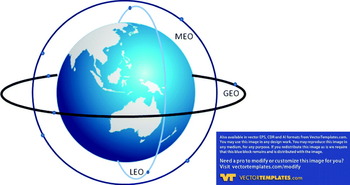
As data can only be received when in the footprint of a satellite, the orbit of the satellite will dictate when information can be received. Satellites orbit the earth at different levels, or altitudes, with varying orbital periods (NASA Orbit Fact Sheet, 2011). The orbits vary depending on the expected service use for the satellite (see Figure 2).
• Geostationary Earth Orbit (GEO). GEO satellites operate at an altitude of 35,786 km in orbit over the Equator (0 degrees latitude) at various longitudes. These satellites have an orbital period equal to the rotation of the Earth and appear stationary above a fixed point on the Earth's Equator.
• Medium Earth Orbit (MEO). MEO satellites operate at altitudes between 2,000–35,786 km. The most common MEO orbits are at just over 20,000 km with an orbital period of 12 hours. These satellites are commonly used for navigation services. There are a number of such services which are either developed, or in development, such as the Global Positioning System (GPS) [USA], GLObal NAvigation Satellite System (GLONASS) [Russia] and Galileo [Eurpean Union].
• Low Earth Orbit (LEO). LEO satellites operate at altitudes between 80–2,000 km. The majority of LEO satellites make a complete revolution of the Earth in approximately 90 minutes. For persistent coverage of any one area of the Earth there is a need to have a grouping of multiple satellites, known as a ‘constellation’. The footprint of a LEO satellite would be in the realm of 3,281 km or 1,770 nautical miles. Satellite AIS uses LEO satellites.
LEO, MEO and GEO satellite orbits.

2.3. AIS Units within the Satellite Footprint
AIS was developed as a terrestrial system and was therefore never intended to be received by satellites. As such, AIS has been developed to use relatively low power (1–12·5 watts, depending on the type of AIS transmitter). The height of the satellites can cause signals to be lost due to weak transmission power, especially in areas where there are many vessels (areas of high VHF data link usage).
In addition, AIS messages can be transmitted within the same ‘slot’ by two AIS units when sufficient physical distance exists between the units. This means that two different units can transmit information at the same time. In areas of high vessel traffic density there could be two or more vessels using the same ‘slot’ to transmit data (data packets) within the footprint of the satellite. The effect of this for the receiving Satellite AIS unit is not unlike being in a meeting with three or four colleagues all talking at once; it is difficult to capture even one or two words of the discussion. These data packet collisions can result in incomplete data sets which then require further analysis, or the conflicts may result in lost data.
2.4. Developing Satellite AIS
While the design of AIS was terrestrial, with expected signal propagation from shipboard mounted AIS VHF antennas primarily along the Earth's surface, investigation into the reception of the VHF AIS transmissions by LEO satellites was a natural progression (Wahl and Høye, 2003a, 2003b).
The Norwegian Defence Research Establishment (FFI) has continued exploring the capabilities of AIS reception via satellite, as has the Japan Aerospace Exploration Agency (JAXA). European projects such as Land and Sea Monitoring for Environment and Security (LIMES, 2011) and Maritime Security Services Project (MARISS, 2011) are also looking at interoperability across different satellite types, data sharing and automated analysis tools. The results of these trials have been encouraging, with successful reception of AIS signals by satellite.
A number of commercial organisations have carried out experiments with Satellite AIS, including: SpaceQuest®; ORBCOMM®; and exactEarth® (a subsidiary of COMDEV®). These developments have led to the ability to access Satellite AIS from commercial providers.
3. ISSUES WITH SATELLITE AIS
Although there have been successful scientific trials of Satellite AIS, with a fledgling commercial provision of the service, there remain a number of issues with the technology. The challenges in reception of AIS by LEO satellite include the technical characteristics of AIS, the AIS messages themselves and the satellites that are used for the AIS receiver payload.
3.1. AIS Technical Characteristics
AIS, designed for terrestrial use, has relatively weak signal strength (between 1 and 12·5 watts depending on transmitter type). This weaker signal strength could limit signal reception, resulting in either partial reception, garbled reception or lost messages. The re-use of slots within a set frame, suitable for a terrestrial system, can lead to data packet collisions when a number of messages are received within the same slot/frame (‘blurred’ reception).
In addition, to maximise terrestrial reception of the signals, the ships' transmitting antenna may not be located in a position that enables satellite reception. There are many existing issues with AIS installation procedures, including physical separation from other (already existing) antennas and the noise floor of the installation (IMO SOLAS, 2008).
3.2. AIS Message Characteristics
Some AIS messages are quite short, which could lead to insufficient time for the satellite to include the message in their buffer when in satellite detection range. In addition, noting the ongoing development of AIS, some of the message types may not be configured for reception by Satellite AIS units.
This inability to receive some of the newer message types is currently being observed in older AIS Class A units that were configured for Messages 1–21.
3.2.1. Data Packet Collision of Satellite AIS Messages
A study and simulation showed that the system provided good ship detection probability (>99%) in areas with low ship density; however detection dropped significantly when ship density increased (Hoye et al., Reference Høye, Eriksen, Meland and Narheim2008). That paper proposed developing a specific AIS satellite capability by moving AIS transmissions to a new VHF frequency with a longer time period between transmissions.
Commercial Satellite AIS providers have addressed the data packet collision issue through proprietary ‘de-conflicting’ algorithms, for example:
• ORBCOMM® uses a de-conflicting process on the satellite which then forwards the ‘clean’ transmissions to one of their land Earth stations for forwarding to the client. The de-conflicting occurs onboard the satellite, with no additional ground requirement.
• exactEarth® has two processing techniques: OnBoard Processing (OBP) and de- conflicting technology.
○ OBP takes the messages, carries out onboard de-conflicting, and then forwards the messages as soon as they are downloaded from the spacecraft.
○ The de-conflicting technology involves storing the raw data as collected in the satellite pass, forwarding the data when the satellite is in sight of an LES and then processing the data through a proprietary algorithmic process. Once the data has been ‘cleaned’ through this process, it is sent to the user.
3.3. Satellite Characteristics
LEO satellites may be affected by propagation, including possible interference from terrestrial services within the satellite footprint. This could have an impact on the messages received.
As the satellite constellation for AIS reception is relatively small (at the time of writing one organisation has three satellites with AIS reception capability) there is concern with the revisit rate. In addition, there could be latency in delivery of messages; this may depend on the de-confliction process used to minimise the effect of the data packet collisions or latency in the transmission process of the data.
3.3.1. Latency and Revisit Time
In the case of Satellite AIS, the following definitions may be established:
• Latency may be defined as the difference in time between the transmission of the AIS Message from an AIS station and the time that the message is delivered to the organisation/system viewing the data.
• Revisit time is linked to the satellite orbital period, which is the time it takes the satellite to pass over the same location on a second or subsequent orbit.
3.3.1.1. Latency
In terms of Satellite AIS, latency can vary depending on the data packet de-conflicting process. Typically, the onboard process will result in reduced latency; however there could be lost data packets. Where de-confliction occurs on land, latency is increased, however the process should result in better de-confliction with increased data reception.
The proposal to introduce an additional frequency for Satellite AIS, with reduced transmission rate, could limit the need for de-confliction either onboard or on the ground, thereby reducing latency in data reception.
Latency can vary from a matter of seconds (for ‘direct dump’ of onboard processing) to a matter of minutes (for ground de-confliction). In some cases the latency can also be affected by the orbit of the satellite, with time taken for the satellite to pass over an area of interest, collect Satellite AIS data and then continue in its orbit until it reaches an LES for downlink of data. As identified by exactEarth®, latency for messages using the exactEarth® ground de-confliction can be in the realm of 20 to 70 minutes.
3.3.1.2. Revisit Time
LEO satellites used for Satellite AIS typically have an orbital period of approximately 90 minutes. Depending on the plane of the orbit, there would be additional orbits required to revisit the same location on the Earth.
With the revisit time, orbit and latency issues, there is a need to provide a constellation of multiple LEO satellites to provide persistent monitoring of any given area.
4. DEVELOPMENTS IN SATELLITE AIS
Noting the concerns identified with regards to Satellite AIS for global vessel traffic monitoring’ monitoring’ (Hoye et al., Reference Høye, Eriksen, Meland and Narheim2008) current developments have concentrated on providing enhanced capability for AIS.
Beyond the practical measures to enhance Satellite AIS reception, there remain concerns with regards to the predicted level of service. With the recent failure of the ORBCOMM® AIS Satellites in 2010, there is a need to increase the number of satellites providing AIS capability to provide effective and persistent coverage.
Calculating the number of satellites required is a field of study in its own right. When determining the number of satellites in a LEO constellation it will be necessary to identify the objective of the service and balance this with the constellation size. Elements to be included in the calculation of the constellation include the inclination and orbital plane on which the satellite is travelling as well as the relative spacing between satellite planes.
4.1. Research and Development
Many areas of research and development are continuing with regards to Satellite AIS. These include trials of commercially available services, launching of satellite capability and combining AIS with other satellite data sources (i.e., Synthetic Aperture Radar or Earth observation data) to provide an effective surface picture.
Some of the areas where research and development are taking place include Australia, Norway, Japan and the United States of America. Details are provided at Subsections 4.1.1 to 4.1.4.
4.1.1. Australia
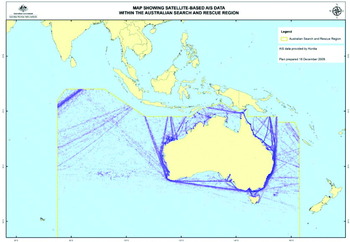
In 2009 Australia conducted a trial of commercially available Satellite AIS. The results of the trial were presented in an information paper to the IMO Sub-Committee On Communications and Search and Rescue (COMSAR). The data was presented in a visual representation of shipping traffic around Australia during the trial (see Figure 3).
Satellite AIS data tracks in the Australian Search and Rescue Region.

In that paper, it was noted that the AIS data was delivered in bursts, received at the various ORBCOMM® Gateway Earth Stations (GES). The data stream originated from the ORBCOMM® Gateway Control Centre in the United States and was delivered to the Australian Maritime Safety Authority via ORBCOMM®'s partner, Kordia Solutions®. Data was received from four operational satellites in a single orbital plane at approximately 825 km of altitudeFootnote 3.
AIS Messages received during the trial were limited to position reports and static and voyage related data Messages 1, 2, 3 and 5 (Appendix A, Table A1 refers). The display of the data appeared identical to terrestrial AIS data, with the ‘time from last update’ ranging from two seconds to over nine minutes when both the vessel and the GES were within the footprint of the satellite.
During the trial, the data was compared with data from the Long Range Identification and Tracking (LRIT) system (IMO SOLAS, 2009). Results of the comparative observations noted that, of the entire population of vessels observed during the trial, those observed through Satellite AIS (83% to 92%) was greater than through LRIT (31% to 40%) with 19% to 28% of vessels seen through both systems (Cooper, Reference Cooper2010).
In addition, for those vessels seen through both systems, LRIT provided a marginally more consistent report rate (81% to 88%) than Satellite AIS (76% to 80%).
It would be expected that Satellite AIS would see a greater number of unique vessels due to the existing carriage requirements for the two systems. LRIT reporting is mandatory for specified vessels on international voyages while AIS is required on specified vessels on both domestic and international voyages. In addition, many vessels that may not be required by law to carry AIS are fitting the system voluntarily.
4.1.2. Norway
Building on early initial work, members of the Norwegian Defence Research Establishment (FFI) have continued to work on satellite reception of AIS (Eriksen et al., Reference Eriksen, Høye, Narheim and Meland2006).
On 12 July 2010 Norway launched AISSat-1, a nano-satellite weighing six kilograms and measuring 20 cm3 (AISSAT-1 Fact Sheet, 2011). As a polar orbiting satellite, the goal was to provide empirical evidence that the low traffic density in high north latitudes will require only a single receiver to handle the reduced volume of AIS Messages. This initiative is a collaborative project, involving the Norwegian Space Centre (project owner), the Norwegian Coastal Administration and FFI. It is expected that FFI will control the operations of the satellite for approximately one year, after which Kongsberg® Satellite Services (KSAT) will take over and the data will be integrated into the Norwegian Coastal Administration to complement the existing terrestrial AIS network.
4.1.3. Japan
The Japan Aerospace Exploration Agency (JAXA) works to provide maritime situational awareness around Japan, with identification of both cooperative and non-cooperative targets. It promotes the development and use of marine resources, including fishery resources and energy and mineral resources; preservation of the marine environment; secure maritime transport and comprehensive management of coastal zones.
The JAXA marine space coordination committee is working to combine Synthetic Aperture Radar with AIS data. A nano-satellite demonstration project is planned for 2012 which would include Satellite AIS.
4.1.4. United States of America
The United States Department of Transportation, Maritime Administration has developed an integrated web-based tool known as ‘MarView®’ (www.marview.gov). The tool links data from multiple sources, including vessels, ports, intermodal port infrastructure, waterways, cargo, passengers and maritime trade information (Effa, L. 2010).
This data-driven environment has been developed with stakeholder involvement from Government, industry and the public to provide real-time tracking of vessels, with display of vessel data. The system integrates terrestrial and Satellite AIS data within the view, providing real-time information on waterways and facilities.
Examples of use of the system include national security, disaster recovery, commercial mobility and environmental stewardship. MarView® is seen to support the strategic requirement of the US Marine Transportation System (MTS) and its contribution to the economic viability of the nation. Access to MarView® is granted through a vetted subscription process.
4.2. Enhancing AIS for Satellite Reception
The issue of Satellite AIS reception has been reviewed by the International Telecommunications Union (ITU) and a number of proposals are under consideration, as follows:
• Allocation of additional AIS frequencies.
• Development of a new, shorter, AIS Message 27.
• Setting a report interval for the Satellite AIS Message 27 to three minutes.
• Eliminating AIS Class A vessels that are in range of an AIS base station.
• Eliminating AIS Class B from satellite reception.
At the time of writing, a proposal has been put forward for consideration at the World Radio Conference 2012 (WRC 2012) to allocate two VHF Channels 75 (156·775 MHz) and 76 (156·825 MHz) for Satellite AIS. These frequencies are on either side of the distress and safety frequency of Channel 16 (156·8 MHz). The possible allocation of VHF Channels 75 and 76 for Satellite AIS use will not be confirmed until WRC 2012Footnote 4 takes place.
The IALA AIS Technical Working Group has begun development on the proposed new AIS Message 27. In addition, a process to eliminate AIS Class A vessels in range of an AIS base station is being developed. There have been initial trials using the new Message 27 on the proposed additional frequencies for Satellite AIS which indicate the chosen approach is feasible.
In addition, existing shipborne AIS equipment would need to be updated, likely through a software update via the pilot port fitted on all installed AIS Class A units.
Some administrations have expressed a desire to monitor additional AIS stations, such as AIS AtoNs. Based on trials in low density traffic areas this could be possible, noting increased data packet reception.
With developments in e-Navigation, and noting the capability of AIS, it can be expected that additional uses for AIS – both terrestrial and satellite – will arise. Noting developments of Satellite AIS, there will be a need to consider possible satellite reception of new AIS stations and applications.
4.3. Developing Satellite AIS Expertise
Satellite AIS continues to develop through the sharing of results of research and development, as well as trial applications, in various international forums. A ‘Technical Exchange on AIS via Satellite’ (TEXAS) conference series provides an opportunity to address the developments in Satellite AIS. The fourth in this series of conferences (TEXAS IV), was held in September, 2010.
During the evolution of the TEXAS conference series, ideas and proposals have developed into practical trials and integrated capability. AIS use is growing, not only for maritime navigation and safety, but also in support of vessel tracking to address a range of requirements.
It must be noted, however, that AIS is a participatory system for specified vessels or it may be voluntarily fitted to vessels. As presented at TEXAS IV, the growing integration of Satellite AIS and terrestrial AIS with other sensors (e.g., Synthetic Aperture Radar) could provide a more comprehensive picture of maritime vessel traffic.
5. CURRENT USES OF SATELLITE AIS
There are a number of current, practical uses for Satellite AIS which include disaster response; environmental protection and integration of Satellite AIS with other data sources to support maritime domain awareness.
5.1. Disaster Response
The US based system MarView® has been used to support safety and disaster relief efforts, including:
• Use as a port management tool by the United States Coast Guard to manage relief vessels for Haiti relief efforts.
• Monitoring shipping movement in the path of hurricanes (e. g., Hurricane Ike) (MARAD, 2008).
5.2. Search and Rescue
The benefit of the data for search and rescue within Australia was highlighted in the information paper to the IMO (IMO COMSAR 2009). The paper highlighted the use of the data to successfully execute a search and rescue incident in a remote location. Noting the large search and rescue region covered by Australia (52·8 million square kilometres), the Australian Emergency Response Centre (ERC) uses multiple vessel track data sources, including terrestrial and Satellite AIS, as an integral element of emergency response.
5.3. Environmental Response and Protection
The use of AIS for ship monitoring and analysis has been highlighted in a number of papers (Schwehr and McGillivary, Reference Schwehr and McGillivary2007; Eide et al., Reference Eide, Endrese, Brett, Ervik and Røang2007).
These papers both look at the use of AIS technology, not only in aiding the monitoring of ship traffic, but also to provide input data that can then be used as a basis for further evaluation of individual vessels' pollution risk profiles.
The review of historic data from AIS is promoted to assist in identifying which ships may have been involved in a spill at sea. To facilitate this forensic analysis, there is a need to provide a secure means to collect and then store AIS data for later review. As the analysis could then lead to possible litigation, there is a need to verify the continuity of a secure data chain. It is likely that AIS data would provide only one aspect of the evidence being compiled for possible litigation.
Although these papers were written based on terrestrial AIS networks, the same arguments and opportunities discussed would apply to the further reaching coverage area of Satellite AIS.
5.4. Risk Modelling
AIS data is being used to provide data sets to assist in the development of models to facilitate the comparison of vessels and support risk-based decision making to assist inspection regimes. Data available from AIS includes basic information such as ship identity, ship type, cargo and destination. The division of ship types is critical in risk modelling as this forms an aspect of the legal base which is used to focus port state control inspections. The ability to determine trade flows also provides additional data sets to risk modelling as this will determine the ship types that will visit a particular country (Knapp, Reference Knapp2007).
The data that can be collected through Satellite AIS provides more detailed information on ship routing, with the ability to link to additional data sources to determine ship age, size, hull type, etc. Through the analysis of various data sets, modelling can then be used to determine the risk profile for each vessel.
6. POSSIBLE IMPLICATIONS/APPLICATIONS OF A GLOBAL VESSEL TRACKING SENSOR
Satellite AIS paves the way for truly global tracking of vessels. But what does this mean for the safety of vessels, the business aspects of shipping and the response of the regulatory and shore authorities? In addition, noting that the data set is appropriate to respond to a variety of user requirements, how is access provided and governed?
6.1. Satellite AIS and LRIT
The IMO development of LRIT was initially presented as ‘technology neutral’. Faced with the limitations of technology at the time of implementation, technical documentation (IMO, 2011) was developed to enable ships to provide the required 6 hourly report into a system. As Satellite AIS develops, there is a possibility to look at alternative technologies that can respond to the SOLAS regulation.
The initial development of AIS included a ‘long range’ capability. The thought at the time was to integrate AIS with other technologies (e.g., Inmarsat-C or MF/HF radio as part of the Global Maritime Distress and Safety System [GMDSS]) to provide a long range function (IMO, 2008).
During the development of LRIT, Norway submitted an FFI paper (Eriksen et al., Reference Eriksen, Høye, Narheim and Meland2006) to the IMO (IMO COMSAR, 2009). The submission noted that, with a sufficient number of satellites able to receive AIS signals and combined with shore-based AIS infrastructure, AIS could be used as a technology to provide LRIT with global coverage. Although the paper was noted, LRIT continued to develop using alternate satellite technologies that were proven at the time, with reference to equipment already mandated for carriage by vessels to respond to the requirements of GMDSS (IMO, 2008).
It can be expected that, as members of IMO continue to express concerns over the cost imposition of LRIT, alternative technologies will be assessed to provide the most effective means of responding to the obligations of the SOLAS Chapter V, Regulation 19-1.
6.2. Environmental Aspects
AIS data, such as vessel identification (IMO number, Maritime Mobile Service Identity [MMSI], and callsign), vessel type, speed, navigational status, and draught, can be linked with other data sets to determine expected ship emissions. The location provided by AIS can then be factored in to identify the location of specific emissions. A number of studies have already been carried out using the available AIS data collected from terrestrial shore station systems in the Netherlands, USA, Indonesia and Denmark (Lack et al., Reference Lack, Cappa, Langridge, Bahreini, Buffaloes, Brock, Cerully, Coffman, Hayden, Holloway, Lerner, Massoli, Li, McLaren, Middlebrook, Moore, Nenes, Nuaaman, Onasch, Peischl, Perring, Quinn, Ryerson, Schwartz, Spackman, Wofsy, Worsnop, Xiang and Williams2011; Olesen, Reference Olesen2010; Pitana et al., 2010; van der Tak and Cotteleer, Reference van der Tak and Cotteleer.2011).
As data sets received from Satellite AIS can include the same data as received from shore stations, the existing methodology could be adapted to enable analysis on a global scale.
6.3. Cargo Chain/Commercial Implications
To enable smooth port operations, vessels, ports and charters work together to identify expected time of arrival/loading. Vessel tracking technologies can enhance the information flow, with some ports using both pre-arrival reports and real-time/near real-time monitoring of ships through vessel tracking technologies to more clearly identify expected time of loading.
Satellite AIS data provided to ports could assist in more effective port operations, with the ability to schedule ship arrivals more accurately. The ‘just in time’ approach based on actual data could enhance port efficiency, with less time lost waiting for berths and/or cargo. The use of vessel track data has been used for this ‘slot’ management approach (Newcastle Port Corporation, 2010).
6.4. Shipping Route Analysis
Data collected over time through Satellite AIS will be suitable for global shipping route analysis. The data on vessel movements, linked to vessel type and characteristics, can also be linked to external factors such as:
• Weather events (e.g., cyclones/hurricanes).
• Prevailing meteorological and hyrodrographic conditions (e.g., ships affected more by current or by wind).
• Safety and security aspects (e.g., ships' routing altered by pirate activity).
• Impact of environmental conditions (e.g., global warming effect on existing/potential shipping routes).
The management of information collected through satellite data for such trend analysis will require consideration of data reliability; data storage capability and any limitations that may be placed on the use of the data.
7. CONCLUSIONS
Satellite AIS is an existing capability, with proven effectiveness to assist in search and rescue as well as vessel monitoring in offshore areas. The availability of satellites able to receive AIS signals is increasing, with significant growth in satellite constellations expected in 2012–2015. The development of Satellite AIS is not limited to research and development; some commercial services are currently available. There is, however, concern regarding the level of service available through Satellite AIS, noting the current limited constellation and the expected life-span of the nano-satellites used for Low Earth Orbits (LEOs).
Satellite AIS could provide an alternative technology capability to respond to the existing International Maritime Organisation Safety of Life At Sea (IMO SOLAS) regulations on Long Range Identification and Tracking (LRIT). However, Satellite AIS may not be able to address all the current performance requirements of the regulations on its own.
Beyond the implications linked to the IMO SOLAS regulation, Satellite AIS provides a means to monitor vessels effectively, from berth to berth. This ability is linked to the reception and availability of the data and a need to address access protocols.
A number of trials are underway where Satellite AIS is being integrated with terrestrial AIS networks to support environmental protection, maritime security and port efficiency. In addition, some of the trials have resulted in a move to purchase the capability on an ongoing basis.
While current use of Satellite AIS is increasing, the technology is continuing to develop with a number of issues that remain to be fully addressed, including:
• Data Packet Collisions. There are continuing concerns with lost data packets. The means to overcome this is being further addressed through de-confliction algorithms and the request for additional AIS frequencies with a new Satellite AIS message;
• Satellite Availability. The number of satellites with AIS receivers at present do not provide persistent, global coverage. While new launches are being planned, it will be some years before full constellations are available.
• Service Levels. Linked to the satellite constellation requirements and de-confliction processes, latency and revisit time could result in reduced service capability. However, this is currently measured in minutes and it is expected this will continue to improve as additional satellites are launched to enhance the constellation.
• Display of Data. While many shore authorities have developed integrated terrestrial AIS networks, the amount of additional data provided through Satellite AIS can cause disruption on the network with possible overloading of existing systems.
• Access to Data. With common data formats there is the ability to share data, however there is a need to determine the data access protocols to ensure effective, and secure, data use.
Acknowledging these issues, and recognising the continuing development of the technology, it appears that Satellite AIS a viable, current and effective tool. The use of Satellite AIS has grown beyond the theoretical to the practical. It can be expected that the ability to provide berth to berth vessel monitoring on a truly global basis will continue to drive development.
APPENDIX A. AN OVERVIEW OF THE AUTOMATIC IDENTIFICATION SYSTEM
A1. OVERVIEW OF AIS
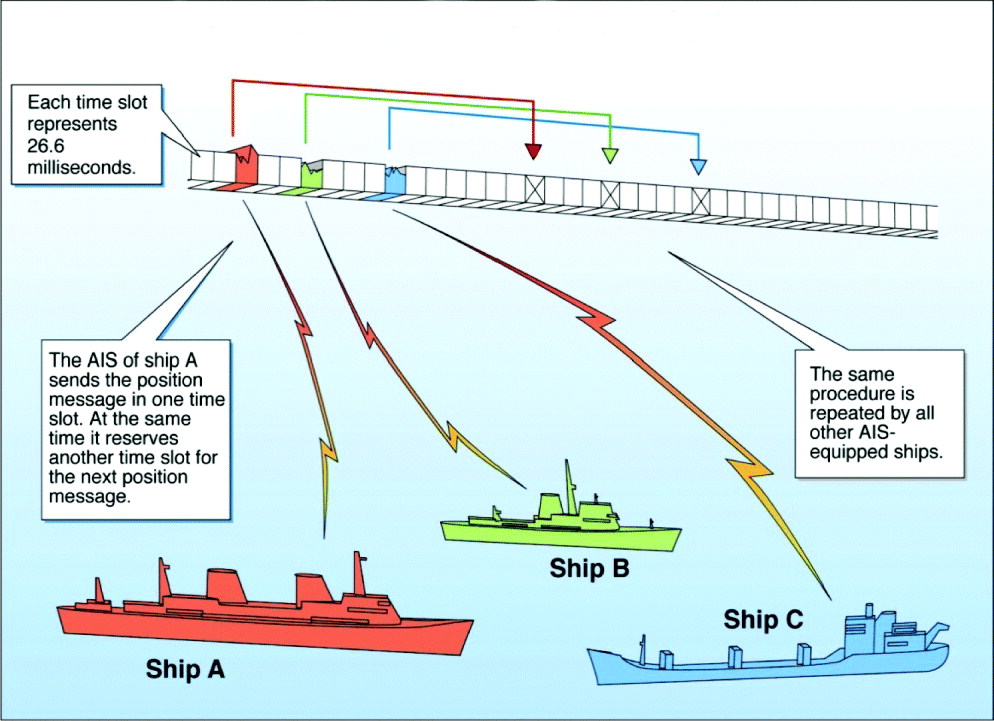
AIS uses the VHF maritime mobile band for the exchange of information using two VHF frequencies: AIS 1 (161·975 MHz) and AIS 2 (162·025 MHz). These are known as the VHF data link (VDL). There are numerous AIS devices, or stations, which use the same VDL to communicate. AIS was initially developed for terrestrial use, based on an open protocol, and was not intended for secure communications. Figure A1 presents the concept of ‘slots’ and ‘frames’ used in the communications protocol of AIS.
AIS transmission (IALA Guideline 1028).
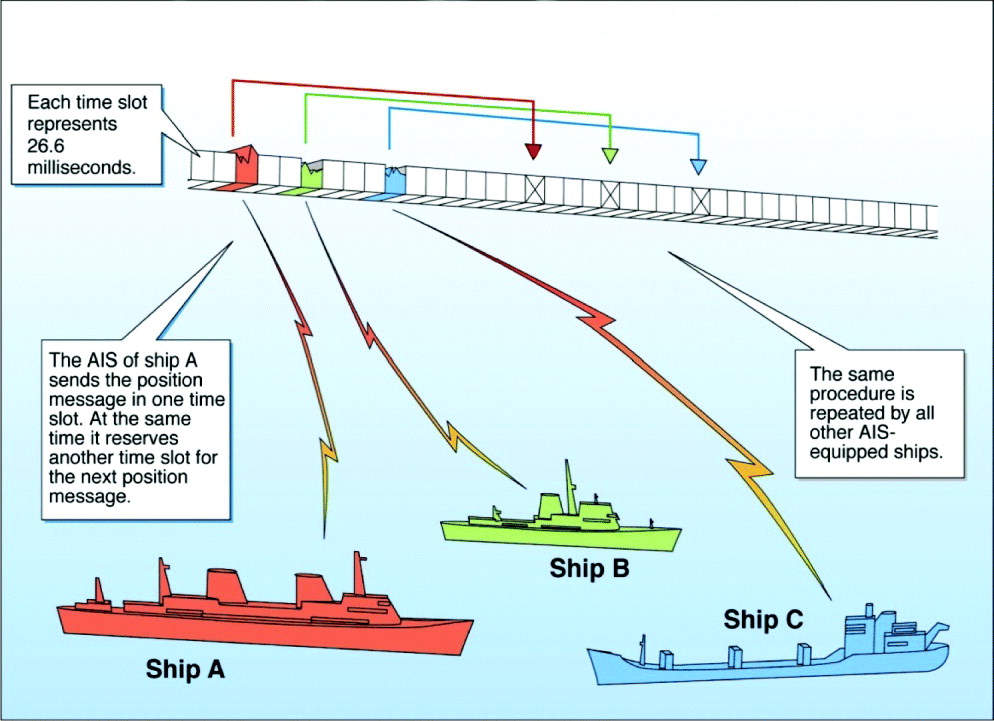
AIS uses a series of ‘slots’ in which messages are transmitted. On each of the two AIS frequencies, each frame (1 minute of time) is broken into 2250 ‘slots’ with each slot lasting 26·6 milliseconds. With the two AIS frequencies available, this means there is a finite number of 4500 slots available in each frame.
Information exchange occurs as packets of data are sent during one or more slot. The International Telecommunications Union (ITU) recommendation (ITU, 2010) notes that slots by a base station should not be re-used unless there is 120 nautical miles of physical separation (the ‘120 nautical mile rule’). Slot re-use provides candidate slots that other AIS stations can then access. The ITU recommendation presents a number of rules to be followed in selecting slots for re-use.
Short range VHF coverage is normally referred to as ‘line of sight’ and could have an expected coverage area of 10 to 15 nautical miles. Shore based AIS base stations typically have high antenna positions and increased coverage area which would enable the reception of messages from a larger area and may result in data packet collisions where slots are re-used within the base station footprint.
A2. FUNCTIONS OF AIS
The principal functions of AIS are to facilitate:
• Information exchange between vessels within VHF range of each other, increasing situational awareness.
• Information exchange between a vessel and a shore station, such as a VTS, to improve traffic management in congested waterways.
• Automatic reporting in areas of mandatory and voluntary reporting.
• Exchange of safety related information between vessels, and between vessels and shore station(s).
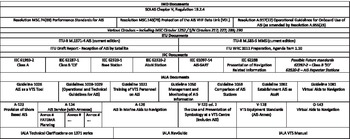
The development of AIS has expanded to include AIS for smaller vessels (Class B AIS); AIS AToNs, AIS for use on search and rescue aircraft and AIS search and rescue transmittersFootnote 5 (AIS SART). Table A2 presents a matrix that outlines the various AIS related documents, including IMO, ITU, IEC and IALA.
A3. DATA TRANSMITTED BY AIS
AIS operates without any interaction by the ship or the shore; this is known as an autonomous and continuous system. There are distinct sets of data included in the transmissions:
• Static data, which does not change frequently (e.g., ship length, name, MMSI), is entered when setting up the system.
• Dynamic data, which is taken from ship sensors or a sensor within the unit, changes as the ship moves (e.g., course, speed).
• Voyage related data, which changes on each voyage or during a voyage, is entered/updated by the Master or Officer of the Watch (e.g., navigational status, destination, cargo).
Stations may also be polled (interrogated) or commanded to transmit in a different manner; for example more frequently, or on a different frequency.
The information in AIS is transmitted using ‘messages’. Each message type refers to a different aspect of the information. The main messages transmitted by SOLAS vessels are position messages (Messages 1, 2 and 3); static and voyage related messages (Message 5) and an extended static data message (Message 24).
In addition, there are messages for other AIS stations, including AIS Base Stations (Message 4), AIS AToN (Message 21) and Class B AIS (Messages 18, 19 and 24).
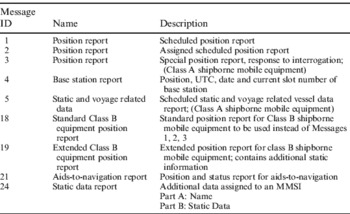
Some of the more common message types are included in Table A1.
Common AIS Message Types (Adapted from ITU-R M.1371-4 Table 43).

There are additional message types to address the ability of AIS to transmit or respond to short safety related messages, transmit or respond to application specific messages, and enable other aspects of the system Table A2.
AIS Documentation Matrix.