Atopic dermatitis (AD) is a chronic inflammatory skin disease and one of type I allergic symptoms with elevation of serum IgE (Hanifin et al. Reference Hanifin and Rajka1980; Platts-Mills, Reference Platts-Mills2001). It has been increasing recently in industrialized countries. The anti-allergic effect of probiotics attracts great attention and various researchers have reported that the immunoregulatory action of probiotics is deeply involved in these anti-allergy actions.
NC/Nga mice were established from Japanese fancy mice as an inbred strain by Kondo et al. (Reference Kondo, Nagami, Teramoto, Bond and Sugahara1969). NC/Nga mice spontaneously developed AD-like skin lesions and markedly elevated total plasma IgE level when they were maintained under very dirty conventional conditions, but these effects were not apparent under specific pathogen-free (SPF) conditions. SPF NC/Nga mice developed AD by repeated topical application with specific antigen of 2,4,6-trinitrochlorobenzene. It was reported that the mice were a good animal model for human AD, and were suitable for the analysis of allergy mechanism (Matsuda et al. Reference Matsuda, Watanabe, Geba, Sperl, Tsudzuki, Hiroi, Matsumoto, Ushio, Saito, Askenase and Ra1997).
Helper T cells are one of the immune cells and there are two types: type 1 helper T (Th1) cells and type 2 helper T (Th2) cells (Mosmann et al. Reference Mosmann, Cherwinski, Bond, Giedlin and Coffman1986). They usually keep balance mutually (Abbas et al. Reference Abbas, Muphy and Sher1996; Powrie et al. Reference Powrie and Coffman1993) but if a type I allergy develops, the Th2 cell becomes superfluous and the production of IgE is promoted (Shida et al. Reference Shida, Makino, Morishita, Takamizawa, Hachimura, Ametani, Sato, Kumagai, Habu and Kaminogawa1998). IgE is involved in allergic diseases, including AD. Antigen presenting cells produce IL-12, which activate Th1 cells and the cells inhibit production of IgE through IFN-γ, in contrast Th2 cells promote IgE by secreting IL-4 and IL-5 (Shida et al. Reference Shida, Makino, Morishita, Takamizawa, Hachimura, Ametani, Sato, Kumagai, Habu and Kaminogawa1998; Fujiwara et al. Reference Fujiwara, Inoue, Wakabayashi and Fujii2004).
Several reports have shown that certain LAB could control IgE concentration by adjusting Th1/Th2 balance, and show anti-allergic effects (Matsuzaki et al. Reference Matsuzaki, Yamazaki, Hashimoto and Yokokura1998; Yasui et al. Reference Yasui, Shida, Matsuzaki and Yokokura1999; Shida et al. Reference Shida, Takahashi, Iwadate, kamizawa, Yasui, Sato, Habu, Hachimura and Kaminogawa2002; Ishida et al. Reference Ishida, Bandou, Kanzato and Yamamoto2003; Fujiwara et al. Reference Fujiwara, Inoue, Wakabayashi and Fujii2004). Also in human trials, there are reports about the depression effect of AD using LAB (Isolauri et al. Reference Isolauri, Arvola, Sutas, Moilanen and Salminen2000; Kalliomaki et al. Reference Kalliomaki, Salminen, Arvilommi, Kero, Koskinen and Isolauri2001). But these immunoregulatory functions and anti-allegic effects of LAB were studied using the starter of LAB for commercial yogurt, and these functions in LAB derived from traditional fermented milk have many unknown points. We examined the anti-allergic effect of LAB isolated from Mongolian fermented milk which is traditional fermented milk. As a result of searching 52 strains of LAB from Mongolian fermented milk, Enterococcus faecium strain T120 (strain T120) was selected as the strain with the highest Th1 type cytokine (IL-12) induction (Kimura et al. Reference Kimura, Danno and Yasui2006). Therefore we investigated the immunoregulatory activity and anti-AD function of strain T120 using NC/Nga mice.
In this report, we investigated the anti-allergy activity of strain T120 in both an in vitro and an in vivo experiment using NC/Nga mice. In in vitro studies, the suppression of IgE levels by strain T120 and the mechanism were examined using splenocytes and Peyer's patch (PP) cells. In in vivo studies, we also examined the suppression of AD by intraperitoneal injection of strain T120.
Materials and Methods
Bacterial strain
Enterococcus faecium strain T120 (strain T120) isolated from Mongolian fermented milk, was used in these studies. The strain was identified as Ent. faecium (homology 99·7%) from homology of the 16S rDNA. The microorganisms were cultivated at 37°C for 48 h in de Man, Rogosa and Shape (MRS) liquid culture medium. The cultivated microorganisms were centrifuged at 1000 g for 5 min and were washed with phosphate buffered saline (PBS) twice. The pelleted microorganisms were lyophilized and stored at 4°C until use. The microorganisms were sterilized and killed at 121°C for 15 min before addition to cell cultures.
Mice and inductive protocol of AD
Male 5-week-old SPF NC/Nga mice were purchased from Charles River Japan Inc (Kanagawa, Japan), and maintained for more than 1 week before use. Mice were maintained in a filter-lamnar flow enclosure in a bioclean room.
AD was induced by repeated topical application with 2,4,6-trinitrochlorobenzene (picryl chloride; PiCl; Tokyo kasei kogyo). At first, 150 μl 5% PiCl dissolved in 99·5% ethanol and acetone mixture (4:1) was applied to the abdomen, breast and sole of the feet of mice. Four days after the first immunization, 20 μl 1% PiCl dissolved in olive oil was applied to each side of the ears from 4 to 5 times at 7 d intervals. Blood was withdrawn from the caudal vein after 24 h since application. Serum samples were stored at −20°C until quantitative analysis for total IgE.
Cell cultures
Splenocytes and PP cells were isolated as a single-cell-suspension from NC/Nga mice sensitized 4 to 5 times after first immunization. After depletion of erythrocytes, splenocyte were suspended at the concentration of 5×10⁶ cells/ml in RPMI-1640 medium (Sigma-Aldrich) supplemented with 10% heat-inactivated foetal calf serum (FCS), 100 U penicillin/ml and 100 μg streptomycin/ml. PP cells were prepared by treating PP of the small intestine with dispase (Yasui et al. Reference Yasui, Mike and Ohwaki1989) and were suspended as same as splenocytes. The splenocytes and PP cells (5×10⁵ cells/well) were cultured in the absence or presence of strain T120 (10 μg/ml) in a 96-well culture plate at 37°C, 5% CO2 incubator. Supernatants were sampled at maximum productive time, 2 d for IL-4, 3 d for IL-12 and IFN-γ and 14 d for IgE, and stored at −20°C for further analysis.
ELISA
Determination of total IgE levels was performed by sandwich ELISA. Rat anti-mouse IgE antibody (BD Biosciences; clone R35-72) was coated on the wells of a 96-well ELISA immunoplate (Nunc). After blocking unoccupied platic sites with 1% bovine serum albumin (BSA), samples and standard mouse IgE (Pharmingen) were added. Subsequently, bound IgE was detected by sequential incubaton with biotinylated rat anti-mouse IgE antibody (Techopharm Biotechnology; clone R35-118) and streptavidin-peroxidase conjugate (Biosource) was added to each well. 3,3′,-5,5′-tetramethylbenzidine (TMB) substrate (Sigma) was added to the wells and then the reaction was stopped by 1m-H2SO4. The absorbance of the contents of the wells was read at 450 nm on a Microplate Reader (Bio-Rad Laboratories).
Determination of IL-12, IFN-γ, IL-4 and IL-10 was done by sandwich ELISA. Purified rat anti-mouse IL-12 (p40/p70) monoclonal antibody (BD Biosciences; clone C15.6), rabbit (polyclonal) anti-mouse/rat IFN-γ (Biosource), monoclonal antibody mouse IL-4 (Mabtec; clone 11B11) and purified anti-mouse IL-10 (BioLegend; clone JES5-16E3) were used as the capture antibody, and biotinylated rat anti-mouse IL-12 (p40/p70) monoclonal antibody (BD Biosciences; clone C17.8), biotinylated anti-mouse IFN-γ antibody (BD Biosciences; clone DB-1), biotin conjugated antibody mouse monoclonal IL-4 (Mabtec; clone BVD6-24G2) and biotinylated anti-mouse IL-10 (BioLegend; clone JES5-16E3) were used as the detection antibody, respectively. As the standard, recombinant mouse IL-12 (Techne Corporaton), recombinant murine IFN-γ (Biosource), recombinant murine IL-4 (Strathmann Biotec) and recombinant mouse IL-10 (BioLegend) were used. Determination of TGF-β was done by sandwich ELISA and measured using mouse TGF-β kit (Bender MedSystems), according to recommended protocol.
Neutralization
To examine the effects of cytokine such as IL-12 and IFN-γ on IgE suppression, neutralization test was performed. Three concentrations (0·1, 1 and 10 μg/ml) of either purified rat anti-mouse IL-12 monoclonal antibody (BD Biosciences; clone C17.8) or purified rat anti-mouse IFN-γ monoclonal antibody (BD Biosciences; clone XMG1.2) was added into splenocytes (5×10⁵ cells/well) and cultured in the presence of strain T120 (10 μg/ml) in a 96-well culture plate at 37°C, 5% CO2 incubator. As a control, splenocytes were cultured in absence of strain T120 and these antibodies. Supernatants were sampled at 2 d for IL-4, 3 d for IL-12 and IFN-γ and 14 d for IgE, and stored at −20°C for further analysis.
Removal of macrophages or dendritic cells and FACS
To remove macrophages or DCs from splenocytes, splenocytes (2×10⁸ cells) from NC/Nga mice were added 20 μl rat anti-mouse/human CD11b Micro Beads (Miltenyi Biotec; clone M1/70.15.11.5) or 100 μl rat anti-mouse CD11c Micro Beads (Miltenyi Biotec; clone N418), and incubated for 15 min at 4°C and washed with 0·5% BSA and 2 mm-EDTA in PBS. Then the cell suspension was loaded onto a MACS Column (Miltenyi Biotec) two times. The magnetically labelled CD11b+ or CD11c+ cells are retained on the column. The unlabelled cells run through and the resulting cell fraction is depleted CD11b+ or CD11c+ cells from splenocytes.
Removal of CD11b+ or CD11c+ cells from splenocytes of NC/Nga mice was evaluated by flow cytometric analysis (FACS). Splenocytes (1×10⁶ cells) were incubated with FITC labelled rat anti-mouse CD11b monoclonal antibody (BD Biosciences; clone M1/70) or with PE labelled rat anti-mouse CD11c antibody (Miltenyi Biotec; clone N418) and washed with Hanks Balanced Salt Solution. Analysis was performed on an FACS Calibur with Cell Quest Pro (BD Biosciences). Removal ration of CD11b+ and CD11c+ cells were >90%, respectively.
In vivo experiments
Male 5-weeks-old NC/Nga mice were divided into strain T120 administration group (T120 group) and control group (n=5 per group). T120 group and control group were injected intraperitoneally 200 μg heat-killed strain T120 cells and 200 μl PBS 3 times per week from beginning to end of this experiment. Day 11 after first injection, these mice were immunized by repeated topical application with PiCl for induction of AD. First immunization, 150 μl 5% PiCl dissolved in 99·5% ethanol and acetone mixture (4:1) was applied to the abdomen, breast and sole of the feet of mice. Day 4 after first immunization, 15 μl 1% PiCl dissolved in olive oil was applied to each side of ears 9 times at 7 d intervals. On d 78, the mice were killed and splenocytes and PP cells were harvested for culture. According to the evaluation standards for clinical symptoms of human AD (Leung et al. Reference Leung, Hirsch, Schneider, Moody, Takaoka, Li, Meyerson, Mariam, Goldstein and Hanifin1990), 5 items were examined for redness/hemorrhage, edema, acomia/excoriation, dryness, anthema. The total scores were made into the index of severity of dermatitis. The index was classified into four; not observed, mild, moderate and severe, scoring 0, 1, 2 and 3, respectively. Ear thickness by repeated challenge of PiCl was measured by using a Coolant proof micrometer (Mitsutoyo).
Statistical analysis
Results are expressed as means±sd. The statistical difference of the clinical score was determined by Mann-Whitney's U test. The statistical difference of the other experiments was determined by two-sided Student's t test. P<0·05 was considered statistically significant.
Results
Effects of strainT120 on IL-12, IFN-γ, IL-4 and total IgE production of splenocytes and PP cells in NC/Nga mice
Splenocytes and PP cells derived from NC/Nga mice sensitized with PiCl and with confirmed high serum IgE level (approx. 2000 ng/ml) were used. On the splenocytes, strain T120 significantly (P<0·01) caused total inhibition of IgE production and significantly (P<0·01) induced IL-12 and IFN-γ production, but it didn't affect IL-4 level. On the PP cells, IL-12 and IFN-γ levels were also increased significantly (P<0·01) with addition of strain T120 (Table 1).
Effect of strain T120 on Th1 (IL-12 and IFN-γ), Th2 (IL-4) cytokines and total IgE production by splenocytes or PP cells derived from PiCl-treated NC/Nga mice

Splenocytes or PP cells derived from PiCl-treated NC/Nga mice were cultured in the absence (control) or presence (T120) of heat-killed strain T120 (10 μg/ml). The levels of IL-12, IFN-γ, IL-4 and total IgE in culture supernatant were determined by ELISA.
** P<0·01 vs. the value of control
Mechanism of strain-T120-mediated response of IL-12, IFN-γ, IL-4 and total IgE production by splenocytes in NC/Nga mice
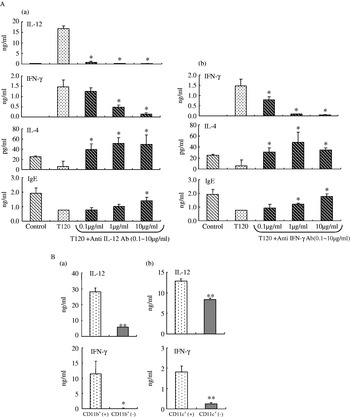
By neutralizing cytokine activity induced by strain T120, the mechanism of IgE suppression of strain T120 was analysed. With addition of anti-IL-12 antibody, IL-12 level decreased significantly (P<0·05) and production of IFN-γ was depressed in connection with it. From this result, it was clear that IL-12 strongly involved in production of IFN-γ. Furthermore, the addition of anti-IL-12 antibody significantly (P<0·05) increased production of IL-4 and IgE (Fig. 1Aa). With addition of anti-IFN-γ antibody, IFN-γ level was decreased and IL-4 level was increased significantly (P<0·05). IgE level which was suppressed by strain T120 was increased by addition of anti-IFN-γ antibody. It was significantly (P<0·05) increased by addition of 1 and 10 μg/ml of anti-IFN-γ antibody especially (Fig. 1Ab).
Analysis of mechanism on strain T120-mediated response of IL-12, IFN-γ, IL-4 and total IgE productions of splenocytes in PiCl-treated NC/Nga mice. A: Splenocytes were cultured in the absence (control) or presence (T120) of strain T120 (10 μg/ml). Anti-IL-12 antibody (0·1, 1 and 10 μg/ml) (a) or anti-IFN-γ antibody (0·1, 1 and 10 μg/ml) (b) was added in presence of strain T120 at the beginning of the culture period. The levels of IL-12, IFN-γ, IL-4 and total IgE were determined by ELISA. B: Role of macrophages and DCs in cytokine expression induced by strain T120 was studied. Splenocytes in the presence (+) or absence (−) of CD11b+ (a) or CD11c+ (b) cells were cultured with strain T120. The levels of cytokines in culture supernatant were determined by ELISA. *P<0·05, **P<0·01 vs. the value of strain T120 or the value of CD11b+(+) or CD11c+(+).

To define the cells which induce high levels of IL-12 by the addition of strain T120, CD11b+ or CD11c+ cells were removed from splenocytes and the production of cytokine was measured. The production of IL-12 and IFN-γ induced by strain T120 was significantly (P<0·01 and P<0·05, respectively) decreased by depleting the CD11b+ cells (Fig. 1Ba). When the CD11c+ cells were removed, the production of IL-12 and IFN-γ induced by strain T120 were also significantly (P<0·01) decreased (Fig. 1Bb).
The effects of strain T120 on production of IL-10 and TGF-β in splenocytes
After splenocytes were cultured with strain T120, IL-10 and TGF-β mainly produced by regulatory T cells, were measured. Production of IL-10 was significantly (P<0·01) increased by adding strain T120 but production of TGF-β was at the same level for control and T120 group (Table 2).
Effect of strain T120 on production of IL-10 and TGF-β of splenocytes derived from PiCl-treated NC/Nga mice

Splenocytes from NC/Nga mice were cultured in the absence (control) or presence (T120) of strain T120 (10 μg/ml). The levels of IL-10 and TGF-β in culture supernatant were determined by ELISA.
** P<0·01 vs. the value of control
Inhibitory effect of strain T120 on AD symptom in NC/Nga mice
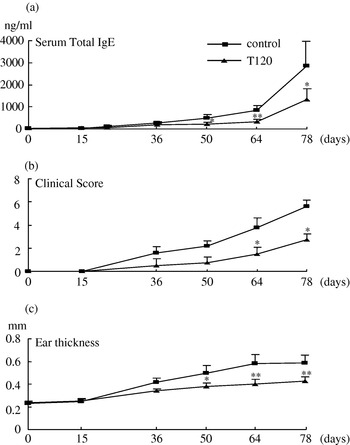
The AD condition was assessed following the intraperitoneal injection of strain T120 to NC/Nga mice. Serum total IgE level of T120 group was decreased significantly (P<0·05) compared with that of control group and at 78 d the serum IgE concentration of T120 group was approximately half that of the control group (Fig. 2a). Clinical severity of the dermatitis was increased following the addition of immunization to the control group but inflammation of the skin in T120 group was suppressed compared with that of control group (Fig. 2b). Ear thickness was increased with elevation of IgE level in the control group but in contrast, ear thickness of T120 group was suppressed (Fig. 2c).
Effects of intraperioneal injection of strain T120 on AD symptom of PiCl-treated NC/Nga mice. Mice were injected with 200 μg of strain T120 (T120 group) or PBS (control group) three times per week. The level of serum IgE was determined by ELISA (a). According to the evaluation standards for clinical symptoms of human AD, skin severity score in NC/Nga mice of T120 and control group was measured (b). Change in ear thickness was measured using a coolant proof micrometer (c). *P<0·05, **P<0·01 vs. the value of control group.

In the splenocytes, production of total IgE was significantly (P<0·05) inhibited in T120 group but production of IL-12, IFN-γ and IL-4 were at the same level in control and T120 group. In PP cells, production of total IgE in T120 group was significantly (P<0·01) suppressed along with splenocytes and production of IL-12 and IFN-γ in T120 group were significantly (P<0·01 and P<0·05, respectively) increased but IL-4 was the same level in both groups (Table 3).
Productive activity of total IgE and cytokine (IL-12, IFN-γ and IL-4) in splenocytes and PP cells derived from PiCl-treated NC/Nga mice administrated with strain T120

The mice which treated with PiCl and administrated strain T120 (T120 group) or PBS (control group) were sacrificed at 78 days and splenocytes and PP cells were cultured for determination of IL-12, IFN-γ, IL-4 and IgE. *P<0·05,
** P<0·01 vs. the value of control group
Discussion
There are few reports of the immunoregulatory function of LAB derived from traditional fermented milk, and much remains unknown. In this paper, analysis of the immunomodulatory property of LAB originating from Mongolian fermented milk was performed. We studied the anti-allergic action of strain T120 with the ability to powerful induce IL-12 from both in vitro and in vivo experiments using the NC/Nga mice. Shida et al. (Reference Shida, Makino, Morishita, Takamizawa, Hachimura, Ametani, Sato, Kumagai, Habu and Kaminogawa1998) has reported that suppression of IgE production by one strain of LAB from commercial yogurt is due to improved Th1/Th2 balance through the enhancement of Th1 and inhibition of Th2 cytokine. However, strain T120 suppressed IgE production through the enhancement of only Th1 cytokine and improvement of Th1/Th2 balance
It has been reported that the cells producing IL-12, induced by stimulation of LAB, are either macrophages or DCs (Fujiwara et al. Reference Fujiwara, Inoue, Wakabayashi and Fujii2004). Since the production of IL-12 and IFN-γ induced by strain T120 were decreased by removing CD11b+ or CD11c+ cells, it was suggested that strain T120 stimulated macrophages and DCs to produce IL-12 (Fig. 1Ba, b). As reduction of IL-12 in macrophages (CD11b+ cell)-deficient splenocytes was more than that in DCs (CD11c+ cells)-deficient splenocytes, it was concluded that macrophages play the major role of IL-12 production induced by strain T120.
It has been reported that Th3 cells, characterized by production of TGF-β (Chen et al. Reference Chen, Kuchroo, Inobe, Hafler and Weiner1994; Weiner et al. Reference Weiner1997) and regulatory T (Tr) 1 cells, characterized by production of IL-10 (Groux et al. Reference Groux, O'Garra, Bigler, Rouleau, Antonenko, De Vries and Roncarolo1997; Levings et al. Reference Levings and Roncarolo2000) participate in the anti-allergic function. Okamoto et al. (Reference Okamoto, Kawamura, Kanbe, Kanamaru, Ogawa, Okumura and Nakao2005) reported that oral administration of TGF-β to mice suppressed allergic reactions, such as total IgE production in blood, anaphylactic shock, and dermatitis formation. And according to the report of Rautava et al. (Reference Rautava, Kalliomaki and Isolauri2002) oral administration of probiotics to pregnant women increased TGF-β concentration in breast milk and the rate of symptoms of AD development in infants was reduced. On the other hand, Pessi et al. (Reference Pessi, Sutas, Hurme and Isolauri2000) have reported that oral administration of Lactobacillus rhamnosus GG to children with allergies increased IL-10 in serum and decreased allergy symptoms. In this study, production of TGF-β and IL-10 by addition of strain T120 in the splenocytes culture system was examined (Table 2). Although production of TGF-β was not affected, production of IL-10 was increased significantly and it was hypothesized that regulatory T cells participated in the improvement of AD by strain T120.
In in vivo systems, intraperitoneal injection of strain T120 which induced IL-12 strongly suppressed the total IgE in serum Surprisingly, unlike in in vitro systems, the enhancement of Th1 cytokine was confirmed only on PP cells and not on splenocytes. The results suggested that different mechanisms of suppression of IgE production by intraperitonial injection of strain T120 were associated with splenocytes and PP cells. Further studies on the different mechanism of both cell types are now in progress. It is well known that th2 cytokine have an important role in development of allergy (Matsuda et al. Reference Matsuda, Watanabe, Geba, Sperl, Tsudzuki, Hiroi, Matsumoto, Ushio, Saito, Askenase and Ra1997). However, our results showed that production of IL-4 did not change on both cells in in vitro systems. It was reported that the Th2-mediated immune response is not necessary for the development of AD-like skin disease in NC/Nga mice (Yagi et al. Reference Yagi, Nagai, Iigo, Arai and Kudo2002). Therefore, one possibility is that strain T120 may improve the AD symptom despite no change in the IL-4 level (Fig. 2, Table 3). Thus, strain T120 did not act on Th2 cells, it acted mainly on Th1 cells and improved Th1/Th2 balance and suppressed IgE production (Table 3).
In conclusion, we demonstrated that the administration of strain T120 inhibited AD-like skin lesion in NC/Nga mice. This result could may be mainly due to suppression of IgE production through shift to Th1 of Th1/Th2 balance and enhancement of Tr1 cells which produced IL-10.