Introduction
Chilling injury caused by exposure to low temperatures places serious constraints on crop production worldwide. This form of stress affects plant growth adversely, resulting in lower production, and in extreme cases, plant death (Allen & Ort Reference Allen and Ort2001; Viswanathan & Zhu Reference Viswanathan and Zhu2002). Cotton (Gossypium hirsutum L.) is sensitive to cold and therefore susceptible to chilling damage in the first few weeks after sowing. The adverse impact of chilling stress (temperatures between 0 and 10 °C) on crop growth and development varies with growth stage. Chilling stress at germination and seedling emergence may cause long-term damage with adverse impacts on fruiting, lint yield and lint quality.
In response to chilling stress, plants accumulate compatible solutes, which are typically small organic metabolites that dissolve readily in water, are electrically neutral within a wide range of physiological pH values and are non-toxic even at high concentrations (Yancey et al. Reference Yancey1982). One such compatible solute, glycine betaine (N,N,N-trimethyl glycine; GB), is distributed widely in microorganisms, higher plants and animals (Rhodes & Hanson Reference Rhodes and Hanson1993; Kurepin et al. Reference Kurepin2015). Both the exogenous application of GB and the creation of a pathway to synthesize GB in plants by means of genetic engineering have served to make plants more tolerant to abiotic sources of stress (Chen & Murata Reference Chen and Murata2002, Reference Chen and Murata2008; Wani et al. Reference Wani2013; Shams et al. Reference Shams2016), such as high salt concentration, low temperature (Quan et al. Reference Quan2004), drought (Lv et al. Reference Lv2007) and high temperature. Moreover, plants accumulate GB faster when under stress and endogenous GB contents are correlated positively with enhanced tolerance (Rhodes & Hanson Reference Rhodes and Hanson1993). Glycine betaine also effectively stabilizes the quaternary structures of enzymes and complex proteins and maintains the integrity of cell membranes despite extreme temperatures or high salt concentrations (Papageorgiou & Murata Reference Papageorgiou and Murata1995).
Glycine betaine is stable in vivo in plants and the rate-limiting step in its accumulation is its synthesis rather than its degradation (Rhodes & Hanson Reference Rhodes and Hanson1993). Based on this observation, researchers have introduced the GB biosynthetic pathway into GB-deficient plants using transgenic methods. However, transgenic plants vary in the extent to which they can accumulate GB. Some species cannot synthesize it in sufficient quantities. This shortcoming has led to greater attention being paid to the benefits of GB as a foliar spray and as a seed treatment (Agboma et al. Reference Agboma1997; Sakamoto & Murata Reference Sakamoto and Murata2002; Naidu & Williams Reference Naidu and Williams2004).
Exogenous application of GB can improve the growth and survival of many crops under environmental stress and make them more tolerant to freezing and chilling (Ashraf & Foolad Reference Ashraf and Foolad2007; Farooq et al. Reference Farooq, Basra and Ahmad2007, Reference Farooq2008a, Reference Farooqb; Chen & Heuer Reference Chen and Heuer2013). In tomato, exogenous GB was shown to be readily taken up and translocated to various organs when applied as a foliar spray (Park et al. Reference Park, Jeknic and Chen2006). The chilling tolerance of GB-treated plants improves because GB not only protects macromolecules and the cell membrane but also stimulates hydrogen peroxide (H2O2)-mediated antioxidant mechanisms (Park et al. Reference Park, Jeknic and Chen2006). Treatment with GB also modulates the expression of some genes involved in stress tolerance, including those that produce reactive oxygen species (ROS)-scavenging enzymes. The latter are partially localized on the plasma membrane and accelerate the production of a reductant in the cell wall, which also plays a role in rendering cells more tolerant to chilling (Einset & Connolly Reference Einset and Connolly2009).
Seed germination and seedling survival under various forms of environmental stress are crucial for crop establishment and yield (Naidu Reference Naidu1995) and can be effectively enhanced by treating seed with GB under sub-optimal temperatures (Demir & Oztokat Reference Demir and Oztokat2003; Farooq et al. Reference Farooq, Basra and Ahmad2007). Naidu et al. (Reference Naidu, Cameron, Konduri, Michalk and Pratley1998) reported that drought tolerance in cotton was improved by seed treatment with GB. Research has found that chilling tolerance was improved by seed priming of late-sown wheat and by seed treatment of hybrid maize with GB (Farooq et al. Reference Farooq2008a). The increased tolerance was attributed to the high water content of the tissues, reduced leakage of membrane electrolytes, and higher antioxidant activity and carbohydrate metabolism.
The north-western inland cotton belt, Yellow River cotton belt and Yangtse River cotton belt are the main cotton growing regions in China at present. Low-temperature stress can occur during each growth period of cotton, but the main adverse effect is chilling stress during the sowing to seedling stages. During the growth period from mid-April to mid-May, cotton in the seedling stage frequently suffers from chilling damage because of temperature instability and long periods of low temperatures. This occurs in the spring in the north-western inland cotton belt and influences the survival rate of seedlings as well as seedling growth. Chilling stress during the seedling period can result in runt seedlings or seedling death; consequently, the seeds either do not emerge or die in the fields after emergence. The province of Xinjiang is in north-western China and has a relatively large cotton planting area. Chilling is a common weather characteristic of this area in early spring and results in considerable challenge to cotton plants (Li et al. Reference Li2012). The early stages affect later growth and development stages of cotton seedlings, so chilling stress in the early stages can influence the growth of cotton seedlings negatively. To manage the impact of chilling on cotton seedling growth, cold-resistant strategies need to be adopted. A simple, convenient and effective method to improve the ability of cotton seedlings to resist chilling stress is needed urgently for actual production. Based on this, the current study attempts to explore whether the cold resistance of cotton at the seedling stage is improved effectively by soaking the seeds in GB. The biochemical basis and further understanding of the mechanism underlying GB treatment require further study. The results will have an important application value and theoretical significance for research on the chilling stress and production of cotton.
Materials and methods
Seed material and treatments
The plant material used in the current study was cotton cultivar Lumianyan19, which was bred by the Shandong Faculty of Agricultural Sciences in China. The experiment was conducted on the campus of Shan Dong University (36°40′N, 117°03′E, 50 m a.s.l.). The seeds were delinted with concentrated sulphuric acid and then washed repeatedly with water. Selected fully developed seeds were surface sterilized with 0.7 ml/ml ethanol for 1 min and then 1 g/l mercuric chloride for 10 min, followed by washing five times with sterile distilled water. The seeds were soaked in 100, 200, 400 or 800 µg/ml of GB (Sigma Chemical Co., St. Louis, MO, USA) or in sterilized distilled water for 14 h at room temperature (25 °C) under dark conditions. Subsequently, the soaked seeds were blotted dry rapidly and carefully using filter paper. Five batches of seeds were treated separately with GB for biological replicates of subsequent experiments.
Seed germination percentage at different temperatures
The control and GB-treated seeds were sown in pots (diameter, 30 cm; height, 25 cm) filled with clean sand (25 seeds per pot; five pots per treatment). After sowing, pots were maintained under dark conditions in a climate chamber (Beijing Qianjing-huibang greenhouse Technology Co Ltd, LT/ACR-2002, Beijing, China) at 25, 15 and 10 °C. The germination percentage of each treatment was recorded daily. The time required to achieve half seed emergence (E 50) was calculated according to the formula presented by Farooq et al. (Reference Farooq2005).
 $$E_{50} = t_i + \displaystyle{{((N/2) - n_i)\,(t_j - t_i)} \over {n_j - n_i}}$$
where n i and n j are the cumulative numbers of seeds germinated by adjacent counts at times t i and t j when n i < N/2 < n j, and N was the final number of germinating seeds.
Chilling treatment of cotton seedlings
The control and 400 µg/ml GB-treated seeds were sown in pots that contained loam soil. After germination, one vigorous plant was maintained per pot. The plants were irrigated twice weekly with Hoagland's solution. The seedlings were cultured in a greenhouse at 30/25 °C (day/night) with a photon flux density (PFD) of 500 µmol/m2/s, a relative humidity of 60–70%, and 14 h day length.
At the four-leaf stage, half of the seedlings initiated from the control and GB-treated seeds were transferred to a growth chamber (Percival Scientific Inc, Percival I-30VL, Perry, Georgia, USA) set at 5 °C with a relative humidity of 60–70% and a PFD of 500 µmol/m2/s under 14/10 h (light/dark) conditions. After 3 days’ growth under these conditions, all chilled seedlings were allowed to recover in a greenhouse at 30/25 °C (day/night) for 3 days.
Determination of glycine betaine using 1H nuclear magnetic resonance
Fresh cotton leaves were frozen in liquid nitrogen. The sap of gradually thawed cotton leaves was absorbed by a glass injector and the absorbed leaf sap centrifuged at 12 000 g at 4 °C for 10 min. The supernatant was dried by a stream of nitrogen gas. The dried fractions were dissolved with deuterium oxide containing 1 mmol/l 3-(trimethylsilyl)-propanesulphonic acid sodium, which acted as the internal reference for quantification. The GB contents in the control and GB-treated plant leaves were determined using 1H nuclear magnetic resonance spectroscopy as described previously (Quan et al. Reference Quan2004).
Measurement of ion leakage and malondialdehyde
Detached leaves of the GB-treated and control plants were washed three times with deionized water, blotted on filter paper, cut into pieces and placed in 25 ml of deionized water, after which they were vacuumed to 0.05 MPa for 20 min. The conductivity of the solution was measured using a conductivity meter (Leici, DDSJ-308A, Shanghai, China) after gentle agitation for 2 h. The total ionic strength was remeasured after the solution was heated in 100 °C water for 20 min and cooled to 25 °C. The conductivity due to leakage was represented by the percentage of initial conductivity v. total conductivity (Fan et al. Reference Fan, Zheng and Wang1997).
The malondialdehyde (MDA) content in the leaves were determined according to Quan et al. (Reference Quan2004). Cotton leaves were homogenized in 5 ml of 100 g/l trichloroacetic acid (TCA) and then centrifuged at 12 000 g for 10 min. Two millilitres of supernatant were added to 2 ml of 6 g/l thiobarbituric acid (in 100 g/l TCA), and the reaction mixture was incubated at 100 °C in a water bath for 15 min. The reaction was ended at 25 °C. After the reaction mixture was centrifuged at 12 000 g for 10 min, the absorbance of the supernatant at 450, 532 and 600 nm was determined using a spectrometer (Perkin-Elmer Corp, Lambda35, Waltham, Massachusetts, USA). The concentration of MDA was calculated using the following formula:
 $$C\,({\rm \mu mol/l}) = {6.45} \times ({\rm O}{\rm D}_{532} - {\rm O}{\rm D}_{600}) - {0.56} \times {\rm O}{\rm D}_{450}$$
The MDA content was expressed as nmol/g of fresh weight.
Quantification of hydrogen peroxide
Fresh leaves of GB-treated and control plants were homogenized in 5 ml of ice-cold acetone. The homogenate was centrifuged at 4000 g for 15 min at 4 °C, and the supernatant was used for determination of H2O2. The supernatant (1 ml) was mixed with 0.1 ml of 50 g/l titanium sulphate and 0.2 ml of strong ammonia. The mixtures were centrifuged, the supernatant was discarded and the precipitate washed repeatedly with acetone to remove the plant pigments. After washing, 2 mol/l of sulphuric acid was added to resuspend the precipitate, and the volume was brought up to 10 ml with cold distilled water. The absorbance values were measured spectrophotometrically (Perkin-Elmer Corp, Lambda35) at 415 nm according to the standard curve of the oxygen (O2)-free radicals (Mukherjee & Choudhuri Reference Mukherjee and Choudhuri1983).
Determination of antioxidant enzyme activities
Leaves from the control and GB-treated plants were homogenized in 5 ml of 50 mm phosphate buffer that contained 0.2 mm ethylene diamine tetra-acetic acid (EDTA) and 20 g/l polyvinylpyrrolidone. The homogenate was centrifuged at 10 000 g for 15 min at 4 °C. The resultant supernatant was used for the determination of enzymatic activity.
Catalase (CAT) and ascorbate peroxidase (APX) activities were determined as described by Cakmak et al. (Reference Cakmak, Strbac and Marschner1993). The CAT was assayed by monitoring the decreases in absorbance at 240 nm due to the decomposition of H2O2. The reaction mixture contained 50 mm phosphate buffer (pH 7.0), 20 mm H2O2 and an aliquot of the extract.
The activity of APX was determined as a decrease in the absorbance at 290 nm due to the oxidation of ascorbate. The reaction mixture consisted of 50 mm phosphate buffer (pH 7.0), 0.1 mm EDTA, 1.0 mm H2O2, 0.25 mm ascorbate and an aliquot of the extract.
Total superoxide dismutase (SOD) activity was determined as described by Lv et al. (Reference Lv2007). Cotton leaf (about 200 mg) was ground under pre-cooled 50 mm potassium phosphate (pH 7.8). The grinding products were centrifuged at 7500 g under 4 °C for 15 min and the supernatants preserved and used for SOD activity assay. The 3 ml of reaction mixture containing 50 mm potassium phosphate (pH 7.8), 75 mm nitro blue tetrazolium (NBT), 13 mm methionine, 0.1 mm EDTA and 2 µm riboflavin was added to suitable enzyme extract in the SOD activity assay. The amount of enzyme needed to inhibit half of the NBT photoreduction was considered to be one unit of SOD activity.
Determination of relative water content and osmotic potential
Fresh weight was measured immediately after the leaves were cut from plants. Leaves were then cut into pieces and soaked in distilled water to constant weight, when they were blotted carefully on filter paper and the turgid weight measured. Then, the leaf samples were dried in an oven for 72 h at 70 °C for dry weight determination. The relative water content (RWC) was calculated using the following equation:
 $${\rm RWC}\,{\rm (\% )} = \displaystyle{{({\rm FW} - {\rm DW})} \over {({\rm TW} - {\rm DW})}} \times 100$$
The osmotic potential of the leaves at full turgor (Ψs) was measured as described by Gaxiola et al. (Reference Gaxiola2001). Leaf samples were cut into pieces, immersed in deionized water at 4 °C overnight, blotted dry with filter paper and frozen in liquid nitrogen to drain them of their sap. The iC value of the expressed sap was determined using a freezing point micro-osmometer (Fiske Associates, Model-210, Norwood, Massachusetts, USA) and Ψs was calculated using the following formula:
 $$\Psi {\rm s} = - iCRK$$
where R = 0.008314 and K = 298.
Chlorophyll content determination
Cotton leaf samples were cut into pieces and extracted in 0.8 ml/ml acetone. The total chlorophyll content was measured using a spectrophotometer (Perkin-Elmer Corp, Lambda35) as described by Arnon (Reference Arnon1949).
Measurement of chlorophyll fluorescence and photosynthesis
The LI-COR 6400 portable photosynthetic analyser (LI-COR Inc, Lincoln, LI-6400, Nebraska, USA) was used to measure net photosynthesis. The photosynthetic PFD was set at 600 µmol/m2/s using an internal 6400-02B LED source and the flow rate was set to 500 µmol/s. All measurements were completed between 9:30 and 11:30 a.m. After dark adaptation for 30 min, the Hansatech Fluorescence Monitoring System (Hansatech Instruments Ltd, FMS-2, King's Lynn, UK) was used to measure some relevant chlorophyll fluorescence characteristics of the third fully expanded leaves of cotton seedlings.
Statistical analysis
All data are presented as the mean ± standard error (s.e.). Comparisons between the GB-treated and control plants were performed using Student's t test. A value of P < 0.05 was considered statistically significant. Correlations of antioxidant enzyme activity were established with the H2O2 content, MDA content, ion leakage and GB content in the leaf. Correlation coefficients were deemed statistically significant at P < 0.05. All statistical analyses of the data were performed using SPSS for Windows version 10.0 (SPSS Inc, Chicago, Illinois, USA).
Results
Germination of cotton
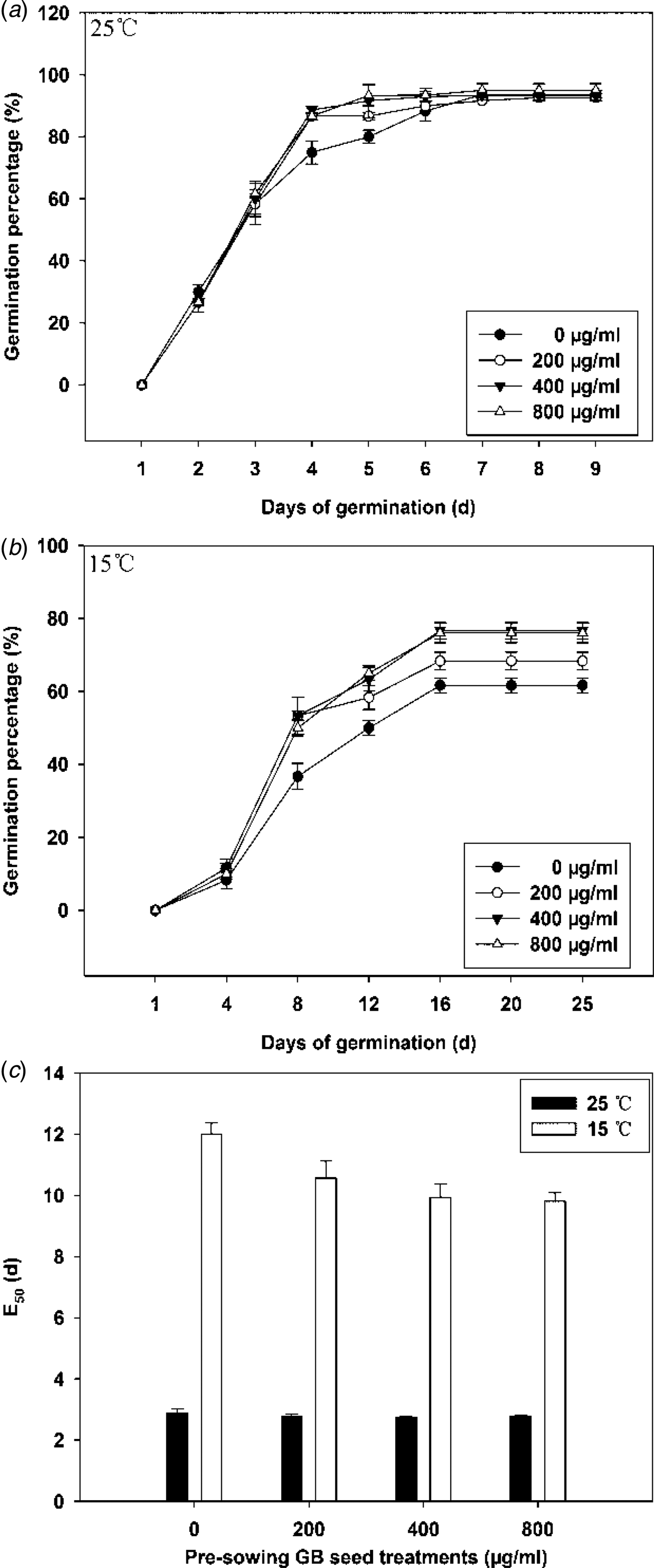
The rate of germination was recorded for seeds maintained at 25 °C (Fig. 1(a)), 15 °C (Fig. 1(b)) and 10 °C. At 25 °C, the seeds began to germinate 2 days after sowing, and the differences in germination percentage among the 200 µg/ml GB-treated seeds (92.7%), 400 µg/ml GB-treated seeds (93.3%), 800 µg/ml GB-treated seeds (95.0%) and control seeds (93.7%) were not significant (Fig. 1(a)). At 10 °C, all the seeds failed to germinate (data not shown). At 15 °C, germination was delayed and was less uniform compared with germination at 25 °C. It took approximately 9 days for the GB-treated seeds and approximately 12 days for the untreated seeds to reach half germination (often referred to as E 50, or half-emergence time) (Fig. 1(c)). In the seeds exposed to chilling, E 50 was increased significantly (P < 0.05, Fig. 1(c)), and the final germination percentage was higher in seeds treated with 400 µg/ml GB compared with those treated with 200 µg/ml GB (P < 0.05, Fig. 1(b)). After 16 days, there was no difference in germination percentage of seeds treated with 400 and 800 µg/ml GB at 15 °C (Fig. 1(b)). Based on the above results, the material derived from seeds treated with 400 µg/ml GB was used to determinate the related indicators.
The impact of temperature on seed germination of control and glycine betaine (GB)-treated plants. (a) 25 °C; (b) 15 °C; (c) the time required to achieve half seed emergence (E 50). Vertical bars represent s.e. (n = 5).

Glycine betaine content, osmotic potential and relative water content
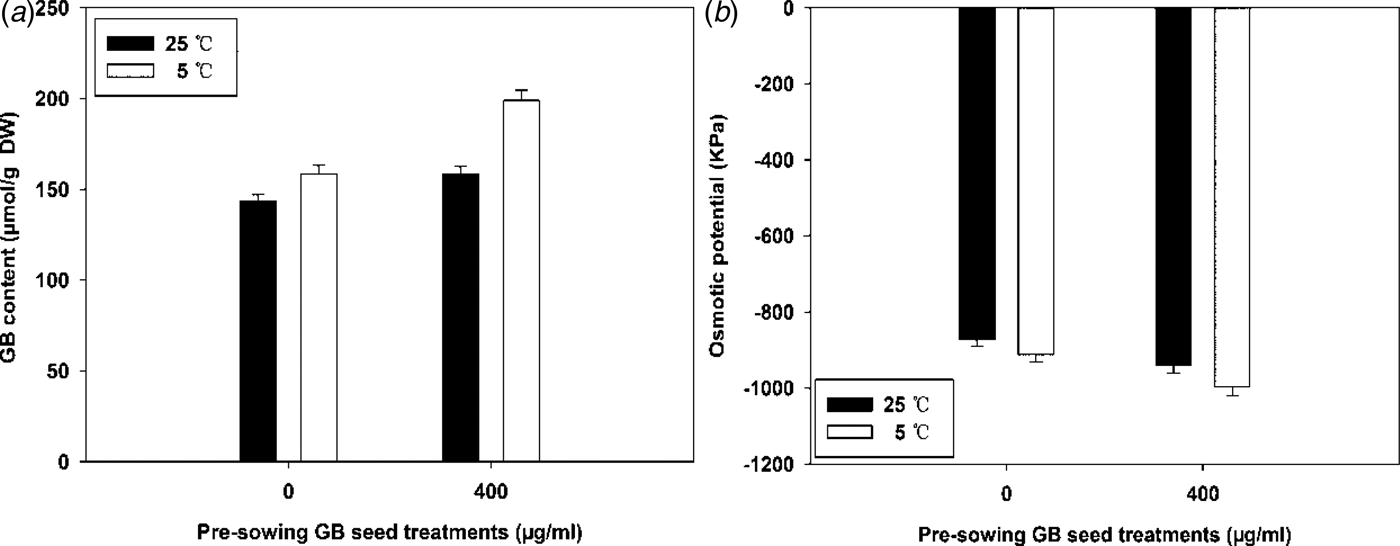
The GB content of the second fully expanded leaves of cotton plants with or without treatment at 5 °C was determined using 1H nuclear magnetic resonance spectroscopy. Under normal conditions, seed treatment with GB increased the GB content of treated plants by 10.2% compared with the control plants (P < 0.05, Fig. 2(a)). After chilling treatment at 5 °C for 3 days, the GB content of leaves was increased in all plants but was 25.6% higher in treated than in control plants (P < 0.05, Fig. 2(a)).
The impact of temperature on glycine betaine (GB) content and osmotic potential of control and GB-treated plants. (a) GB content; (b) osmotic potential. Vertical bars represent s.e. (n = 5).

As shown in Fig. 2(b), the Ψs of treated plants (−941 KPa) was lower than that of control plants (−873 KPa) under normal growth conditions (P < 0.05). After stress treatment, the Ψs of the treated plants decreased to −997 KPa, which was significantly lower than that of control plants (−912 KPa) (P < 0.05). These results indicated that more solutes accumulated in the treated plants to enable the cells to absorb more water and to maintain cell turgor under osmotic stress.
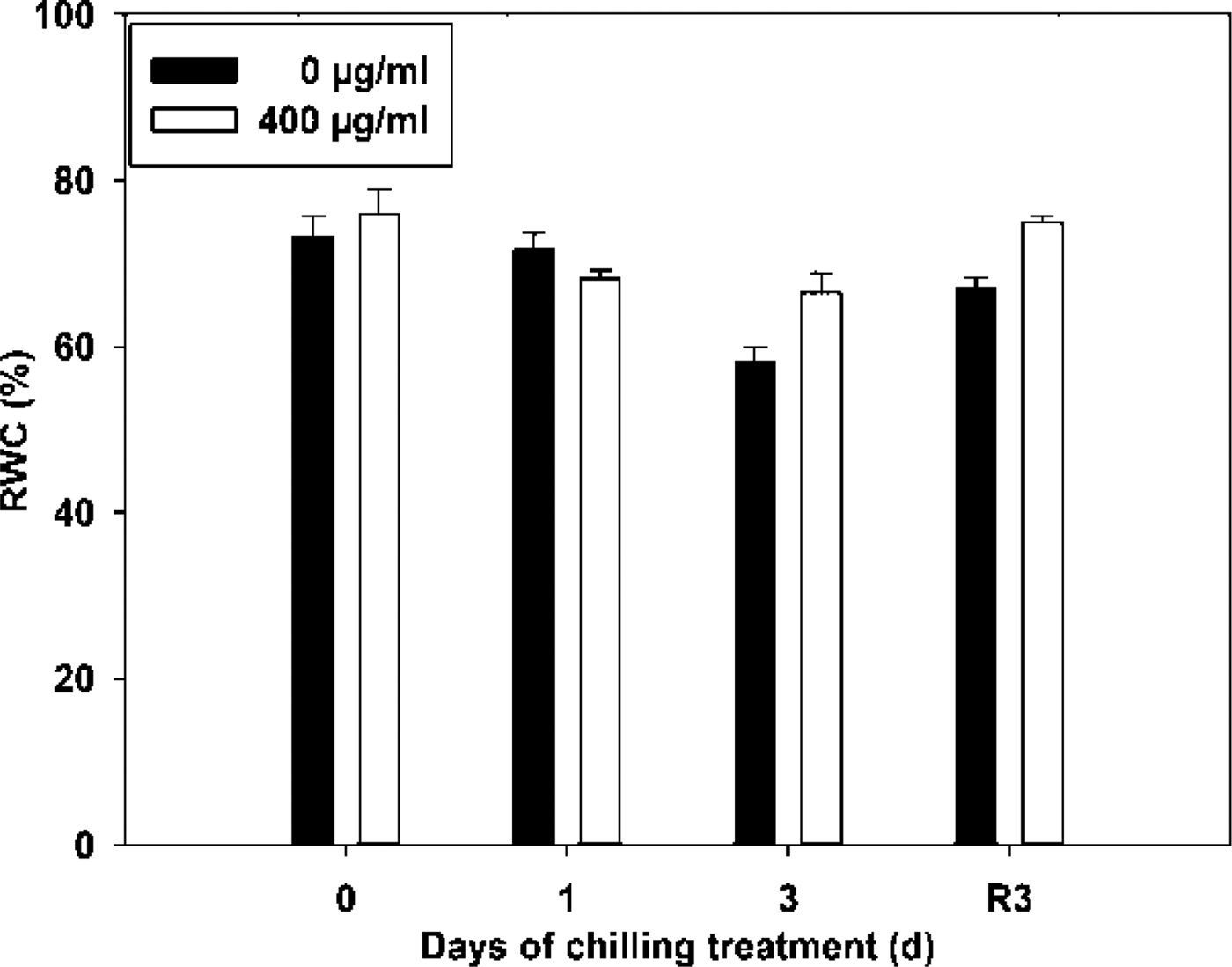
Under normal conditions, the RWC of the leaves of all plants was approximately 75.0% (Fig. 3) and it decreased in all plants when they were exposed to chilling stress, although the extent of the decrease was generally lower in treated plants (P < 0.05, Fig. 3). The treated plants also recovered faster at 3 days after exposure to low temperature (P < 0.05, Fig. 3), while the leaf RWC of seedlings from treated seeds was close to the value of RWC measured before the chilling treatment was imposed.
The impact of temperature on the relative water content (RWC) of control and glycine betaine-treated cotton seedlings. Vertical bars represent s.e. (n = 5).

Chlorophyll content, photosynthesis and chlorophyll fluorescence
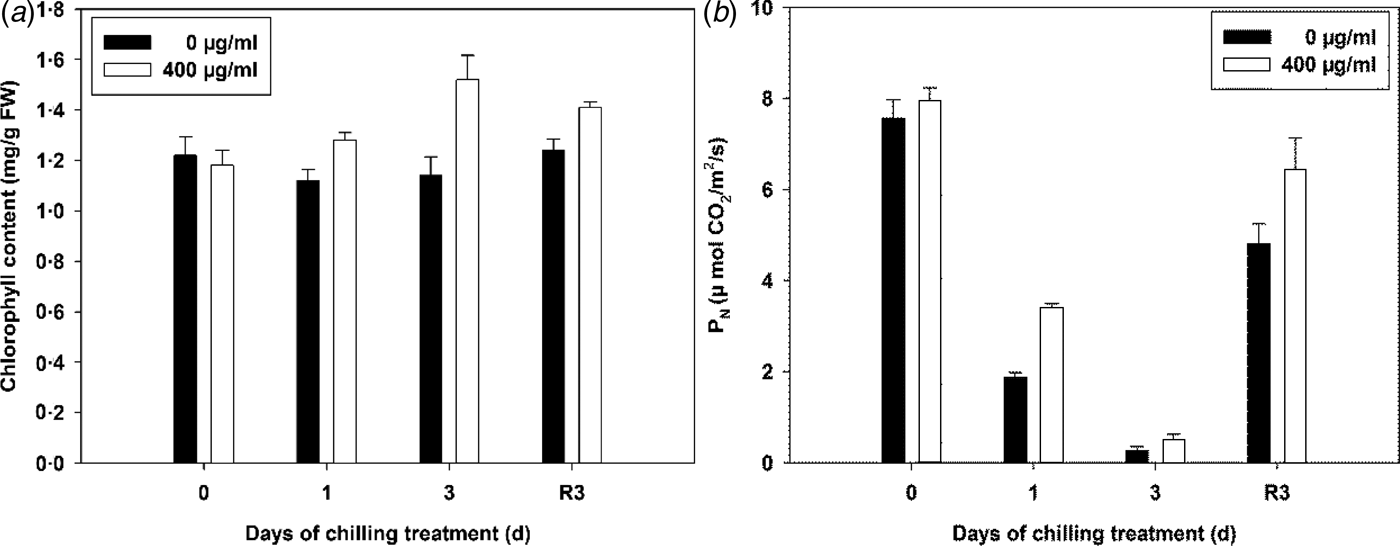
Under normal conditions, no significant differences were found in chlorophyll content between treated and untreated plants (Fig. 4(a)). On the first and third day of the chilling treatment and 3 days after it was discontinued, the chlorophyll content of GB-treated plants was higher than that of control plants, by 14.3% (P < 0.05, Fig. 4(a)), 33.3% (P < 0.01, Fig. 4(a)) and 13.7% (P < 0.05, Fig. 4(a)), respectively. This indicated a greater resistance to low-temperature damage in treated plants.
The impact of temperature on chlorophyll content and net photosynthesis rate (P N) of control and glycine betaine-treated. (a) Chlorophyll content; (b) P N. Vertical bars represent s.e. (n = 5).

Seed treatment with GB also increased the leaf net photosynthetic rate (P N) under low temperature. As the chilling stress continued, the P N decreased rapidly, although it was significantly higher in treated plants (P < 0.05, Fig. 4(b)). After 3 days of recovery at optimal temperatures, the P N of the treated plants was 34.1% higher (P < 0.05, Fig. 4(b)). These results indicated that the photosystems of the treated plants recovered earlier from chilling stress compared with untreated plants.
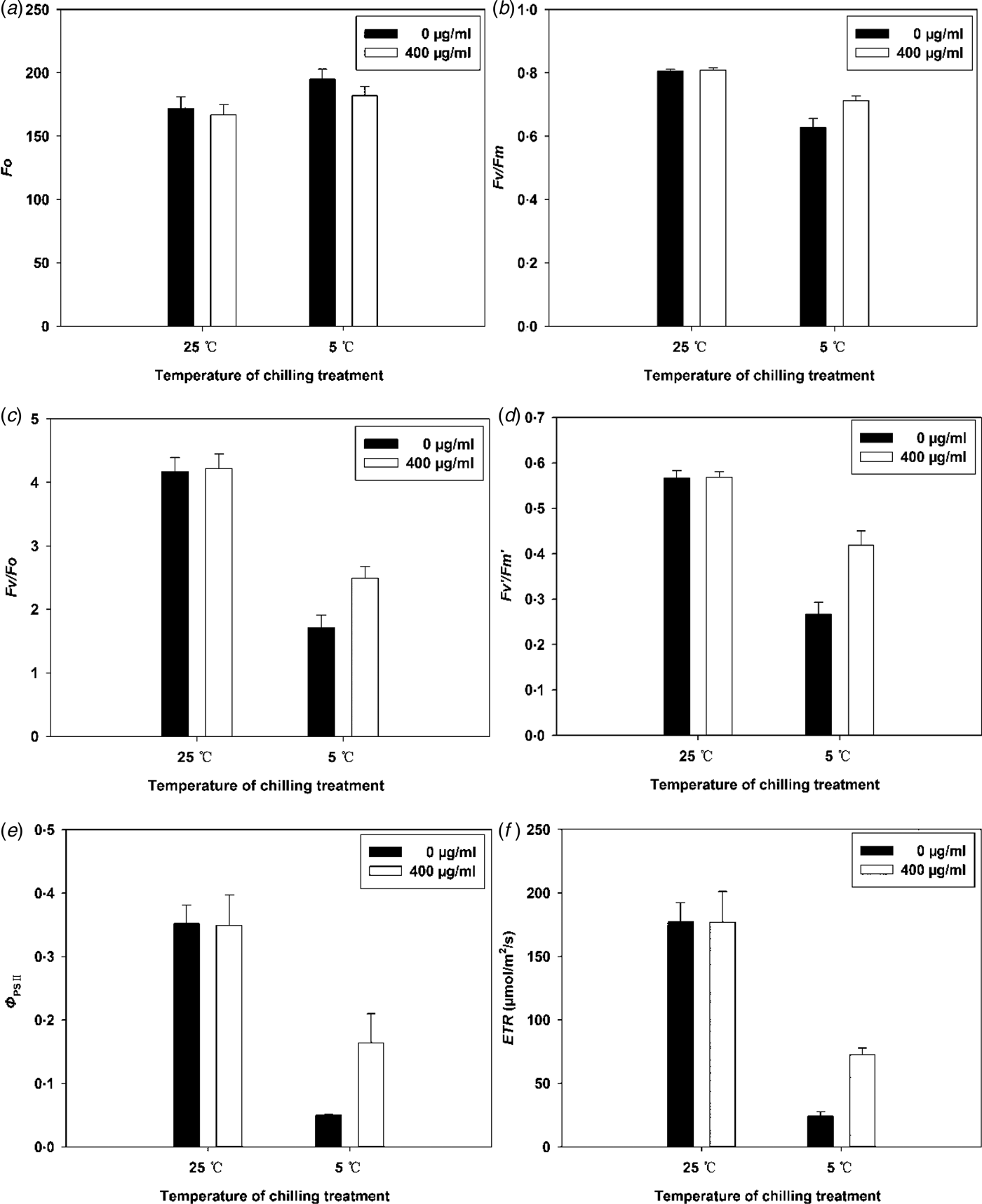
Compared with the control, seed treatment also reduced the minimal fluorescence (F o) significantly (P < 0.05, Fig. 5(a)) and improved the maximal efficiency of photosystem II (PSII) (F v/F m) (P < 0.05, Fig. 5(b)), maximum primary yield of the photochemistry of PSII (F v/F o) (P < 0.05, Fig. 5(c)), effective photochemical efficiency of PSII ( ${F}^{\prime}_{\rm v}/{F}^{\prime}_{\rm m}$) (P < 0.05, Fig. 5(d)), actual photochemical efficiency of PSII (ΦPSII) (P < 0.05, Fig. 5(e)) and the electron transport rate (ETR) (P < 0.05, Fig. 5(f)) of leaves exposed to chilling stress. This indicated that the degree of photoinhibition in the GB-treated plants was slight. In the absence of stress, the difference in the F v/F m between the two groups was not significant (Fig. 5(b)). Under chilling stress, F v/F m values decreased in all types of cotton leaves. This decrease was greater in the control plants after 3 days of chilling treatment (P < 0.05, Fig. 5(b)). These results indicated that the initial photochemical transformation efficiency of PSII and the activity of the PSII reaction centre was higher in GB-treated plants than in the control plants. The F v/F o is a measure of the damage to the photosystem caused by chilling. It is regarded as another form of F v/F m and showed the same pattern of variation in the present study as that shown by F v/F m.
Effects of seed soaking with glycine betaine on chlorophyll fluorescence characters at the seedling stage. (a) F o; (b) F v/F m; (c) F v/F o; (d)  ${F}^{\prime}_{\rm v}/{F}^{\prime}_{\rm m}$; (e) ΦPSII; (f) electron transport rate (ETR). Vertical bars represent s.e. (n = 5).

The ETR in the GB-treated and control plants was approximately the same under normal conditions (Fig. 5(f)). After 3 days of treatment at 5 °C, treated plants continued to maintain higher PSII and ETR values than control plants (P < 0.05, Fig. 5(f)). The  ${F}^{\prime}_{\rm v}/{F}^{\prime}_{\rm m}$ also decreased after chilling stress and was significantly higher in treated plants (P < 0.05, Fig. 5(d)). The quantum yield of PSII electron transport (Ф PSII) reflects the actual initial efficiency of the excitation energy captured by the open PSII centres with partial closure under stress conditions and reflects the actual photochemical reaction efficiency of the PSII reaction centres. Under normal conditions, the Ф PSII of the GB-treated and control plants was almost the same (Fig. 5(e)). After chilling treatment, the values decreased in all plants but remained higher in those that were treated (P < 0.05, Fig. 5(e)). These results indicate that the PSII reaction centres of treated plants had higher photochemical efficiency.
Changes in antioxidant enzyme activity
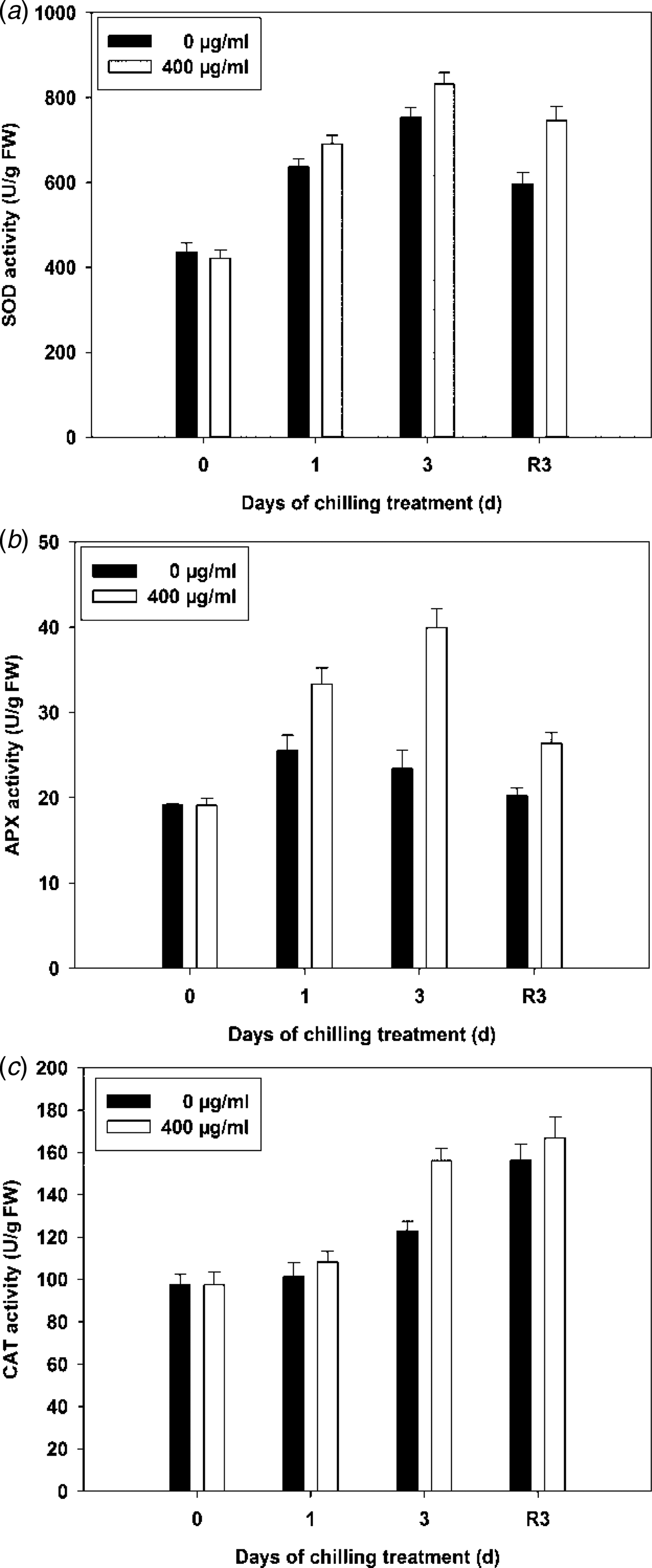
To determine changes in the activity of the antioxidant enzymes of plants exposed to chilling temperatures, the activities of SOD, APX and CAT in the leaves (Fig. 6) were measured. Under optimal conditions (25 °C), the treatment of GB had no significant effect on the activity of SOD (Fig. 6(a)), APX (Fig. 6(b)) or CAT (Fig. 6(c)).
The impact of temperature on the activities of antioxidant enzymes of the control and glycine betaine-treated plants. (a) Superoxide dismutase (SOD); (b) ascorbate peroxidase (APX); (c) catalase (CAT). Vertical bars represent s.e. (n = 5).

Exposure to chilling temperatures (5 °C), however, stimulated the activities of SOD, APX and CAT in all seedlings, especially those that were treated. On the third day of the treatment, the activities of SOD, APX and CAT in the leaves of treated plants were 10.3% (P < 0.05, Fig. 6(a)), 70.3% (P < 0.05, Fig. 6(b)) and 27.0% (P < 0.05, Fig. 6(c)) greater, respectively, than that of leaves from untreated plants. The GB-treated leaves had higher antioxidant enzyme activity than untreated leaves under chilling stress. After recovering for 3 days under optimal conditions, treated plants continued to show significantly higher enzyme activities (P < 0.05, Figs 6(a) and (b)). The CAT activity in control and treated plants increased throughout the period of exposure to chilling and the period of recovery and the highest measurements in both groups were obtained during the 3 days of recovery in a warm greenhouse. The CAT activity of treated plants remained at a higher level compared with control plants, on the third day (P < 0.05, Fig. 6(c)).
Changes in the hydrogen peroxide content and lipid peroxidation in seedlings
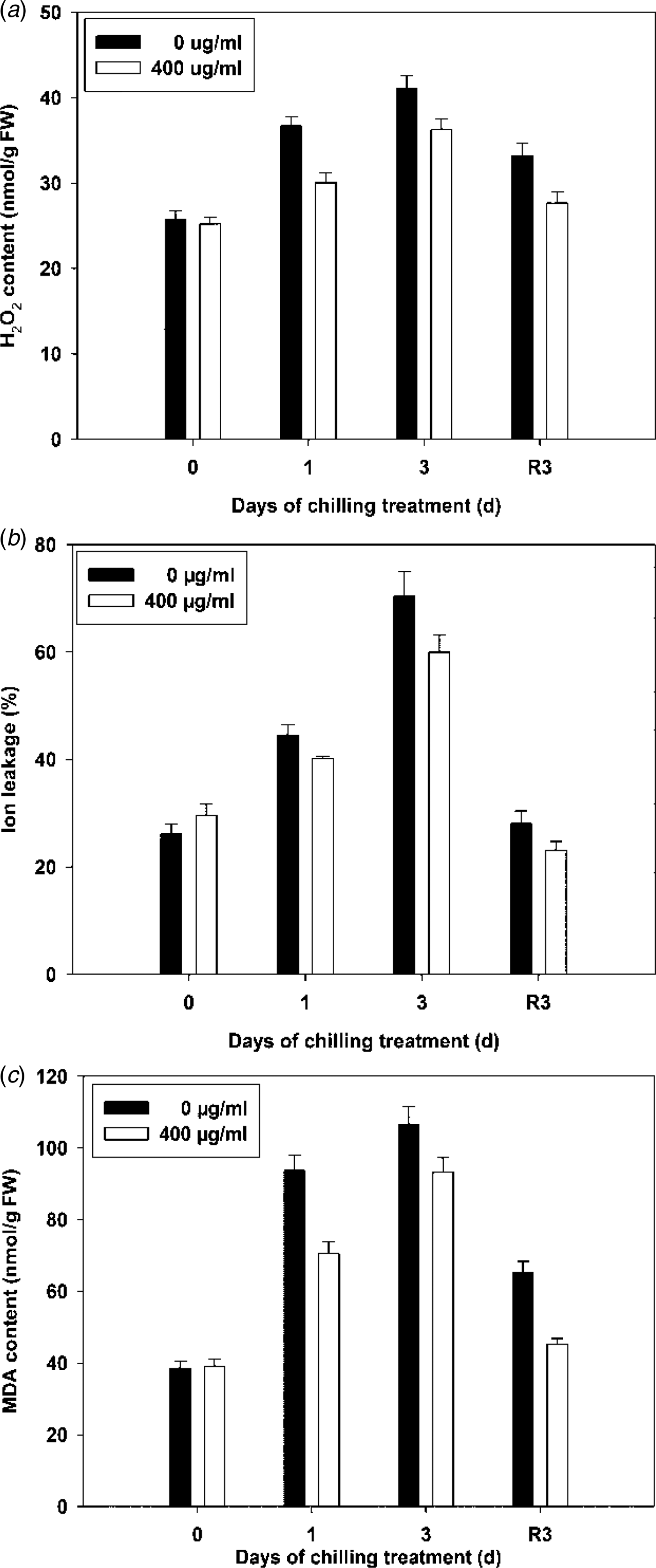
To understand the effects of GB treatment on the oxidative damage caused to leaves by low-temperature stress, H2O2 and lipid peroxidation contents in the leaves were determined (Fig. 7). The stress led to H2O2 accumulating in greater quantities in both groups, although the extent of the increase was lower in treated plants. After 3 days of chilling treatment, the H2O2 content of GB-treated plants was lower than that of control plants by 11.7% (P < 0.05, Fig. 7(a)), as was the extent of damage caused to the cell membrane. Leakage of leaf ions and the MDA content were significantly lower in the GB-treated plants after 3 days of cold treatment as well as after 3 days of recovery under optimal temperatures (P < 0.05, Figs 7(b) and (c)). These results indicated that seedlings from GB-treated seeds maintained better membrane stability and suffered less membrane damage than those from untreated seeds.
The impact of temperature on cotton leaf membrane damage degree of control and glycine betaine-treated plants. (a) Hydrogen peroxide (H2O2) content; (b) ion leakage; (c) malondialdehyde (MDA) content. Vertical bars represent s.e. (n = 5).

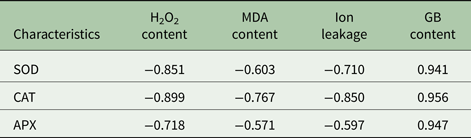
Correlation analysis showed that GB content was correlated negatively with ion leakage (P < 0.05) and MDA content (P < 0.05), and positively with SOD (P < 0.01), CAT (P < 0.01) and APX activity (P < 0.01) after 3 days at 5 °C. By contrast, ion leakage, MDA and H2O2 content were correlated negatively with SOD (P < 0.05), APX (P < 0.01) and CAT activity (P < 0.05) (Table 1). These results indicated that seed treatment with GB increased the GB content of cotton leaves, ultimately reduced their H2O2 content and alleviated membrane damage, a result of enhanced activity of the antioxidant enzymes.
Correlation coefficients of some antioxidant enzymes with hydrogen peroxide (H2O2) content, malondialdehyde (MDA) content, ion leakage and glycine betaine (GB) content

SOD, superoxide dismutase; CAT, catalase; APX, ascorbate peroxidase.
Discussion
Abiotic sources of stress, including chilling, always lower the germination percentage. In the current study, seed treatment with GB effectively increased germination percentage and decreased the E 50 value despite exposure to chilling.
Cell membrane permeability and MDA content are important measures of cell membrane stability under environmental stress. Malondialdehyde, as a product of membrane-lipid peroxidation, is correlated positively with membrane damage caused by greater accumulation of H2O2 induced by low temperature and water stress (Halliwell & Gutteridge Reference Halliwell and Gutteridge1986). In the current study, seed treatment with GB decreased MDA content and membrane ion leakage significantly, indicating that GB-treated plants were able to maintain greater membrane stability during chilling stress.
Crops susceptible to chilling injury consistently exhibit symptoms of water stress, including decreased retention of water in leaves and lower turgor potential. Cotton is one such crop, and low-temperature stress induces water stress in cotton leaves. However, GB may improve tissue water status through osmotic adjustment and/or changes in cell wall elasticity (Bandurska Reference Bandurska2005; Korkmaz et al. Reference Korkmaz, Uzunlu and Demirkiran2007; Lv et al. Reference Lv2007). It was also found that although the leaf water content decreased with the duration of chilling stress, the leaf water content in GB-treated plants was generally higher than that in control plants.
Cotton seedlings are considered sensitive to temperature stress. Exposing plants to sub-optimal temperatures causes overproduction of ROS, resulting in oxidative damage. Plants have evolved many mechanisms to prevent ROS from reaching toxic concentrations (Ashraf Reference Ashraf2009), and enhanced antioxidant metabolism is beneficial to plants that are exposed to acute oxidative stress (Mahan et al. Reference Mahan2009). Higher plants possess antioxidant enzymes to scavenge ROS, including SOD, APX, glutathione reductase and CAT. Superoxide dismutase eliminates superoxide efficiently by catalysing the dismutation of superoxide into H2O2 and O2. However, H2O2 can also damage many enzymes and is known to be a powerful inhibitor of the Calvin cycle (Kaiser Reference Kaiser1976). Therefore, rapid removal of H2O2, which minimizes its toxicity and the formation of highly toxic hydroxyl radicals, is also important in protecting plants from oxidative damage (Perl et al. Reference Perl1993). The content of intracellular H2O2 is regulated by CAT and peroxidases. Ascorbate peroxidase can also scavenge H2O2 but not as effectively as CAT because of its low affinity for H2O2 and different sub-cellular locations (Noctor et al. Reference Noctor, Veljovic-Jovanovic and Foyer2000). Many other reports have also confirmed that under low-temperature stress, plants stimulate H2O2-metabolizing enzymes in vivo to mitigate or prevent oxidative damage caused by low temperature, thereby enhancing tolerance to chilling (Miyake & Yokota Reference Miyake and Yokota2000; Keleş & Öncel Reference Keleş and Öncel2002; Guo et al. Reference Guo2006; Park et al. Reference Park, Jeknic and Chen2006). Both exogenous application of GB and enhanced GB accumulation achieved through transgenic methods have confirmed that GB can enhance the scavenging of ROS (Chen & Murata Reference Chen and Murata2011). Because GB does not scavenge ROS directly, GB must regulate this process in other ways, including activating or stabilizing ROS-scavenging enzymes and/or inhibiting the production of ROS through an unknown mechanism (Chen & Murata Reference Chen and Murata2008). In control tomato plants subjected to chilling stress, exogenous application of GB decreased the content of H2O2 and increased the activity of CAT and the CAT2 transcripts (Park et al. Reference Park, Jeknic and Chen2006). In a suspension culture of cells from salt-sensitive tobacco, GB effectively reduced ROS accumulation and lipid peroxidation induced by salt stress; moreover, under salt stress, mRNA contents encoding salicylic acid-binding CAT and lignin-forming peroxidase were also increased by GB. Thus, GB can provide protection from salt-induced cell death by decreasing the concentration of ROS accumulation and improving membrane integrity (Banu et al. Reference Banu2009). In the present study, the activity of antioxidant enzymes, including SOD, APX and CAT, was higher and the H2O2 content was lower in GB-treated plants (Asada Reference Asada1999; Kumar et al. Reference Kumar, Sarwat, Ahmad, Abdin and Ibrahim2017). The H2O2 content was correlated negatively with the activity of antioxidant enzymes. Seed treatment with GB therefore provided better protection from oxidative damage as a result of chilling stress by maintaining the activities of antioxidant enzymes at a high level.
The rate of photosynthesis also declines in most plants under low-temperature stress. The photosystems of cotton are especially sensitive to chilling at high PFD. The current results showed that low temperature inhibited photosynthesis, but GB treatment countered this inhibition significantly during chilling treatment. After 3 days of recovery at 25 °C, GB-treated plants maintained a significantly higher P N compared with control plants. Under low temperature, carbon dioxide (CO2) fixation in the Calvin cycle is limited, and the consumption of adenosine triphosphate and nicotinamide adenine dinucleotide phosphate (NADPH) are reduced, resulting in an excess of NADPH and a decrease in the content of oxidized NADP+. Because NADP+ is a major acceptor of electrons in photosystem I (PSI), depletion of NADP+ results in electrons being transferred from PSI to O2 in excessive quantities with the generation of H2O2 (Asada Reference Asada1999). If this H2O2 is not removed rapidly, the synthesis of PSII proteins (especially the D1 protein) is inhibited (Nishiyama et al. Reference Nishiyama2001; Takahashi & Murata Reference Takahashi and Murata2006), which ultimately inhibits the repair of PSII and accelerates photoinhibition. By activating or stabilizing ROS-scavenging enzymes, GB ensures the effective scavenging of ROS and thus mitigates the adverse effects of abiotic stress on the photosynthetic machinery. In addition, GB may also sustain CO2 fixation by protecting the CO2-fixing enzymes, such as Rubisco and Rubisco activase, from abiotic stress and, in turn, from ROS (Murata et al. Reference Murata2007). In the current study, GB application under low-temperature stress might have also decreased the H2O2 content by maintaining antioxidase activity at a higher extent, thereby reducing the low-temperature-mediated oxidative damage and maintaining a higher leaf P N.
Plant species sensitive to chilling, including cotton, are vulnerable to chilling-induced photoinhibition. In the current work, chilling stress significantly decreased F v/F o and F v/F m but increased F o, indicating that the initial photochemical activity of PSII was inhibited, and the active centre of PSII was damaged (Baker Reference Baker1991). In addition, low temperature also decreased ΦPSII and  ${F}^{\prime}_{\rm v}/{F}^{\prime}_{\rm m}$, indicating that the efficiency of the capture of excitation energy at the PSII reaction centre was decreased, and the PSII function was destroyed. Further, the photochemical efficiency of the PSII reaction centre declined and ETR decreased. In the current work, seed treatment with GB improved the activity of the PSII reaction centre. Glycine betaine is known to be effective in maintaining PSII activity and structure under various forms of environmental stress (Sakamoto & Murata Reference Sakamoto and Murata2000, Reference Sakamoto and Murata2002). Intracellular GB protects the photochemical reaction centre and the O2-evolving complex, and the accumulation of GB also alleviates the inhibitory effect of stress on the repair of PSII by accelerating synthesis of the D1 protein (Allakhverdiev et al. Reference Allakhverdiev2007). Increased contents of GB in plants raised from GB-treated seeds might be beneficial in maintaining PSII activity at a higher rate under chilling stress.
In conclusion, seedlings from GB-treated seeds maintained higher SOD, CAT and APX activities and thus maintained the H2O2 content of leaves at a lower extent, thereby decreasing the extent of injury caused to the cell membrane. At the same time, photosynthetic systems were well protected because oxidative stress as a result of chilling was decreased, and resistance to chilling injury was enhanced. Therefore, seed priming with GB is likely to make cotton seedlings more resistant to chilling.
Genetic engineering can further improve the ability of plants to respond to chilling stress by enhancing the expression of genes related to the synthesis of GB in plant cells (Zhang et al. Reference Zhang2012). Because the application and production of transgenic plants require relevant laws to be passed and rigorous safety regulations to be implemented and assessed in different countries, it is important to improve the cold tolerance ability of plants in the seedling stage agronomically by soaking seeds in GB.
The experimental results showed that the cold tolerance advantage endowed by cotton seeds soaked in GB occurs at both the germination stage as well as the four-leaf stage of seedlings. In China, the cotton seeds sown in late April can grow to the four- or five-leaf stage by the middle of May. It is significant that in actual production, cold tolerance at the seed germination stage and the four-leaf stage of the seedling can be improved, especially for cotton whose growth period is in mid-April to mid-May, during which time plants frequently suffer from chilling damage. There are also many unknowns that need to be resolved, for example, the physiological stage of cotton to which this cold tolerance advantage will persist has yet to be determined. Future research will focus on studying the influence of GB-treated cotton seeds on later stages of cotton growth.
Acknowledgements
The authors are grateful to Dr Yongbin Yan (Tsinghua University) for his assistance with the NMR spectroscopy.
Financial support
This research was supported by Shandong Natural Science Foundation of China (ZR2017MC025) and by the Genetically Modified Organisms Breeding Major Projects (Grant Nos. 2018ZX00800501B, 2014ZX0800504B-003 and 2016ZX08005-004).
Declaration of interest
None.
Ethical standards
Not applicable.