Introduction
Cultivated rice (Oryza sativa L.) is one of the main food sources for a large portion of the human population, contributing approximately 21% of the world per capita caloric intake, and 27% in developing countries (Awika Reference Awika, Awika, Piironen and Bean2011). In any rice production system, weeds are one of the main biological limitations. During the last 30 yr, weedy rice has been among the most common weeds in crop rice around the world. Weedy rice, a complex of taxonomically poorly defined Oryza species, hybrids, and special biotypes (Kraehmer et al. Reference Kraehmer, Jabran, Mennan and Chauhan2016), has great impacts both on yield and cultivated rice quality and are distributed globally in different irrigated and rainfed cropping systems.
Weedy rice, in general, shares characteristics with other successful weed species, such as: (1) adaptation to management practices and the environmental conditions of crop fields, (2) synchronization of biological cycle with the crop, (3) high production of seeds with easy and early shattering, (4) staggered germination due to prolonged dormancy, and (5) rapid emergence of seedlings that leads to vigorous and competitive vegetative stages (Burton et al. Reference Burton, Beckie, Willenborg, Shirtliffe, Schoenau and Johnson2016; Delouche et al. Reference Delouche, Burgos, Gealy, Zorrilla, Labrada, Larinde and Rosell2007; Kwon et al. Reference Kwon, Smith and Talbert1992; Singh et al. Reference Singh, Kumar, Saharawat, Gathala, Ladha and Chauhan2013; Valverde Reference Valverde and Gressel2005). Weedy rice also has unique characteristics that contribute to the complexity of its control, including: (1) phenology and morphology similar to cultivated rice in early stages of development, which makes weedy rice impossible to distinguish; (2) presence of some ecotypes that are morphologically similar to cultivated varieties at the reproductive stage (seeds), increasing their distribution in cropped fields; (3) conspecificity with cultivated rice, which precludes use of selective herbicides widely used for management of other weed species in rice; and (4) grains in some weedy rice being difficult to differentiate from cultivated rice postharvest, which diminishes the market grade and value of the cultivated grain when there is contamination. Additionally, weedy rice grains do not have milling quality, so breakage reduces mill turnout and grade of commercial rice (Delouche et al. Reference Delouche, Burgos, Gealy, Zorrilla, Labrada, Larinde and Rosell2007; Singh et al. Reference Singh, Kumar, Saharawat, Gathala, Ladha and Chauhan2013; Valverde Reference Valverde and Gressel2005). Apart from these broadly shared “weediness” traits, however, there is great morphological diversity among weedy rice from different regions of the world. Understanding and classifying this diversity may be helpful in understanding weedy rice origins, evolution, and potential management practices.
In Colombia’s agricultural production systems, rice ranks eighth in land use; 570,802 ha were cultivated in 2016 with a production of 2.97 billion kg of paddy rice (DANE and Fedearroz 2017). Weedy rice is among the primary limiting weeds in Colombian rice production, and studies carried out in the 1990s documented its impact on rice cultivation. Up to 2.3 million seeds of weedy rice per hectare have been found within 10 cm of the soil surface in rice paddies (Gómez de Barreda et al. Reference Gómez de Barreda, Carrero, Del Busto and Briendicho1999). Montealegre and Vargas (Reference Montealegre and Vargas1989) identified 20% yield losses with 5 plants of weedy rice m−2, and losses of 57% with 20 plants m−2. In the 1990s, it was estimated that 20% of the area planted to rice had weedy rice problems, and 50% was highly infested (Montealegre and Vargas Reference Montealegre, Vargas and Cuevas1992).
Some prior studies of weedy rice morphology in Colombia have been carried out, but primarily with a regional focus. In the Departments (the Colombian geopolitical unit of division) of Huila and Tolima, 65 biotypes of weedy rice were identified, with color of awns, apiculus, and pericarp, as well as grain length and width, being considered the best morphological descriptors (Vásquez et al. Reference Vásquez, Ruiz, Corredor, González, Fory, Mora, Silva, Duque and Lentini2002). In the Zulia River irrigation district in the Department of Norte de Santander, high phenotypic variability was found for many vegetative and reproductive characters (Canal et al. Reference Canal, Arnaude, Ortiz-Domínguez, Valverde and Fuentes2009). Currently, the phenotypic classification of weedy rice performed by Montealegre and Clavijo (Reference Montealegre and Clavijo1991) is the one most recognized and used by farmers and agronomists in the rice sector throughout the country. These authors reported 16 ecotypes according to phenotypic characteristics of the seed, distributed in four groups: “varietales,” characterized by seeds resembling those of cultivated rice in grain size and hull color, with mainly red pericarps; “pipones,” characterized by wide grains with variable length (short, intermediate, or long) and bulging in the middle part, straw-colored hulls, red pericarps, and greater shattering; “mechudos,” characterized by very long awns and straw and brown- and black-colored hulls; and “rayones,” characterized by the presence of two hull colors (straw and brown) and the absence of awns (Montealegre and Clavijo Reference Montealegre and Clavijo1991). However, this classification was based solely on regional sampling carried out in the Usosaldaña irrigation district in the Department of Tolima.
To date, the great morphological diversity of weedy rice in Colombia has not been evaluated on a national scale, and no attempts have been made to understand this diversity in the context of weedy rice origins and evolution. The objectives of this study were (1) to establish the variation in different morphological characters for weedy rice collected in all five rice production zones of Colombia and to compare them with those of commercial varieties and landraces sown in the country, (2) to determine the association between weedy rice morphotypes and rice production areas, and (3) to determine the association between morphological groupings of weedy rice and groupings we have recently defined based on genetic data (Hoyos Reference Hoyos2018).
Materials and methods
Plant material
Weedy rice was sampled from August 2014 to March 2015 in the five major rice production areas of Colombia, collected from 8 departments and 15 municipalities with significant rice production. In each rice production zone, 9 to 12 fields were sampled. In each weed-infested cultivated rice field, seeds were collected from weedy rice plants spanning the entire morphological diversity detected in the field based on visible traits such as seeds and plant size; seeds from individual mother plants were kept separate. A total of 387 weedy rice samples were collected around the country. Because an exhaustive phenotypic characterization of phenological and morphological traits of 387 samples was not possible, we selected 71 representative weedy accessions (14 from the Central zone, 16 from the Llanos [plains] zone, 18 from the Bajo Cauca zone, 11 from the Costa Norte area, and 12 from the Santanderes zone), for phenotyping, as well as 10 landraces and 5 common commercial varieties (‘Cica9’, ‘F2000’, ‘F50’, ‘F60’, and ‘Orizica1’), for a total of 86 accessions. The 71 weedy rice accessions were chosen to encompass weeds from all rice-growing regions of Colombia. Additionally, accessions were chosen based on assessment of seed traits such as hull and pericarp color, awn presence and length, and size of grain, so that all variants found in each rice-growing zone were captured in the final sample.
Weed morphological characterization was carried out in a common garden in the municipality of Espinal, Tolima (4.152°N, 74.903°W), which corresponds to the Central rice production zone, between October 2016 and April 2017. Weed seeds were heat treated through exposure to 50 C for 12 h to break dormancy (seeds that did not germinate under this treatment were maintained at 50 C for 72 h). Five seeds from a single panicle, corresponding to a collected accession, were sown per pot in 18.5-cm-diameter pots. Local loamy sand soil that contained organic matter at 1.3% was used to fill the pots, and plants were grown outside, with an average temperature of 27 C (maximum of 38 C and minimum of 20 C) and average relative humidity of 81%, typical conditions for rice growth in Colombia. Plants were watered daily. All management practices, including the application of fertilizers and phytosanitary control, followed the recommendations of the National Federation of Rice Growers (Fedearroz). Plants were fertilized (190 kg ha−1 of N, 60 kg ha−1 of P2O5, and 110 kg ha−1 of K2O) three times between establishment and maximum tillering.
After the establishment of the plants (2 to 3 wk), 1 plant per pot was maintained for phenotyping. Four replicates were included per accession, and pots had a completely random spatial arrangement. Panicles were covered with nylon mesh bags before seeds matured to prevent seed loss due to shattering. At the end of the experiment, data could not be collected from 11 weedy rice accessions due to plant losses. Thus, our final phenotypic characterizations were based on 60 weedy rice accessions from across Colombian rice-growing regions. Though a limited sample size, this provides a first characterization of weedy rice diversity in the entire country of Colombia.
Morphological characterization
Twenty-seven phenotypic characteristics were evaluated according to descriptors for wild and cultivated rice (Oryza spp.) (Bioversity International et al. 2007; Muñoz et al. Reference Muñoz, Giraldo and de Soto1993), which are presented in detail in Supplementary Table 1. The following seed descriptors were considered: hull, awn, apiculus and pericarp color, awn presence and size, grain length and width (with and without hulls), grain length:width ratio with hulls, 100-grain weight, and shattering. The morphological and phenological plant descriptors were: flag leaf attitude, leaf area, flag leaf length and width, culm anthocyanin coloration, culm length, plant height, tiller number and attitude, culm habit, days to tillering, days to flowering, and panicle number and length (Supplementary Table 1). Grain size measurements were taken by processing of images with SmartGrain software (Tanabata et al. Reference Tanabata, Shibaya, Hori, Ebana and Yano2012). Shattering was evaluated using a digital force gauge (Imada, Northbrook, IL) to measure the amount of weight a seed could bear before releasing from the pedicel (breaking tensile strength [BTS]; Thurber et al. Reference Thurber, Reagon, Gross, Olsen, Jia and Caicedo2010). Leaf area was evaluated from the flag leaf length and width, applying a correction factor of 0.75 (Yoshida et al. Reference Yoshida, Forno, Cock and Gomez1976). To avoid obscuring any phenotypic effects due to hybridization or heterozygosity, plants used for phenotypic measurements were grown from field-collected seed; it is thus possible the maternal effects may have influenced values of some phenotypic traits.
Data analysis
For the statistical analysis, accessions were assigned to subgroups according to the Oryza type (weed, landrace, and commercial crop classifications) and hull coloration. The grouping according to hull coloration was carried out because this variable presented greater variability compared with awn presence. These two characteristics have been used for weedy rice phenotyping in previous studies, either alone (e.g., awn presence[Fogliatto et al. Reference Fogliatto, Vidotto and Ferrero2012; Grimm et al. Reference Grimm, Fogliatto, Nick, Ferrero and Vidotto2013] or hull color [Arrieta-Espinoza et al. Reference Arrieta-Espinoza, Sánchez, Vargas, Lobo, Quesada and Espinoza2005; Shivrain et al. Reference Shivrain, Burgos, Scott, Gbur, Estorninos and Mcclelland2010]) or in combination (e.g., Song et al. Reference Song, Chuah, Tam and Olsen2014; Sudianto et al. Reference Sudianto, Neik, Tam, Chuah, Idris, Olsen and Song2016). Additionally, we assigned weeds to genetic groupings determined through population structure analysis of single-nucleotide polymorphisms (SNPs) generated through genotyping by sequencing (GBS) (Elshire et al. Reference Elshire, Glaubitz, Sun, Poland, Kawamoto, Buckler and Mitchell2011). Colombian weedy rice was categorized into three groups based on genetic ancestry identified in our work: aus-like (of which we had 3 individuals), indica-like (33 individuals), and admixed indica–aus (24 individuals) (Hoyos Reference Hoyos2018).
A univariate analysis using a general linear model for continuous (quantitative) variables was performed for the three classification factors of the Colombian populations (Oryza type, genetic group, and hull coloration) in SPSS Statistics v. 23 (IBM, Armonk, NY). Assumptions of normality were tested for all the variables, with small deviations found for some; however, the ANOVA was robust for moderate deviations from normality (Lindman Reference Lindman1992). The comparison of means within each group was carried out using Tukey’s test at P < 0.05.
For all 27 variables evaluated (continuous and categorical), a two-step cluster analysis was performed using SPSS software. Groupings were based on Schwarz’s Bayesian criterion. This analysis allows groupings present in a data set to be inferred, generating information criteria, frequencies of clusters, descriptive statistics by cluster, and graphs of variable importance (Rubio-Hurtado and Vilà-baños Reference Rubio-Hurtado and Vilà-baños2016). To improve the quality of the clusters, the 13 variables that had less than 0.05 importance and that did not contribute to the differences among groups were eliminated; these were: flag leaf length, width, leaf area and attitude, culm habit, plant height, culm length, days to heading, panicle length and number, tiller number and attitude, and shattering.
Results and discussion
Our analyses of vegetative and reproductive traits revealed high phenotypic variability within weedy rice populations from different regions of Colombia. High phenotypic variability has been reported in different world regions such as Costa Rica (Arrieta-Espinoza et al. Reference Arrieta-Espinoza, Sánchez, Vargas, Lobo, Quesada and Espinoza2005), northeast and central Colombia (Canal et al. Reference Canal, Arnaude, Ortiz-Domínguez, Valverde and Fuentes2009; Montealegre and Clavijo Reference Montealegre and Clavijo1991), Malaysia (Hussain et al. Reference Hussain, Man and Othman2010; Sudianto et al. Reference Sudianto, Neik, Tam, Chuah, Idris, Olsen and Song2016), the United States (Shivrain et al. Reference Shivrain, Burgos, Scott, Gbur, Estorninos and Mcclelland2010), Italy (Fogliatto et al. Reference Fogliatto, Vidotto and Ferrero2012), India (Rathore et al. Reference Rathore, Singh, Kumar and Chauhan2016), and Sri Lanka (Ratnasekera et al. Reference Ratnasekera, Perera, He, Senanayake, Wijesekara, Yang and Lu2014). However, the criteria used for morphotype classification vary greatly by country, with some studies focusing exclusively on seed traits (see, e.g., weedy rice in Thailand [Prathepha Reference Prathepha2009] and in Costa Rica [Arrieta-Espinoza et al. Reference Arrieta-Espinoza, Sánchez, Vargas, Lobo, Quesada and Espinoza2005]), and others including phenology and plant architecture (see, e.g., weedy rice in Malaysia [Hussain et al. Reference Hussain, Man and Othman2010]). We describe here our classification of weedy rice phenotypic diversity in Colombia based on different grouping criteria and compare our findings with patterns found elsewhere in the world.
Classification by Oryza types
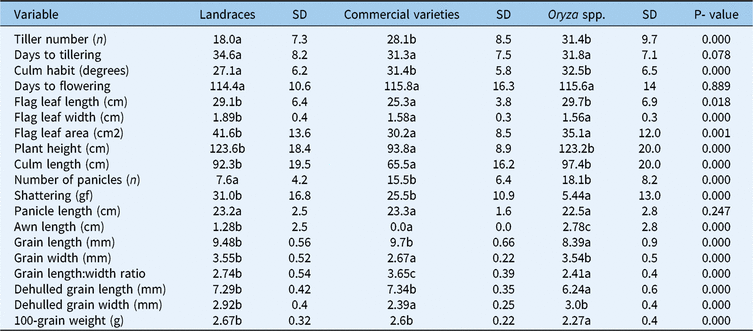
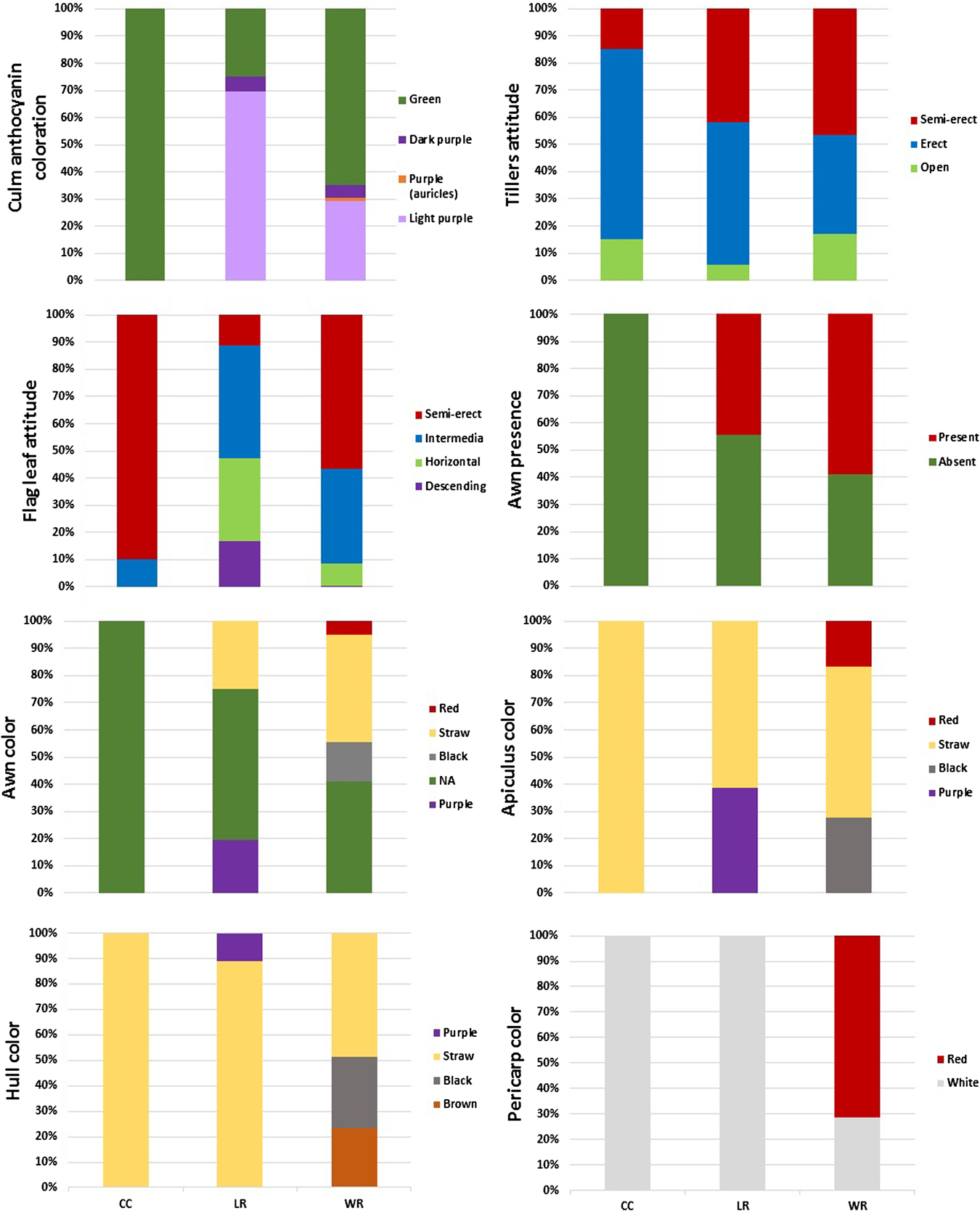
Colombian cultivated rice groups, comprising commercial varieties and landraces, share some characteristics with each other; however, there are some unique characteristics for each group. Landraces differ statistically (P < 0.05) from commercial varieties and weedy rice in having a smaller number of tillers, more compact plant geometry with a semi-erect culm habit (Muñoz et al. Reference Muñoz, Giraldo and de Soto1993), fewer panicles, and a wider flag leaf, which leads to a greater leaf area (Table 1). Commercial varieties have a longer and narrower flag leaf (although there is no significant difference in flag leaf area compared with weedy rice), comparatively reduced plant height and culm length, and smaller grain width with and without hulls (Table 1); in addition, culm anthocyanin coloration is green, hulls and apiculi are straw colored, plants are awnless, and the pericarp is white in 100% of the evaluated accessions (Figure 1).
Vegetative and seed morphological characteristics of Colombian weedy rice populations, landraces, and commercial varieties.a

a Values that share the same letter are not significantly different according to Tukey’s test (significance at 0.05).
Percentage of weedy rice individuals, cultivated varieties, and landraces for different categorical variables. Abbreviations: CC, commercial crop; LR, landraces; WR, weedy rice; NA, not applicable.

In general, weedy rice plants around the world are often described as taller than commercial varieties, with more tillers and panicles per plant, but frequently with lower seed production (Delouche et al. Reference Delouche, Burgos, Gealy, Zorrilla, Labrada, Larinde and Rosell2007; Diarra et al. Reference Diarra, Smith and Talbert1985; Noldin et al. Reference Noldin, Chandler and McCauley1999). In our study, there were no significant differences in the production of tillers or number of panicles between Colombian weeds and commercial varieties; however, weeds were significantly taller than commercial rice, sharing this characteristic with landraces, and our results were similar to weedy rice findings in California, USA (Kanapeckas et al. Reference Kanapeckas, Vigueira, Ortiz, Gettler, Burgos, Fischer and Lawton-rauh2016, Reference Kanapeckas, Tseng, Vigueira, Ortiz, Bridges, Burgos, Fischer and Lawton-Rauh2018), Malaysia (Hussain et al. Reference Hussain, Man and Othman2010), and Costa Rica (Arrieta-Espinoza et al. Reference Arrieta-Espinoza, Sánchez, Vargas, Lobo, Quesada and Espinoza2005). This characteristic makes weeds more competitive for space and resources (Delouche et al. Reference Delouche, Burgos, Gealy, Zorrilla, Labrada, Larinde and Rosell2007; Diarra et al. Reference Diarra, Smith and Talbert1985), but also makes them more easily distinguished for weed control. Some strategies to avoid weedy reinfestation of fields take advantage of plant height using cutting bars, sponges or ropes wetted with herbicides (Fogliatto et al. Reference Fogliatto, Vidotto and Ferrero2012).
Studies of weedy rice in different world regions have often found a broad range of flowering times, with some weeds overlapping with cultivated rice in heading dates, and some flowering earlier or later (Canal et al. Reference Canal, Arnaude, Ortiz-Domínguez, Valverde and Fuentes2009; Kanapeckas et al. Reference Kanapeckas, Tseng, Vigueira, Ortiz, Bridges, Burgos, Fischer and Lawton-Rauh2018; Shivrain et al. Reference Shivrain, Burgos, Scott, Gbur, Estorninos and Mcclelland2010; Thurber et al. Reference Thurber, Reagon, Olsen, Jia and Caicedo2014). However, we found no significant differences in flowering time among weedy, commercial, and landrace rice in Colombia. Flowering synchronization between weedy and cultivated populations increases the probability of gene flow, which could enhance the adaptive capacity of weedy rice. Although rice is a predominantly self-pollinating species, natural hybridization has been reported among cultivated, wild, and weedy rice at rates between 0.036% to 0.086% (Messeguer et al. Reference Messeguer, Marfà, Català, Guiderdoni and Melé2004) and 0.003% to 0.008% (Shivrain et al. Reference Shivrain, Burgos, Anders, Rajguru, Moore and Sales2007). This is of particular concern with the growing use of Clearfield® (BASF, Florham Park, NJ) cultivated rice varieties, because weedy–cultivar hybrids can display resistance to the herbicide imazethapyr (Burgos et al. Reference Burgos, Singh, Tseng, Black, Young, Huang, Hyma, Gealy and Caicedo2014; Shivrain et al. Reference Shivrain, Burgos, Anders, Rajguru, Moore and Sales2007). Our flowering time results suggest that gene flow between weedy and cultivated rice in Colombia is likely to occur. In a recent study, a possible case of imidazolinone resistance was reported for an awned weedy rice morphotype with straw hulls in Colombia (J. Velásquez, V. Hoyos, L. Ávila and G. Plaza, personal communication), perhaps a confirmation of this risk.
As expected, given that crops are heavily selected for yield, Colombian weedy rice has lower grain weight than commercial varieties and landraces as well as shorter grains (with and without hulls) and awn presence. Although local landrace varieties can have awns, weeds have a longer awn length. A critical trait, seed shattering, which has consistently been reported in other parts of the world (Huang et al. Reference Huang, Young, Reagon, Hyma, Olsen, Jia and Caicedo2017; Nunes et al. Reference Nunes, Delatorre and Merotto2014; Qiu et al. Reference Qiu, Zhou, Mao, Ye, Wang, Zhang, Yu, Fu, Wang, Qian, Qi, Wu, Sultana, Cao, Wang, Timko, Ge, Fan and Lu2017; Thurber et al. Reference Thurber, Reagon, Gross, Olsen, Jia and Caicedo2010; Ziska et al. Reference Ziska, Gealy, Burgos, Caicedo, Gressel, Lawton-Rauh, Avila, Theisen, Norsworthy, Ferrero, Vidotto, Johnson, Ferreira, Marchesan, Menezes, Cohn, Linscombe, Carmona, Tang, Merotto and Sparks2015), is also present in Colombian weedy rice (Table 1), likely enhancing seed dispersal capabilities and ability to invade commercial fields.
We noticed some interesting similarities between landraces and weedy rice, with both groups sporting erect and semi-erect tiller angles, some sharing of awn presence, and occurrence of diverse colors for awns, apiculi, and hulls, though the colors present in each group vary (Figure 1). Additionally, there is some overlap in culm anthocyanin coloration, a characteristic that could allow weedy recognition in the field at a vegetative stage, but not when grown in conjunction with some landraces. Despite some similarities, weedy rice is distinct from landraces in possessing a red pericarp in most (71%) of the accessions studied (Figure 1). The preponderance of red pericarps in weedy rice is consistent with what has been observed in other world regions (Arrieta-Espinoza et al. Reference Arrieta-Espinoza, Sánchez, Vargas, Lobo, Quesada and Espinoza2005; Canal et al. Reference Canal, Arnaude, Ortiz-Domínguez, Valverde and Fuentes2009; Prathepha Reference Prathepha2009; Rathore et al. Reference Rathore, Singh, Kumar and Chauhan2016).
Classification by genetic group
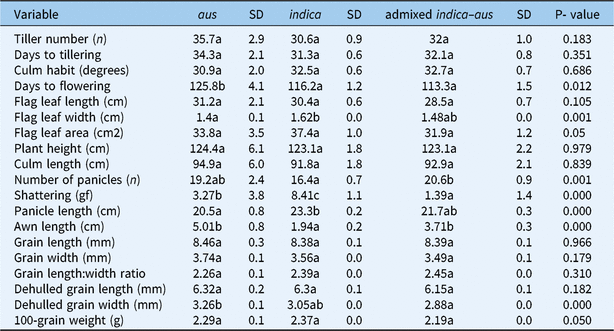
In a separate study (Hoyos Reference Hoyos2018), we used genome-wide SNP markers obtained through GBS to establish the genetic ancestry of weedy rice in Colombia. Population structure and phylogenetic analyses, incorporating both weedy material and that of cultivated and wild Oryza groups around the world, distinguished three groups of weedy rice in Colombia: weeds that seem to have originated from indica cultivated rice, weeds that have originated from aus cultivated rice, and weeds that seems to be an admixture between the aus and indica groups. This latter admixed group could have arisen through hybridization of aus-like weeds with local indica cultivars or hybridization of indica-derived and aus-derived weedy rice. No significant differences between these ancestral groups were detected for most of the morphological variables we evaluated (Table 2). However, some key traits, including days to flowering, flag leaf width, number of panicles, shattering, panicle and awn lengths, and dehulled grain width, did show significant differences among genetic groups.
Vegetative and seed morphological characteristics of Colombian weedy rice according to the genetic group.a

a Values that share the same letter are not significantly different according to Tukey’s test (significance at 0.05).
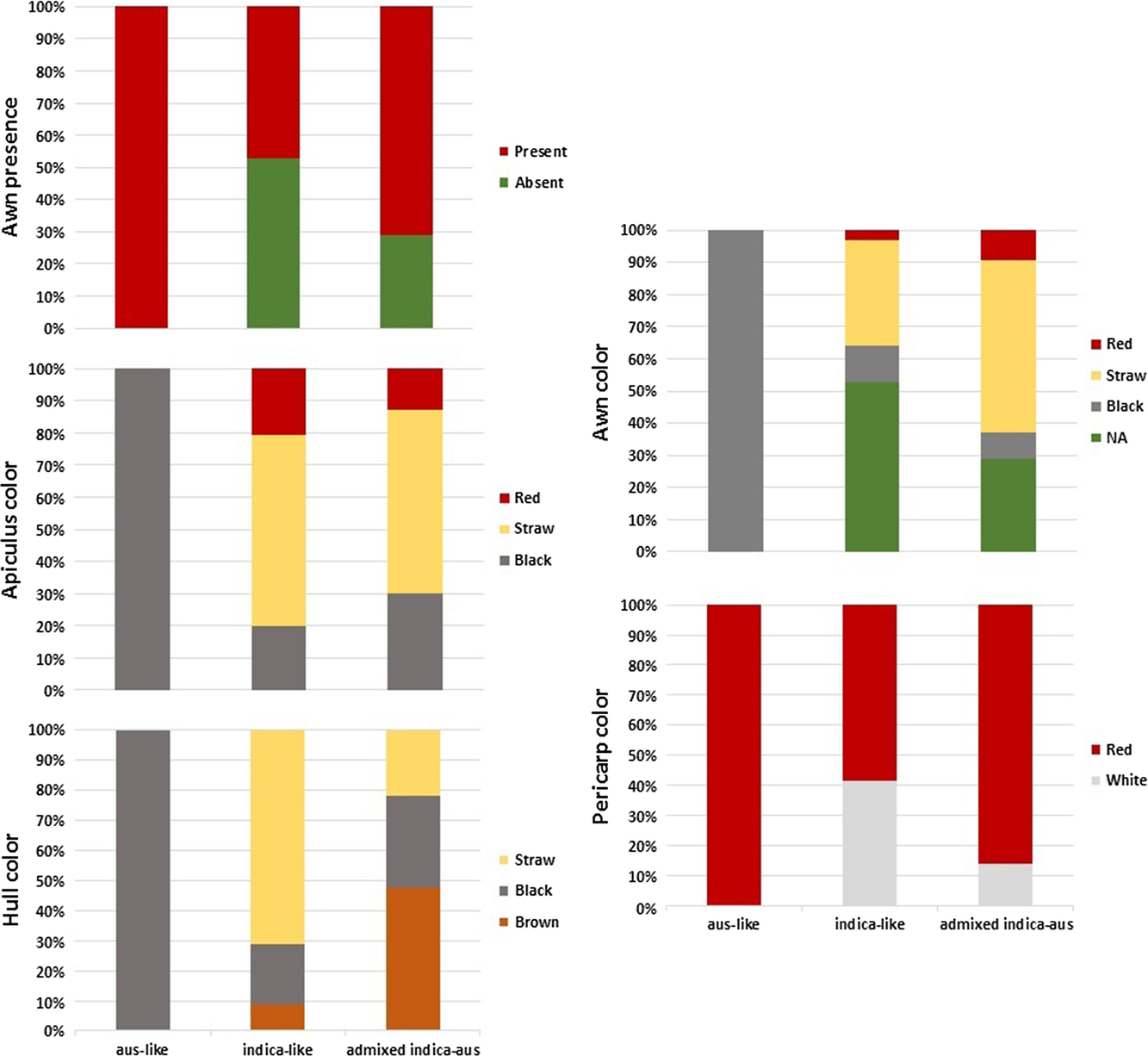
The aus-like weeds are the least frequent in our sample (three accessions) but most distinct among the weedy rice groups. They have much longer days to flowering and intermediate shattering levels (Table 2). They also uniformly contain awns and have black hulls and apiculi and red pericarps. The indica-like and admixed indica–aus weeds share seed morphological characteristics but at lower frequencies, with more diversity in awn, hull, and pericarp colors (Figure 2). The indica-like weeds stand out as the genetic group with the lowest shattering (highest BTS value) and the smallest average awn size. Admixed weeds, which are common in Colombian rice fields (36% of our original genotyped samples; Hoyos Reference Hoyos2018), have the highest shattering levels and intermediate values of flag leaf width and panicle length when compared with Colombian aus- and indica-like weeds, the latter variables being consistent with admixed origins (Table 2).
Percentage of weedy rice individuals according to their genetic group (aus-like weeds, indica-like weeds, and admixed indica–aus weeds). Abbreviation: NA, not applicable.

Although our sampling of Colombian diversity may possibly not be exhaustive, due to the phenotype sample size, the seed morphology associations for weedy genetic groups is similar to that seen in other world regions. In the southern United States, two main types of genetically different weedy rice are SH weeds, with straw-colored hulls without awns, and BHA weeds, mainly with black hulls and awns (Gealy et al. Reference Gealy, Tai and Sneller2002; Londo and Schaal Reference Londo and Schaal2007; Reagon et al. Reference Reagon, Thurber, Gross, Olsen, Jia and Caicedo2010; Vaughan et al. Reference Vaughan, Ottis, Prazak-Havey, Bormans, Sneller, Chandler and Park2001). These groups have evolved from indica and aus cultivars, respectively (Londo and Schaal Reference Londo and Schaal2007; Reagon et al. Reference Reagon, Thurber, Gross, Olsen, Jia and Caicedo2010). Likewise, weeds from South Asia with aus origins have predominantly black hulls and awns, and indica-like weeds have predominantly straw hulls with presence or absence of awns (Huang et al. Reference Huang, Young, Reagon, Hyma, Olsen, Jia and Caicedo2017). Additionally, BHA weeds in the United States tend to flower later than other groups (Thurber et al. Reference Thurber, Reagon, Olsen, Jia and Caicedo2014), like aus-derived Colombian weedy rice. Interestingly, Colombian indica–aus derived weeds seem to have high variability in their characteristics but tend to be more similar to indica-like weeds. Thus, results from Colombian weedy rice largely coincide with those from other parts of the world with respect to seed characteristics of genetically defined groups, but primarily so for Colombian aus-like weeds.
Classification by hull color
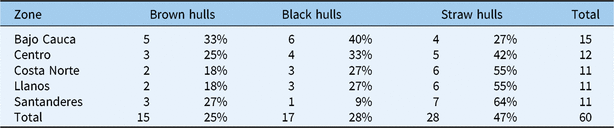
As hull color is the trait most often used to distinguish weedy rice types worldwide, we also classified Colombian weedy rice solely by hull color to see whether any other traits were shared by hull classification groups. Most of the rice weeds collected have straw-colored hulls (47%), making this the most frequent color for most of the rice areas, with the exception of Bajo Cauca (Table 3). The morphotype following in importance was black hulls (28%), where the Bajo Cauca area had the highest proportion (40%) and the Santanderes zone the lowest (9%). In the United States, weedy rice with straw-colored hulls is also the most common morphotype (Shivrain et al. Reference Shivrain, Burgos, Scott, Gbur, Estorninos and Mcclelland2010). However, in Thailand, approximately 50% of the accessions have black hulls, and the others have straw- and brown-colored hulls (Prathepha Reference Prathepha2009). In Costa Rica and Malaysia, the most common morphotypes are brown hulls (Canal et al. Reference Canal, Arnaude, Ortiz-Domínguez, Valverde and Fuentes2009; Sudianto et al. Reference Sudianto, Neik, Tam, Chuah, Idris, Olsen and Song2016), pointing to the diversity of hull color patterns observed around the world.
Distribution and frequency of weedy rice populations based on hull color in the five rice production areas.

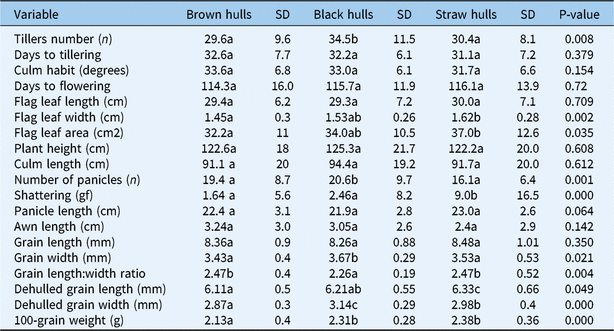
Despite the stark differences in hull color among collected samples, there are no significant differences among these hull groupings for Colombian weedy rice for most of the examined variables (Table 4). The lack of differences in plant height (total or culm length), flag leaf length, and days to heading between hull groups contrasts with U.S. weedy rice, in which weed populations with straw hull coloration had plants that were significantly shorter with a longer flag leaf and required fewer heat units to reach heading (Shivrain et al. Reference Shivrain, Burgos, Scott, Gbur, Estorninos and Mcclelland2010).
Vegetative and seed morphological characteristics of Colombian weedy rice populations, according to hull color.

a Values that share the same letter are not significantly different according to Tukey’s test (significance at 0.05).
The variables that presented the greatest differences for hull groups in Colombia were flag leaf width and area and dehulled grain size (length and width). Populations with black hulls had greater tiller numbers and greater grain widths but smaller grain length:width ratios. Populations with straw-colored hulls had a lower number of panicles but greater flag leaf width, greater BTS, and shorter awn length. Weedy rice with brown hulls only differed from the other groups in the 100-grain weight, presenting a lower value (Table 4). These results coincide with those reported for U.S. weedy rice by Shivrain et al. (Reference Shivrain, Burgos, Scott, Gbur, Estorninos and Mcclelland2010), who found that straw-colored populations have wider flag leaves and short awns, seeds with brown hulls weight less, and populations with black hulls have higher tiller numbers, differing in the amount per plant.
Clustering analysis of Colombian weedy rice
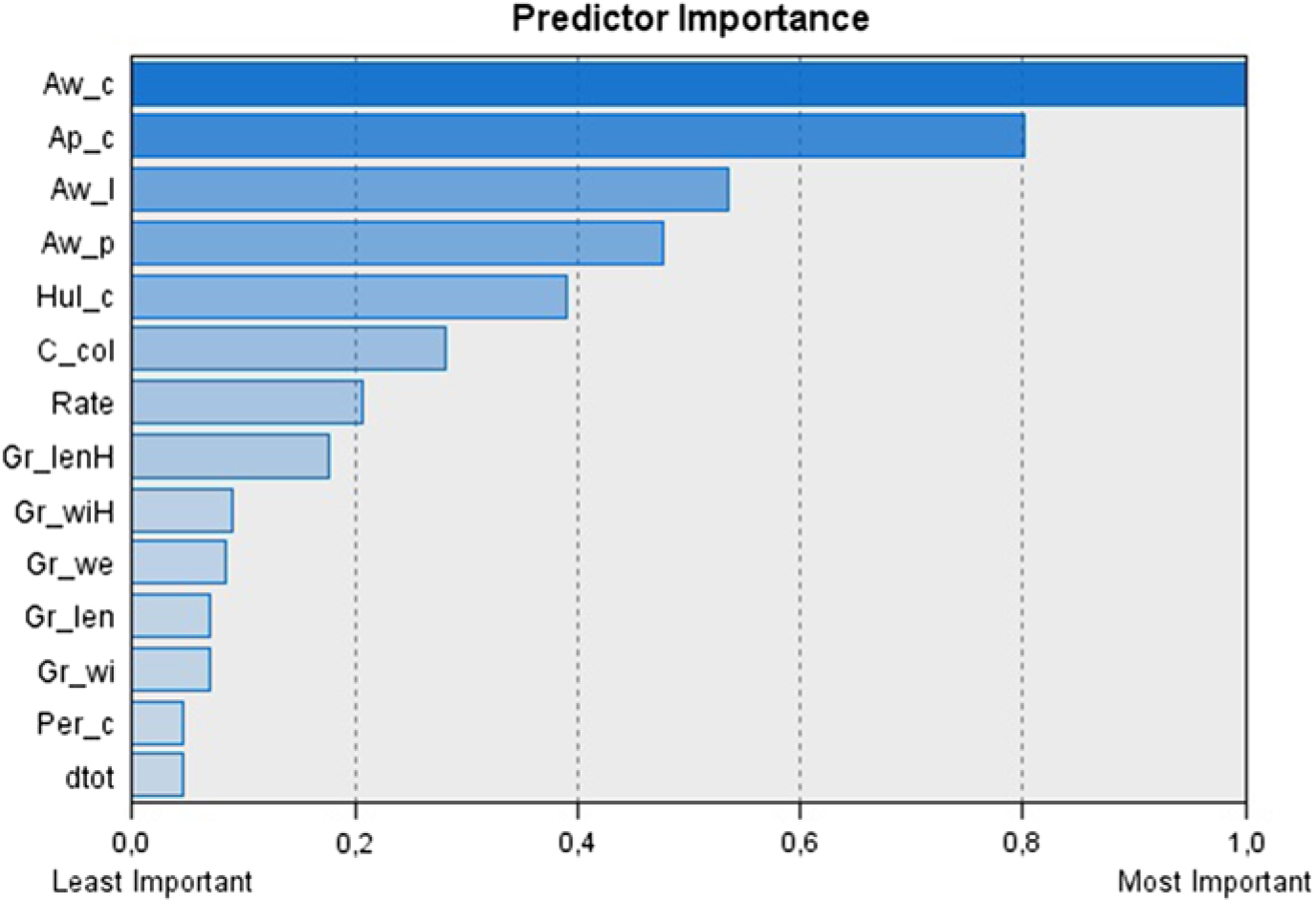
We carried out a two-step cluster analysis to discern the traits most useful for categorizing weedy rice based on phenotypes in Colombia. Such phenotypic categorization can be used to devise control methods that target common or shared phenotypes in weeds. Our analysis showed four weedy rice groupings in Colombia based on 14 variables with greater than 0.05 importance (Figure 3). Awn color is the most important variable as a predictor of the relative importance of each field in estimating the model (with a value of 1), followed by apiculus color (0.80), awn length (0.54), and awn presence (0.48). These variables also coincide with the ones reported in Costa Rica by Arrieta-Espinoza et al. (Reference Arrieta-Espinoza, Sánchez, Vargas, Lobo, Quesada and Espinoza2005), who identified two groups based on awn presence and color and observed an additional morphological variation in the apiculus color.
Variables that constituted the main predictors for the definition of the four conglomerates of Colombian weedy rice populations. The color intensity of the bars indicates the level of importance. Abbreviations: Aw_c, awn color; Ap_c, apiculus color; Aw_l, awn length; Aw_p, awn presence; Hul_c, hull color; C_col, culm anthocyanin coloration; Rate, length:width ratio; Gr_lenH, grain length; Gr_wiH, grain width; Gr_we, 100-grain weight; Gr_len, dehulled grain length; Gr_wi, dehulled grain width; Per_c, pericarp color; dtot, days to tillering.

The variables that have been considered most useful in the morphological classification of weedy rice vary with world region, however. In a study carried out on Italian weedy rice, the variables that played a significant role in the grouping were awn length and germination at 0 and 10 d after ripening, leading to two clusters (Fogliatto et al. Reference Fogliatto, Vidotto and Ferrero2012). The morphological classification of southern U.S. weedy rice has been based on hull color, plant height, and days to flowering, with six phenotypic groups observed (Shivrain et al. Reference Shivrain, Burgos, Scott, Gbur, Estorninos and Mcclelland2010). A separate analysis classified weedy rice in Arkansas into eight morphogroups with reproductive/yield traits (leaf and panicle length, flowering time, awn color, and awn length) having greater influence than vegetative traits (Kanapeckas et al. Reference Kanapeckas, Tseng, Vigueira, Ortiz, Bridges, Burgos, Fischer and Lawton-Rauh2018). Weedy rice of Malaysia comprises four morphological groups, in which hull color and awn presence are the determinants for the classification (Sudianto et al. Reference Sudianto, Neik, Tam, Chuah, Idris, Olsen and Song2016). Thus, the traits that best categorize weedy rice in Colombia have some similarity, but do not completely overlap with those of weedy rice populations growing in other regions of the world.
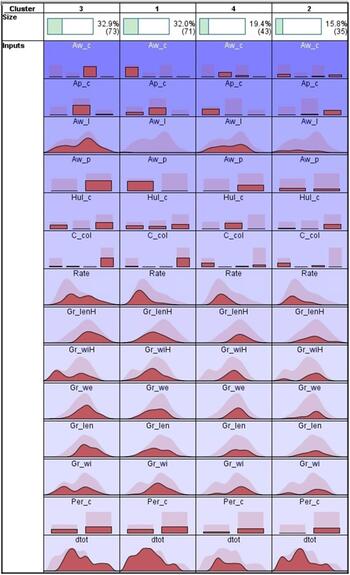
There were four groupings observed for Colombian weedy rice. Cluster 1 is composed of 32% of the accessions studied, with all of these being awnless. Accessions tend to have straw-colored apiculi (73.2%) and hulls (43.7%), green culm anthocyanin coloration (90.1%), a grain length:width ratio of 2.19, mean grain length of 7.7 cm and width of 3.55 cm, 100-grain weight of 2.10 g, mean dehulled grain length of 5.95 cm and width of 3.04 cm, a red pericarp (63.4%), and a mean of 29 d to tillering (Figure 4). This group prevails in three of the five rice zones of the country: Costa Norte (45% of the evaluated weeds of this zone), Bajo Cauca (40%), and the Central zone (33%). The weeds associated with this cluster belong to both the indica-like (63%) and admixed indica–aus (37%) genetic groups.
Absolute distributions of the variables that explain the clusters of Colombian weedy rice populations. Abbreviations: Aw_c, awn color; Ap_c, apiculus color; Aw_l, awn length; Aw_p, awn presence; Hul_c, hull color; C_col, culm anthocyanin coloration; Rate, length:width ratio; Gr_lenH, grain length; Gr_wiH, grain width; Gr_we, 100-grain weight; Gr_len, dehulled grain length; Gr_wi, dehulled grain; Per_c, pericarp color; dtot, days to tillering.

Cluster 2 is composed of 15.8% of our weed accessions, which makes it the smallest group. It is characterized by having red apiculi (94.3%) and straw-colored hulls (88.6%), with most of the accessions being awnless (57.1%) or having a short mean awn length (1.61 cm). Accessions also tend to have a purple culm anthocyanin coloration (77.1%), a grain length:width ratio of 2.25, mean grain length of 8.41 cm and width of 3.78 cm, 100-grain weight of 2.35 g, mean dehulled grain length of 6.23 cm and width of 3.08 cm, a red pericarp (100%), and a mean of 31 d to tillering (Figure 4). Cluster 2 only predominates in the Santanderes area, with a participation of 45% of the populations sampled in this region. Although this group is geographically restricted, as in Cluster 1, weeds belong to both indica-like (70%) and admixed indica–aus (30%) groups.
Cluster 3 is composed of 32.9% of the accessions, with this and Cluster 1 being the largest. All accessions are awned, with mean awn length of 5.09 cm. It is further characterized by straw-colored awns (100%), apiculi (94.5%), and hulls (63%), green culm anthocyanin coloration (87.7%), a grain length:width ratio of 2.75, mean grain length of 8.89 cm and width of 3.31 cm, 100-grain weight of 2.41 g, mean dehulled grain length of 6.46 cm and width of 2.82 cm, a red pericarp (61.6%), and a mean of 34 d to tillering (Figure 4). This group is commonly found in the Llanos area (45% of the weeds) and, like Cluster 1, also in the Central zone (33%). Weeds belonging to this phenotypic group correspond to the indica-like (47%) and admixed indica–aus (53%) genetic groups.
Cluster 4 is composed of 19.4% of the accessions of weedy rice studied. All accessions in this cluster are awned, with an average awn size of 4.40 cm. Awns tend to be black (74.4%), as are all apiculi and hulls, while culm anthocyanin coloration tends to be purple (60.5%). Accessions have a grain length:width ratio of 2.32, average grain length of 8.66 cm and width of 3.74 cm, 100-grain weight of 2.39 g, mean dehulled grain length of 6.38 cm and width of 3.16 cm, a red pericarp (76.7%), and a mean of 32 d to tillering (Figure 4). This group of weeds is not specific to any of the evaluated zones, although it is present in all of them and also contains members from the three genetic groups evaluated for Colombian weeds, with a greater proportion of indica-like (42%), followed by admixed indica–aus (33%), and finally aus-like (25%). It is important to highlight that it is the only phenotypic cluster associated with aus-like weeds.
Morphologically, weedy rice around the world has often been described as sharing some characteristics with domesticated rice and some with wild rice (Cao et al. Reference Cao, Lu, Xia, Rong, Sala, Spada and Grassi2006; Federici et al. Reference Federici, Vaughan, Norihiko, Kaga, Wang Wang, Doi, Francis, Zorrilla and Saldain2001; Londo and Schaal Reference Londo and Schaal2007; Vaughan et al. Reference Vaughan, Ottis, Prazak-Havey, Bormans, Sneller, Chandler and Park2001; Yu et al. Reference Yu, Bao, Shi, Dong and Ge2005). Because of this, some scientists have proposed that weedy rice can be phenotypically classified into two groups: weedy rice that mimics wild rice, which often has black hulls, awns, and greater height than cultivated rice plants, and crop-mimic weedy rice, which has straw-colored hulls without awns and is similar in height to the commercial varieties (Gross and Olsen Reference Gross, Olsen and Stewart2009). Based on these classifications and the groupings made in our study of Colombian weedy rice, the accessions belonging to Cluster 1 can be considered to mimic “varietal” cultivated morphotypes, and Cluster 4 accessions resemble wild morphotypes. However, not all accessions belonging to Cluster 1 have straw-colored hulls, and Clusters 2 and 3 have mixed crop and wild characteristics. Thus, our survey of Colombian weeds suggests that there are multiple weedy rice morphotypes that can be successful in crop fields, and not just the crop-mimic and wild-mimic weedy rice, as previously proposed.
We found surprisingly few relationships between geographic zones and phenotypic weedy rice groupings in Colombia, with only Cluster 2 showing a strong association with a single region. Similar results were found by Shivrain et al. (Reference Shivrain, Burgos, Scott, Gbur, Estorninos and Mcclelland2010) in the United States, Ratnasekera et al. (Reference Ratnasekera, Perera, He, Senanayake, Wijesekara, Yang and Lu2014) in Sri Lanka, Rathore et al. (Reference Rathore, Singh, Kumar and Chauhan2016) in India, and Sudianto et al. (Reference Sudianto, Neik, Tam, Chuah, Idris, Olsen and Song2016) in Malaysia, all of whom indicated that clusters and morphotypes were not necessarily delimited by the geographic zones, nor were they associated with dry or humid conditions, with several types of weedy rice infesting a locality and/or the same crop field. However, most Colombian weedy rice clusters are not uniformly prevalent in all zones; for example, in the Central production zone, weeds are more likely to belong to Clusters 1 and 3, and in the Santanderes region they are more likely to belong to Cluster 2. The widespread distribution of weeds from all clusters in Colombia suggests that the traits defining groupings are not adaptive to the different environmental conditions and production systems present in the country. Though our modest sample size allows only some preliminary conclusions, the fact that some clusters are more common in some areas than others could more likely be due to shared crop seed provenance (which can be contaminated by weedy rice) and/or more sharing of agricultural machinery (also potentially contaminated) within regions.
Finally, although certain traits distinguished the aus-like weeds (i.e., black hulls, awns, later flowering, red pericarps, classification into Cluster 4), weeds from the other ancestral groups were not correlated with phenotypic cluster membership in Colombia. The indica and admixed indica–aus weeds are present in the four clusters, and thus show great variability in their phenotypic characteristics. Although high levels of phenotypic variation in indica–aus weeds could possibly be attributed to admixture between two distinct lineages, the high variability of indica-like weeds would seem to suggest that even within a single lineage, the potential for variability in traits exists. Given that the origins of weedy rice in Colombia are from crop ancestors, as has been inferred for weedy rice in other world regions (e.g., Goulart et al. Reference Goulart, Borba, Menezes and Merotto2014; He et al. Reference He, Kim and Park2016; Huang et al. Reference Huang, Young, Reagon, Hyma, Olsen, Jia and Caicedo2017; Li et al. Reference Li, Li, Jia, Caicedo and Olsen2017; Qiu et al. Reference Qiu, Zhou, Mao, Ye, Wang, Zhang, Yu, Fu, Wang, Qian, Qi, Wu, Sultana, Cao, Wang, Timko, Ge, Fan and Lu2017; Reagon et al. Reference Reagon, Thurber, Gross, Olsen, Jia and Caicedo2010; Song et al. Reference Song, Chuah, Tam and Olsen2014), and crops generally lose variation through domestication bottlenecks and strong positive selection, the variability in weedy rice suggests there is much potential for phenotypic evolution in cultivated rice.
The high phenotypic variability in Colombian weedy rice suggests that there is not a single phenotype associated with being a successful weed of rice in Colombia, although our sampling scheme within growing regions does not allow us to determine whether a particular weed group or cluster is the most prevalent overall. Because not all weedy rice studies have considered the same traits, it is hard to conclude whether the extent of phenotypic variability is similar to that in other countries; levels seem to exceed what is found in the United States, but may be comparable to what is reported for Malaysia, Costa Rica, Italy, the United States, India, and Sri Lanka (Arrieta-Espinoza et al. Reference Arrieta-Espinoza, Sánchez, Vargas, Lobo, Quesada and Espinoza2005; Fogliatto et al. Reference Fogliatto, Vidotto and Ferrero2012; Hussain et al. Reference Hussain, Man and Othman2010; Rathore et al. Reference Rathore, Singh, Kumar and Chauhan2016; Ratnasekera et al. Reference Ratnasekera, Perera, He, Senanayake, Wijesekara, Yang and Lu2014; Shivrain et al. Reference Shivrain, Burgos, Scott, Gbur, Estorninos and Mcclelland2010; Sudianto et al. Reference Sudianto, Neik, Tam, Chuah, Idris, Olsen and Song2016). The fact that most of the traits examined varied so widely may be useful in helping define those that are essential for weedy rice’s success and thus may be good targets for management strategies. For example, degree of shattering and presence of red pericarp vary less among weed accessions or weed groupings, suggesting that seed dispersal and seed dormancy (which has been linked to the red pericarp trait; Cui et al. Reference Cui, Song, Li, Li, Huang, Caicedo and Olsen2016; Gu et al., Reference Gu, Foley, Horvath, Anderson, Feng, Zhang and Chen2011) may be of great importance to weedy rice’s success. Probably many other unexamined shared features among weedy rice accessions and groups, perhaps physiological traits, are also necessary for weedy rice’s success and could be leveraged for eradication efforts. Our results shed light on the complexity of the weedy rice problem in Colombia, providing information that can be used to design and implement integrated long-term and large-scale management solutions for weed control.
Author ORCID
Veronica Hoyos, https://orcid.org/0000-0002-2313-7419; Ana L. Caicedo, https://orcid.org/0000-0002-0378-6374; Guido Plaza https://orcid.org/0000-0002-6029-0818.
Acknowledgments
This project was funded, in part, by a Developing Country Collaboration supplement to U.S. National Science Foundation grant IOS-1032023 and the Universidad Nacional de Colombia-Bogotá. Special thanks to Fedearroz staff, Fabio Montealegre and Luis Perez. No conflicts of interest have been declared.
Supplementary material
To view supplementary material for this article, please visit https://doi.org/10.1017/wsc.2019.18.