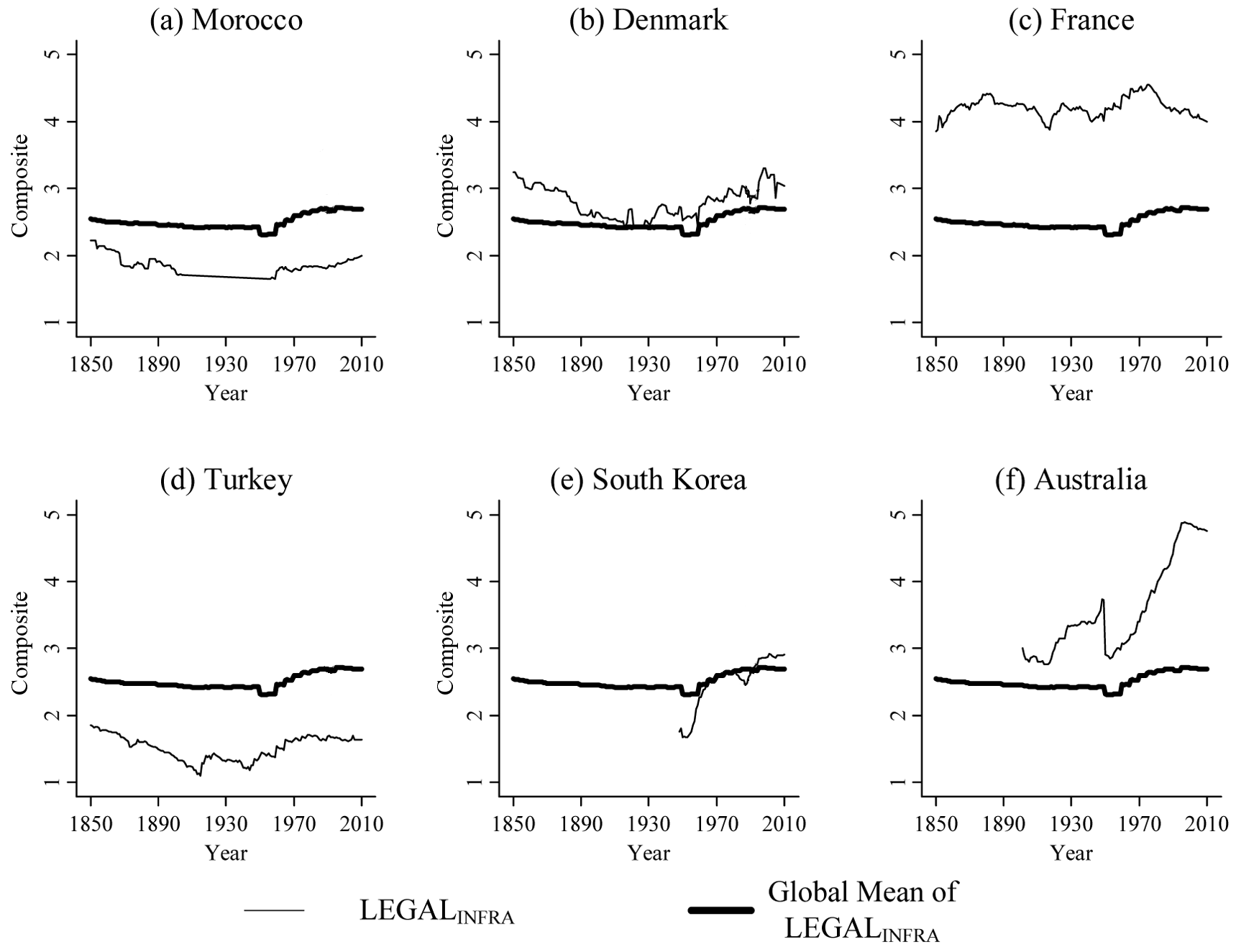
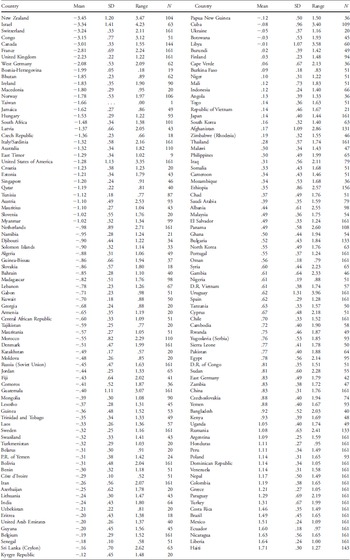
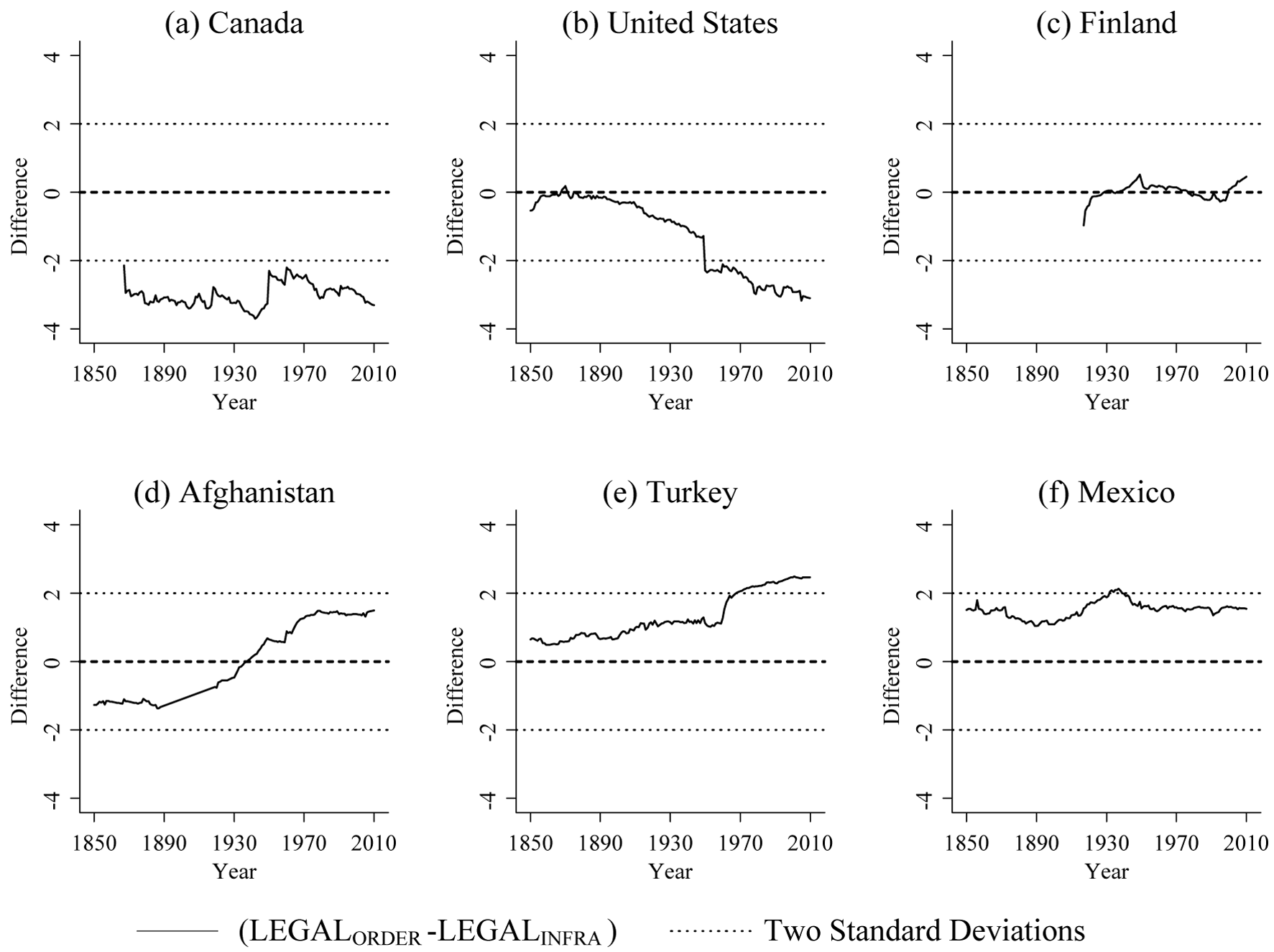
Bodies of written rules, laws in common parlance, predate recorded history. The Code of Hammurabi, the Ten Commandments, the laws of Draco and Solon, the Laws of the Twelve Tables, and the Justinian Code are among the most noteworthy early efforts to codify rules of conduct. Indeed, Shklar notes that “the antiquity of legalism as an ideology is, in fact, one of the wonders of history” (Shklar Reference Shklar1964, 14). In fact, she goes on to note, skeptically, that when scholars attempt to extract the quintessence of the West, it always comes down to “‘freedom under law,’ ‘a government of laws not of men’” (Shklar Reference Shklar1964, 20). Much to Shklar’s chagrin, the allure of law has increased considerably since she wrote, and it has spread well beyond the West.
For example, Peerenboom (Reference Peerenboom2002, 1) contends that “the hallmarks of modernity are a market economy, democracy, human rights, and rule of law.” Tamanaha argues that “the rule of law is the most important political ideal today” (Peerenboom Reference Peerenboom2004, frontispiece). He supports this contention with a series of quotes from a diverse set of global leaders that is remarkable enough to quote at length:
Russian “President Putin continues to place judicial reform and the full implementation of the principles of the rule of law among the country’s highest priorities.” … Chinese leaders say they … “support the establishment of the rule of law.” Robert Mugabe, embattled President of Zimbabwe, previously stated that “Only a government that subjects itself to the rule of law has any moral right to demand of its citizens obedience to the rule of law.”… President Mohammed Khatami of Iran has made repeated remarks about the value of a civil society and the importance of the rule of law. … Even a notorious Afghan warlord, Abdul Rashid Dostum, campaigning for a position in the post-Taliban government, was quoted as saying “Now is the time to defend ourselves not with tanks and armed corps but by the rule of law.” (Tamanaha Reference Tamanaha2004, 2–3)
Two factors account for the increasing centrality and global embrace of legalism at the beginning of the 20th century. The first derives from recent changes in the importance attributed to law as a vehicle for advancing societal welfare. The earliest conceptions of the social utility of law, beginning with the seminal reflections of Plato and Aristotle, stressed its double-edged ability to preserve social order and curb the discretion of rulers. Centuries later, it became recognized by liberals as the principal tool for the protection of liberty. More recently, however, the rule of law has been viewed as an essential tool for advancing societal development, central to efforts to secure prosperity and a higher standard of living (Dellepiane-Avellaneda Reference Dellepiane-Avellaneda2009; Haggard and Tiede Reference Haggard2011). Both intellectual and historical factors led to the view that law was an important developmental force. Intellectually, the stimulus derived from theoretical insights contained in the neoinstitutionalism of North (North Reference North1970; North and Thomas Reference North1990) and Hayek’s embellishment and extension of the core tenets of liberalism (Hayek Reference Hayek1960, Reference Hayek1973). The impact of these bodies of work was enhanced by the demise of the Soviet Union, the discrediting of socialism, and the end of the Cold War. These factors stimulated the “rule of law revival” that began in the 1990s (Carothers Reference Carothers1998).
The confluence of these developments led entities such as the World Bank and the International Monetary Fund to pursue institutions-oriented development strategies, which condition external aid on the adoption of economic, legal, and political reforms that will generate “good governance.” The political reforms were designed to enhance the accountability of leaders through democratic reforms and the strengthening of civil societies. Legal reforms were central to these development strategies because, without a credible commitment to accept constraints on discretion and comply with well-known rules of the game, neither free enterprise nor democracy would thrive.
The second factor driving the contemporary centrality of legalism relates to the ambiguity that is recognized and lamented by virtually all who have studied the concept since the term was initially coined. Thus, at the end of the 19th century, Alfred V. Dicey noted: “Whenever we talk of Englishmen as loving the government or law, or of the supremacy of law as being a characteristic of the English Constitution, [we] are using words which, though they possess a real significance, are nevertheless to most persons who employ them full of vagueness and ambiguity” (Dicey 1896, 109–10).
Lamentably, the conceptual confusion that Dicey observed has worsened since 1896. Tamanaha readily acknowledges that political leaders who endorse the rule of law seldom articulate precisely what it means. This allows it to be embraced by leaders with widely divergent social and political views. While this gives the rule of law a universal appeal, it also makes it impossible to clearly identify its core components or agree upon its clear empirical referents. Scholars have fared no better in articulating a clear conceptualization of the term. For example, in some contemporary scholarship, a Hobbesian perspective is taken and the rule of law is seen as being synonymous with societal stability (Hirshleifer Reference Hirshleifer1995; Dixit Reference Dixit2004; Belton Reference Belton2005). Political conceptions focus on governmental constraint, namely, a government that obeys its own rules and is subordinate to an independent judiciary (Buchanan and Tullock Reference Buchanan1962; Hayek Reference Hayek1973, Reference Hayek1979; Dicey Reference Dicey1915/1982; Olson Reference Olson1993; Weingast Reference Weingast1995, Reference Weingast1997). Classical economic conceptualizations focus on the importance of property rights and contract enforcement (North and Thomas Reference North1970; North Reference North1990); others emphasize governmental transparency, efficiency, and corruption (Knack and Keefer Reference Knack1995; Mauro Reference Mauro1995; Keefer Reference Keefer2004). Yet another conceptualization treats the rule of law as being synonymous with freedom/human rights (Sen Reference Sen1999).
If the first factor driving the contemporary appeal of the rule of law is rooted in the thoughtful integration of seminal insights, the second derives from the failure to adequately theorize an age-old concept. Moreover, this failure has handicapped efforts to develop cross-national rule of law measures for extended time frames, which are essential for evaluating the societal role of law. Conceptual and methodological deficiencies are hardly unique to this field. What does distinguish it, however, is its central role in a governance system that is at the heart of aid strategies that are consuming tens of billions of dollars and affecting the welfare of hundreds of millions of people.
The centrality of legalism in contemporary social thought and policy underscores the importance of transforming the rule of law into a useful tool for social scientific inquiry. Until this transformation is achieved it will be impossible to develop a cumulative, well-grounded body of knowledge that clarifies the unique contributions that law can make to societal well-being by identifying the factors that affect the efficacy of legal orders, the amount of time required for legal reforms to generate benefits, and the unintended consequences of legalism.
This article offers an approach to initiating the needed transformation. Its principal contributions are twofold. First, it introduces and develops a conceptual framework that provides the basis for conducting longitudinal, cross-national research into the societal role of law. The framework was developed as part of the Societal Infrastructures and Development (SID) project. The SID project is concerned with the role of national institutions and contexts in societal development; it focuses on 165 countries (all those with populations above 500,000 in 2005).Footnote 1 At the heart of the SID rule of law schema are two concepts—legal orders and legal regimes—that serve to organize the myriad ideas that have been associated with the rule of law over the centuries. Second, it offers a partial operationalization of the SID framework (from 1850 to 2010) using several sets of original data to construct two measures. One captures a country’s efforts to embed a law-based order in its constitution (LEGALORDER); the second gauges the status of the counry’s legal infrastructures (LEGALINFRA). Both have proven useful in an analysis of economic growth (Nardulli, Peyton, and Bajjalieh Reference Nardulli2010); LEGALORDER has been shown to be associated with lower levels of civil strife in the aftermath of rapid-onset, climate-related disasters (Nardulli et al. Reference Nardulli2013).
The next section addresses theoretical issues. It introduces the concepts of a legal order and a legal regime and elaborates upon the notion of a legal order. The second section is methodological: it reviews existing rule of law gauges and then distinguishes LEGALORDER and LEGALINFRA from them, details their derivation, and examines their temporal distribution to see if they provide reinforcing insights into a country’s legal order. The final section presents the conclusions.
Foundations of the SID Conceptual Framework: Legal Orders and Legal Regimes
The rule of law concept predates the emergence of modern social science by millennia and was never intended to comport with the basic strictures for a theoretical concept that could direct empirical research. Moreover, because of its allure, it has been appropriated over the centuries by a range of users—from rulers to dissidents to scholars—and new layers of meaning have been added to it. These developments account for the ambiguity and confusion that plague the current usage of this term. Thus, the first step toward advancing research in this area is to unpack the various ideas associated with the rule of law, identify their roots, and reassemble them into a more coherent framework. Our analysis of both older and more recent bodies of scholarship lead us to focus on two key concepts, legal order and legal regime. The first section introduces these concepts; the second section provides a fuller elaboration of the key components of a legal order as well as discussion of why and how they evolved.
Legal Orders and Legal Regimes
The concept of a legal order emerges from the seminal work of Kelsen (Reference Kelsen1945). It refers to a distinctive type of rule-based governance, one that relies on (1) transparent and formally institutionalized rules to order human behavior and interactions and (2) the structured deployment of coercion to enforce rules. It captures the instrumental/procedural/ formal components that have long been associated with the rule of law. A legal order rests on a specific approach to regulating human behavior as well as a set of philosophical tenets that Shklar (Reference Shklar1964) refers to as “legalism.” She defines legalism as “the ethical attitude that holds moral conduct to be a matter of rule following, and moral relationships to consist of duties and rights determined by rules. … Its most nearly complete expression is in the great legal systems of the European world” (Shklar Reference Shklar1964, 1–2).
Kelsen asserts that a legal order functions to “bring about a certain reciprocal behavior of human beings: to make them refrain from certain acts which, for some reason, are deemed detrimental to society, and to make them perform others which, for some reason, are considered useful to society” (Kelsen Reference Kelsen1945, 15). Societies can neither persist nor prosper without the structure that legal orders make possible. The creation of a law-based order is not the only way to provide social structure and, within societies that embrace them, it is only one tool they use. This notwithstanding, legalists argue that legal orders clarify the status, obligations, and rights of individuals—across a diverse set of spheres—in ways that other modes of social control cannot.
The concept of a legal regime refers to the design of the laws and legal rights embedded within a legal order; it captures the normative values that many have associated with the rule of law (human rights, social order, property rights, individual liberties, religious precepts, etc.). Thus, this concept refers to the type of social structure that a country is attempting to create through its institutionalization of a law-based order. Differences in legal regimes exist because they reflect efforts to structure human conduct and relationships in ways that comport with different values. At a very abstract level it is possible to conceive of distinctive legal regimes (liberal, authoritarian, socialist, feminist, Confucian, Islamic, etc.). However, legal regimes are likely to evolve in a layered manner, responding to specific historical developments in light of extant political circumstances. This could lead to new value commitments being added to existing ones, often without regard to the inconsistencies and incompatibilities these additions imply. Moreover, legal regimes normally evolve in a sector-specific manner. The historical developments that shape legal regimes are far more likely to affect specific legal domains (commercial, family relations, criminal, individual rights, etc.) than to reshape a country’s entire corpus of law. In one country Islamic values may dominate in criminal and family domains, whereas liberal values may dominate its commercial sector. In another country authoritarian values may dominate its individual rights sector, whereas socialist values may dominate its social welfare sector.
Focusing on legal orders and legal regimes is vital for efforts to advance research into law and society for several reasons; two are most important. First, this framework provides the basis for separating normative considerations from the instrumental principles that have long been associated with legal orders. Second, clearly distinguishing between these two concepts provides analytic benefits: it makes it possible to examine the individual and joint effects of the array of instrumental and the normative factors that have been amalgamated into rule of law rhetoric. Peerenboom’s distinction between “thin” and “thick” conceptions of the rule of law (Peerenboom Reference Peerenboom2002, Reference Peerenboom2004) corresponds roughly to the distinction between legal orders and legal regimes. As conceived here, however, these instrumental and normative dimensions do not constitute competing conceptions; they simply refer to different, and potentially complementary, components of a legal system. This leads to a more integrated and encompassing understanding of law and society.
The next subsection offers a conceptual framework that develops the notion of a legal order. It is appropriate to begin with the concept of a legal order because, without a well-established legal order, the concept of a legal regime would be largely irrelevant to our understanding of law and society. That is, without the instruments to enforce them, substantive laws would not be part of a formal, rule-based governance system. Those laws may serve symbolic functions and/or may be part of another type of governance system (paternalistic, totalitarian, clan-based, etc.), but they would not be part of a law-based system.
The Concept of a Legal Order: An Elaboration
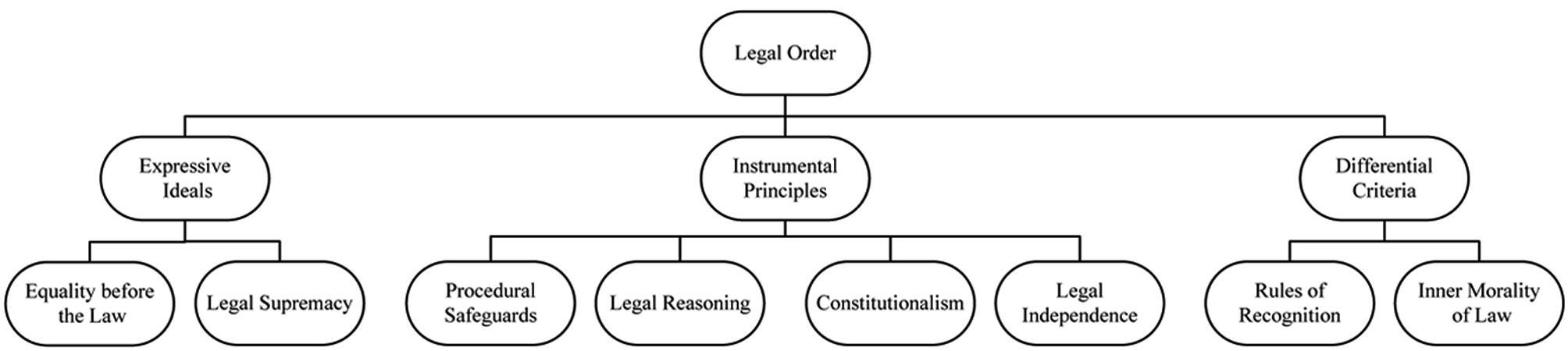
Despite the ambiguity that has long plagued rule of law rhetoric, there is a core meaning to what has been defined here as a legal order. This core meaning has been forged by historical settings and events that have unfolded, in a sporadic and disjointed manner, over two millennia. These historical developments have generated a series of intellectual epiphanies that have clarified the core components of a socially useful, rule-based mechanism for structuring human behaviors and interactions. These epiphanies have been the subject of fierce political debates. They have been captured in seminal works and then refined and augmented by later works. In the wake of these intellectual developments are several well-developed, if disconnected, bodies of thought on legal orders. The integration of these works provides the basis for dimensionalizing this concept, which is the first step in transforming it into a useful tool for social research. This integration suggests that there are three key dimensions (see fig. 1).
SID legal order conceptual framework
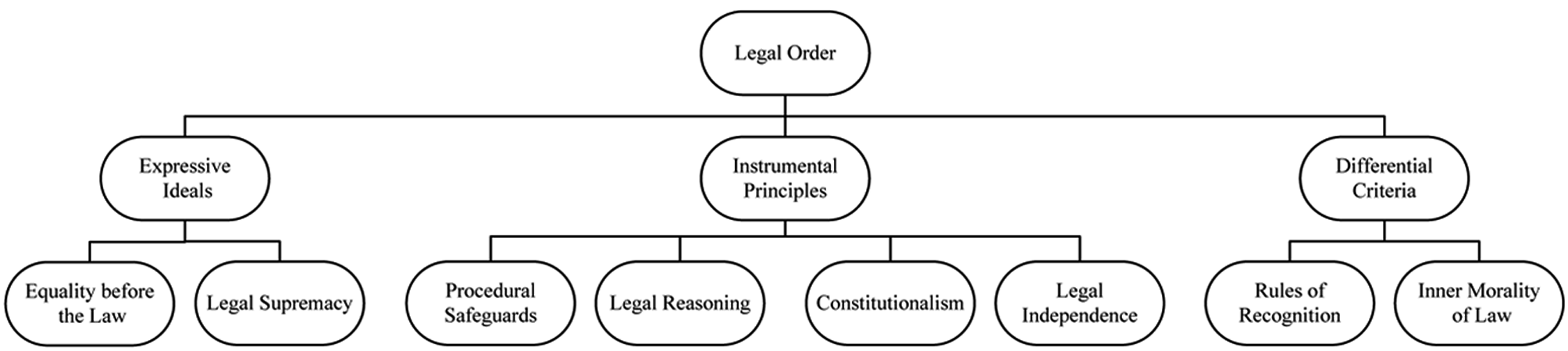
The first is an expressive dimension. The key components here are a pair of ideals: equality before the law and the supremacy of law. These expressive ideals distinguish law-based orders from other governing mechanisms that could be used to provide social order, such as rule by patrimonialism, vanguards of the proletariat, warlords, dictators, and so forth. Because of these expressive ideals, the earliest political thinkers believed that legal orders were unique in their capacity to simultaneously maintain social order, curb the discretion of rulers, and guarantee liberty.
The second component is an instrumental dimension. The centrality of this instrumental component derives from the realization that the expressive ideals of a legal order are not self-realizing. This realization came centuries after those expressive ideals were articulated, and it led to the development of a set of principles thought to be necessary for realizing them. The articulation of these principles unfolded over centuries, but it began with the English experience in the Middle Ages. The principles thought to be necessary for realizing them include procedural safeguards, legal reasoning, constitutionalism, and institutional independence. Moreover, to be effective in realizing these principles a society must have the capacity to do such things as educate aspiring legal actors, regulate legal decision makers, and conduct dialogues on legal matters. Collectively, the mechanisms that provide for these services can be termed a legal infrastructure. Legal infrastructures have received comparatively little scholarly attention. But they are necessary accoutrements of a modern legal order, and no complex society can sustain a law-based order without a well-developed legal infrastructure.
The third component is a differential dimension, which speaks to the distinction between laws and other types of rules. While legal orders are rule-based, not all rules are laws. The distinction between rules and laws did not emerge clearly until well after a legal order’s expressive ideals and instrumental principles were established. But centuries of intellectual debate over the meaning of law led to refinements in positivist conceptions of law. Around the middle of the 20th century it became clear that “rules of recognition” were essential in differentiating laws from other normatively based rules. Also, the mid-20th-century experience with fascism led to the realization that law had an “inner morality.” If lawmakers ignored this inner morality, the rules they produced were not laws. Thus, the realization of expressive ideals depends as much on the observance of these differential criteria as it does on the implementation of instrumental principles. The following subsections develop the concepts outlined in figure 1.
Expressive Ideals
Perhaps the earliest extended commentary on legal orders is found in ancient Greece, reaching its apex in the work of Plato and Aristotle. Their ruminations on legal orders were an integral part of their thinking about how to structure societies so as to optimize well-being. They both believed that investing wide discretion in the hands of wise and noble political leaders was the optimal design for a society. At the same time, both Plato and Aristotle were realists who were familiar with ancient political history. They understood both the rarity of benevolent guardians and the amount of harm that abusive and self-serving rulers could do. This led them to embrace law-based orders as a worthy substitute for philosopher kings. In their view legal orders both provide the basis for social order and curb the capricious exercise of discretion by rulers. In turn, these public goods generate a degree of individual liberty for Athenian citizens that Pericles celebrated as unique in the ancient world.
To Athenians, law-based orders were synonymous with rule by enlightened reason. As such, it was the antithesis of arbitrary rule of either tyrants or demagogues, which were synonymous with rule by desire or passion: “It follows therefore that it is preferable that law should rule rather than any single one of the citizens. … He who asks the law to rule is asking God and intelligence and no others to rule; while he who asks for the rule of a human being is importing a wild beast too; for desire is like a wild beast, and anger perverts rulers and the very best of men. Hence, law is intelligence without appetition” (Aristotle 350 BC/1988, 226).
The high regard that classical thinkers had for legal orders was rooted in their reified conception of law. To them, and other classical thinkers, such as Cicero, “true” law reflected a divine or natural order that served an enlightened view of the common good. It was accessible by reason and was decidedly not equated with the will of a transient majority. Indeed, those who would change the law bore a heavy burden; Plato went so far as to advocate that the legal code he offered in The Laws be permanent.
Unlike the reified conception of law that buttressed classical conceptions of law-based orders, two themes of classical thought have endured: equality before the law and the supremacy of law. Because of their close association with the distinctive nature of a legal order, these can be understood as its expressive ideals. No conception of a legal order that is consistent with the historical development of law-based orders can fail to view them as defining traits.
Equality before the law emerges as a key component of classical conceptions of law-based orders as early as the rule of Solon. Captured by the Greek term isonomia, it is the notion that laws are to be applied equally to all, according to its terms. Thus, while laws can make distinctions, those distinctions must be applied similarly across individuals. This is a key expressive ideal because it is central to the societal utility of legal orders, their ability to provide for social order. Few things are more detrimental to domestic tranquility than blatant and systematic favoritism by legal actors. This was clear to the ancient Greeks, and it has become even clearer since then.
The supremacy of law is the notion that law binds a society’s rulers as well as its citizens. It is an expressive ideal because, without it, legal orders could not curb the abusive discretion of rulers. Plato could not be more explicit about the importance of the supremacy of law for realizing the societal benefits of legal orders:
The highest office in the service of the gods must be allocated to the man who is best at obeying the established laws. … Such people are usually referred to as ‘rulers’, and if I have called them ‘servants of the law’ … [it is] because I believe that the success or failure of a state hinges on this point more than anything else. Where the law is subject to some other authority and has none of its own, the collapse of the state, in my view, is not far off; but if the law is the master of the government and the government is its slave, then the situation is full of promise. (Plato 1970, 128)
Cicero is equally clear:
A magistrate’s function is to take charge and to issue directives which are right, beneficial, and in accordance with the laws. As magistrates are subject to the laws, the people are subject to the magistrates. In fact it is true to say that a magistrate is a speaking law, and a law a silent magistrate. Nothing is so closely bound up with the decrees and terms of nature. Without that, no house or state or clan can survive—no, nor the human race, nor the whole of nature, nor the very universe itself. (Cicero 1998, 150 [emphasis added])
The supremacy of law as an expressive ideal is lost briefly during the Roman Empire. But it reemerges with the rise of the Church as a social force in the Middle Ages, one that could counter monarchial power and authority. The Magna Carta notwithstanding, it is difficult to argue that kings were subject to positive law, which they promulgated and enforced. It was, however, widely believed that monarchs were subject to divine law. Moreover, oath-taking on the part of kings during coronations became established and contributed to the widespread view that they were subordinate to higher law. The supremacy of law has been an integral part of the concept of a legal order continuously since then. National constitutions often establish the supremacy of law as part of the social compact, and contemporary leaders routinely swear allegiance to the law upon taking office.
Instrumental Principles
While classical thinkers devoted a great deal of thought to the virtues of a legal order, they gave much less thought to how these virtues would be achieved. The rise of absolutism in the West underscored the fact that these ideals were not self-realizing. Indeed, perhaps the key theme in Dicey’s seminal 19th-century treatise is the importance of institutionalized mechanisms for realizing expressive ideals. In contrasting the England’s legal system with France’s, he disparagingly notes: “The Declaration of the Rights of Man proclaimed the right of every citizen to publish and print his opinions. … But the Declaration of Rights and this guarantee were practically worthless. They enounced a theory which for many years was utterly opposed to the practice of every French government” (Dicey 1896, 118). What made England different from France was that “there runs through the English constitution that inseparable connection between the means of enforcing a right and the right to be enforced” (Dicey 1896, 118).
The institutionalized mechanisms that Dicey equates with the English Constitution began with festering concerns that produced the Magna Carta, evolved with the development of the English common law system, were crystallized in the aftermath of the English Civil War, and were advanced by the American founding experience. They can be expressed succinctly in terms of four instrumental principles that are central to any historically faithful conception of a legal order: procedural safeguards, legal reasoning, constitutionalism, and institutional independence. These, in turn, depend upon the existence of a viable legal infrastructure for their vitality.
The first two instrumental principles, procedural safeguards and legal reasoning, are essential to the capacity of legal orders to curb the arbitrary exercise of governmental authority. Their centrality was underscored as society and governments became more complex and specialized. Arbitrary rule was not restricted to monarchs; it could also be engaged in by magistrates (and later administrative agencies) who were unfaithfully applying otherwise sound laws. Thus, developing procedures to govern the actions of legal actors and establishing principles of legal reasoning to use in applying legal principles came to be seen as crucial to realizing the benefits of law-based orders.
The importance of procedural safeguards was first articulated and acknowledged formally in chapter 39 of the Magna Carta. It stipulates: “No freeman shall be taken or imprisoned or disseised or exiled or in any way destroyed, nor will we go upon him nor send upon him, except by the lawful judgment of this peers or by the law of the land.”
Conceptions of procedural safeguards have changed considerably since 1215 and continue to evolve. There remains, however, a widespread consensus among legalists that the rules governing legal proceedings be publicly known, clearly expressed, and fairly applied. Within these general strictures, there are many approaches to designing procedures and many values that can be manifested in them. Examples of procedural safeguards include public hearings, rules of procedure, the right to participate meaningfully in proceedings, and the right to appeal.
Legal reasoning is the notion that applications of the law to specific cases must be expressed in reasoned explanations and based on applicable legal provisions. It is a key instrumental principle because the notion of “a government of laws not men” is a political slogan, not an apt depiction of reality. Laws do not implement themselves. Nor do they fill in gaps that inevitably emerge in laws that are designed to be general in nature. Legal reasoning is an independent instrumental principle because, even if effective procedural safeguards exist, the idiosyncratic application of legal principles could undermine the societal benefits proponents associate with legal orders.
The abuse of official discretion is curtailed when legal actors faithfully and ably integrate the law into their decisions, but the societal utility of legal reasoning goes beyond this. To illustrate, contrast a legal order with a system in which well-intentioned, well-trained mediators are given license to take into account any and all considerations that may seem relevant to them in a particular case. Many, including Shklar (1964), argue that this type of forum may provide a more appropriate resolution of a particular dispute. This may well be the case, especially if such a mediation forum were couched within a legal order. The problem with an unbounded system of discretion is that, unlike a law-based order, it fails to provide individuals with a priori guidance as to their behavior. This could both jeopardize individual liberty and undermine societal stability, thereby impeding progress. This is especially true when the mediators are not “well-intentioned and well-trained.”
Constitutionalism is the notion that a state is governed by a set of fundamental written principles. Implicit in this notion is the existence of a hierarchy of laws. The law at the top of this hierarchy, the nation’s founding document, cannot be modified by ordinary law-making procedures. Consequently, these fundamental principles define the framework of ordinary government actions and constrain the actions of government officials. Dunham (1965) asserts that the genesis of constitutionalism precedes the Magna Carta and dates at least to King Alfred’s reign in the 9th century. But it was not until the 1680s that the term “constitution” was used to convey the idea of a set of fundamental principles that governed the operation of a state.
Constitutionalism is essential to contemporary conceptions of a legal order because it performs the role that higher law performed in constraining the actions of absolutist monarchs in the Middle Ages. Indeed, without constitutionalism it is difficult to imagine a meaningful conception of the supremacy of law. Raz, for example, asserts that, without constitutionalism, a law-based order is a tautology (Raz Reference Raz1979, 112). Hayek views constitutionalism as essential to a law-based order because a legislature “will be more reluctant to take certain measures for an important immediate aim if this requires the explicit repudiation of principles formally announced” (Hayek Reference Hayek1960, 179). However, for the behavioral impact of constitutionalism to be meaningful, there must be some type of implementation mechanism, such as judicial review. However, despite the attention devoted to judicial review, Ginsburg (Reference Ginsburg2003) notes that it is not the only mechanism that uses constitutional principles and provisions for restraining governmental action. He prefers the term “constitutional review,” which encompasses a number of mechanisms that check the sovereignty of governmental actors.
The importance of institutional independence as an instrumental principle, judicial independence in particular, was highlighted in the English Civil War (Hayek Reference Hayek1960, 169) and underscored by the writings of William Paley, whom Hayek characterizes as “the great codifier of thought in an age of codification.” Paley contends that “the first maxim of a free state is, that the laws be made by one set of men, and administered by another; in other words, that the legislative and the judicial character be kept separate” (Paley 1785/1824, 348).
There are a number of ways to provide for institutional independence of those entities charged with applying the laws. Among these are lifetime tenure, civil service protections, and prohibitions on salary reductions. It is important to emphasize that institutional independence and the other instrumental principles are both highly interdependent and mutually reinforcing. If legal institutions are not independent, then their commitment to procedural safeguards, legal reasoning, and constitutionalism cannot be assured. However, if legal institutions are independent, then they must be constrained by other instrumental principles. The failure of these instrumental principles to constrain independent legal actors makes it possible for them to act on their own predispositions, which will undermine their legitimacy.
Differential Criteria
While the nature and sources of law have been debated endlessly, most conceptions of law and its societal role rest on a positivist conception. By the middle part of the 20th century, developments in positivists’ conception of law produced some key insights into the nature of a legal order. Some of these insights were intellectual developments; others were a result of the sobering effects of fascism. The seminal contributions here are Kelsen (Reference Kelsen1945), Hart (Reference Hart1961), Fuller (Reference Fuller1969), and Raz (Reference Raz1979). Two of these insights are of particular importance for dimensionalizing the concept of a legal order. The first is the existence of clear rules of recognition; the second is a set of requirements derived from what Fuller terms “the inner morality of law.”
Rules of recognition are essential for identifying when a rule attains the status of a law. Hart (Reference Hart1961) argues that law must be viewed as the union of primary and secondary rules. Primary rules are laws about the conduct, obligations, and powers of individuals; secondary rules are laws that specify how primary rules can be (1) ascertained, (2) established, (3) clarified, and (4) changed. Rules of recognition are so fundamental to contemporary conceptions of a law-based order that Hart says they can “be considered a step from the pre-legal into the legal world” (Hart Reference Hart1961, 91).
The 20th-century experience with fascism led to much soul-searching among legal scholars. The fact that Nazi Germany had many of the trappings of a legal order was unsettling. This stimulated a great deal of thinking about the difference between laws and other rules. The most relevant insights derive from Fuller’s analysis of the “inner morality of law.” Fuller’s analysis of what makes law-based orders distinctive from other rule-based systems generates seven criteria that a rule must meet before it can be viewed as a law: (1) generality: laws should not be targeted to specific individuals or groups; (2) publicity: laws must be knowable by those subject to their provisions; (3) prospectivity: laws—especially criminal laws—should not be applied retroactively; (4) clarity: laws should be straightforward and understandable; (5) logical consistency: the provisions within a law should not impose incompatible obligations; (6) feasibility: laws should not be impossible to obey; (7) stability: laws should be constant enough for individuals to orient their action to them (Fuller Reference Fuller1969, 39).
The gist of Fuller’s analysis is that simply having and following rules of recognition are insufficient for differentiating laws from other rules. Law makers must also comply with the set of affirmative obligations embodied in the inner morality of law; meeting these obligations is essential to making legal orders socially useful mechanisms. However, with the exception of the publicity requirement, Fuller does not consider any of these requirements to be a litmus test. Rather he concedes that “the inner morality of law is condemned to remain largely a morality of aspiration and not of duty” (Fuller 1969, 43). Thus, the morality embodied in these requirements is something to which we aspire even though we will never attain it.
Gauging Cross-national and Intertemporal Differences in Legal Orders
Like Fuller’s assessment of the inner morality of law, it can be said that the conceptual framework offered here is an aspirational ideal. It is unlikely that any society has ever—or will ever—create a legal order that is wholly consistent with the SID conceptualization. But it is clear that some countries have made more progress than others. This suggests the importance of developing well-conceived cross-national rule of law measures. The surge of interest in legalism in the 1990s sparked a number of pioneering efforts to construct such measures. But the challenges these first-generation efforts faced were formidable. Moreover, they were compounded by the fact that researchers desired to cover a large number of countries over an extended period of time with limited resources and few prior efforts upon which to build.
The most fundamental of these challenges are theoretical. When attempting to operationalize a complex, multidimensional concept such as the rule of law, researchers must be able to identify and specify the pertinent theoretical dimensions. Methodological challenges are equally imposing; three are most important. First, sources of pertinent information for each dimension must be assembled that cover the set of countries and the time frame to be included in the operationalization effort. Second, the pertinent information for each dimension must be quantified into a set of component variables. Finally, the component variables must be integrated into a composite variable or a set of composite variables. How these methodological challenges are performed can affect the validity, reliability, and analytic utility of the measures.
To attain a set of rule of law measures that meet the highest scholarly standards will require several waves of scholars refining and extending first-generation efforts. The SID variables (LEGALORDER and LEGALINFRA) developed here are offered in that spirit. Our operationalizations fall well short of what we should demand for such an important social science construct. But we submit that the measures described below differ from existing measures in several ways that provide the potential to advance research on law and society. The first, and most important, distinction is that the SID variables derive from an explicit conceptual framework; most existing measures are not anchored in such a framework. Tight theoretical moorings are essential for informing and focusing measurement efforts; their absence leads to the introduction of extraneous components, construct conflation, the misspecification of key terms, and conceptual gaps. Second, while most first-generation measures are based on derivative data, which can pose validity threats, LEGALORDER and LEGALINFRA derive from original and significant data collection efforts. These efforts were designed to operationalize the SID framework and were informed by the innovations, shortcomings, and critiques of first-generation efforts. A third important distinction concerns quantification procedures. While existing measures rely heavily on “perceptions” data to quantify their component measures, the SID effort minimized subjective evaluations and strove to obtain more objective data. Finally, the SID composite variables were created by the careful and transparent integration of component variables. In contrast, few of the existing composite measures detail or justify the integrative procedures used to create them.
The next part of this section illustrates these observations by providing a focused review of first-generation rule of law measures. This review will contribute to a better understanding of extant measures and lay the groundwork for introducing the SID variables. The following part of the section details the derivation of LEGALORDER and LEGALINFRA; it will provide an appreciation of the value-added of the SID variables as well as provide insights into the type of future refinements and extensions that will be needed to advance research in this field. The final part of this methodology section undertakes a county-specific comparison of the two SID measures; it will help to shed light on their validity and utility.
First-Generation Rule of Law Measures: A Focused Review and Comparison
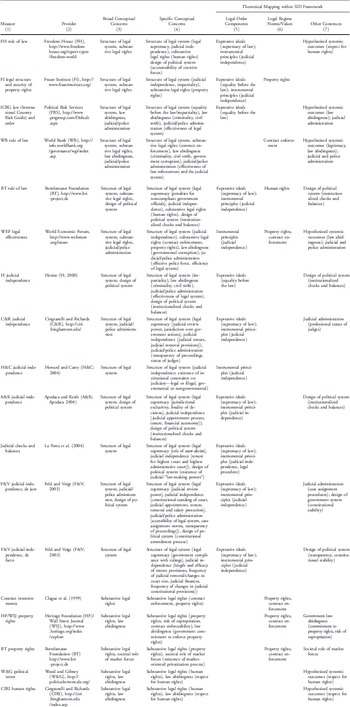
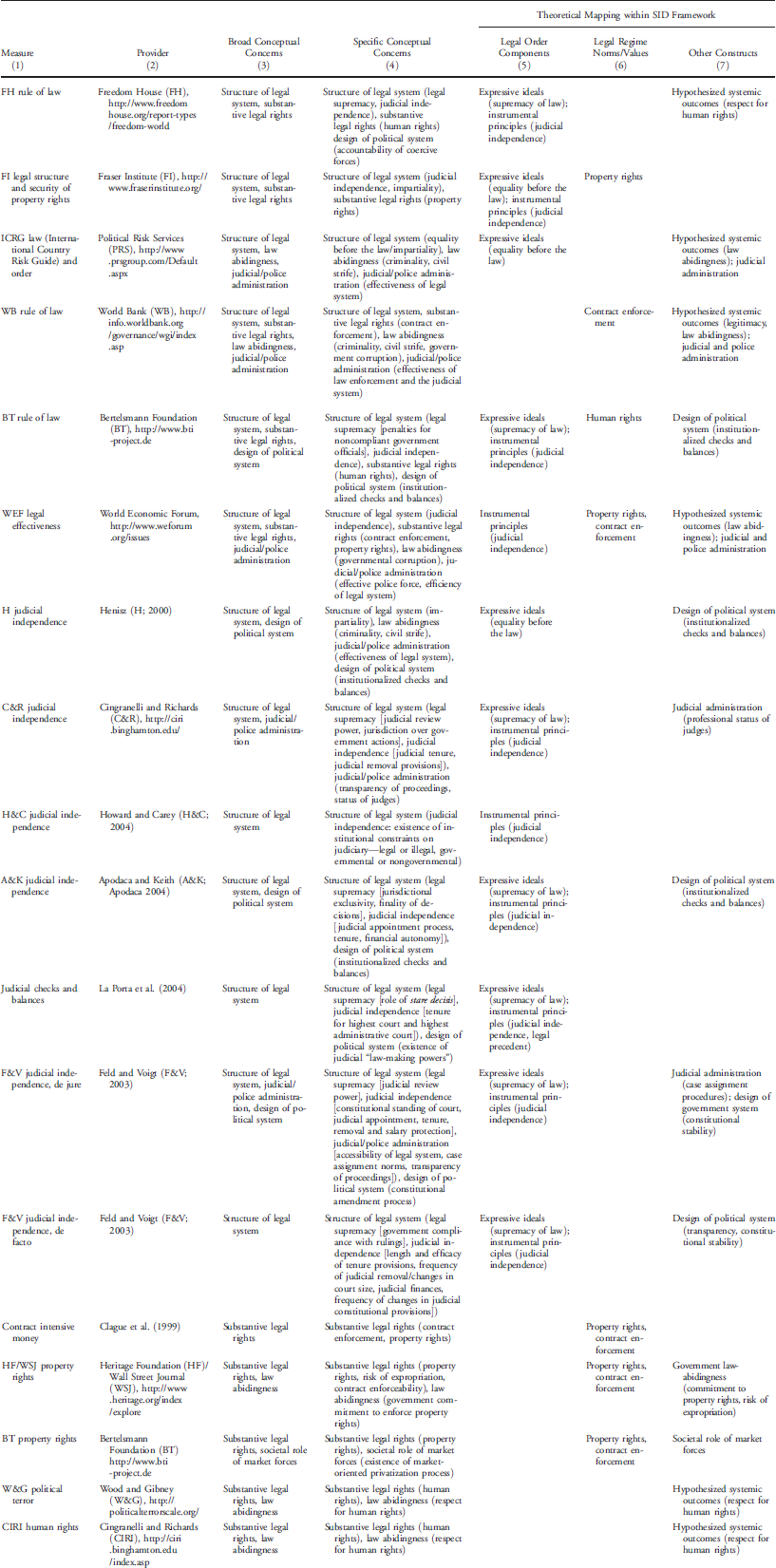
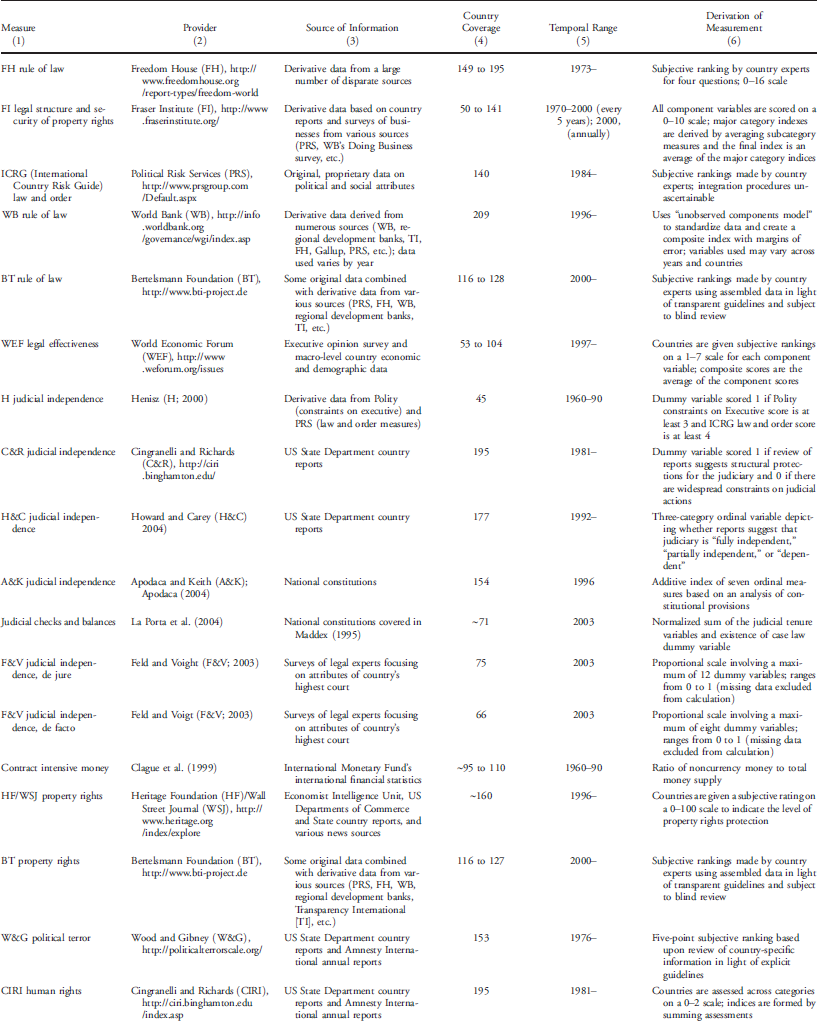
In a very comprehensive overview, Tiede (2007, 2) identifies over 70 rule of law indicators. The proliferation of these measures over the past two decades has led to several scholarly reviews of them (Munck Reference Munck2003; Woodruff Reference Woodruff2006; Tiede Reference Tiede2007; Haggard, MacIntyre, and Tiede Reference Haggard2008; Rios-Figueroa and Staton Reference Rios-Figueroa2009; Skaaning Reference Skaaning2010; Ginsburg Reference Ginsburg2011). This review differs from those because it takes as its vantage point the SID conceptual framework and the SID effort to construct LEGALORDER and LEGALINFRA. It would be unnecessarily cumbersome and repetitive to review all of the measures Tiede identifies; thus, this review focuses on 21 of the most prominent measures. They are listed in the first two columns of table 1 and table 2, which, respectively, provide summary information on each effort from a theoretical and methodological perspective.
Theoretical Perspectives
The most fundamental distinction between the SID variables and existing cross-national rule of law measures is that LEGALORDER and LEGALINFRA are rooted in an explicit theoretical framework. One consequence of the loose theoretical moorings that characterize many of the first-generation efforts is the failure to distinguish between the core components of the rule of law, the means used to implement rule of law ideals and principles, and the purported ends of a law-based order. The entries in column 3 of table 1, which categorize first-generation rule of law measures in terms of their broad conceptual foci, illustrate this point. Two of the broad foci listed in column 3 are consistent with the SID theoretical framework: the structure of the legal system and substantive legal rights. The legal system focus pertains to the concept of a legal order, while the legal rights focus relates to the concept of a legal regime. The other foci listed in column 3 (judicial/police administration, law abidingness, the design of the political system, etc.) are extraneous to historically grounded conceptions of the rule of law. Incorporating these extraneous concerns into rule of law measures erodes the validity of the measures and undermines their utility because it conflates the rule of law with other phenomena, which can lead to misleading inferences about its societal role and impact.
To illustrate this point, consider the implications of including a focus on judicial and police administration. While the rule of law refers to a set of ideals, principles, institutions, and processes, administrative measures focus more on resource levels, work flows, and outputs. Efficient and adequately resourced police forces and judiciaries may well be essential to realizing rule of law ideals. But this is an independent matter that can only be addressed by joining rule of law measures with a separate set of administrative measures. Even more troubling here is the possibility that police and judicial systems that are highly effective at apprehending criminals and processing cases may derive their efficaciousness from efforts that are inconsistent with rule of law ideals and principles. Equally troublesome are measures that incorporate a law abidingness dimension. Law abidingness is a hypothesized outcome of a legal order; incorporating it into rule of law measures severely compromises efforts to understand the conditions under which law-based orders foster law abidingness. Also, law abidingness may be the result of actions that are highly inconsistent with the rule of law. Including a focus on the design of a country’s political system is also problematic, even though most rule of law indicators with a political design focus are concerned with institutionalized checks and balances. A credible law-based order is an important check on government actions, but it is not the only check. Thus, a measure such as Polity IV’s “constraints on the executive” is not an appropriate rule of law measure because it captures constraints not rooted in a law-based order.
Another consequence of the failure to anchor rule of law measures in a well-developed theoretical framework is that it impedes efforts to specify key terms clearly and consistently. This can impede intellectual progress and generate confusing findings. Because the broad characterizations provided in column 3 mask the inconsistencies across common foci, column 4 provides more details on how different efforts specify their broad concerns. The entries in column 4 reveal both inconsistent and overly vague specifications of key concepts. For example, legal supremacy is associated with such disparate matters as the role of stare decisis, jurisdictional exclusivity, finality of judicial decisions, government compliance with legal edicts, and the existence of judicial review power. Judicial independence is variously equated with the constitutional standing of courts; the stability of constitutional provisions; judicial appointment, tenure, and removal provisions; salary protections; and financial autonomy. Examples of vague specifications include defining legal supremacy as the “primacy of law” or equality before the law as “impartiality.” Defining a term with a synonym does little to provide for commonalities across measurement efforts; more concrete specifications are needed to advance research on the rule of law. While these specification issues are not unusual for a field in its infancy as a domain for empirical research, they must be addressed before sustained intellectual progress can be generated. Moreover, the optimal way to address these issues is for operationalizations to be rooted in a well-developed theoretical framework.
A final consequence of the loose theoretical moorings that characterize most extant rule of law measures is the existence of conceptual gaps. To highlight these gaps, columns 5 and 6 map the conceptual concerns reported in column 3 onto the SID conceptualization; column 7 captures the concerns that do not fit within it. The notion of a legal order includes expressive, instrumental, and differential dimensions; the entries in column 5 show which of these dimensions are included in existing measures. While equality before the law and legal supremacy are two ideals that have long been associated with the rule of law, two-thirds of the first-generation efforts fail to incorporate them. Four efforts include a focus on equality; another seven include a focus on supremacy. No effort focuses on both. Only 10 measures touch upon instrumental principles. However, all but one (La Porta et al. 2004) focus solely on judicial independence. Moreover, no work has been done to develop measures that address the differential dimension that rose to prominence after World War II. Column 7 captures conceptual concerns relevant for gauging differences in legal regimes. While there has been a good deal of work addressing classical liberal concerns (property rights, contract enforceability, human rights), little work has been invested in developing religious or non-Western conceptions of a legal regime.
Methodological Perspectives
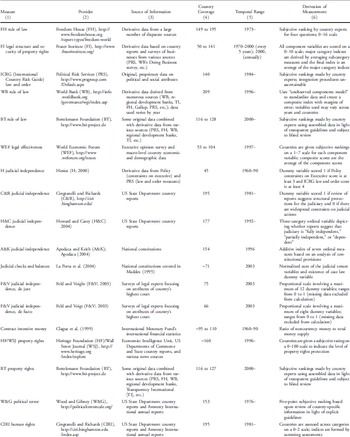
Perhaps the most significant methodological distinction between the SID variables and the first-generation measures concerns the assembly of relevant information. LEGALORDER and LEGALINFRA are the result of a set of original research projects designed to operationalize key components of the SID framework. In contrast, only one-third of the efforts reviewed here are based on original research efforts: International Country Risk Guide’s law and order, Apodaca and Keith’s judicial independence, La Porta et al.’s judicial checks and balances, Feld and Voight’s judicial independence (de jure and de facto), World Economic Forum’s legal effectiveness, and the Word Bank’s measure for legal environment. All of the other measures use mostly derivative data, as reported in column 3 of table 2.
Given the contemporary importance attributed to the rule of law, it is puzzling that so few resources have been devoted to original data collection efforts. While there is nothing inherently wrong with using derivative data, it is sufficiently challenging to design original data collection efforts to measure complex concepts validly. The threats to validity increase exponentially when employing data that others have collected for different purposes, especially if those efforts reflect political or ideological considerations. Moreover, original research efforts provide designers with the ability to address methodological issues that have plagued some first-generation measures. These include such matters as temporal and spatial reach, missing data, and consistency in procedures across countries and years. Finally, designing a project “from scratch” allows researchers to introduce refinements that are often not possible when using derivative data.
Comparing the SID project with first-generation efforts will illustrate the value of original data collection efforts. The SID variables are derived from a research design that included all countries with a population of over 500,000 in 2004 (165 countries). The data sources used (national constitutions, legal periodical indexes, compilations of legal education programs) enabled us to cover an exceptionally long time frame (1850–2010) and make it possible to update the data series with comparable data. Moreover, the SID variables were constructed using identical procedures for all countries and years. Finally, the SID research teams were sensitive to missing data issues and made concerted efforts to minimize missing values. As a result, data exist on the SID variables for almost all of the country-years included in the research design; the few remaining holes are not systematic gaps that would impede statistical inference.
In contrast to LEGALORDER and LEGALINFRA, many existing measures are limited in their spatial and temporal reach and have serious missing data problems. Moreover, some (e.g., World Bank’s rule of law) employed different data sources for different years or countries; others used measurement procedures that do not lend themselves to comparisons over time (e.g., TI’s corruption perceptions). It is somewhat difficult to compare the country coverage of the SID variables with extant measures because the countries included in some of the latter measures vary over time. However, as seen in column 4 of table 2, the lowest number of countries covered is 29; the highest is 209. The median low coverage is 116; the median high coverage is 140. It is difficult to characterize the temporal span for most of the extant measures because many are ongoing. Thus, column 5 in table 2 reports only the earliest year in the series, unless it is clear that the series has ended. With the exception of the Polity executive constraints measure (which, as noted above, is inappropriate as a rule of law measure), the earliest date for which data are available is 1960; the median date is 1992. Six of the measures begin before 1980, and five others do not begin until 2000 or later. The SID effort includes a consistent time series for more countries than all but four of the first-generation efforts; its temporal reach is nearly a century longer than the existing rule of law measures with the longest time series (H judicial independence; Contract Intensive Money).
None of the four measures with more country coverage than the SID variables extends before 1981, and two do not extend before 1990. These advantages in spatial and temporal reach, when combined with the fact that the SID effort minimized missing data and employed similar procedures and data across countries and time, provide several analytic benefits. Three are most noteworthy. First, conducting analyses using comparable measures for a large and identifiable subset of countries (all but the microstates in the case of SID) provides for the accumulation of knowledge. In a research domain populated by a range of measures covering different subsets of countries and time frames, it is difficult to compare findings across studies. Second, the existence of missing data can lead to biased parameter estimates if the missing data are not random. This is a relevant point because work by Rios-Figueroa and Staton suggest that missing data in this field is not random. Rather, they demonstrate that data on judicial independence measures are much more likely to be missing for poorer countries (Rios-Figueroa and Staton 2009, 27). Third, the type of data employed and the temporal reach of the SID time series makes it possible to assess the longevity of a country’s commitment to rule of law ideals and principles.
The capacity to differentiate among countries in terms of the longevity of their commitment to the rule of law made it possible to include a temporal dimension to the SID component measures. This temporal component represents one of the important methodological advances over first-generation efforts. To say that the SID variables include a temporal dimension means that they are constructed in a way that history matters. Thus, if two countries have identical constitutional provisions bearing on judicial independence, but one country’s provision was adopted in a 1974 constitutional amendment and the other’s had been in place since 1900, these differences would be reflected in the judicial independence variable’s 1975 value. The rationale for incorporating a temporal dimension is that the notion of a law-based order embodies historically radical ideas that require the transformation of traditional attitudes and behaviors. The realization of these behavioral and attitudinal changes is likely to occur gradually, which suggests that the societal effects of efforts to create a law-based order are likely to vary over time. Details on how a temporal dimension was incorporated into the SID variables are reported in the next section.
Assembling pertinent information is perhaps the most important methodological challenge for constructing cross-national rule of law measures. But quantifying that information to construct component variables and integrating those component variables into composite variable(s) also involve important methodological challenges; contrasting the approach used to construct the SID variables with those used to generate first-generation efforts will yield insights into the differences between them. With respect to scoring the component variables, the SID initiative made a conscious effort to minimize subjective judgments. With the exception of the Contract Intensive Money (CIM) measure and those based on survey data or constitutional reviews, the scoring of most of the component variables reviewed here is based on subjective rankings by informed experts. This method is especially prevalent in efforts with a longer temporal reach. As reported in column 6 of table 2, in most instances these subjective rankings are based on a review of a considerable amount of information; often there are guidelines/criteria that are used to structure the evaluation process. This quantification method gives rise to three key concerns.
The first relates to the type of information being reviewed. The array of data used in many cases is impressive, but the type of information included is sometimes problematic. The most appropriate type of data pertains to the design and operation of legal institutions and processes. Unfortunately, some of the data used in the construction of some first-generation component variables focus either on matters outside the legal system or outcomes that it may affect (law abidingness, security of property rights, economic output). A focus on nonlegal referents or outcomes can lead to conflation that undermines the validity of the measure. The second concern has to do with the guidelines used in the evaluation of the available information. These guidelines should focus evaluators on legal institutions, processes, ideals, and the like, and, in most instances, they do. In others, however, they focus on outcomes. For example, the following question is included in Freedom House guidelines: “Is violent crime either against specific groups or within the general population widespread?” One component of the ICRG law and order measure relates to popular observance of the law. In both instances, hypothesized outcomes are integrated into an independent variable, which undermines its validity and introduces endogeneity concerns. The third issue concerns reliability. While some efforts strive to insure consistent coding, reliability tests are virtually nonexistent (or at least unreported). This makes it difficult to know whether different coders looking at the same information provide comparable scores. While Kurtz and Schrank (2007) were not specifically concerned with rule of law measures, they provide a stinging critique of governance measures based largely on subjective evaluations.
Integrating the component scores into a composite measure is not as fundamental as the specification and quantification of component measures: no integration technique can salvage inappropriate or inadequate data. However, poorly conceived integration techniques can undermine good data. As is demonstrated in the next subsection, great care was taken in integrating the SID component variables into LEGALORDER and LEGALINFRA, and the integration technique is very transparent. In contrast, not all first-generation efforts are clear on how they integrate component variables. Moreover, where the methods are revealed, there is often cause for concern. In most instances integration is attained by a simple averaging or summation technique. In some cases these techniques may be warranted; in other cases it is not. It is almost always the case that not all component variables are equally good indicators of an underlying dimension; moreover, simple techniques exist (e.g., factor analysis) for determining how well indicators used to measure a concept “hang together.” To combine component variables without determining whether they belong together has the potential for diluting valid measures and ignoring important dimensions in the data. With the exception of the World Bank’s rule of law measure, there is little evidence that adequate attention was given to the integration of component variables.
SID Rule of Law Variables
As noted above, efforts to develop rule of law measures that meet the highest scholarly standards will require refinements and extensions from several waves of researchers. The LEGALORDER and LEGALINFRA variables developed here suffer from some of the shortcomings identified above but nonetheless represent an advance over first-generation efforts.Footnote 2 Clearly laying out the procedures used to construct them will aid in future refinement and extension efforts. The following subsections report the details of those procedures.
The Formal Commitment to a Law-Based Order: Constructing LEGALORDER
Since the adoption of the US Constitution in 1789, strong international norms concerning the use of written constitutions have evolved, and by the turn of the 21st century, virtually every major country had a written constitution (Elkins, Ginsburg, and Melton 2009). To craft these basic laws, constitutional conventions or some other type of formal mechanism is the norm; moreover, participants are selected carefully, and a formal adoption process is almost always required. Thus, the adoption of a national constitution represents a watershed event in a country’s history, during which important issues are researched, debated, and resolved. The outcome of these deliberations can provide insights into a country’s goals and aspirations, its internal power structure, and the importance it attaches to the creation of a law-based order. Enacting constitutional provisions designed to create a legal order does not imply success. But the failure to adopt such provisions, or the revocation of existing provisions, suggests an indifference toward a law-based order that can be invaluable when making cross-national comparisons.
The assessment of constitutional provisions needed to construct LEGALORDER was greatly facilitated by the Comparative Constitutions Project (CCP),Footnote 3 which assembled, digitized, translated, and systematically double-coded and reconciled an exhaustive set of constitutional variables for every country in the world since 1789. But, despite the reach and depth of the CCP, data do not exist to discern every key component of a law-based order. The CCP does, however, provide data to capture formal commitments to three key attributes: equality before the law, the supremacy of law, and judicial independence. The next subsection introduces the component variables used to gauge these key concepts; the subsection after that describes the procedure used to infuse these variables with a temporal dimension. The following subsection describes how the component variables are used to create LEGALORDER and selectively illustrates its historical evolution.
The LEGALORDER Component Variables
One of the defining ideals of a law-based order is its commitment to legal equality. One key CCP question provides the basis for capturing a country’s formal commitment to equality before the law: “Does the constitution refer to equality before the law, the equal rights of men, or non-discrimination?” It was used to create a dummy variable (EQUALITYDUM) capturing a country’s commitment to legal equality. Calculating the annual average value of EQUALITYDUM for all independent nations provides some insights into the diffusion of this principle over time and across countries; these proportions are depicted in figure 2(a). In 1850 the average value of EQUALITYDUM is .25; it increases to almost .5 by 1900. In 2010 its value is .95.
Percentage of countries with the indicated provisions in their constitutions
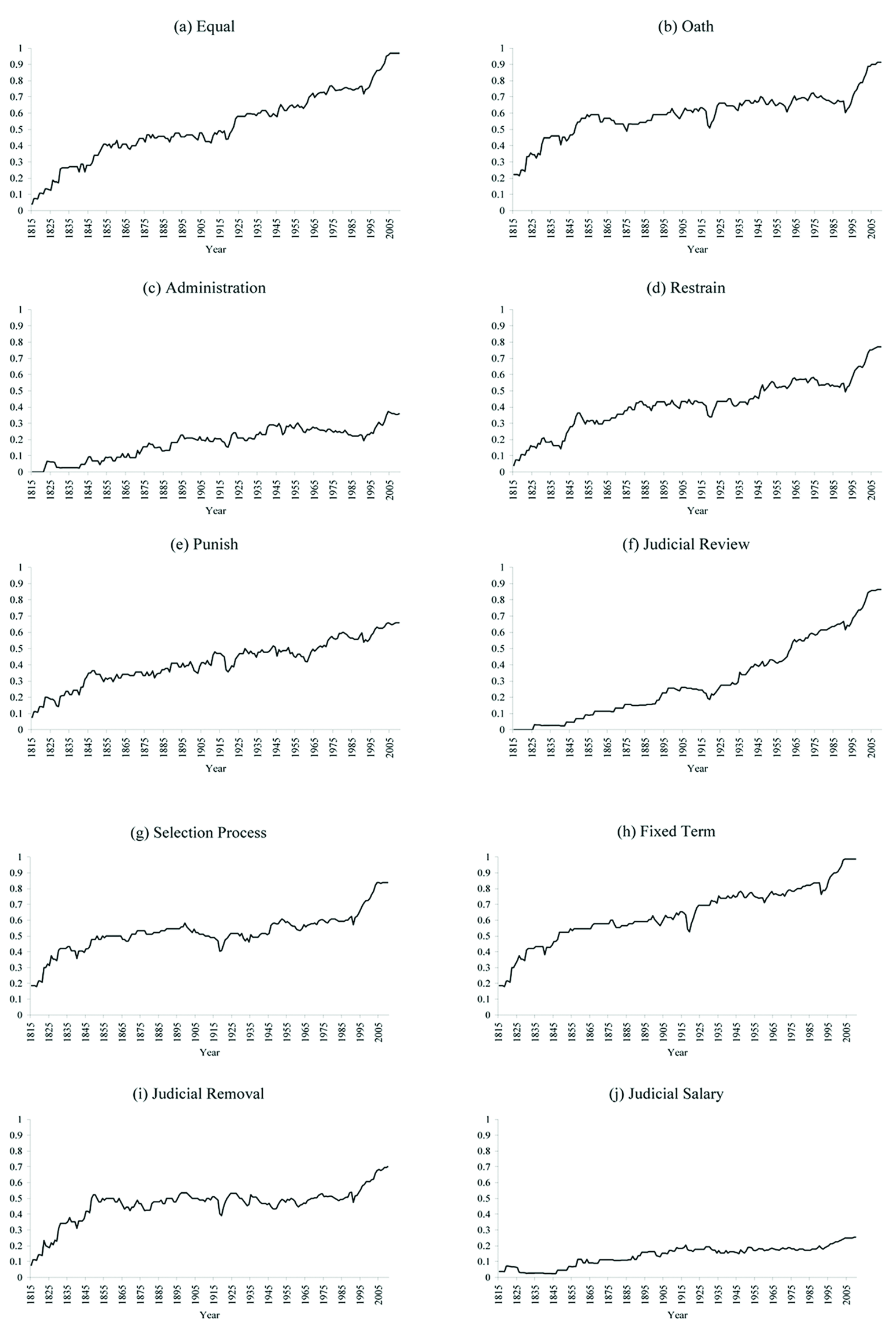
Supremacy of law is another defining legal ideal; three types of provisions were used to gauge a country’s commitment to it. The first embodies general restraints on government officials; the second relates to specific restraints on their behavior; the third involves provisions establishing the judiciary as the arbiter of legal disputes. Two CCP variables reflect the degree to which there is a general commitment to the supremacy of law. The first indicates whether public office holders must take an oath to obey the constitution; the second indicates whether the constitution imposes an affirmative duty to obey the constitution. These two variables were combined into a single dummy variable (OATHDUM; fig. 2[b]). Three other CCP variables, ADMINDUM, (fig. 2[c]), RESTRAINDUM (fig. 2[d]), and PUNISHDUM (fig. 2[e]), relate to specific restraints on governmental actions. They indicate whether individuals are protected from illegal or ultra-vires administrative actions, whether the constitution provides protection from unjustified restraint/detention (habeas corpus), and whether the constitution bans punishment without law (nulla poena sine lege), respectively. Finally, JUD_INTRPTDUM indicates whether the responsibility for interpreting the constitution falls to the judiciary (fig. 2[f]).
As seen in figure 2(b), the average annual value of OATHDUM does not approach .5 until the middle of the 19th century; for most of the 20th century it ranges between .6 and .7, though two noticeable drops occur. The first drop coincides with the break-up of the German, Austro-Hungarian, and Ottoman Empires; the second coincides with the breakup of Yugoslavia and the Soviet Union. By 2010, the average value of OATHDUM exceeds .9. More specific constitutional provisions designed to establish legal supremacy have never been as common. For example, the average annual value of ADMINDUM is low throughout the 19th century; by 1900 it is still less than .25 (see fig. 2[c]). A noticeable decline in the average values of ADMINDUM again occurs in the periods after World War I and the break-up of the Soviet Union; in 2010 its value is only .4. Figure 2(d) presents similar data for habeas corpus protections (RESTRAINDUM). The average value of RESTRAINDUM is less than .4 in 1850; it only increases to .5 after the end of World War II. Its value in 2010 is .75, following a spike after the end of the Cold War. The average annual values for PUNISHDUM increase steadily from the early 1800s (see fig. 2[e]); these values approach .4 by 1900 and show a significant increase after the break-up of the Soviet Union; in 2010 its value is .65. Finally, figure 2(f) presents the data for JUD_INTRPTDUM. Constitutional provisions empowering the judiciary were relatively rare in the 19th century; the average value JUD_INTRPTDUM never reaches .25. However, the average value of JUD_INTRPTDUM increases throughout the 20th century; it approaches .5 after the end of World War II and .9 in 2010.
Centuries after the notions of legal equality and supremacy emerged, it became evident that a law-based order required that those charged with resolving legal disputes had to be independent of those charged with enacting and enforcing the law. Several CCP variables were used to capture cross-national differences in formal commitments to judicial independence; they pertain to provisions concerning the judicial selection process, term length, removal procedures, and salary protections. The logic underlying the use of these variables is that specifying key aspects of judicial tenure in the constitution makes it much more difficult for other political actors to bring untoward pressures on judges. These measures indicate whether the judicial selection process is specified in the constitution (SEL_PROCDUM), whether the terms for various judicial positions are constitutionally specified (FIX_TERMDUM), whether there are there are constitutional provisions governing the removal process (JUD_REMDUM), and whether the constitution explicitly states that judicial salaries are protected (JUD_SALDUM).
Three of the judicial independence variables, SEL_PROCDUM, FIX_TERMDUM, and JUD_REMDUM, follow a fairly common historical pattern prior to the onset of the 21st century (see fig. 2[g–i]). Their annual average values hover around .5 but then begin to increase significantly in the late 1990s. In 2010 the average value for SEL_PROCDUM exceeds .8; the average value for FIX_TERMDUM exceeds .98, and JUD_REMDUM is .7. In contrast, constitutional provisions protecting judicial salaries are never widely embraced (see fig. 2[j]). The annual average value for JUD_SALDUM is less than .2 in the 19th and 20th centuries; in 2010 it approaches .25.
Incorporating a Temporal Dimension to the Component Variables
A basic flaw in first-generation rule of law measures is that they lack a temporal dimension; that is, they constitute little more than a snapshot of a country’s legal system at a certain point in time. Introducing a temporal dimension to the constitutional variables used to construct LEGALORDER is particularly important. A radical break from a traditional order is not likely to be generated by the simple enactment of constitutional provisions designed to institutionalize a law-based order. Rather, such a transformation will be realized, if at all, only after a sustained commitment to the ideals/principles embedded in those provisions. In some cases, this transformation will be the result of an evolutionary process—perhaps the result of both international pressures (economic competition, aid contingencies, cultural shifts, etc.) and domestic factors (the emergence of new groups, shifts in the power/status of groups, and generational shifts). In other cases, the process will be more uneven—the result of scandals, international crises, or economic turbulence, for example. Moreover, the transformational process may be interrupted by the revocation of legal reforms (i.e., legal regressions). Rather than providing reassurances, such backsliding introduces uncertainty as societal actors contemplate future developments and plan future behaviors. This, of course, undermines the transformational process.
Introducing a temporal dimension to the 10 variables described above can be achieved by incorporating information on the number of years a provision has continuously been in effect. But incorporating this information requires addressing several issues concerning how sustained commitments to legal principles affect individual beliefs and behaviors. Few social scientists would argue that constitutional reforms generate immediate changes to beliefs and behaviors; some would deny that they have any independent effect at all. These ambiguities give rise to several issues that must be considered in order to incorporate a temporal dimension to the constitutional variables used to construct LEGALORDER.
For example, if behavioral changes can be generated by constitutional reforms, how long does it take? And what is the pace of change? Also, is it likely that over time legal reforms generate diminishing returns? That is, after some lengthy and continuous commitment to a principle such as judicial independence, have most of the attitudinal and behavioral adjustments been made? If so, then diminishing effects come into play and the fact that one country has been continuously committed to judicial independence for 70 years whereas another has been committed for 90 years becomes a distinction without a difference. Finally, how do legal regressions affect beliefs and behaviors? If a country has been committed to a legal principle for 20 years but it is revoked in a subsequent constitution, what impact will this have? Does socialization have to begin anew? Or does the prior commitment have residual effects? If residual effects exist and the regression lasts for several years, what is the pace of the erosion? Is the erosion uniform across countries and time regardless of the country’s prior commitment and the length of time the regression lasts?
Providing definitive solutions to these issues is likely beyond the capacity of contemporary social science; it is certainly beyond the scope of this effort. But few behavioral issues can be definitively resolved, and the challenges posed here do not justify ignoring the temporal concerns raised above. This is particularly true because defensible (if not definitive) solutions to these concerns can be forged. The solution used here (after experimentation with alternative approaches) involved a logarithmic transformation of a set of “run” variables based on the 10 component variables introduced earlier. These run variables are cumulative measures that reflect the number of continuous years that a constitutional provision has been in effect; if a provision is subsequently revoked, the run variable deteriorates for every year that the revocation is sustained. To illustrate the construction of these run variables, consider a country that adopted a provision establishing legal equality in 1965 but then revoked it in 1980 for 10 years. The value of EQUALITYRUN would be zero for every year between independence and 1966. In 1966, the value of EQUALITYRUN would be 1, in 1967 it would be 2, and so forth. This run would continue until 1980, when its value would be 15. Because the provision was revoked in 1980, the value of EQUALITYRUN would be 14 in 1981 and decline to 5 in 1990, when the provision was reincorporated. Because of this reincorporation, the value of EQUALITYRUN becomes 6 in 1991 and increases sequentially every year thereafter as long as it stays in effect.
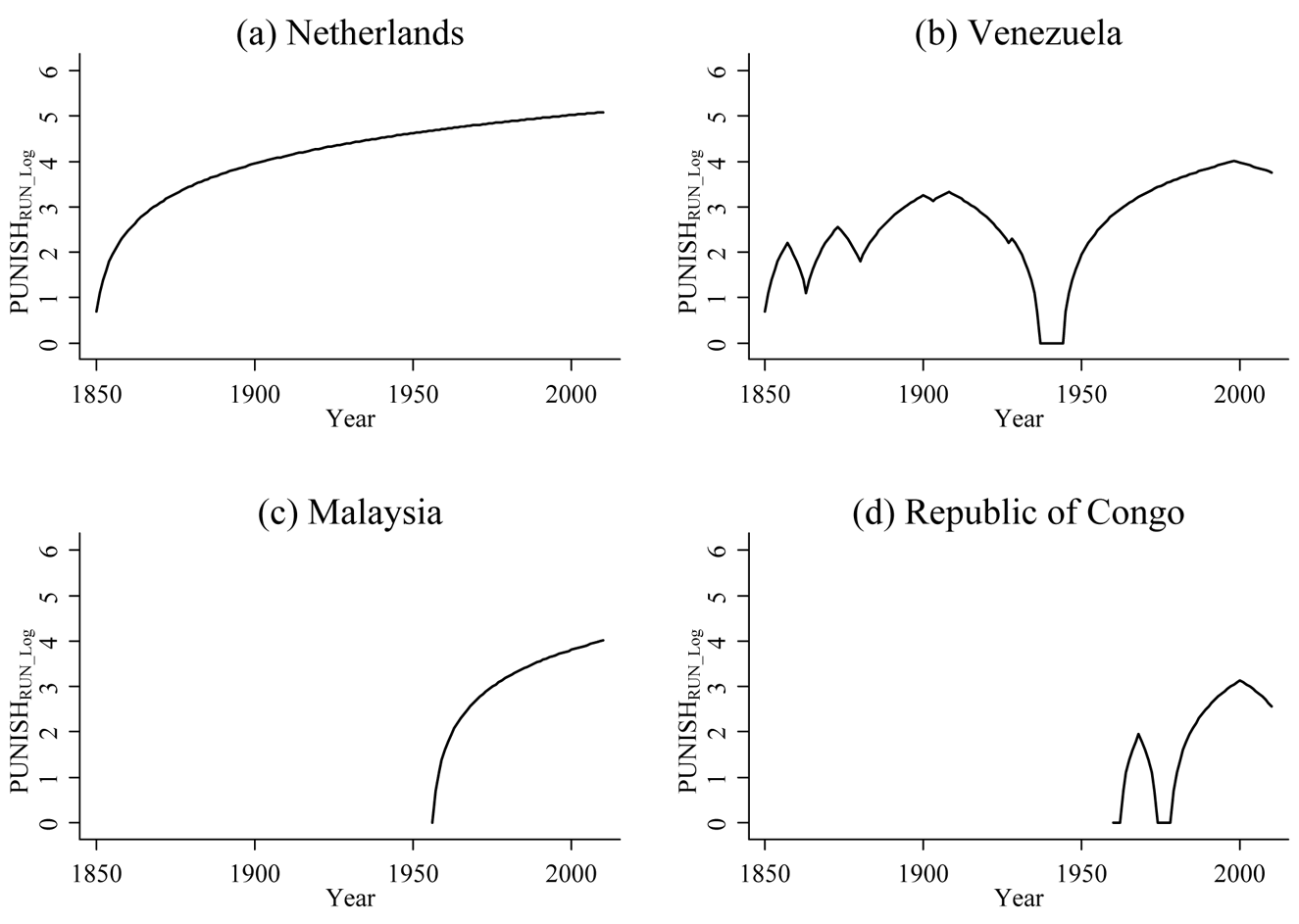
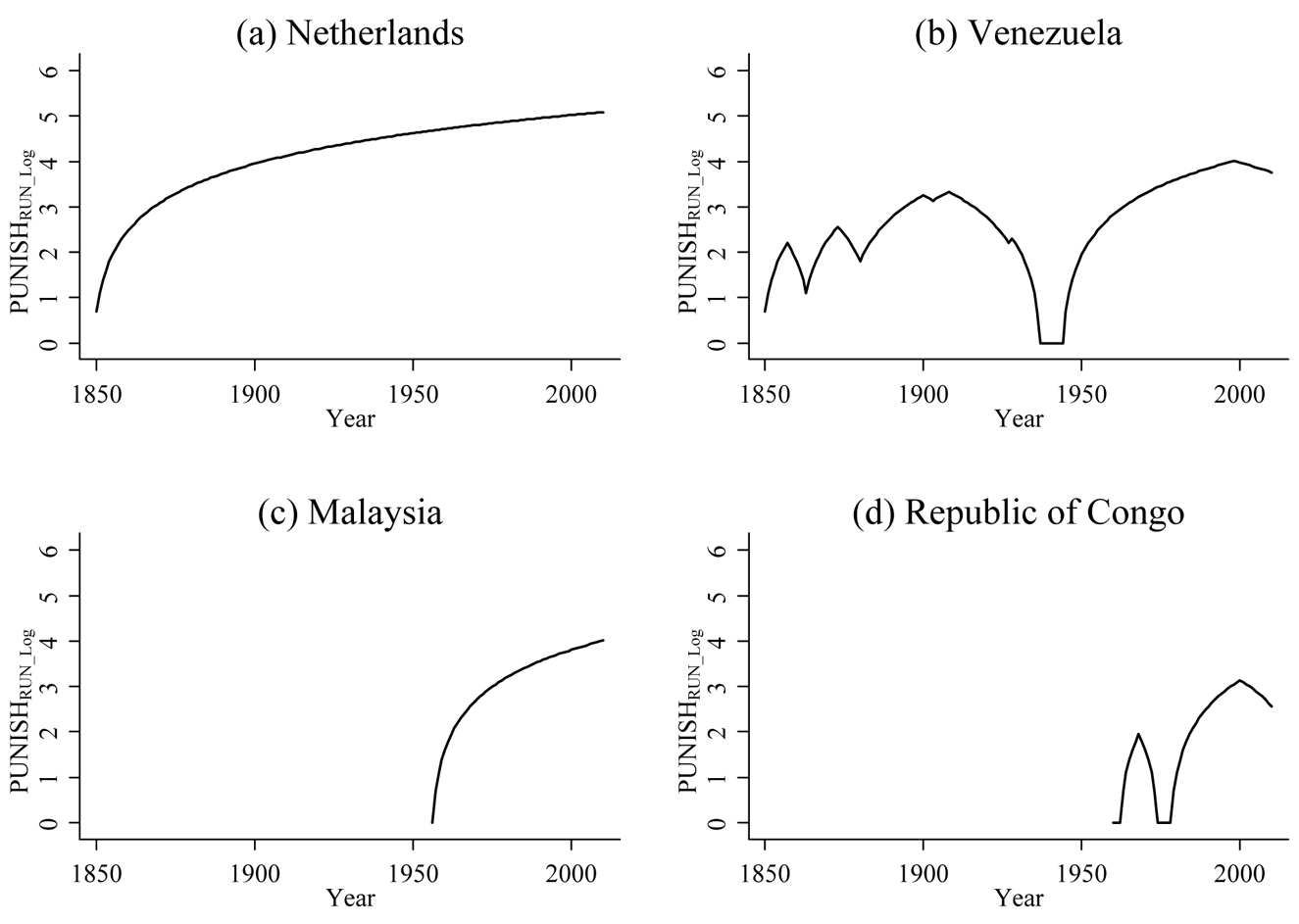
A logarithmic transformation is performed on the 10 run variables to reflect the fact that diminishing returns are likely to occur over time and that a sustained constitutional commitment to a legal principle likely has residual effects even after it is revoked. Figure 3 illustrates the effect of this transformation by depicting the distribution of PUNISHRUN_LOG for four countries that evidence different historical patterns. The Netherlands has a long-term commitment to the principle of nulla poena sine lege. Correspondingly, the distribution of its values for PUNISHRUN_LOG shows a slow continuous rise that levels off at around 5. Venezuela has a long-term familiarity with this principle, but its history evidences several regressions; its values for PUNISHRUN_LOG fluctuate between 1 and 3 for most of the latter part of the 19th century, then begin a long decline, reaching zero in 1937. Reembracing this principle in 1945 leads to a steady increase until it is revoked again in 1991; its highest value for PUNISHRUN_LOG is 4 (1998). Malaysia is a relatively new nation with a continuous commitment to nulla poena sine lege; its trend line is similar to Netherlands, except its value is 4 in 2010, a full point below the Netherlands. The Republic of Congo is also a new country, but its commitment to the principle has wavered over time, as do its values for PUNISHRUN_LOG, which never get much above 3.
Distribution of logged PUNISHRUN for selected countries
Constructing a Composite Measure of the Formal Commitment to a Law-Based Order
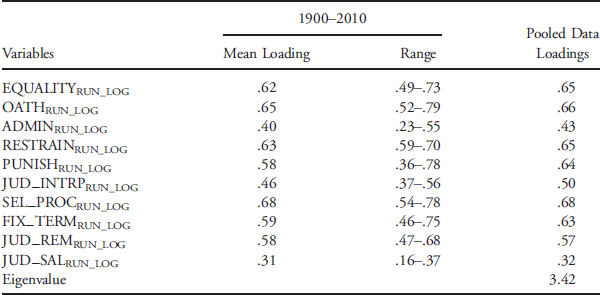
The final step in the measurement procedure entails integrating these 10 “run” variables into a composite variable, LEGALORDER. As noted above, this is an important, but often overlooked, component of the measurement process. After a review of several alternatives, the integration procedure employed was a factor analysis employing all 10 variables. This approach involves the fewest assumptions about relative weights and provides a strong test of the unidimensionality of the variables. To check the temporal stability of the factor analysis, it was done at 10-year intervals, from 1850 to 2010. While the structure of the analysis is consistently one dimensional across this period, the factor loadings vary somewhat across time, particularly during the 19th century. Thus, to construct the composite measure, we conducted the final factor analysis using only the data from 1900 to the present.Footnote 4 Table 3 reports selected statistics for the factor loadings (mean, range, pooled). The pooled factor loadings, which are very similar to the mean loadings, were used to create the composite measure, thus insuring that any changes in factor scores are due to changes in the values of the variables. To facilitate quantitative analyses, LEGALORDER was rescaled so that the smallest value is 1; it has a range of 1 to 5, a mean of 3.01, and a standard deviation of 0.95.
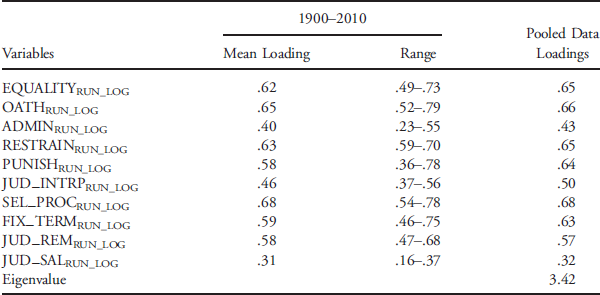
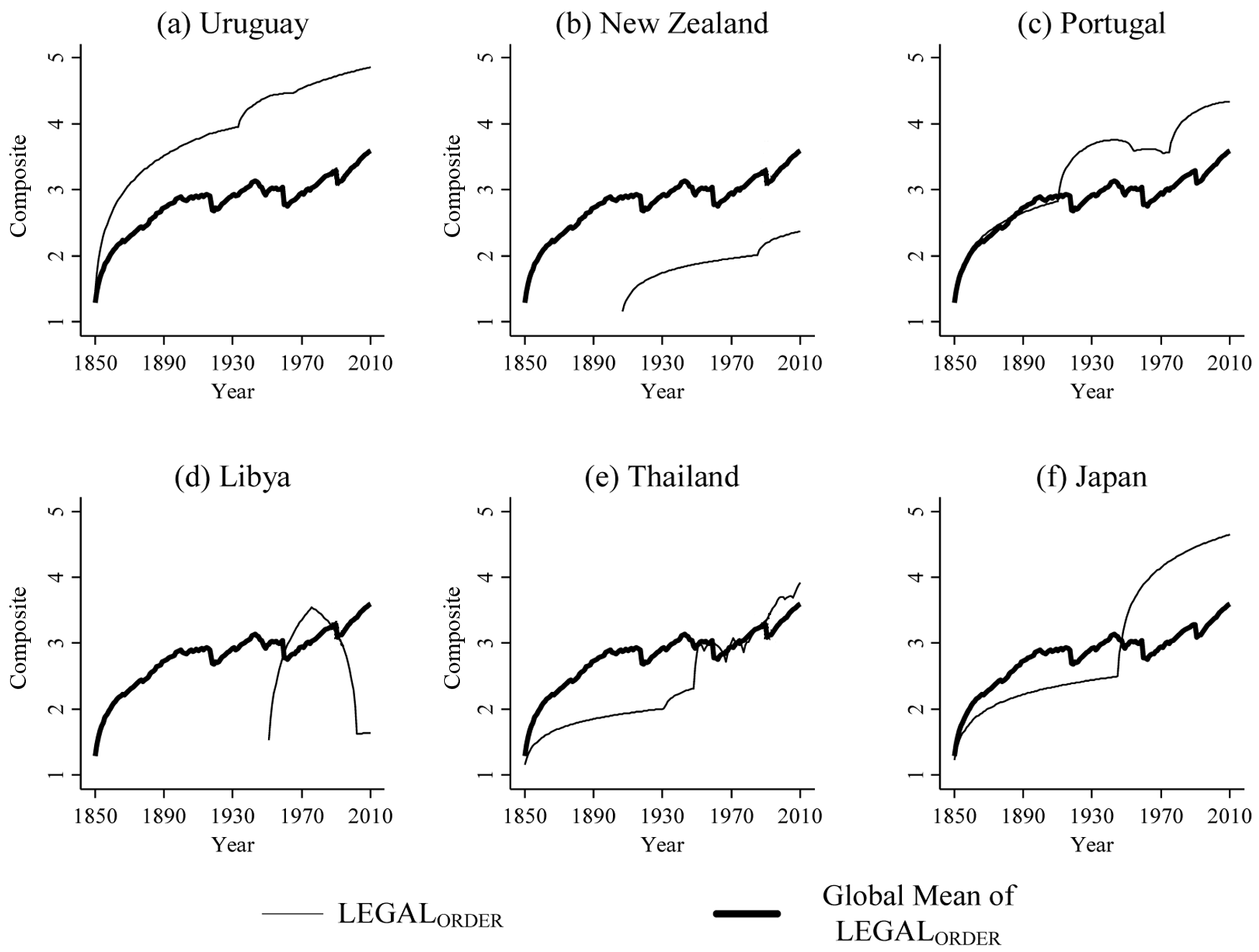
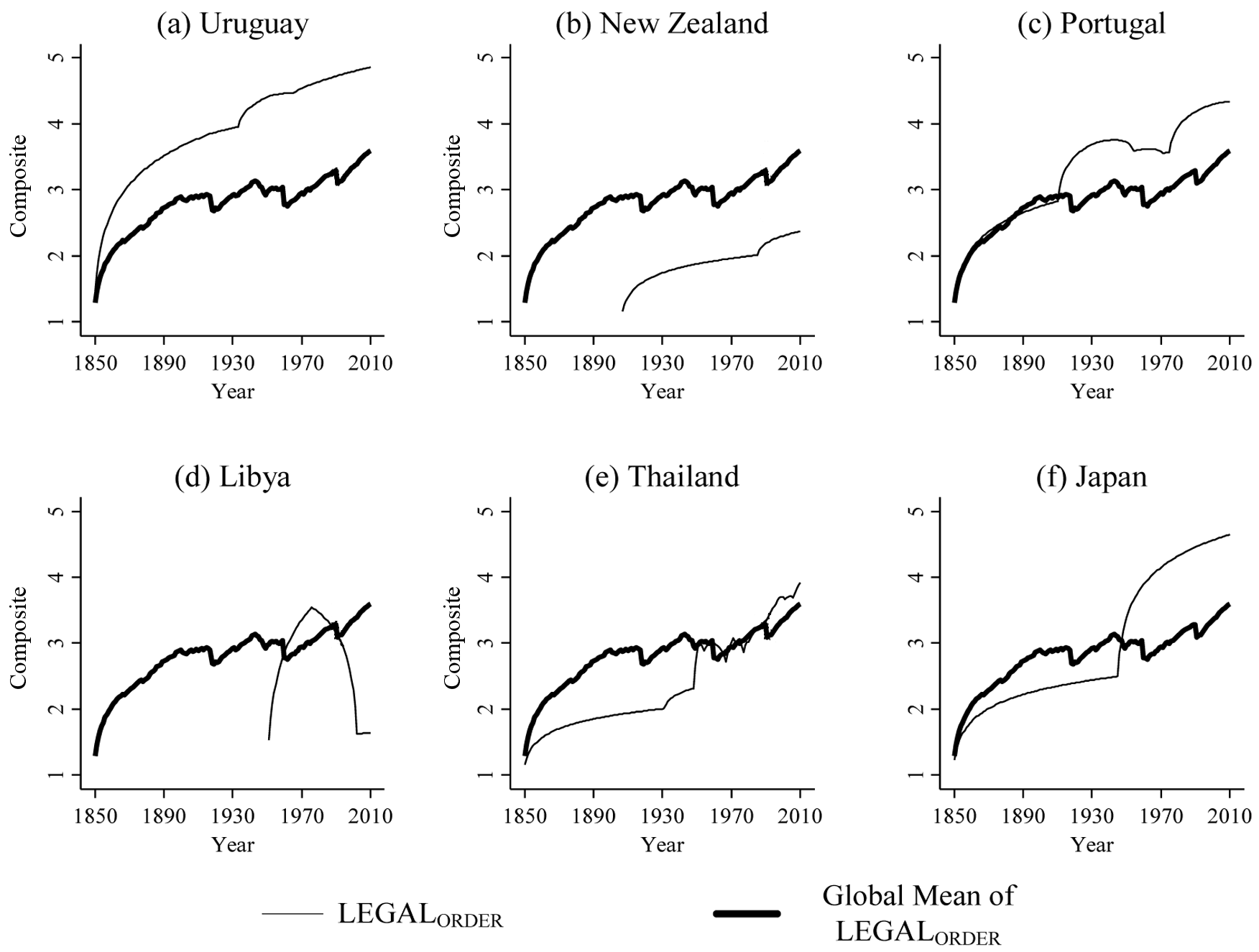
Figure 4(a–f) illustrates the distribution of LEGALORDER over the post-1850 period for a handful of countries;Footnote 5 the global mean for LEGALORDER is also displayed. Uruguay illustrates how an early formal commitment to a law-based order is captured. Its trend line demonstrates a steady rise that generates a substantial gap between its values and the global mean that only begins to get smaller after the widespread constitutional reforms of the 1990s. In contrast, New Zealand has a relatively weak constitutional commitment; it never gets much above a 2 and is always well below the global mean. Portugal is an example of a country that mirrors the global mean until the 1920 and then surpasses it. Libya shows a strong commitment to a law-based order for several decades after its independence, followed by a marked and sustained regression during the Kaddafi era. Post-Kaddafi reforms could generate a renewed commitment to a legal order, as countries such as Thailand and Japan have done in the past. After much ambivalence to a law-based order early in its history and many legal regressions, by 1970 Thailand hovers around the global mean for the next four decades. Japan is consistently below the global mean before the end of World War II. Its postwar constitution initiated a trajectory that placed it well above the mean by the late 1960s.
Evolution of LEGALORDER for selected countries
Legal Infrastructures: Constructing LEGALINFRA
The concept of a legal infrastructure refers to a set of entities and processes that are essential to the creation, development, and operation of a viable legal order. Infrastructures include such things as legal educational programs, vehicles to conduct formalized legal discourse, and bodies that regulate legal professionals. Legal infrastructures are the result of spontaneous and diffuse behaviors of diverse actors over many decades. Indeed, because the design and operation of their components has evolved over time, it is more useful to think of legal infrastructures as “emerging” rather than being “created.” In addition to enhancing the institutionalization of a society’s legal sector, legal infrastructures are vital to the realization of legal ideals: they contribute to the development and dissemination of the basic tenets of legal reasoning and procedures. Correspondingly, the state of a country’s legal infrastructure can provide important insights into cross-national and intertemporal differences in law-based orders, ones that can complement those provided by the analysis of formal constitutional commitments.
Incorporating a temporal dimension into LEGALINFRA is as important as it was for LEGALORDER. Instituting a new legal journal will not revolutionize legal thought with its first volume; creating an official disciplinary committee will not eliminate corrupt lawyers—or properly incentivize legal actors—as soon as it is staffed. Establishing a program of legal education requires hiring faculty, developing curriculum, building facilities, and so forth. Moreover, it takes years to train students; it will take even longer for them to have a meaningful impact on the legal system. More importantly, there are feedback loops that shape the evolution of infrastructures over time. Where law emerges as a vital societal force there will be an increased demand for more legal discourse and more individuals will be trained in legal matters. Where law does not play such a vital role, the demand for the services that a legal infrastructure provides will be stagnant or decline—as will its infrastructure. Viewing legal infrastructures statically fails to capture these feedback mechanisms. It would be inappropriate, for example, to equate a country with three law schools that have been open for 2 years with one that has three law schools that have been operating for decades.
Because developing legal infrastructure measures for 165 nations over an extended period of time is challenging, we focused our efforts on two key components: mechanisms that provide for formalized legal discourse (i.e., legal periodicals) and legal education programs. Data were most readily available for these components, and, based on the results presented below, it is unlikely that adding further dimensions would contribute much to the final measure. The data used to construct LEGALINFRA were derived from two of SID’s thematic projects: the Legal Periodicals Project and the Legal Education Project. Each project is summarized below; then the procedures used to integrate the data into a legal infrastructure measure are reported. Finally, some illustrative data are presented.
The Legal Periodicals Project
In contemporary societies, formalized legal discourse is conducted mainly within legal periodicals. A systematic examination of legal periodicals can provide useful insights into the extent to which a nation has institutionalized a law-based order because, where law is central to the structuring of human intercourse, there will be a demand for legal discourse. This demand is rooted in the need to (1) know what the law is, (2) keep abreast of legal changes, (3) maintain active and spirited exchanges on existing laws and legal doctrines, and (4) provide the intellectual footings for new legal provisions and doctrines. In healthy law-based societies, these demands will be met by a diverse set of actors and outlets. Over time, free and far-ranging dialogues that duel over competing perspectives on legal matters will contribute much to the creation of a viable legal order. Open and sustained dialogues contribute to the instilling of cultural norms and values that sustain a law-based order. These dialogues also provide the fodder for the law to evolve in ways that ensure it remains relevant to societies that are continually adapting to external and internal forces. Indeed, a rich supply of legal discourse is an important source of the claim that law is an independent societal force, one that shapes—rather than reflects—the behavior of powerful elites. In societies where party dictates or cultural norms structure human intercourse, both the demand for—and the supply of—legal discourse will be considerably less. While isolated entities (governmental entities, party organs) may routinely generate legal discourse even where law is not an independent societal force, the mix and density of this discourse—as well as the diversity of actors supplying it—will be much less.
An ideal measure of formalized legal discourse would include a well-designed and carefully implemented content analysis of articles that appeared in legal periodicals, as well as information on their authors. However, because tens of thousands of legal periodicals exist in scores of different languages—some dating to the latter part of the 18th century—such a task is, to say the least, formidable and well beyond the reach of this effort. This notwithstanding, it is possible to develop a serviceable indicator of legal discourse—and one with a temporal dimension—by focusing on the density, mix, and duration of legal periodicals within a country.
Density refers to the number of legal periodicals operating within a country during a given year; to be a useful cross-national indicator, density variables must be standardized to take into account differences in population sizes. The mix of legal periodicals relates to the diversity of legal publications operating within a country in a given year. This is an important discourse indicator because legal periodicals differ in ways that provide important insights into the state of a legal order. Some are scholarly legal journals that explore doctrinal issues; others are practitioner-oriented digests that summarize legal developments. Some of these publications will have a more general orientation, whereas others are specialized. More mature legal orders will have a more diverse set of legal periodicals. As law moves from an esoteric academic concern to a force in human affairs, there will be a demand for legal information by practitioners who must negotiate the myriad situations that arise within the lives of their clients. This will give rise to demands for publications that provide straightforward and succinct summaries of current laws and legal developments. As law becomes more integral to a wider range of human activities, there will be a greater need to address the type of idiosyncratic legal issues that arise in those realms of activity. This will generate demands for more specialized periodicals.
Duration refers to the length of time a periodical has been published; it provides the temporal dimension to the periodicals data. The emergence of a new legal periodical may be a positive development, but it will take years for its effects to be felt, if they are realized at all. Thus, a journal that collapses within a year of its inception is not likely to make much of a ripple. In contrast, long runs of periodicals can provide the basis for continuous waves of insights into legal matters. Moreover, a long tradition of diverse legal periodicals suggests that (1) there is a durable demand for them and (2) this demand has been met by an institutionalized supply of legal discourse. The existence of long runs of a large number of diverse legal publications makes possible the type of extended legal dialogues that are needed to develop viable legal doctrines and provide for the cumulative development of a useful body of legal knowledge. This type of evolving knowledge base can provide the basis for a viable legal order in complex, evolving societies—as well as aid those charged with implementing that order.
A multistage process was required to capture data on the density, mix, and duration of legal periodicals. These stages include assembling a global and historical list of legal periodicals, translating titles into English, screening and classifying the entries, estimating missing values, and creating density and duration variables for the various types of journals.Footnote 6 Implementation led to the analysis of over 45,000 legal periodicals and thecreation of density and duration variables for four categories of publications. These categories include (1) general scholarly journals (GSJ), (2) general legal digests (GLD), (3) specialized scholarly journals (SSJ), and (4) specialized legal digests (SLD). The corresponding variables are DENSITYGSJ, DENSITYGLD, DENSITYSSJ, DENSITYSLD DURATIONGSJ, DURATIONGLD, DURATIONSSJ, and DURATIONSLD.
The four density variables simply depict the number of active periodicals in each category for a country in a given year. The values of these variables would be unchanged until a new legal periodical was created or an existing one ceased to publish. In contrast, the four duration variables are cumulative measures that reflect the total number of “periodical-years” for a given country. To illustrate the coding of the duration variables, consider a country that had never had a general scholarly journal before 1871. The value of DURATIONGSJ for that country in 1871 (and every year before 1871 that it was an independent country) would be zero. If a single general scholarly journal began publishing during 1871, the country’s value for DURATIONGSJ in 1872 would be 1, its value in 1873 would be 2, its value in 1874 would be 3, and so forth. If a second general scholarly journal began publishing in 1874, the value of DURATIONGSJ would be 5 in 1875, as long as the first journal continued to operate. Once a journal ceases operations its contributions to the duration measure end— unless it begins publishing again in the future.
Figure 5 displays the distribution of the duration variables for four countries (Italy, Brazil, China, and Nigeria).Footnote 7 Figure 5 provides several insights. The first is that a good deal of variance exists in start dates for different periodicals. Italy is the first to begin publishing, beginning in 1846 with a specialized scholarly journal. While this ranks first among the four countries depicted in figure 5, it is considerably later than the 1771 appearance of a generalized legal digest in the United Kingdom. Italy added a specialized legal digest in 1848, a general legal digest in 1859, and a general scholarly journal in 1867. In contrast, Brazil began publishing a general scholarly journal and a legal digest in 1872. A specialized Brazilian scholarly journal does not appear until 1903, followed by a specialized legal digest in 1929. China begins with a general legal digest in 1904 and two general scholarly journals in 1905; a specialized Chinese academic journal first appears in 1932; its first specialized legal digest begins in 1955. Nigeria publishes its first general legal digest in 1910, and a general scholarly journal does not appear until 1945. Nigeria’s first specialized scholarly journal appears in 1965; specialized legal digests do not appear until 1979.
Scholarly legal journals and legal digests for selected countries, 1772–2007
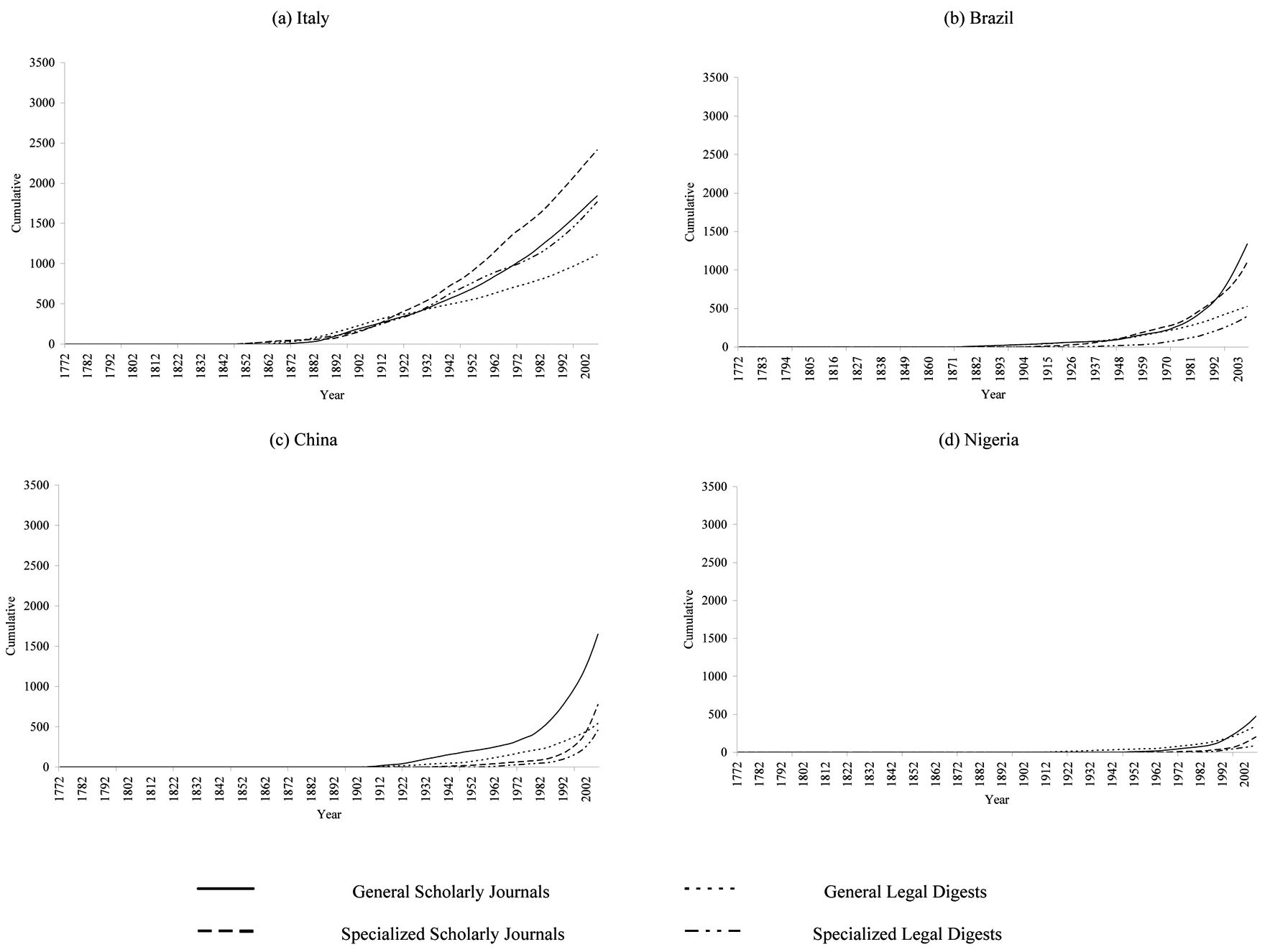
It is not possible to use the raw data for the density and duration variables for several reasons; two are most important. The first is that the differences in population sizes for the 165 SID countries are simply too great to make meaningful cross-national comparisons using the raw data. But taking population difference into account by simply creating per capita versions of the legal periodical variables is suboptimal: these periodicals are “consumed” by only a small portion of the population. To overcome the issues with per capitization, we standardized the density and duration variables by population grouping. To illustrate, consider the procedure used to standardize the density measures. The four density variables (DENSITYGSJ, DENSITYGLD, DENSITYSSJ, and DENSITYSLD) were aggregated to create a variable that depicted the total number of legal periodicals in a country by year. The distribution of this variable was examined by various subsets (quartiles, quintiles, etc.) of a nation’s population that was between the ages of 25 and 65. T-tests for the differences in the means across these subgroups were conducted and examined for every decade. It was determined that dividing the ages 25–65 population into quartiles produced the most consistent statistically significant differences across group means. Thus, we divided the countries into population quartiles and standardized the periodical variables by the quartile mean; a country’s value on each variable reflects its deviation from its group mean. The same procedure was used to standardize the duration variables.Footnote 8
The second issue with the raw data has to do with diminishing returns from the proliferation of legal periodicals. At some point, the effect of adding additional periodicals contributes very little to the tenor of legal discourse. Thus, a log transformation was performed on the standardized periodical variables, leading to the creation of eight transformed periodical variables: DENSITYGSJ_LOG, DENSITYGLD_LOG, DENSITYSSJ_LOG, DENSITYSLD_LOG,, DURATIONGSJ_LOG, DURATIONGLD_LOG, DURATIONSSJ_LOG, and DURATIONSLD_LOG.
The Legal Education Project
A law-based order in the 20th century is inconceivable without a system of education to train and socialize lawyers. Like the data on legal periodicals, the priority that a country attaches to legal education (reflected in facilities, curricular development, faculty, enrollments, etc.) can be a useful unobtrusive indicator of the role of law in its social order. While such refined indicators were impossible to collect for the time frame and number of countries being studied here, it was possible to collect information on the number of law schools that operated within a country in a given year since the beginning of formal legal education. The Legal Education Project was a multistage, multiyear effort structured to (1) identify comprehensive listings of legal education programs, (2) extract data on dates of operation, (3) secure missing data on operating dates, and (4) create density and duration variables.
We identified a number of sources that provided global lists of legal education programs to compile a comprehensive master list; we accepted the criteria used by the sources for inclusion as a program of legal education. These sources included The World of Learning (1947, 1948, 1954, and 2004), The Law Schools of the World (1977), and World’s Universities (1939). Also used was a website (http://www.hg.org/schools.html) that contains data on current legal education programs. For each program identified, we sought data on their operating dates. After completing the master list, we pursued missing data on operating dates. These data were collected by conducting website searches, e-mails, and telephone calls by native language speakers.Footnote 9 These efforts added 124 missing dates and resulted in good data on operating dates for 2,015 of 2,244 programs on the master list (89.8%). We used information on when a program first appeared in the World of Learning series to estimate start dates for scores of additional programs. As a result, we had operating dates for 98.6% of the programs on our master list (2,193 legal education programs in 165 countries); data were missing for only 31 programs.Footnote 10 Fifteen countries had no identifiable programs.Footnote 11
We used the data on legal education programs to construct two variables that paralleled those developed with the legal periodicals data. One was a density variable that reflected the number of legal education programs that operated within a country during a given year; the other was a duration variable that was a cumulative measure reflecting the total number of “legal education program-years.” The distribution of these variables parallels those for the legal periodical variables, and the raw legal education variables suffer from the same interpretation issues (i.e., they are not meaningful without standardizing them for population differences and using a logarithmic transformation to address diminishing effects). To implement these transformations, we used an approach similar to that used with respect to the legal periodical variables.Footnote 12 The result of these operations is two transformed legal education variables (DENSITYLE_LOG and DURATIONLE_LOG).
Legal Infrastructure Scale Construction
To construct a composite legal infrastructure variable, we followed a procedure similar to that used to construct the legal order composite. A factor analysis was performed at 10-year intervals between 1850 and 2000 using the transformed values of the eight legal periodical variables and the two legal education variables. The structure of the data was somewhat unstable in the 19th century.Footnote 13 Thus, to construct the composite measure, we conducted the final factor analysis using only the data from 1900 to the present. These analyses showed that the data are one dimensional with very high loadings on all 10 variables. Table 4 contains pertinent data on the factor analysis. The pooled factor loadings, which are very similar to the mean loadings, were used to create the composite measure (LEGALINFRA). The composite measure is rescaled so the smallest value is 1; it has a range of 1 to 7, a mean of 2.46, and a standard deviation of 0.94.
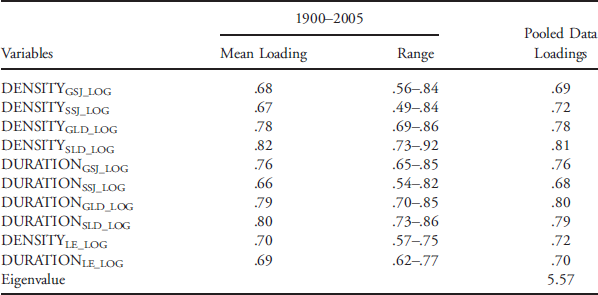
Figure 6 (parts a–f) illustrates the distribution of LEGALINFRA for the 1850–2010 period for a handful of countries;Footnote 14 the global mean for LEGALINFRA is also displayed. Morocco provides an example of a country that begins the period very close to the global mean but then increasingly lags behind it over time. In contrast, Denmark begins the period somewhat above the global mean but then converges toward it over time. France and Turkey are mirror images of each other: France begins well above the global mean and maintains its advantage; Turkey begins well below the global mean and remains there. Finally, South Korea illustrates an example of a new nation that converges on the global mean quickly and maintains its position over time; Australia is already above the global mean at the time of independence and moves well beyond it over time.
Distribution of LEGALINFRA variable for selected countries
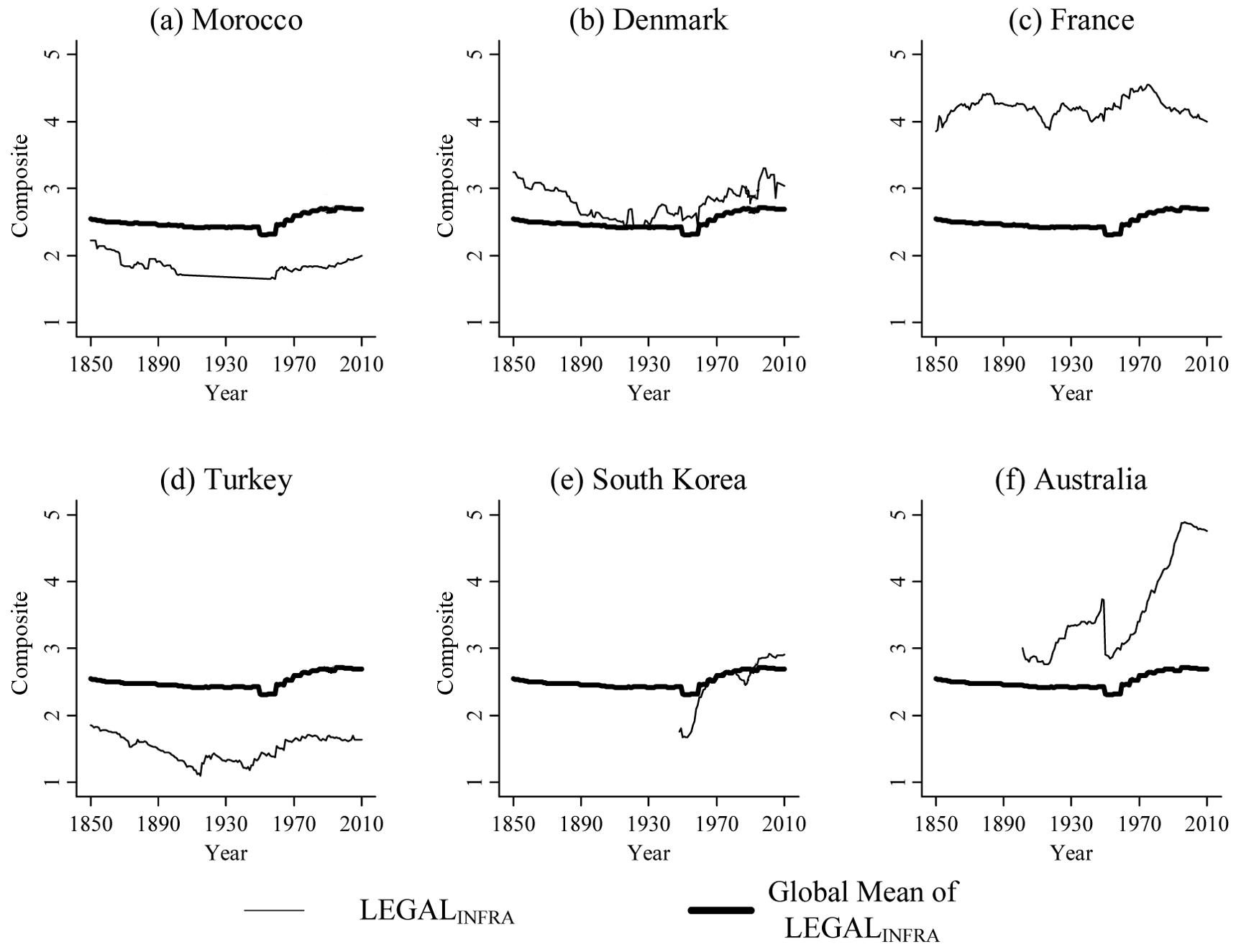
Insights into Commitments to a Law-Based Order: Comparing LEGALORDER and LEGALINFRA
Because the rule of law is an aspirational ideal, the objective in creating LEGALORDER and LEGALINFRA was to gauge the relative extent to which a law-based order has been created. To achieve this objective, we studied a large number of countries over an extended time frame using two very different approaches. These approaches asked different questions and employed different data, but they used data collection procedures that were comparable across countries and time. LEGALORDER captures the extent to which nation-builders attempted to institutionalize a legal order, largely by enshrining key ideals and principles into their national constitutions. In contrast, LEGALINFRA is an unobtrusive measure of developments initiated by a plethora of largely nonstate actors. These developments reflect the degree to which law has evolved into a relevant and independent societal force.
Given the objectives of this effort, it is appropriate to ask whether these two measures yield comparable insights into a country’s efforts to institutionalize a law-based order. In other words, if a country scored relatively highly on LEGALORDER at a given point in time, did it also score relatively highly on LEGALINFRA? If most countries evidence comparable profiles on these variables throughout much of their history, it would bolster confidence in them as a tool for advancing our understanding of law and society. Country-specific historical distributions of these measures are not likely to be identical because the measures were designed to capture different dimensions of a legal order, dimensions that are driven by different actors and forces. This notwithstanding, the historical distribution of these variables should provide reinforcing profiles of a country’s commitment to a legal order.
To gauge, in an efficient and methodologically sound manner, the extent to which LEGALORDER and LEGALINFRA provide reinforcing historical profiles, the following approach was used. Both measures were standardized by year; then a difference variable was calculated (LEGALDIF = LEGALORDER − LEGALINFRA). It captures the difference in the relative standing of a country, in a given year, on the LEGALORDER and LEGALINFRA scales; countries whose relative standing on LEGALORDER was greater than its relative standing on LEGALINFRA would receive positive scores on the difference variable, and vice versa. More importantly, because the difference variable was calculated as the difference between two standardized variables, an absolute value on LEGALDIF of greater than or equal to 2 for a country in a given year would indicate that there was a statistically significant difference between its LEGALORDER and LEGALINFRA scores. Sustained periods of such differences for a substantial number of countries would undermine the contention that the LEGALORDER and LEGALINFRA variables yielded reinforcing historical profiles.
To begin the analysis of the LEGALDIF variable, we examined the total number of country-years since 1850 with an absolute value of 2 or greater. There were 1,223 such country-years, 9% of all country-years. One would think that most of these would be examples of countries whose LEGALORDER scores exceeded their LEGALINFRA scores, as it would seem to be a simpler matter to generate a “rule of law” façade through toothless constitutional provisions than for formidable legal infrastructures to emerge. But just the opposite is true: the vast majority of the 1,223 country-years (1,030, 84%) have negative LEGALDIF scores, indicating that their relative standing on LEGALINFRA exceeds their relative standing on LEGALORDER. Moreover, 92% of the scores that were less than or equal to −2 occurred in 12 countries: Switzerland (159), Canada (144), United States (144), France (132), New Zealand (102), Uruguay (61), Republic of Congo (46), Israel (45), German Federal Republic (33), Norway (32), Ireland (23), and the Netherlands (23). With respect to country-years with scores greater than or equal to 2, 73% occurred in three countries: Nicaragua (66), Turkey (43), and Brazil (31). Thus, large and sustained disjunctures between LEGALORDER and LEGALINFRA occurred in only 15 of 165 countries (9%), suggesting that for most countries, most of the time, these measures yield reinforcing historical profiles.
Table 5 presents some country-specific data on the difference variable that provide additional historical insights into the joint distribution of LEGALORDER and LEGALINFRA. The average within-country standard deviation for the 165 countries is .43; the means can be classified within one of five categories: 10% (16) had a mean of −1.5 or less; 21% (35) had a mean above −1.5 but below −.5; 40% (66) had a mean between −.5 and .5; 26% (43) had a mean above .5 but below 1.5; and 3% (5) had a mean that was 1.5 or above. Figure 7 (parts a–f) illustrates the distribution of LEGALDIF for representative countries within each of these categories. Canada, for example, illustrates a country with an exceptionally low value on LEGALDIF (−3.01) and a relatively low standard deviation (.33). As seen in figure 7(a), Canada’s difference score is always below −2 and relatively stable. In contrast, the United States is an example of a country with a relatively low mean value of the difference variable (−1.28) and a relatively high standard deviation (1.13). As figure 7(b) illustrates, the reason for the high standard deviation is that, since the end of the 19th century, the pace of change in the United States’ legal infrastructure has exceeded that of its constitutional framework, which has remained largely stable.
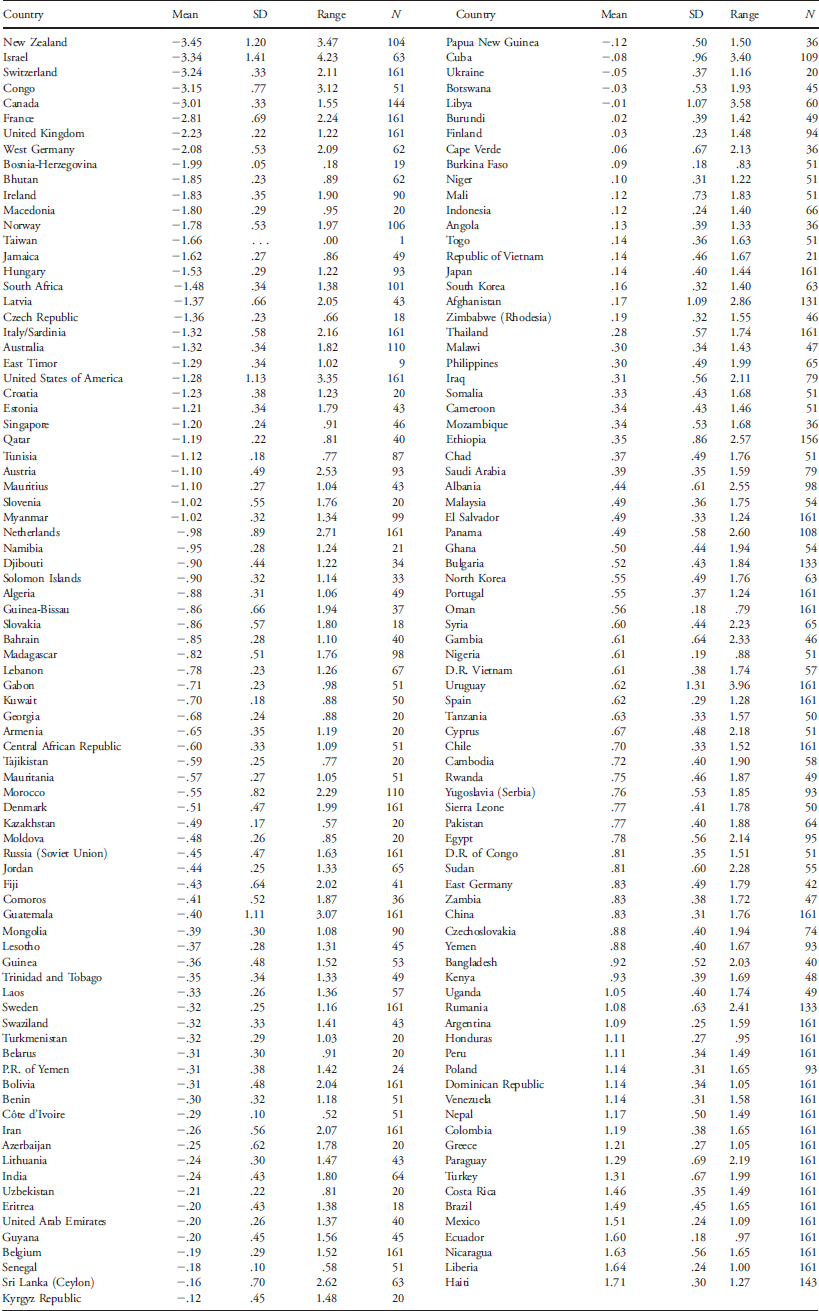
LEGALDIF measures for selected countries
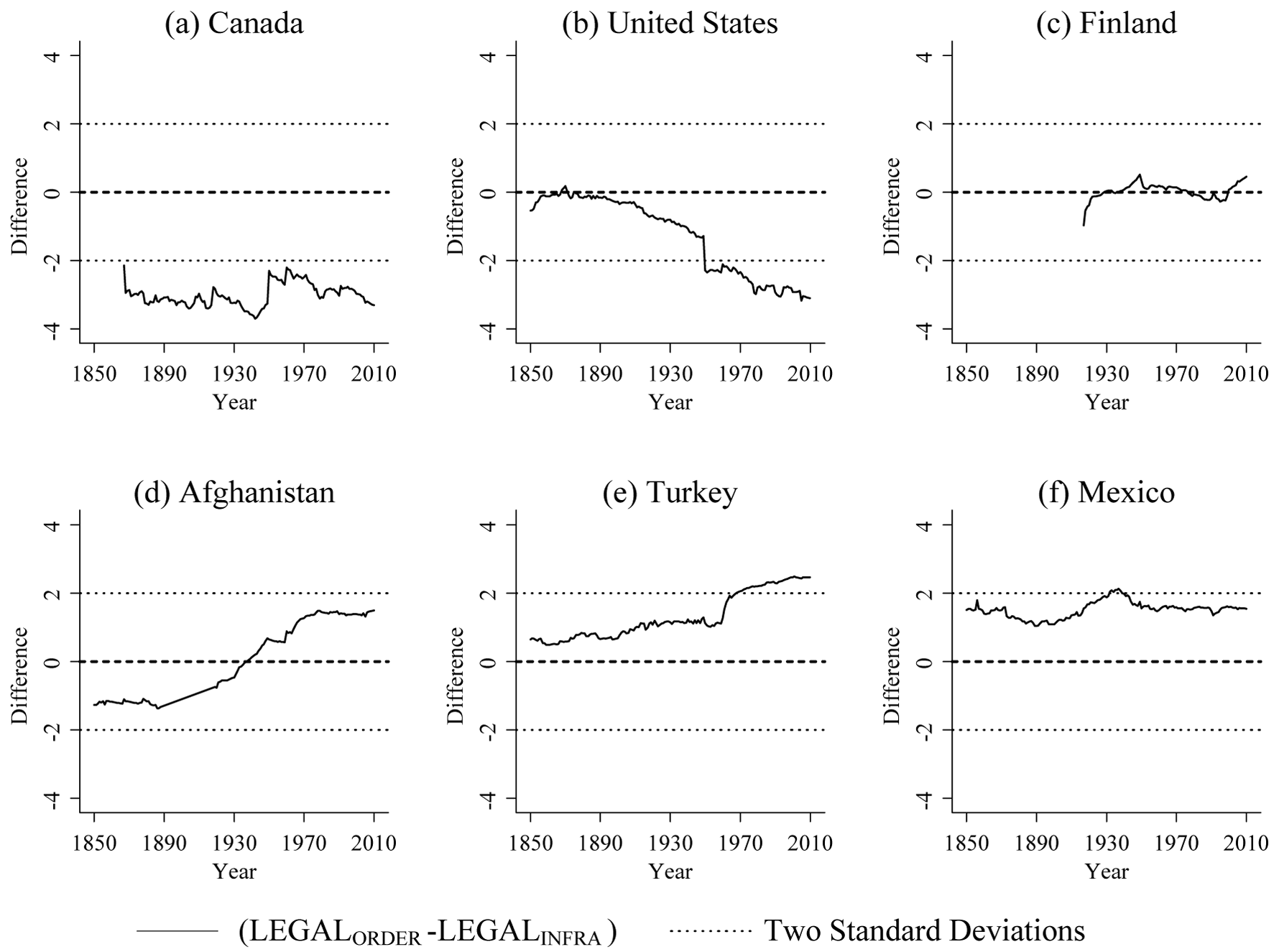
Finland and Afghanistan represent countries with mean values on the difference variable that are relatively close to zero (.03 and .17, respectively) but with markedly different standard deviations (.23, 1.09). As seen in figure 7 (parts c and d), while Finland hovers around the y-axis throughout its independent history, the values of LEGALDIF for Afghanistan evidence a steady upward trend for much of the period after the close of the 19th century. Turkey illustrates a country with a moderately high value of LEGALDIF (1.31) and a modestly high standard deviation (.67). What drives the greater variation in Turkey’s LEGALDIF scores are some constitutional reforms in the post-1960s that outstripped its infrastructure growth, as seen in figure 7(e). Finally, Mexico, as seen in figure 7(f), illustrates a country with relatively high mean value on LEGALDIF (1.51) and a relatively low standard deviation (.24). Mexico’s formal commitment to a legal order has always exceeded its infrastructure development, but not in a statistically meaningful way.
Using the five-category breakdown introduced above, fig. A1 depicts the geographic distribution of the country-specific mean values for LEGALDIF; it generates some noteworthy observations. Perhaps the most important is that most of the countries with relatively advanced legal infrastructures fall within North America and Western Europe, as well as Australia and New Zealand. In contrast, most of the countries with somewhat higher formal commitments to a legal order fall within Latin America, segments of Central Africa, and Southern and Eastern Europe, as well as China and Pakistan. Most of Asia and Africa show relatively balanced formal commitments and infrastructure developments.
Summary
Since the 1990s, the rule of law has emerged as an increasingly important concept with global appeal, one that is central to a governing strategy that is at the core of many international aid programs. It is also an ancient concept that has been appropriated over time by a range of users who have muddied its meaning and generated much ambiguity as to its core components. This ambiguity has impeded the efforts of those have tried to create an empirical knowledge base concerning law’s societal role, one that could aid both those charged with administering international aid programs and their beneficiaries. This article has attempted to advance these efforts by unpacking the various ideas associated with the rule of law and reassembling them into a more coherent framework. While the SID framework is simply an initial attempt to reconceptualize these ideas—one that will hopefully generate on-going refinements—it has proven useful in identifying shortcomings in existing rule of law gauges. The SID framework was also useful in structuring the design of several major research projects that generated original data that were used to construct two new cross-national rule of law measures: LEGALORDER and LEGALINFRA.
While these measures share some of the same shortcomings of earlier measures, confidence in them is bolstered by the results of the factor analyses that were used to construct them, as well as the analysis of the LEGALDIF variable. The factor analyses showed an impressive degree of consistency among diverse sets of variables across a heterogeneous set of countries over a lengthy time frame. The analysis of the difference variable showed that the two composite variables provide largely reinforcing profiles of a country’s commitment to a legal order. Moreover, these variables have already proven useful in empirical applications in two different domains (economic growth, civil unrest). Their utility will undoubtedly be tested by applications to other areas (e.g., political stability, state repression, and democratization) by other scholars.
Just as important as extending these measures to other applications is developing additional measures to fill the conceptual gaps left by LEGALORDER and LEGALINFRA. For example, work needs to be done with respect to instrumental principles other than judicial independence (e.g., procedural safeguards amd legal reasoning) as well as the differential criteria that derive from the work of Hart and Fuller. It would also be useful to create de facto measures of legal equality and supremacy, perhaps from global event data. Finally, it is unlikely that major advances in our understanding of the societal role of law will be generated until efforts are made to join measures of legal regimes with measures of legal orders. Clarity in the societal role of law will not be achieved until we understand what desiderata are trying to be achieved through a law-based order.