On questions of race and racism, scholars of urban life in the Americas often segregate our hemisphere along lines of the national and the transnational, cities of the past and cities of the future. We have, on the one hand, cities of the American century. People built and maintained these in explicit terms of ‘black’ and ‘white’, using a combination of racialized zoning, restrictive covenants, violent residential protectionism and discriminatory housing policies and lending practices. On the other hand, we have North America's great global centres – twenty-first-century metropolises like Los Angeles, New York or Miami, decades removed from the seeming failures of New-Deal-era growth economics or the overt discriminations of the previous century. These cities hold promises of racial ‘diversity’ and stand as glittering stops along fast-moving circuits of capital, labour and technological innovation, all increasingly unbound by and untethered to state mechanisms of nation-building.Footnote 1 In short, the history of the colour line, quite ironically, now serves as the temporal fault line between two very different scholarly treatments of the city. And yet, when we collapse the history of the segregated American city into the making of the global city, race and racial segregation become bridges, not barriers, between cities past and future. Segregation itself becomes a kind of technology, one under constant innovation and responsible in no small way for the latter-day flowering of the transnational metropolis.Footnote 2
This article uses the history of Greater Miami between the 1910s and 1950s to offer a view of race and the work it performed for the burgeoning global city in North America.Footnote 3 Rather than start my treatment of a global Miami with the typical transnational marker, the 1959 Cuban Revolution, I argue it was during the most blatant years of legal and extralegal racial segregation – the so-called ‘Age of Jim Crow’ – that South Floridians used race to build Miami into a city of multinational significance.Footnote 4 I argue, moreover, that race itself functioned as a kind of technology of profit and demographic control. And as such, it worked in tandem with other twentieth-century innovations to help human hands construct Miami as a city at once global and incurably bi-racial.
Technology, by definition, is the application of scientific knowledge for practical purposes. Thus, in calling racial segregation ‘technology’, I seek to echo Barbara J. Fields’ simple yet profound distinction between what scholars typically call ‘race’ – that which mostly ‘blacks’ seem to have – and racism – which is something people do, a practical application of racial knowledge.Footnote 5 Unique to neither Miami nor the twentieth century, technologies of racism in the Americas have changed and continue to change over time – sometimes in cities, sometimes in the countryside, but always in direct response to human needs and desires. In mid-nineteenth-century New York, for instance, myths of black inferiority empowered competing factions of white politicians to disenfranchise free ‘negro’ or ‘mulatto’ voters who would have otherwise had the power to tip the balance of close elections. In Progressive-era San Francisco, capricious public health officials applied racial knowledge to Chinese immigrants with brutal results, results which, according to historian Nayan Shah, included disproportionate immigrant death, disease-induced sterilization, and the racialization of Chinatowns everywhere as places of danger and pestilence. Many scholars have even argued that the suburban origins and subsequent electoral strength of America's present-day Republican Party relied heavily on thinly veiled anti-black discourse – a kind of rhetorical technology party officials used to consolidate white voters and secure repeated political victories, despite that party's support of policies economically harmful to massive swathes of the United States’ white majority.Footnote 6
Informed by such interplays of racism, power and the American cityscape, the point of my argument is twofold. First, the history of Greater Miami suggests that, in the United States, what we now interpret as the global metropolis did not begin with the recent arrival of so-called ‘new immigrants’, the dawn of complex financing instruments or even the invention of the computer. The postmodern metropolis emerged, instead, through a series of very modern, very mundane actions whereby local boosters, tourists, immigrants and citizens of all classes and colours crafted fresh means for wealth creation, self-determination and with them new articulations of perceived racial difference. Second, by framing race and, more pointedly, racial segregation as manmade technologies in the service of human interests, this article locates racism through both its impact on and people's responses to other technologies governing the land, air and sea. Racism, in other words, becomes less an abstract concept than a material building block of urban life. Indeed, cities across the Americas are nothing if not spatial expressions of the interplay between race and its sister inventions. And as a city that has remained ‘American’ in the fullest, hemispheric sense, Greater Miami exhibits this interplay as well as anywhere.
Like Mexico City or New Orleans, Miami is a Pan-American city – indeed, both a US Southern and a Caribbean city. It is also a city easily shaken by changes in the winds of human migration, given its uniquely shallow historical roots.Footnote 7 Unlike many other great urban centres of the Americas, this port town lives without a storied past of racial slavery and without a history of grand, pre-Columbian civilizations or European colonization. Nevertheless, it is precisely Miami's relatively short urban history that renders it indispensable for urban historians. Almost entirely a product of the twentieth century, Greater Miami provides a condensed historical view of racism and the constellation of human activity it inspires.
Constructing a colony
In the two decades preceding and following Miami's incorporation in 1896, migrants to South Florida either built from the ground up or imported everything from palm trees to race relations. Often under insufferable heat, men and women carried out harsh labours on what was ultimately the Caribbean's northern frontier, digging drainage canals, planting sugarcane and pineapples and scattering the seeds of racial order. Railroad magnate Henry Flagler, since considered the de facto founder of the city, drew his workforce from every shade of American, European and Caribbean islander in hopes of constructing a chain of luxury hotels from the North Florida coast all the way down to Cuba. He planned for his Florida East Coast Railroad (FEC) to connect each one of his leisure destinations to the next. And at Miami, Flagler's newly laid tracks served as the colour line between two work camps – one for ‘whites’ and the other for those deemed ‘coloured’. But, typical of segregation's porous boundaries elsewhere, light- and dark-skinned labourers crossed the tracks with such regularity that late night, mixed-race prostitution and gambling remained constant, greatly vexing the region's Progressive-era ‘reformers’.Footnote 8
Florida legislators, moved by these concerns of illicit race mixing, attempted to reduce unscripted black/white contact during the 1910s. They wrote into the state constitution restrictions against racially integrated railcars, black and white co-education and interracial marriage. According to the work of Carl Nightingale, in fact, the reach of white supremacy around the globe during this period made cities as disparate as Madras, India, and Baltimore, Maryland, subject to similar spikes in racial restrictions.Footnote 9 Day-to-day life in the South Florida wilderness, however, left the relevance of these laws questionable; for, anyone who stepped off a segregated rail car at Miami soon found that schools were few and mixed-race liaisons rarely reached anything as serious as marriage. As one ‘coloured’ worker remembered of race relations during the early 1900s, ‘We were all too busy trying to survive.’ The colour-blind necessity of survival, of course, did not make the world of workers in South Florida a kind of interracial utopia. Violence remained a common feature in labour camps. And the FEC rail line, in the words of one historian, was ‘more than once . . . marked with human blood’.Footnote 10
As population growth during the 1910s turned work camps into city blocks and blocks into neighbourhoods, competition over housing and jobs in Miami's nascent tourist industry reached a violent apex. Black and white chauffeurs, musicians and day labourers were literally fighting in the streets over access to the tourist dollar. In response, the local Negro Board of Trade began hammering out a set of compromises with Miami city officials to segregate further the region's expanding neighbourhoods and job market. Issuing a string of new race mandates, the City of Miami barred blacks from chauffeuring white travellers. City officials also prohibited black performers from playing in white establishments, and began imposing harsher zoning restrictions to keep blacks from living in white communities. They also instituted 6 p.m., 8 p.m. and 10 p.m. curfews – known colloquially as ‘sundown laws’ – in part to reduce sexual liaisons across the colour line. For both Miamians and denizens of other American cities, the decision to impose a more explicit segregation of the ‘races’ would accompany other ostensible reforms, such as increased police presence and greater public health oversight. And while these particular increases in state presence carried checked consequences for the black and poor of South Florida, white powerbrokers touted the seemingly progressive inflation of the Jim Crow state as an enticement to any workers or entrepreneurs seeking a tranquil racial environment in which to prosper.Footnote 11
Between 1905 and 1915, blacks remained between 30 and 40 per cent of the population and an indispensable cross-section of the voluntary labour force. This, combined with a near constant shortage of workers, meant city officials needed a measure of black support in order to make Progressive-era race mandates work. Local bureaucrats therefore assured ‘coloured’ leaders that reciprocal race restrictions would apply to whites as well. In every respect, though, enforcement tended to be inconsistent where whites were concerned.Footnote 12
Historians have often used the fashioning of local Jim Crow practices during this period to characterize Miami as part of the American South, subject to standard interpretations of exceptionally oppressive, ‘Deep South’ race relations. But, again, the Miami race experience was far more than an American phenomenon. Indeed, the South Florida tropics were lands of what Ann Stoler calls ‘compounded colonialisms’. The specific ‘sundown’ rules by which ‘coloureds’ had to abide, for instance, were common practice not just in Florida and across the country, but also in American-controlled work zones and resort communities in Central America and on Caribbean islands. Black Miamians lived as subjects of a sprawling American empire, an empire that regularly bumped up against the holdings of other imperial powers. In fact, with the United States expropriating land in Cuba, Panama and elsewhere around the turn of the twentieth century, British colonial authorities remained quite wary of America's growing imperialist zeal. As one observer warned in 1906, ‘If we imagine . . . the expansion of the United States will stop short of the British West Indies, we are mistaken . . . and if we suffer each fresh aggression . . . the Caribbean will become an American lake.’Footnote 13
Miami represented a partial realization of British concerns. Many foreign-born ‘coloured’ workers who eventually became subject to Jim Crowism in Miami preferred it to the discrimination, low wages and general exploitation they suffered at the hands of British, white creole and America-born land owners in their colonized homelands. Bahamians in particular fled the cruelties of pineapple and sponge harvesting in such great numbers that the overall population in the Bahamas between 1911 and 1921 decreased by nearly 6 per cent. For the equivalent of five US dollars, labourers from the Bahamas boarded mail-carrying boats in Nassau and migrated in droves to South Florida. And in the rural and depressed communities many of these men and women left behind, remittances became the chief source of income, forecasting what would become a trademark of the immigrant experience in the late twentieth and twenty-first centuries.Footnote 14
Technologies of urban profit
It was at this very moment when innovations in modern urban planning buttressed the otherwise ad hoc drawing of the colour line and facilitated the creation of more standardized, state-sponsored forms of racial segregation. As part of yet another international trend, social and spatial engineers across the United States and Europe used the power of zoning to generate economic growth and impose a sense of order on their chaotically expanding urban milieus. In 1921, the banker-politicians on the Miami city commission used a new city charter to grant themselves the planning powers to ‘establish and set apart . . . separate residential limits or districts for white and negro residents [sic]’. The charter also explicitly forbade ‘negroes’ and ‘whites’ from establishing businesses in districts set aside for the racial other. As with earlier race edicts, enforcement tended to be one sided. Essentially, there was ‘Colored Town’ – the concentrated black quarter near downtown – and ‘everywhere else’, which generally consisted of majority white communities abutting a much smaller, impoverished ‘coloured’ enclave of domestics and day labourers. And even though the United States Supreme Court had declared race-based city planning unconstitutional four years before the ratification of Miami's city charter (Buchanan v. Warley, 1917), the illusion of parity between black and white restrictions allowed the city commission to keep residential segregation on the books until 1946, when the Florida State Supreme Court officially ruled against the practice.Footnote 15
Perhaps more important than any official expressions of land-based segregation were the unofficial real estate practices that assured separate would never be equal. Simply, the demarcating of black and white living areas allowed enterprising developers to extract tremendous profits from the land. Greater Miami's local power base shifted in the 1920s from railroad magnates and Northern industrialists to local businessmen, construction companies and private builders. These represented a new kind of capitalist, less concerned with seasonal leisure than year-round profits. Those with a particular interest in real estate built block-upon-block of concentrated, downtown slums for Negroes; cheap, often-substandard homes for white workers; and luxurious seaside or tree-shaded accommodations for upper-class whites. The willingness of both white and black developers to use low-quality building materials and exercise minimal upkeep of rental housing contributed to a broader problem of urban neglect on the part of Miami's relatively young city government. And as long as private investors promised to alleviate an increasingly desperate housing shortage, local officials looked the other way whenever developers and rental property owners transgressed city zoning and housing codes. In many instances, the only codes builders and landlords did not break were the ones city officials allowed developers to write themselves.
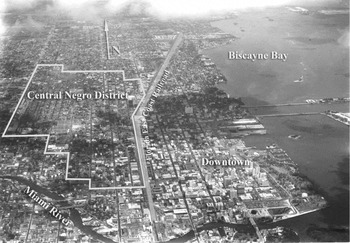
The Pan-American metropolis (c. 1957). Image courtesy of the Historical Museum of Southern Florida, labels by the author.

Once real estate speculators added New Deal federal housing programmes to these practices, the result was a cruel dialectic of legislation and selective transgression that enabled the most inventive entrepreneurs to augment revenues through an intentionally segmented housing market. As David Freund has cogently argued, developers, planners, real estate agents and landlords across the country constructed America's modern housing market on top of multiple foundations of inequality, both racial and economic segregations.Footnote 16 They assured profits in a manner later made famous by Miami drug cartels, managing supply, standardizing quality (or the lack thereof) and setting prices. Consequently, both blacks and whites paid more for less. And what had once been known as ‘Colored Town’ ballooned into a massive 136-block ‘Central Negro District’ wherein absentee white landlords owned a full 70 percent of the black-occupied rental housing.Footnote 17
Until the arrival of formal urban renewal campaigns during the 1960s, the constancy of market manipulation made slum housing a better investment than hotels in America's burgeoning tourist capital. According to sources from 1950, it cost ‘coloured’ slum dwellers a $100 deposit and $18 a week to move into a two-room wooden shack that usually suffered from inconsistent electrical service and a lack of indoor plumbing. Across the colour line, white tourists from Cuba or New York paid $17.50 a week, or $2.50 a night – with no deposit – to stay at a hotel with a private beach, turndown service and a television and telephone in every room. Racial segregation was clearly good business for landlords and slum builders, but bad living for Miami's black population.Footnote 18
Real estate profiteering greatly boosted South Florida's population and weakened the bargaining power of local blacks. Miami had only 7,500 people in 1905 and 10,000 by 1910, a respectable increase to be sure. By 1920, though, Miami's population had tripled to 30,000, with the white population increasing another 908 per cent over the next ten years. Greater Miami's black population increased apace to general population growth, experiencing a threefold increase from 10,000 in 1920 to some 30,000 by 1930. Blacks steadily became a smaller slice of the population, however, as their growth numbers in no way kept pace with those of whites. By the end of the Great Depression, black Miami's proportion of the overall population held around 20 per cent, all but guaranteeing that the Magic City would continue to evolve as a decidedly ‘white’ city.Footnote 19 The modernization of travel technology would prove critical to this process as well.
Problems of modern mobility
While urban planning and real estate profiteering were standardizing categories of ‘white’ and ‘coloured’, the instruments of mechanical power were literally shrinking the world, drastically reducing travel times between states and nations and changing the pace and look of segregated life in South Florida.
In terms of land-based travel and the growth it spurred, the FEC Railway upgraded from coal- to oil-burning engines in the late 1910s, greatly improving the cleanliness and efficiency of locomotives. By the mid-1920s, the FEC could boast trips from New York to Miami in only thirty-six hours, a journey that once took well over a week. Eight separate FEC trains ran daily in each direction over the 340-plus miles between Miami and Jacksonville. Each engine pulled a mix of heavy freight and passengers, the stuff of fortunes in a booming 1920s real estate market. And even though rampant speculation and a monster hurricane caused Miami's real estate bubble to burst violently in 1926, these events did not prevent continued population growth and the arrival of a second railroad company – Seaboard Air Line Railway – which sought to cut into the FEC's passenger business. Ford's Model T also made South Florida broadly accessible by road travel for the very first time. The ‘Tin Lizzie’, as the car came to be known, revolutionized the ability of Americans to travel great distances, with blacks being able to cover hundreds of miles without having to endure the insult of segregated rail cars.Footnote 20 Still, in the years before the building of the interstate highway, railroad corporations enjoyed a near-monopoly on long-distance domestic travel. And this dominance continued through World War II, until innovations in aviation changed both Miami and the world.
One could argue that no single mechanical breakthrough impacted Greater Miami more than the airplane, starting with the ‘Clipper’ fleet of Pan American Airways. Pan Am opened the international aviation age in 1927 when its Clippers began carrying mail over the waters between Key West and Havana. In response to railroad companies’ corporate stranglehold on domestic travel, a holdover of the nineteenth century, Pan Am's president, Juan Trippe, chose to market his company's Clippers as the first iconic means of travel for the twentieth century. Slow-floating ocean liners or smoky train cars seemed antiquated when compared to a modern view of the world from above, what Pan Am offered. The finest and most massive Clippers, in fact, looked and felt like ocean liners with wings. They came replete with full dining rooms, finely dressed wait-staffs, and soundproofed bedchambers. More important, they sported broad, boat-shaped hulls that allowed pilots to land vessels weighing as much as 20 tons at speeds of over 120 miles per hour.Footnote 21
While water take-offs were invariably bumpy, Pan Am's appropriation of the sea-as-runway made it easier for the company to negotiate landing rights with foreign governments. With US agribusiness and mineral companies gobbling up thousands of acres in the Caribbean and Latin America, many foreign bureaucrats welcomed not having to surrender additional land to American firms. Moreover, water take-offs and landings saved smaller countries the expense of having to build massive landing strips.Footnote 22
The advantages of water-based flight, especially among the increasingly tourist-attractive countries of the Caribbean Sea, gave Pan Am an almost insurmountable edge over its competitors. With access to scores of coastal cities in the Atlantic, Pan Am created ‘island hopping’ packages – an eventual staple of the industry. These enabled pilots to circumvent the limitations of fuel, add lucrative shipping stops and increase the range and visibility of the Pan Am brand in the Caribbean. The company then combined island hopping with America's existing domestic rail service, the result being the fastest and most affordable link mankind had ever known between the cities of the northern and southern hemispheres.Footnote 23
By 1935, Pan Am acquired routes and landing rights in Mexico, Central and South America. And by choosing Miami as the company's American hub, Pan Am's new arteries into the Atlantic World vaulted South Florida into the distinction of being the largest airport entry on the globe.Footnote 24 When World War II closed off Europe as a tourist destination, many of South Florida's more ambitious entrepreneurs believed their economy sat primed to become the ‘New Riviera of the Americas.’Footnote 25 It helped that Pan Am executives had an even bigger vision, believing their company had officially expanded America's frontier ‘to infinity’.Footnote 26
Building on Pan Am's entrepreneurial vision, members of Greater Miami's chamber of commerce began aggressively reaching out to Latin American and Caribbean tourists who might enter the United States by way of Miami. In 1940, they peppered libraries and hotels across the Americas with 10,000 ‘City of Miami’ promotional booklets written in Spanish. A year later, the chamber opened its membership to representatives of Cuban companies and American-owned businesses in Cuba. And, in a moment of profound clairvoyance, some chamber members even suggested in 1941 that Miami schools make Spanish language training compulsory in preparation for the stronger business connections developing between South Florida and the rest of the hemisphere.Footnote 27
As one might expect, not all travel innovations worked to Miami's potential advantage. During the late 1930s, new photographic mapping technology depicted a geographic relationship between North and South America that was closer than many imagined. When it came to accessing markets in the Caribbean Basin, Greater Miami, it now appeared, was no more special than other coastal cities in the southern part of the country. In fact, because of its sizable port, centuries-long shipping history and growing aviation industry, it was New Orleans, not Miami, that served at mid-century as the South's major distribution point of American goods to Latin America. In 1944 alone, ‘The Big Easy’ exported nearly 11 million dollars in goods to Rio de Janeiro, 26 million to Buenos Aires and 12 million to Valparaiso. ‘Partly to prevent New Orleans from monopolizing . . . the trade of the Caribbean countries’, wrote one observer in 1946, ‘the people of Miami . . . believe they should act before New Orleans goes too far with its plans.’ With little regard for Miami's claims as America's choice Caribbean city, boosters and export firms from New Orleans, Galveston and elsewhere in the coastal South touted their cities as ‘Gateways to the Americas’. Further complicating matters, die-hard Southerners occupied many of the federal government's most powerful foreign relations posts – from the secretary of state to the heads of the Senate and House Foreign Relations Committees. True to politics, these men from Florida's competitor states often looked to privilege their flagship cities in ‘reciprocal trade agreements’ with nearby nations.Footnote 28
New breakthroughs at Pan Am likewise threatened Miami's anointing as America's pre-eminent international city. At the urging of famed aviator Charles Lindbergh, a close friend of Juan Trippe, Pan Am entered the 1940s with fresh innovations in landing gear, hastening the irrelevance of the company's Miami-based Clipper fleet. Immediately following World War II, the heart of Pan Am's international operation became faster land-based planes flying out of New York and nearby cities. Unlike the old ‘flying boats’, Pan Am's new planes could fly at higher altitudes. They also enjoyed greater fuel efficiency and could take off from Northern airports even during stormy winter months. New planes, of course, required a new business model. And as with their planes, Pan Am's infrastructural investments – new offices, terminals and jobs – privileged New York as the most convenient point of embarkation for Americans' vacations abroad. No longer would wealthy travellers from Boston or Connecticut have to take a train all the way to Miami for a December flight to Mexico or Europe. And no more could Miami count on the financial windfall that came with being America's doorstep to the world. In short order, and in large measure because of Pan Am, New York went from handling 4,000 fewer air and sea voyages than Miami in 1945 to more than half a million more just three years later.Footnote 29
In addition to the problem of competitor cities, Miami's boosters had to deal with the economic consequences of their city's own racial history, above all the problem of Jim Crowed leisure and real estate. The 1940s thus saw Miami fall subject to the geopolitical demands of a shrinking world, the economic demands of a fragile city and the existential demands of those hoping to take advantage of segregation's shifting ground.
Making Jim Crow a ‘Good Neighbor’
Informed in part by concerns over the expansion of Nazism in South America, President Franklin Roosevelt's administration crafted the idea of ‘Good Neighbor’ Pan Americanism, designing in one stroke both an economic and cultural programme. Envisioning a hemisphere unified against potential European aggression, Roosevelt and his cabinet drew from nineteenth-century anti-imperialists such as Simon Bolívar. Unlike Bolívar or other Latin American nationalists, however, Roosevelt's expressed purpose was to bind the Americas under a spirit of co-operation and collective affluence facilitated principally by the United States spreading its military, agricultural and industrial investment throughout the hemisphere.Footnote 30 Roosevelt's successor, President Harry Truman, would continue this work in the event of Roosevelt's passing in 1945. Yet, as with nearly every other New Deal programme, ‘Good Neighbor’ Pan Americanism carried complicated racial baggage that far outlived Franklin Roosevelt.
As historians have shown elsewhere, ‘Good Neighbor’ foreign relations relied heavily on the willingness and ability of local actors to reinvent the legal and extralegal rules of white racial membership. Indeed, the cultural backbone of twentieth-century Pan Americanism lay in what one Argentine minister called the ‘bilateral link between the Anglo-Saxon and the Latin world’. In keeping with this belief, many South Florida whites felt that any effective cultural gestures required supplanting old habits of American chauvinism in favour of celebrating the shared European ancestry of Americans and ‘white’ foreign nationals. Miami in the 1940s thus hosted every manner of festival, park opening and statue unveiling smattered with markers of whiteness and occurring in the name of ‘Good Neighbor’ politics. One collection of wealthy white residents, for instance, calling themselves the Pan-American League of Miami, used the aesthetic power of monument to nuance the cultural margins of Jim Crow. They promised, with city funds, to erect a monument to Bolívar, a man who, with no shortage of racial implication, they referred to as ‘The George Washington of South America.’ In May of 1949, the mayor of Havana, Nicolas Castellanos, received the go ahead from the Miami City Commission to erect a similar monument of Cuban national hero Jose Martí in Miami's Bayfront Park. Tellingly, General Antonio Maceo, a black national hero undoubtedly equal to Martí in his importance to Cuban independence, received no such honour.Footnote 31
Regardless of how white boosters may have imagined America's Anglo past, however, the Caribbean's demographic realities remained less beholden to myths of absolute black and white. Thus, no matter how much boosters chose to ignore long dead negros like Maceo, Miami could not ignore the hundreds of living, breathing and spending foreigners who, in spite of their dark skin, decided to pass through or stop for vacation in Jim Crow's ‘Magic City’. On one level, the preponderance of foreigners in Miami had done much to affirm the city's reputation as one on a par with Atlanta and other more progressive Southern locales.Footnote 32 Still, the undeniable blackness of many foreigners created considerable anxieties at the Miami grassroots. What has ‘concerned the people of Miami’, reported one official observer in 1946, ‘is the fact that many Latin Americans are dark-skinned or are Negroes’. A spike in Afro-Latin migration to South Florida represented an unintended consequence of Miami's ad campaigns in foreign newspapers. The politics and economics of mestizaje in Latin America also allowed greater measures of upward mobility and increased opportunities for travel among darker-skinned Spanish-speakers. Regardless of black foreigners' heightened income, though, one travel writer for the Chicago Defender described the following of Miami: ‘[H]otel accommodations are a ticklish point and dark-skinned Puerto-Ricans or Cubans are apt to be sent over to the Mary Elizabeth [Hotel], the acknowledged stopping place for Negro travelers.’ Most locals knew that both black and white patrons frequented the Mary Elizabeth, and for nearly 30 years national news media and tourists considered it the finest black-owned hotel in the South. In the eyes of many whites and blacks, however, it was still just another ‘coloured’ hotel that black foreigners had to suffer, even if they could afford better.Footnote 33
When Haiti's president, Stenio Vincent, embarked on a trip to Washington, DC, in 1939, for instance, he ran into the limits of ‘Good Neighbor’ politics. Vincent came to Miami to meet with President Franklin Roosevelt, but before he could leave Pan Am's terminal, local officials informed Vincent that no white hotels would accept him for the night. US State Department representatives and executives from Pan Am had been pressuring local proprietors to make room for Haiti's head of state four full days before his arrival. Not one luxury hotel owner would budge. Rather than subject the sixty-year-old Vincent to cramped downtown lodging at a smaller hotel or force him to submit to a ‘coloured’ stay in the Central Negro District, Pan Am executives, local officials and agents of the US State Department staged a reception at the Pan Am Airways terminal lobby. From there, local authorities shuttled Haiti's president to a private northbound train without Vincent having spent so much as one overnight stay in Miami.Footnote 34
In its handling of Vincent, Pan American Airways affirmed its long-held opposition to Jim Crow business practices. By virtue of his dealings with foreign governments, in fact, Juan Trippe in 1929 drafted Pan Am's anti-discrimination policies personally. The company's refusal to take Jim Crow into the skies made Pan Am the carrier of choice for many well-to-do blacks. And those African Americans with the means to travel internationally stopped in Miami regularly en route to Haiti and other foreign ports.Footnote 35
It is important to keep in mind, though, that even the great Pan Am could not undo the decades of segregated city building, cultural reproduction and on-the-ground racial politics governing Miami at mid-century. Truly, the absurd lengths to which federal, city and Pan Am officials went to accommodate Vincent reflect a longer history of whites contorting to negotiate the problem of black money in a Jim Crowed world built on profit. The early 1950s, for example, brought Greater Miami successive years of nationwide recession, slow summer tourist seasons and the arrival of large mixed-race conventions seeking overnight accommodations. All of these, combined with America's growing spirit of post-war ‘tolerance’, forced white hoteliers to bend the rules of ‘whites only’ leisure and admit black travellers for the first time. Moreover, the presence of black foreign nationals – Haitian, Cuban and otherwise – bedeviled careful legal definitions of ‘the Negro’ and required, instead, that whites decide, often on a case-by-case basis, who belonged to the Negro race and who did not.Footnote 36
As one might expect, many native-born blacks took advantage of Jim Crow's inconsistency. Some did so by simply convening with large, interracial tourist groups, such as the National Education Association or the National Baptist Convention. And, sometimes, American blacks took a more ad hoc approach – like that of Wilfred McKenzie – choosing to pass themselves off as non-Americans.
Born in Miami to Bahamian parents, McKenzie served in World War II. When it came to transgressing Jim Crow's colour line in Miami shortly after the war, though, his having fought fascism in Europe proved far less useful than his ability to feign being Haitian. Walking with a Haitian friend visiting from Boston, McKenzie literally talked his way into a Miami Beach movie house. The two men walked past the white ushers guarding the theatre entrance as the Haitian spoke loudly to McKenzie in almost exaggerated French. Though he himself spoke no French, McKenzie played his role in the ploy by simply responding ‘Oui, oui, oui.’ They hoped this ruse would give the ushers the impression that neither McKenzie nor his companion was ‘coloured’, at least not in the American sense. Laughing as he recounted the story, McKenzie recalled being stopped briefly. ‘The usher went up and told the manager, “There are a couple of niggers out here trying to get in, speaking French.”‘ After some thought on the manager's part, ‘They let us sit in the back [of the theatre].’Footnote 37
Regardless of how much black agency bent the colour line, it never quite broke (‘Come in the theatre, but sit in the back’). Even in a city as clearly transnational as Miami, there remained a ‘coloured’ threshold bounding the black experience.
At the same time, hotels and movie houses began admitting blacks through the economic or cultural backdoor, the Miami Police Department required black entertainers from Harlem or Midwestern cities to carry apartheid-style work passes. Before any crime had been committed, newly arrived black performers hoping to play at Miami's premier hotels had to take fingerprints and mugshots at the nearest police precinct. Local officials had actually developed this programme during the early 1940s as part of a larger wartime security effort to monitor potential Nazis, Communists and poor labourers of every complexion. Over time, though, local whites subjected the work pass programme to profane modernizations. The cards became a hand-held expression of earlier zoning initiatives, housing practices and recreation restrictions meant to exclude blacks. As with each articulation of Jim Crow, the work pass was a little bit of custom, a little bit of law. And like a kind of racial assembly line, African Americans, Bahamians and other Caribbean blacks entered one end of the surveillance apparatus as people of diverse history, language and background; they came out the other end as part of a single, usable labour category – ‘coloured’. This practice lasted well into the 1960s. And throughout the work pass's evolution, it helped segregation – like a Pan Am aircraft – retain some semblance of its original design.
Then there remained the problem that, to this day, marks the divide between ‘White’ and ‘Lack’ in Greater Miami – housing. Since before World War II, entrepreneurs in the tourist industry joined with local housing reformers in calls against the city to ‘clean up our slums’. Slum dwellers certainly had their own agenda for improving Miami's rundown housing stock, but the priority of Miami's booster community was to shelter Latin tourists from white racism, unsightly shanties or the prospect of having to suffer accommodations in the Central Negro District.Footnote 38
City officials so feared Negro slums as an impediment to Miami's economic destiny that, in 1941, they planned to raze over 350 dwellings in the city's ‘coloured’ downtown to build whites-only apartments, a new train terminal and a ‘Pan-American Trade Mart Plaza’.Footnote 39 Planners, in part, hoped the project would undo a growing sentiment surrounding the city. Summed up best, perhaps, in the pages of Time, the magazine, in 1940, condemned Miami as a patchwork city where ‘slack-chinned, dull-eyed Crackers from the back country thronged the narrow streets’. Luckily for Greater Miami's entrepreneurs, world war and a growing aviation business would prompt Time a year later to anoint Miami as ‘sitting on the doorstep of tomorrow's big business’. And, tellingly, the magazine made the unconscious connection between ‘Good Neighbor’ politics and the imperial age by echoing earlier British predictions of the ‘Caribbean [becoming] an American lake’.Footnote 40 Despite this discursive anointing, however, Miami's Pan-American development projects were never to be. Landlords, still fat from decades of legal preferences, blocked these and a full decade's worth of urban redevelopment initiatives in order to protect the profits their segregated housing market had assured.Footnote 41
Conclusion
Ever-evolving technologies of social power and a shrinking world combined with Greater Miami's tangled American and Caribbean roots to provide city dwellers with a decidedly local and undeniably transnational encounter with race in all its spatial expressions. In both a literal and figurative sense, Miami's remarkable growth – from wilderness to city to global metropolis – crept along racial tracks laid as early as the 1890s. Even as Miami still aspires to serve the four corners of the globe, urban development, immigration patterns and circuits of capital all follow decades-old colour lines. This kind of segregated cosmopolitanism is what made twentieth-century Miami not simply a global city, but a Pan-American city; its policymakers and elites remained committed to a decidedly ‘Pan-Americanist’ vision, rooted in the New Deal era's long antagonism toward those racialized as ‘black’, ‘Negro’ or ‘coloured’. Thus, even as Haitian visitors fell out of ‘Good Neighbor’ favour with white powerbrokers, urban growth policies continue to reflect clear racial biases in favour of foreign nationals. In short, the slew of timely innovations that made Greater Miami a global city also left it a city of clear bi-racial tendencies.
This should not be surprising. Even during what were arguably the darkest years of twentieth-century race relations, there was never one, capital-S ‘Segregation’, but many spatialized forms of racial discrimination. Jim Crow never stood still. Instead, like the aircraft or other travel technology, it underwent and is still experiencing revisions at the hands of South Floridians who constantly negotiate and rewrite its rules, mediate it with new technology and take pieces from earlier regimes in order to fit them to new circumstances. Still, despite, or perhaps even because of, the protean nature of Jim Crow, we should always remember that its racism remained ever-rooted in the built environment and the land, even when fuelled, in some cases, by events on the sea and in the sky.