


Introduction
Cognitive behaviour therapy (CBT) and psychopharmacotherapy can sometimes be uneasy bedfellows. CBT and psychopharmacotherapy share the same values of empiricism so that in theory controlled trials should assist in guiding health professionals and their patients. However, there is a paucity of evidence for long-term effects of interaction between CBT and medication. Furthermore, controlled trials rarely inform which type of patient might do better with CBT, medication, or a combination of the two. There are cultural differences between the scientists who conduct such studies and the two approaches can sometimes appear to conflict. Philosophically, the main goal of medication is to make a client feel better and to reduce symptoms. Medication is considered to be ineffective if symptoms are not relieved. In contrast, CBT is increasingly focused on having better feelings by acceptance and helping patients do the things in life that are important to them despite the way they feel, with less emphasis on symptom relief (even if this occurs without being directly targeted).
Differences in approaches
Psychopharmacology traditionally uses models of defects or abnormalities for emotional disorders. Antidepressants are thought to ‘work’ by enhancing neural transmission and regulating neuroceptors to directly enhance mood. Recently, Harmer et al. (Reference Harmer, Goodwin and Cowen2009) suggested that antidepressants work by remediating negative affective biases relatively quickly after administration. This is an intriguing convergence of psychopharmacology and CBT models of an emotional disorder.
CBT models for the mechanism of action emphasize normalizing many experiences. Thus in panic disorder, medication may be prescribed to control anxiety and bodily sensations whereas CBT encourages acceptance of physiological sensations and re-interpretation of the sensations without catastrophizing, and to view them as a normal response to threat.
Other tensions between CBT and psychopharmacology are that medication is often regarded as a long-term solution. This may be a problem if the patient is no longer symptomatic from the disorder but has significant side-effects from the medication. In CBT, there is an emphasis on self-management and when the therapist fades out, becoming one's own therapist. Medication, by contrast, could be viewed as reducing self-efficacy and encouraging a reliance on an external solution. More studies on beliefs about mechanism of change with medication and CBT and whether this is predictive of outcome would be interesting to conduct.
Last, the gold standard for psychopharmacologists is placebo-controlled trials and double-blind assessments. This is more difficult to do in CBT and there are relatively few RCTs where the comparator is a non-specific intervention of equal credibility (e.g. stress management). At best in CBT trials assessments can only be single blind when an observer-rated scale is performed blind to the treatment given.
American Psychiatric Association guidelines (APA, Reference APA2010) often assume a person is taking medication first and CBT is then added to ‘augment’ medication. This is the opposite to CBT and the stepped-care approach of the National Institute for Health and Clinical Excellence (NICE) guidelines in the UK. Most patient preference is where CBT is generally offered first and if this fails or the disorder is more severe then health professionals may be advised to add medication to ‘augment’ CBT. Although much is known about the short-term comparisons of CBT and medication in common emotional disorders, much less is known about the interaction of medication and CBT especially in the long term when one or both treatments are discontinued. A problem of a meta-analysis of several controlled trials is it may be valid to combine a class of drugs [e.g. all selective serotonergic reuptake inhibitors (SSRIs)] but less valid to combine different protocols of CBT which have evolved over time and to then compare a SSRI vs. CBT or a combination of the two.
We attempt to highlight when a combination may be more effective and when it may hinder. However, outcome studies rarely discuss evidence-based patient choice and values, e.g. when patients are unwilling to reduce the risk of relapse because it would involve side-effects in the long term and be a constant reminder of vulnerability. More research is needed on the psychological aspects of taking medication and its clinical and cost-effectiveness when used alone or with CBT in the long term.
Cognitive behaviour therapists may cross the path of pharmacotherapy in various scenarios:
(a) When clients seek a therapist's advice on combining psychotropic medication with CBT when therapy starts or if they should start medication while on a CBT waiting list.
(b) Evaluating when CBT has failed or not had optimal outcome and recommending to the client when to seek advice on medication.
(c) Evaluating when medication has led to a significant improvement and it now difficult to use CBT without stopping medication.
(d) Evaluating when CBT has led to a significant improvement and seeking a therapist's advice on whether to come off medication and when to stop.
(e) Evaluating when a client is experiencing a side-effect of medication, or whether they are exhibiting a symptom of an underlying disorder.
(f) Evaluating when a client is experiencing withdrawal symptoms from stopping medication or whether it is a symptom of relapse.
(g) Being aware of when medication is taken (usually episodically) as a safety-seeking behaviour to prevent a feared consequence.
It is not possible to provide clear advice for every scenario and a therapist might not feel confident about the questions being posed and advise a client to talk with their prescribing doctor. However, the doctor also may know just as little about many of these scenarios as they often relate to the interaction of medication with CBT or determining when medication may enhance or interfere with therapy. This article aims to assist therapists in each of these scenarios according to the guidelines for various disorders and other resources. Often there is no evidence base to turn to and much will depend on clinical judgement and experience in applying limited knowledge to a particular scenario. The therapist should of course communicate his concerns to the prescribing doctor (with his rationale) and clients should discuss such concerns about altering their medication with their prescribing doctor. Ideally the therapist may have access to a psychiatrist trained in CBT, where a balanced opinion might be obtained.
Types of medication
There are four common types of psychotropic medication that are prescribed for common emotional disorders. These are antidepressants, antipsychotics, tranquillizers, and beta-blockers. (Mood stabilizers used in bipolar disorder are not discussed in this article.) A brief overview is given of each class of medication before discussing the way they are used.
Antidepressants
The seven main classes of antidepressants are briefly described below.
Selective serotonergic reuptake inhibitors (SSRIs)
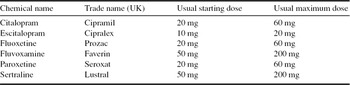
SSRIs are the most common class of antidepressants that may be effective for depression, various anxiety disorders and bulimia nervosa. ‘Serotonergic’ means that the drugs act on serotonin receptors in the brain. ‘Selective’ refers to the fact that they act on serotonin receptors rather than others such as noradrenergic or histamine. ‘Reuptake inhibitor’ refers to the way the drug acts: they help to increase the concentration of serotonin in the receptor. This in turn helps to enhance transmission in serotonergic pathways that, for example, reduce anxiety. Table 1 lists all the SSRIs and the typical doses used. (In the following text, the trade names are provided in parentheses.)
SSRI and typical doses

Potential side-effects of a SSRI can include nausea, diarrhoea, headaches, excessive sweating, dry mouth, insomnia, tremor, and sexual dysfunction. Occasionally a client may experience ‘activation’ which can include increased anxiety, panic, insomnia, irritability, impulsivity, hostility and suicidal ideation. NICE recommends that patients taking a SSRI are monitored for symptoms of activation and suicide ideation, especially young people in the first few weeks after starting treatment. Side-effects can usually be managed (Veale & Willson, Reference Veale and Willson2007) or minimized by the doctor reducing the dose and slowly titrating it upwards. Alternatively a patient may be advised to try a different SSRI or class of antidepressant, or to wait as many of the side-effects (but not sexual side-effects) tend to be mild and improve over time. There are also atypical SSRIs – trazodone (Molipaxin) and nefazadone (Dutonin) – that have a slightly different side-effect profile. They are better at improving sleep and have less sexual side-effects than a SSRI.
It can sometimes be difficult to differentiate between what is a side-effect and what is part of an underlying disorder. In general, side-effects tend to occur within the first few weeks of commencing a SSRI or increasing a dose. They will lessen if the dose is increased at a slower rate (whereas anxiety from an underlying disorder will not.) A SSRI can sometimes cause emotional numbing or inhibit anxiety to a degree that makes CBT an intellectual exercise. This may be an idiosyncratic reaction or one that occurs in some individuals at higher doses. CBT needs emotion for conducting behavioural experiments, exposure or to practise the skills required or to access ‘hot cognitions’. This is a difficult conundrum, which can only be discussed with the patient and prescribing doctor. In such circumstances, patients may need to be gradually withdrawn from the antidepressant or to decrease the dose. Caution is required as they may be at risk of relapse when they stop taking the drug.
Selective serotonergic and noradrenergic reuptake inhibitors (SSNRIs)
SSNRIs are a newer class of antidepressant – there are only two, venlafaxine (Efexor) and duloxetine (Cymbalata). Potential side-effects are generally similar to those of a SSRI although venlafaxine is not suitable if the patient has raised blood pressure. Specialists will usually initiate the prescription of SSNRIs as NICE guidelines only recommend them as a second line of treatment if a SSRI has failed.
Selective noradrenergic reuptake inhibitors (SNRIs)
The only drug in this class is reboxetine (Edronax), although the older drug lofepramine (a tricyclic) is a potent noradrenergic reuptake inhibitor. The potential side-effects are different to a SSRI (e.g. blurred vision, increased heart rate, difficulty in urinating, dry mouth, drowsiness or insomnia) and it is less likely to interfere with sexual functioning. A SNRI is sometimes used in depression as an alternative to a SSRI.
Noradrenergic and selective serotonergic antidepressants (NSSAs)
The only drugs in this class are mianserin (Remeron) and mirtazapine (Zispin). They act both on serotonin and α2 adrenergic receptors. The potential side-effects are similar to those of a SSRI, but they are more likely to cause sedation. This can be turned to advantage by taking the medication at night. Increased appetite and slight weight gain are more common, so they can be used to good effect in someone who has lost weight and their appetite. Compared to a SSRI, they do not cause sexual dysfunction or nausea. They are used an alternative in depression when sleep disturbance, sexual dysfunction, nausea or weight loss is a problem. However, they are less useful in those who are sensitive about weight gain.
Noradrenaline and dopamine reuptake inhibitor (NDRI)
The only drug in this category is buproprion (Zyban). It is licensed in the UK as an anti-smoking drug but is also used an antidepressant internationally. It is less likely than a SSRI to cause weight gain or sexual problems. Sometimes buproprion is used in combination with other antidepressants for severe depression.
Tricylics
The name ‘tricyclic’ is used to describe the structure of the chemical. These are an older class of antidepressant that lost favour to SSRIs because they were more likely to be fatal in an overdose and potentially had more anticholinergic side-effects (e.g. dry mouth, constipation, dizziness, tremor, weight gain, fatigue, blurred vision, headache, sexual problems, increased sweating). Examples of tricyclics include doxepin, amitriptyline, imipramine and clomipramine. Most tricyclics enhance both serotonin and noradrenergic transmission although some like clomipramine are potent serotonergic reuptake inhibitors. They are just as effective as the newer antidepressants and some doctors believe they are more effective than a SSRI in severe depression with ‘melancholia’ (i.e. early morning wakening, weight loss, anhedonia, diurnal variation in mood). A minimum dose of a tricyclic for depression is 125 mg – lower doses may have a sedative and placebo action only.
St John's Wort
St John's Wort (Hypericum perforatum) is a perennial herb from which extracts are derived for the treatment of depression. NICE recommends St John's Wort for mild depression only. Although the optimum dose for depression is not known, the usual recommended dose is 900 mg/day (either as one tablet or three 300-mg tablets a day) standardized to contain 0.3% hypericin. If this is ineffective, the dosage can be increased up to 1800 mg/day. St John's Wort cannot be prescribed by a doctor (except in Germany). A client can buy it at health-food shops, herbalists or pharmacies. It seems to have fewer side-effects than standard antidepressants. If a patient is taking St John's Wort, it should be remembered that it is still a ‘drug’ and the patient should inform their pharmacist or doctor if they are taking another medication as it can interfere in the metabolism of a number of other drugs.
Stopping an antidepressant
In general, if a patient is taking an antidepressant when commencing CBT, it is preferable that the dose remains stable so there is no potential deterioration in mood or anxiety during therapy. If CBT is successful, then a patient may want to stop taking an antidepressant near the end of therapy. This is a more difficult decision when judging the risk of relapse and whether the patient has the necessary skills to prevent a relapse. For depression, an assessment includes whether the client has a previous history of depression and severity, a history of relapse when stopping medication in the past, and how effective CBT is in maintaining the improvements that have been made. NICE advises that people who have had two or more depressive episodes in the past should remain on antidepressants for at least 2 years. In general, if a patient has received CBT then this reduces the risk of relapse. The risk of relapse upon discontinuation should be discussed, as well having a relapse prevention plan and discussing the possibility of withdrawal symptoms on discontinuation.
Withdrawal symptoms of antidepressants
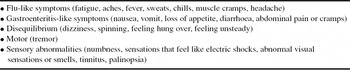
Patients may stop or reduce antidepressants on their own accord and experience withdrawal symptoms. This might occur during CBT and a patient's deterioration may be unexplained. Some people experience withdrawal symptoms if they forget to take a dose or renew a prescription. This is also referred to as ‘discontinuation syndrome’ and the phenomenon can occur with a number of classes of medication (Lader, Reference Lader and Trimble1983). In general withdrawal symptoms can be managed and it is only minority who require specialist help. Antidepressants are not ‘addictive’ in the sense that there is no craving or dose escalation as found in opiates or cocaine. A small minority of people coming off antidepressants have marked or severe symptoms that require more gradual withdrawal. Possible physical withdrawal symptoms can include any of those listed in Table 2.
Physical withdrawal symptoms of antidepressants

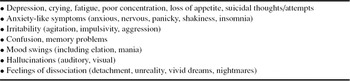
The second group of symptoms that have been reported in withdrawal from antidepressants are predominantly psychological (see Table 3).
Psychological symptoms of antidepressant withdrawal

In most people these withdrawal effects are mild or last a few days. For a small number of people withdrawal symptoms can be severe especially if the medication is stopped abruptly. The speed at which the discontinuation of a drug causes withdrawal symptoms is partly related to how fast the drug is metabolized. Thus fluoxetine is the least likely of antidepressants to cause withdrawal symptoms as it has the longest half-life and is in the body for up to 5 weeks. Drugs more likely to cause withdrawal symptoms are paroxetine, fluvoxamine and venlafaxine that have short half-lives and can cause symptoms on the same day a dose is missed. Other SSRIs such as sertraline may cause withdrawal symptoms within 2–3 days. Another problem is deciding whether symptoms that emerge on stopping medication are those of withdrawal or whether they are a relapse of the disorder. Asking the client the following questions may assist:
(1) Do your symptoms come on suddenly over a few days or within a week after stopping? Withdrawal symptoms come on relatively suddenly within days to weeks of lowering or stopping an antidepressant. Symptoms of relapse of depression or anxiety disorder usually occur within one or more months after stopping an antidepressant.
(2) Do you have physical symptoms? Physical symptoms such as feeling dizzy or light-headed, having flu-like aches, sweating, nausea, numbness, electric shocks and headaches are usually part of withdrawal state. While some of these physical symptoms can occasionally occur in relapse of depression, they would have been part of the client's original symptoms and the client would be more likely to recognize them as such.
(3) How quickly do your symptoms improve when you stop medication? Withdrawal symptoms peak within 7–10 days and are usually gone within 3 weeks; by contrast symptoms of a relapse of depression or an anxiety disorder will persist and may get worse.
(4) How quickly do your symptoms improve if you restart the medication? Withdrawal symptoms immediately improve on recommencing a drug or increasing the dose within about 24 hours. Symptoms of relapse may continue or become worse and take several weeks to improve on recommencing an antidepressant.
There are well-established routines for managing withdrawal of antidepressants. In general, slightly increasing the dose of medication and withdrawing it more slowly can lessen the effects of withdrawal. Patients may find it helpful to read about withdrawing from antidepressants (see e.g. Glenmullen, Reference Glenmullen2006).
Educating patients about medication
Antidepressant drugs may be advertised directly to the public in the USA. This has generally led to a nation that has learned to view mental disorder as a biological defect that can be corrected by taking the right medication (Conrad, Reference Conrad2007). This might potentially interfere in the credibility of CBT. Aetiology cannot of course be inferred from treatment and it is equally credible to inform patients that antidepressants enhance normal pathways and improve the brain's ability to regulate mood (without there being a defect).
When patients are enthusiastic about trying out new medication, it is worth attempting to understand their beliefs about taking medication or about the intended consequences of taking medication. This is because the intended aim in, for example, a client with obsessive–compulsive disorder (OCD) may be to ensure that s/he no longer experiences any unwanted intrusive thoughts (when of course CBT tries to normalize their occurrence). Another example is a client with depression who has experienced loss and does not want to experience any ‘bad’ feelings, while CBT would want to normalize the feelings and allow the person to emotionally process a loss. Experiential avoidance might be especially strong in those patients who are enthusiastic for electroconvulsive therapy (ECT) or psychosurgery to ‘wipe away their feelings’ and is probably a poor prognostic sign for any treatment (medication or psychological). It should be appreciated that there is a fine dividing line between alleviating symptoms of depression and appropriate sadness and good clinical judgement is required here.
We also recommend identifying beliefs about taking antidepressant medication that relate to adherence. Thus a client may be taking an antidepressant intermittently and having regular withdrawal symptoms. The client may reveal a belief that taking an antidepressant medication is a sign of weakness or a failure and feel stigmatized. Equally, some clients may be criticized by relatives for taking medication and believe that they should ‘pull themselves together’. In general we advocate a pragmatic approach in helping patients to question their unhelpful beliefs about medication, explaining the importance of taking their medication regularly (or not at all), discussing with their doctor when they want to stop medication, while emphasizing client choice and using NICE guidelines. We summarize below the recommendations from the NICE guidelines for common emotional disorders and highlight those areas where further research on the interaction of CBT and medication is required.
Antipsychotic drugs
Antipsychotic drugs (or ‘neuroleptics’) are commonly prescribed for psychosis or bipolar disorder. However, they are also used for tics and Tourette's syndrome (Sandor, Reference Sandor2003); agitated or psychotic depression (NICE, 2007); reducing impulsivity and sometimes in OCD when a patient has failed to respond to at least two SSRIs or clomipramine and CBT (NICE, 2005). The most common antipsychotics are olanzapine (Zyprexa), risperidone (Risperidal), quetiapine (Seroquel), aripripazole (Abilify) and amisulpiride (Solian). In general, lower doses are used for common emotional disorders compared to antipsychotic use. Side-effects of antipsychotics tend to be dose dependent so that higher doses may be associated with resting tremor, akathisia (a movement disorder characterized by a feeling of inner restlessness and need to be in constant motion), emotional numbness, sedation and reduced libido. They may cause weight gain, amenorrhoea and metabolic syndrome (a combination of diabetes, raised blood pressure, obesity and abnormal lipids) especially in higher doses in the long term. We believe antipsychotic drugs are too often prescribed for common emotional disorders before one or more trials of CBT. If a patient does not have schizophrenia, bipolar disorder, severe depression or OCD and is about to start CBT, our bias is to advise that antipsychotics are stopped or the dose reduced unless there are very good reasons to continue (e.g. a high risk of deterioration). Patients with common emotional disorders should not be prescribed antipsychotic drugs in the long term without being regularly reviewed for effectiveness and emergence of a metabolic syndrome or other side-effects.
Tranquillizers
The most common tranquillizers are benzodiazepines (e.g. diazepam, nitrazepam, lorazepam, clonazepam). They used to be commonly prescribed for anxiety and insomnia but are prescribed less now because of the risks of dependence and side-effects, especially in higher doses such as emotional numbing and psychomotor impairment. However, doses do not tend to escalate over time (tolerance) and they provide rapid relief of anxiety. They are generally prescribed for sedation or reducing agitation or anxiety in the short term. Risk of withdrawal symptoms are increased with use for more than 4 months, higher doses, a short half-life of the drug (e.g. lorazepam or alprazolam); or if there are chronic problems such as dysthymia or borderline personality disorder. Withdrawal can lead to an increase in anxiety, insomnia, irritability, headaches and many other possible physical symptoms that should be carefully managed. Like discontinuation of antidepressants, physical symptoms of withdrawal such as increased sensitivity to light and sound, numbing, muscle cramps, depersonalization, and myoclonic jerks may differentiate withdrawal from underlying anxiety. In general, we would encourage withdrawal from benzodiazepines prior to commencing CBT (or during CBT) as they are not are a long-term solution. We discuss the use of benzodiazepines for different disorders below and when they may be indicated in the short term.
Beta-blockers
Beta-blockers are so named because they block β-androceptors and are used for hypertension. The most common beta-blocker is propranolol. They are commonly prescribed for anxiety by family doctors often at a low dose. However, they have little benefit in anxiety disorders apart from reducing tremor and perhaps palpitations (which may be undesirable in CBT). They may be prescribed episodically for performance anxiety. This may interfere in the effectiveness of CBT and this is discussed below under social phobia.
Guidelines for disorders
Depression
Antidepressants are not recommended by NICE for mild depression and are no better than placebo. The exceptions are if depression persists despite other interventions or is associated with poor psychosocial or medical problems, and unless the client has a history of moderate or severe depression and is presenting now with mild depression. Part of the problem in interpreting controlled trials is the diagnosis of depression is its heterogeneity. Two patients may have the same severity of depression on a standard rating scale but may be vastly different, yet both may be included in a controlled trial, e.g. one may be a student who has a brief episode of depression after breaking up with a partner and have good family and social support and will probably recover with the passage of time. Another patient may be a single mother with chronic depression, a family history of depression, a history of sexual abuse, no social support, and comorbid personality disorder. People who respond to antidepressants generally have more ‘melancholic’ symptoms, e.g. psychomotor retardation, anhedonia, diurnal variation in mood and early morning awakening. Severe depression can interfere with engagement in the more cerebral aspects of CBT through lack of motivation and poor concentration. NICE recommends CBT in combination with antidepressant for patients who are treatment resistant or presenting initially with severe depression. Several studies suggest that the combination of CBT (NICE, 2007) or cognitive behavioural analysis systems (CBAS; Keller et al. Reference Keller, McCullough, Klein, Arnow, Dunner, Gelenberg, Markowitz, Nemeroff, Russell, Thase, Trivedi and Zajecka2000) with an antidepressant is more effective than either alone. Behavioural activation (BA) is probably the most appropriate intervention in severe depression and there is no evidence that medication may interfere in BA (Dimidjian et al. Reference Dimidjian, Hollon, Dobson, Schmaling, Kohlenberg, Addis, Gallop, McGlinchey, Markley, Gollan, Atkins, Dunner and Jacobson2006).
OCD
Both CBT and SSRI or clomipramine alone are equally effective for OCD. NICE guidelines recommend that a SSRI or clomipramine should be combined with CBT when a client has severe functional impairment or has not responded adequately to CBT treatment (NICE, 2005). A SSRI may be indicated if a client has comorbid depression, especially if this is interfering with the ability to engage in therapy or there is suicidal idration. Response with a SSRI is generally dose dependent, therefore higher doses tend to perform better in OCD. If a patient has been treated by a SSRI or clomipramine without CBT, then there is a higher risk of relapse than CBT alone when either is discontinued. NICE recommend that antidepressant medication is continued for 12 months from time of effectiveness. A SSRI is less likely to help those whose main problem is hoarding or who have low levels of anxiety. Antipsychotic drugs (usually a low dose) may augment a SSRI in those who are treatment refractory, although the effect size is modest and as noted above, possible side-effects should be closely monitored. There are no studies that have compared CBT with antipsychotic augmentation or the combination of the two.
Body dysmorphic disorder (BDD)
Both CBT and SSRI alone are probably equally effective for BDD. NICE recommends that clients with BDD with severe functional impairment be offered combination treatment of CBT and SSRI (NICE, 2005). Combination treatment is also indicated if there is comorbid depression, particularly if a client is significantly depressed and unable to engage in therapy or is suicidal. Like OCD, the response is probably dose dependent so higher doses tend to be better. Antipsychotics are not recommended in BDD even when there is comorbid delusional disorder as they are ineffective. When a person already has a body image problem, such drugs are also not popular because of potential weight gain and loss of libido.
Panic disorder with or without agoraphobia
Antidepressant medication may be used for panic or it may be indicated if CBT has not been effective or if a client has comorbid depression. NICE makes no specific recommendation for CBT in combination with an antidepressant in panic disorder. Some meta-analyses suggest that a adding CBT to an antidepressant is better than an antidepressant alone or CBT alone but the effect sizes in favour of a combination of the two are small (Bandelow et al. Reference Bandelow, Seidler-Brandler, Becker, Wedekind and Rüther2007). Barlow et al. (Reference Barlow, Gorman, Shear and Woods2000) found that both imipramine (a tricyclic antidepressant) alone and CBT alone were better than a placebo in the acute treatment phase. However at 6 months follow-up, patients who had antidepressant medication together with CBT were more at risk of relapse when stopping the antidepressant than if they had CBT alone. There is a problem of combining different protocols of CBT and varying stages of development as these confound interpretation of past results.
Clinically some patients who experience significant anticipatory anxiety and marked avoidance may benefit from a SSRI antidepressant if they are not yet ready for CBT. The issue of determining what symptoms are related to withdrawal and what is recurrence of panic disorder may also occur.
In standard doses, and if taken regularly, benzodiazepines do not interfere in the outcome for CBT for panic and agoraphobia in the short term. If they are taken episodically at a time of panic then they can become a safety-seeking behaviour. NICE guidelines for panic suggest that when benzodiazepines are prescribed alone they are associated with a less good outcome than CBT alone and should not generally be prescribed for panic disorder as they may undermine the benefits of CBT in the long term. Interestingly psychopharmacology guidelines (which reviewed the same evidence) suggest that some benzodiazepines are efficacious for acute treatment especially at the onset of using a SSRI which can lead to increased anxiety (Baldwin et al. Reference Baldwin, Anderson, Nutt, Bandelow, Bond, Davidson, Den Boer, Fineberg, Knapp, Scott and Wittchen2005). Therapists should be aware that clients may misuse tranquillizers for experiential avoidance and in general it is advised that patients who come off should have a planned withdrawal programme.
Social phobia
There are currently no NICE guidelines for the treatment of social phobia. SSRIs have a modest effect size for treating social phobia (generalized type) (Hedges et al. Reference Hedges, Brown, Shwalb, Godfrey and Larcher2007). Furthermore, the rate of relapse on discontinuation of a SSRI is probably high compared to stopping CBT. Monoamine oxidase inhibitors (MAOIs) have a similar effect size to a SSRI but are rarely prescribed because of the dietary restrictions and drug interactions. Benzodiazepines have a small effect size but are not recommended because of the problems of dependence. Propranolol is sometimes used episodically as a single dose for performance anxiety (James et al. Reference James, Griffith, Pearson and Newbury1977) for a specific performance but is not effective for generalized type of social phobia. A problem can occur if a beta-blocker is used and it blocks symptoms of tremor or blushing which may be required for a behavioural experiment (e.g. video feedback).
Only two studies study have compared CBT alone with the combination of CBT and antidepressant medication in social phobia (generalized type) (Blomhoff et al. Reference Blomhoff, Tangen Haug, Hellstrom, Holme, Humble, Madsbu and Wold2001, Davidson et al. Reference Davidson, Foa, Huppert, Keefe, Franklin, Compton, Zhao, Connor, Lynch and Gadde2004). Self-report showed a very small effect size in favour of combined treatment. However, these studies did not use the more recent CBT protocols (Clark et al. Reference Clark, Ehlers, McManus, Hackmann, Fennell, Campbell, Flower, Davenport and Louis2003) that have larger effect sizes. There is, however, no evidence that a SSRI will interfere with CBT for social phobia. In summary a SSRI is a second-line treatment after CBT for treating social phobia (generalized type) and may be combined with CBT if CBT alone fails.
Post-traumatic stress disorder (PTSD)
There is modest effect size of SSRI or mirtazapine in PTSD (Bisson, Reference Bisson2007). A SSRI or mirtazapine are therefore recommended as second-line treatment for PTSD. One study in childhood PTSD found only minimal evidence that adding sertraline (a SSRI) to CBT was superior to CBT alone, although the numbers were very small (Cohen et al. Reference Cohen, Mannarino, Perel and Staron2007). No such studies have been conducted in adults. The recommendation is therefore to only add a SSRI or mirtazapine in those who are unresponsive to CBT alone. Benzodiazepines or antipsychotic drugs are not generally recommended for PTSD. Propranolol (a beta blocker) has reported enhanced exposure to traumatic memories in the treatment of PTSD (Menzies, Reference Menzies2009). Patients administered a single dose of propranolol during exposure to memories in a single case-series showed improvements in distress levels when accessing trauma memories and this benefit continued at 4 months follow-up. This needs further research in a controlled trial.
Generalized anxiety disorder (GAD)
There is some evidence for the benefit of SSRI or SNRI antidepressants alone for GAD in the short term. There are not sufficient studies to draw conclusions on combination of CBT and antidepressants. Benzodiazepines should not be used beyond 2–4 weeks for GAD (NICE, 2004). In general, benzodiazepines and antidepressants may be more effective for somatic rather than psychological symptoms. Sometimes patients are prescribed antipsychotic drugs for GAD at a relatively low dose but they have only been evaluated as being somewhat effective in the short term. A relatively new drug for GAD is pregabalin but no studies have been conducted on the combination of CBT and pregabalin.
Eating disorders
In bulimia nervosa and binge-eating disorder, a SSRI especially at a higher dose can reduce the frequency of binge-eating and purging (Hudson et al. Reference Hudson, McElroy, Raymond, Crow, Keck, Carter, Mitchell, Strakowski, Pope, Coleman and Jonas1998). There is less convincing evidence of efficacy for any drug treatment for anorexia nervosa. Antidepressants have not shown any benefit in weight gain or symptoms of depression in anorexia nervosa. Olanzapine has, however, been shown to reduce rumination, depression and obsessive-compulsive symptoms, especially in anorexia nervosa – binge-eating/purging type (Brambilla et al. Reference Brambilla, Garcia, Fassino, Daga, Favaro, Santonastaso, Ramaciotti, Bondi, Mellado, Borriello and Monteleone2007; Bissada et al. Reference Bissada, Tasca, Barber and Bradwejn2008).
NICE guidelines advise caution in the use of medication for comorbid disorders such as depression or OCD, as these disorders might improve with weight gain or stability in eating alone. Side-effects of medication can be problematic (especially cardiac) in anorexia nervosa given the often poor physical health of patients. Presently, research into the treatment of comorbid illnesses in eating disorders is limited, and further studies are required.
Personality disorder
NICE guidance only exists for borderline personality disorder (BPD), which does not advocate medication unless there is comorbidity, when the recommendations of NICE should be followed for that disorder. However, identifying comorbid depression or an anxiety disorder in BPD can be difficult. Working with patients with BPD requires multi-disciplinary team working and close collaboration with an experienced psychiatrist in order to avoid poly-pharmacy. It may be important to identify the beliefs regarding taking medication and to conduct a functional analysis to identify experiential avoidance. Benzodiazepines and to a lesser extent antipsychotics may be sought by patients and on par with alcohol, substances and self-harm in order to obtain immediate reduction in emotion. Good CBT and Dialectical Behaviour Therapy will of course teach alternative emotional regulation.
New directions in CBT and medication
D-cycloserine is a partial N-methyl-d-aspartic acid (NMDA) agonist and antibiotic used for many years as second-line treatment for tuberculosis. It has been found to enhance extinction learning in exposure. Preliminary studies suggest that acute dosing prior to exposure may enhance habituation in OCD (Wilhelm et al. Reference Wilhelm, Buhlmann, Tolin, Meunier, Pearlson, Reese, Cannistraro, Jenike and Rauch2008), specific phobia (Ressler et al. Reference Ressler, Rothbaum, Tannenbaum, Anderson, Graap, Zimand, Hodges and Davis2004) and social anxiety (Hofmann et al. Reference Hofmann, Meuret, Smits, Simon, Pollack, Eisenmenger, Shiekh and Otto2006). However, results are preliminary and further research is needed to determine effective dose, ideal timing and whether positive findings are lasting or whether they enhance the latest CBT protocols. The drug is relatively expensive and difficult to obtain in the lower dosage required.
Research
Articles often end with the call for more research and this is especially the case with attempting to advise on the interaction of CBT and medication. Unfortunately it is very difficult for cognitive behaviour therapists to conduct independent research even in single case-series designs because of the costs of sponsorship, registering a trial with the Medicines Healthcare and Products Regulatory Authority and monitoring by the host institution. This is true even when the patient's family doctor routinely prescribes the drugs and one wishes to determine, for example, the effect of withdrawal of the medication. We believe the greatest advances in the role of medication are more likely to be made with the development of novel agents that might augment behavioural experiments or exposure tasks in anxiety disorders. Unfortunately there is no financial incentive to develop such medications and such findings are more likely to occur by serendipity.
Declaration of Interest
None.
Acknowledgements
David Veale is supported by the National Institute for Health Research (NIHR) Specialist Biomedical Research Centre for Mental Health award to the South London and Maudsley NHS Foundation Trust and the Institute of Psychiatry, King's College London.
Learning objectives
By the end of this article, a reader will have obtained knowledge on:
(1) Classes of psychotropic medications used for common emotional disorders and their side-effects.
(2) Managing withdrawal symptoms of antidepressants.
(3) When CBT for common emotional disorders might be enhanced by medication.
(4) When medication might interfere with CBT for common emotional disorders.



Comments
No Comments have been published for this article.