Introduction
Neuroendocrine carcinoma of uterine cervix is an aggressive, but rare form of cervical cancer with an incidence of less than 1·5% of all cervical cancers.Reference Clemens, Iris and Askin1 Small-cell neuroendocrine carcinoma of the uterine cervix was first described by Reagan et al. in 1957.Reference Reagan, Hamonic and Wentz2 Albores-Saavedra reported cervical neuroendocrine tumours in 1972.Reference Albores-Saavedra, Poucell and Rodriguez Martinez3 Currently, neuroendocrine tumours are divided into well differentiated (carcinoid and atypical carcinoid) and poorly differentiated (small-cell and large-cell tumours).
It is proven that the integration of the human papillomavirus (HPV) into the host genome is the single most important event in the evolution of cervical cancer. Neuroendocrine carcinoma of cervix is associated with HPV18 and seldom with HPV16.Reference Conner, Richter, Moran, Hameed and Albores-Saavedra4 It develops from neuroendocrine cells in the normal endocervix or from stimulated multipotent reserve cells of endocervical epithelium undergoing neuroendocrine metaplasia and hyperplasia. Various reports have shown that majority of patients present in advanced stage, have lymph node metastasis, are at a high risk for recurrence and disseminated metastases, thus are associated with high mortality. As shown by McCusker et al.,Reference McCusker, Coté, Clegg and Tavassoli5 compared with cervical squamous cell carcinoma, women with neuroendocrine carcinoma have 1·84 times greater risk of death. Women with small-cell cervical cancer have a worse prognosis than other histologic cell types. Of those with stage IB1 disease, the 10-year survival was 55% in small cell compared with 76 and 88% in adenocarcinoma and squamous cell patients, respectively.Reference McCusker, Coté, Clegg and Tavassoli5
Owing to their rarity, the prognostic factors are less understood and optimal treatments of neuroendocrine cervical carcinoma are controversial. Standard of care in early-stage disease is surgery followed by adjuvant treatment based on final histopathology, and in advanced stages, concurrent chemoradiotherapy followed by brachytherapy with or without adjuvant chemotherapy. Neoadjuvant chemotherapy followed by surgery or concurrent chemoradiotherapy is an alternative option, but there are no specific guidelines.
To date, most studies on neuroendocrine cervical carcinoma are comprised of only small series and case reports, making it difficult to draw conclusions on overall management. Given the aggressive nature of neuroendocrine cervical cancer, it is imperative to identify potential treatments that can improve the outcomes of these patients. In this retrospective study, we sought to investigate the clinicopathological characteristics and outcomes of patients treated with multi-modality approach at our centre.
Objectives
(1) To assess the clinicopathological features and modes of presentation of neuroendocrine carcinoma cervix at our centre.
(2) To analyse the treatment outcomes in terms of disease-free survival and overall survival.
Materials and Methods
This retrospective study was conducted in Christian Medical College, Vellore, Tamil Nadu, India, and was approved by the Institutional Review Board. The data of patients diagnosed to have cervical cancer between October 2004 and November 2018 were retrieved, and 14 cases of neuroendocrine carcinoma cervix who received treatment in our institution were identified. The cases were analysed based on demographic characteristics, disease stage, pathological characteristics, treatment and follow-up.
Pathology
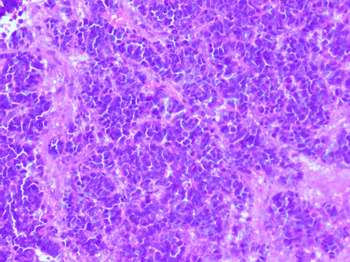
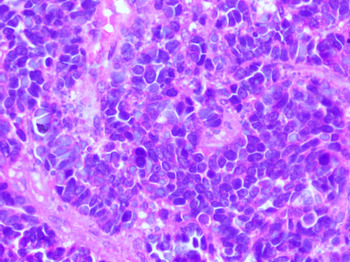
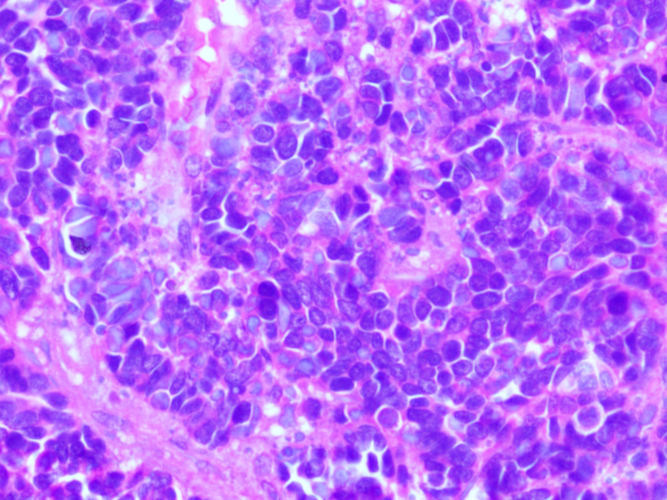
Following routine histopathological examination of the punch biopsy samples or the fresh-frozen paraffin-embedded samples, those cases with morphological features of neuroendocrine carcinomas (Figures 1 and 2) were subjected to immunohistochemical analysis. Stains used were synaptophysin, chromogranin A, neuron-specific enolase (NSE), cytokeratin, cluster differentiation 56, cellular adhesion molecule 5·2, thyroid transcription factor-1 and Ki-67.
Tumour cells arranged as nests, islands and trabeculae (100×. H&E).

Moderately pleomorphic hyperchromatic nuclei with characteristic nuclear moulding (400×, H&E).
Treatment
Most of the patients received neoadjuvant chemotherapy with cisplatin/carboplatin and etoposide followed by concurrent chemo-irradiation and brachytherapy.
Statistics
Statistical analysis was performed on IBM SPSS version 20.0 software. Mean and median were used to describe demographic characteristics.
Results
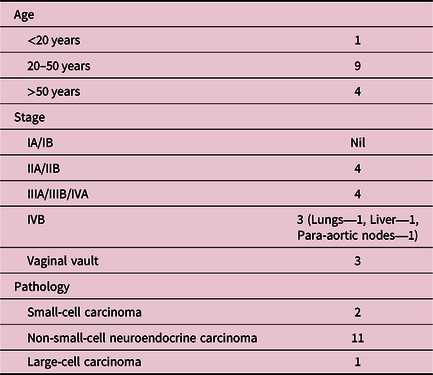
Of the 14 eligible patients identified between 2004 and 2018, 13 patients were Indian and 1 was from Bangladesh. Median age of these patients was 46 years (range 17–55 years). Patient characteristics are detailed in Table 1.
Demographic characteristics

Patient characteristics
Four patients were diagnosed to have the International Federation of Gynecology and Obstetrics (FIGO) stage IIB, one patient with stage IIIA, two patients with stage IIIB, one patient with stage IVA, three patients with stage IVB and three were post-operative patients with a recurrence in vaginal vault. The sites of metastases were liver, lungs and para-aortic nodes (as per FIGO 2009 staging6). Two patients were diagnosed with small-cell carcinoma, one patient had large-cell carcinoma and rest 11 patients were reported to have neuroendocrine carcinoma.
Immunohistochemical characteristics
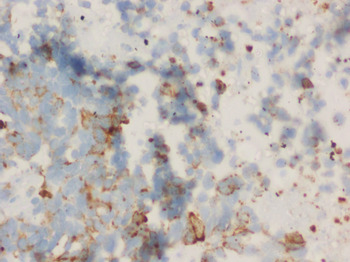
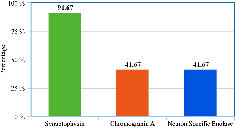
Immunohistochemistry showed that the positivity rate of synaptophysin, NSE and chromogranin A (Figure 3) were 91·67% (11/12), 41·67% (5/12) and 41·67% (5/12), respectively (Graph 1).
Tumour cells focally positive for chromogranin (200×, immunohistochemistry).

Representing the immunohistochemical characteristics.

Treatment characteristics
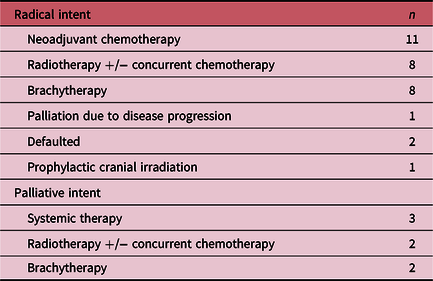
Of the 14 patients, 3 patients presented with stage IVB disease and they were treated with palliative intent. However, two patients had good disease regression with systemic therapy and they received concurrent chemoradiotherapy followed by brachytherapy subsequently. Ten patients (out of 11 patients treated with radical intent) received neoadjuvant chemotherapy with cisplatin/carboplatin and etoposide. Mean number of neoadjuvant chemotherapy cycles was 4.
Out of the ten patients who received systemic chemotherapy, seven patients received concurrent chemo-irradiation with cisplatin with or without etoposide and one patient received radical external beam radiotherapy. One patient (stage IVA) had significant disease progression despite neoadjuvant therapy and was started on palliative chemotherapy with second-line agents (taxane and platinum). Two patients defaulted treatment after neoadjuvant chemotherapy and did not come for further follow-up (Table 2). All the patients who received external beam radiotherapy were reassessed for response and were planned for intracavitary or vaginal mould brachytherapy.
Treatment characteristics
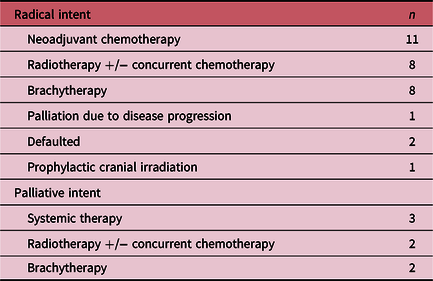
n: number of patients
The median external beam radiotherapy dose was 50 Gy delivered in 25 fractions at 2 Gy per fraction, 5 days a week over 5 weeks and the median equivalent dose in 2 Gy per fraction (EQD2) after completion of brachytherapy was 83 Gy. Six patients received external beam radiation therapy with 3D conformal technique and four patients were treated with conventional four-field box technique on a 6/15 megavolt dual energy linear accelerator.
Brachytherapy details
Two patients were treated with computed tomography-guided intracavitary brachytherapy with prescription to high-risk clinical target volume as per the Groupe Européen de Curiethérapie (GEC) and the European Society for Radiotherapy and Oncology guidelines,Reference Potter, Haie-Meder and Van Limbergen7 and all the other patients were treated following International Commission for Radiation Units and Measurements 38 guidelines8 with prescription to point A. Vaginal mould brachytherapy was following the standard loading technique (Table 3).
Brachytherapy details

a HDR—High-dose rate
b LDR—Low-dose rate
Median follow-up period was 8 months (range 1–52 months). There were no deaths during treatment. Six patients died within 4 months of completion of treatment and four patients have survived more than 1 year from the date of completion of treatment. Median overall survival period is estimated to be 12 months (range 6–52 months). Four of the seven patients who underwent combined modality treatment consisting of neoadjuvant chemotherapy, concurrent chemoradiation therapy and brachytherapy are still on regular follow-up and are disease-free. They had received four to six cycles of neoadjuvant chemotherapy followed by concurrent chemoradiotherapy and brachytherapy. Median disease-free interval was estimated to be 5·5 months (range 3–13 months).
Discussion
Although constituting less than 1·5% of all cases of cervical cancer, neuroendocrine carcinomas are the most aggressive in terms of rapidity of progression and systemic dissemination.Reference Clemens, Iris and Askin1,Reference McCusker, Coté, Clegg and Tavassoli5 Given the detrimental nature of the tumour biology, it is imperative to generate potential treatment strategies that can improve the outcomes of patients.
For the purpose of this retrospective review, a strict immunohistochemical and morphologic inclusion criteria were followed. Eleven of the 14 cases were positive for neuroendocrine markers, 6 of the 14 (42·8%) cases were positive for all 3 neuroendocrine markers. One of the patients was negative for all three neuroendocrine markers and the diagnosis was based on morphology alone. Two of the 14 patients did not have sufficient material for immunohistochemical analysis. This was similar to the study published by Viswanathan et al.,Reference Viswanathan, Deavers, Jhingran, Ramirez, Levenback and Eifel9 where they found neuroendocrine markers to be positive in 21/25 cases, 1/25 cases was not positive for any of the 3 neuroendocrine markers, while 11/21 cases were positive for all 3 neuroendocrine markers and material was insufficient for analysis for 3 patients.
Stage at presentation is the most important factor in determining the long-term outcome. Four of the patients who presented with localised disease underwent aggressive treatment with neoadjuvant chemotherapy (4–6 cycles) followed by concurrent chemoradiotherapy and brachytherapy. These are the patients who are disease-free on long-term follow-up.
Compared to non-neuroendocrine cervical cancers, neuroendocrine tumours demonstrate extremely aggressive behaviour, and in the present study, 6 of the 14 patients died within 4 months of completion of treatment due to disease progression. This was irrespective of response at the end of treatment.
In the study by Vishwanathan et al.,Reference Viswanathan, Deavers, Jhingran, Ramirez, Levenback and Eifel9 of the 21 patients who were analysed, 14 had a relapse, and all 14 died of their disease. The mean time to first relapse was 8·4 months (range, 3·6–28 months); only one patient had a relapse more than 24 months after diagnosis.
In another series by Delaloge et al.,Reference Delaloge, Pautier and Kerbrat10 only two of ten patients survived after treatment with various combinations, surgery and/or radiotherapy with chemotherapy.
Hoskins et al.Reference Hoskins, Swenerton and Pike11 used concurrent chemoradiation in patients with more advanced disease. In their study, the 3-year survival rate for patients with stages I–II, node negative disease was 80% and the survival rate for patients with more advanced disease was 38%.
Due to the aggressive nature and potential for dissemination, the role of chemotherapy takes precedence. This was studied by Chang et al.Reference Chang, Lai, Tseng, Hsueh, Huang and Chou12 in a series of 23 patients compared chemotherapy with vincristine, doxorubicin and cyclophosphamide alternating with cisplatin and etoposide versus other regimens. They found that following radical hysterectomy, 10/14 patients who received vincristine, cyclophosphamide, doxorubicin-based chemotherapy were alive as against only 3/9 patients who received other regimens. In our study, 11 patients received neoadjuvant chemotherapy, 8 of whom further went on to receive concurrent chemo-irradiation and brachytherapy. Four of these eight went on to be disease-free at the time of analysis. The findings of this study have helped in establishing the institutional protocol of neoadjuvant chemotherapy followed by concurrent chemoradiation and brachytherapy as a viable treatment option for neuroendocrine carcinoma cervix.
Limitations
Retrospective study design and small sample size considering the rarity of diagnosis.
Conclusion
Neuroendocrine carcinoma of the cervix is rare and is associated with poor prognosis. The course of the disease is frequently characterised by the development of widespread haematogenous metastasis. Early-stage, aggressively managed patients showed significantly longer survival compared to late-stage patients. In locally advanced disease, neoadjuvant chemotherapy followed by concurrent chemo-irradiation and brachytherapy is the optimal treatment of choice. However, in early stages, surgery followed by adjuvant treatment based on histopathology should be considered. In view of the high risk of disseminated metastases following definitive treatment, role of maintenance systemic therapy is thought-provoking and should be looked into.
Acknowledgements
None.
Financial Support
None.
Conflict of Interest
The authors of this study do not have any conflict of interest.
Ethical Standards
This study was initiated after approval from the institutional review board.