Introduction
Rare earth elements (REE) include lanthanide group elements as well as Y and Sc, with similar chemical properties. In general, they are divided into light REE (LREE; La–Eu) and heavy REE (HREE; Gd–Lu, Y, and Sc) (Balaram, Reference Balaram2019). REE have been used widely in high-technology fields such as medicine, mobile communication, energy, electronic devices, and national security (Balaram, Reference Balaram2019; Kynicky et al., Reference Kynicky, Smith and Xu2012; Sanematsu & Watanabe, Reference Sanematsu and Watanabe2016).
Ion adsorption-type REE deposits (IADs) contain 65–90% ion-exchangeable REE, which are predominantly adsorbed on the surface of kaolinite and halloysite (Bao & Zhao, Reference Bao and Zhao2008; Li & Zhou, Reference Li and Zhou2020; Sanematsu et al., Reference Sanematsu, Ejima, Kon, Manaka, Zaw, Morita and Seo2018). This kind of REE deposit is of great industrial significance, supplying ~15% of REE production worldwide and 90% of the global HREE (Li et al., Reference Li, Zhou and Williams-Jones2020; Riesgo García et al., Reference RiesgoGarcía, Krzemień, Manzanedo del Campo, Menéndez Álvarez and Gent2017). Currently, IADs are found mainly in South China (Guangxi province, Jiangxi province, and Guangdong province), Japan, northern Vietnam, and Thailand (Sanematsu & Watanabe, Reference Sanematsu and Watanabe2016; Xie et al., Reference Xie, Hou, Goldfarb, Guo and Wang2016; Yamaguchi et al., Reference Yamaguchi, Tanaka, Kurihara and Takahashi2018; Zhao et al., 2022).
With growing demand for REE, research on the formation process of IADs has attracted much attention in recent years (Deng et al., Reference Deng, Li, Vasconcelos, Cohen and Kusky2014; Liu et al., Reference Liu, Liu, Brantley, Xu, Zhao, Liu and Gu2016; Lybrand & Rasmussen, Reference Lybrand and Rasmussen2014). REE have been recognized as being dissolved from primary REE-bearing minerals during the weathering process under warm and humid climates (annual average temperature of 18–22°C, annual precipitation of 1400–1800 mm), and then accumulated as secondary REE minerals or through adsorption onto clay minerals and Fe–Mn (oxyhydr)oxides in the completely weathered horizon of the regolith (Lara et al., Reference Lara, Buss and Pett-Ridge2018; Li et al., Reference Li, Zhou and Williams-Jones2019; Yang et al., Reference Yang, Liang, Ma, Huang, He and Zhu2019). REE fractionation during chemical weathering is controlled by primary and secondary REE-bearing minerals, and the ligand complexation in surface water and groundwater (Cheshire et al., Reference Cheshire, Bish, Cahill, Kertesz and Stack2018; Dardenne et al., Reference Dardenne, Schäfer, Lindqvist-Reis, Denecke, Plaschke, Rothe and Kim2002; Li et al., Reference Li, Zhao and Zhou2017; Nesbitt & Young, Reference Nesbitt and Young1982; Tang & Johannesson, Reference Tang and Johannesson2010).
Most IADs are developed via prolonged weathering of REE-rich volcanic rocks, and of metamorphic rocks in southeast China (Li et al., Reference Li, Zhou and Williams-Jones2019, Reference Li, Zhou and Williams-Jones2020). As the intensive magmatic activity occurred during the Yanshanian (199.6–65.5 Ma) and Caledonian orogenesis (542–359.2 Ma) (Wang, Reference Wang2016; Zhang et al., Reference Zhang, Zheng and Guo2018), granites are widely distributed in Guangdong province, with an outcrop area of >50,000 km2 (Bao & Zhao, 2003; Ling et al., 2006). Although the strength and breadth of magmatic activity in Yanshanian times were much more intense than those in Caledonian times (Hua et al., 2013), the Caledonian Orogeny initiated the intra-continental crust evolution. The Caledonian granitoids were produced mainly by melting of crustal materials following tectonic episodes such as the Variscan (359.2–251.0 Ma), Indosinian (251.0–199.6 Ma), and Yanshanian (Sun., Reference Sun2006). Moreover, they, together with the accompanying granitic magmatism, enriched the rare metals in the crust for subsequent magmatic-hydrothermal and supergene mineralization in South China. Therefore, the widespread Caledonian granitoids provide a rich material basis for the formation of IADs.
According to regional geological reports, there is indeed a widespread distribution of Caledonian granitoids in Maofeng Mountain in Guangzhou city, Guangdong province. Interestingly, from recent research (Wang et al., 2022), it was found that REE concentrations in the Maofeng Mountain regolith were up to ~2000 mg kg–1 and averaged 900 mg kg–1, which exceeded the industrial grade of IADs (500 mg kg–1) (Bao & Zhao, Reference Bao and Zhao2008). Moreover, ion-exchangeable REE were prevalent in the regolith. However, the geochemical characteristics and REE fractionation in the Maofeng Mountain regolith remain poorly known. Hence, the present study focused on the REE enrichment and fractionation in the regolith of Maofeng Mountain based on mineralogical and geochemical analyses. The objectives of the present study were to: (1) elucidate the weathering characteristics of regolith, and the migration and fractionation of REE in the regolith; (2) determine the distribution of REE via sequential extraction; and (3) clarify the key factors controlling REE enrichment in the regolith. The present study revisits the REE enrichment and fractionation mechanism in the IADs in Guangzhou city and provides new insight into the genesis of IADs in the weathering crusts of metamorphic rocks.
Geological Background
The regolith of Maofeng Mountain is located in Guangzhou City, Guangdong Province (Fig. 1). Guangzhou (112° 57′–114° 3′ E, 22° 26′– 23° 56′ N), Guangdong province, is located in southern China, north of the Pearl River Delta. The climate of Guangzhou is subtropical maritime monsoon, which is characteristically humid and wet with a mean annual temperature of 20–22°C and an annual rainfall of 1720 mm/y (Gu et al., Reference Gu, Gao and Lin2016).
Simplified geological map of the Maofeng Mountain area (from national geological archives of China, 1:200,000 scale)

The Maofeng Mountain area is composed of the Maofeng Mountain pluton and a small part of the Nanxiang Mountain pluton (Fig. 1). The Maofeng Mountain pluton is elongated from east to west, with an exposed area of 89 km2. It is composed mainly of grey–off-white, equigranular Caledonian granodiorite gneiss (410–460 Ma), which is found in the northern and southern parts of the pluton and consists of plagioclase (40–55%), quartz (20–30%), biotite (10–15%), and microcline (15–20%). Granitic gneiss is located mainly in the middle part of Maofeng Mountain pluton and is composed of microcline (30–40%), quartz (20–30%), plagioclase feldspar (25–35%), and biotite (5–10%). Small quantities of the Nanxiang Mountain pluton are exposed in the eastern part of the Maofeng Mountain area and consists of Indosinian (251–199.6 Ma) fine-grained granite intruding into the Maofeng Mountain pluton. Biotite granite is observed in Yanshanian magmatic rock intrusions at a small scale (199.6–65.5 Ma). This type of rock is found frequently in the Nanxiang Mountain and Maofeng Mountain plutons.
Materials and Methods
Sample Preparation
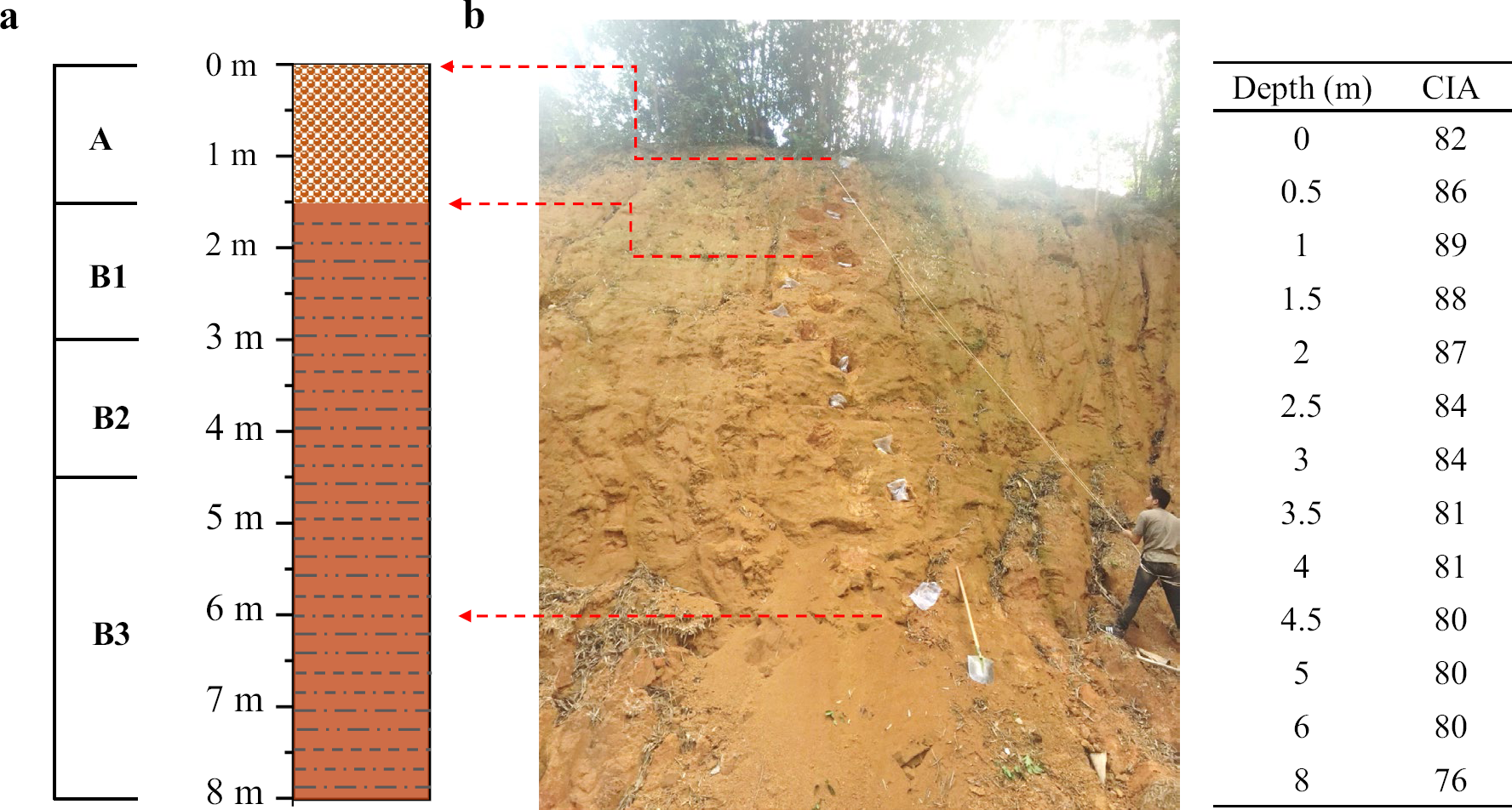
The sampling site (113°27′10" E, 23°18′31" N, 102.8 m) is located on the Maofeng Mountain, Guangzhou city, Guangdong province. The topographic features of Maofeng Mountain are at low elevations, the Maofeng mountain is 534.9 m tall at its highest point. The deposit is hosted in the fresh regolith, which is quarried beside the road by an excavator. The samples studied were taken from a regolith profile at intervals of 0.5–1.0 m using a stainless steel shovel. The regolith profile (0–8 m, n = 13) is composed of brownish-red topsoil (from the surface to a depth of 1.5 m) and completely weathered regolith (from a depth of 1.5–8 m) (Fig. 2). No fresh bedrock is present at the bottom of the profile, thus two relatively fresh bedrock samples were collected (labeled MF1, MF2) from nearby (20–30 m) outcrops (Fig. S1).
a Regolith profile of Maofeng Mountain and b outcrop photograph showing weathering stages and the CIA value of the regolith

A total of 15 samples were obtained. These samples were dried at 40°C in an oven and ground to a fine powder (200 mesh) using a ball mill (FRITSCHP 6, Shanghai, China). Powdered samples were prepared for mineralogical and elemental determinations and REE speciation.
Mineralogical Composition
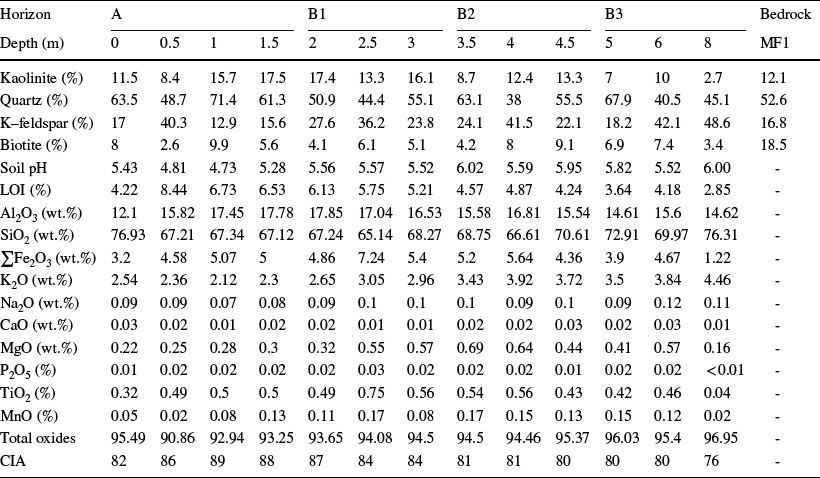
The mineralogical compositions of the samples were measured using a Bruker D8 Advance X-ray diffractometer (Karlsruhe, Germany) at between 3 and 80°2θ at a fast scanning speed of 3° min−1 with CuKα radiation (40 mA and 40 kV). The X-ray diffraction (XRD) data were processed using Jade 6.5 software, and the quantitative calculation of minerals was obtained by Rietveld and a reference intensity ratio (RIR) method. The results are listed in Table 1.
Mineralogical compositions and major element concentrations for the regolith profile studied at Maofeng Mountain, Guangzhou, South China

Major Element Analysis
The major element concentrations of the samples were measured at the Australian Laboratory Services Mineral, ALS Chemex (Guangzhou city, Guangdong province, China) Co. Ltd. The method uses a Panalytical PW2424 X-ray fluorescence spectrometer (Almelo, Netherlands) with fused glass beads. The analytical precision was better than 5% for all major elements (K, Na, Ca, Mg, Al, Si, Fe, P, Ti, Mn, and LOI); results are listed in Table 1.
The chemical index of alteration (CIA) is used to estimate the degree of weathering alteration as follows: (Eq. 1) (Nesbitt & Young, Reference Nesbitt and Young1982)

where the CaO was not from carbonate.
REE Analysis
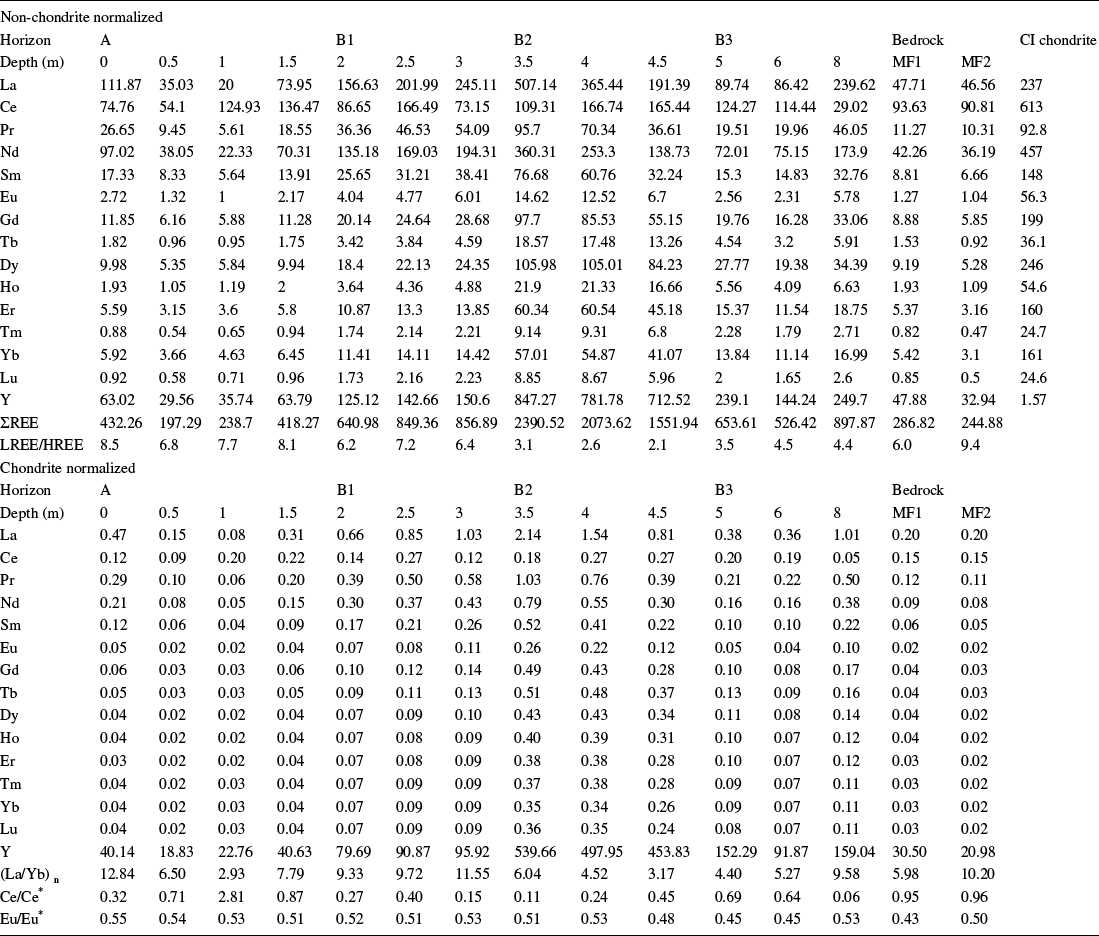
The concentrations of REE in the bulk samples were analyzed at the State Key Laboratory of Isotope Geochemistry, GIGCAS. Following this, ~0.4 g of each sample was digested with a mixture of HNO3-HF-HClO4 in a closed Teflon beaker and heated in an oven at 190°C for 40 h. The digested samples were evaporated to dryness at 100°C and then redigested with a mixture of HNO3-HF-HClO4 at 190°C for 2 days. The redigested samples were evaporated to dryness at 100°C, dissolved in HNO3 until no residue remained, and then further diluted with 2% HNO3 for REE measurements. The analyses were carried out using a Thermo Icap Qc Inductively Coupled Plasma-Mass Spectrometer (ICP-MS, Thermo Fisher Scientific, America) with an accuracy of <3% relative standard deviations. The analytical precision for the trace element contents was better than 3% relative standard deviation. The results of REE analyses are given in Table 2.
REE concentrations (non-chondrite normalized and chondrite-normalized) in the Maofeng regolith, Guangzhou, South China

All concentrations are in mg kg–1, CI chondrite (McDonough & Sun, 1995)
In the present study, REE contents (ΣREE) including lanthanide elements and Y in regolith samples were normalized (i.e. REEN) using the chondrite reference value (McDonough & Sun, 1995). The REE distribution patterns were estimated by LREE/HREE, Eu/Eu*, and Ce/Ce*. The LREE/HREE values are non-chondrite normalized, and LREE refer to La–Eu while HREE refer to Gd–Lu not including Y. The Ce anomaly (Ce/Ce*) was calculated by {2*CeN/ [LaN + PrN]}, and the Eu anomaly (Eu/Eu*) was calculated by {2*EuN/ [SmN + GdN}. The REE fractionation and geochemical characteristics of the regolith were analyzed through the Pearson correlation coefficient via IBM SPSS Statistics 25. A level of p < 0.05 was considered statistically significant for multiple comparisons and linear regression analysis, and 0.05 < p < 0.01 was considered a strong statistical significance.
Soil pH Analysis
The soil pH of the regolith profile was measured by the following process: 10.0 g of each powdered sample (200 mesh) was mixed with 25.0 g of Milli-Q water (18.25 MΩ cm) in a capped beaker for 8 h. Then the supernatant was collected and filtered for measuring the pH values using a Mettler-Toledo Five Easy Plus™ pH meter (Zurich, Switzerland), and the precision was ± 0.02. The results of pH analyses are given in Table 1.
Sequential Extraction Experiments
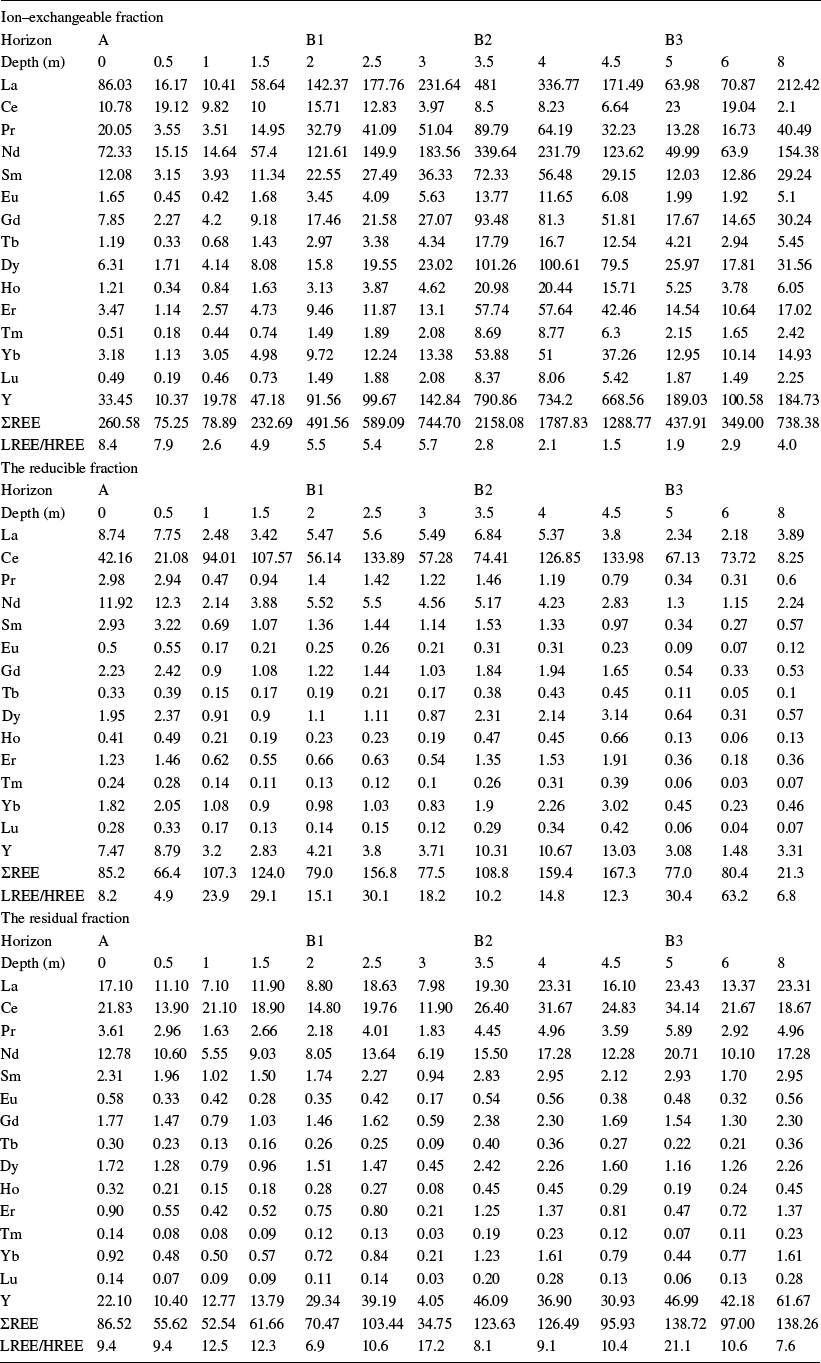
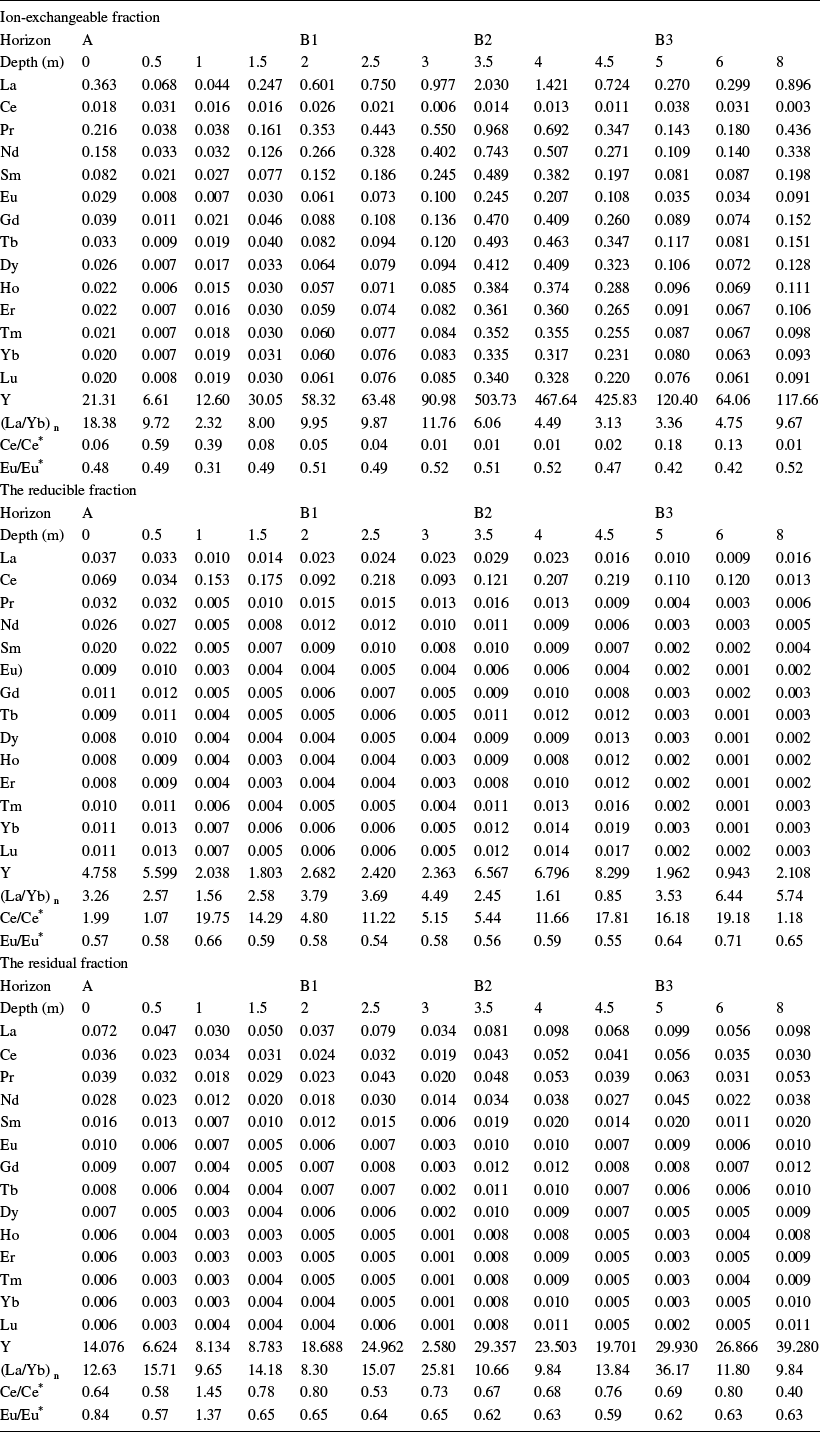
Sequential extraction of REE was conducted to quantify the various species of REE in the regolith, following the method described by Huang, Y., et al. (Reference Huang, He, Liang, Bao, Tan, Ma and Wang2021). The REE speciation obtained included ion-exchangeable, reducible, and residue fractions (Tables 3, 4 and 5). The ion-exchangeable fraction refers to the REE adsorbed mainly by clay minerals and which can be exchanged with other cations, and it is the most important REE speciation in IADs during mining. The reducible fraction refers to REE associated with Fe–Mn (oxyhydr)oxides, while the residual fraction refers to the REE involved in REE-bearing minerals that were stable throughout the regolith. Details of the sequential extraction method are listed as follows:
(1) Ion-exchangeable fraction: 1.00 g of bulk sample (200 mesh) was mixed with 10 mL of Mg (NO3)2 solution (1 mol L–1, pH 5.0 ± 0.2) in Teflon centrifuge tubes; the centrifuge tubes were shaken at room temperature (25 ± 0.2°C) for 2 h. The supernatant was collected and filtered through a 0.45 μm membrane for REE quantity analysis.
(2) Reducible fraction: 10 mL of NH2OH⋅HCl solution (0.2 mol L–1, pH = 2.0 ± 0.2) was added to the residue and shaken at room temperature (25 ± 0.2°C) for 30 min. The supernatant was heated in a 95°C water bath kettle (BHS-2, Lingke, shanghai, China) for 7 h and then shaken for 2 h. The supernatant was collected and acidified with 2% HNO3 and stored at 4°C, until REE concentration analysis.
(3) Residue fraction: the REE content in the residue fraction was calculated by subtracting the sum of those in the ion-exchangeable and the reducible fractions from the total REE content of samples obtained by trace element analyses.
The ion-exchangeable, reducible, and residual fraction of REE (non-chondrite normalized) in the Maofeng regolith, Guangzhou, South China

all concentrations are in mg kg–1
The ion-exchangeable, reducible, and residual fraction of REE (chondrite normalized) in the Maofeng regolith, Guangzhou, South China

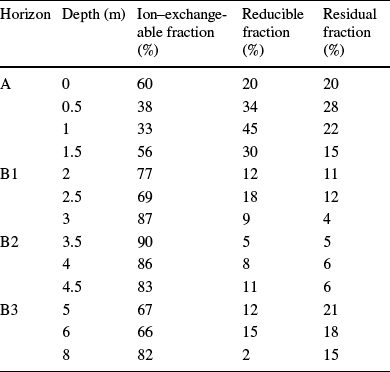
The percentage of all fractions in the total REE of the regolith profile studied in Maofeng Mountain, Guangzhou, South China

Results
Characteristics of the Maofeng Regolith Profile
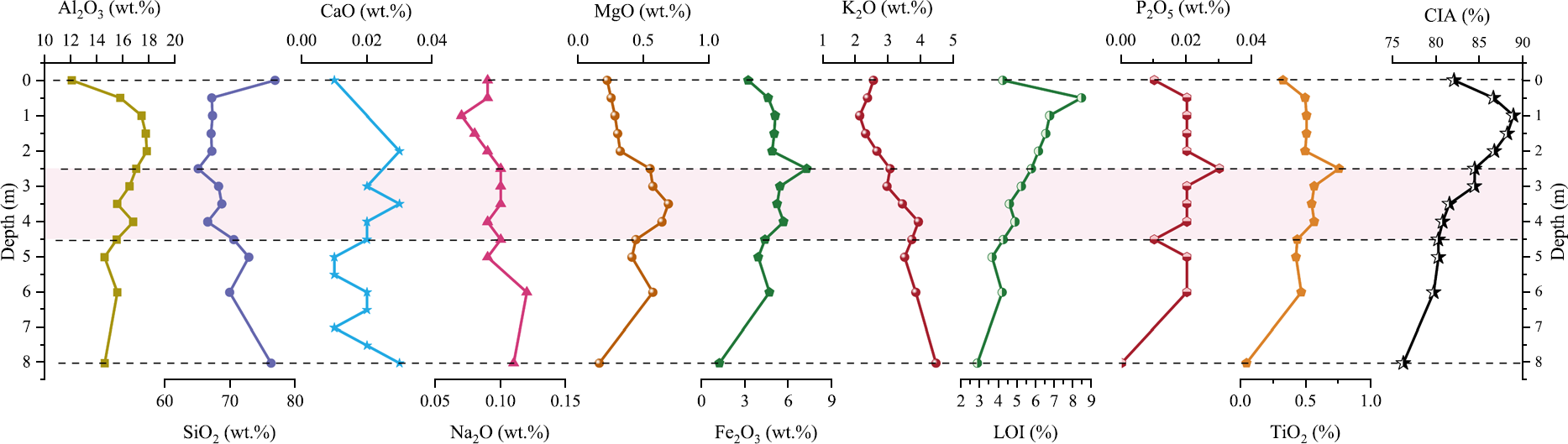
The chemical evolution of regolith is controlled by the stability of minerals and the mobility of elements during weathering. From the top down, the Maofeng regolith profile can be divided into different horizons based on the CIA values and the ΣREE, including a lateritic horizon (A horizon, 0.0–1.5 m) and a completely weathered horizon (B horizon, 1.5–8.0 m). The B horizon consists of an upper completely weathered horizon (B1 horizon, 1.5–3.0 m), a middle completely weathered horizon (B2 horizon, 3.0–4.5 m), and a lower completely weathered horizon (B3 horizon, 4.5–8.0 m) (Fig. 2).
The A horizon is characterized by a high degree of weathering (CIA average 86) and low ΣREE (197–432 mg kg–1) (Figs. 3 and 4). Brownish red topsoil with a loose structure containing a small number of pores is dominant in the A horizon, while feldspar and clay minerals with some rounded residual quartz grains are observed in the A horizon. REE are enriched in the B horizon, which has a relatively low degree of weathering. The B1 horizon (CIA: 84–88) is moderately enriched in REE (ΣREE: 418–857 mg kg–1). The soil in this horizon is mottled red and white soil composed of Fe-oxide minerals and clay mineral aggregates. The B2 horizon (CIA: 80–84) is the most enriched in REE (ΣREE: 857–2391 mg kg–1) in all horizons. The soil in this horizon is a mottled pink–yellow rock. The B3 horizon (CIA: 76–80) is slightly enriched in REE with ΣREE ranging 526–1552 mg kg–1. This horizon exhibits a yellow color and contains fragments of protolith rock (Fig. S2).
Variations of major element concentrations and the CIA with depth in the regolith profile. The shaded area represents the REE-rich horizon (at depths of 2.0–4.5 m)

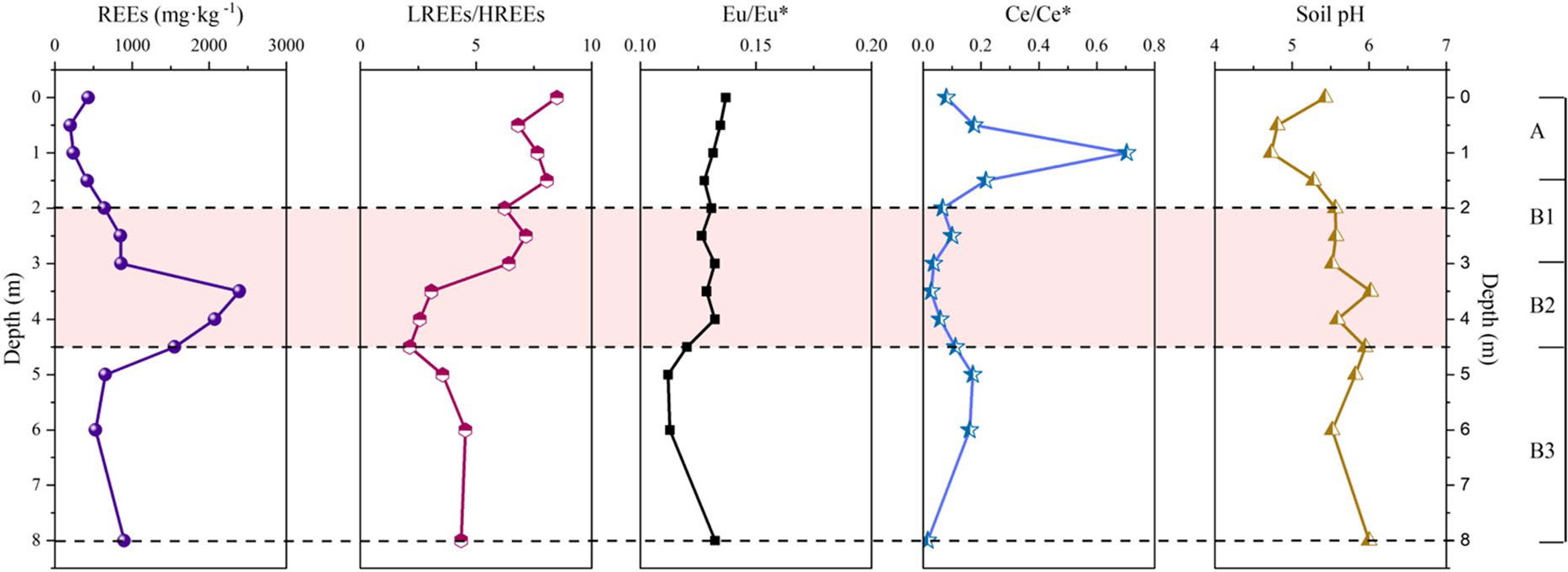
Vertical variations of REE indices (ΣREE, LREE/HREE ratios, Eu and Ce anomalies values) and pH values in the regolith. The shaded area represents the REE-rich horizon (at depths of 2.0–4.5 m)

The CIA values show an increasing trend from 76 at the lower B3 horizon to 89 at the upper A horizon. The exception is the fluctuation in the topsoil, with CIA changing from 89 at 1.5 m to 82 at the top. The pH values range from 4.73 to 6.02 in the regolith. The soil pH value decreases progressively from 6.00 at a depth of 8 m to 5.59 in the B2 horizon (at a depth of 4 m) and shows a maximum value (6.02) in the upper B2 horizon, followed by a decrease to 4.73 in the A horizon (at a depth of 1 m). In the topsoil, the soil pH does not change significantly, ranging from 4.81 to 5.43 (Fig. 4). The relatively low pH of the A horizon may be influenced by organic acids produced by vegetation.
Mineralogical Components of the Regolith Profile
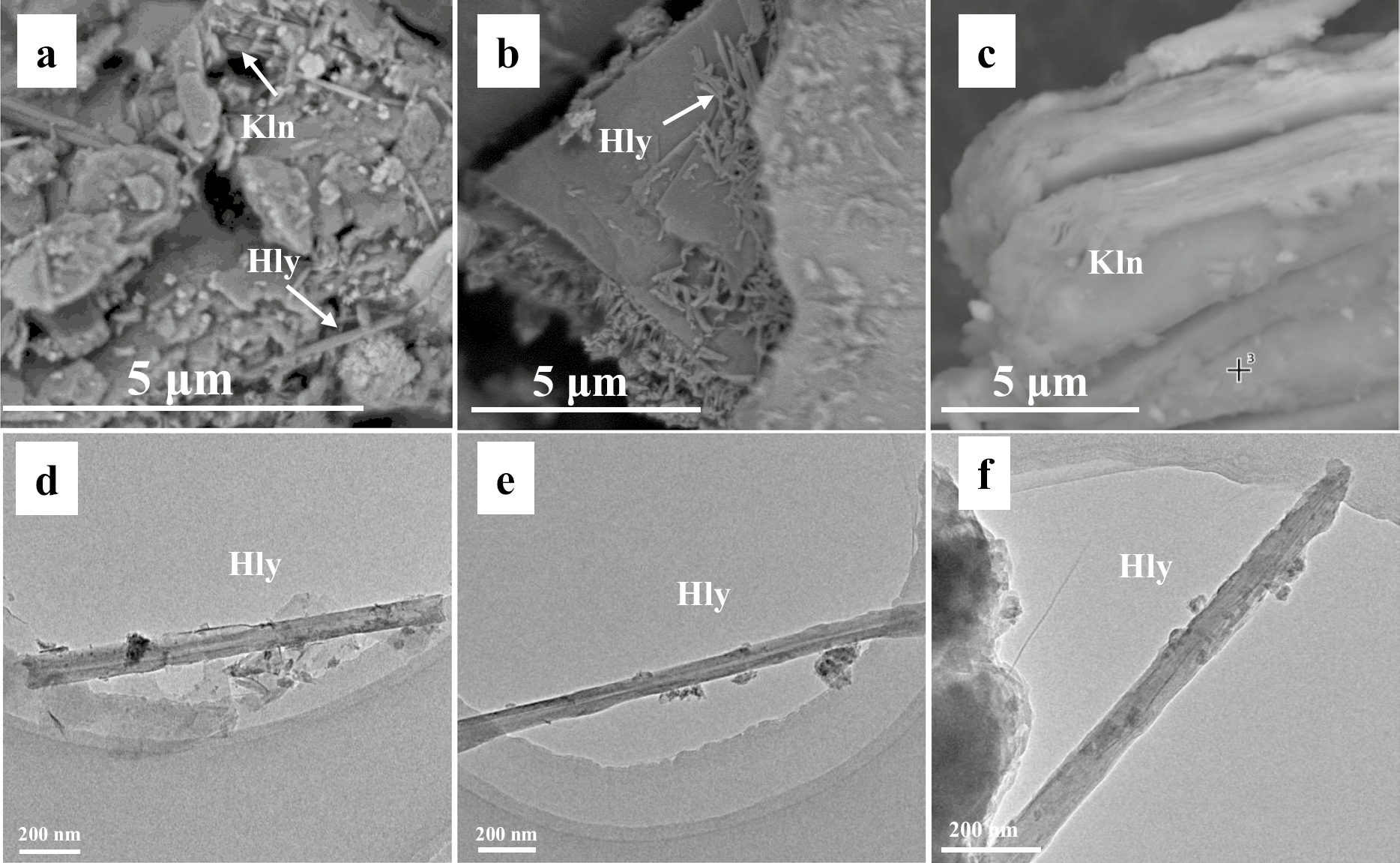
Based on XRD characterizations (Table 1, Fig. S3), the main minerals in the regolith are biotite, quartz, K-feldspar, and kaolinite. The bedrock consists of biotite (19%), quartz (53%), K-feldspar (17%), and kaolinite (12%). The amount of quartz present at the lower B3 horizon and the A horizon increases gradually from 45% (at a depth of 8 m) to >60% (the topmost surface), while the K-feldspar content decreases gradually from 49 to 17%. Kaolinite is the main clay mineral in the regolith and its content exhibits an increasing trend from bottom to top. It increases gradually from 3% in the B3 horizon to 17% in the upper B1 horizon (at 2 m depth) with some fluctuations in the upper A horizon. Although the XRD peak of halloysite is not found, halloysite is abundant in the regolith samples via transmission electron microscopy (TEM) and scanning electron microscopy (SEM) analyses (Fig. 5). The biotite concentration increases from 3% at the lower B3 horizon to 9% in the lower B2 horizon (at 4.5 m depth) and decreases to 5% at the A horizon. Overall, the K-feldspar content decreases progressively with intensified weathering, while the amounts of quartz and kaolinite increase.
Scanning electron microscopy backscattered electron images (a, b, c) and transmission electron microscopy images (d, e, f) of the clay minerals. The main clay minerals in the Maofeng Mountain regolith are halloysite (Hly) and kaolinite (Kln) (abbreviations after Warr, Reference Warr2020)

Major Element Variation
From the bottom to the top of regolith, the SiO2 content shows a gradually decreasing trend, from 76.3 wt.% in the lower B3 horizon (at a depth of 8 m) to 69.7 wt.% in the A horizon (Fig. 3, Table 1). The Al2O3 content remains stable and varies between 14.62 and 17.45 wt.% at a depth of 8 to 1 m, followed by the abrupt decrease to 15.8–12.1 wt.% at topsoil (0–0.5 m). However, the K2O and Na2O contents decrease gradually from 4.46 and 0.11 wt.% in the lower B3 horizon to 2.54 and 0.09 wt.%. The CaO and MgO contents are so small that they were ignored. The Fe2O3 is concentrated mainly in the B1 and B3 horizons (particularly at 2.5–4.5 m), with the highest value of 7.24 wt.%. According to Li et al. (Reference Li, Zhao and Zhou2017), P2O5 is used to represent the abundance of apatite and monazite, while CaO and TiO2 are used to represent the abundance of titanite. The P2O5 content ranges from 0.01–0.03 wt.% in the regolith, with the highest value (0.03 wt.%) in the B1 horizon. The concentrations of CaO + TiO2 are higher in the B1 (0.61 wt.%) and B2 (0.53 wt.%) horizons, suggesting that titanite might be abundant in the B1 and B2 horizons.
REE Abundances
The ΣREE in the bedrock range from 245 to 287 mg kg–1 (Table 2). The ΣREE content increases to 526–898 mg kg–1 in the B3 horizon (at a depth of 5–8 m). There is a subsequent rapid increase to a maximum of 2391 mg kg–1 in the B2 horizon (at a depth of 3.5 m). After that, ΣREE decreases to 418–857 mg kg–1 in the B1 horizon (at a depth of 1.5–3 m). In the A horizon, ΣREE decrease to 197 mg kg–1 (at a depth of 0.5 m), which is the lowest in the regolith (Fig. 4).
The REE distribution patterns show that the bedrock is enriched in LREE with LREE/HREE ranging from 6.0 to 9.4 (Table 2). Slightly negative Ce anomalies (Ce/Ce*: 0.95–0.96) and moderately negative Eu anomalies (Eu/Eu*: 0.43–0.50) are observed in the bedrocks. The regolith displays LREE enrichment with significant Eu and Ce negative anomalies (Fig. 6). The exceptions are the B2 and upper B3 horizons (at depths of 3.5–5 m), which show slight HREE enrichment patterns. Thus, the REE distribution patterns of the regolith profile are identical to those of the bedrock.
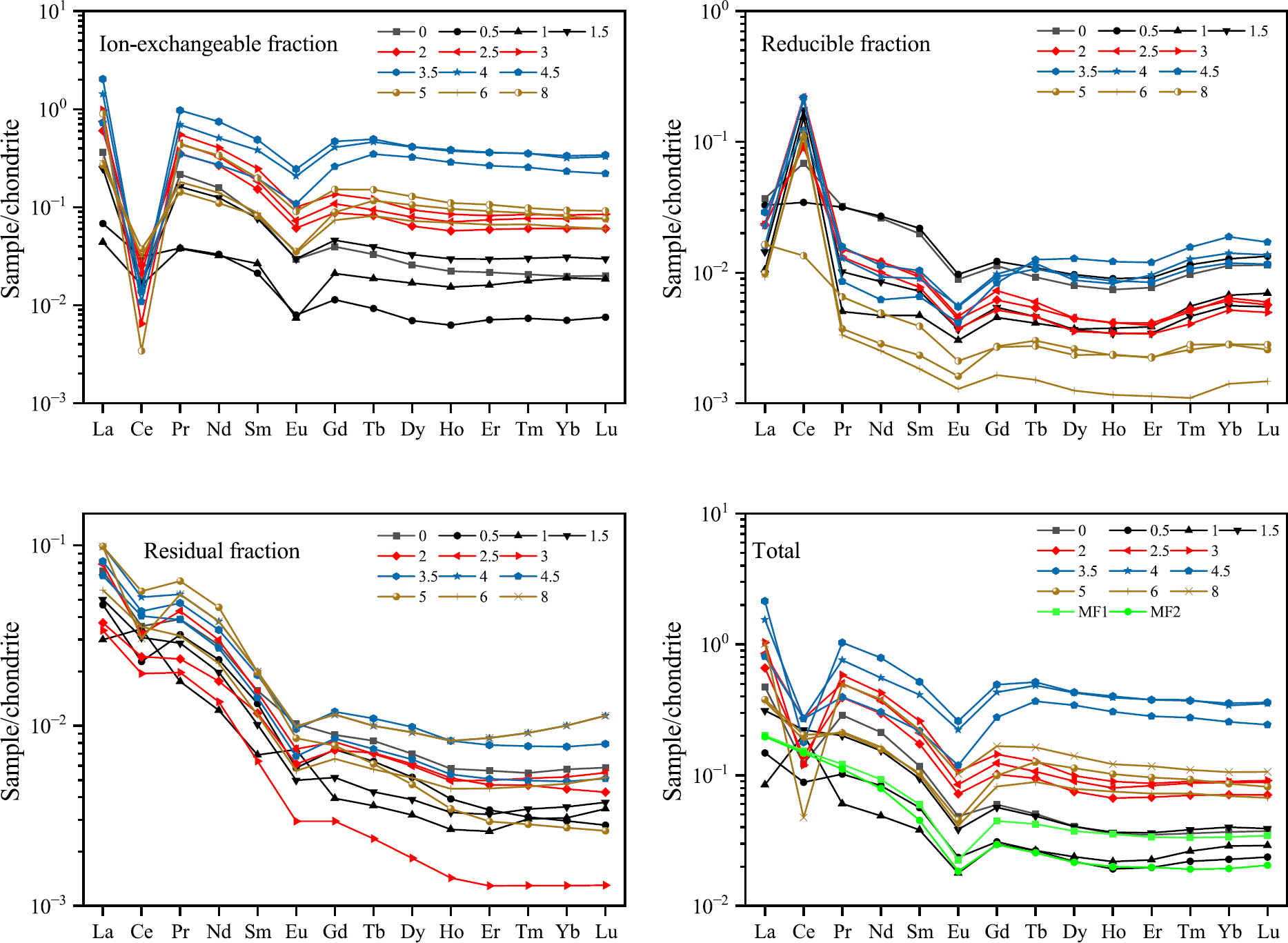
Chondrite-normalized REE patterns in ion-exchangeable, reducible, and residual fractions and total REE throughout the samples at various depths of the regolith profile

The LREE/HREE ratios display a general decrease from 4.4 in the lower B3 horizon (at a depth of 8 m) to 2.1 in the B2 horizon (at a depth of 4.5 m), followed by an overall increase to 8.5 in the A horizon (the topmost surface). In the whole regolith profile, chondrite-normalized REE patterns exhibit stable negative Eu anomalies with the Eu/Eu* values ranging from 0.45 to 0.55. The Ce/Ce* values are 0.06 in the B horizon (at a depth of 8.0 m), followed by a maximum value of 2.8 in the A horizon (at a depth of 1.0 m). It returns to 0.3 at the top of the A horizon.
REE Speciation
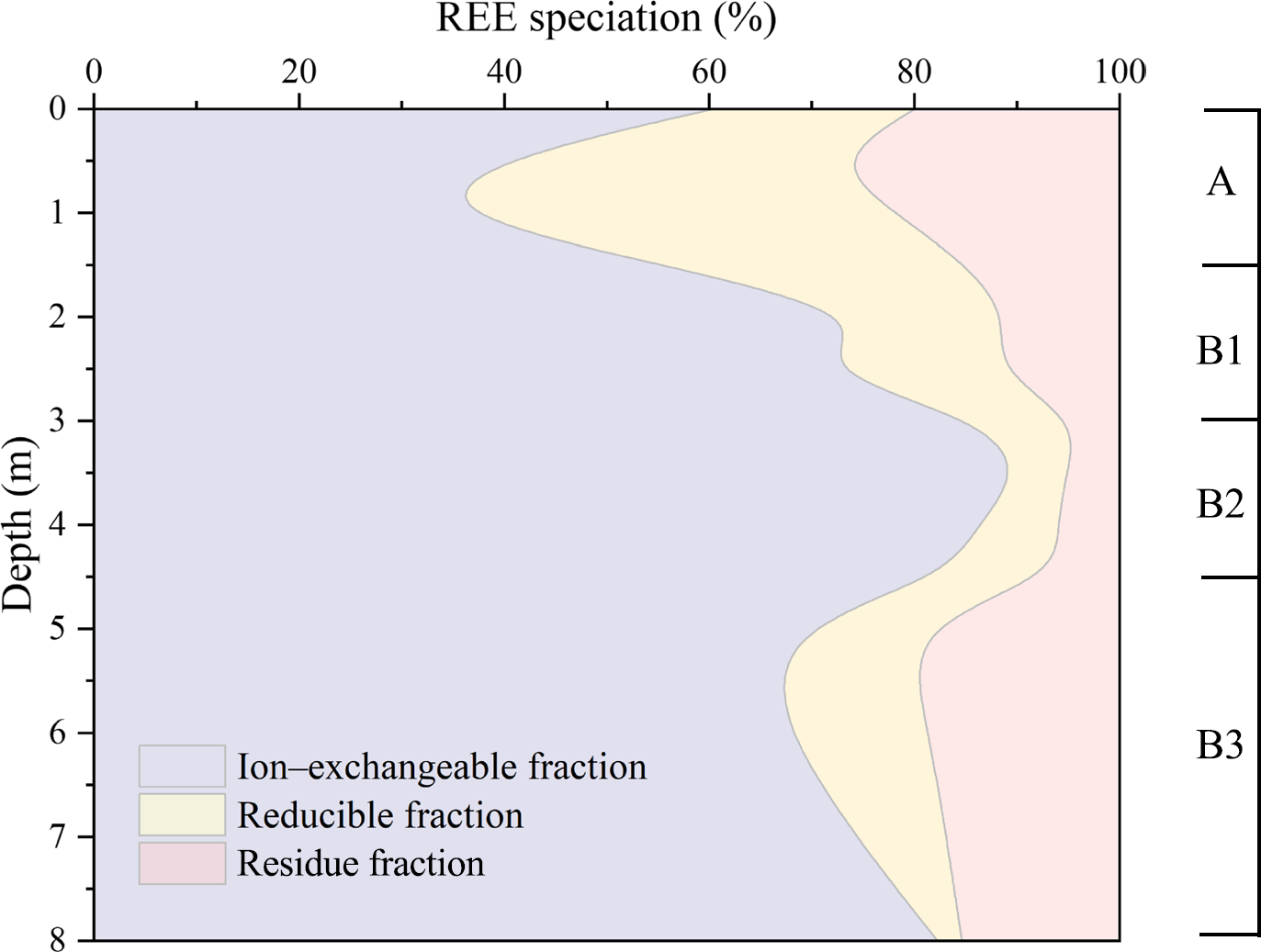
Along the regolith profile, REE are present mainly in the ion-exchangeable and reducible fractions. The proportion of ion-exchangeable, reducible, and residual fractions in the total REE varies with depth (Fig. 7, Tables 3, and 5).
Variations in REE speciation with depth in the regolith profile of Maofeng Mountain

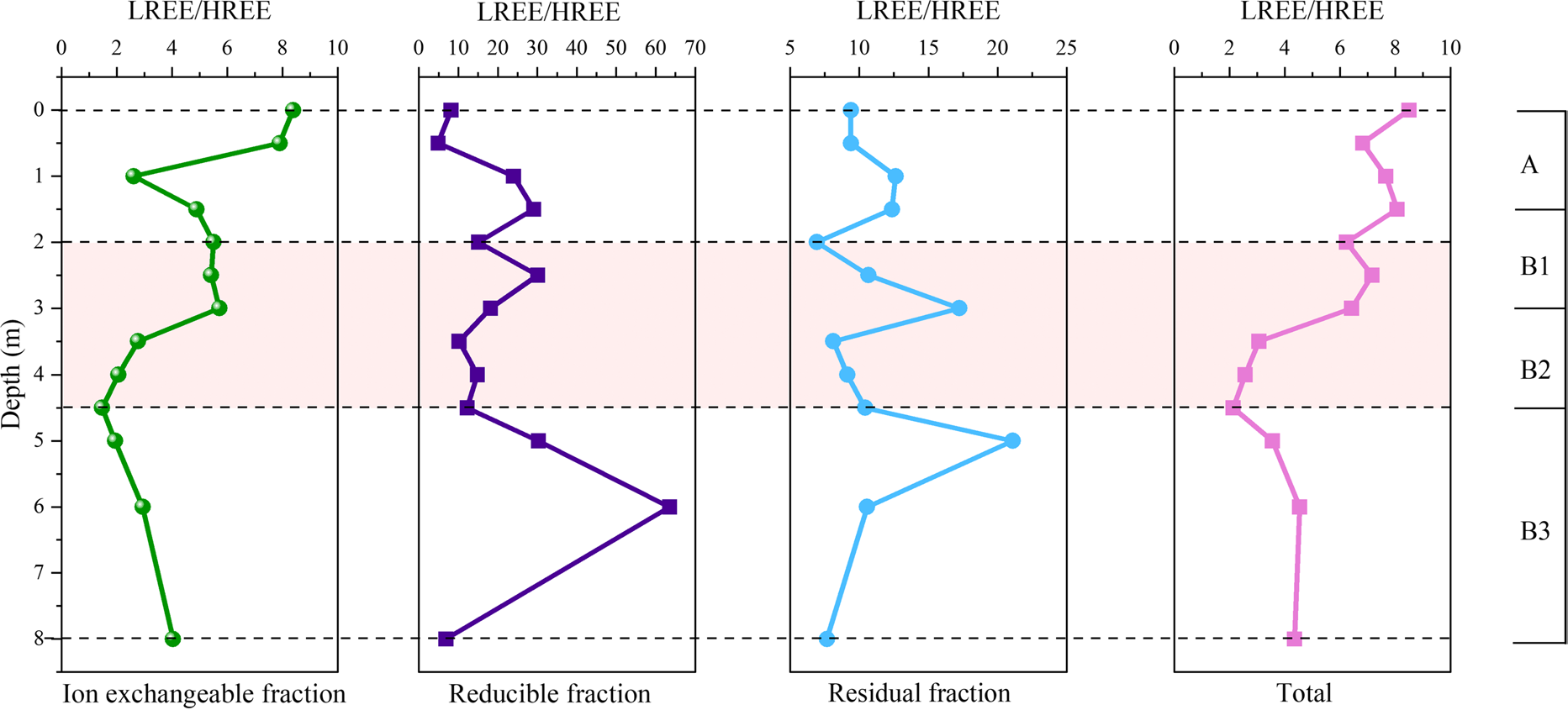
From the B3 horizon to the A horizon, the proportion of the ion-exchangeable REE fraction decreases slowly from 82% (ΣREE, 738 mg kg–1) at a depth of 8 m to 67% (ΣREE, 438 mg kg–1) at 5 m and then increases rapidly from 83% to as high as 90% (ΣREE, 1289–2158 mg kg–1) in the B2 horizon (at depths of 3–4.5 m). Following this, it decreases gradually to 77% (ΣREE, 492 mg kg–1) in the upper B1 horizon (at a depth of 2 m) and 38% (ΣREE, 75 mg kg–1, at a depth of 0.5 m) in the A horizon, and eventually increases to 60% (ΣREE, 261 mg kg–1) at the top of the regolith. Overall, there is a dramatic increase in the concentration of the ion-exchangeable REE at a depth of 5 m and a marked decrease after a depth of 2 m, resulting in significant enrichment at depths of 3–5 m. LREE enrichment is observed in the ion-exchangeable fraction while the LREE/HREE ratio ranges from 1.5 to 8.4 (Table 3). The LREE/HREE ratio decreases from 8.4 in the A horizon (the topmost surface) to 2.1 in the B2 horizon (at 4 m depth), followed by a slight increase to 4.0 in the B3 horizon (at 8 m depth).
The reducible fraction increases slightly from 2% (ΣREE, 21 mg kg–1) at the bottom of the B3 horizon to 12% (ΣREE, 77 mg kg–1) in the upper B3 horizon (at a depth of 5 m) and then decreases to 5% (ΣREE, 109 mg kg–1) in the upper B2 horizon (at a depth of 3.5 m). Then it increases quickly to 20–45% (ΣREE, 66–124 mg kg–1) in the A horizon (at depths of 0–1.5 m). Overall, the reducible fraction is enriched mainly in the upper B3 horizon and A horizon (Fig. 7). The LREE/HREE ratio ranges from 4.9 to 63.2 for the whole regolith. Moreover, the LREE/HREE ratio is greatest in the B3 horizon (63.2, at 6 m depth), following the progressive decrease in the A horizon (8.2, at the topmost surface).
The residual fraction has a constant content of 18% (ΣREE, 97–139 mg kg–1) in the B3 horizon (at depths of 5–8 m) with slight fluctuations, followed by a rapid decrease to a minimum of 4% (ΣREE, 35 mg kg–1) in the lower B1 horizon (at a depth of 3 m). It subsequently increases to 20–28% (ΣREE, 56–87 mg kg–1) in the upper A horizon (at depths of 0–0.5 m) (Fig. 7). REE distribution patterns of the residual fraction show obvious LREE enrichment, with LREE/HREE ranging 6.9 to 21.1. The degree of LREE enrichment (LREE/HREE: 20.5 ± 15.0; average ± standard deviation) in the reducible fraction is much greater than it is in the ion-exchangeable fraction (LREE/HREE: 4.3 ± 2.2) and residual fraction (LREE/HREE: 11.2 ± 2.1).
Discussion
Factors Controlling the Weathering and Mineralization of the Profile
In the current study, the factors that control the REE enrichment in the Maofeng Mountain regolith have been discussed. REE enrichment in the regolith during chemical weathering refers to element mobilization and redistribution, which are controlled by regional exogenetic conditions (e.g. climate, landforms, vegetation, and water) and regolith development (mineralogy and mineral–fluid interaction) (Huang et al., 2021a; Laveuf & Cornu, 2009).
The continuous denudation and uplift in Maofeng Mountain (high denudation rate: 0.1 mm/a) (Liu., 2007) expose fresh bedrock to the weathering system, which is favorable to the development of regolith as well as accumulation of REE (Li et al., Reference Li, Zhao and Zhou2017). Meanwhile, the landform of Maofeng Mountain is characterized by low and flat hills ~500 m in height (Xiao. et al., Reference Xiao, Liu, Xu, Li and Chen2004), which is similar to that of the majority of IADs (Yang & Xiao, Reference Yang and Xiao2011; Zhang et al., Reference Zhang, Qiu and Wang2013). The warm humid and rainy climate of Guangzhou city facilitates the weathering process on Maofeng Mountain (White & Blum, Reference White and Blum1995). In particular, the frequency of acid rain in the Guangzhou area ranges from 61 to 96% (average value of 73%) during 1996–2005 and 2008–2012. The average pH of acid rain is 4.53, reflecting strong and moderate acid precipitation (Liu et al., Reference Liu, Song and Xu2006; Wu, Reference Wu2006; Yang et al., Reference Yang, Wang, Cheng and Zhang2014). The acid rain in the Guangzhou area of frequent precipitation and low pH penetrates the regolith by vertical infiltration, which also reduces the pH of the upper regolith units compared to the lower units (Fig. 4). Similar phenomena were also observed in other regolith profiles (Bai et al., 1989; Deng, Reference Deng1985). The mobilization of REE occurs in acidic to circumneutral conditions and immobilization happens in alkaline environments (Wood, Reference Wood1990). However, excess rainfall probably causes REE to be depleted in the regolith (Bai et al., 1989). Therefore, moderate rainfall, especially acid rain, promotes the breakdown of primary minerals and the leaching of elements including REE from the regolith.
Bedrock with abundant REE is the key factor controlling REE enrichment (Sanematsu et al., Reference Sanematsu, Kon and Imai2015; Zhu et al., 2022). The average ΣREE in the bedrock is 266 mg kg–1, which is higher than the average ΣREE (~ 229 mg kg–1) of granites in South China (Shi et al., Reference Shi, Yan, Liu, Chi, Hu, Gu and Yan2005). The REE-bearing minerals include apatite, zircon, and allanite (Bureau and of Geology and Mineral Resources, 1988); apatite and allanite are LREE-enriched minerals while zircon is a HREE-enriched mineral (Hoskin & Schaltegger, Reference Hoskin and Schaltegger2003; Li et al., Reference Li, Zhao and Zhou2017). The LREE-enrichment of the bedrock is probably attributed to the different proportions of LREE-bearing and HREE-bearing minerals and the degree of weathering. The bedrock consists mainly of quartz (SiO2), K-feldspar (K[AlSl3O8]), and biotite (K (Mg, Fe)3(AlSi3O10) (F, OH)2) (Table 1 and Fig. S3). The amount of MgO is probably related to REE enrichment in the regolith; the weathering process of biotite consumes acid, leading to the increase in soil pH and promoting the adsorption and enrichment of REE.
REE Enrichment and Fractionation in the Regolith
During continuous leaching, elements mobilized downward in the weathering profile are scavenged by secondary minerals including kaolinite, halloysite, gibbsite, and hematite and REE become depleted in the topsoil and accumulate in the lower horizons with higher pH (Chi et al., Reference Chi, Tian, Li, Peng, Wu, Li and Zhou2005; Wang et al., Reference Wang, Zhao, Yu, Zhao, Li, Dai and He2013; Zhao et al., Reference Zhao, Wang, Chen, Chen, Zheng and Liu2014). Therefore, the vertical change of ΣREE in the regolith shows a parabolic shape (Fu et al., Reference Fu, Li, Feng, Feng, Peng, Yu and Lin2019a, 2019b), which is also observed in the Maofeng regolith (Fig. 4).
REE enrichment of the Maofeng Mountain regolith occurs mainly at the completely weathered layer (B1, B2, and B3 horizons), particularly at a depth of 2.5–4.5 m (ΣREE: 849–2391 mg kg–1). The peak positions of ΣREE along the various profiles are different and are controlled by the properties of the bedrock (permeability), soil pH, and the groundwater table (Huang et al., 2021a). Literature shows that the ore bodies are located in the lower parts of the completely weathered horizon and the upper parts of the semi-weathered horizon (Zhou et al., 2020). However, Huang et al. (2021b) focused on the weathering crust of metamorphic rock and found that due to the low permeability of the metamorphic rock and pH conditions (5.14–6.67), REE became enriched in the middle and upper parts of the completely weathered horizon. The peak of ΣREE is located in the upper, completely weathered layer of the Renju regolith profile and is affected by the groundwater table (Huang et al., 2021a).
In the current study, the soil pH at a depth of 2.5–4.5 m ranged from 5.52 to 6.02, which is the most favorable range for adsorption of REE cations by clay minerals (5.5–6.5) (Bao, Reference Bao1992). The types and amounts of clay minerals are the most important factors affecting the adsorption capacity of ion-exchangeable REE in the regolith. In particular, kaolinite and halloysite are the major contributors to the adsorption of REE in South China because of the pH of the point of zero charges of kaolinite (< 3.7) and the tubular shape of halloysite (Chi & Tian, Reference Chi and Tian2007; Kosmulski, Reference Kosmulski2009; Pei et al., Reference Pei, Liu, Yuan, Cao, Li and Hu2015). In the layer of the greatest enrichment, the kaolinite and halloysite are responsible for the high concentration of ion-exchangeable REE. The depths of the buried ore bodies of the Maofeng Mountain regolith are shallow and <5 m, which is consistent with the universal feature of IADs in metamorphic weathering crusts. The permeability coefficient of metamorphic rocks is less than that of granitoids (Liu et al., 2014). Due to the low permeability of the metamorphic rocks, REE ions released by the weathering of REE-bearing minerals and rock-forming minerals migrate downward slowly. During the short-distance transport, most REE ions were adsorbed by clay minerals with suitable pH conditions. However, compared to the whole regolith, relatively small CIA values, Al contents, and high pH were observed in the topsoil. Therefore, it is possible that there is some colluvium on top of the regolith profile.
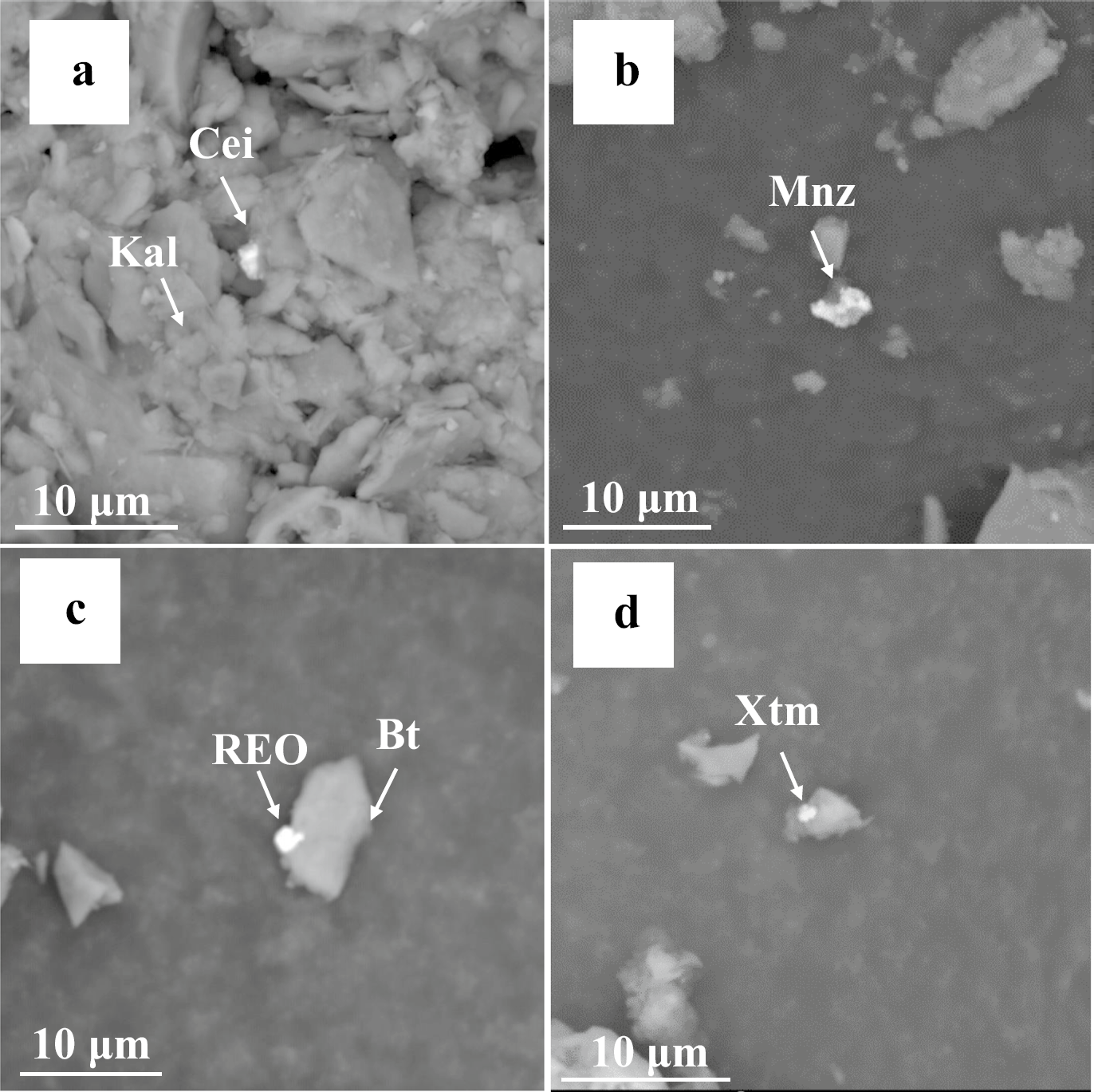
REE distribution patterns in the regolith were inherited mainly from the parent rocks (Berger et al., Reference Berger, Janots, Gnos, Frei and Bernier2014). However, the characteristics of REE fractionation in different horizons are different. For the current study, LREE/HREE ratios instead of La/Yb ratios were selected to depict the fractionation of LREE from HREE. The largest LREE/HREE ratio (~8.5) was observed in the upper part of the Maofeng Mountain regolith (Fig. 4), suggesting that LREE enrichment is greatest in the A and upper B horizons. The LREE/HREE ratio decreased progressively to 6.4 in the lower B1 horizon and continued to decrease to 2.1 in the lower B2 horizon; after that, it increased slightly to 4.4 in the lower B3 horizon of the regolith profile. The increasing trend of the LREE/HREE ratio corresponds well with the increasing degree of weathering represented by the CIA (r2 = 0.74, p < 0.01). The depletion of HREE in the topsoil was probably caused by HREE combining preferentially with various ligands containing inorganic ligands (CO3 2–) and organic ligands (Aubert et al., 2001; Ma et al., Reference Ma, Wei, Xu, Long and Sun2007). LREE/HREE ratios are <1 in the B2 and upper B3 horizons (at depths of 3.5–5 m), indicating that HREE were transported and enriched in the lower layers after being depleted from the upper layer of the regolith. This result is consistent with the results of Y concentration in the regolith. The Y contents at a depth of 3.5–5 m (150.6–781.8 mg kg–1) are much greater than those at depths of 0–3 m (29.6–150.6 mg kg–1). The locations of Ce anomalies and REE enrichment in the profile are different. Compared to distinctly negative Ce anomalies in other parts of the regolith profile, an obviously positive Ce anomaly was seen in the A horizon (at depths shallower than 1 m), and cerianite was observed in the topsoil of the regolith (Fig. 8). The positive Ce anomaly is probably affected by the oxidation–reduction potential of the soil, which is affected by soil pH. Thus, Ce3+ was probably oxidized to Ce4+ and occurs in CeO2, which is adsorbed on the surface of Mn and Fe (oxyhydr)oxides or kaolinte (Fig. 8). Meanwhile, Ce/Ce* is correlated positively to the CIA of the regolith (r2 = 0.56, p < 0.05). The Eu anomalies in the regolith profile remained stable, suggesting that they were controlled by the parent rock and that very slight Eu fractionation occurred.
Scanning electron microscopy backscattered electron images of REE-bearing minerals in the Maofeng Mountain regolith: a cerianite and kaolinite, b monazite, c rare earth oxide and biotite, d xenotime. Abbreviations: Cei = cerianite, Kln = kaolinite, REO = rare earth oxide, Bt = Biotite, Mnz = monazite, Xtm = xenotime (after Warr, Reference Warr2021)

REE Fractionations in Various Fractions
Various kinds of clay minerals are present in the regolith in South China, including smectite, illite, kaolinite, halloysite, and gibbsite, but kaolinite and halloysite are the main clay minerals that enrich REE (Sinitsyn et al., Reference Sinitsyn, Aja, Kulik and Wood2000). Adsorbed REE on kaolinite and halloysite are outer-sphere hydrated and/or OH-bearing hydrated in the regolith in South China (Borst et al., Reference Borst, Smith, Finch, Estrade, Villanova-de-Benavent, Nason and Geraki2020). The adsorption capacity of the two clays increases with pH (Yang et al., Reference Yang, Liang, Ma, Huang, He and Zhu2019). In the case of the Maofeng regolith, the ion-exchangeable REE occurred through adsorption on kaolinite and halloysite. High ΣREE contents with a large proportion of the ion-exchangeable fraction (up to 90%, 2158 mg kg–1) occurred in the regolith profile. LREE enrichment was observed in the ion-exchangeable fraction. The decrease of LREE/HREE from the A horizon to the B2 horizon showing that LREE were depleted in the layer of most intensive mineralization (B2 and upper B3 horizons) (Fig. 9). This result is consistent with the results of Huang et al. (2021b), suggesting that exchangeable HREE rather than LREE migrate preferentially downward due to continuous leaching. However, REE fractionation induced by kaolinite adsorption is limited at low pH and ionic strength (Coppin et al., Reference Coppin, Berger, Bauer, Castet and Loubet2002). Therefore, the REE fractionation in the ion-exchangeable fraction is probably influenced by other REE speciation. For example, Ce negative (Ce/Ce*: 0.1) anomalies are very strong in the ion exchangeable fraction (Fig. 6 and Table 4) suggesting that Ce occurs in CeO2, which cannot be exchanged by competitive ions and depleted in the ion-exchangeable fraction. Moreover, (La/Yb)n ratios of total REE which are not influenced by Ce fractionation from the other REE are lower at the depth of 3.5–8 m than those at depths of 0–3.5 m (Table 4), suggesting that this depth is enriched in HREE without Ce fractionation.
REE fractionation in various fractions including ion-exchangeable, reducible, and residual fractions. REE fractionation is represented via total LREE/HREE ratios

ΣREE in the residual fraction are enriched in A, B2, and B3 horizons. The REE distribution patterns in the residual faction featured LREE enrichment. This result indicates that REE-bearing minerals in the regolith are mainly LREE-enriched. From SEM analysis, the main REE-bearing minerals in the regolith are probably xenotime and monazite, while cerianite and rare earth oxidates are also observed (Fig. 8). According to the composition of REE-bearing minerals in the bedrock, apatite, zircon, and allanite probably exist also in the regolith.
The reducible fraction refers to REE scavenged by Fe–Mn (oxyhydr)oxides, particularly Fe (oxyhydr)oxides with large surface areas that play an important role in REE enrichment and fractionation in IADs. They have large reactive surfaces and abundant surface hydroxyl groups, contributing to controlling the enrichment of REE in the regolith (Yang et al., Reference Yang, Liang, Li, He, Zhu and Arai2021). Iron was released from primary Fe-bearing minerals to form metastable ferrihydrite, and transform into stable Fe (oxyhydr)oxides, including goethite (α-FeOOH) in the regolith (Barrón & Torrent, 2013). The reducible fraction contains a high proportion of ΣREE, especially in the A horizon (32%) and the B1 horizon (13%), which featured relatively high Fe2O3 contents (Fig. 3). In the REE-rich horizon this fraction makes up 18% (i.e. 156.8 mg kg–1) of bulk samples. The LREE/HREE ratio of the reducible fraction is mostly greater than that of the bedrock. This indicates that LREE are more enriched in the Fe–Mn (oxyhydr)oxides, which is not consistent with the results of other studies (Liu et al., Reference Liu, Pourret, Guo and Bonhoure2017; Quinn et al., Reference Quinn, Byrne and Schijf2006). In support of this assertion, a large number of simulation experiments confirmed that HREE were preferentially sequestered by Fe–Mn (oxyhydr)oxides during the transformation from ferrihydrite to goethite at low pH (Yang et al., Reference Yang, Liang, Li, He, Zhu and Arai2021). The LREE enrichment in the reducible fraction was probably caused by the LREE-bearing minerals including apatite and monazite decomposing in the bedrock and releasing LREE by preferential dissolution, and probably fixed preferentially by Fe–Mn (oxyhydr)oxides. Although ΣREE in the reducible fractions are lower than in the ion-exchangeable fraction (Fig. 7), Fe–Mn (oxyhydr)oxides play an important role in REE fractionation. Moreover, marked Ce positive (Ce/Ce*: 10) anomalies were found in the reducible fraction (Fig. 6 and Table 4), which is contrary to that in the ion-exchangeable fraction. This can be explained by Ce3+ being oxidized by Fe–Mn (oxyhydr)oxides to cerianite (CeO2) and by Ce4+ being adsorbed on Fe–Mn (oxyhydr)oxides surfaces (Pourret et al., Reference Pourret, Davranche, Gruau and Dia2007; Takahashi et al., Reference Takahashi, Manceau, Geoffroy, Marcus and Usui2007).
Conclusions
The focus of this study was on REE enrichment and fractionation in a complete regolith profile developed on Maofeng Mountain. Intense magmatic activity provided the rich material basis for the formation of IADs. At the same time, the climate of warm humid and adequate rainfall and high temperature provided favorable conditions for weathering. The bedrock with ΣREE of 245–287 mg kg–1 was enriched in LREE relative to HREE, displaying negative Ce and Eu anomalies. During the weathering process, major elements (K, Na) were lost progressively, and the degree of weathering (CIA) increased gradually. The REE distribution patterns in the regolith samples were inherited from the bedrock. Due to the preferential migration of HREE, the enrichment of LREE in the topsoil layer is marked. Ce was oxidized to CeO2 in the topsoil, with a larger Ce/Ce* value compared to other horizons. REE existed mainly in the ion-exchangeable, Fe–Mn (oxyhydr)oxides, and residual fractions, accounting for 69, 17, and 14%, respectively. Because the pH of the regolith profile is 4.73–6.02, REE fractionation induced by the adsorption of kaolinite is very limited. The Fe–Mn (oxyhydr)oxides fraction played an important role in REE enrichment and fractionation. The released LREE were fixed by Fe–Mn (oxyhydr)oxides and LREE-enrichment was observed in the Fe–Mn (oxyhydr)oxide fraction. Ce3+ could be oxidized by Fe–Mn (oxyhydr)oxides to CeO2, with obvious Ce positive anomalies.
Supplementary Information
The online version contains supplementary material available at https://doi.org/10.1007/s42860-023-00251-7.
Acknowledgements
The authors express their sincere gratitude to the Editor, Associate Editor, and reviewers for their valuable comments and constructive suggestions, which greatly improved the quality of this manuscript. The insightful feedback and attention to detail have been instrumental in shaping the final version of the research. They thank Dr Wenshuai Li and Dr. Heng Wang for fruitful discussions and constructive comments on the manuscript. This work was supported by the Guangdong Major Project of Basic and Applied Basic Research [grant number 2019B030302013]; National Natural Science Foundation of China [grant numbers 41825003, 41921003]; Key Research Program of the Institute of Geology and Geophysics; CAS [grant number IGGCAS–201901]; Guangdong Special Support Program [grant number 2019TX05L169]; Science and Technology Planning of Guangdong Province, China [grant number 2020B1212060055]; and China Scholarship Council (CSC) Grant [grant number 202104910284].
Data availability
All data generated or analyzed during this study are included in this published article and its supplementary information files.
Declarations
Conflict of interest
On behalf of all authors, the corresponding author states that there is no conflict of interest.