Introduction
Gastrothylax crumenifer, a common rumen amphistome, produces huge economic losses for farmers in terms of mortality of young animals and reduced production of adult animals (Prasad & Varma, Reference Prasad and Varma1999). Still there is no selective drug against these amphistomes and there is an urgent need to develop effective and safer anthelmintics (von Samson-Himmelstjerna & Blackhall, Reference von Samson-Himmelstjerna and Blackhall2005). To aid identification of selective target sites, these amphistomes have been screened for tryptaminergic (Verma et al., Reference Verma, Kumar, Tandan and Raina2007) and cholinergic components (Verma et al., Reference Verma, Kumar and Tandan2009). Several selective anthelminthics, such as piperazine and ivermectin, cause paralysis of nematodes by mimicking the action of gamma-aminobutyric acid (GABA) (Martin, Reference Martin1987) and by potentiating the action of glutamate-gated Cl− channels (Martin, Reference Martin1996), respectively. Various preliminary studies have demonstrated the structural and functional presence of glutamatergic and GABAergic systems in flatworms. GABA has been shown immunocytochemically in the planarian Dugesia tigrina (Eriksson & Panula, Reference Eriksson and Panula1994), Moneizia expansa and Fasciola hepatica (Eriksson et al., Reference Eriksson, Maule, Halton, Panula and Shaw1995). Glutamate-like immunoreactivity was also demonstrated in Hymenolepis diminuta (Webb & Eklove, Reference Webb and Eklove1989) and the presence of glutamatergic receptors (Mendonca-Silva et al., Reference Mendonca-Silva, Pessoa and Noel2002) and GABA immunoreactivity (Mendonca-Silva et al., Reference Mendonca-Silva, Gardino, Kubrusly, De Mello and Noel2004) has been demonstrated in Schistosoma mansoni (Mendonca-Silva et al., Reference Mendonca-Silva, Pessoa and Noel2002). In Dicrocoelium dendriticum, GABA binding sites have been demonstrated (Gimenez-Pardo et al., Reference Gimenez-Pardo, Ros-Moreno, De Armas-Serra and Rodriguez-Caabeiro2000). Glutamate- and aspartate-like fluorescence was demonstrated in the longitudinal nerve cord in Gyrocotyle fimbriata (Keenan & Koopowitz, Reference Keenan and Koopowitz1982). In adult Chlonorchis sinensis (Shyu et al., Reference Shyu, Terada and Lee1998) and Dipylidium caninum (Terada et al., Reference Terada, Ishii, Kino and Sano1982), strychnine stimulated the motility, while GABA had little effect. Electrically evoked activity in the submuscular ventral longitudinal cord of the flatworm Notoplana acticola was depressed by GABA and glycine, and the action was reversed non-specifically by picrotoxin, bicuculline and strychnine (Keenan et al., Reference Keenan, Koopowitz and Bernardo1979). Picrotoxin also modified the motility of S. mansoni (Gimenez-Pardo et al., Reference Gimenez-Pardo, Ros-Moreno, De Armas-Serra and Rodriguez-Caabeiro2000). Glutamate and aspartate at a concentration less than 10− 5 m caused excitation in the longitudinal nerve cord in Gyrocotyle fimbriata and the activity was blocked by 2-amino-4-phosphonobutyrate, an aminergic blocking agent (Keenan & Koopowitz, Reference Keenan and Koopowitz1982). A glutamate uptake system was found in H. diminuta (Webb, Reference Webb1986, Reference Webb1988) and l-glutamate stimulated the adenylate cyclase activity in H. diminuta (Eklove & Webb, Reference Eklove and Webb1991). l-Glutamate elicited contractions in isolated muscle fibres of S. mansoni in a concentration-dependent manner (Miller et al., Reference Miller, Day, Bennett and Pax1996), whereas GABA, glycine and glutamate had no effect on spontaneously active fibres of Bdelloura candida (Blair & Anderson, Reference Blair and Anderson1994). In view of the above, the present study aimed to investigate the effect of different classical amino acid neurotransmitters on isometrically mounted G. crumenifer, a rumen amphistome.
Materials and methods
Collection of rumen amphistomes
Mature and apparently healthy amphistomes from the rumen of freshly slaughtered goats at a local abattoir were collected in warm (38 ± 1°C) Hank's Balanced Salt Solution (HBSS) in an insulated container and brought to the laboratory. These amphistomes were identified as G. crumenifer and were kept in a biological oxygen demand (BOD) incubator in HBSS at 38 ± 1°C until further use.
Tissue preparation and mechanical recording
The spontaneously active amphistomes were mounted isometrically in HBSS at 38 ± 1°C as per the method described for Gigantocotyle explanatum (Ahmad & Nizami, Reference Ahmad and Nizami1990). In short, the amphistomes were mounted with the help of two fine hooks. One hook was inserted 1–2 mm caudal to the anterior sucker and fixed to the tip of the aeration tube and another hook was pierced through the surface of the acetabulum and connected to the isometric force transducer. The spontaneous muscular activity of isometrically mounted amphistomes was recorded in a Chart 4 Windows software program using an isometric force transducer (PowerLab, AD Instruments, Sydney, Australia). Control recordings were made 15 min after application of tension for 15 min and before administration of an amino acid neurotransmitter. During the equilibration and control recording periods, the bath fluid was changed once in every 10 min.
Experimental protocol
Cumulative molar concentrations at an increment of 1 log unit (10− 7–10− 3 m) of glycine (Sigma, St. Louis, Missori, USA), l-glutamate (Merck, Mumbai, India) or GABA (Sigma) were applied into the tissue bath to assess their effects on spontaneous muscular activity of the amphistomes. In view of substantiating the observations of GABA, the GABAA receptor antagonists, picrotoxin (Sigma) and bicuculline (Sigma) were also applied in graded molar concentrations (10− 7–10− 3 m) to determine their effect on spontaneous muscular activity of G. crumenifer.
Data presentation and analysis
Three attributes, viz. the amplitude (average of all peaks per 5 min), baseline tension (average of all minimum levels of contractions used for measuring amplitude) and frequency (total number of contractions in 5 min) of spontaneous muscular contractions were utilized to evaluate the effect of different concentrations of various drugs. Experiments with each drug were repeated at least six times on fresh isometrically mounted G. crumenifer. The results are presented as mean ± standard error of the mean. Paired t-tests were applied to measure the levels of significance (Snedecor & Cochran, Reference Snedecor and Cochran1989).
Results
The isometrically mounted amphistomes exhibited rhythmic and apparently uniform patterns of spontaneous muscular activity for a period of 2 h. The mean amplitude, baseline tension and frequency of the contractions recorded 15 min after applying a tension of 200 mg, were 0.42 ± 0.03 g, 0.13 ± 0.01 g and 45 ± 2.90 contractions/5-min time period, respectively. In all the experiments six recordings were made.
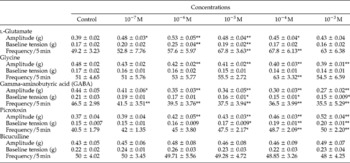
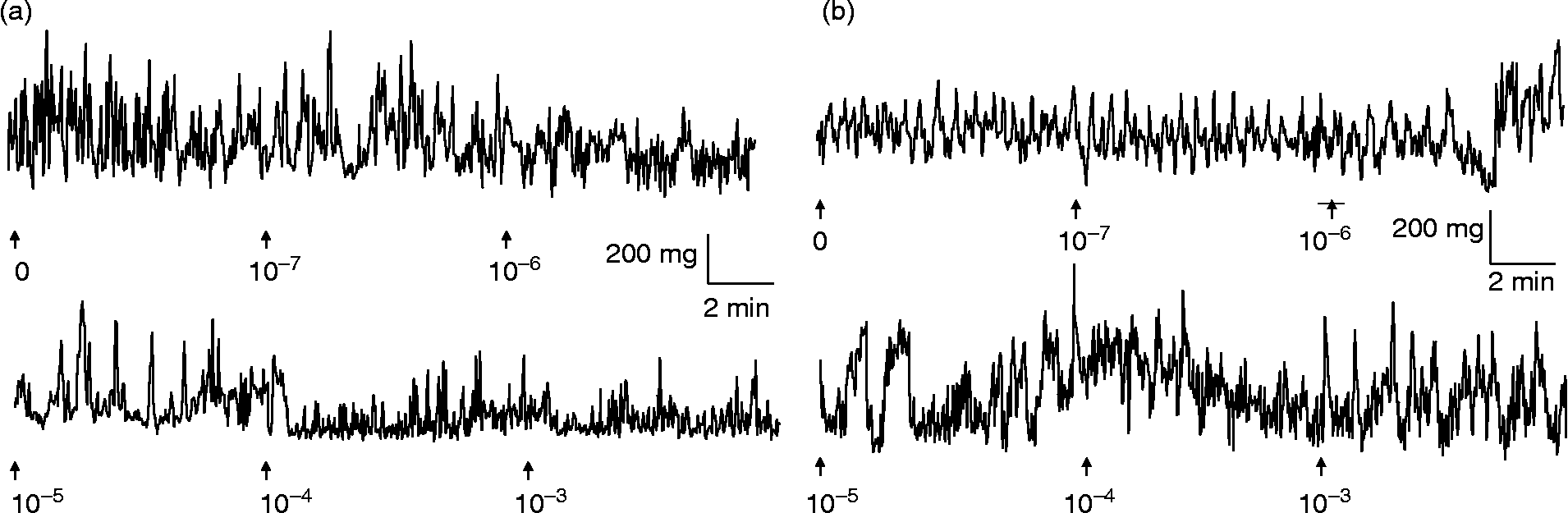
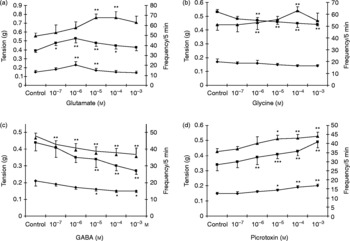
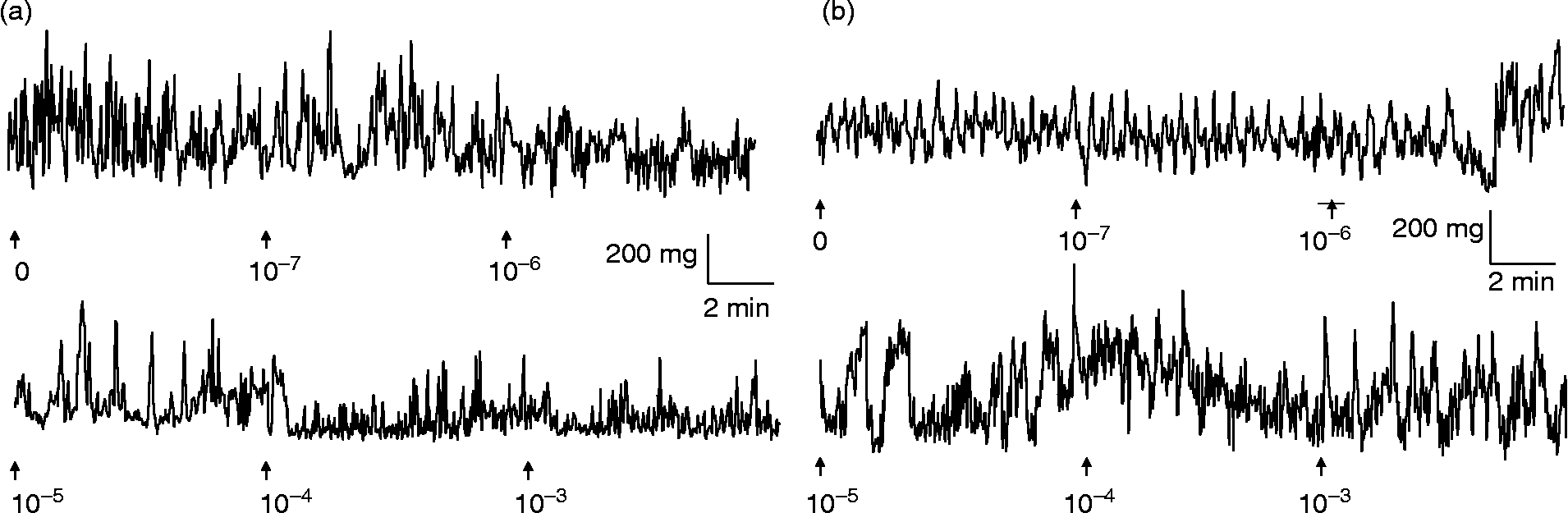
Glutamate caused a significant (P < 0.05) increase in the amplitude of muscular contractions of G. crumenifer in a concentration-dependent manner (10− 6–10− 3 m) as compared to control amplitude (0.39 ± 0.02 g). The frequency was significantly increased at 10− 5 m (P < 0.01) and at 10− 4 m (P < 0.01) concentrations of glycine as compared to control frequency (49.2 ± 3.23/5 min). The data are presented in table 1 and representative recordings are shown in figs 1b and 2.
Effect of l-glutamate, glycine, GABA, picrotoxin and bicuculline on amplitude (g), baseline tension (g) and frequency (per 5 min) of spontaneous muscular activity of Gastrothylax crumenifer.

Values represent mean ± standard error (n = 6).
* and ** represent levels of significance P < 0.05 and P < 0.01, respectively.
Effect of application of graded molar concentration (10− 7–10− 3 m) of GABA (a) and l-glutamate (b) on spontaneous muscular activity of Gastrothylax crumenifer.
Effect of different concentrations (10− 7–10− 3 m) of l-glutamate (a), glycine (b), GABA (c), and picrotoxin (d) on amplitude (■) baseline tension (♦) and frequency per 5 min (▲) of spontaneous muscular activity of G. crumenifer. * and ** represent level of significance P < 0.05 and P < 0.01, respectively.

Glycine application (10− 6–10− 3 m) caused a significant (P < 0.01) decrease in amplitude as compared to that of the control. However, frequency and baseline tension were not altered significantly at any of the concentrations applied.
GABA 10− 6–10− 3 m concentration inhibited the amplitude and frequency of the muscular contractions of G. crumenifer in a concentration-dependent manner. It also caused relaxation of the amphistomes at 10− 5–10− 3 m concentrations. Representative recordings are shown in figs 1a and 2 and data are presented in table 1.
A progressively increasing trend was observed in amplitude, baseline tension and frequency of the isometrically mounted amphistome by picrotoxin application (10− 7–10− 3 m), a blocker of the GABAA receptor, as compared with the control amplitude, baseline tension and frequency. Bicuculline (10− 7–10− 3 m), a GABAA receptor blocker, did not evoke any significant effect on amplitude, baseline tension and frequency as compared with control amplitude, baseline tension and frequency of spontaneous contractions. The data are presented in table 1.
Discussion
Amino acid neurotransmitters have well-defined roles in the neuromuscular system of vertebrates and some invertebrates. The present study provides functional evidence of the involvement of aminergic signalling in regulating the muscular activity of G. crumenifer. Preliminary neuropharmacological work on S. mansoni, F. hepatica and F. gigantica also suggested that these parasites have putative inhibitory as well as excitatory neurotransmitters.
l-Glutamate, hypothesized to be an excitatory neurotransmitter in platyhelminths (Webb, Reference Webb1986), produced an excitatory effect on amplitude, baseline tension and frequency of spontaneous muscle activity of G. crumenifer. Similar findings have also been reported in longitudinal strip preparations of Hymenolepis diminuta (Chappell & Walker, Reference Chappell and Walker1982; Webb, Reference Webb1988) and isolated muscle fibres from S. mansoni (Miller et al., Reference Miller, Day, Bennett and Pax1996). l-Glutamate increases the spontaneous activity of longitudinal nerve cord preparation of Gyrocotyle fimbriata (Keenan & Koopowitz, Reference Keenan and Koopowitz1982). Furthermore, l-glutamate application causes contraction of isolated muscle fibres of S. mansoni. The contraction is dependent on extracellular Ca2+ and is blocked by nicardipine (Miller et al., Reference Miller, Day, Bennett and Pax1996). In many flatworms, glutamate or glutamate-like immunoreactivity has been localized in the longitudinal nerve cord and areas of sarconeural innervation (Keenan & Koopowitz, Reference Keenan and Koopowitz1982; Webb, Reference Webb1988; Webb & Eklove, Reference Webb and Eklove1989). Thus, the present results are not only indicative of an excitatory role of glutamate in G. crumenifer but they also support its excitatory role in flatworms.
Glycine appears to play an inhibitory role in spontaneous muscular activity of G. crumenifer, as it caused a marked reduction in the amplitude of contractile activity of the fluke at different concentrations. Electrically evoked activity in sub-muscular ventral longitudinal nerve cords of flatworm N. acticola is depressed by glycine (Keenan et al., Reference Keenan, Koopowitz and Bernardo1979). Although not many reports are available on the effects of glycine in neuromuscular physiology of flatworms, the above reports provide preliminary evidence for a functional role of glycine in flatworms.
GABA is an important inhibitory neurotransmitter in both vertebrates and invertebrates (Eriksson et al., Reference Eriksson, Maule, Halton, Panula and Shaw1995). In the marine polyclad flatworm, N. acticola, GABA decreased the electrical activity in the ventral nerve cord and the effect was prevented by picrotoxin, bicuculline and strychnine (Keenan et al., Reference Keenan, Koopowitz and Bernardo1979). The inhibitory effect of GABA in flatworms is also supported by the observations that the GABA antagonist, picrotoxin, produced contractile effects in S. mansoni (Mendonca-Silva et al., Reference Mendonca-Silva, Pessoa and Noel2002, Reference Mendonca-Silva, Gardino, Kubrusly, De Mello and Noel2004). In the present study, GABA caused a marked reduction in the amplitude and frequency of contractile activity of G. crumenifer at a concentration as low as 10− 7 m and significantly reduced baseline tension at 10− 5 m concentration. These findings also substantiate an inhibitory role for GABA in neuromuscular physiology of flatworms. To further establish the inhibitory effect of GABA on spontaneous muscular activity of rumen fluke, the present study also involved two GABAA-specific antagonists. The GABAA receptor antagonist, picrotoxin, produced excitatory effects on amplitude, baseline tension and frequency, whereas bicuculline (GABAA-specific antagonist) did not alter the spontaneous muscular activity of G. crumenifer. Similarly, a GABAA antagonist (bicuculline) did not show any observable effect on the rhythmic activity of S. mansoni (Mellin et al., Reference Mellin, Busch, Wang and Kath1983; Mendonca-Silva et al., Reference Mendonca-Silva, Pessoa and Noel2002, Reference Mendonca-Silva, Gardino, Kubrusly, De Mello and Noel2004). However, Bascal et al. (Reference Bascal, Montgomery, Holden-Dye, Williams and Walker1995) have reported that the GABAergic system in muscle of A. suum muscle is picrotoxin-sensitive and bicuculline-insensitive. Thus, with respect to GABA receptors, the neuromuscular system of G. crumenifer appears to be closer to that of nematodes than to other trematodes.
In conclusion, the present study demonstrates an excitatory role for glutamate and inhibitory roles for GABA and glycine in the spontaneous muscular contractions of G. crumenifer.
Acknowledgements
The authors thank the Director, IVRI, Izatnagar, Bareilly for providing the necessary facilities for conducting the study. The authors are also grateful to Dr A. Prasad, Division of Parasitology, IVRI, for helping in identification of rumen flukes.