The Cold War Era
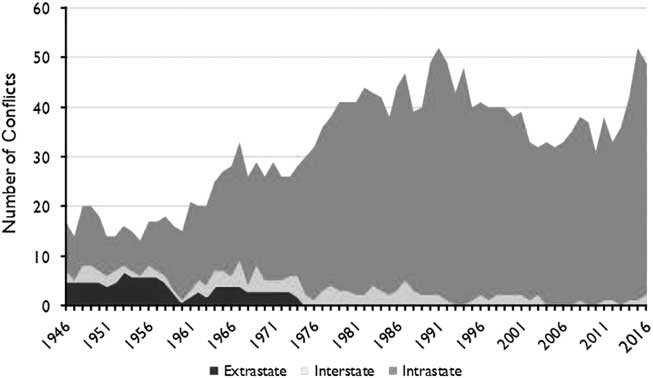
The Cold War (1947-1991) heralded in the process of characterizing armed conflicts defined within the framework of international lawReference Roser
5
:
∙ An armed conflict is coded as a war when the battle-death toll reaches 1,000 or more in a given calendar year.
∙ An interstate armed conflict is fought between two or more states. An intrastate armed conflict (also known as a civil conflict or civil war) is a conflict between a government and a nonstate group that takes place largely within the territory of the state in question.
∙ An intrastate armed conflict becomes an internationalized intrastate armed conflict when the government, or an armed group opposing it, receives support, in the form of troops, from one or more foreign states.
∙ An extrastate armed conflict is a conflict between a state and an armed group outside the state’s own home territory. These are mostly colonial conflicts.
The Cold War resulted in an array of armed conflicts, including 25 superpower proxy wars and conventional interstate wars as well as 122 intrastate or noninternational armed conflicts and anticolonial wars of liberation that erupted between armed groups representing the state and one or more nonstate groups, often fueled by complex ethnic, religious, political, and military tensions and unresolved grievances once held in check by colonial regimes.Reference Trei
6
During the Cold War, these armed conflicts provided the proxies for superpower competition and gave rise to Common Article 3 and Additional Protocol II, applicable in noninternational “wars of national liberation” (Figure 1).
7
-
Reference Dupuy, Gates and Nygard
10
Figure 1Number of Armed Conflicts by Type of Conflict, 1946-2016
In the immediate aftermath of WWII, it was the occupying armies that provided the overwhelming majority of emergency relief and assistance, not the International Committee of the Red Cross (ICRC) or other nongovernmental organizations (NGOs). The Oxford Committee for Famine Relief (OXFAM) was founded for famine relief in Greece during WWII, and the International Rescue Committee (IRC) helped refugees and repatriate liberated prisoners of war; but the preponderance of what has become known as “humanitarian” aid was provided by the occupying allied military forces, who fed, sheltered, clothed, and cared for the millions of residents, refugees, and displaced persons in Europe. This also gave rise to GC IV, Articles 55 and 56, which state that the military occupier must supply life-sustaining requisites “to the fullest extent of the means available to it” to ensure “food and medical supplies to the population” and “prophylactic and preventive measures necessary to combat the spread of contagious diseases and epidemics. Medical personnel of all categories shall be allowed to carry out their duties.”
11
Essentially, if you occupy a territory, you are responsible for the civilian population, from health care to picking up the garbage; in modern American parlance, “you break it, you own it.”Reference Siegel
12
In the Cold War armed conflicts that followed, health care personnel, guided primarily by IHL and the unique protections guaranteed to health care in conflict, reported that major violations were commonplace and demanded many mission-specific unique skill sets. The work of humanitarian organizations was severely constrained by logistical, safety, and legal obstacles, including prohibitions on unilateral intervention under international law, even for urgent humanitarian purposes. Lacking access to conflict-affected states, aid was often restricted to refugee camps that were across borders and addressed mortality and morbidity crises from infectious diseases, malnutrition, and micronutrient deficiencies.Reference Salama, Spiegel, Talley and Waldman
13
It is important to note that the Cold War was an ideological war in which a “my side is better than your side” mentality prevailed. Winning hearts and minds was the political objective. This allowed the US and USSR to impose a certain discipline on the protagonists that each supported with money, weapons, and diplomacy. “You must show yourselves to be better than the other side, so follow the rules,” the rules being a relative adherence to the GCs, for example. Adherence was more or less dependent on the level of discipline of the combatants and their command structure. Eventually, United Nations (UN) resolutions enabled humanitarian and international aid organizations to shift their operations from relief and early response to more sustained peace-building and development activities, all of which were complex and demanded a workable knowledge of supporting IHL and its unique tool chest of updated protections.Reference Abiew and Keating
14
Post–Cold War Era
With the end of the ideological conflict of the Cold War, things changed. Intra-ideological conflict began to dominate: Serb nationalism versus Croat nationalism, Hutu versus Tutsi. The enemy is essential, no one is trying to convince the other side of the rectitude of one’s position; the other side is the enemy by essence, no matter what ideology (democracy, socialism, etc.) that one possesses. The Serb did not try to win over the Croat civilian. From the Biafra War (1967-1970) to the implosion of the Soviet Union and end of the Cold War was the golden era of humanitarian NGOs.Reference Brown
15
The relative discipline imposed on the various warring parties was important in ensuring the safety and security of humanitarian workers, helped create a neutral humanitarian space, and made humanitarian workers more accepted. This discipline disappeared with the end of the ideological Cold War. Armed groups took to self-financing: “blood diamonds”, ransoming of humanitarian agencies, narcotics trafficking, etc.
Contrary to the predictions that war would become obsolete in the post–Cold War era, violent and protracted ethnic and nationalistic intrastate or noninternational armed conflicts became increasingly the norm. In the 15-year period between 1990 and 2005, only 4 of the active conflicts were fought between states; the remaining conflicts, 172 in number, were fought within states. The tragedies and gruesome atrocities of these intrastate conflicts pushed the “imperative for humanitarian intervention to the fore of contemporary international politics and practice, provoking a shift on the international right and necessity of using military force to protect civilians within sovereign states.”Reference Enuka
16
Data from the Uppsala Conflict Data Program confirmed that in 2007 more than half a billion people lived in conflict-affected areas. An increasing proportion of those people lived in early post conflict areas, where hostilities were judged or declared during the preceding 5 years. Despite these findings, most of the world’s large-scale medical responses to emergencies focused on high-intensity conflicts. This suggests that effective emergency and reconstruction activities in the health sector depended on reorganizing services on transition to low-level and post-conflict environments, which was eventually reflected in education and training programs for a burgeoning humanitarian community.Reference Garfield, Polonsky and Burkle
17
Governments and the international community have often failed to prevent and halt serious crimes under international law. The crisis situations led civil society, the UN, and other national, regional, and subregional actors to refer to or invoke the “Responsibility to Protect”(R2P). Recognizing the failure to adequately respond to the most heinous crimes known to humankind, world leaders made a historic commitment to protect populations at the UN 2005 World Summit. The R2P stipulates that the state carries the primary responsibility for the protection of populations from genocide, war crimes, crimes against humanity, and ethnic cleansing; the international community has a responsibility to assist states in fulfilling this responsibility; and the international community should use appropriate diplomatic, humanitarian, and other peaceful means to protect populations from these crimes. If a state fails to protect its populations or is in fact the perpetrator of crimes, the international community must be prepared to take stronger measures, including the collective use of force through the UN Security Council.
18
The post–Cold War period also witnessed an increasing debate over the militarization of humanitarian action. When militaries engaged in conflict or armed forces were deployed on UN peacekeeping missions, they were mandated to carry out humanitarian operations and the distinction between humanitarian, political, and military action became increasingly unclear. This was particularly the case for UN agencies, which are politically neutral, while UN peacekeeping forces often had a political mandate. Humanitarian actors mounted a vigorous defense of the perceived risk that multinational military forces becoming belligerents, in addition to providing humanitarian assistance, threatened the perception of neutral, independent humanitarian action.Reference Rana
19
Without a UN mandate, the situation became even more problematic. In the 2003 war with Iraq, the blurring of these lines became prophetic when the US Secretary of Defense, who assumed humanitarian responsibilities from the State Department, argued that the US forces would conclude their duties and leave Iraq within 3 weeks, claiming that their brief role was one of “liberators, not occupiers,” and that they were therefore not responsible for medical and public health recovery obligated under Articles 55 and 56 of the GCs (IV). The humanitarian assistance budget was slashed in half, resulting in the emergence of a chronic public health emergency which in many areas remains today.Reference Burkle and Garfield
20
In addition, American NGOs were called “force multipliers,” thus further blurring the humanitarian lines.
Current Armed Conflicts
Today we have witnessed war in Afghanistan since 1979, first the Soviet intervention, fighting against the mujahideen; the mujahideen civil war; then a civil war between the Taliban and the Northern Alliance, which became internationalized when the US invasion took the side of the Northern Alliance to overthrow the Taliban. Similarly, both Syria and Yemen, which began as noninternational conflicts, also became internationalized; the Somalia War has continued since 1991, and recently intrastate conflicts have occurred in Libya, South Sudan, southwest Turkey, Iraq, Egypt’s Sinai Peninsula, Mali, northwest Nigeria, Colombia, Myanmar, and Ukraine.
21
The 1991 Persian Gulf War began as a pure interstate international war when the US coalition invaded but soon led to a civil war within Iraq (Kurds in the north, Shi’ites in the south). The only true interstate confrontations in today’s world are between India and Pakistan, the United States/South Korea and North Korea, and Israel and Lebanon/Iran.
It is a given, nonetheless, that IHL applies in different context-specific situations, whether the wars were continuing in a chronically poor country or a new war erupted within a middle-income country, and whether international public opinion realized this or not. All conflicts have proven to be increasingly more barbaric, with humanitarian health workers facing unprecedented personal risk from targeted killings and flagrant violations of the protections historically provided to medical workers under IHL and the GCs; the most deplorable conditions not seen since WWII. Health care providers face unprecedented challenges ranging from managing triage in increasingly resource-poor or constrained environments to protecting civilian and military victims as well as their own staff.Reference Burkle
22
,
Reference Burkle, Erickson and von Schreeb
23
It is debated whether today’s conflicts, fueled once again by great power competition, as was the case pre-1914, are appearing more and more like a resurgence of the Cold War mentality of superpower hegemony. It is commonly questioned whether the world is rushing into a second Cold War while threats of a third World War and nuclear weapon use abound. Current proxy war struggles are fought by armies or insurgents often working on behalf of the United States, Russia, or China. Again, clear violations of IHL and the GCs are at the forefront of the debates, the egregiousness of which are defining the abhorrent nature of these conflicts to the outside world on a daily basis, whether they be from the hands of ISIS or as a summary response from government allied forces. In the past 2 years, 4 of the 5 permanent members of the UN Security Council have, to varying degrees, enabled or been involved in attacks against medical facilities. The Syrian government and its Russian allies, the US government and its Afghan allies, and the international coalition headed by Saudi Arabia in Yemen and backed by the United States, the United kingdom, and France all share a deplorable track record of being associated with bombings of medical facilities.Reference Burkle, Erickson and von Schreeb
23
,
24
UN Security Council “reassurances given by the powers that be—some of whom have been directly involved in hospital bombings—are hollow, if not hypocritical.”
25
UN Security Council members unanimously signed a resolution on May 3, 2016 (Resolution 2286), reaffirming the protected status of medical services and civilians in conflict and outlining the need for all conflict actors to fulfill their obligations under IHL by not attacking medical facilities, training their personnel on the laws of war, and protecting humanitarian workers by respecting the neutrality and impartiality of medical facilities.
26
This included an unprecedented outline for the potential role of UN Peacekeepers to provide a “secure environment for the delivery of medical assistance in accordance with humanitarian principles.”Reference Davies and Ruston
27
Robin Coupland, former Chief Surgeon and Medical Advisor for ICRC, suggests that war is changing. First, the wounded and hospitals are “becoming integrated into the conflict, within rather than between countries with clearly defined fronts, and where combatants lack awareness of international conventions governing the way civilians should be treated.” Because of the “blurred nature of contemporary war it is not uncommon for soldiers to enter a hospital to settle scores or for governmental forces to search for insurgents or prevent medical personnel from treating them” and perhaps arrest or kill providers when they do so. Coupland adds that professionals with experience in the field “go to great lengths to avert such outside interference.”Reference Serle and Fleck
28
Physicians for Human Rights, collecting information on attacks on health workers and institutions for decades, claims that “the intensity of attacks, especially in terms of doctors being threatened, has increased,” but “without reliable data on this phenomenon they can only make intelligent guesses about what is really going on.”Reference Serle and Fleck
28
The 2015 ICRC Violence Against Health Care report, which surveyed 16 countries and took more than 2 years to research, warned that “the very foundations of the GCs—the right of those wounded in war to receive medical attention, and the right of those treating them to work unimpeded—are under threat.”
29
Both ICRC and Médecins sans Frontières (MSF; Doctors Without Borders) defend the relevancy of IHL, asserting that the current lack of respect for IHL has arisen from an unprecedented number of concurrent crises where egregious violations of IHL are being committed every day, both by states and non-states. The lines between military and humanitarian work in conflict are blurred, and the number of armed groups, ranging from organized forces to loosely structured nonstate forces, that must be negotiated with is growing.
30
Coupland reminds us that threats to health care during conflicts are not just an issue for humanitarian aid agencies. The “global health community has taken a long time to recognize that conflict, violence, and insecurity are more than constraints on the delivery of health care in many parts of the world: they are showstoppers.”Reference Coupland
31
Responsibility for addressing this massive global health issue ultimately lies with national and international organizations responsible for ensuring people’s security. The responsibilities of the health care community, however, must include “fierce advocacy for the maintenance of this security” which should be continually reflected in education and training.Reference Coupland
31
The Mosul War in Iraq
The controversies plaguing proper management of civilian casualties in intrastate conflicts came to a head in the planning (2016-2017) for the retaking of the cities of Mosul and Tel Afar from ISIS by the Iraqi government forces with allied militias, the Kurdistan Regional Government, and international forces.Reference Coupland
32
They deliberated on plans to care for as many civilians as possible by establishing “trauma referral pathways” from the warring cities to designated routes to safer medical facilities in the rear.Reference Ajello and Sultany
33
Under leadership of the Mosul Ninewa Department of Health, the World Health Organization (WHO), and trauma partners, planners using trauma care principles developed by military experience in Iraq and Afghanistan developed a piecemeal trauma system based on the necessity for stabilization and emergency surgery within the “golden hour” and called for role one facilities to be placed closer to the front lines than was commonly seen in previous conflict settings.
34
The UN Humanitarian Coordinator for Iraq turned to WHO to request both ICRC and MSF field hospitals to establish care in these areas. Both ICRC and MSF declined, their decisions based on their capacities and concerns about security and humanitarian principles of neutrality as well as an inability to negotiate their required parameters of intervention, such as humanitarian access, security, and modes of operation, with the Iraqi military, the coalition forces, and ISIS to ensure a neutral space before the fighting began.
WHO, as the “provider of last resort” for the WHO Health Cluster in Iraq,Reference Childers and Parker
35
,
36
identified three nontraditional partners (a humanitarian NGO, a private medical contractor, and a new humanitarian NGO that had never worked in a conflict setting before) to attempt to provide life- and limb-saving surgery within an hour of the frontline. Compounding this dilemma was the fact that both the Iraqi military and the US-led coalition forces claimed that they did not have sufficient medical capacity to protect or care for civilians as well as their own military. Some of these organizations ended up working close to the front lines embedded with specific Iraqi and Coalition military units. This was explained to be necessary for protection from ISIS, as well as to expedite both the delivery of wounded civilians and the treatment of wounded Iraqi military.
Although the WHO-led collaborative saved lives, there are multiple concerns and questions that demand immediate debate and resolution. For example, had there been a security breach or capture, injury, or death of an NGO/private contractor, would the incident have been severely adjudicated; how were ad hoc security arrangements guaranteed; were the terms of the embedded private contractor and NGOs roles as “force multipliers” (capability that significantly increases the combat potential of that force) negotiated and in what manner
37
; did the WHO, or will it in the future, require operational understanding of IHL, negotiating skills, and information on the culture, country, and other potential risks to their employees that are operationally crucial under IHL; was this deployment truly safe and efficient; were there medical errors made by these inexperienced teams (because war surgery is not the same as simple civilian trauma surgery); and because of these new operational realities, do the GCs need to be modified to adapt to current armed conflicts? Admittedly, any medical facility or organization, civilian or military that is officially habilitated by governments to care for war wounded and sick is covered by the GCs and has the right to use the Red Cross emblem as a sign of protection.
Andrew Cunningham, Operations Advisor for MSF, stresses that negotiating “parameters of intervention before starting field operations is essential,” giving the example that MSF in Afghanistan spent “nine months communicating and negotiating with all the relevant military and paramilitary actors to create the neutral space in which we could work before starting.” He emphasizes the importance of creating prenegotiated zones and laying down ground rules and enforcing them, adding that MSF is “vocal and firm” about any incidents. Interestingly, in 2012 he warned that smaller organizations, such as those WHO deployed in Mosul, “are likely to be more vulnerable.”Reference Serle and Fleck
28
Violations of Proportionality
The combination of marked diversity of conflicts, the increasing number of parties in conflict, prolonged urban warfare, denial of applicability of IHL (in particular to organizations employing the tactic of acts of terrorism), lack of political will to implement IHL, politicization of IHL, and basic ignorance of the law by bearers of arms, all increasing since 2003, has contributed to decisions leading to unprecedented “disproportionate attacks” and risks of more occurring in the future.
38
Customary International Law Rule 14: Proportionality in Attack prohibits “launching an attack which may be expected to cause incidental loss of civilian life, injury to civilians, damage to civilian objects, or a combination thereof, which would be excessive in relation to the concrete and direct military advantage anticipated.”
39
Both the total destruction by the Syrian government of east Aleppo and Western-based bombing campaigns that flattened Raqqa have been condemned by the UN as violations of proportionality, risking efforts to increase respect for IHL and to regulate the behavior of the parties to conflicts in the future.
40
,
Reference D’Ascanio
41





 You have
Access
Today, no walls can separate humanitarian or human rights crises in one part of the world from national security crises in another. What begins with the failure to uphold the dignity of one life all too often ends with a calamity for entire nations.
Kofi Annan, Seventh Secretary General of the United Nations
INTRODUCTION
The end of World War II (WWII) launched two memorable events that advanced international law, both designed to prevent or mitigate interstate or cross-border wars. First, in 1945 the United Nations Charter was created to prevail over all other treaty obligations, and required that all members promote international cooperation and maintain international order. Second, in 1949 the Geneva Conventions (GCs), already improved several times after major wars, were once again updated when the most-specific fourth GC dealing with the civilian population and civilian targets was first negotiated and implemented to limit the effects of armed conflict for humanitarian reasons. The GCs serve as the modern foundation of International Humanitarian Law (IHL), which is the set of rules that limit the effects of armed conflict by protecting civilians and people who are incapacitated by wounds or sickness and therefore no longer participating in hostilities, otherwise known as hors de combat or “outside the fight.” 1
Since 1945, events generating major humanitarian crises and the way in which the world responds to them has dramatically changed every 10 to 15 years or less.Reference Burkle, Martone and Greenough 2 Planning, response, and recovery for these tragic events have often been ad hoc, inconsistent, and insufficient, largely because of the complexity of global humanitarian demands and the corresponding response system capabilities. Recent internationalized intrastate tragedies, such as those in Syria and Yemen, have proven difficult for the humanitarian community, which often finds itself more unprepared today than in years past, especially in their operational capacity to safely gain access to vulnerable populations.
Spiegel argues that the current “humanitarian system is broken and urges wholesale reform,” stressing that “operationalizing the centrality of protection encompasses human security” inclusive of “basic life-saving protection interventions” but does not specifically address reform of the education and training of humanitarian personnel given the significant changes in the humanitarian landscape and its demands.Reference Spiegel 3 However, Hawkins and Perache attest that success or failure of humanitarian medicine and aid is “largely dependent on access to populations in crisis, inevitably involves fighting the established order responsible for such crises,” and requires the “relentless pursuit to access and care for vulnerable populations.”Reference Hawkins and Pérache 4
No discipline has been impacted more by war and armed conflicts than health care, which today has suffered from increasing deliberate heinous acts of the belligerents perpetrated against health care personnel and the essential and protective health and public health infrastructure of the state at war. In recognition of the unique and complex nature of war and armed conflict and the various nuances and demands of IHL, the culture, the country, and team preparation, the authors in Part I provide a historical overview of the transformation of armed conflicts from the Cold War to today, emphasizing the impact these events have had on humanitarian professionals and their struggle to adapt to increasing humanitarian, operational, and political challenges.
WAR AND ARMED CONFLICT FROM THE COLD WAR TO TODAY
The Cold War Era
The Cold War (1947-1991) heralded in the process of characterizing armed conflicts defined within the framework of international lawReference Roser 5 :
∙ An armed conflict is coded as a war when the battle-death toll reaches 1,000 or more in a given calendar year.
∙ An interstate armed conflict is fought between two or more states. An intrastate armed conflict (also known as a civil conflict or civil war) is a conflict between a government and a nonstate group that takes place largely within the territory of the state in question.
∙ An intrastate armed conflict becomes an internationalized intrastate armed conflict when the government, or an armed group opposing it, receives support, in the form of troops, from one or more foreign states.
∙ An extrastate armed conflict is a conflict between a state and an armed group outside the state’s own home territory. These are mostly colonial conflicts.
The Cold War resulted in an array of armed conflicts, including 25 superpower proxy wars and conventional interstate wars as well as 122 intrastate or noninternational armed conflicts and anticolonial wars of liberation that erupted between armed groups representing the state and one or more nonstate groups, often fueled by complex ethnic, religious, political, and military tensions and unresolved grievances once held in check by colonial regimes.Reference Trei 6 During the Cold War, these armed conflicts provided the proxies for superpower competition and gave rise to Common Article 3 and Additional Protocol II, applicable in noninternational “wars of national liberation” (Figure 1). 7 - Reference Dupuy, Gates and Nygard 10
Number of Armed Conflicts by Type of Conflict, 1946-2016
In the immediate aftermath of WWII, it was the occupying armies that provided the overwhelming majority of emergency relief and assistance, not the International Committee of the Red Cross (ICRC) or other nongovernmental organizations (NGOs). The Oxford Committee for Famine Relief (OXFAM) was founded for famine relief in Greece during WWII, and the International Rescue Committee (IRC) helped refugees and repatriate liberated prisoners of war; but the preponderance of what has become known as “humanitarian” aid was provided by the occupying allied military forces, who fed, sheltered, clothed, and cared for the millions of residents, refugees, and displaced persons in Europe. This also gave rise to GC IV, Articles 55 and 56, which state that the military occupier must supply life-sustaining requisites “to the fullest extent of the means available to it” to ensure “food and medical supplies to the population” and “prophylactic and preventive measures necessary to combat the spread of contagious diseases and epidemics. Medical personnel of all categories shall be allowed to carry out their duties.” 11 Essentially, if you occupy a territory, you are responsible for the civilian population, from health care to picking up the garbage; in modern American parlance, “you break it, you own it.”Reference Siegel 12
In the Cold War armed conflicts that followed, health care personnel, guided primarily by IHL and the unique protections guaranteed to health care in conflict, reported that major violations were commonplace and demanded many mission-specific unique skill sets. The work of humanitarian organizations was severely constrained by logistical, safety, and legal obstacles, including prohibitions on unilateral intervention under international law, even for urgent humanitarian purposes. Lacking access to conflict-affected states, aid was often restricted to refugee camps that were across borders and addressed mortality and morbidity crises from infectious diseases, malnutrition, and micronutrient deficiencies.Reference Salama, Spiegel, Talley and Waldman 13 It is important to note that the Cold War was an ideological war in which a “my side is better than your side” mentality prevailed. Winning hearts and minds was the political objective. This allowed the US and USSR to impose a certain discipline on the protagonists that each supported with money, weapons, and diplomacy. “You must show yourselves to be better than the other side, so follow the rules,” the rules being a relative adherence to the GCs, for example. Adherence was more or less dependent on the level of discipline of the combatants and their command structure. Eventually, United Nations (UN) resolutions enabled humanitarian and international aid organizations to shift their operations from relief and early response to more sustained peace-building and development activities, all of which were complex and demanded a workable knowledge of supporting IHL and its unique tool chest of updated protections.Reference Abiew and Keating 14
Post–Cold War Era
With the end of the ideological conflict of the Cold War, things changed. Intra-ideological conflict began to dominate: Serb nationalism versus Croat nationalism, Hutu versus Tutsi. The enemy is essential, no one is trying to convince the other side of the rectitude of one’s position; the other side is the enemy by essence, no matter what ideology (democracy, socialism, etc.) that one possesses. The Serb did not try to win over the Croat civilian. From the Biafra War (1967-1970) to the implosion of the Soviet Union and end of the Cold War was the golden era of humanitarian NGOs.Reference Brown 15 The relative discipline imposed on the various warring parties was important in ensuring the safety and security of humanitarian workers, helped create a neutral humanitarian space, and made humanitarian workers more accepted. This discipline disappeared with the end of the ideological Cold War. Armed groups took to self-financing: “blood diamonds”, ransoming of humanitarian agencies, narcotics trafficking, etc.
Contrary to the predictions that war would become obsolete in the post–Cold War era, violent and protracted ethnic and nationalistic intrastate or noninternational armed conflicts became increasingly the norm. In the 15-year period between 1990 and 2005, only 4 of the active conflicts were fought between states; the remaining conflicts, 172 in number, were fought within states. The tragedies and gruesome atrocities of these intrastate conflicts pushed the “imperative for humanitarian intervention to the fore of contemporary international politics and practice, provoking a shift on the international right and necessity of using military force to protect civilians within sovereign states.”Reference Enuka 16
Data from the Uppsala Conflict Data Program confirmed that in 2007 more than half a billion people lived in conflict-affected areas. An increasing proportion of those people lived in early post conflict areas, where hostilities were judged or declared during the preceding 5 years. Despite these findings, most of the world’s large-scale medical responses to emergencies focused on high-intensity conflicts. This suggests that effective emergency and reconstruction activities in the health sector depended on reorganizing services on transition to low-level and post-conflict environments, which was eventually reflected in education and training programs for a burgeoning humanitarian community.Reference Garfield, Polonsky and Burkle 17
Governments and the international community have often failed to prevent and halt serious crimes under international law. The crisis situations led civil society, the UN, and other national, regional, and subregional actors to refer to or invoke the “Responsibility to Protect”(R2P). Recognizing the failure to adequately respond to the most heinous crimes known to humankind, world leaders made a historic commitment to protect populations at the UN 2005 World Summit. The R2P stipulates that the state carries the primary responsibility for the protection of populations from genocide, war crimes, crimes against humanity, and ethnic cleansing; the international community has a responsibility to assist states in fulfilling this responsibility; and the international community should use appropriate diplomatic, humanitarian, and other peaceful means to protect populations from these crimes. If a state fails to protect its populations or is in fact the perpetrator of crimes, the international community must be prepared to take stronger measures, including the collective use of force through the UN Security Council. 18
The post–Cold War period also witnessed an increasing debate over the militarization of humanitarian action. When militaries engaged in conflict or armed forces were deployed on UN peacekeeping missions, they were mandated to carry out humanitarian operations and the distinction between humanitarian, political, and military action became increasingly unclear. This was particularly the case for UN agencies, which are politically neutral, while UN peacekeeping forces often had a political mandate. Humanitarian actors mounted a vigorous defense of the perceived risk that multinational military forces becoming belligerents, in addition to providing humanitarian assistance, threatened the perception of neutral, independent humanitarian action.Reference Rana 19
Without a UN mandate, the situation became even more problematic. In the 2003 war with Iraq, the blurring of these lines became prophetic when the US Secretary of Defense, who assumed humanitarian responsibilities from the State Department, argued that the US forces would conclude their duties and leave Iraq within 3 weeks, claiming that their brief role was one of “liberators, not occupiers,” and that they were therefore not responsible for medical and public health recovery obligated under Articles 55 and 56 of the GCs (IV). The humanitarian assistance budget was slashed in half, resulting in the emergence of a chronic public health emergency which in many areas remains today.Reference Burkle and Garfield 20 In addition, American NGOs were called “force multipliers,” thus further blurring the humanitarian lines.
Current Armed Conflicts
Today we have witnessed war in Afghanistan since 1979, first the Soviet intervention, fighting against the mujahideen; the mujahideen civil war; then a civil war between the Taliban and the Northern Alliance, which became internationalized when the US invasion took the side of the Northern Alliance to overthrow the Taliban. Similarly, both Syria and Yemen, which began as noninternational conflicts, also became internationalized; the Somalia War has continued since 1991, and recently intrastate conflicts have occurred in Libya, South Sudan, southwest Turkey, Iraq, Egypt’s Sinai Peninsula, Mali, northwest Nigeria, Colombia, Myanmar, and Ukraine. 21 The 1991 Persian Gulf War began as a pure interstate international war when the US coalition invaded but soon led to a civil war within Iraq (Kurds in the north, Shi’ites in the south). The only true interstate confrontations in today’s world are between India and Pakistan, the United States/South Korea and North Korea, and Israel and Lebanon/Iran.
It is a given, nonetheless, that IHL applies in different context-specific situations, whether the wars were continuing in a chronically poor country or a new war erupted within a middle-income country, and whether international public opinion realized this or not. All conflicts have proven to be increasingly more barbaric, with humanitarian health workers facing unprecedented personal risk from targeted killings and flagrant violations of the protections historically provided to medical workers under IHL and the GCs; the most deplorable conditions not seen since WWII. Health care providers face unprecedented challenges ranging from managing triage in increasingly resource-poor or constrained environments to protecting civilian and military victims as well as their own staff.Reference Burkle 22 , Reference Burkle, Erickson and von Schreeb 23
It is debated whether today’s conflicts, fueled once again by great power competition, as was the case pre-1914, are appearing more and more like a resurgence of the Cold War mentality of superpower hegemony. It is commonly questioned whether the world is rushing into a second Cold War while threats of a third World War and nuclear weapon use abound. Current proxy war struggles are fought by armies or insurgents often working on behalf of the United States, Russia, or China. Again, clear violations of IHL and the GCs are at the forefront of the debates, the egregiousness of which are defining the abhorrent nature of these conflicts to the outside world on a daily basis, whether they be from the hands of ISIS or as a summary response from government allied forces. In the past 2 years, 4 of the 5 permanent members of the UN Security Council have, to varying degrees, enabled or been involved in attacks against medical facilities. The Syrian government and its Russian allies, the US government and its Afghan allies, and the international coalition headed by Saudi Arabia in Yemen and backed by the United States, the United kingdom, and France all share a deplorable track record of being associated with bombings of medical facilities.Reference Burkle, Erickson and von Schreeb 23 , 24 UN Security Council “reassurances given by the powers that be—some of whom have been directly involved in hospital bombings—are hollow, if not hypocritical.” 25 UN Security Council members unanimously signed a resolution on May 3, 2016 (Resolution 2286), reaffirming the protected status of medical services and civilians in conflict and outlining the need for all conflict actors to fulfill their obligations under IHL by not attacking medical facilities, training their personnel on the laws of war, and protecting humanitarian workers by respecting the neutrality and impartiality of medical facilities. 26 This included an unprecedented outline for the potential role of UN Peacekeepers to provide a “secure environment for the delivery of medical assistance in accordance with humanitarian principles.”Reference Davies and Ruston 27
Robin Coupland, former Chief Surgeon and Medical Advisor for ICRC, suggests that war is changing. First, the wounded and hospitals are “becoming integrated into the conflict, within rather than between countries with clearly defined fronts, and where combatants lack awareness of international conventions governing the way civilians should be treated.” Because of the “blurred nature of contemporary war it is not uncommon for soldiers to enter a hospital to settle scores or for governmental forces to search for insurgents or prevent medical personnel from treating them” and perhaps arrest or kill providers when they do so. Coupland adds that professionals with experience in the field “go to great lengths to avert such outside interference.”Reference Serle and Fleck 28 Physicians for Human Rights, collecting information on attacks on health workers and institutions for decades, claims that “the intensity of attacks, especially in terms of doctors being threatened, has increased,” but “without reliable data on this phenomenon they can only make intelligent guesses about what is really going on.”Reference Serle and Fleck 28
The 2015 ICRC Violence Against Health Care report, which surveyed 16 countries and took more than 2 years to research, warned that “the very foundations of the GCs—the right of those wounded in war to receive medical attention, and the right of those treating them to work unimpeded—are under threat.” 29 Both ICRC and Médecins sans Frontières (MSF; Doctors Without Borders) defend the relevancy of IHL, asserting that the current lack of respect for IHL has arisen from an unprecedented number of concurrent crises where egregious violations of IHL are being committed every day, both by states and non-states. The lines between military and humanitarian work in conflict are blurred, and the number of armed groups, ranging from organized forces to loosely structured nonstate forces, that must be negotiated with is growing. 30 Coupland reminds us that threats to health care during conflicts are not just an issue for humanitarian aid agencies. The “global health community has taken a long time to recognize that conflict, violence, and insecurity are more than constraints on the delivery of health care in many parts of the world: they are showstoppers.”Reference Coupland 31 Responsibility for addressing this massive global health issue ultimately lies with national and international organizations responsible for ensuring people’s security. The responsibilities of the health care community, however, must include “fierce advocacy for the maintenance of this security” which should be continually reflected in education and training.Reference Coupland 31
The Mosul War in Iraq
The controversies plaguing proper management of civilian casualties in intrastate conflicts came to a head in the planning (2016-2017) for the retaking of the cities of Mosul and Tel Afar from ISIS by the Iraqi government forces with allied militias, the Kurdistan Regional Government, and international forces.Reference Coupland 32 They deliberated on plans to care for as many civilians as possible by establishing “trauma referral pathways” from the warring cities to designated routes to safer medical facilities in the rear.Reference Ajello and Sultany 33 Under leadership of the Mosul Ninewa Department of Health, the World Health Organization (WHO), and trauma partners, planners using trauma care principles developed by military experience in Iraq and Afghanistan developed a piecemeal trauma system based on the necessity for stabilization and emergency surgery within the “golden hour” and called for role one facilities to be placed closer to the front lines than was commonly seen in previous conflict settings. 34 The UN Humanitarian Coordinator for Iraq turned to WHO to request both ICRC and MSF field hospitals to establish care in these areas. Both ICRC and MSF declined, their decisions based on their capacities and concerns about security and humanitarian principles of neutrality as well as an inability to negotiate their required parameters of intervention, such as humanitarian access, security, and modes of operation, with the Iraqi military, the coalition forces, and ISIS to ensure a neutral space before the fighting began.
WHO, as the “provider of last resort” for the WHO Health Cluster in Iraq,Reference Childers and Parker 35 , 36 identified three nontraditional partners (a humanitarian NGO, a private medical contractor, and a new humanitarian NGO that had never worked in a conflict setting before) to attempt to provide life- and limb-saving surgery within an hour of the frontline. Compounding this dilemma was the fact that both the Iraqi military and the US-led coalition forces claimed that they did not have sufficient medical capacity to protect or care for civilians as well as their own military. Some of these organizations ended up working close to the front lines embedded with specific Iraqi and Coalition military units. This was explained to be necessary for protection from ISIS, as well as to expedite both the delivery of wounded civilians and the treatment of wounded Iraqi military.
Although the WHO-led collaborative saved lives, there are multiple concerns and questions that demand immediate debate and resolution. For example, had there been a security breach or capture, injury, or death of an NGO/private contractor, would the incident have been severely adjudicated; how were ad hoc security arrangements guaranteed; were the terms of the embedded private contractor and NGOs roles as “force multipliers” (capability that significantly increases the combat potential of that force) negotiated and in what manner 37 ; did the WHO, or will it in the future, require operational understanding of IHL, negotiating skills, and information on the culture, country, and other potential risks to their employees that are operationally crucial under IHL; was this deployment truly safe and efficient; were there medical errors made by these inexperienced teams (because war surgery is not the same as simple civilian trauma surgery); and because of these new operational realities, do the GCs need to be modified to adapt to current armed conflicts? Admittedly, any medical facility or organization, civilian or military that is officially habilitated by governments to care for war wounded and sick is covered by the GCs and has the right to use the Red Cross emblem as a sign of protection.
Andrew Cunningham, Operations Advisor for MSF, stresses that negotiating “parameters of intervention before starting field operations is essential,” giving the example that MSF in Afghanistan spent “nine months communicating and negotiating with all the relevant military and paramilitary actors to create the neutral space in which we could work before starting.” He emphasizes the importance of creating prenegotiated zones and laying down ground rules and enforcing them, adding that MSF is “vocal and firm” about any incidents. Interestingly, in 2012 he warned that smaller organizations, such as those WHO deployed in Mosul, “are likely to be more vulnerable.”Reference Serle and Fleck 28
Violations of Proportionality
The combination of marked diversity of conflicts, the increasing number of parties in conflict, prolonged urban warfare, denial of applicability of IHL (in particular to organizations employing the tactic of acts of terrorism), lack of political will to implement IHL, politicization of IHL, and basic ignorance of the law by bearers of arms, all increasing since 2003, has contributed to decisions leading to unprecedented “disproportionate attacks” and risks of more occurring in the future. 38 Customary International Law Rule 14: Proportionality in Attack prohibits “launching an attack which may be expected to cause incidental loss of civilian life, injury to civilians, damage to civilian objects, or a combination thereof, which would be excessive in relation to the concrete and direct military advantage anticipated.” 39 Both the total destruction by the Syrian government of east Aleppo and Western-based bombing campaigns that flattened Raqqa have been condemned by the UN as violations of proportionality, risking efforts to increase respect for IHL and to regulate the behavior of the parties to conflicts in the future. 40 , Reference D’Ascanio 41
CONCLUSIONS
A historical overview of the transformation of armed conflicts from the Cold War to today confirms that the reasons for humanitarian crises and the way in which the world responds to them has dramatically changed every 10 to 15 years or less. These events have had a dramatic impact on each generation of humanitarian professionals and their struggle to adapt to increasing humanitarian, operational, and political challenges. Current conflicts have proved increasingly barbaric, with humanitarian health workers facing unprecedented personal risk from targeted killings and flagrant violations of the protections historically provided to medical workers under IHL and the GCs, with the most deplorable conditions not seen since WWII. Increasingly violent and protracted ethnic and nationalistic intrastate or noninternational armed conflicts dominate the violence, which is made more complex by multiple parties to a conflict, prolonged urban warfare, both the politicization of and basic ignorance of IHL, and the unbridled “disproportionate attacks” and risks of more occurring in the future.Reference McKernan 42 Current conflicts underscore that a total reassessment of the capacity and capability of deployed medical assets, including their education and training under the defined rubric of IHL, is immediately crucial before any future deployments occur.