In a disaster, the necessary response to serve the affected population overwhelms existing local health care capacities.Reference Kano, Wood, Siegel and Bourque1 In a Lancet publication by Salama and colleagues, the term complex emergency was defined as a situation in which mortality among the civilian population substantially increases above the population baseline.Reference Salama, Spiegel, Talley and Waldman2 This situation occurs either as a result of the direct effects of the disaster or indirectly through the increased prevalence of malnutrition or the transmission of communicable diseases, or both.Reference Salama, Spiegel, Talley and Waldman2
During the past few decades, an increasing number of national and international organizations have been deploying surgical and anesthesia teams to deliver necessary treatment for the affected population.Reference McCunn, Ashburn and Floyd3-Reference Ursprung7 Providing safe, timely, and adequate anesthesia care during such emergency and disaster relief operations is one of the most challenging situations for anesthesiologists.
Anesthesiologists working in disaster settings are required to perform high-quality anesthesia in either a field hospital, local clinic, or even outside a health facility. Furthermore, for many of the deployed anesthesiologists the setting, equipment, tasks, and morbidity patterns can be very different than in the normal place of work. In addition to the need for excellent medical knowledge, anesthesiologists have to be prepared for unfamiliar tasks such as readiness preparation; triage of mass casualties; a high numbers of crush, burn, or gunshot victims; limited access to resources; lack of postanesthesia and intensive care facilities; unfamiliar anesthesia techniques; and unfamiliar equipment that may need maintenance and repair.Reference McCunn, Ashburn and Floyd3, Reference Missair, Gebhard and Pierre4, Reference Rice, Gwertzman, Finley and Morey6, Reference Baker8-Reference Suzuki10
Anesthesiologists who normally practice in high-technology surroundings will therefore require special training and preparation to respond adequately in disasters associated with natural hazards or settings of armed conflict.Reference Baker8 As a result, it is challenging for organizations recruiting medical staff for relief operations to find sufficient numbers of anesthesiologists with competence in managing the essential challenges during the mission.
Consequently, we hypothesized that preparedness is insufficient among anesthesiologists working in complex emergencies, disasters associated with natural hazards, or armed conflict. Therefore, perceived preparedness was defined as the primary outcome parameter. In addition, this trial evaluated participation in preparatory courses and aimed at identifying the skills and knowledge of anesthesiologists needed for deployment to these settings.
Methods
A questionnaire based on the current literature and in cooperation with deploying organizations was designed to cover the following aspects of the anesthesiologists’ work: type of mission, setting and workplace, type of surgeries and caseload, equipment, management, supply, and education and staff training. Questions were designed to evaluate demographics of the respondents and their perception on relevance of knowledge and skills in each subcategory during a relief operation. The participants were asked to specify skills and techniques required during deployment. Open, qualitative questions were included in the questionnaire to allow the participants to state personal experiences and necessary skills and knowledge specific to a mission.
This trial aimed at including some of the main deploying agencies from Europe. Consequently, the invitation to the web-based questionnaire was distributed via e-mail to anesthesiologists who have been deployed by the following organizations: Médecins Sans Frontières (MSF) Austria, MSF Switzerland, International Committee of the Red Cross (ICRC), Austrian Red Cross, German Red Cross, Finnish Red Cross, Go International, and Johanniter International. The questionnaire (www.surveymonkey.com/anaesthesiaincomplexemergencies) was available from May 1, 2011, until June 30, 2011.
To ensure confidentiality, the questionnaire was conducted anonymously and independently. For protection of privacy, e-mails were sent from the human resource representative of the participating organization. To increase participation, a reminder e-mail was sent 3 weeks after the initial invitation. Care was taken to minimize the risk of participants receiving the same invitation by various organizations. If more than 1 invitation was received, the anesthesiologists were instructed to answer only once and to focus on the last mission, where applicable. The authors expected a return rate of 30% by using an online questionnaire with a reminder e-mail.Reference Kaplowitz, Hadlock and Levine11 Qualitative data were sorted by frequencies and similarities and clustered according to type of answers.
Data management was conducted with Microsoft Excel for Mac 2011 (14.0.2). Statistical analysis was performed with SPSS 18.0 (IBM) for all analyses. Data were prepared as percent of respondents, quartiles, and ranges, as well as mean plus or minus the standard deviation, where appropriate.
Results
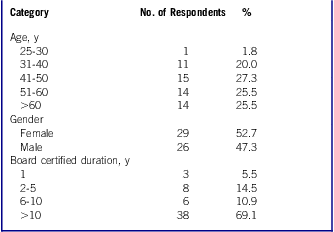
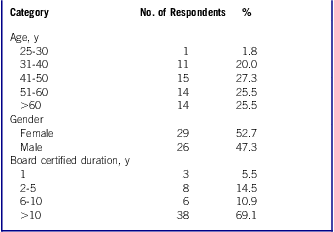
In total, 121 invitations were sent. While 62 (51%) answered the questionnaire, 7 were excluded from the final analysis due to incomplete answers. Consequently, 55 questionnaires entered data analysis. Demographic data of the respondents have been provided in Table 1.
Demographic Data of the Respondents
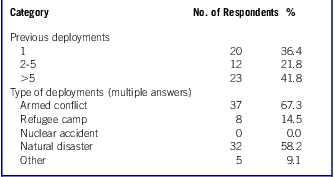
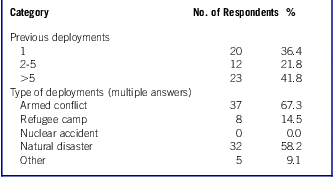
Twenty-six (47.3%) respondents had been on a mission for the ICRC, 27 (49.1%) for MSF, and 22 (40.0%) for a National Red Cross or Red Crescent Society. Ten (18.2%) respondents had been working for other organizations. Twenty-two anesthesiologists were working in Haiti (40.0%) on their last deployment; 7 were in Pakistan (12.7%); 5 in Afghanistan (9.1%); 3 in Libya (5.5%); 2 each in Sudan, Thailand, Chad, Democratic Republic of Congo, and Palestine (3.6% each); and 1 each in Burundi, Indonesia, Ivory Coast, Nigeria, Ruanda, Russia, and Yemen (1.8% each). One participant chose not to specify the country of deployment. Deployment details have been provided in Table 2.
Number and Type of Deployments
Thirteen respondents (23.6%) did not feel sufficiently prepared for the mission, and 35 (63.6%) respondents did not participate in a preparatory course covering anesthesia topics by the deploying organization before departure. The median duration of the course for the deploying organization was 4 days (range: 1h-30 days). Furthermore, 38 (69.1%) respondents did not complete additional training relevant for missions. Relevant additional training included public health, tropical medicine, humanitarian assistance, disaster medicine, health emergencies in large populations (HELP), advanced trauma live support (ATLS), and management courses.
Six (30%) of the 20 respondents who took part in a preparatory course did not feel sufficiently prepared. Four participants perceived themselves as insufficiently prepared in the group after only 1 deployment before answering the questionnaire (33.3%), and 4 participants with 2 to 5 previous deployments had the lowest rate of insufficient preparedness (17.4%). In the group with more than 5 previous deployments, 5 (25%) felt insufficiently prepared.
During their missions, 45 (81.8%) anesthesiologists had to do maintenance work on anesthesia equipment, while 28 (50.9%) had to repair anesthesia equipment. Surgical suite management had to be done by 32 (58.2%) of the respondents; 28 (50.9%) had to conduct triage of mass casualties; 25 (45.5%) were responsible for shift schedules of nurses and physicians and for staff management. Ordering supplies, consumables, and machines was done by 31 (56.4%) of the respondents.
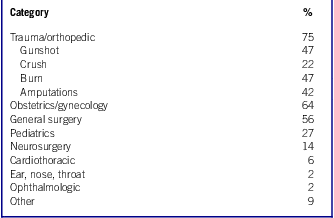
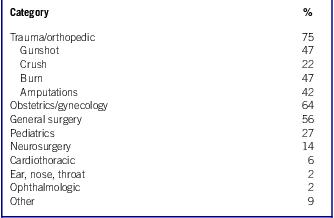
Regarding the lack of specific information before departure, respondents emphasized the need for information on anesthesia topics relevant to a given setting or mission. Asked what important part of the deployment was not covered in the training in their home country, 9 respondents emphasized lack of proficiency to deal with equipment problems (eg, maintenance, repair of anesthetic machines, monitoring, or sterilizers). Six emphasized the lack of management skills, including administrative work such as maintaining a supply chain of anesthetic goods or supervision of local staff; while 5 respondents focused on unfamiliar medications or blood products (eg, halothane, ketamine, local anesthetics, or full blood packages). Another 5 respondents described the lack of regional anesthetic techniques, such as neuroaxial and peripheral techniques, landmark approach, and pediatric regional anesthesia. Three respondents were lacking teaching skills and materials to train local staff, while 2 emphasized a need for improved psychological preparation. Most commonly performed procedures requiring anesthetics have been listed in Table 3.
Procedures Requiring Anesthesia
Discussion
Even though all of the respondents were experienced clinicians and more than two-thirds were board certified longer than 10 years, more than one-fifth did not feel sufficiently prepared for the deployment. In addition, the majority did not complete additional education relevant for missions. Respondents especially felt insufficiently prepared after their first deployment.
Job profiles from agencies deploying anesthesiologists often contain a broad field of expertise necessary for the applicant. While these descriptions are available online for many organizations, their existence alone does not inevitably create awareness and positive impact on preparedness. Improved preparation and transparency with regard to the expected duties are necessary. Nevertheless, lack of knowledge and skills was most frequently related to anesthesia and management topics as well as psychological preparation. The respondents perceived insufficient preparation, for example, regarding equipment and drugs.
This lack of knowledge can lead to precarious situations, because familiarity with anesthesia equipment is essential in the performance of safe, high-quality anesthesia and, consequently, the issue of adequate training and introduction,Reference Beydon, Ledenmat and Soltner12, Reference Cooper, Newbower and Kitz13 especially as medication errors are a major cause of anesthetic-related death.Reference Orser, Chen and Yee14, Reference Orser and Byrick15 International standards for providing safe anesthesia, including the necessity of monitoring, have been published. Nonadherence to the latter, even in the most austere setting, must be regarded as highly questionable practice.Reference Gaba16-Reference Merry, Cooper, Soyannwo, Wilson and Eichhorn18 Maintenance and repair was a crucial point often emphasized by the respondents. Every 4 in 5 respondents had to do maintenance work on anesthesia equipment, and more than one-half had to repair equipment. Because the lack of repair can lead to reduced surgical suite capacity and insufficient maintenance can dangerously decrease patients’ safety, these shortcomings must be overcome.Reference Beydon, Ledenmat and Soltner12, Reference Cooper, Newbower and Kitz13
Furthermore, participants emphasized the lack of regional anesthesia skills. This finding was unexpected, as previous findings stressed the importance and value of adequate integration of regional anesthesia techniques in the care of trauma victims.Reference Missair, Gebhard and Pierre4 Also, we found that some deploying organizations encourage the use of regional anesthesia techniques.Reference Giannou and Baldan19 Participants emphasized the need for adequate training. The reasons for the low utilization of peripheral blocks were unfamiliarity with the block or the application technique and difficulty in communication with the patient due to language barriers. However, the findings from Missair and colleagues were aligned with previous findings from Rice and co-workers, who described that regional anesthesia was extremely useful to provide operative anesthesia and postoperative analgesia while reducing the burden on the postanesthesia care unit.Reference Missair, Gebhard and Pierre4, Reference Rice, Gwertzman, Finley and Morey6 Regional anesthesia remains a safe but underused technique. Even though regional anesthesia is frequently performed using ultrasound-guided techniques in European teaching hospitals,Reference Marhofer, Harrop-Griffiths, Kettner and Kirchmair20 anesthesiologists are not routinely trained in the landmark technique, as performing a block using the landmark technique exclusively, when ultrasound or nerve stimulator is available, is hardly justifiably.
Although some deployments use techniques and equipment well outside the standard care and training of the contracted anesthesiologists, training to use landmark techniques would be neither feasible (timing of training before deploying, skill retention between deployments) nor hardly justifiable in view of current developments.Reference Marhofer, Harrop-Griffiths, Kettner and Kirchmair20 To benefit from the wide application of regional anesthesia techniques, especially in settings with a high number of traumatic injuries, deploying agencies should be strongly encouraged to provide the technical background to allow application.Reference Missair, Gebhard and Pierre4
International anesthesia assistance has been designed to provide quality health care through uninterrupted support to local health care facilities, and therefore reducing the burden of disease of a population.Reference du Mortier and Arpagaus21 Consequently, not only disaster-related injuries are to be treated, but capacities have to also include a broad surgical spectrum of care for the population including, for example, general surgery and obstetric or pediatric anesthesia. Often nonsurgical conditions prove challenging for medical staff, and outbreaks of diarrheal diseases or measles also heavily affect the work of the anaesthesiologist.Reference Rahardjo, Wiroatmodjo and Koeshartono22 The lack of knowledge in tropical diseases was noted. In addition, knowledge of infectious diseases and tropical medicine can be important, as during many missions anesthesiologists serve as the intensivist. Furthermore, knowledge of tropical medicine is essential, as populations that are normally affected by these diseases suddenly suffer from an outbreak threatening a large part of the population.Reference Ginosar and Shapira23
Initial care of the patients on arrival was also the anesthesiologists’ task in some cases. Triage of mass casualties was performed by more than one-half of the respondents. The majority of the respondents had to perform surgical suite and intensive care unit management, as indicated in job descriptions of deploying agencies. Intensive care treatment in emergency settings included sepsis, tetanus, burns, and obstetric and pediatric critical care, whether or not resources are limited.
Deployments after natural disasters often do not allow participation in extended preparatory courses once the organizations start to recruit staff. Consequently, anesthesiologists interested in international humanitarian work should be strongly encouraged to participate in relevant courses covering existing gaps in advance. Some longer term humanitarian disasters (eg, armed conflicts and refugee care) might also allow the deploying organization to conduct short-term preparatory courses that focus on the anesthesiologists’ work or to participate in a course run by a third party. Nevertheless, the heterogeneity of organizations, deployments, and settings would limit the impact of a single preparatory course. This situation is also reflected in the fact that respondents who completed relevant additional training often completed more than 1 course.
In situations of armed conflict, humanitarian assistance can be provided by military or civilian organizations. Great differences exist between civilian nongovernmental organizations and military medical services. However, our questionnaire aimed to elicit the civilian anesthesiologists’ role in complex emergencies. Furthermore, services that have to be provided are directly related to preexisting, very heterogeneous, local health infrastructure and their capacities during crisis. Consequently, the questionnaire did not aim at identifying situations in which the lack of preparedness led to poor outcomes. The questionnaire focused on international medical staff of organizations and did not include local health workers and anesthesiologists from recipient countries.
While some respondents participated in preparatory courses covering anesthesia topics by the deploying organization, others, although sometimes deployed by the same organizations, did not. Whether the courses were not held before some deployments or the individual respondent could not attend was beyond the scope of this questionnaire. To reduce nonresponder or selection bias, reminder e-mails were sent through the participating organization. While a return rate more than 30% for web-based questionnaires was acceptable in comparison with previous publications, the results have to be interpreted carefully and the conclusions cannot be extrapolated to every deploying organization and even less so to all deployed anesthetists. Furthermore, we cannot rule out a remaining selection bias resulting from the choice of collaborating organizations and their current or previous employed anesthesiologists to participate.Reference Kaplowitz, Hadlock and Levine11
Conclusions
The findings from this study provide evidence that many anesthesiologists deployed to complex emergencies lack important preparedness before leaving. Gaps in context-specific medical, technical, and administrational aspects must therefore be overcome, and additional research in this field is needed. Improved preparation in close collaboration with deploying agencies is necessary to provide safe anesthesia and must strongly be encouraged. Nevertheless, while striving for improved preparation, the format and optimal duration of a preparatory course aimed at filling this gap remains undetermined.
Acknowledgments
The anesthesiologists who participated in the study have given their time, effort, and dedication to patients worldwide, regardless of nationality, religious belief, or ethnicity. The participating organizations provided their support to this project.
Funding and Support
This work was supported solely by the Medical University of Vienna, Austria.
Disclaimer
Bernadette Peterhans has received honoraria from the International Committee of the Red Cross for consultancy work and teaching.
Presentations
Parts of the findings have been presented as a poster at the Resuscitation Congress in Vienna, Austria, October 18-20, 2012.