The current study examines the linguistic and social nature of maternal input in an understudied population, namely, low-income African American mother–infant dyads, followed from 0 years, 1 month (0;1) to 2;0, and the relations of various input measures to children's early language development. Numerous studies of caregiver input have revealed systematic relations between children's language environments and their development of language. Both lexical and syntactic properties of parental input have been found to predict children's language development. Relevant measures of linguistic input include the frequency of maternal verbalizations or word tokens (Huttenlocher, Haight, Bryk, Seltzer, & Lyons, Reference Huttenlocher, Haight, Bryk, Seltzer and Lyons1991; Naigles & Hoff-Ginsberg, Reference Naigles and Hoff-Ginsberg1998), the mean length of utterances (Bornstein, Haynes, & Painter, Reference Bornstein, Haynes and Painter1998), and the number of different word types (Bornstein et al., Reference Bornstein, Haynes and Painter1998). Each of these input variables has been shown to be positively correlated with children's vocabulary development (Hoff & Naigles, Reference Hoff and Naigles2002; Hoff-Ginsberg, Reference Hoff-Ginsberg1994; Tamis-LeMonda & Bornstein, Reference Tamis-LeMonda and Bornstein1994; Tamis-LeMonda, Bornstein, Kahana-Kalman, Baumwell, & Cyphers, Reference Tamis-LeMonda, Bornstein, Kahana-Kalman, Baumwell and Cyphers1998).
In addition to measuring the frequency and complexity of mothers’ verbalizations, research has also focused on the social cues associated with language development. However, these studies have been much less conclusive in their findings regarding the relationships between social cues (e.g., gesture) and children's language development. Thus, there is much disagreement on how, when, and even whether parents’ social behaviors may predict their children's language development (Hoff & Naigles, Reference Hoff and Naigles2002; Masur, Flynn, & Eichorst, Reference Masur, Flynn and Eichorst2005). In the following sections, we review studies indicating that parents’ social behaviors relate positively to language development, and then discuss some of the recent conflicting evidence about the importance of this type of input.
MATERNAL RESPONSIVENESS AND CONTINGENCY
Various studies have shown that mothers who respond verbally to their infants’ attentional focus (Akhtar, Dunham, & Dunham, Reference Akhtar, Dunham and Dunham1991; Rogoff, Malkin, & Gillbride, Reference Rogoff, Malkin and Gillbride1984; Shimpi & Huttenlocher, Reference Shimpi and Huttenlocher2007; Tomasello & Farrar, Reference Tomasello and Farrar1986; Tomasello, Strosberg, & Akhtar, Reference Tomasello, Strosberg and Akhtar1996) as well as to their vocalizations (Baumwell, Tamis-Leonda, & Bornstein, Reference Baumwell, Tamis-LeMonda and Bornstein1997; Rollins & Snow, Reference Rollins and Snow1998; Tamis-LeMonda, Bornstein, & Baumwell, Reference Tamis-LeMonda, Bornstein and Baumwell2001) have infants who are more productive with language. Tomasello and Farrar (Reference Tomasello and Farrar1986) found that mothers who responded more to their child's attentional focus when their infants were 1;3 had children with higher vocabulary scores at 1;9 (see also Carpenter, Nagell, & Tomasello, Reference Carpenter, Nagell and Tomasello1998). Harris, Jones, Brookes, and Grant (Reference Harris, Jones, Brookes and Grant1986) found similar relations between mothers’ responsiveness to children's focus of attention and children's subsequent language development. Thus, there is considerable evidence that children's vocabulary development seems to be facilitated when they hear language that is responsive to their own vocalizations and that is relevant to their current attentional focus.
In younger prelinguistic infants, contingency has been defined by the extent to which parents verbalize in response to infant vocalizations. This measure has been used to predict later language growth. Tamis-LeMonda et al. (Reference Tamis-LeMonda, Bornstein and Baumwell2001) found that mothers who more often responded contingently to their infants’ vocalizations had children who were more developmentally advanced than infants whose mothers’ responses were not contingent (for later relations to syntax, see also Rollins & Snow, Reference Rollins and Snow1998). Thus, there is evidence that social input behaviors predict children's early language development.
It is important to note that the linguistic (e.g., amount of word types or tokens) and social aspects (i.e., contingent verbalizations, measures of joint attention) of early dyadic conversation that we have reviewed are not necessarily independent. As demonstrated in previous studies, both have been found to work together to contribute to language development (Akhtar & Tomasello, Reference Akhtar, Tomasello, Golinkoff and Hirsh-Pasek2000; Hollich, Hirsh-Pasek, & Golinkoff, Reference Hollich, Hirsh-Pasek and Golinkoff2000). However, as we noted earlier, questions remain as to when these input factors may hold the most predictive value for children's language development, and even whether some of these factors are relevant at all to language outcomes.
ALTERNATE ACCOUNTS OF THE PREDICTIVE VALUE OF RESPONSIVENESS
Not all studies have found associations between social response characteristics and child language development. Hoff and Naigles (Reference Hoff and Naigles2002) conducted an observation of 63 mother–infant dyads at the second year to determine which social and linguistic features of input may relate to child language development. They found no relation between what they referred to as “social-pragmatic” aspects of input (e.g., social responsiveness) and child language outcomes. However, they did find positive predictors of child language in parents’ number of types, tokens, and mean length of utterance. Note that Hoff and Naigles’ sample did not focus on children under the age of 2; therefore, it was not possible for them to investigate whether social–pragmatic sources of input may have predictive value before 2 years. Thus, in discussing their findings in relation to another study of social input by Carpenter et al. (Reference Carpenter, Nagell and Tomasello1998), Hoff and Naigles (Reference Hoff and Naigles2002) hypothesize that although these social processes may be important to the child before 2 years of age, they may not be essential components of the language–acquisition process after this period. Instead, linguistic features of input such as the frequency, complexity, and number of words that caregivers use become more decisive in determining the rate of the child's lexical development. Thus, although there has been extensive support for the contribution of joint attention to language development, some researchers have begun to argue that a critical assessment of these studies indicates otherwise (Akhtar, Reference Akhtar, Homer and Tamis-LeMonda2005; Akhtar & Gernsbacher, Reference Akhtar and Gernsbacher2007; Hoff & Naigles, Reference Hoff and Naigles2002).
In a recent study, Masur et al. (Reference Masur, Flynn and Eichorst2005) examined the relationships between mothers’ responsive and directive behaviors and their children's subsequent vocabularies in 20 mother–infant dyads. Although, overall, they found that maternal responsiveness was a positive predictor of children's vocabularies, they also found that directiveness at 1;1 approached significance in positively predicting children's language at 1;5. Shimpi and Huttenlocher (Reference Shimpi and Huttenlocher2007) found that mothers’ use of directive labels at 1;6 and 1;10 was positively associated with child vocabulary at 1;10 if paired with gesture; however, without gesture, directive labels were negatively related to child language. Further work is necessary to fully understand the combined relation of social and linguistic input to child language development.
LANGUAGE DEVELOPMENT IN DIVERSE POPULATIONS
The input studies we have reviewed focus almost exclusively on middle class European American samples. Much less information is available about the contributions of social and linguistic input in ethnic minority families and groups from multiple social–economic levels. We argue that an increased diversity of participants in language development research is important, as studies have consistently revealed differences across cultures and social class in the amount of speech and the interaction styles of parents and infants (Hart & Risley, Reference Hart and Risley1995; Hoff, Reference Hoff, Bornstein and Bradley2003a, Reference Hoff2003b; Snow et al., Reference Snow, Arlman-Rupp, Hassing, Jobse, Joosten and Vorster1976; but see Childres, Vaughan, & Burquest, Reference Childers, Vaughan and Burquest2007). Given the differences in language input and subsequent development observed between different social classes and ethnic groups, there is a relative lack of studies concerned with the relations between these factors, either cross-culturally or even within many populations. Pan, Rowe, Singer, and Snow (Reference Pan, Rowe, Singer and Snow2005) tracked parents’ language input and children's language development in 108 low-income, primarily European American (91%) dyads. They examined predictors of children's language development from 1;0 to 3;0, using a seminaturalistic methodology. Their results indicated that variables such as maternal depression and maternal linguistic skills predicted child vocabulary growth. They also found that predictors of child language growth included diversity, but not sheer frequency of maternal speech, a result that shows interesting between-group differences when compared to previous studies of middle class dyads (e.g., Huttenlocher et al., Reference Huttenlocher, Haight, Bryk, Seltzer and Lyons1991). Furthermore, there was a notable amount of variation in the input within their sample, indicating that studying these underrepresented groups on their own may reveal important individual and within-group differences. Clearly, more studies of parent–child groups across different social and ethnic backgrounds are necessary to fully understand variation we see both between and within different populations.
As mentioned previously, relatively little research has been conducted with African American families. Those studies that exist suggest meaningful differences between ethnic groups in both parent input and child outcomes (e.g., Hart and Risley, Reference Hart and Risley1995; Heath, Reference Heath1983; Lawrence & Shipley, Reference Lawrence and Shipley1996). Pan, Rowe, Spier, and Tamis-LeMonda (Reference Pan, Rowe, Spier and Tamis-LeMonda2004) found significant differences in reported (MacArthur Communicative Development Inventory) and observed (Peabody Picture Vocabulary Test) child vocabulary between European American, African American, and Hispanic children. Furthermore, Brooks-Gunn and Markman (Reference Brooks-Gunn and Markman2005) report that there are differences between parents from different ethnic groups on measures of discipline, sensitivity, and the amount of speech and reading activities conducted with children. Given that parental input and child outcomes both vary across populations, we cannot be certain that the relationships between these sets of factors are always the same. Therefore, it is important that we further examine social and linguistic input and child language development in underresearched groups in order to better understand the appropriateness of word learning models based on European American middle class samples.
THE CURRENT STUDY
The current study examines the relevance of social and linguistic input measures in early infancy to children's language outcomes at 1;6 and 2;0. The uniqueness of the present study lies in its focus on both social and linguistic input measures, the underrepresented sample, and the study's longitudinal nature. By thorough observations of mother–child interactions in a seminaturalistic setting, we address three major questions. First, we consider whether maternal social and linguistic input is stable over time. Second, we examine the relation between maternal input and child vocabulary development. Third, we look at the relationship between maternal social responsiveness and child vocabulary. We discuss these results with respect to previous studies of language development to examine the extent to which earlier findings generalize to understudied populations.
METHOD
Participants
The sample consisted of 30 mother–child dyads (13 females). The sample is a subset from a larger study of low-income parent–child dyads; the current participants were drug-free members of a control group in a study of opioid-dependent mothers (Bernstein & Hans, Reference Bernstein and Hans1994), and were recruited through screening interviews at Chicago Lying-In Hospital's obstetrics clinics, serving medically low-risk, low-income patients. Participants in the current study were chosen from the original sample based on the availability of, and sound quality of, videotaped observations for the time periods studied. The average age of the mothers at the time of their giving birth was 25;9 (SD = 4.0 years). Many of the women in the sample group were unmarried (66.7%) but most of the women were living with the infant's father at the time they gave birth (63.3%). Socioeconomic status (SES) was determined at both the time when the mother was pregnant and when the child was 10 years old using a Two-Factor Index of Social Position (Hollingshead & Redlich, Reference Hollingshead and Redlich1958). All of the women in this sample represented the lowest three levels on this social classification (3, 4, 5); 50% were from the lowest level (5). Mothers had attained, on average, 11.4 years of schooling (range = 8–14, SD = 1.19). For more details concerning the recruitment of participants and the determination of social–environmental risk factors, see Bernstein and Hans (Reference Bernstein and Hans1994). The infants in the sample were all later born, and their mothers were the primary caretakers.
Procedure
The data were collected via videotaped sessions of mother–child interaction at 0;1, 1;4, 1;8, 1;0, 1;6, and 2;0 (Grattan & Hans, Reference Grattan and Hans1996). The average length of each taped session was approximately 30 min long, but because some sessions varied in length, measures were computed using transcripts truncated to the shortest taping. The durations used for the current analysis were the following: Month 1, 10 min; Month 4, 15 min; Month 8, 20 min; Month 12, 17 min; Month 18, 27 min; Month 24, 20 min.
Mother–child dyads were videotaped in a university office furnished like a living room, in a number of age-appropriate activities that included feeding, diapering or toilet training, and play with specified objects and free play. In each session there was a researcher present videotaping the mother–child interaction.
Transcription
An utterance was defined as no more than one grammatical sentence, separated primarily by pause duration and intonation. Utterances constituting only of disfluencies (e.g., “hmm,” and “ah”) were not included, nor were utterances that were either directed by or toward the experimenter. Sessions were transcribed and coded by two independent researchers. Reliability between the two coders was 93% on a sample of 200 utterances. Transcripts were verified by a third researcher to check for content and to minimize discrepancies.
Maternal linguistic measures
All maternal linguistic input was measured within the truncated time span of each videotaped session. The measures of linguistic properties of parent speech taken at each session included mothers’ total number of word tokens and the total number of different word types produced. These numbers were counted by hand for each utterance, and totals for each session were calculated using a spreadsheet program. Mothers’ number of word tokens was defined as the total number of words uttered to the child within each session. Thus, the measure of word tokens was one of talkativeness. The total number of word types mothers produced was a measure of the diversity of words the child received. As in Hoff-Ginsberg (Reference Hoff-Ginsberg1991), this measure of word types was defined as the total number of different word roots produced. For example, if a mother, at 18 months, used the words “looks,” “looked,” and looking,” we would count these words as three tokens, but only as one type.
Maternal social measures
All maternal social input was measured within the truncated time span of each videotaped session.
Contingent vocalizations. The extent to which mothers verbally responded to children's vocalizations was used as a measure of maternal responsiveness. The coding of contingent vocalizations was conservative in that only verbal responses to children's vocalizations are taken into account, yet this measure is frequently used with parent–child interactions (see Baumwell et al., Reference Baumwell, Tamis-LeMonda and Bornstein1997; Rollins & Snow, Reference Rollins and Snow1998; and Tamis-LeMonda et al., Reference Tamis-LeMonda, Bornstein and Baumwell2001). During the preverbal stages, infant vocalizations included crying or babbling but did not include feeding or other vegetative sounds. The cessation of a crying bout was defined by a brief pause, wherein the mother was coded as contingently responding if she verbalized to the infant within a two second window (Bigelow & Rochat, Reference Bigelow and Rochat2006; Prorok, Reference Prorok1980; Poulson, Reference Poulson1983).
Directiveness/responsiveness in labeling. As discussed earlier, prior research with European American samples suggests that responsiveness to infant attention during object labeling sessions has an important influence on children's vocabulary. Because it has been found that these kinds of mutual, responsive interactions do not begin to appear until the infant is around 9 months of age (see Carpenter et al., Reference Carpenter, Nagell and Tomasello1998), labeling measures were only coded from 0;8 through 2;0 in the current study. Words were coded as object labels if they were nouns or proper nouns that referred to a concrete, perceptually present object or person (see Snow, Reference Snow1977), as these are cases for which children's attention to the referent is clear.
The coding system used here classified object references as responsive or directive largely based on Tomasello and Farrar's (Reference Tomasello and Farrar1986) coding scheme (see also Shimpi & Huttenlocher, Reference Shimpi and Huttenlocher2007, for the use of this scheme with European American middle class participants). Our measure of responsive labels was the percentage of all labels during which a mother labeled an item already in the child's current focus. Labels for items not in the child's focus were coded as directive. In addition, we measured the percentage of all labels during which a mother labeled an item while using a gesture highlighting the object's location (i.e., pointing, waving, or moving the object). Object references made when one or both members of the dyad were not in view of the camera were excluded.
Child outcome measures
Child vocabulary measures included both word tokens and word types at 1;6, and 2;0. Like the maternal measures, children's language measures were also based on the truncated transcripts from each videotaped session. Although the number of word tokens for the children was recorded, we argue that this is not so much a measure of the child's vocabulary content as it is a measure of the child's talkativeness. Thus, the measure of productive vocabulary for the present study focuses on the number of cumulative word types for months 1;6, and 2;0. We chose to use a cumulative measure (for a justification of this measure, see Huttenlocher et al., Reference Huttenlocher, Haight, Bryk, Seltzer and Lyons1991). Therefore, word types that the children produced at 1;6 months but did not produce at 2;0 were still included when calculating the child's productive vocabulary at 2;0.
Analysis
In order to answer the questions posed by the present study, we focused our analysis on the relationships between maternal input and children's vocabulary. To directly measure these relationships, we conducted Pearson bivariate correlations between the maternal input factors of linguistic input, contingent verbalizations, and directive behavior and the child outcome measures of child word types and tokens at 1;6 and 2;0.
RESULTS
Descriptive statistics
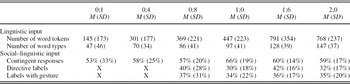
Recall that for children, word tokens are noncumulative, whereas types are cumulative. At 1;6, children produced an average of 26 tokens (SD = 28) and 14 types (SD = 14), whereas at 2;0, they averaged 91 tokens (SD = 125) and 42 types (SD = 32). Means and standard deviations for maternal input measures are presented in Table 1.
Means (standard deviations) for maternal input measures

Note: X indicates that this measure was not computed during this time period. Ages are in years;months.
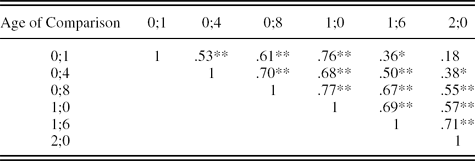
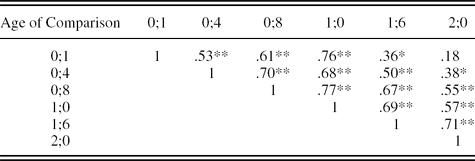
Bivariate correlations were calculated between children's language measures over time. Table 2 displays the consistency of and the relations between children's speech measures. Children's number of word tokens over time was strongly positively correlated from 1;6 to 2;0 (r = .60, p < .01; all correlations reported are two tailed). Children's number of word types was additive over time, thus correlations are not reported. At any given time period, children's numbers of tokens and types were extremely highly correlated (at 1;6, r = .95, p < .01; at 2;0, r = .97, p < .01; between 1;6 and 2;0 months, r = .69, p < .01). Thus, the frequency and diversity of child vocabulary use was consistent over time.
Bivariate correlations between maternal language measures over time: Word types over time
Note: Ages are in years;months.
*p < .05 (two tailed). **p < .01 (two tailed).
One of the goals of the current study was to determine the extent to which maternal linguistic input was consistent over time. Table 2 depicts the correlations between mothers’ number of word types over time. The correlations between consecutive time periods were always positive and significant (p < .01 for all time points). Mothers’ frequency of word types (noncumulative) also showed consistent patterns over time. Thus, maternal speech was consistent over time, in terms of amount and diversity of vocabulary.
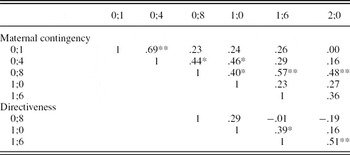
Next, we conducted bivariate correlations between measures of social input over time. First, we find that maternal contingency is positively correlated at each pair of consecutive time periods from 0;1 through 1;0 (see Table 4). Contingency at 8 months was also related to contingency at 1;6 and 2;0 (p < .01).
Table 3 also shows stability across time for the measures of directiveness. Mothers’ tendency to be responsive (rather than directive) in labeling objects for their infants was significantly positively correlated between 1;0 and 1;6 and between 1;6 and 2;0. Finally, we looked at mothers’ tendency to gesture when giving object labels to their children over time. This measure was significantly positively correlated between 1;0 and 1;6 (r = .42, p < .05) and between 1;6 and 2;0 (r = .46, p < .05). Note that there was not as much continuity across age for these sociolinguistic measures as for the language input measures.
Bivariate correlations between maternal social input measures over time

Note: Ages are in years;months.
*p < .05 (two tailed). **p < .01 (two tailed).
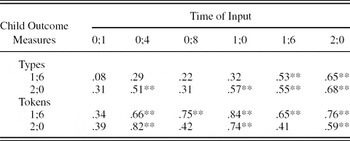
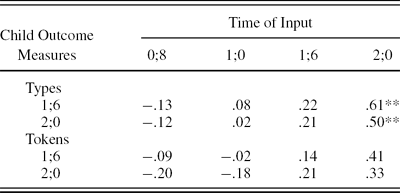
Of interest to this study was the relation between maternal linguistic input and child outcome measures. Table 4 depicts these correlations over time. In general, the number of maternal types is positively correlated with children's types and tokens throughout the time period studied.
Bivariate correlations between maternal word types and child language outcomes at 1;6 and 2;0

Note: Ages are in years;months.
**p < .01 (two tailed).
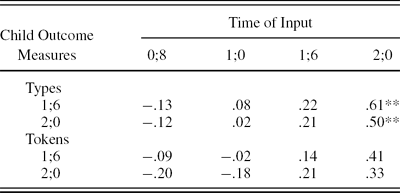
Next, we present results from our social input measures. We found no significant relations between our measures of maternal contingency and child language measures at any age. However, the proportion of directive labels at 2;0 was significantly positively correlated with child type counts at 1;6 and 2;0 (p < .01 in both cases). Finally, we found no relation between gesture use in labeling and child language outcomes (Table 5).
Bivariate correlations between maternal directiveness and child language outcomes at 1;6 and 2;0
Note: Ages are in years;months.
**p< .01 (two tailed).
DISCUSSION
The purpose of the present study was to investigate the relations between a number of maternal input properties, both linguistic and social, and children's language development in an underrepresented group of mother–infant dyads. The goal was to further understand how linguistic input measures (word types and tokens) and social input measures (directiveness and contingent verbalizations) predicted children's subsequent language development. We first summarize our main findings, and then explore some of the issues to consider in interpreting these data.
For our linguistic data, we found that properties of maternal speech were highly consistent over time, in terms of amount and diversity of vocabulary. We saw a similar consistency in child vocabulary measures over time. Furthermore, we found that speech diversity in maternal linguistic input was strongly associated with children's subsequent language development measures. In looking at our social measures of input, our measure of maternal verbal contingency did not predict child language at any time point throughout the longitudinal study. Surprisingly, we found a positive correlation between maternal use of directive labels and child vocabulary. We discuss the implications for these findings, and how they relate to previous research on parent sociolinguistic input and child language development.
Relations between maternal speech and child language
Based on previous studies, we predicted that linguistic aspects of maternal input would be reflected in children's speech output. Our findings were consistent with these studies (Hoff, Reference Hoff, Bornstein and Bradley2003a; Hoff & Naigles, Reference Hoff and Naigles2002; Huttenlocher et al., Reference Huttenlocher, Haight, Bryk, Seltzer and Lyons1991). The linguistic properties of maternal speech were strongly associated with child language outcomes. What is noteworthy about the current findings is both the strength of the relations and their consistency across time. For example, the diversity of mothers’ vocabulary, as measured by the number of (nonadditive) types, shows consistent patterns from the child's first month, and has predictive value for children's vocabulary over this longitudinal period. Thus, the more diverse the mother's vocabulary was early in development, the more diverse the child's vocabulary tended to be in toddlerhood. This result supports recent findings suggesting the importance of the diversity of maternal word types to child language development (Pan et al., Reference Pan, Rowe, Singer and Snow2005).
Relations between parent social input and child language
We initially predicted that sensitive social monitoring of infant vocal and attentional behavior would be positively correlated with child language development, and that directive social behaviors would be negatively associated with child language development. We chose these types of measures based on previous studies (Baldwin, Reference Baldwin1991, Reference Baldwin1993; Masur et al., Reference Masur, Flynn and Eichorst2005; Shimpi & Huttenlocher, Reference Shimpi and Huttenlocher2007; Tomasello & Farrar, Reference Tomasello and Farrar1986; Tomasello & Todd, Reference Tomasello and Todd1983) as well as on the basic hypothesis that responsive social input decreases the amount of effort the child has to make to enter into conversations and identify the referents in their environment. However, our data fail to show clear relations between responsive social input measures and child language in the current study. This was surprising, especially in the context of the numerous research findings showing the importance of responsive measures, including those which used similar, if not identical, measures (Shimpi & Huttenlocher, Reference Shimpi and Huttenlocher2007; Tomasello & Farrar, Reference Tomasello and Farrar1986). However, the importance of social pragmatic behaviors to child language development is not universally accepted, and the current study contributes to the debate about the role of these input measures in predicting children's language (Akhtar & Gernsbacher, Reference Akhtar and Gernsbacher2007; Hoff & Naigles, Reference Hoff and Naigles2002). In interpreting our results, we do not claim that social–pragmatic input behaviors are not important, but what we do argue is that our current view of what counts as responsive social–pragmatic behavior (verbal contingency, follow-in behavior) that has been shown to be predictive of European American middle-class mother–infant dyads might not work in the same way across different cultural, ethnic, or socioeconomic groups. Below, we discuss these possibilities in relation to our data.
Contingent vocalizations. It was predicted that the higher the frequency of contingent vocalizations from 0;1 to 2;0, the higher the child's complexity of speech at 2;0. However, the data did not reveal any strong relations between these measures. This is in contrast to other studies that have found a relation between maternal contingency from 1;0 to 2;0 and subsequent child vocabulary (Rollins, Reference Rollins2003; Tamis-LeMonda et al., Reference Tamis-LeMonda, Bornstein, Kahana-Kalman, Baumwell and Cyphers1998; Yoder & Warren, Reference Yoder and Warren1999). For example, in a study of middle- to upper-middle-class European American mother–infant dyads, it was found that verbal contingent responsiveness during play at 0;9 was a significant predictor of the infants’ first 50 words, complexity of speech, and expression of a first memory at age 0;9 (Tamis-Lemonda et al., Reference Tamis-LeMonda, Bornstein, Kahana-Kalman, Baumwell and Cyphers1998). Another study also revealed a significantly strong positive correlation between mothers’ contingent comments at 0;9 and child vocabulary comprehension at 1;0 (Rollins, Reference Rollins2003). Rollins (Reference Rollins2003) also found that 64% of the variance in child word comprehension at 1;6 was attributable to the combined effects of maternal contingent verbalizations at 0;9 and the frequency of coordinated joint attention at 1;0.
It is possible that the measures used to index contingency may not have the same predictive power across different populations. This is not to say that contingent behavior is not important across different populations, but that the way in which contingent behavior has been measured might need to be expanded to account for potential differences in interactive behaviors (Vigil, Reference Vigil2002). Thus, a possible reason why these data may not match earlier reports is that such a measure of contingency is a conservative one. It is possible that including other contingent behaviors such as smiling or touch may result in more sensitive measures of maternal contingency (Akhtar & Gernsbacher, Reference Akhtar and Gernsbacher2007). Furthermore, in the current study, maternal verbal responses to child gestures or other nonverbal behaviors were not included. Future studies may take into account the role of children's communicative gestures during the early preverbal and verbal stages of development (Goldin-Meadow, Reference Goldin-Meadow1999; Masur, Reference Masur1982; Rowe, Reference Rowe2000).
Responsive/directive labels. Following previous findings regarding responsiveness to children's attention (Laakso, Poikkeus, Eklund, & Lyytinen, Reference Laakso, Poikkeus, Eklund and Lyytinen1999; Rollins & Snow, Reference Rollins and Snow1998; Shimpi & Huttenlocher, Reference Shimpi and Huttenlocher2007; Tomasello & Farrar, Reference Tomasello and Farrar1986), we predicted that mothers who tended to produce more responsive object labels at 0;8, 1;0, 1;6, and 2;0 would have children with a higher vocabulary at 2;0, and that the relation for directive labels would be negative. In contrast, we found that directive behavior was positively related to the number of child types at 1;6 and 2;0. A possible explanation is that directive labels were often attempts to tell children to retrieve or attend to an object in their surroundings. Often, these were single word utterances, repeating the name of the target objects. Thus, our results may be related to general effects of imperative speech types, which tend to be shorter utterances, but in the case of the current study, may serve to highlight a diversity of object names when retrieval or attention is necessary. To support this possibility, we found a significant, positive correlation between the diversity of parent word types at 1;6 and 2;0 and use of directive labels at 2;0.
Another potential explanation for our results could be that the effects of an input pattern that has been shown to predict high child vocabulary for European American, middle-class dyads may not replicate in all populations. There is support in the literature for this claim. For example, Saxon and Reilly (Reference Saxon and Reilly1998) found that joint attention did not relate to language variables in low-SES mother–infant dyads. Although Saxon and Reilly examined the amount of time spent in joint attention, whereas the current study focused on maternal object labels in joint attention, the common thread was the finding that the proposed hypothesis relating joint attention measures to later measures of child language did not replicate in a low-income sample. However, as we have argued earlier, the current measures of joint attention (i.e., eye gaze and overt gestures) may overlook other ways caregivers can share attention with their children, such as touch and proximity (Akhtar & Gernsbacher, Reference Akhtar and Gernsbacher2007).
Differences in uses of social–pragmatic behaviors such as the use of directives may also have a cultural basis. Johnston and Wong (Reference Johnston and Wong2002) found that compared to Western mothers, Chinese mothers used more directives in their speech and were less likely to follow their children's topic of conversation (for similar differences in interactions between American and Chinese mothers and their deaf children, see also Goldin-Meadow & Saltzman, Reference Goldin-Meadow and Saltzman2000). Similarly, Vigil and her colleagues (Vigil, Reference Vigil2002; Vigil, Tyler, & Ross, Reference Vigil, Tylar and Ross2006) found that compared to American and British caregivers, Chinese and Mexican caregivers are more directive in their communication. However, Vigil (Reference Vigil2002) found no differences in Chinese immigrant and British children's vocabulary sizes at 18 months of age. Furthermore, Vigil et al. (Reference Vigil, Tylar and Ross2006) found that Mexican children learned words better from directive input than when given an attention-following style, evidence that children's language development may depend on a match between the learning context and children's typical environments.
According to social–pragmatic language development theories, learning is facilitated when parents are sensitive to the child's line of focus when labeling objects (e.g., Akhtar et al., Reference Akhtar, Dunham and Dunham1991; Tomasello & Farrar, Reference Tomasello and Farrar1986). However, the supporting studies were based primarily on middle-class European–American dyads. For this cultural majority population, the social context in which a majority of learning takes place is typically one in which the caregiver monitors the child's attention and follows the child's lead (Chavajay & Rogoff, Reference Chavajay and Rogoff1999; Rogoff, Mistry, Göncü, & Mosier, Reference Rogoff, Mistry, Göncü and Mosier1993). However, a growing body of counterevidence is demonstrating that this type of social interaction is not common across, or even within, cultural groups, and that alternate types of social contexts lead to differences in learning and attention that reflect the diversity of children's environments. The origins of these differences may reflect deeply held cultural beliefs and expectations about the role of adults and children (Burns & Radford, Reference Burns and Radford2008).
In non-Western or nondominant cultures, children may rarely be in dyadic conversations with their caregivers, and may not be directly addressed at all (Ochs & Schieffelin, Reference Ochs, Schieffelin, Shweder and LeVine1984). Children in these families may often be in rich social contexts with multiple children and adults and are expected by the culture to attend to and learn from observation rather than direct instruction these interactions (e.g., Rogoff, Reference Rogoff2003). In response, these children have developed attention strategies that allow them to attend to and learn from multiple sources of information in the environment (Chavajay & Rogoff, Reference Chavajay and Rogoff1999; Gaskins Reference Gaskins and Göncü1999; Rogoff, Reference Rogoff2003; Rogoff et al., Reference Rogoff, Mistry, Göncü and Mosier1993). Even within a dominant culture, children who spend more time with multiple adults are more likely to attend to and learn from observing adults interact than children who do not have these typical daily experiences (Shneidman, Buresh, Shimpi, Knight-Schwartz, & Woodward, Reference Shneidman, Buresh, Shimpi, Knight-Schwartz and Woodward2009.). These cross-cultural and intracultural studies demonstrate how social context and cultural expectations play a role in shaping children's learning. The idea of sensitively monitoring a child's attention may then be seen as a culturally specific strategy, and may therefore have limited application to both theory and practice.
Intervention targeting children “at risk” for language delays or disabilities can be similarly characterized as supporting the use of a culturally specific communicative style. A majority of intervention studies have involved European American middle-class families (Burns & Radford, Reference Burns and Radford2008). Some of the most popular and widespread language intervention strategies have been developed from this type of research. As a likely result, in speech–language pathology, language interventions are primarily dyadic and child-led (Wing et al., Reference Wing, Kohnert, Pham, Cordero, Ebert and Kan2007). Methods employing directives, on the other hand, are viewed as detrimental. For example, the widely used Hanen Center's (n.d.) Program “It Takes Two to Talk™” is based on what they term the “responsivity hypothesis” focusing on the importance of the social behaviors highlighted in the current study such as: “responsive speech” and “prompt, poisitive, contingent input.” In the program, caregivers and professionals are trained to use behaviors such as “follow the child's lead,” and results from this intervention shows decreases in parent directiveness (It Takes Two to Talk; Manolson, Reference Manolson1992). This program has been translated into Spanish and Chinese, which is of note given this type of interaction may not necessarily be beneficial to the corresponding cultures (Vigil & Hwa-Froelich, Reference Vigil and Hwa-Froelich2004). Currently, intervention strategies that take into account the child's culture are rare, but some researchers and practitioners are attending to this need (e.g., Burns & Radford, Reference Burns and Radford2008; Van Kleek, Reference Van Kleeck1994; Wing et al., Reference Wing, Kohnert, Pham, Cordero, Ebert and Kan2007). Our current findings highlight the importance of further study of the context of caregiver social and linguistic input, and how it may relate to language development across different populations.
GENERAL LIMITATIONS AND IMPLICATIONS
This study is limited in its scope, as it focuses on dyads from a single ethnic group at a very low SES level, albeit a very underrepresented group in the literature. Because of the composition of our sample, we cannot address separately the effects of race, culture, and SES. It is important to note that there are SES-related differences in input style across African American mothers (e.g., Rooparine, Fouts, Lamb, & Lewis-Elligan, Reference Rooparine, Fouts, Lamb and Lewis-Elligan2005; Sheffner Hammer & Weiss, Reference Scheffner Hammer and Weiss1999, Reference Scheffner Hammer and Weiss2000), but the current study only examines those mothers from a very low SES group. Furthermore, we must be careful to note that the current data cannot speak to the effects of social input on other measures of child development (e.g., social development). Finally, the design of this study may have had an impact on how language was elicited, as these episodes were seminaturalistic and constrained by the laboratory environment. The dyadic nature of the laboratory free-play tasks may not have been representative of the children's typical social environments.
Despite these limitations, given the paucity of data on mother–child interactions from low-income samples (for further discussion, see Pan et al., Reference Pan, Rowe, Singer and Snow2005), this study expands what we know about the social and linguistic interactions of an underrepresented group of mothers and their children over an extended period of time. Specifically, the data collected from the current study highlight the importance of linguistic input from very early in children's preverbal experiences for predicting children's subsequent vocabulary development. The main contribution of this study concerns the relations between maternal linguistic measures and children's language outcomes over the time period studied. The diversity of mothers’ word types was strongly positively correlated with children's word types (and word tokens). The results concerning the predictive value of the social input in our dyads, however, are less clear, and pose further questions with respect to language development in children from groups other than middle-class European American samples. As a result, much more research is needed in a longitudinal, naturalistic context with a larger range of populations, in order to further explore the relations between social and linguistic input and child language development.
ACKNOWLEDGMENTS
We greatly appreciate the participation of parents and families. Work was supported by grants (R18DA-01884 and R01DA-05396) from the National Institute on Drug Abuse. We acknowledge the major contributions of Joseph Marcus, Rita Jeremy, Victor Bernstein, Carrie Patterson, and Linda Henson in the design and execution of the longitudinal study. We appreciate comments on the manuscript from Nameera Akhtar and Meredith Rowe.