


1 Introduction
The present paper has two main results. The first one shows that the reciprocal dual algebra of a unital Kirchberg algebra with finitely generated
$\mathrm {K}$
 -groups has a universal property with respect to a generating subalgebra and partial isometries. The second one shows that any Kirchberg algebra with finitely generated
$\mathrm {K}$
 -groups has an ergodic automorphism having a unique invariant state. The unique invariant state is pure. The uniqueness of invariant states is proved by using the universal relations of generators of the reciprocal Kirchberg algebra proved as the first main result.
The notion of the reciprocality in Kirchberg algebras with finitely generated
$\mathrm {K}$
 -groups has been introduced by the second named author in [Reference Sogabe27] in relationship to the study of the homotopy groups of the automorphism groups of Kirchberg algebras and bundles of
$C^*$
 -algebras. Two unital Kirchberg algebras
${\mathcal {A}}$
 and
${\mathcal {B}}$
 are said to be reciprocal if
${\mathcal {A}}$
 is
$\mathrm {K}\!\mathrm {K}$
 -equivalent to
$D(C_{\mathcal {B}})$
 and
${\mathcal {B}}$
 is
$\mathrm {K}\!\mathrm {K}$
 -equivalent to
$D(C_{\mathcal {A}})$
 , where
$C_{\mathcal {A}}$
 for a unital Kirchberg algebra
${\mathcal {A}}$
 is defined as the mapping cone algebra for the unital embedding
$u_{\mathcal {A}}: \mathbb {C}\rightarrow {\mathcal {A}}$
 , and
$D(C_{\mathcal {A}})$
 is the Spanier–Whitehead
$\mathrm {K}$
 -dual of
$C_{\mathcal {A}}$
 ([Reference Sogabe27], compare with [Reference Kaminker and Putnam11, Reference Kaminker and Schochet12]). In this case, we say that
${\mathcal {A}}$
 (respectively
${\mathcal {B}}$
 ) is reciprocal to
${\mathcal {B}}$
 (respectively
${\mathcal {A}}$
 ). The reciprocality is a duality between
$\mathrm {K}_i(\, - \, )$
 and
$\mathrm {Ext}_{\mathrm {s}}^{i+1}(\, - \, )$
 in unital Kirchberg algebras with finitely generated
$\mathrm {K}$
 -groups such that
${\mathcal {A}}$
 is reciprocal to
${\mathcal {B}}$
 if and only if
$\mathrm {K}_i({\mathcal {A}}) = \mathrm {Ext}_{\mathrm {s}}^{i+1}({\mathcal {B}})$
 ,
$\mathrm {K}_i({\mathcal {B}}) = \mathrm {Ext}_{\mathrm {s}}^{i+1}({\mathcal {A}})$
 ,
$i=0,1$
 , where
$\mathrm {Ext}_{\mathrm {s}}^i$
 is the strong extension group [Reference Matsumoto and Sogabe17, Proposition 3.7]. If
${\mathcal {B}}$
 is reciprocal to
${\mathcal {A}}$
 (and hence
${\mathcal {A}}$
 is reciprocal to
${\mathcal {B}}$
 ), then
${\mathcal {B}}$
 is written as
${\widehat {{\mathcal {A}}}}$
 and called the reciprocal dual of
${\mathcal {A}}$
 or the reciprocal algebra of
${\mathcal {A}}$
 . It was proved in [Reference Sogabe27] that
${\widehat {{\mathcal {A}}}}$
 exists uniquely up to isomorphism of
$C^*$
 -algebras and satisfies
$\widehat {{\widehat {{\mathcal {A}}}}} \cong {\mathcal {A}}$
 . In [Reference Matsumoto and Sogabe18], the reciprocal dual
$\widehat {\mathcal {O}}_A$
 of a simple Cuntz–Krieger algebra
${{\mathcal {O}}_A}$
 has been studied so that it may be realized as a unital simple Exel–Laca algebra. Hence,
$\widehat {\mathcal {O}}_A$
 has a universal and uniqueness property with respect to generating partial isometries subject to its defining matrix with entries in
$\{0,1 \}.$

In the first part of the present paper, we generalize the realization result in [Reference Matsumoto and Sogabe18] of the reciprocal dual
$\widehat {\mathcal {O}}_A$
 as a universal
$C^*$
 -algebra to more general unital Kirchberg algebras with finitely generated
$\mathrm {K}$
 -groups. We first prove the following theorem.
Theorem 1.1. Let
${\mathcal {A}}$
 be a unital Kirchberg algebra with finitely generated
$\mathrm {K}$
 -groups.
-
(i) The reciprocal dual $\widehat {{\mathcal {A}}}$
 of
${\mathcal {A}}$
is the universal unique unital Kirchberg algebra written
$C^*_{\text {univ}}(\mathcal {T}, \{t_j\}_{j \in \mathbb {N}})$
generated by a separable unital nuclear
$C^*$
-algebra
$\mathcal {T}$
satisfying the universal coefficient theorem (UCT) and an infinite family
$t_i, \, i \in \mathbb {N}$
of partial isometries satisfying the following properties:
-
(a) $\mathcal {T}$
contains a
$C^*$
-subalgebra isomorphic to the
$C^*$
-algebra
$\mathcal {K}$
of compact operators on a separable infinite dimensional Hilbert space as an essential ideal with a minimal projection
$e \in \mathcal {K} \subset \mathcal {T}$
satisfying (1-1) $$ \begin{align} (\mathrm{K}_0(\mathcal{T}), [e]_0, \mathrm{K}_1(\mathcal{T})) \cong (\mathrm{Ext}_{\mathrm{s}}^1({\mathcal{A}}), [\iota_{\mathcal{A}}(1)]_s, \mathrm{Ext}_{\mathrm{s}}^0({\mathcal{A}})), \end{align} $$where $[\iota _{\mathcal {A}}(1)]_s$
is the class of an extension
$\iota _{\mathcal {A}}(1)$
of
${\mathcal {A}}$
satisfying
$\mathrm {Ext}_{\mathrm {s}}^1({\mathcal {A}})/\mathbb {Z} [\iota _{\mathcal {A}}(1)]_s =\mathrm {Ext}_{\mathrm {w}}^1({\mathcal {A}})$
(see Section 2 for the definition of
$\iota _{\mathcal {A}}$
);
-
(b) the partial isometries $t_j, j \in \mathbb {N}$
satisfy the relations (1-2) $$ \begin{align} \left\{\begin{array}{@{}lll} t_1^* t_1 = 1_{{\widehat{{\mathcal{A}}}}}, \quad & t_j^* t_j = 1_{\mathcal{T}} \quad & \text{for } j \ge 2,\\ t_1 t_1^* =e, \quad & 1_{\mathcal{T}} + \sum_{j=2}^m t_j t_j^* < 1_{\widehat{{\mathcal{A}}}} \quad & \text{for } m \ge 2, \end{array}\right. \end{align} $$where $1_{\widehat {{\mathcal {A}}}}, 1_{\mathcal {T}}$
denote the units of
$\widehat {{\mathcal {A}}}, \mathcal {T}$
, respectively.
-
-
(ii) We have $(\mathrm {K}_0(\mathcal {T}), [e]_0, \mathrm {K}_1(\mathcal {T})) \cong (\mathrm {K}_0({\widehat {{\mathcal {A}}}}), [1_{{\widehat {{\mathcal {A}}}}}]_0, \mathrm {K}_1({\widehat {{\mathcal {A}}}})) $
and hence the
$C^*$
-algebra
${\widehat {{\mathcal {A}}}}$
does not depend on the choice of the separable unital nuclear UCT
$C^*$
-algebra
$\mathcal {T}$
as long as it satisfies (1-1).











Let
${{\mathcal {P}}_\infty }$
 be the unital Kirchberg algebra such that
$\mathrm {K}_0({{\mathcal {P}}_\infty }) = 0, \mathrm {K}_1({{\mathcal {P}}_\infty }) = \mathbb {Z}$
 . Its reciprocal dual
$\widehat {{{\mathcal {P}}_\infty }}$
 is also a Kirchberg algebra such that
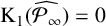
$\mathrm {K}_0(\widehat {{{\mathcal {P}}_\infty }}) = \mathbb {Z} \oplus \mathbb {Z}$
 and
$\mathrm {K}_1(\widehat {{{\mathcal {P}}_\infty }}) = 0$
 . By using the above theorem, we may concretely realize the algebra
$\widehat {{{\mathcal {P}}_\infty }}$
 as a unital simple Exel–Laca algebra of some infinite matrix
$\widehat {P}_\infty $
 , which is studied in Section 7.
The second main result of the present paper shows the existence of a uniquely ergodic automorphism of a unital Kirchberg algebra with finitely generated
$\mathrm {K}$
 -groups. We prove the unique ergodicity of an automorphism of unital Kirchberg algebras with finitely generated
$\mathrm {K}$
 -groups by using the above description of generators. There are many important and fundamental results on studies of automorphisms on Kirchberg algebras such as Nakamura [Reference Nakamura21], Izumi [Reference Izumi10], Gabe and Szabo [Reference Gabe and Szabó9], and so forth. By using an idea that appeared in the structural analysis of reciprocal Cuntz–Krieger algebras in [Reference Matsumoto and Sogabe18], the authors recently showed in [Reference Matsumoto and Sogabe19] that any unital Kirchberg algebra has an aperiodic ergodic automorphism that has an invariant state, where an automorphism
$\alpha $
 on
${\mathcal {A}}$
 is said to be aperiodic if
$\alpha ^n$
 is outer for every
$n \in \mathbb {Z}$
 with
$n\ne 0$
 . It is said to be ergodic if the fixed point algebra
${\mathcal {A}}^\alpha $
 of
${\mathcal {A}}$
 under
$\alpha $
 is the scalar multiples of the unit
$1_{\mathcal {A}}$
 of
${\mathcal {A}}$
 . Since any unital Kirchberg algebra
${\mathcal {A}}$
 with finitely generated
$\mathrm {K}$
 -groups is isomorphic to the reciprocal dual of
${\widehat {{\mathcal {A}}}}$
 (that is,
${\mathcal {A}}\cong \widehat {{\widehat {{\mathcal {A}}}}}$
 ),
${\mathcal {A}}$
 itself satisfies the universal property of Theorem 1.1. In the present paper, we give an description of the aperiodic ergodic automorphism given in [Reference Matsumoto and Sogabe19] in terms of the generating elements appearing in Theorem 1.1. By using the description of the ergodic automorphism, we may prove that the invariant state is unique and pure, so that we have the following theorem.
Theorem 1.2. Let
${\mathcal {A}}$
 be an arbitrary unital Kirchberg algebra with finitely generated
$\mathrm {K}$
 -groups. There exists an aperiodic ergodic automorphism on
${\mathcal {A}}$
 having a unique invariant state. The invariant state is pure.
An automorphism
$\alpha $
 on a
$C^*$
 -algebra
${\mathcal {A}}$
 is said to be uniquely ergodic if an
$\alpha $
 -invariant state uniquely exists (see [Reference Abadie and Dykema1]). The above theorem shows that any unital Kirchberg algebra with finitely generated
$\mathrm {K}$
 -groups has a uniquely ergodic automorphism. To the best knowledge of the authors, there seem to be no other previous examples of uniquely ergodic automorphisms even on Cuntz–Krieger algebras, except the shifts on the canonical generators on
${{\mathcal {O}}_\infty }$
 .
Corollary 1.3. There exists an aperiodic ergodic automorphism on a simple Cuntz–Krieger algebra
${{\mathcal {O}}_A}$
 having a unique invariant state.
Remark 1.4. In particular, there exists an aperiodic ergodic automorphism on the Cuntz algebra
${\mathcal {O}}_2$
 having a unique invariant state. In [Reference Carey and Evans4], Carey and Evans constructed ergodic automorphisms on
${\mathcal {O}}_2$
 having two distinct invariant states. Our aperiodic ergodic automorphism on the Cuntz algebra
${\mathcal {O}}_2$
 has only one invariant state so that our automorphism is not conjugate to the ergodic automorphisms constructed by Carey and Evans (although they are cocycle conjugate by H. Nakamura’s theorem [Reference Nakamura21]). Another example of an ergodic automorphism is the automorphism shifting the tensor factors of
$\mathcal {O}_2\cong \bigotimes _{\mathbb {Z}}\mathcal {O}_2$
 . This automorphism has infinitely many invariant states given by the product states (that is,
$\varphi ^{\otimes \infty } : \mathcal {O}_2^{\otimes \infty }\to \mathbb {C}$
 ) and is not conjugate to our automorphism.
Throughout the paper, Kirchberg algebras mean separable unital simple purely infinite nuclear
$C^*$
 -algebras satisfying the UCT. The UCT
$C^*$
 -algebras mean
$C^*$
 -algebras belonging to the bootstrap class to which the UCT applies. We denote by
${\mathbb {Z}}_+$
 and
$\mathbb {N}$
 the set of nonnegative integers and the set of positive integers, respectively.
2 Review of the construction of the reciprocal dual
$\widehat {{\mathcal {A}}}$

In this section, we review the construction of the reciprocal dual
$\widehat {{\mathcal {A}}}$
 of a unital Kirchberg algebra
${\mathcal {A}}$
 following [Reference Matsumoto and Sogabe18]. Throughout the section, we denote by
$\mathcal {K}(H)$
 the
$C^*$
 -algebra of compact operators on a separable infinite dimensional Hilbert space
$H$
 , written in short as
$\mathcal {K}$
 . We refer to Blackadar’s textbook [Reference Blackadar2] for the basic facts and notation related to
$\mathrm {K}\!\mathrm {K}$
 -groups.
We write
$\mathcal {S} = C_0(0,1)$
 and
$\mathcal {S}^k = \mathcal {S}^{\otimes k}$
 . For a separable unital nuclear
$C^*$
 -algebra
${\mathcal {A}}$
 , the mapping cone algebra
$C_{\mathcal {A}}$
 is defined by
$C_{\mathcal {A}} =\{a(t) \in C_0(0,1] \otimes {\mathcal {A}}\mid a(1) \in {\mathbb {C}}1_{{\mathcal {A}}}\}$
 . Following Skandalis [Reference Skandalis26], we write

As in [Reference Blackadar2], the group
$\mathrm {Ext}_{\mathrm {w}}^i({\mathcal {A}})$
 is given by
$\mathrm {K}\!\mathrm {K}({\mathcal {A}}, \mathcal {S}^i)$
 for
$i=0,1$
 . It is well known that the group
$\mathrm {Ext}_{\mathrm {s}}^1({\mathcal {A}})$
 (respectively
$\mathrm {Ext}_{\mathrm {w}}^1({\mathcal {A}})$
 ) is realized as the strong (respectively weak) extension group
$\mathrm {Ext}_{\mathrm {s}}({\mathcal {A}})$
 (respectively
$\mathrm {Ext}_{\mathrm {w}}({\mathcal {A}})$
 ), which is the abelian group of strong (respectively weak) unitary equivalence classes of unital Busby invariants (see [Reference Blackadar2, Reference Skandalis26]). We write
$\mathcal {S}\otimes {\mathcal {A}}$
 as
$\mathcal {S} {\mathcal {A}}$
 . Applying the
$\mathrm {K}$
 -homology functor
$\mathrm {K}\!\mathrm {K}(\, - \, , \mathbb {C})$
 to the natural short exact sequence
$0\rightarrow \mathcal {S}{\mathcal {A}} \rightarrow C_{\mathcal {A}} \rightarrow \mathbb {C} \rightarrow 0$
 , we have a cyclic six-term exact sequence of
${{\mathrm {Ext}}}_*$
 -groups:

The class of
$\iota _{\mathcal {A}}(1)$
 in
$\mathrm {Ext}_{\mathrm {s}}^1({\mathcal {A}})$
 is denoted by
$[\iota _{\mathcal {A}}(1)]_s$
 , which corresponds to a strong unitary equivalence class of a Busby invariant
$\mathrm {Ad}u\circ \rho $
 with a unital trivial extension
$\rho $
 and a unitary
$u$
 in the Calkin algebra
${\mathcal {B}}(H)/\mathcal {K}(H)$
 with the Fredholm index
$1$
 .
Throughout the rest of this section, we fix a Kirchberg algebra
${\mathcal {A}}$
 . Let
${\mathcal {F}}$
 be a separable unital nuclear UCT
$C^*$
 -algebra containing
$\mathcal {K}(H)$
 as an essential ideal of
${\mathcal {F}}$
 such that

where
$[f]_0$
 is the class in
$\mathrm {K}_0({\mathcal {F}})$
 of a fixed minimal projection
$f\in \mathcal {K}(H)$
 so that
$f \in \mathcal {K}(H) \subset {\mathcal {F}}$
 . Such a separable unital
$C^*$
 -algebra
${\mathcal {F}}$
 for a given unital Kirchberg algebra
${\mathcal {A}}$
 always exists by [Reference Pennig and Sogabe22, Theorem 1.2]. Since
$\mathcal {K}(H)$
 is an essential ideal of
${\mathcal {F}}$
 , there exists an injective
$*$
 -homomorphism
$\pi _{\mathcal {F}}:{\mathcal {F}}\rightarrow {\mathcal {B}}(H)$
 . Let us denote by
$e_k, k \in \mathbb {N}$
 the canonical basis of
$\ell ^2(\mathbb {N})$
 defined by
$e_k(m) = \delta _{k,m}, \, k,m \in \mathbb {N}.$
 Define the Hilbert
$C^*$
 -bimodule
$H_{\mathcal {F}}$
 over
${\mathcal {F}}$
 by setting

where the
${\mathcal {F}}$
 -valued inner product
$\langle \mid \rangle _{\mathcal {F}}$
 on
$H_{\mathcal {F}}$
 is defined by

for
$\xi , \eta \in H$
 ,
$e_k, e_l \in \ell ^2(\mathbb {N})$
 , and
$x, y \in {\mathcal {F}}.$
 The left action of
${\mathcal {F}}$
 on
$H_{\mathcal {F}}$
 to the algebra
${\mathcal {L}}(H_{\mathcal {F}})$
 of adjointable bounded module maps on
$H_{\mathcal {F}}$
 is given by

Take Pimsner’s Toeplitz algebra
$\mathcal {T}_{H_{\mathcal {F}}}$
 (see [Reference Pimsner24]), which is
$\mathrm {K}\!\mathrm {K}$
 -equivalent to
${\mathcal {F}}$
 via the unital embedding
$ {\mathcal {F}} \hookrightarrow \mathcal {T}_{H_{\mathcal {F}}}.$
 Since
${\mathcal {F}}\otimes \mathbb {C} 1_{\ell ^2(\mathbb {N})}\otimes \mathbb {C}1_{\mathcal {F}} \cap \mathcal {K}(H_{\mathcal {F}}) = \{ 0 \},$
 Kumjian’s results [Reference Kumujian14, Proposition 2.1] and [Reference Kumujian14, Theorem 3.1], together with [Reference Pimsner24, Corollary 4.5] tell us that the Cuntz–Pimsner algebra
${\mathcal {O}}_{H_{\mathcal {F}}}$
 is a separable unital simple purely infinite nuclear UCT
$C^*$
 -algebra, and hence a Kirchberg algebra such that
${\mathcal {O}}_{H_{\mathcal {F}}}$
 and
$\mathcal {T}_{H_{\mathcal {F}}}$
 are canonically isomorphic, and the natural unital embedding
${\mathcal {F}}\hookrightarrow \mathcal {T}_{H_{\mathcal {F}}}$
 yields a
$\mathrm {K}\!\mathrm {K}$
 -equivalence. We identify the minimal projection
$f$
 in
$\mathcal {K}(H)$
 with the projection in
${{\mathcal {O}}_{H_{\mathcal {F}}}}$
 through the embedding and the identification:

We then have

The reciprocal duality (see [Reference Matsumoto and Sogabe17, Proposition 3.7]) tells us

so that by the hypothesis (2-2), we obtain that

showing that

by the Kirchberg–Philips classification theorem of Kirchberg algebras [Reference Kirchberg13, Reference Phillips23].
3 Universality of the Cuntz–Pimsner algebra
${{\mathcal {O}}_{H_{\mathcal {F}}}}$

Let
${\mathcal {F}}$
 be a separable
$C^*$
 -algebra with unit
$1_{\mathcal {F}}$
 containing
$\mathcal {K}(H)$
 as an essential ideal. Take a minimal projection
$f$
 in
$\mathcal {K}(H)$
 . In this section, we begin with only
$f \in \mathcal {K}(H) \triangleleft {\mathcal {F}}$
 from which one may construct the Cuntz–Pimsner algebra
${{\mathcal {O}}_{H_{\mathcal {F}}}}$
 . We need not provide a Kirchberg algebra
${\mathcal {A}}$
 in this section, so we do not assume the hypothesis (2-2).
Lemma 3.1. The
$C^*$
 -algebra
${\mathcal {O}}_{H_{\mathcal {F}}}$
 is generated by
${\mathcal {F}}$
 and isometries
$S_i, i \in \mathbb {N}$
 satisfying

Proof. We follow the previous construction of the
$C^*$
 -algebra
${{\mathcal {O}}_{H_{\mathcal {F}}}}$
 in detail. Take a unit vector
$\xi _0 \in H$
 such that
$ f H= \mathbb {C}\xi _0$
 . The Hilbert
$C^*$
 -bimodule
$H_{\mathcal {F}} = H \otimes _{\mathbb {C}} \ell ^2(\mathbb {N}) \otimes _{\mathbb {C}} {\mathcal {F}}$
 has a left action
$\varphi _{\mathcal {F}}: {\mathcal {F}} \rightarrow {\mathcal {L}}(H_{\mathcal {F}})$
 defined by
$\varphi _{\mathcal {F}}(a) = \pi _{\mathcal {F}}(a) \otimes 1_{\ell ^2(\mathbb {N})} \otimes 1_{\mathcal {F}}$
 for
$a \in {\mathcal {F}}$
 . We write
$\pi _{\mathcal {F}}(a)$
 as
$a$
 for short. The action
$\varphi _{\mathcal {F}}$
 is denoted by
$\varphi $
 . Consider the Fock space
${\mathcal {E}}_{\mathcal {F}}$
 of
$H_{\mathcal {F}}$
 defined by

where
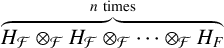
$H_{\mathcal {F}}^{\otimes n}$
 is the
$n$
 -times relative tensor product
$\overbrace {H_{\mathcal {F}} \otimes _{\mathcal {F}} H_{\mathcal {F}} \otimes _{\mathcal {F}} \cdots \otimes _{\mathcal {F}} H_F}^{n\ \text {times}}$
 over
${\mathcal {F}}$
 . The creation operator
$T_{\xi \otimes e_k \otimes y}$
 for
$\xi \otimes e_k \otimes y \in H_{\mathcal {F}}$
 is defined by

for
$\zeta _1\otimes \zeta _2\otimes \cdots \otimes \zeta _n \in H_{\mathcal {F}}^{\otimes n}$
 . The Toeplitz algebra
$\mathcal {T}_{H_{\mathcal {F}}}$
 for the
$C^*$
 -bimodule
$H_{\mathcal {F}}$
 is defined by the
$C^*$
 -algebra
$C^*(T_{\xi \otimes e_k \otimes y}\mid \xi \in H,\, k \in \mathbb {N},\, y \in {\mathcal {F}})$
 generated by the creation operators
$T_{\xi \otimes e_k \otimes y} \in {\mathcal {L}}({\mathcal {E}}_{\mathcal {F}})$
 for
$\xi \otimes e_k \otimes y \in H_{\mathcal {F}}$
 . Define
$\varphi _+: x \in {\mathcal {F}} \rightarrow \varphi _+(x) \in {\mathcal {L}}({\mathcal {E}}_{\mathcal {F}})$
 by

$\zeta _1\otimes \zeta _2\otimes \cdots \otimes \zeta _n \in H_{\mathcal {F}}^{\otimes n}.$
 We then have

for
$\xi \otimes e_k \otimes y, \, \eta \otimes e_l \otimes z \in H_{\mathcal {F}}$
 , and

Hence, the
$C^*$
 -algebra
$\mathcal {T}_{H_{\mathcal {F}}}$
 is generated by
$\varphi _+(x), x \in {\mathcal {F}}$
 and
$T_{\xi _0\otimes e_k\otimes 1_{\mathcal {F}}}, k \in \mathbb {N}$
 . We write

for
$k \in \mathbb {N}$
 . By (3-2), we have
$S_k^* S_l = \delta _{k,l}.$
 It is easy to see that

so that
$S_k S_k^*$
 is the projection onto the subspace spanned by

The projection onto the subspace

corresponds to the minimal projection
$f$
 in
$\mathcal {K}(H)$
 by identifying
$f$
 with
$\varphi _+(f).$
 We may regard
$f$
 as an element of
${{\mathcal {O}}_{H_{\mathcal {F}}}}$
 through the correspondence (2-3) under the natural identification between
$\mathcal {T}_{H_{\mathcal {F}}}$
 and
${{\mathcal {O}}_{H_{\mathcal {F}}}}$
 . Since
$S_k S_k^* < f$
 for all
$k \in \mathbb {N}$
 and
$\{S_kS_k^*\}_{k\in \mathbb {N}}$
 are mutually orthogonal,

We may write
$\varphi _+(x) T_{\xi \otimes e_k \otimes 1}\varphi _+(y)$
 as
$x S_k y$
 for short, so that the
$C^*$
 -algebra
${{\mathcal {O}}_{H_{\mathcal {F}}}}$
 is generated by
${\mathcal {F}}$
 and
$S_k, k\in \mathbb {N}$
 satisfying (3-1).
We note that the algebraic structure of the Cuntz–Pimsner algebra
${{\mathcal {O}}_{H_{\mathcal {F}}}}$
 is determined by the following two relations (see [Reference Brown and Ozawa3, Definition 4.6.14]):

for
$\xi , \eta \in H_{\mathcal {F}}, \, k,l \in \mathbb {N}, \, x,y \in {\mathcal {F}}.$

Lemma 3.2. Keep the unital
$C^*$
 -algebra
${\mathcal {F}}$
 containing
$\mathcal {K}(H)$
 as an essential ideal and fix a minimal projection
$f \in \mathcal {K}(H)$
 . Suppose that there exist a unital representation
$\pi : {\mathcal {F}} \rightarrow {\mathcal {B}}$
 of
${\mathcal {F}}$
 to a unital
$C^*$
 -algebra
${\mathcal {B}}$
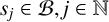
 and a family of isometries
$s_j \in {\mathcal {B}}, j \in \mathbb {N}$
 satisfying

Then, there exists a linear map
$\tau : H_{\mathcal {F}}\rightarrow {\mathcal {B}}$
 such that

Hence, the pair
$(\pi ,\tau )$
 gives rise to a covariant representation of the Hilbert
$C^*$
 -bimodule
$H_{\mathcal {F}}$
 such that the
$C^*$
 -algebra
$C^*(\tau (u)\mid u \in H_{\mathcal {F}})$
 generated by
$\tau (u), u \in H_{\mathcal {F}}$
 coincides with the
$C^*$
 -algebra
$C^*(\pi ({\mathcal {F}}), \{ s_j\}_{j \in \mathbb {N}})$
 generated by
$\pi ({\mathcal {F}})$
 and
$\{s_j\}_{j \in \mathbb {N}}.$

Proof. Take a unit vector
$\xi _0 \in H$
 such that
$f H = \mathbb {C} \xi _0.$
 For
$\xi \in H_{\mathcal {F}}$
 , let us denote by
$t_{\xi , \xi _0}\in \mathcal {K}(H)$
 the operator on
$H$
 defined by
$t_{\xi ,\xi _0}(\zeta ) = \xi \langle \xi _0\mid \zeta \rangle _H, \, \zeta \in H_{\mathcal {F}}.$
 As
$\mathcal {K}(H) \subset {\mathcal {F}},$
 it belongs to
${\mathcal {F}}.$
 For
$u = \xi \otimes e_k\otimes y \in H_{\mathcal {F}},$
 define

and extend it linearly to
$H_{\mathcal {F}}$
 in a natural way. As
$t_{\xi _0, \xi _0} =f$
 and
$s_k s_k^* < \pi (f),$
 we have for
$a,b \in {\mathcal {F}}$
 ,
$u = \xi \otimes e_k \otimes y, \, v = \eta \otimes e_l\otimes z \in H_{\mathcal {F}}$
 ,

and

As
$\varphi ({\mathcal {F}}) \cap \mathcal {K}(H_{\mathcal {F}}) = \{ 0 \}$
 , [Reference Kumujian14, Proposition 2.1] shows that the representation
$(\pi ,\tau )$
 is covariant by [Reference Brown and Ozawa3, Definition 4.6.9]. For
$k \in \mathbb {N}$
 and
$a \in {\mathcal {F}}$
 , we have
$s_k = \tau (\xi _0\otimes e_k \otimes 1)$
 and

showing that
$C^*(\tau (u)\mid u \in H_{\mathcal {F}})= C^*(\pi ({\mathcal {F}}), \{ s_j\}_{j \in \mathbb {N}}).$

Therefore, we have the following proposition.
Proposition 3.3. Keep the unital
$C^*$
 -algebra
${\mathcal {F}}$
 containing
$\mathcal {K}(H)$
 as an essential ideal and fix a minimal projection
$f \in \mathcal {K}(H)$
 . Suppose that there exist a unital representation
$\pi : {\mathcal {F}} \rightarrow {\mathcal {B}}$
 of
${\mathcal {F}}$
 to a unital
$C^*$
 -algebra
${\mathcal {B}}$
 and a family of isometries
$s_j \in {\mathcal {B}}, j \in \mathbb {N}$
 satisfying (3-3). Then, there exists a surjective
$*$
 -isomorphism
$\Phi : {{\mathcal {O}}_{H_{\mathcal {F}}}} \rightarrow C^*(\pi ({\mathcal {F}}), \{s_j\}_{j\in \mathbb {N}})$
 such that

Hence, we have
${{\mathcal {O}}_{H_{\mathcal {F}}}} \cong C^*(\pi ({\mathcal {F}}), \{s_j\}_{j\in \mathbb {N}}).$

Proof. As in [Reference Brown and Ozawa3, Definition 4.6.14], the Cuntz–Pimsner algebra
${{\mathcal {O}}_{H_{\mathcal {F}}}}$
 has universality for a covariant representation such that there exists a surjective
$*$
 -homomorphism
$\Phi : {{\mathcal {O}}_{H_{\mathcal {F}}}} \rightarrow C^*(\tau (u)\mid u\in H_{\mathcal {F}})=C^*(\pi ({\mathcal {F}}), \{s_j\}_{j\in \mathbb {N}})$
 satisfying

As
$ \tau (\xi _0\otimes e_k \otimes 1) =\pi (t_{\xi _0,\xi _0}) s_k \pi (1) = s_k, $
 we obtain (3-4). As in [Reference Kumujian14, Theorem 2.8], the
$C^*$
 -algebra
${{\mathcal {O}}_{H_{\mathcal {F}}}}$
 is simple, so that
$\Phi : {{\mathcal {O}}_{H_{\mathcal {F}}}} \rightarrow C^*(\pi ({\mathcal {F}}), \{s_j\}_{j\in \mathbb {N}})$
 is isomorphic.
Remark 3.4.
-
(i) We have to remark that a unital representation $\pi :{\mathcal {F}}\rightarrow {\mathcal {B}}$
in Proposition 3.3 with partial isometries
$\{ s_j \}_{j \in \mathbb {N}}$
satisfying (3-3) automatically becomes faithful, because
${\mathcal {F}}$
contains
$\mathcal {K}(H)$
as an essential ideal and
$\pi (f)$
for the minimal projection
$f$
does not vanish by (3-3). One in fact sees that if
$\ker (\pi ) \ne \{0 \},$
then
$\ker (\pi ) \cap \mathcal {K}(H) \ne \{0 \}$
and, hence,
$\ker (\pi ) \supset \mathcal {K}(H)$
so that
$f \in \ker (\pi )$
, which is a contradiction to (3-3). -
(ii) If, in particular, ${\mathcal {F}}$
is a nuclear UCT
$C^*$
-algebra, so is the
$C^*$
-algebra
${{\mathcal {O}}_{H_{\mathcal {F}}}}$
by [Reference Kumujian14, Theorem 3.1], so that
${{\mathcal {O}}_{H_{\mathcal {F}}}}$
is a Kirchberg algebra.


The proposition above implies the following theorem.
Theorem 3.5. Let
${\mathcal {F}}$
 be a separable unital
$C^*$
 -algebra containing
$\mathcal {K}(H)$
 as an essential ideal, and
$f \in \mathcal {K}(H)$
 a fixed minimal projection. The
$C^*$
 -algebra
${{\mathcal {O}}_{H_{\mathcal {F}}}}$
 is the universal unique unital
$C^*$
 -algebra
$C^*_{\text {univ}}({\mathcal {F}}, \{S_j\}_{j \in \mathbb {N}})$
 generated by
${\mathcal {F}}$
 and a family
$\{S_j\}_{j \in \mathbb {N}} $
 of isometries subject to the relations:

4 Universality of the reciprocal algebra
${\widehat {{\mathcal {A}}}}$

Keep the situation that
${\mathcal {F}}$
 is a separable unital
$C^*$
 -algebra containing
$\mathcal {K}(H)$
 as an essential ideal and fix a minimal projection
$f \in \mathcal {K}(H)$
 . Let
${{\mathcal {O}}_{H_{\mathcal {F}}}}$
 be the
$C^*$
 -algebra
$C^*_{\text {univ}}({\mathcal {F}}, \{S_j\}_{j \in \mathbb {N}})$
 as in Theorem 3.5. The unit
$1_{\mathcal {F}}$
 of
${\mathcal {F}}$
 coincides with the unit
$1_{{\mathcal {O}}_{H_{\mathcal {F}}}}$
 of
${{\mathcal {O}}_{H_{\mathcal {F}}}}$
 . We define a
$C^*$
 -algebra
$\mathcal {T}$
 and a projection
$e \in \mathcal {T}$
 by

and a family
$\{ T_j \}_{j \in \mathbb {N}}$
 of partial isometries in
$C^*_{\text {univ}}({\mathcal {F}}, \{S_j\}_{j \in \mathbb {N}})$
 by

Hence, the unit
$1_{\mathcal {T}}$
 of the algebra
$\mathcal {T}$
 is
$S_1 S_1^*$
 . Note that
$\mathcal {T}\not \subset \mathcal {F}$
 .
Lemma 4.1. Put
$ V: = S_1 \,\, (\not \in C^*(\mathcal {T}, \{T_j\}_{j \in \mathbb {N}})). $

-
(i) The following identities (T $1$
), (T
$2$
), (T
$3$
) and (T
$4$
) hold:-
(T1) $T_j^* T_j = 1_{\mathcal {T}} \quad j\ge 2$
; -
(T2) $T_1 T_1^* = e, \quad 1_{\mathcal {T}} + \sum _{j=2}^m T_j T_j^* < T_1^* T_1 $
for
$m \ge 2$
; -
(T3) $T_1 T_1^*= V T_1^*, \quad T_1^* T_1= V^* T_1;$
-
(T4) $V V^* = 1_{\mathcal {T}}, \quad V^*V = 1_{{{\mathcal {O}}_{H_{\mathcal {F}}}}}.$
-
-
(ii) The $C^*$
-algebra
${{\mathcal {O}}_{H_{\mathcal {F}}}}$
is generated by
$\mathcal {T},\, \{T_j\}_{j \in \mathbb {N}}$
and
$V$
, that is, $$ \begin{align*} {{\mathcal{O}}_{H_{\mathcal{F}}}} = C^*(\mathcal{T}, \{T_j\}_{j \in \mathbb{N}}, V). \end{align*} $$


Proof. (i) (
$T$
 1). For
$j \ge 2$
 , we have
$ T_j^* T_j = S_1 S_j^* S_j S_1^* = S_1 1_{\mathcal {F}} S_1^* = 1_{\mathcal {T}}. $

(
$T$
 2). We have
$T_1 T_1^* = S_1 f S_1^* = e. $
 For
$m \ge 2$
 ,

The identities
$ T_1 T_1^* = S_1 f S_1^* = V T_1^*, \, \, T_1^* T_1 = f = S_1^* S_1 f = V^* T_1, $
 and
$V V^* = S_1 S_1^* = S_1 1_{\mathcal {F}} S_1^* = 1_{\mathcal {T}}, \, \, V^* V = S_1^* S_1 = 1_{\mathcal {F}} (= 1_{{{\mathcal {O}}_{H_{\mathcal {F}}}}}) $
 show us Identities (
$T$
 3) and (
$T$
 4).
(ii) It suffices to show that
$ {{\mathcal {O}}_{H_{\mathcal {F}}}} = C^*(S_1{\mathcal {F}} S_1^*, \, S_1 f, \, \{S_j S_1^*\}_{2\le j \in \mathbb {N}}, \, S_1 ). $
 Since
${{\mathcal {O}}_{H_{\mathcal {F}}}} = C^*({\mathcal {F}}, \{S_j \}_{j \in \mathbb {N}})$
 , the inclusion relation
${{\mathcal {O}}_{H_{\mathcal {F}}}} \supset C^*(S_1{\mathcal {F}} S_1^*, \, S_1 f, \, \{S_j S_1^*\}_{2\le j \in \mathbb {N}}, \, S_1 )$
 is obvious. Conversely, for
$a \in {\mathcal {F}}$
 and
$ 2\le j \in \mathbb {N}$
 ,

so that
${{\mathcal {O}}_{H_{\mathcal {F}}}} \subset C^*(S_1{\mathcal {F}} S_1^*, \, S_1 f, \, \{S_j S_1^*\}_{2\le j \in \mathbb {N}}, \, S_1 ).$

Lemma 4.2. The corner
$f {\mathcal {O}}_{H_{\mathcal {F}}} f$
 of the
$C^*$
 -algebra
${{\mathcal {O}}_{H_{\mathcal {F}}}}$
 is generated by

Proof. We first note that the identity
$f = (S_1 f)^* S_1 f$
 holds. Since
$\sum _{j=1}^m S_j S_j^* < f$
 for all
$m \in \mathbb {N}$
 , we have
$f S_n = S_n$
 and
$S_n^* f = S_n$
 for all
$n \in \mathbb {N}.$
 Hence, it is obvious to see that all the elements written in (4-3) belong to
$f {\mathcal {O}}_{H_{\mathcal {F}}} f.$
 Let us denote
$\mathbb {N}^* = \bigcup _{m=0}^\infty \mathbb {N}^m$
 , where
$\mathbb {N}^0=\{\emptyset \}, \mathbb {N}^m = \{(\mu _1,\ldots , \mu _m) \mid \mu _i \in \mathbb {N}\}$
 . For
$\mu =(\mu _1,\ldots , \mu _m) \in \mathbb {N}^m$
 , we write
$S_\mu = S_{\mu _1}\cdots S_{\mu _m}$
 and
$S_\mu =1_{{{\mathcal {O}}_{H_{\mathcal {F}}}}}$
 for
$\mu = \emptyset $
 . Since
$S_j^*S_i = \delta _{j,i}1_{{{\mathcal {O}}_{H_{\mathcal {F}}}}}$
 , the linear span of elements of the form
$f a_1 a_2 \cdots a_k f$
 for
$a_i \in {\mathcal {F}}$
 or
$a_i = S_\mu S_\nu ^*$
 with
$\mu , \nu \in \mathbb {N}^*$
 is dense in
$f {{\mathcal {O}}_{H_{\mathcal {F}}}} f$
 . As
$1_{{{\mathcal {O}}_{H_{\mathcal {F}}}}} = 1_{\mathcal {F}} \in {\mathcal {F}}$
 , one may assume that the element
$f a_1 a_2 \cdots a_k f$
 satisfies
$a_1, a_3 \in {\mathcal {F}}$
 and
$a_2 = S_\mu S_\nu ^*$
 with
$\mu =(\mu _1,\ldots , \mu _m), \nu = (\nu _1,\ldots ,\nu _n) \in \mathbb {N}^*$
 .
We have three cases.
Case 1:
$\, m \ge 1$
 and
$n \ge 1.$
 As
$S_j = f S_j$
 and
$S_j^* = S_j^* f$
 ,

where

and

Hence, the word
$f a_1 a_2(= f a_1 f S_{\mu _1} S_{\mu _2}\cdots S_{\mu _m}S_{\nu _n}^*\cdots S_{\nu _1}^*) $
 can be written in words of elements of the form of (4-3).
Case 2.
$\, m=0$
 and
$n \ge 1.$
 We then have

Hence, the word
$f a_1 a_2(=f a_1 S_\nu ^*)$
 can be written in words of elements of the form of (4-3).
Case 3.
$\, m \ge 1$
 and
$n =0.$
 We then have

Hence, the word
$f a_1 S_{\mu _1}\cdots S_{\mu _m} S_1^* S_1 a_3 S_1^*$
 can be written in words of elements of the form of (4-3).
Since
$f S_1 f = f\cdot S_1 f$
 ,
$ f S_1 S_j f = f S_1 S_jS_1^*\cdot S_1 f, $
 and
$ f S_1 S_j^* f = f S_1 S_j^* S_1^*\cdot S_1 f, $
 by induction on the length
$k$
 of the word
$f a_1 a_2 a_3 \cdots a_k f$
 , we may conclude that the word
$ f a_1 a_2 a_3 \cdots a_k f $
 can be written in words of elements of the form of (4-3).
Lemma 4.3. The
$C^*$
 -algebra
$f {\mathcal {O}}_{H_{\mathcal {F}}} f$
 is generated by

Proof. We set

and
$ \mathcal {T}: = S_1 {\mathcal {F}} S_1^*, \, \, S:= S_1 f, \, \, R_i :=S_1 S_i S_1^*, \, i \in \mathbb {N}. $
 By the preceding lemma, we know that
$f {\mathcal {O}}_{H_{\mathcal {F}}} f ={\mathcal {A}}_*$
 , and
${\mathcal {A}}_1 \subset {\mathcal {A}}_*$
 is clear. We show that
${\mathcal {A}}_1\supset {\mathcal {A}}_*$
 . For
$S_i S_1^*$
 with
$i \in \mathbb {N}$
 ,

so that
$S_i S_1^* \in {\mathcal {A}}_1$
 . For
$n \in \mathbb {N}$
 and
$a \in {\mathcal {F}}$
 , as
$S_1^* S_1 =1_{{\mathcal {O}}_{H_{\mathcal {F}}}}$
 ,

so that
$S_n a S_n^* \in {\mathcal {A}}_1$
 for all
$n \in \mathbb {N}$
 , and similarly the identity
$ S_n S_i S_n^* = S^* R_n \cdot R_i \cdot R_n^* S $
 holds so that
$S_n S_i S_n^* \in {\mathcal {A}}_1$
 for all
$n, i \in \mathbb {N}$
 . We also have

so that
$S_n f \in {\mathcal {A}}_1$
 for all
$n \in \mathbb {N}$
 , showing that
${\mathcal {A}}_* \subset {\mathcal {A}}_1$
 and, hence,
${\mathcal {A}}_* = {\mathcal {A}}_1.$

Recall that the
$C^*$
 -subalgebra
$\mathcal {T}$
 of
${{\mathcal {O}}_{H_{\mathcal {F}}}}$
 and a family
$\{ T_j \}_{j \in \mathbb {N}}$
 of partial isometries in
${{\mathcal {O}}_{H_{\mathcal {F}}}}$
 are defined by (4-1) and (4-2), respectively. Hence, we have the following lemma.
Lemma 4.4. The
$C^*$
 -algebra
$f {\mathcal {O}}_{H_{\mathcal {F}}} f$
 is generated by
$\mathcal {T}$
 and
$T_j, j \in \mathbb {N}$
 :

Proof. We have
$ S_1 S_j S_1^* = S_1 f S_j S_1^* = T_1 T_j $
 for
$j \ge 2$
 , and

However, we have
$ T_j =(S_1 f)^* S_1 S_j S_1^* $
 for
$j \ge 2$
 . By Lemma 4.3, we conclude that
$ f {{\mathcal {O}}_{H_{\mathcal {F}}}} f = C^*(\mathcal {T}, \{T_j\}_{j \in \mathbb {N}}). $

Recall that the projection
$e \in \mathcal {T}$
 is defined by
$e= S_1 f S_1^*\in \mathcal {T}$
 .
Lemma 4.5. Assume that there exist a degenerate representation
$\pi : \mathcal {T} \rightarrow {\mathcal {B}}({\frak {H}})$
 and a family
$t_j \in {\mathcal {B}}({\frak {H}}), j \in \mathbb {N}$
 of partial isometries on a Hilbert space
${\frak {H}}$
 satisfying

Then, there exist a Hilbert space
${\widetilde {\frak {H}}} = {\frak {H}}\oplus {\frak {K}}$
 for some Hilbert space
${\frak {K}}$
 and an isometry
$v \in {\mathcal {B}}({\widetilde {\frak {H}}})$
 such that

where
${\mathcal {B}}({\frak {H}}) = {\mathcal {B}}({\frak {H}}\oplus 0) \subset {\mathcal {B}}({\widetilde {\frak {H}}})$
 .
Proof. Put
${\frak {K}} : = \pi (1_{\mathcal {T}} - e){\frak {H}}$
 and
${\widetilde {\frak {H}}} = {\frak {H}} \oplus {\frak {K}}$
 . Represent
$C^*(\pi (\mathcal {T}), \{ t_j \}_{j \in \mathbb {N}})$
 on
${\widetilde {\frak {H}}}$
 by

Hence,
$x \in C^*(\pi (\mathcal {T}), \{t_j\}_{j \in \mathbb {N}})$
 is written as
$x = \begin {bmatrix} x & 0 \\ 0 & 0 \end {bmatrix} \text { on } {\frak {H}} \oplus {\frak {K}}. $
 Define

Since

it is direct to see that
$v$
 is an isometry on
${\widetilde {\frak {H}}}$
 satisfying Conditions
$(t3)$
 and
$(t4)$
 .
Remark 4.6. The representation
$\pi :\mathcal {T}\rightarrow {\mathcal {B}}({\frak {H}})$
 with the partial isometries
$\{t_j \}_{j \in \mathbb {N}}$
 satisfying Conditions
$(t1)$
 and
$(t2)$
 automatically becomes faithful, because
$\mathcal {T}$
 contains a
$C^*$
 -subalgebra
$\mathcal {K}$
 as an essential ideal, and
$\pi (e)$
 for the minimal projection
$e$
 in
$\mathcal {K}$
 does not vanish by the relations
$t_1 t_1^*= \pi (e)$
 and
$t_1^* t_1 = 1_{{\mathcal {B}}({\frak {H}})}.$
Proposition 4.7. Keep the assumption of Lemma 4.5. Take the Hilbert space
${\widetilde {\frak {H}}}$
 and the isometry
$v$
 on
${\widetilde {\frak {H}}}$
 satisfying Conditions
$(t3)$
 and
$(t4)$
 in Lemma 4.5. Define the partial isometries
$\tilde {s}_j, \, j \in \mathbb {N}$
 on
${\widetilde {\frak {H}}}$
 and a representation
$\tilde {\pi }: {\mathcal {F}} \rightarrow {\mathcal {B}}({\widetilde {\frak {H}}})$
 by setting

Then, we have the following properties.
-
(i) $\tilde {\pi }: {\mathcal {F}} \rightarrow {\mathcal {B}}({\widetilde {\frak {H}}})$
is a unital representation such that $$ \begin{align*} \tilde{s}_i^* \tilde{s}_i = 1_{{\mathcal{B}}({\widetilde{\frak{H}}})} \quad \text{for } i \in \mathbb{N} \quad \text{and} \quad \sum_{j=1}^m \tilde{s}_j \tilde{s}_j^* < \tilde{\pi}(f) \quad \text{for } m \in \mathbb{N}. \end{align*} $$
-
(ii) There exists an injective $*$
-homomorphism
$\Phi : {{\mathcal {O}}_{H_{\mathcal {F}}}}\rightarrow {\mathcal {B}}({\widetilde {\frak {H}}})$
such that:-
(a) $ \Phi (S_i) = \tilde {s}_i \text { for } i \in \mathbb {N} $
and
$ \Phi (a) = \tilde {\pi }(a) \text { for } a \in {\mathcal {F}}, $
and hence, $$ \begin{align*} {{\mathcal{O}}_{H_{\mathcal{F}}}} \cong C^*(\tilde{\pi}({\mathcal{F}}), \{\tilde{s}_j\}_{j\in \mathbb{N}}); \end{align*} $$
-
(b) $\Phi (f {{\mathcal {O}}_{H_{\mathcal {F}}}} f) = C^*(\pi (\mathcal {T}), \{ t_j \}_{j \in \mathbb {N}})$
and, hence, $$ \begin{align*} f {{\mathcal{O}}_{H_{\mathcal{F}}}} f \cong C^*(\pi(\mathcal{T}), \{ t_j \}_{j \in \mathbb{N}}). \end{align*} $$
-


Proof. (i) The equalities

show that
$\pi : {\mathcal {F}} \rightarrow {\mathcal {B}}({\widetilde {\frak {H}}})$
 is unital. Since
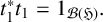
$v^* t_1 = t_1^* t_1 = 1_{{\mathcal {B}}({\frak {H}})}$
 and, hence,
$ t_1^* v = 1_{{\mathcal {B}}({\frak {H}})}$
 ,

We also have

so that

(ii) Since the representation
$\tilde {\pi }: {\mathcal {F}} \rightarrow {\mathcal {B}}({\widetilde {\frak {H}}})$
 and the isometries
$\{\tilde {s}_j \}_{j \in \mathbb {N}}$
 satisfy (3-3), Proposition 3.3 tells us that there exists an injective
$*$
 -homomorphism
$\Phi : {{\mathcal {O}}_{H_{\mathcal {F}}}}\rightarrow {\mathcal {B}}({\widetilde {\frak {H}}})$
 satisfying
$ \Phi (S_i) = \tilde {s}_i, \, i \in \mathbb {N} $
 and
$ \Phi (a) = \tilde {\pi }(a), \, a \in {\mathcal {F}}, $
 which gives rise to an isomorphism from
$ {{\mathcal {O}}_{H_{\mathcal {F}}}} $
 to
$C^*(\tilde {\pi }({\mathcal {F}}), \{\tilde {s}_j\}_{j\in \mathbb {N}}). $

We next prove that
$\Phi (f {{\mathcal {O}}_{H_{\mathcal {F}}}} f) = C^*(\pi (\mathcal {T}), \{ t_j \}_{j \in \mathbb {N}})$
 . Put
$\tilde {f}: = \tilde {\pi }(f).$
 In a completely similar manner to the proofs of Lemmas 4.2 and 4.3, one knows that

So, by using a similar manner to the proof of Lemma 4.4, it suffices to prove that
$\tilde {s}_1 \tilde {\pi }({\mathcal {F}}) \tilde {s}_1^* = \pi (\mathcal {T})$
 ,
$\tilde {s}_1 \tilde {f} = t_1$
 , and
$\tilde {s}_j \tilde {s}_1^* =t_j$
 for
$j \ge 2.$
 Since
$ \tilde {s}_1 v^* = v^* t_1 vv^* = t_1^* t_1 \pi (1_{\mathcal {T}}) = \pi (1_{\mathcal {T}}), $


We also have

By (4-4),

As
$\Phi (f {{\mathcal {O}}_{H_{\mathcal {F}}}} f ) = \tilde {f}\, C^*(\tilde {\pi }({\mathcal {F}}), \{\tilde {s}_j\}_{j\in \mathbb {N}})\, \tilde {f}$
 , we have
$f {{\mathcal {O}}_{H_{\mathcal {F}}}} f \cong C^*(\pi (\mathcal {T}), \{ t_j \}_{j \in \mathbb {N}}).$

Recall that the unital
$C^*$
 -algebra
$\mathcal {T}$
 is defined by
$S_1 {\mathcal {F}} S_1^*$
 as a subalgebra of
${{\mathcal {O}}_{H_{\mathcal {F}}}}$
 and the projection
$e \in \mathcal {T}$
 is defined by
$e= S_1 f S_1^*\in \mathcal {K}(H)$
 .
Corollary 4.8. Suppose that there exist a representation
$\pi : \mathcal {T} \rightarrow {\mathcal {B}}({\frak {H}})$
 and a family
$t_j \in {\mathcal {B}}({\frak {H}}),\, j \in \mathbb {N}$
 of partial isometries on
${\frak {H}}$
 satisfying

Then, there exists an isomorphism
$\Phi : f {{\mathcal {O}}_{H_{\mathcal {F}}}} f \rightarrow C^*(\pi (\mathcal {T}), \{ t_j \}_{j \in \mathbb {N}})$
 .
Now we are in position to give a proof of Theorem 1.1.
Proof of Theorem 1.1.
(i) Let
${\mathcal {A}}$
 be a unital Kirchberg algebra with finitely generated
$\mathrm {K}$
 -groups. One may take a separable unital nuclear UCT
$C^*$
 -algebra
${\mathcal {F}}$
 satisfying (2-2) as in Section 2. By (2-4) and Lemma 4.4, the reciprocal dual
${\widehat {{\mathcal {A}}}}$
 is generated by the unital subalgebra
$\mathcal {T}$
 and partial isometries
$\{ T_j \}_{j \in \mathbb {N}}$
 satisfying the relations in Lemma 4.1(i). As
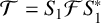
$\mathcal {T} = S_1 {\mathcal {F}} S_1^*$
 and
$e = S_1 f S_1^*$
 with
$S_1^* S_1 = 1_{\mathcal {F}}$
 ,

showing (1-1). In the relations (
$T2$
 ) of Lemma 4.1(i),
$T_1^* T_1 = f$
 because
$T_1 = S_1 f$
 , which is the unit of the algebra
$f {{\mathcal {O}}_{H_{\mathcal {F}}}} f$
 and written as
$1_{{\widehat {{\mathcal {A}}}}}$
 . Hence, the relations (
$T1$
 ), (
$T2$
 ) in Lemma 4.1(i) are those that appeared in (1-2). This shows that the
$C^*$
 -algebra
${\widehat {{\mathcal {A}}}}$
 is the
$C^*$
 -algebra satisfying the conditions (a) and (b) of Theorem 1.1(i). Its universality and uniqueness with respect to the subalgebra
$\mathcal {T}$
 and (1-2) follow from Corollary 4.8.
(ii) Since

together with (4-5),

because of (2-2). As the
$C^*$
 -algebra
${\widehat {{\mathcal {A}}}}$
 is a Kirchberg algebra, its isomorphism class depends only on its
$K$
 -theory data, together with the position of the class of the unit in
$\mathrm {K}_0$
 -group [Reference Kirchberg13, Reference Phillips23], so the isomorphism class of
${\widehat {{\mathcal {A}}}}$
 does not depend on the choice of the unital
$C^*$
 -algebra
$\mathcal {T}$
 as long as it satisfies (1-1).
Remark 4.9. If a Kirchberg algebra
${\mathcal {A}}$
 is a simple Cuntz–Krieger algebra
${{\mathcal {O}}_A}$
 , one may take the unital
$C^*$
 -algebra
$\mathcal {T}$
 as the Toeplitz algebra
$\mathcal {T}_{A^t}$
 for the transposed matrix
$A^t$
 . Then, the universality of the reciprocal dual
$\widehat {\mathcal {O}}_A$
 in Theorem 1.1 is nothing but the universality stated as in [Reference Matsumoto and Sogabe18, Theorem 1.2]. The details are discussed in Section 7.
5 Ergodic automorphisms on
${\widehat {{\mathcal {A}}}}$
in terms of the generators

In [Reference Matsumoto and Sogabe19], it was proved that there exists an aperiodic ergodic automorphism of an arbitrary unital Kirchberg algebra. In this section, we concretely realize the ergodic automorphism on the Kirchberg algebra with finitely generated
$\mathrm {K}$
 -groups in terms of their generators in the universal representation stated in Theorem 1.1. It induces a concrete description of an ergodic automorphism of the Cuntz algebra
${\mathcal {O}}_2$
 , which is stated in Section 7.
As in Theorem 3.5, let us represent
${{\mathcal {O}}_{H_{\mathcal {F}}}}$
 as the universal
$C^*$
 -algebra
$C^*_{\text {univ}}({\mathcal {F}}, \{ S_n \}_{n \in \mathbb {Z}})$
 with relations:

where
$f \in \mathcal {K}(H) \subset {\mathcal {F}}$
 is a fixed minimal projection. We note that in the above description, the index set of the isometries
$\{S_n \}_{n \in \mathbb {Z}}$
 is the integer group
$\mathbb {Z}$
 instead of
$\mathbb {N}$
 and
$S_0$
 plays the role of
$S_1$
 in the previous section. By Theorem 1.1, the reciprocal dual
${\widehat {{\mathcal {A}}}}$
 of
${\mathcal {A}}$
 is given by the corner
$f {{\mathcal {O}}_{H_{\mathcal {F}}}} f$
 of
${{\mathcal {O}}_{H_{\mathcal {F}}}}$
 . Put

We have shown that
${\widehat {{\mathcal {A}}}}$
 is realized as the universal
$C^*$
 -algebra
$C^*_{\text {univ}}(\mathcal {T}, \{t_n\}_{n \in \mathbb {Z}})$
 satisfying (1-2) such that

Define an automorphism
$\theta $
 on the
$C^*$
 -algebra
$C^*_{\text {univ}}({\mathcal {F}}, \{ S_n \}_{n \in \mathbb {Z}})$
 by

By the universality of the
$C^*$
 -algebra
${{\mathcal {O}}_{H_{\mathcal {F}}}}$
 ,
$\theta $
 gives rise to an automorphism on
${{\mathcal {O}}_{H_{\mathcal {F}}}}$
 . We know the following lemma proved in [Reference Matsumoto and Sogabe19, Lemmas 3.2 and 3.3].
Lemma 5.1 [Reference Matsumoto and Sogabe19, Lemmas 3.2 and 3.3].
The automorphism
$\theta ^n$
 on
${{\mathcal {O}}_{H_{\mathcal {F}}}}$
 for each
$n \in \mathbb {Z}$
 with
$n\ne 0$
 is outer, and the fixed point algebra
$({{\mathcal {O}}_{H_{\mathcal {F}}}})^\theta $
 of
${{\mathcal {O}}_{H_{\mathcal {F}}}}$
 under
$\theta $
 is
${\mathcal {F}}$
 .
Since
$\theta $
 satisfies
$\theta (f) = f$
 , it induces an automorphism written
$\hat {\theta }$
 on
${\widehat {{\mathcal {A}}}}$
 by restricting
$\theta $
 to the subalgebra
$f {{\mathcal {O}}_{H_{\mathcal {F}}}} f$
 . The automorphism
$\hat {\theta }$
 on
${\widehat {{\mathcal {A}}}}$
 is nothing but that constructed in [Reference Matsumoto and Sogabe19, Theorem 3.1]. Lemma 5.1 together with the minimality of the projection
$f$
 in
${\mathcal {F}}$
 directly tells us that the fixed point algebra
$(f {{\mathcal {O}}_{H_{\mathcal {F}}}} f)^{\theta }$
 of
$f {{\mathcal {O}}_{H_{\mathcal {F}}}} f$
 under
$f$
 is a scalar multiple of the unit
$f$
 (that is,
$f\mathcal {F}f=\mathbb {C}f$
 ). The following result was proved in [Reference Matsumoto and Sogabe19] in a more general setting.
Proposition 5.2 [Reference Matsumoto and Sogabe19, Theorem 3.1].
The automorphism
$\hat {\theta }^n$
 on
${\widehat {{\mathcal {A}}}}$
 for each
$n \in \mathbb {Z}$
 with
$n\ne 0$
 is outer, and the fixed point algebra
$({\widehat {{\mathcal {A}}}})^\theta $
 of
${\widehat {{\mathcal {A}}}}$
 under
$\hat {\theta }$
 is
$\mathbb {C}1_{{\widehat {{\mathcal {A}}}}}$
 (that is, the automorphism
$\hat {\theta }$
 is aperiodic and ergodic on
${\widehat {{\mathcal {A}}}}$
 ).
We write
$\hat {\theta }$
 in terms of
$\mathcal {T} $
 and
$ t_n , n\in \mathbb {Z}$
 in the following way. For
$b \in \mathcal {T} = S_0 {\mathcal {F}} S_0^*$
 , so that
$ b = S_0 a S_0^*$
 for some
$ a ( = S_0^* b S_0) \in {\mathcal {F}}$
 , we then have for
$n \in \mathbb {Z}$
 with
$n \ne 0$
 ,

so that
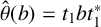
$\hat {\theta }^n(b) = t_n b t_n^*$
 for
$b \in \mathcal {T}$
 and
$ n \in \mathbb {Z}, n \ne 0$
 . In particular,
$\hat {\theta }(b) = t_1 b t_1^*$
 for
$b \in \mathcal {T}$
 . We note that
$ b = \hat {\theta }^0(b) \ne t_0 b t_0^* = S_0 b S_0^*$
 . Also,

Similarly, we have for
$n \in \mathbb {Z}$
 with
$n \ne 0, -1$
 ,

Therefore, we have the following proposition.
Proposition 5.3. In the reciprocal dual
${\widehat {{\mathcal {A}}}} = C^*_{\text {univ}}(\mathcal {T}, \{ t_n \}_{n \in \mathbb {Z}})$
 , the correspondence
$\hat {\theta }:{\widehat {{\mathcal {A}}}} \rightarrow {\widehat {{\mathcal {A}}}}$
 defined by

gives rise to an aperiodic ergodic automorphism on
${\widehat {{\mathcal {A}}}}$
 .
Remark 5.4. It is easy to see that the conjugacy class of the automorphism
$\hat {\theta }$
 of
${\widehat {{\mathcal {A}}}}$
 does not depend on the choice of a bijection between
$\mathbb {N}$
 and
$\mathbb {Z}$
 in exchanging the index set of the family
$\{t_j\}_j$
 of partial isometries.
6 Invariant states
In this section, we show that a
$\hat {\theta }$
 -invariant state on
${\widehat {{\mathcal {A}}}}$
 is unique, so that the automorphism
$\hat {\theta }$
 on
${\widehat {{\mathcal {A}}}}$
 is uniquely ergodic. In [Reference Matsumoto and Sogabe19, Theorem 1.5], it is shown that there exists a
$\hat {\theta }$
 -invariant state on
${\widehat {{\mathcal {A}}}}$
 in a more general setting. The construction of the
$\hat {\theta }$
 -invariant state in our setting is as follows. Let
${\mathcal {F}}$
 be a separable unital nuclear UCT
$C^*$
 -algebra containing
$\mathcal {K}(H)$
 as an essential ideal and
$f \in \mathcal {K}(H)$
 as a minimal projection satisfying (2-2). Then, we have a
$C^*$
 -algebra
$\mathcal {T}_{H_{\mathcal {F}}}$
 as in the proof of Lemma 3.1. Let
$E_{\mathcal {F}}: \mathcal {T}_{H_{\mathcal {F}}}\rightarrow {\mathcal {F}}$
 be the conditional expectation arising from a projection on the Fock space
${\mathcal {E}}_{\mathcal {F}} ={\mathcal {F}} \oplus \bigoplus _{n=1}^\infty H_{\mathcal {F}}^{\otimes n}$
 onto the subspace
${\mathcal {F}}$
 . As
$f$
 is a minimal projection in
${\mathcal {F}}$
 , there exists a scalar
$\varphi _{{\widehat {{\mathcal {A}}}}}(f x f) \in \mathbb {C}$
 for
$x \in {\mathcal {O}}_{H_{\mathcal {F}}}$
 satisfying

Under the identification between
$\mathcal {T}_{H_{\mathcal {F}}}$
 and
${\mathcal {O}}_{H_{\mathcal {F}}}$
 , we have a state
$\varphi _{{\widehat {{\mathcal {A}}}}}$
 on
$f {\mathcal {O}}_{H_{\mathcal {F}}} f = {\widehat {{\mathcal {A}}}}$
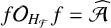 , which was proved in [Reference Matsumoto and Sogabe19] to be invariant under the automorphism
$\hat {\theta }$
 .
Let us represent the reciprocal algebra
${\widehat {{\mathcal {A}}}}$
 as
$C^*_{\text {univ}}(\mathcal {T}, \{ t_n \}_{n \in \mathbb {Z}})$
 as in the previous section. We show the following proposition.
Proposition 6.1. Let
$\varphi $
 be a state on
${\widehat {{\mathcal {A}}}}$
 such that
$\varphi \circ \hat {\theta } =\varphi $
 . Let
$a \in {\widehat {{\mathcal {A}}}}$
 be a finite word of elements of
$\mathcal {T} \cup \{ t_j\}_{j \in \mathbb {Z}} \cup \{ t_j^*\}_{j \in \mathbb {Z}}$
 such that
$\varphi (a) \ne 0$
 . Then, we have
$ a \in \mathbb {C} 1_{{\widehat {{\mathcal {A}}}}}$
 .
To prove the proposition, we provide several lemmas. The first one is obtained from (5-1).
Lemma 6.2. For
$b \in \mathcal {T}$
 and
$j,k \in \mathbb {Z}$
 :
-
(i) $t_j^* b = b t_j = 0$
for
$ j\ne 0$
; -
(ii) $t_k t_j = t_k^* t_j^* =0$
for
$j,k \ne 0$
; -
(iii) $t_k^* t_j =0$
for
$j \ne k$
; -
(iv) $t_k^* b t_j = \begin {cases} c 1_{{\widehat {{\mathcal {A}}}}} \text { for some } c \in \mathbb {C} & \text { if } k = j =0, \\ 0 & \text { otherwise. } \end {cases} $


Proof. (i) By the second relation of property (2) in (5-1), the projection
$t_j t_j^*$
 for
$j \ne 0$
 is perpendicular to
$\mathcal {T}$
 , so we have
$t_j^* b = b t_j = 0$
 for
$ j\ne 0$
 .
(ii) The second relation of property (1) in (5-1) shows us that
$t_k^* t_k$
 for
$k \ne 0$
 belongs to
$\mathcal {T}$
 , so that
$t_k^* t_k t_j t_j^*=0$
 for
$j \ne 0$
 by item (i), showing that
$t_k t_j =0$
 for
$k,j \ne 0.$

(iii) As
$t_0 t_0^* =e \in \mathcal {K} \subset \mathcal {T}$
 , we have
$\sum _{j=-m}^m t_j t_j^* < 1_{{\widehat {{\mathcal {A}}}}}$
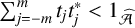 for all
$m \in {\mathbb {Z}}_+$
 , which shows
$t_k^* t_j =0$
 for
$j \ne k$
 .
(iv) Suppose
$k = j = 0$
 . By the first relation of property (2) in (5-1), we have
$t_0^* b t_0 = t_0^* e b e t_0$
 . As
$e$
 is a minimal projection in
$\mathcal {K}$
 , so is it in
$\mathcal {T}$
 because
$\mathcal {K}$
 is essential in
$\mathcal {T}$
 . Hence, we have
$ ebe = c e$
 for some
$c \in \mathbb {C}$
 so that
$t_0^* b t_0 = c t_0^* e t_0 = c 1_{{\widehat {{\mathcal {A}}}}}$
 by the first relation of property (1) in (5-1). In case either
$j\ne 0$
 or
$k \ne 0$
 , the relation
$t_k^* b t_j =0$
 follows from item (i).
The next one is straightforward from Proposition 5.3.
Lemma 6.3.

By using the lemma above, we have the following lemma.
Lemma 6.4. Let
$\varphi $
 be a state on
${\widehat {{\mathcal {A}}}}$
 such that
$\varphi \circ \hat {\theta } =\varphi $
 . Then, we have
$\varphi (t_j t_j^*) =0$
 for all
$j \in \mathbb {Z},$
 and
$\varphi (b) =\varphi (t_i^* t_i) =0$
 for all
$b \in \mathcal {T}$
 and
$i \in \mathbb {Z}$
 with
$i \ne 0$
 .
Proof. We first see that
$\varphi (t_1 t_1^*) =0.$
 Put
$\epsilon =\varphi (t_1 t_1^*).$
 By Lemma 6.3, we have for
$n \in \mathbb {N}$
 ,

The inequality
$1_{\mathcal {T}} + \sum _{n=1}^m t_j t_j^* < 1_{{\widehat {{\mathcal {A}}}}}$
 tells us that
$\varphi (1_{\mathcal {T}}) + m \epsilon <1$
 for all
$m \in \mathbb {N}$
 , so that we have
$\epsilon =0$
 , and (6-1) shows
$\varphi (t_{n} t_{n}^*) =0$
 for all
$n \in \mathbb {N}$
 . Since

we have
$\varphi (t_0 t_0^*) =0.$
 We also have

and, similarly for
$n \ge 2$
 ,

Therefore,
$\varphi (t_j t_j^*) =0$
 for all
$j \in \mathbb {Z}.$
 As in (6-2), we have
$\varphi (1_{\mathcal {T}}) = \varphi \circ \hat {\theta }(1_{\mathcal {T}}) =0$
 , so that

Recall that
$e\in \mathcal {T}$
 is a minimal projection (that is,
$e\mathcal {T} e=\mathbb {C}e$
 ). Let
$a\in C^*_{\text {univ}}(\mathcal {T}, \{t_j\}_{j \in \mathbb {Z}})$
 be of the form

Assume that
$\varphi (a) \ne 0$
 . If
$a_1 \in \mathcal {T}\cup \{ t_j \}_{j \in \mathbb {Z}}\cup \{ t_j^* \}_{j \in \mathbb {Z}, j\ne 0}$
 , the inequality

together with Lemma 6.4 show us
$\varphi (a_1 a_1^*) =0$
 so that
$\varphi (a)=0$
 , which is a contradiction to the hypothesis that
$\varphi (a) \ne 0.$
 If
$a_m \in \mathcal {T}\cup \{ t_j^* \}_{j \in \mathbb {Z}}\cup \{ t_j \}_{j \in \mathbb {Z}, j \ne 0}$
 , the inequality

similarly shows us that
$\varphi (a_m^* a_m)=0$
 and, hence,
$\varphi (a) =0$
 . Therefore, we have
$a_m =t_0$
 as well as
$a_1 = t_0^*$
 , so that the element
$a$
 must be of the form

If
$a_2, \ldots ,a_{m-1} \in \mathcal {T}$
 , then by putting
$b:= a_2 \cdots a_{m-1} \in \mathcal {T}$
 , we have
$ a = t_0^* b t_0$
 , so that by Lemma 6.2, we see that
$a = c 1_{{\widehat {{\mathcal {A}}}}}$
 for some
$c \in \mathbb {C}$
 , showing the desired conclusion of Proposition 6.1. Henceforth, we assume that there exists
$k$
 with
$ 2 \le k < m-1$
 such that

Put
$b_1 := a_2 \cdots a_k \in \mathcal {T}$
 . In case
$a_2 \not \in \mathcal {T}$
 , we take the number
$k$
 as
$k=1$
 , and then
$t_0 b_1$
 is written as
$t_0$
 . Hence, (6-4) goes to

where
$b_1 \in \mathcal {T}, \, a_{k+1} \in \{ t_j \}_{j \in \mathbb {Z}} \cup \{ t_j^* \}_{j \in \mathbb {Z}} $
 and
$ a_{k+2}, \ldots , a_{m-1} \in \mathcal {T} \cup \{ t_j \}_{j \in \mathbb {Z}} \cup \{ t_j^* \}_{j \in \mathbb {Z}}. $
 We provide one more lemma to prove Proposition 6.1.
Lemma 6.5. For the expression (6-5) of the element
$a$
 , there exist
$b_1\in \mathcal {T}$
 and
$k \ge 1$
 such that

up to scalar multiples.
Proof. (1), (2) Assume that
$a_{k+1} = t_i$
 for some
$i \in \mathbb {Z}$
 . By Lemma 6.2(iv),

For
$i=0$
 ,

By applying the preceding argument to reduce (6-4) from (6-3) to (6-6), we have
$a_{k+2} = t_0^*$
 .
Condition (3) is obvious. (4) Assume that
$a_{k+1} = t_{j_1}^*, \, j_1\ne 0, \, \, a_{k+2} \in \mathcal {T}.$
 By Lemma 6.2(i), we have
$a_{k+1}a_{k+2} =0.$

(5), (6) Assume that
$a_{k+1} = t_{j_1}^*,\, j_1\ne 0, \, \, a_{k+2}= t_i$
 for some
$i \in \mathbb {Z}.$
 By Lemma 6.2(iii),

so that Conditions (5) and (6) hold.
(7), (8) Assume that
$a_{k+1} = t_{j_1}^*,\, j_1\ne 0, \, \, a_{k+2}= t_i^*$
 for some
$i \in \mathbb {Z}$
 . As
$j_1 \ne 0$
 , by Lemma 6.2(ii),

so that Conditions (7) and (8) hold.
Proof of Proposition 6.1.
Now, assume that an element
$a\in C^*_{\text {univ}}(\mathcal {T}, \{t_j\}_{j \in \mathbb {Z}})$
 is of the form (6-3) such that
$\varphi (a) \ne 0$
 . Since
$a \ne 0$
 , Lemma 6.5 implies that the cases (2), (4), (6), and (8) are excluded. Hence, for the word
$a$
 having the form (6-5), we have the following four cases:

In (6-4), the number of elements in
$\mathcal {T} \cup \{t_i\}\cup \{t_i^*\}$
 between the leftmost
$t_0^*$
 and the rightmost
$t_0$
 is
$m-2.$
 However, we have the numbers of elements in
$\mathcal {T}\cup \{t_i\}\cup \{t_i^*\}$
 as in (6-7):
$\bullet $
 between the leftmost
$t_0^*$
 and the rightmost
$t_0$
 in case (1) is
$m-k-3;$

$\bullet $
 between the second leftmost
$t_0^*$
 and the rightmost
$t_0$
 in case (3) is
$m-k-2;$

$\bullet $
 between the leftmost
$t_0^*$
 and the rightmost
$t_0$
 in case (5) is
$m-k-2$
 ;
$\bullet $
 between the second leftmost
$t_0^*$
 and the rightmost
$t_0$
 in case (7) is
$m-k-3.$

In each case in the above four, the numbers are less than
$m-2$
 because
$1\le k < m-1$
 .
Although the reduction of
$a$
 as in Lemma 6.5 is a procedure from the leftmost of
$A$
 , we may symmetrically apply the discussion of Lemma 6.5 to
$a$
 from the rightmost, or apply it to
$a^*$
 instead of
$a$
 . By alternatively applying the reductions of Lemma 6.5 from the leftmost and the rightmost of
$a$
 toward the middle of the word, two-sided inductions from left and right on the numbers of elements in
$\mathcal {T} \cup \{t_i\}\cup \{t_i^*\}$
 between
$t_0^*$
 and
$t_0$
 work, and we then obtain the following expression for
$a$
 up to a scalar multiple:

for some
$j_1, \ldots , j_r, \, j_{-1}, \ldots , j_{-s} \in \mathbb {Z}$
 with
$r,s \in \mathbb {N},$
 where

and
$b_1,\ldots , b_r, \, b_{-1}, \ldots , b_{-s} \in \mathcal {T}$
 . As
$t_0^* t_0= 1_{{\widehat {{\mathcal {A}}}}}$
 , which is in the middle of (6-8), by using Lemma 6.2(i), (iii), (iv) suitably many times, we finally obtain that the element expressed as (6-8) is reduced to the following form:

As
$| \varphi (t_0^n)| \le \varphi (t_0 t_0^*)^{\frac 12}\varphi {(t_0^{n-1} t_0^{n-1*})}^{\frac 12}, $
 we have
$\varphi (t_0^{n}) = 0$
 and similarly
$ \varphi (t_0^{*n}) = 0$
 for
$n \in \mathbb {N}$
 by Lemma 6.4. We thus conclude that
$p=q$
 and
$a=1_{{\widehat {{\mathcal {A}}}}}$
 up to a scalar multiple.
Proof of Theorem 1.2.
Since the set of linear combinations of finite words of elements of
$\mathcal {T} \cup \{ t_j\}_{j \in \mathbb {Z}} \cup \{ t_j^* \}_{j \in \mathbb {Z}}$
 is dense in
${\widehat {{\mathcal {A}}}}$
 , Proposition 6.1 shows that a
$\hat {\theta }$
 -invariant state of
$\widehat {{\mathcal {A}}}$
 is unique and it has to be
$\varphi _{\widehat {{\mathcal {A}}}}$
 .
We next show that the state
$\varphi _{{\widehat {{\mathcal {A}}}}}$
 on
${\widehat {{\mathcal {A}}}}$
 is pure. Let
${\mathcal {F}}$
 be a separable unital
$C^*$
 -algebra containing
$\mathcal {K}(H)$
 as an essential ideal and
$f \in \mathcal {K}(H)$
 a minimal projection satisfying (2-2). Take a unit vector
$\xi _0 \in H$
 such that
$ f = \xi _0 \otimes \xi _0^*$
 . Let
$H_{\mathcal {F}}$
 be the Hilbert
$C^*$
 -bimodule
$H \otimes _{\mathbb {C}}\ell ^2(\mathbb {Z}) \otimes _{\mathbb {C}} {\mathcal {F}}$
 over
${\mathcal {F}}$
 . One may regard
$f$
 as an element of
${\mathcal {O}}_{H_{\mathcal {F}}}= \mathcal {T}_{H_{\mathcal {F}}}$
 as in (2-3). Let
$L^2({\widehat {{\mathcal {A}}}}, \varphi _{{\widehat {{\mathcal {A}}}}})$
 be the Hilbert space of the Gelfand--Naimark--Segal (GNS) representation of
${\widehat {{\mathcal {A}}}}$
 by the state
$\varphi _{{\widehat {{\mathcal {A}}}}}$
 . Under the identification
${\widehat {{\mathcal {A}}}} = f {\mathcal {O}}_{H_F} f$
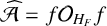 as in (2-4), one may naturally identify
$L^2({\widehat {{\mathcal {A}}}}, \varphi _{{\widehat {{\mathcal {A}}}}})$
 with the Hilbert space spanned by

through the correspondence

where
$\Omega $
 is a vacuum vector. Note that
$fF(H_{\mathcal {F}})f$
 is a right Hilbert
$f{\mathcal {F}} f$
 -module and
$f{\mathcal {F}} f=\mathbb {C}f$
 . For any
$X \in {\mathcal {B}}(L^2({\widehat {{\mathcal {A}}}}, \varphi _{{\widehat {{\mathcal {A}}}}}))\cap ({\widehat {{\mathcal {A}}}})^\prime $
 and
$\xi \in (\xi _0 \otimes _{\mathbb {C}}\ell ^2(\mathbb {Z}) \otimes _{\mathbb {C}} {\mathcal {F}} f) \cup (\xi _0 \otimes _{\mathbb {C}}\ell ^2(\mathbb {Z}) \otimes _{\mathbb {C}} {\mathcal {F}})\otimes (H \otimes _{\mathbb {C}}\ell ^2(\mathbb {Z}) \otimes _{\mathbb {C}} {\mathcal {F}})^{\otimes k-2} \otimes (H \otimes _{\mathbb {C}}\ell ^2(\mathbb {Z}) \otimes _{\mathbb {C}} {\mathcal {F}} f) $
 with
$k\ge 2$
 , we have
$T_\xi ^* \Omega =0$
 so that

so that
$ X \Omega = \lambda \Omega $
 for some
$\lambda \in \mathbb {C}.$
 Since
$X\xi = X T_\xi \Omega = T_\xi X\Omega = \lambda \xi $
 , we have
$X = \lambda \in \mathbb {C}$
 , showing that
${\mathcal {B}}(L^2({\widehat {{\mathcal {A}}}}, \varphi _{{\widehat {{\mathcal {A}}}}}))\cap {\widehat {{\mathcal {A}}}}^\prime = \mathbb {C}$
 . Hence, the state
$\varphi _{{\widehat {{\mathcal {A}}}}}$
 is pure.
Since any unital Kirchberg algebra
${\mathcal {A}}$
 with finitely generated
$\mathrm {K}$
 -groups is the reciprocal dual of the reciprocal dual of itself (that is,
${\mathcal {A}} \cong \widehat {{\widehat {{\mathcal {A}}}}}$
 ), we reach the conclusion of Theorem 1.2.
Remark 6.6. (1) As in [Reference Abadie and Dykema1], an automorphism
$\alpha $
 of a unital
$C^*$
 -algebra
${\mathcal {A}}$
 is uniquely ergodic if and only if for every
$a \in {\mathcal {A}}$
 , the ergodic sums
$({1}/{n})\sum _{i=0}^{n-1}\alpha ^i(a)$
 converge in norm to a scalar multiple of the unit
$1_{{\mathcal {A}}}$
 of
${\mathcal {A}}$
 as
$n$
 goes to infinity. By Theorem 3.5, one may represent
${{\mathcal {O}}_{H_{\mathcal {F}}}}$
 as the universal
$C^*$
 -algebra
$C^*_{\text {univ}}({\mathcal {F}}, \{ S_n \}_{n \in \mathbb {Z}})$
 with (3-5). Consider the automorphism
$\theta $
 on
${{\mathcal {O}}_{H_{\mathcal {F}}}}$
 defined by (5-2). The restriction of
$\theta $
 to
$f {{\mathcal {O}}_{H_{\mathcal {F}}}} f$
 is our ergodic automorphism
$\hat {\theta }$
 on
${\widehat {{\mathcal {A}}}}$
 . By using the fact that the family

generates
$f {{\mathcal {O}}_{H_{\mathcal {F}}}} f$
 as in Lemma 4.2, one may prove that the ergodic sums
$({1}/{n})\sum _{i=0}^{n-1}\hat {\theta }^i(a)$
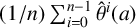 converge in norm to a scalar multiple of the unit
$1_{f{{\mathcal {O}}_{H_{\mathcal {F}}}} f}$
 on the dense subalgebra of
${{\mathcal {O}}_{H_{\mathcal {F}}}}$
 algebraically generated by the elements in (6-9) by overlapping discussions with our proof of Proposition 6.1. Consequently, it is possible to prove that the ergodic sums
$({1}/{n})\sum _{i=0}^{n-1}\hat {\theta }^i(a)$
 converge in norm to a scalar multiple of the unit
$1_{f{{\mathcal {O}}_{H_{\mathcal {F}}}} f}$
 of
$f {{\mathcal {O}}_{H_{\mathcal {F}}}} f$
 for all elements of
$f {{\mathcal {O}}_{H_{\mathcal {F}}}} f$
 , showing that
$\hat {\theta }$
 is uniquely ergodic on
${\widehat {{\mathcal {A}}}}$
 .
(2) Recall that there is another characterization of a state
$\varphi $
 on a
$C^*$
 -algebra
${\mathcal {A}}$
 being pure, that is, every positive linear functional majorized by
$\varphi $
 is a positive scalar multiple of
$\varphi $
 (see [Reference Takesaki28, Definition 9.21]). By using this characterization of a pure state, one may show that
$\varphi _{{\widehat {{\mathcal {A}}}}}$
 is pure in the following way. Let
$\phi $
 be a positive linear functional on
${\widehat {{\mathcal {A}}}}$
 such that
$\phi \le \varphi _{{\widehat {{\mathcal {A}}}}}$
 . Since the state
$\varphi _{{\widehat {{\mathcal {A}}}}}$
 satisfies the conclusion of Lemma 6.4, so does the positive linear functional
$\phi $
 . Hence, the proof of Proposition 6.1 works for
$\phi $
 so that one may conclude that
${\phi }/({\phi (1)})$
 coincides with
$\varphi _{{\widehat {{\mathcal {A}}}}}$
 .
7 Examples
(1) The reciprocal dual
$\widehat {\mathcal {O}}_A$
 of a simple Cuntz–Krieger algebra
${{\mathcal {O}}_A}$
 . Let
${\mathcal {A}}$
 be a simple Cuntz–Krieger algebra
${{\mathcal {O}}_A}$
 for an irreducible nonpermutation matrix
$A =[A(i,j)]_{i,j=1}^N$
 with entries in
$\{0,1 \}$
 . For
$m \in \mathbb {N}$
 , let us denote by
$ B_m(X_A) $
 the set of words
$(\mu _1,\ldots ,\mu _m), \, \mu _i =1,\ldots , N $
 of length
$m$
 such that
$A(\mu _i, \mu _{i+1}) =1, i=1,\ldots , m-1. $
 We put
$B_*(X_A) = \bigcup _{m=0}^\infty B_m(X_A)$
 , where
$B_0(X_A)$
 denotes the empty word. The Toeplitz algebra
${{\mathcal {T}}_A}$
 for the matrix
$A$
 introduced in [Reference Enomoto, Fujii and Watatani6] (compare with [Reference Evans7]) is the universal unital
$C^*$
 -algebra generated by
$N$
 -partial isometries
$T_1,\ldots , T_N$
 and a nonzero projection
$e$
 subject to the following relations:

For
$\mu =(\mu _1,\ldots ,\mu _m)\in B_m(X_A),$
 we write
$T_{\mu _1}\cdots T_{\mu _m}$
 as
$T_\mu $
 . As the identities

for
$\mu , \nu , \xi , \eta \in B_*(X_A)$
 hold,
${{\mathcal {T}}_A}$
 is the closed linear span of elements of the form

and the
$C^*$
 -subalgebra of
${{\mathcal {T}}_A}$
 generated by
$ T_\mu e T_\nu ^*, \mu , \nu \in B_*(X_A)$
 is isomorphic to the
$C^*$
 -algebra
$\mathcal {K}(H)$
 of compact operators on a separable infinite dimensional Hilbert space
$H$
 , such that there is a natural short exact sequence

We consider the Toeplitz algebra
${{\mathcal {T}}_{A^t}}$
 for the transposed matrix
$A^t =[A^t(i,j)]_{i,j=1}^N$
 of
$A$
 . It was proved in [Reference Matsumoto15, Reference Matsumoto16] (compare with [Reference Matsumoto and Sogabe17, Reference Matsumoto and Sogabe20]) that

Hence, the reciprocal dual
$\widehat {\mathcal {O}}_A$
 is realized as a universal
$C^*$
 -algebra
$C^*_{\text {univ}}(\mathcal {T}_{A^t}, \{t_j\}_{j \in \mathbb {N}})$
 generated by
${{\mathcal {T}}_{A^t}}$
 and a family
$\{t_j\}_{j \in \mathbb {N}}$
 of partial isometries satisfying (1-2). The algebra
${{\mathcal {T}}_{A^t}}$
 itself is a universal
$C^*$
 -algebra generated by partial isometries
$T_j, j=1,\ldots N$
 and a projection
$e$
 satisfying (7-1) for the transposed matrix
$A^t$
 . By unifying the generators
$T_j, j=1,\ldots , N$
 and
$\{t_j\}_{j \in \mathbb {N}}$
 with their relations (7-1) and (1-2), we have the following realization of the reciprocal dual
$\widehat {\mathcal {O}}_A$
 as a simple Exel–Laca algebra [Reference Exel and Laca8], which has been already seen in [Reference Matsumoto and Sogabe18, Theorem 1.3].
Proposition 7.1 [Reference Matsumoto and Sogabe18, Theorem 1.3].
The reciprocal dual
$\widehat {\mathcal {O}}_A$
 is the simple Exel–Laca algebra
${\mathcal {O}}_{\widehat {A}}$
 defined by the infinite matrix
$\widehat {A}$
 over
$\mathbb {N}$
 with entries in
$\{0,1\}$
 such that

for
$i,j \in \mathbb {N}$
 . The matrix
$\widehat {A}$
 is written as

Proof. Theorem 1.1(i) tells us that the
$C^*$
 -algebra
$\widehat {\mathcal {O}}_A$
 is the universal
$C^*$
 -algebra
$C^*_{\text {univ}}({{\mathcal {T}}_{A^t}}, \{t_j\}_{j \in \mathbb {N}})$
 generated by
${{\mathcal {T}}_{A^t}}$
 and partial isometries
$\{t_j\}_{j \in \mathbb {N}}$
 satisfying (1-2), which are

for
$m \ge 2$
 . Let us define a family of partial isometries
$\{ s_j \}_{j \in \mathbb {N}}$
 by setting

It is direct to see that the
$C^*$
 -algebra
$C^*(\{s_j \}_{j \in \mathbb {N}})$
 generated by the partial isometries
$\{ s_j \}_{j\in \mathbb {N}}$
 is the Exel–Laca algebra
${\mathcal {O}}_{\widehat {A}}$
 defined by the matrix
$\widehat {A}$
 . As
$C^*(\{s_j \}_{j \in \mathbb {N}})$
 coincides with
$C^*_{\text {univ}}({{\mathcal {T}}_{A^t}}, \{t_j\}_{j \in \mathbb {N}})$
 , we have
$\widehat {\mathcal {O}}_A$
 is the Exel–Laca algebra
${\mathcal {O}}_{\widehat {A}}$
 for the matrix
$\widehat {A}$
 .
Remark 7.2. The matrix
$\widehat {A}$
 defined in (7-2) was written as
${\widehat {A}}_\infty $
 in [Reference Matsumoto and Sogabe18, Theorem 1.3].
The class of the reciprocal duals
$\widehat {\mathcal {O}}_A$
 of simple Cuntz–Krieger algebras is exactly the class of unital Kirchberg algebras
${\mathcal {A}}$
 with finitely generated
$\mathrm {K}$
 -groups having torsion free
$\mathrm {K}_1$
 -groups such that
$ \mathrm {rank}(\mathrm {K}_0({\mathcal {A}})) - \mathrm {rank}(\mathrm {K}_1({\mathcal {A}})) =1$
 [Reference Matsumoto and Sogabe18, Proposition 4.4]. Hence, Proposition 7.1 shows that the Kirchberg algebras belonging to the class are explicitly represented as Exel–Laca algebras by the above matrices.
(2) The reciprocal dual
$\widehat {\mathcal {P}}_\infty $
 of
${{\mathcal {P}}_\infty }$
 . Let
${{\mathcal {P}}_\infty }$
 be the Kirchberg algebra such that
$\mathrm {K}_0({{\mathcal {P}}_\infty }) = 0, \, \mathrm {K}_1({{\mathcal {P}}_\infty }) = \mathbb {Z}$
 . It is the unique Kirchberg algebra realized as the unital Exel–Laca algebra
${\mathcal {O}}_{P_\infty }$
 by the infinite matrix
$P_\infty $
 :

We concretely represent the reciprocal dual
$\widehat {\mathcal {P}}_\infty $
 of
$\mathcal {P}_\infty $
 by generators and their relations as a unital simple Exel–Laca algebra. We know that
$\mathrm {Ext}_{\mathrm {w}}^1({{\mathcal {P}}_\infty }) =\mathbb {Z}, \mathrm {Ext}_{\mathrm {w}}^0({{\mathcal {P}}_\infty }) = 0 $
 by the UCT (see [Reference Blackadar2, Theorem 23.1.1]) so that the cyclic six-term exact sequence (2-1) for
${\mathcal {A}} = {{\mathcal {P}}_\infty }$
 goes to

Since there is an isomorphism between
$\mathrm {Ext}_{\mathrm {s}}^1({{\mathcal {P}}_\infty })$
 and
$\mathbb {Z}\oplus \mathbb {Z}$
 such that
$\iota _{{{\mathcal {P}}_\infty }}(1) $
 is mapped to
$0\oplus 1\in \mathbb {Z}\oplus \mathbb {Z},$


Let
$\mathcal {T}_\infty $
 be the universal unital
$C^*$
 -algebra generated by a countable family
$T_i, i \in \mathbb {N}$
 of isometries and one nonzero projection
$e$
 such that

Since

the
$C^*$
 -subalgebra
$C^*(T_\mu e T_\nu ^* \mid \mu , \nu \in \mathbb {N}^*)$
 generated by partial isometries
$ T_\mu e T_\nu ^*, \mu , \nu \in \mathbb {N}^* $
 is isomorphic to the
$C^*$
 -algebra
$\mathcal {K}(H)$
 of compact operators. It forms an essential ideal of
$\mathcal {T}_\infty $
 such that the sequence

is exact. That is, the exact sequence (7-5) is a trivial extension of
${{\mathcal {O}}_\infty }$
 . The
$\mathrm {K}$
 -theory standard six-term exact sequence for (7-5), together with
$\mathrm {K}_0({{\mathcal {O}}_\infty }) = \mathbb {Z}, \mathrm {K}_1({{\mathcal {O}}_\infty }) = 0$
 yields the cyclic six-term exact sequence

As the downward arrow in the diagram (7-6) is induced by the map
$ \mathbb {Z} \ni 1 \rightarrow [e]_0 \in \mathrm {K}_0({{\mathcal {T}}_\infty })$
 , there is an isomorphism between
$\mathrm {K}_0({{\mathcal {T}}_\infty })$
 and
$\mathbb {Z}\oplus \mathbb {Z}$
 such that
$[e]_0 $
 is mapped to
$0\oplus 1\in \mathbb {Z}\oplus \mathbb {Z},$
 so that

showing that

By Theorem 1.1, the reciprocal dual
$\widehat {\mathcal {P}}_\infty $
 is realized as a universal
$C^*$
 -algebra
$C^*_{\text {univ}}({{\mathcal {T}}_\infty }, \{t_j\}_{j \in \mathbb {N}})$
 generated by
${{\mathcal {T}}_\infty }$
 and a family
$\{t_j\}_{j \in \mathbb {N}}$
 of partial isometries satisfying (1-2) for
$\mathcal {T} = {{\mathcal {T}}_\infty }$
 . The trivial extension
${{\mathcal {T}}_\infty }$
 of
${{\mathcal {O}}_\infty }$
 itself is a universal
$C^*$
 -algebra generated by isometries
$T_j, j \in \mathbb {N}$
 and a nonzero projection
$e$
 satisfying (7-4). By unifying them, we have the following relations:

for
$m \ge 2$
 . They go to the relations:

Therefore, we have the following proposition.
Proposition 7.3. The reciprocal dual
$\widehat {\mathcal {P}}_{\infty }$
 of
${{\mathcal {P}}_\infty }$
 is the universal Kirchberg algebra generated by two families of partial isometries
$\{T_i\}_{i \in \mathbb {N}}$
 and
$\{ t_j \}_{j \in \mathbb {N}}$
 with orthogonal ranges, which is realized as a simple Exel–Laca algebra
${\mathcal {O}}_{\widehat {P}_\infty }$
 defined by a matrix
$\widehat {P}_\infty $
 such as

where the entries of the above matrix are ordered as follows:

For example, the first and second rows in the matrix
$\widehat {P}_\infty $
 show us that

and the middle row shows us that

and so on.
(3) The reciprocal dual
$\widehat {{\mathcal {O}}}_\infty $
 of
${{\mathcal {O}}_\infty }$
 . The
$C^*$
 -algebra
${{\mathcal {P}}_\infty }$
 is the Exel–Laca algebra
${\mathcal {O}}_{P_\infty }$
 for the matrix
$P_\infty $
 defined by (7-3). It is the universal
$C^*$
 -algebra generated by a family
$\{S_i\}_{i\in \mathbb {N}}$
 of partial isometries such that

Let us consider the following universal
$C^*$
 -algebra, written
$\mathcal {T}_{P_\infty }$
 , and generated by partial isometries
$s_i, i \in \mathbb {N}$
 and a nonzero projection
$e$
 :

Since the
$C^*$
 -subalgebra
$C^*(s_\mu s_2 e s_2^* s_\nu ^* \mid \mu , \nu \in \{1,2,3,\ldots \}^*)$
 of
$\mathcal {T}_{P_\infty }$
 forms an essential ideal of
$\mathcal {T}_{P_\infty }$
 isomorphic to
$\mathcal {K}(H)$
 , we have a short exact sequence

As
$ s_1^* s_1 + s_2 s_2^* +e = s_2^* s_2 + s_1 s_1^* =1$
 and
$[s_is_i^*]_0 = [s_i^* s_i]_0$
 in
$\mathrm {K}_0(\mathcal {T}_{P_\infty })$
 , we have
$[e]_0 = 0$
 in
$\mathrm {K}_0(\mathcal {T}_{P_\infty }).$
 By the
$\mathrm {K}$
 -theory standard cyclic six-term exact sequence for (7-7) together with
$\mathrm {K}_1({{\mathcal {P}}_\infty }) = \mathbb {Z}, \, \mathrm {K}_0({{\mathcal {P}}_\infty }) = \{ 0 \}$
 , we have the cyclic six-term exact sequence

Since the downward arrow
$\iota _*: \mathbb {Z} \rightarrow \mathrm {K}_0(\mathcal {T}_{P_\infty })$
 satisfies
$\iota _*(1) = [e]_0 =0 $
 in
$\mathrm {K}_0(\mathcal {T}_{P_\infty })$
 , so that
$\iota _*: \mathbb {Z} \rightarrow \mathrm {K}_0(\mathcal {T}_{P_\infty })$
 is the zero map, hence, we have
$\mathrm {K}_0(\mathcal {T}_{P_\infty }) = 0,$
 and the upper horizontal arrow
$\partial : \mathbb {Z} \rightarrow \mathbb {Z}$
 is surjective and hence isomorphic. We then have
$\mathrm {K}_1(\mathcal {T}_{P_\infty }) = 0$
 and, hence,

As
$\mathrm {Ext}_{\mathrm {s}}^i({{\mathcal {O}}_\infty }) = 0$
 for
$i=0,1$
 ,

Hence, the
$C^*$
 -algebra
$\widehat {{\mathcal {O}}}_\infty $
 is the universal
$C^*$
 -algebra
$C^*_{\text {univ}}(\mathcal {T}_{P_\infty }, \{t_i\}_{i \in \mathbb {N}}) $
 generated by
$\mathcal {T}_{P_\infty }$
 and partial isometries
$\{t_j \}_{j \in \mathbb {N}}$
 satisfying (1-2) for
$\mathcal {T} = \mathcal {T}_{P_\infty }$
 . By [Reference Matsumoto and Sogabe18, Section 8],
$\widehat {{{\mathcal {O}}}}_\infty $
 is isomorphic to the Cuntz algebra
${\mathcal {O}}_2$
 (see [Reference Cuntz5]). One may construct an aperiodic ergodic automorphism on
${\mathcal {O}}_2$
 as in Section 5. We then choose the index set of
$\{ t_j\}_{j \in \mathbb {N}}$
 as the integer group
$\mathbb {Z}$
 such that
$\{ t_j\}_{j \in \mathbb {Z}}$
 satisfies (5-1). By Theorem 1.1(i) and Proposition 5.3, we may describe our ergodic automorphism on
${\mathcal {O}}_2$
 as an automorphism on the universal
$C^*$
 -algebra
$C^*_{\text {univ}}(\{s_i\}_{i \in \mathbb {N}}, f, \{t_j\}_{j \in \mathbb {Z}})$
 in the following way.
Proposition 7.4.
-
(i) The Cuntz algebra ${\mathcal {O}}_2$
may be realized as the universal
$C^*$
-algebra
$C^*_{\text {univ}}(\{s_i\}_{i \in \mathbb {N}}, f, \{t_j\}_{j \in \mathbb {Z}})$
generated by two families of partial isometries
$s_i,i \in \mathbb {N}, \,t_j, j \in \mathbb {Z}$
and a nonzero projection
$f$
, subject to the following operator relations: $$ \begin{align*} \begin{cases} t_0^* t_0 =1, \quad t_j^* t_j = f \quad\ \text{for } j\ne 0,\\ f + \sum_{0<|j|<m}t_j t_j^* <1 \quad \text{for } m \in \mathbb{N}, \\ t_0 t_0^* + \sum_{i=1}^m s_i s_i^* < f \quad\text{for } m \in \mathbb{N}, \\ s_1^* s_1 + s_2 s_2^* + t_0 t_0^* = s_2^* s_2 + s_1 s_1^* =f, \\ s_3^* s_3 = s_1 s_1^* + s_3 s_3^*, \\ s_4^* s_4 = s_2 s_2^* + s_4 s_4^*, \\ s_5^* s_5 = s_3 s_3^* + s_5 s_5^*, \\ \qquad \vdots \end{cases} \end{align*} $$
-
(ii) The correspondence $\hat {\theta }:C^*_{\text {univ}}(\{s_i\}_{i \in \mathbb {N}},f, \{t_j\}_{j \in \mathbb {Z}}) \rightarrow C^*_{\text {univ}}(\{s_i\}_{i \in \mathbb {N}}, f, \{t_j\}_{j \in \mathbb {Z}})$
defined by $$ \begin{align*} \begin{cases} \hat{\theta}(s_i) &\!\!\!\! = t_1 s_i t_1^* \quad \text{for } i \in \mathbb{N}, \\ \hat{\theta}(f) & \!\!\!\!= t_1 f t_1^*, \\ \hat{\theta}(t_0) &\!\!\!\! = t_1 t_0, \\ \hat{\theta}(t_{-1}) &\!\!\!\! = t_1^*, \\ \hat{\theta}(t_j) & \!\!\!\!= t_{j+1} t_1^* \quad \text{for } j \in \mathbb{Z}, j \ne 0, \, -1, \end{cases} \end{align*} $$yields an aperiodic ergodic automorphism on ${\mathcal {O}}_2$
.


Remark 7.5. In [Reference Carey and Evans4], Carey and Evans constructed and studied some ergodic automorphisms on the Cuntz algebras
${\mathcal {O}}_n$
 . As in [Reference Carey and Evans4, Corollary 3.6], their ergodic automorphisms on
${\mathcal {O}}_2$
 have two invariant states, whereas our automorphism
$\hat {\theta }$
 on
${\mathcal {O}}_2$
 has exactly one invariant state, so that our automorphism on
${\mathcal {O}}_2$
 is different from the automorphisms in [Reference Carey and Evans4]. By [Reference Nakamura21], two aperiodic automorphisms are cocycle conjugate if and only if their behaviors on
$\mathrm {K}$
 -theory groups coincide. Since
$\mathrm {K}_0({\mathcal {O}}_2) = 0$
 , there exists a unique aperiodic ergodic automorphism on
${\mathcal {O}}_2$
 up to cocycle conjugacy. Hence, our ergodic automorphism on
${\mathcal {O}}_2$
 is cocycle conjugate to the one of Carey and Evans, but not conjugate.
Acknowledgements
The authors would like to thank the anonymous referee for their careful reading and helpful comments and suggestions. In particular, their comments on the proof of Proposition 6.1 in the earlier version were extremely helpful in producing the present version. The authors would like to thank Masaki Izumi for his useful comments and drawing the authors’ attention to [Reference Carey and Evans4].



