INTRODUCTION
The developmental outcome of twins has been the subject of research endeavors for nine decades, with increasing interest following the dramatic rise in multiple gestation since the 1970s (Gucuyener et al., Reference Gucuyener, Arhan, Soysal, Ergenekon, Turan, Onal and Atalay2011). Based on meta-analysis of studies comparing intellectual outcome of multiples and singletons over 8 decades (1924–2008), Voracek and Haubner (Reference Voracek and Haubner2008) concluded that on average, twins obtained 4.2 IQ points below singletons in childhood or adolescence. Similarly Thorpe (Reference Thorpe2006), who systematically examined a similar body of literature in the language domain, found that mild language delays are prevalent and consistently observed in twins. Because multiples are more likely than singletons to experience perinatal complications (ESHRE Capri Workshop Group, 2000; Lorenz, Reference Lorenz2012; Papiernik et al., Reference Papiernik, Zeitlin, Delmas, Blondel, Kunzel, Cuttini and Draper2010), Voracek and Haubner (Reference Voracek and Haubner2008) speculated that the factor accounting for poorer performance in twins could be the increased frequency of complications such as suboptimal intrauterine growth and preterm birth.
To meaningfully study the early biological factors that might adversely influence developmental outcome in multiples, one should use an appropriate singleton comparison group, with sufficient consideration for gestational age. Approximately 10% of preterm births (<37 weeks gestation) in the United States are attributable to twins, whereas premature twins comprise >50% of all U.S. twin births (Martin, Hamilton, & Osterman, Reference Martin, Hamilton and Osterman2012; Martin, Hamilton, Ventura, et al., Reference Martin, Hamilton, Ventura, Osterman, Wilson and Mathews2012). Approximately 11% of twins are very preterm (<32 weeks; Martin, Hamilton, Ventura, Osterman, & Mathews, Reference Martin, Hamilton, Ventura, Osterman and Mathews2013). Thus, comparison of neuropsychological functioning between preterm-born twins and their singleton counterparts is essential for teasing apart the effects of twinning from influences associated with perinatal risk.
Bodeau-Livinec et al. (Reference Bodeau-Livinec, Zeitlin, Blondel, Arnaud, Fresson and Burguet2013) noted that performance deficits observed in term-born twins, compared to term-born singletons, are not easily generalizable to a population of preterm-born twins, compared to their preterm singleton counterparts. Reduced generalizability is expected because, in the preterm population, both twins and singletons are at increased risk for ante-, peri-, and neonatal complications. Yet in term-born cohorts, twins would be at substantially increased risk for medical complications. Because of recent advancements in fertility treatment, conclusions based on the entirety of the 8-decade body of research reviewed by Voracek and Haubner (Reference Voracek and Haubner2008) or Thorpe (Reference Thorpe2006) may not apply to recent birth cohorts. Indeed, Voracek and Haubner reported a substantial difference between “less versus more recent” birth cohorts (5.1 vs. .5 IQ point discrepancy, respectively).
Whereas fertility treatment does not appear to alter developmental outcome (Yeung et al., Reference Yeung, Sundaram, Bell, Druschel, Kus, Ghassabian and Buck Louis2016), a birth cohort effect may be explained, in part, by changes occurring in the composition and nature of the population of multiples available for study in industrialized nations following the introduction of assisted reproductive technology (ART). Although an overall increase in the rate of twin gestation has been attributed to the introduction of these technologies (Zork, Biggio, Tita, Rouse, & Gyamfi-Bannerman, Reference Zork, Biggio, Tita, Rouse and Gyamfi-Bannerman2013), the nonuniform and reduced availability of comprehensive statewide-mandated health insurance coverage of ART produced regional differences (Sunderam et al., Reference Sunderam, Kissin, Crawford, Folger, Jamieson, Warner and Barfield2015), and likely discrepancies between socioeconomic strata, in access to these treatments (Smith et al., Reference Smith, Manktelow, Draper, Boyle, Johnson and Field2014). Hence, earlier findings may not be generalizable to cohorts born in the last two and a half decades.
In addition to changes introduced by fertility treatments, children born preterm since the 1990s, whether twins or singletons, have benefited from advances in neonatal care such as surfactant therapy, gentler mode of mechanical ventilation, and antenatal glucocorticoid therapy (Jobe & Bancalari, Reference Jobe and Bancalari2001). However, few surfactant-era investigations included comparisons of neuropsychological outcome between preterm twins and singletons. Of eight such investigations, six used infancy developmental measures. Four of these studied preterm and/or very preterm samples (Asztalos, Barrett, Lacy, & Luther, Reference Asztalos, Barrett, Lacy and Luther2001; Eras et al., Reference Eras, Ozyurt, Kanmaz, Erdeve, Sakrucu, Oguz and Dilmen2013; Kyriakidou, Karagianni, & Iliodromiti, Reference Kyriakidou, Karagianni and Iliodromiti2013; Manuck, Sheng, Yoder, & Varner, Reference Manuck, Sheng, Yoder and Varner2014), while the remaining two focused on extremely preterm (gestational age<28 weeks), or extremely low birth weight (<1000 g), infants (Hajnal, Braun-Fahrlander, von Siebenthal, Bucher, & Largo, Reference Hajnal, Braun-Fahrlander, von Siebenthal, Bucher and Largo2005; Wadhawan et al., Reference Wadhawan, Oh, Perritt, McDonald, Das, Poole and Higgins2009). Group differences were reported in only one of the six infancy studies (Wadhawan et al., Reference Wadhawan, Oh, Perritt, McDonald, Das, Poole and Higgins2009), yet the investigators incorporated infant demise in their composite index of impairment. Of the two investigations of preschool-age children (Bodeau-livinec et al., Reference Bodeau-Livinec, Zeitlin, Blondel, Arnaud, Fresson and Burguet2013; Einaudi et al., Reference Einaudi, Busuttil, Monnier, Chanus, Palix and Gire2008), only the latter study reported outcome differences in favor of singletons, using a global measure of cognitive ability.
While reports of developmental outcome differences between first-, or second-born twins and their singleton counterparts are uncommon, in several studies increased risk for respiratory complications (Arnold, McLean, Kramer, & Usher, Reference Arnold, McLean, Kramer and Usher1987; Hacking, Watkins, Fraser, Wolfe, & Nolan, Reference Hacking, Watkins, Fraser, Wolfe and Nolan2001) or composite perinatal and neonatal complications (Armson et al., Reference Armson, O’Connell, Persad, Joseph, Young and Baskett2006) was documented in the second-born (nonpresenting) twin regardless of delivery route. A recent investigation of early school-age children revealed a first-born twin advantage in neuropsychological outcome among preterm-born male twins (Gonzalez-Mesa, Cazorla-Granados, & Gonzalez-Valenzuela, Reference Gonzalez-Mesa, Cazorla-Granados and Gonzalez-Valenzuela2016).
In contrast with earlier studies of preterm twins and singletons, in this investigation we examined the associations between multiplicity (plurality) and outcome in several domains of neuropsychological functioning, including memory efficiency, language abilities, visual processing, and motor skills. In particular, we hypothesized that multiplicity will account for a unique portion of developmental outcome variance, over and above the variance explained by sociodemographic or perinatal factors that may confound the effects of twin birth. Because adverse outcome effects of multiplicity may be more pronounced in boys (Gucuyener et al., Reference Gucuyener, Arhan, Soysal, Ergenekon, Turan, Onal and Atalay2011), and since sex differences may be more prominent in the language domain (Thorpe, Reference Thorpe2006), we predicted that the strength of associations between multiplicity and neuropsychological outcomes will depend on “sex,” perhaps more so in language functioning than in other domains. In addition to the above-listed hypotheses, we predicted poorer neuropsychological outcome in second-born twins, compared to their singleton counterparts.
METHOD
Participants
To examine the relationships between multiplicity of birth and neuropsychological outcome in preterm-born children, we evaluated products of either singleton or twin pregnancies at preschool-age. The children were born between 23 and 336/7 weeks gestation at William Beaumont Hospital (WBH), Royal Oak, Michigan, and treated in the neonatal intensive care unit (NICU). Children who had been transferred from other hospitals were excluded. WBH catchment area includes primarily middle socioeconomic strata. The children were born between 1996 and 2001 and evaluated between 3 and 6 years of age adjusted for prematurity. Children who had been diagnosed with congenital anomalies, or who continued to require mechanical ventilation after discharge, were not considered for recruitment.
The approach to extremely preterm infants at WBH was consistent throughout the study period. All infants assessed by the neonatologist to have a reasonable chance to survive based on the information available at the time of delivery received initial life-sustaining care after birth, including endotracheal intubation in the delivery room, if needed. Active intervention was administered to extremely preterm infants, with survival rate at the threshold of viability (23 weeks) reaching 40%. Approximately 87% of these survivors were free from sonographic evidence of severe brain injury (large IVH, intraparenchymal hemorrhage, or cystic PVL), as detailed in Batton, DeWitte, and Pryce (Reference Batton, DeWitte and Pryce2011). The results from WBH NICU for the period of the current study are consistent with reports of extremely preterm infant outcomes from more recent cohorts (see Rysavy et al., Reference Rysavy, Li, Bell, Das, Hintz, Stoll and Higgins2015).
Eighty-one twins (28.02% of the total relevant 1996–2001 twin birth cohort) and 152 singletons (24.91% of the total relevant singleton birth cohort) were available for this investigation. However, since we were interested in studying the unique contribution of multiplicity to developmental outcome, we excluded eight singletons and four twins with neurological disorder or evidence of moderate/severe perinatal CNS injury. Of the eight singleton cases, two were diagnosed with moderate perinatal intraventricular hemorrhage (IVH), with CP diagnosed subsequently in one case. Two additional cases were diagnosed with hydrocephalus and four suffered severe perinatal IVH and/or parenchymal lesions.
Of the four excluded twins, three were diagnosed with severe perinatal IVH and subsequent CP, whereas one case manifested language difficulties of sufficient magnitude to preclude language assessment. In sum, following exclusion of cases diagnosed with congenital anomalies, cerebral palsy, or perinatal intracranial pathology (except mild IVH), and cases discharged on mechanical ventilation, the final sample included 144 singletons and 77 twins, 3–6 years of age, and born<34 weeks gestation at WBH. None of the participants was disabled, with a single exception of a singleton with mild spastic diplegia and above-average intellectual performance who was retained in the sample. Altogether, approximately 20% of the study participants were extremely preterm (<28 weeks) with approximately 10%<25 weeks estimated gestation.
Of the 221 participants remaining following exclusion of 12 “neurological” cases, 184 were recruited through an ongoing prematurity follow-up study (123 singletons and 61 twins) and 37 through an IVH outcome study (21 singletons and 16 twins). The selection criteria were similar for both studies, although the age range and participation rates were slightly different (4–6 years for the prematurity follow-up, 3–5 years for the IVH study, respectively; participation rates 64% and 56% of contactable families, respectively). Across the two studies, reason for nonparticipation was not provided in 51.51% of the cases whose families declined participation. Explanations offered for remaining cases were lack of time (19.39%) or interest in driving to Detroit (8.48%), testing not deemed essential (13.33 %), child unable to cooperate due to severe impairments (4.84%), and English not primary language (2.42%). Regardless of recruitment mechanism, there were no significant differences in the singletons to twins ratio of preschoolers obtained from the two studies for the current investigation (Yates corrected χ2[1]=.93; p=.324).
Eighteen of the twins were products of monochorionic, and 54 of dichorionic, placentation, according to pathology reports. For five cases, information about chorionicity was unavailable. Of the 77 twins, 23 were born following fertility treatment (11 in vitro fertilization, six clomiphene, and six miscellaneous other methods). Altogether, 68 twins were members of 34 pairs, with the remaining nine cases (3 first-, 6 second-born) lacking a tested co-twin. In one of the nine cases the co-twin died at birth, in two cases the co-twin had cerebral palsy (CP), while a single co-twin was unable to complete testing because of language impairment. In five additional cases, co-twins were not scheduled for evaluation by their family for unknown reasons. Little information is available to us approximately four of these five cases, while the remaining co-twin was the donor twin from a set diagnosed with twin-to-twin transfusion syndrome (TTTS). In addition to the recipient co-twin, the sample included a set of twins with TTTS diagnosis.
According to maternal report, none of our participants had sustained a head injury with loss of consciousness. History of at least one seizure was reported for nine cases (seven singletons, two twins), yet only one case, a singleton with petit mal diagnosis, was managed with medication during the evaluation. According to parental report none of the children had significant prenatal alcohol exposure (> a glass per day), although nicotine exposure (1–20 cigarettes per day) was reported for 27 cases.
Testing Procedures and Neuropsychological Assessment
Before the beginning of testing, informed consent was obtained from the attending parent/legal guardian(s), typically the mother, for each participant. All testing and other data collection procedures were conducted in accordance with the Helsinki Declaration and in compliance with the regulations of the Human Investigation Committee of WBH and the Institutional Review Board of Wayne State University.
Children were evaluated in one or two sessions, based on the examiner’s assessment of the child’s attention. The examiners were graduate students trained extensively in developmental neuropsychological assessment. Although they were informed about the participants’ history of premature birth, they were kept unaware of the children’s specific ante-, peri-, and neonatal complications. Memory skills were assessed using the Woodcock-Johnson (W-J) III Tests of Cognitive Abilities (Woodcock, McGrew, & Mather, Reference Woodcock, McGrew and Mather2001) Long Term Retrieval (LTR) domain score and constituting subtests, Visual Auditory Learning (VAL), and Retrieval Fluency (RFL). The broad ability of long-term retrieval (Glr cluster) involves the cognitive processes of acquiring, storing, and retrieving information and reflects the efficiency with which information is initially stored and later retrieved.
Whereas VAL is a test of associative memory that requires paired-associative encoding, storage, and retrieval, RFL is a test of ideational fluency and naming facility, requiring recognition, fluent retrieval, and oral production of examples of a semantic category (Schrank, Reference Schrank2011). We used the Preschool Language Scale (PLS-3; Zimmerman, Steiner, & Pond, 1992) to evaluate language skills. This standardized instrument includes a Total Language scale (TL), comprised of two subscales assessing receptive and expressive language: Auditory Comprehension (AC) and Expressive Communication (EC), respectively. The test includes tasks assessing semantic, morphological, syntactic, integrative language, and pre-literacy, linguistic competencies.
Assessment of visual processing was accomplished with the W-J III Picture Recognition (PR) subtest, which is one of the two tests that create the Gv, a cluster indexing visual-spatial thinking, that is, the extraction of features from visual stimuli. Such extraction includes the processes involved in generating, storing, retrieving, and transforming visual images (Schrank, Reference Schrank2011). Motor skills were assessed using the Peabody Developmental Motor Scales (PDMS-2; Folio & Fewell, 2000). This instrument, normed on a large stratified sample, is a comprehensive, standardized measure of motor skills that includes a Total Motor scale (TM) comprised of Fine and Gross Motor subscales (FM and GM, respectively).
General Statistical Considerations
To evaluate the effects of multiplicity on neuropsychological outcome, we used multiple regression analyses. The predictor of interest was the grouping factor, singleton versus twin birth (multiplicity). The predicted variables were the standard scores for the LTR domain and its components (VAL and RTF) in analyses of memory efficiency, the TL scale and its constituting subscales (AC and EC) in analyses of language abilities, the PR subtest in analyses of visual processing, and the TM scale with its constituting subscales (FM and GM) in analyses of motor skills. We included sociodemographic predictors, SES (Hollingshead, Reference Hollingshead1975), and sex, in all analyses.
To account for early medical risk, we selected three covariates: birth weight, the intrauterine growth Z-score, and the total complication score. Because gestational age and birth weight are highly correlated (Pearson r[219]=.826; p<.001 in our sample), we chose only the latter predictor to reduce collinearity. We reasoned that while the gestational-age range in our sample was truncated at 336/7 weeks, birth weight range was not limited, representing a naturally occurring spectrum within the preterm cohort of origin. Furthermore, birth weight, a variable reflecting perinatal differences within twin-pairs that are not captured by gestational age, is essential in comparing the first versus second-born twins to their singleton counterparts. The intrauterine growth Z-score was defined as the deviation of an infant’s birth weight from the sex-specific mean weight of his/her gestational age group, in accord with norms published by Kramer et al. (Reference Kramer, Platt, Wen, Joseph, Allen, Abrahamowicz and Breart2001). Before all analyses, we examined the interactions between each of the two dichotomous predictors (sex, multiplicity) and each continuous variable in the models. As none of the interactions were found to be significant, the reduced models were used instead.
To ensure independence of observations, and particularly since antenatal characteristics were shared by co-members of twinships, either the first- or second-born twin was randomly excluded from each of the 34 pairs of co-twins using a web-based random number generator (stattrek.com). Thus, together with the nine cases whose co-twin was not available or appropriate for this investigation, the reduced twin group was comprised of 43 members from separate pairs who were compared with the 144 singletons (Table 4). These analyses were followed by comparisons of the first- (Table 5), and second-born (Table 6) twin groups with the singletons. When significant relationships between predictors and global outcome measures were found, follow-up analyses of associations between predictors and subscale/subtest- performance were conducted using Bonferroni-corrected α levels, with familywise adjustments within outcome domains.
RESULTS
The proportions of boys and girls in the singleton and twin groups comprising our final sample, as presented in Table 1, were not significantly different from the proportions observed in the remaining singletons (57.08% males) and twins (50.47% males) from the relevant NICU birth cohorts (Yates corrected χ2[1]=.374; p=.541 and χ2[1]=.081; p=.776, for singletons and multiples, respectively). The proportions of African Americans in the singleton and twin groups comprising our final sample (Table 1) were 9.03% and 5.19%, respectively (Yates corrected χ2[1]=.344; p=.557). These proportions were not significantly different from the proportions observed in the singletons (10%) and twins (6.92%) from the remaining NICU cohort (Yates corrected χ2[1]=.082; p=.775 and χ2[1]=.189; p=.663, for singletons and twins, respectively).
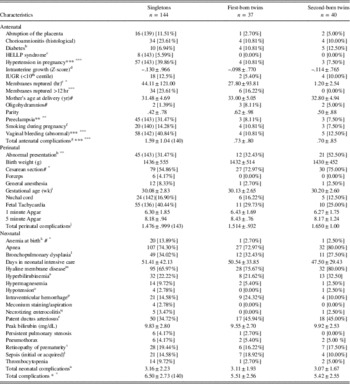
Demographic and socio-familial characteristics by groupFootnote a

Note. Frequencies are reported for discrete data, means and standard deviations for continuous data. Group differences examined via t test (continuous data) and 2×2 χ2 with Yates correction (discrete data), or Fisher exact probability test (<five cases per cell). In the case of missing data, number of subjects used is provided in parentheses. Ranges and percentages by group are provided in brackets.
a All comparisons between preterm born singletons and twins.
b Age at first testing session adjusted for prematurity.
c M=male, F=female.
d W=White, O=Other (at least one parent not Caucasian). Singletons group included 10 African Americans, 1 Asian, and 17 cases of mixed racial origin (1 African-American/Caucasian, 2 Asian/African Americans, 1 American Indian/Caucasian; 8 Hispanic/Caucasian; 5 Asian/Caucasian). First-, or second-born twin groups each included 2 African American and 1 biracial case (Hispanic-Caucasian).
e Hollingshead’s (1975) Four Factor Index of Social Status.
f Prorated parental IQ based on three subtests (Vocabulary, Similarities, and Information) of the Wechsler Adult Intelligence Scale-III (Wechsler, 1997); Testing was completed on the biological mothers in all cases except 12 singletons and 5 twins, where the father was tested instead.*p<.05, **p<.01, ***p<.001 for comparisons of singleton versus first-born twin group; * p<.05, ** p< .01, *** p<.001 for comparisons of singleton versus second-born twin group.
Intrauterine growth restriction (IUGR) rates did not differ between participating versus nonparticipating singletons (12.5% vs. 15.88%, Yates corrected χ2[1]=.735; p=.39) or twins (7.79% vs. 8.49%, Yates corrected χ2[1]=.003; p=.96). Means (±SD) for gestational age and birthweight in our sample’s singleton group (30.08±2.83 weeks and 1436±555 g, respectively) were similar to values observed for the total NICU singleton cohort (29.8±2.8 weeks and 1454±522 g, respectively). Similarly, the twin group means for the same two perinatal characteristics (30.16±2.61 weeks and 1432±480 g, respectively) resembled values observed for the total NICU twin cohort (30±2.6 weeks and 1451±457 g, respectively).
Tables 1–3 provide background sociodemographic and perinatal characteristics for the first-, and second-born twins. As Table 1 reveals, twins were characterized by higher SES, yet no other sociodemographic differences emerged. The observed group differences in SES are consistent with recent demographic trends in industrialized countries (Smith et al., Reference Smith, Manktelow, Draper, Boyle, Johnson and Field2014)
Antenatal, perinatal, and neonatal risk by groupFootnote a

Note. Frequencies are reported for discrete data, means and standard deviations for continuous data. Group differences examined via t test (continuous data) and 2×2 χ2 with Yates correction (discrete data), or Fisher exact probability test (<5 cases per cell). In the case of missing data, number of subjects used is provided in parentheses. Ranges and percentages by group are provided in brackets.
a All comparisons between preterm-born singleton and twins.
b Includes both gestational diabetes and diabetes mellitus.
c Hemolysis, elevated liver enzymes and low platelets.
d A Z-score expressing the deviation of an infant’s birth weight from the mean weight of his/her gestational age group, at delivery, in accord with norms published by Kramer et al. (Reference Kramer, Platt, Wen, Joseph, Allen, Abrahamowicz and Breart2001).
e Time from spontaneous or artificial rupture of membranes to delivery.
f Information was available about the mother’s smoking behavior during pregnancy for sixteen singleton and five twin cases. For singletons, the mother reported smoking a pack per day in four cases, 11–15 cigarettes per day in three cases, half a pack in three cases, and 1–9 cigarettes per day in six cases. For members of twinships, one mother reported smoking a pack per day and another mother smoked 1–9 cigarettes per day. An additional mother (first-born twin group) smoked half a pack per day.
g Total antenatal complications includes placental abruption, histological chorioamnionitis, maternal diabetes, HELLP syndrome, maternal hypertension, IUGR, membranes ruptured >12 hours, multiplicity, and smoking during pregnancy.
h Includes various atypical presentations such as breech, transverse lie, footling, etc.
i As determined by obstetrician; >95% of cases were corroborated by antenatal ultrasound.
j Total perinatal complications include abnormal presentation, C- section, forceps, general anesthesia, nuchal cord, and fetal tachycardia.
k Hematocrit<40%.
l BPD was graded as Mild/Moderate for 22 singletons and seven twins, and Severe for 27 singletons and sixteen twins.
m Based on a chest roentgenogram and clinical evaluation.
n Peak bilirubin≥12 mg/dl.
o Requiring treatment.
p Documented on the basis of cranial ultrasound. There were 16 cases with Grade I and 5 cases with Grade II in the singletons group. All 13 twin cases were diagnosed with Grade I.
q Documented by radiographic changes, positive stool guaiacs, and abdominal distention.
r Diagnosed by clinical manifestations and echocardiographic information.
s Retinopathy was graded as Stage I for 5 singletons , Stage II for 10 singletons and 8 twins, Stage III for 2 singletons, Stage 3+ for 10 singletons and 3 twins, and Stage IV for one singleton and one twin.
t Established by positive blood culture.
u Total neonatal complications includes anemia, apnea, hyaline membrane disease, bronchopulmonary dysplasia, hyperbilirubinemia, hypermagnesemia, hypotension, intraventricular hemorrhage, meconium staining/aspiration, necrotizing enterocolitis, patent ductus arteriosus, persistent pulmonary stenosis, pneumothorax, retinopathy of prematurity, sepsis, and thrombocytopenia.
*p<.05, **p<.01, ***p<.001, # p<.10 for comparisons of singleton versus first-born twin group; * p<.05, ** p<.01, *** p<.001, # p<.10 for comparisons of singleton versus second-born twin group.
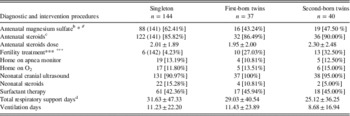
Antenatal and neonatal diagnostic and intervention proceduresFootnote a

Note. Frequencies are reported for discrete data, means and standard deviations for continuous data. Group differences examined via t test (continuous data) and 2×2 χ2 with Yates correction (discrete data), or Fisher exact probability test (<5 cases per cell). In the case of missing data, number of subjects used is provided in parentheses. Ranges and percentages by group are provided in brackets.
a All comparisons between preterm-born singletons and twins.
b Magnesium sulfate, administered to inhibit preterm labor and/or control seizures in preeclampsia.
c Betamethasone, to promote fetal lung maturation.
d Including mechanical ventilation, continuous positive airway pressure (CPAP), nasal cannulae, and oxyhood.
*p<.05, ***p<.001 for comparisons of singleton versus first-born twin group; *** p<.001, # p<.10 for comparisons of singleton versus second-born twin group.
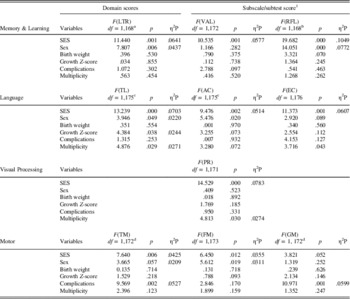
Multiple regression analyses: reduced twin versus singleton group

Note. Memory indices include the Woodcock Johnson - III Tests of Cognitive Abilities (Woodcock, McGrew, & Mather, Reference Woodcock, McGrew and Mather2001) Long Term Retrieval (LTR) cluster score, the Visual Auditory Learning (VAL) and Retrieval Fluency (RFL) subtest scores; language indices include the Preschool Language Scale III (Zimmerman, Steiner & Pond, 1992) Total Language (TL), Auditory Comprehension (AC) and Expressive Communication (EC); visual processing include the WJ-III Tests of Cognitive Abilities Picture Recognition (PR)subtest; motor indices include the Peabody Developmental Motor Scales II (Folio & Fewell, 2000) Fine Motor quotient (FM) and Gross Motor quotient (GM).
a Four multivariate outliers (three with studentized residuals<−3.3 and one with residual=3.66) were removed.
b Two multivariate outliers (studentized residuals<−3.64) were removed.
c A multivariate outlier (studentized residual=−3.78) was removed.
d A multivariate outlier (studentized residual=−5.15) was removed.
1 Bonferroni-corrected α levels (.025) were used to determine statistical significance of associations between predictors and subscale or subtest performance, with familywise adjustments within outcome domains.
As shown in Table 2, the total number of ante-, peri-, and neonatal complications was significantly greater in the singleton group, compared to either the first-, or second-born twin groups. Similar to other reports (e.g., Mizrahi et al., Reference Mizrahi, Furman, Shoham-Vardi, Vardi, Maymon and Mazor1999), these group differences were primarily attributed to a greater number of antenatal complications in singletons, particularly maternal hypertension, membranes ruptured >12 hr, and abnormal vaginal bleed. Inspection of Table 2 also reveals that abnormal presentation at birth was more common in singletons, yet twins were more likely to be born via Cesarean delivery.
Nonetheless, no significant differences were observed in the total number of perinatal complications between singletons and twins. Similarly, although the singletons group was more likely to present with anemia at birth, no significant group differences were observed in the total number of neonatal complications. Table 3 reveals that fertility treatments were characteristic of twin conception, whereas mothers of singletons were more likely to require antepartum magnesium sulfate.
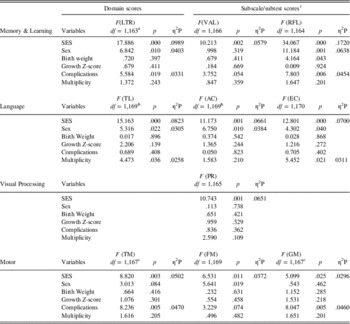
Multiple regression analyses results, using early medical risk and sociodemographic covariates, are reported in Table 4 for the comparison between the singleton and reduced twin group (following random exclusion of a co-twin from the 34 twin pairs comprising our group of 77 twins). Because the predicted Sex by Multiplicity interactions were not significant for either memory (F[1,170]=.028; p=.868), language (F[1,174]=.157; p=.693), or motor (F[1,172]=.003; p=.958) performance, we used the reduced models. Twin boys tended to score lower on the visual processing task, yet the Sex by Multiplicity interaction did not attain statistical significance (F[1,170]=3.527; p<.062).
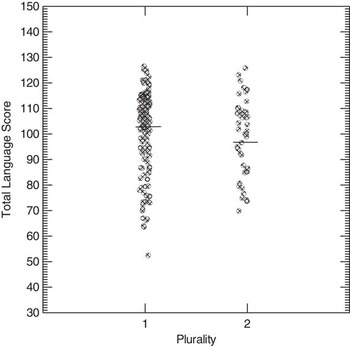
Examination of the relationships between the predictor of interest and the three global scaled scores presented in Table 4 (LTR, TL, and TM) reveals that multiplicity was significantly associated only with global language performance (p=.029). The adjusted means±SE for TL were 97.44±2.34 versus 102.89±1.31 for the twin and singleton groups, respectively (Cohen’s d=.33; see Figure 1), falling well within the Average range. Follow-up univariate analyses disclosed that the relationships between multiplicity and either AC (p=.072) or EC (p=.043) scores did not attain statistical significance following Bonferroni correction (α=.025). The results presented in the table also reveal that, among the perinatal predictors, intrauterine growth (Z-score) was associated with TL performance (p=.038), while the total complications summary score was inversely related to TM performance (p=.002).
Total Language scores by group. Plurality: 1=singletons (n=144) and 2=reduced twin group (n=43). The adjusted means±SE for Total Language score were 97.44±2.34 versus 102.89±1.31 for the twin and singleton groups, respectively (Cohen’s d=.33). Slight random jitter applied to disperse overlapping observations.

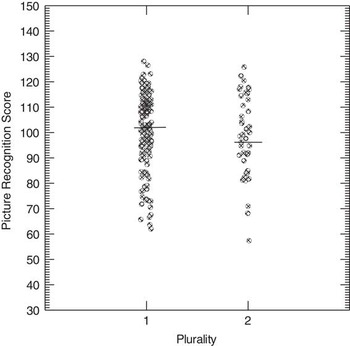
Analyses of visual processing skills reveal a significant association between multiplicity and the PC subtest scores (p=.03; Table 4). The adjusted means±SE were 97.92±2.28 versus 103.69±1.26 (Cohen’s d=.38; see Figure 2) for the twin and singleton groups, respectively, falling well within the Average range. None of the predictors indexing perinatal risk accounted for a significant portion of the variance in visual processing skills.
Picture Recognition subtest scores by group. Plurality: 1=singleton group (n=144) and 2=reduced twin group (n=43). The adjusted means±SE for Picture Recognition score were 97.92±2.28 versus 103.69±1.26 (Cohen’s d=.38) for the twin and singleton groups, respectively (Cohen’s d=.33). Slight random jitter applied to disperse random observations.

Supplemental analyses revealed that addition of fertility treatment as a predictor in our regression model yielded no associations between use of assisted reproductive technology and either TL (F[1,173]=.009; p=.926) or PR (F[1,169]=.045; p=.833) scores. Additionally, a comparison between monochorionic and dichorionic twins in the reduced twin group yielded no significant differences (t[37]=−.352; p=.543 and t[36]=−.658; p=.515 for TL and PC scores, respectively).
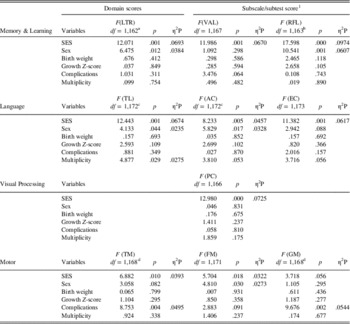
Tables 5 and 6 provide results from comparisons of outcome measures between first-, or second-born twins and singletons, respectively. As shown in these tables, comparisons of overall language performance of either first-, or second-born twins with their singleton counterparts yielded similar findings to those reported for comparisons of singletons with the reduced twin group (Table 4). Multiplicity accounted for TL scores regardless of birth-order (p=.036 and p=.029 for first-, and second-born twins, respectively). In contrast with the findings obtained for the reduced twin group, the differences in visual processing skills between first (Table 5) or second-born (Table 6) twins and their singleton counterparts did not attain statistical significance (p=.109 and p=.175, respectively).
Multiple regression analyses: first-born twin versus singleton group

Note. Memory indices include the Woodcock Johnson - III Tests of Cognitive Abilities (Woodcock, McGrew, & Mather, Reference Woodcock, McGrew and Mather2001). Long Term Retrieval (LTR) cluster score, the Visual Auditory Learning (VAL), and Retrieval Fluency (RFL) subtest scores; language indices include the Preschool Language Scale III (Zimmerman, Steiner & Pond, 1992) Total Language (TL), Auditory Comprehension (AC) and Expressive Communication (EC); visual processing include the WJ-III Tests of Cognitive Abilities Picture Recognition (PR) subtest; motor indices include the Peabody Developmental Motor Scales II (Folio & Fewell, 2000) Fine Motor quotient (FM) and Gross Motor quotient (GM).
a Two multivariate outliers with (studentized residuals=−3.63 and 3.81) were removed.
b A single multivariate outlier (studentized residual=−3.91) was removed.
c A single multivariate outlier (studentized residual=−5.23) was removed.
1 Bonferroni-corrected α levels (.025) were used to determine statistical significance of associations between predictors and subscale or subtest performance, with familywise adjustments within outcome domains.
Multiple regression analyses: second-born twin versus singleton group

Note. Memory indices include the Woodcock Johnson - III Tests of Cognitive Abilities (Woodcock, McGrew, & Mather, Reference Woodcock, McGrew and Mather2001), Long Term Retrieval (LTR) cluster score, the Visual Auditory Learning (VAL) and Retrieval Fluency (RFL) subtest scores; language indices include the Preschool Language Scale III (Zimmerman, Steiner & Pond, 1992) Total Language (TL), Auditory Comprehension (AC) and Expressive Communication (EC); visual processing include the WJ-III Tests of Cognitive Abilities Picture Recognition (PR) subtest; motor indices include the Peabody Developmental Motor Scales II (Folio & Fewell, 2000), Fine Motor quotient (FM), and Gross Motor quotient (GM).
a Two multivariate outliers (three with studentized residuals<−3.64 and one with residual of 3.68) were removed.
b Two multivariate outliers (studentized residuals<−3.64) were removed.
c A multivariate outlier (studentized residual=−3.78) was removed.
d A multivariate outlier (studentized residual=−5.14) was removed.
1 Bonferroni-corrected α levels (.025) were used to determine statistical significance of associations between predictors and subscale or subtest performance, with familywise adjustments within outcome domains.
Supplemental comparisons were conducted between singletons, and either the 34 first-, or second-born co-twins, following exclusion of the nine twins whose co-twin could not be included in our study. Similar to the results presented in Tables 5 and 6, multiplicity accounted for TL performance regardless of birth order (F[1,66]=4.60; p=.033, with adjusted means±SE=96.71±2.64 vs. 103.05±1.28, for first born twins vs. singletons, respectively [Cohen’s d=.40] and F [1, 66]=8.80; p=.003 with adjusted means±SE=94.22±2.63 vs. 102.96±1.28, for second-born twins vs. singletons, respectively [Cohen’s d=.56]). However, with α adjustment (.025), only the second-, but not first-born, twins differed from singletons in global language outcome (TL scores). Additional comparisons of PR subtest scores between 136 singletons and either 31 first-born, or their second-born, co-twins who completed this subtest yielded similar findings to those reported in Table 5 (F[1,160]=2.42; p=.12) and Table 6 (F[1,160]=3.44; p=.066), respectively.
Among sociodemographic covariates, SES was significantly associated with performance in all four outcome domains (Tables 4–6) with the single exception of a trend for an association with GM performance in second-born twins (p<.056; Table 6). Significant associations were also observed between sex and both global memory and language performance (all p levels<.05; Tables 4–6), with girls outperforming boys.
DISCUSSION
We compared the neuropsychological functioning of preterm twins and singletons at preschool age on memory, language, visual processing, and motor tasks. In addition to socioeconomic advantage, the twin group was characterized by reduced early medical risk compared to singletons. An increase in the frequency of various maternal complications in singletons, compared to twins, has also been observed in population studies of very preterm cohorts (e.g., Bodeau-livinec et al., Reference Bodeau-Livinec, Zeitlin, Blondel, Arnaud, Fresson and Burguet2013; Papiernik et al., Reference Papiernik, Zeitlin, Delmas, Blondel, Kunzel, Cuttini and Draper2010). If anything, higher familial SES coupled with reduced medical risk in our multiples may have only served to dilute the group differences observed here.
Nonetheless, neuropsychological assessment at preschool age revealed that, despite reduced social and biological risk, the twin group did not fare better in comparison to their singleton counterparts. Overall language performance was found to be significantly poorer in twins, with group differences of .33 SDs. Twins also exhibited reduced visual-spatial skills, with group differences of .38 SDs. In contrast with sporadic reports in the twin development literature (Gucuyener et al., Reference Gucuyener, Arhan, Soysal, Ergenekon, Turan, Onal and Atalay2011; Thorpe, Reference Thorpe2006), we found little evidence of a male-twin disadvantage either for language or other outcome domains, as indicated by the absence of significant Multiplicity by Sex interaction effects.
Notwithstanding the increase in the proportion of twins within the population of premature infants, few surfactant-era studies have been dedicated to the examination of the unique contribution of multiplicity to neuropsychological functioning at preschool or school age. Einaudi et al. (Reference Einaudi, Busuttil, Monnier, Chanus, Palix and Gire2008) were unable to demonstrate differences between 23 twins and 31 singletons, born<32 weeks gestation, in the frequency of either “comprehensive retardation” or language delay. In contrast, Bodeau-Livinec and the EPIPAGE group (Reference Bodeau-Livinec, Zeitlin, Blondel, Arnaud, Fresson and Burguet2013) were able to show a small difference of 2.4 points on the Mental Processing Composite (Kaufman Assessment Battery for Children, Reference Kaufman1983), in favor of singletons, following adjustment for socioeconomic and early medical risk.
Our findings of mild language and visual processing deficits in preterm-born twins are consistent with the results reported by the EPIPAGE group. Of interest, second- but not first-born twins’ total language scores significantly differed from those of singletons in our supplemental analyses of the 34 pairs of twins. However, group differences approximated or equaled a moderate effect size in both comparisons (Cohen’s d=.56 and .40, respectively) and the relatively small number of cases per group constrained our ability to establish a birth-order effect.
A group of environmental conditions that may explain differences in language development between singletons and twins are twinning-specific phenomena (e.g., TTTS or private language; Thorpe, Reference Thorpe2006). While the “private language” explanation cannot be completely discounted based on our findings, the co-existing relative deficit in visual processing skills, observed in the reduced twin group, mitigates against “private language” explanations of the mild to moderate (Cohen’s d=.33–.56 ) language gaps documented here. An adverse early biological factor specific to twinning could also not be easily negated by our findings. TTTS of different grades of severity (Rychik et al., Reference Rychik, Tian, Bebbington, Xu, McCann, Mann and Johnson2007) and several other unique complications, also attributed to presence of placental vascular anastomoses, are phenomena occurring in complicated monochorionic twin pregnancies (Moldenhauer & Johnson, 2015).
Our analyses revealed that the differences observed in language skills were likely not linked to type of placentation in our twin group, nor were they attributable to the three cases with TTTS whose language scores fell well within or above the average range. We should note here that the current investigation was not designed to evaluate outcome effects of placentation or fertility treatment, as only ten (23.6%) monochorionic and thirteen (30.23%) ART cases were available for study in the reduced twin group.
Another group of conditions that may account for performance deficits in twins are adverse pre- and perinatal events not specific to twinning. In the current study, we documented a multitude of discrete perinatal complications and attempted to account for early biological risk. Indeed, the sum of pre-, peri-, and neonatal complications explained a significant portion of the variance in motor performance, while adequacy of intrauterine growth accounted for variance in language skills (Table 4). Nonetheless, multiplicity explained a unique portion of variance in language and visual processing skills, over and above the variance associated with early medical risk.
Despite our efforts, we cannot exclude the possibility that an undocumented early biological risk factor, whether unique to twinning or simply more common in twins, accounts for the statistically significant, albeit relatively modest, language and visual processing skill disadvantage observed in twins. Indeed, detection of an early biological risk factor explaining the language gap observed here would be consistent with the claim that the perinatal environment (which is overwhelmingly biological) affects linguistic development more than the postnatal environment (which is preponderantly psychosocial; Stromwold, Reference Stromwold2006).
Our findings should be viewed as applicable primarily to middle class families, as generalizability to lower strata was traded-off for higher internal validity. Lower SES is typically associated with reduced access to prenatal care, fewer socio-educational or therapeutic opportunities during infancy and the preschool years, and increased exposure to a variety of environmental insults. Adverse circumstances, in turn, may increase the heterogeneity of the sample and introduce variance that may confound or dilute the effects of multiple birth and perinatal complications on neuropsychological functioning.
Our perinatal data were collected retrospectively, and our investigation was cross-sectional, with participants’ average age of approximately 5 years. It is yet to be determined whether the findings are generalizable to younger preschoolers or to the elementary school years and beyond. A longitudinal investigation will facilitate exploration of age-related effects of multiplicity on neuropsychological outcome domains in children born prematurely. In accord with a recent report of age-related decline in language performance in preterm children (Stolt et al., Reference Stolt, Matomaki, Lind, Lapinleimu, Haataja and Lehtonen2014), it is possible that multiplicity contributes a share to these phenomena. For instance, multiplicity may “exert” negligible developmental outcome effects in infancy that evolve into modest to moderate effects in late preschool age and larger effects in the primary and middle school years.
To conclude, the findings from this investigation suggest that preterm-born twins are at somewhat higher risk for language and visuospatial skill deficits at preschool age compared to their singleton counterparts, possibly a result of biological factors. Early detection, accompanied by interventions such as language therapy and reinforcement of preacademic skills, is essential for preterm-born multiples, yet will likely benefit both at-risk groups. In addition to investigating age-related effects, neuropsychological functions other than those examined in the current study (e.g., executive) should be studied in preterm twins and singletons, as they may prove to be more sensitive to adverse effects of twinning.
Acknowledgments
The authors thank Elizabeth Kring, Tammy Swails, Amanda Shoemaker, Jacquie Perry, and Sarah Meachen for their help in data collection. The study was funded in part by the Merrill-Palmer Skillman Institute. None of the authors has a known conflict of interest concerning this manuscript.