1. Introduction
1.1. Overview
The primary design impetus at the genesis of modular synthesisers was to enable some of the possibilities of tape music to be undertaken in real time. Conceived amid a growing interest in improvisation and indeterminacy, these instruments were designed to enable musical structures to be formed and performed with an immediacy that was previously unachievable in electronic music. As smaller, keyboard-based synthesiser instruments achieved broad commercial success, many of the possibilities for the real-time creation and manipulation of musical structures developed in the larger modular synthesiser designs were not carried forward into the new age of commercial electronic music instruments. The contemporary resurgence of the modular synthesiser has seen these possibilities for improvisation of musical structure revisited, opening up processes and approaches that were almost lost to a new generation.
1.2. Method and delineations
This article sets out to illustrate that the key initial intentions of the earliest modular synthesiser designs were to enable and improve the possibilities for real-time and improvised electronic music composition or performance, and then to link these intentions to contemporary and historic use of modular synthesisers through three case studies. Section 2 focuses upon the initial emergence of commercially manufactured modular synthesisers in the 1960s. Section 3 describes and discusses three case studies, two of which are based upon interviews with artists while the other focuses upon my own work through reflective practice (Schön Reference Schön1983). Section 4 offers a discussion of the modular synthesiser as an instrument that enables real-time improvisation of musical structure.
As articulated by Curtis Roads, the term ‘structure’ is used throughout this article to refer to the arrangement of elements in music at various scales of time (Roads Reference Roads2004, Reference Roads2015: 285). While approaches such as musique concrète or indeterminacy may deprivilege or resist the planning or premeditation of a particular structure in comparison to other approaches such as serialism, both methods result in a form of musical structure or narrative in the eventual performance or recording that can be perceived by listeners (Roads Reference Roads2015: 295). Throughout this article I work with this definition of musical structure as an inevitable outcome of the process of making music, whether that process is premeditated, improvised or procedural (ibid.: 284).
1.3. History and lineage of modular synthesisers
Historical overviews of the development of electronic music in the twentieth century typically discuss the development and use of significant instrument designs such as the Telharmonium, the Theremin, the Trautonium, the Ondes Martenot, the Melochord and the Electronic Sackbut (Manning, Reference Manning2013; Holmes, Reference Holmes2015), rightly bringing a focus to these instruments’ historic use, attributes, technical limitations and stated design intentions. As a result, a perception can emerge that assumes a sort of linear linking in these designs, where each instrument extends or diverts from the intentions or capabilities of earlier instruments. To guard against the risk of incorporating any assumptions as to the genesis of the modular synthesiser, I have focused upon the influences and design intentions that can be verified through primary sources and literature.
For the purposes of this article, a modular synthesiser is defined as an electronic musical instrument having three principal features: (1) multiple independent components that can be configured together in a range of ways; (2) the use of a method of voltage control; (3) the creation or modification of sound in real time (Pinch and Trocco Reference Pinch and Trocco1998: 13, Reference Pinch and Trocco2004 28; Elsea Reference Elsea2013: 209; Dalgleish Reference Dalgleish2016). It is generally accepted that Harold Bode built and documented the earliest example of a modular synthesiser (Bode Reference Bode1961; Manning Reference Manning2013: 101; Dalgleish Reference Dalgleish2016), incorporating both voltage control and modularity of components to enable real-time processes. The first use of voltage control in a musical context is generally attributed to Hugh Le Caine (Holmes Reference Holmes2015: 165), while both voltage control and the flexible interconnection of discrete modules were already key features of many analogue computers that were widely used in the military for fire control in the 1940s, and more generalised engineering and scientific applications in the 1950s and 1960s (Bode Reference Bode1961: 3; Small Reference Small2001: 68).
Robert Moog and Don Buchla are credited with developing the first commercial modular synthesisers at roughly the same time, between 1963 and 1965 (Pinch and Trocco Reference Pinch and Trocco2004: 32; Bernstein Reference Bernstein2008: 167). The influence of these instruments upon subsequent modular or semi-modular Footnote 1 synthesiser designs developed by other companies in the 1970s, such as EMS, EMU, ARP, Serge and Roland, is evident in both their design and functionality. In turn many contemporary modular synthesiser designs clearly draw upon these earlier models, including the Doepfer A-100 modular synthesiser (Ableton n.d.), launched in 1996 (Vail Reference Vail2014: 271), which established the now dominant Eurorack format. I have therefore focused in Section 2 upon the design intentions at the genesis of the Moog and Buchla instruments.
2. At the intersection of tape music and improvisation
2.1. Coming from tape music
In the field of electronic music, tape music can be distinguished from the long history of electronic musical instruments leading back to the musical performance devices of the 1920s such as the Theremin and the Ondes Martenot. The term ‘tape music’ here refers to music composed using disc or tape recorders and performed or played back from a fixed recording medium. Electronic music in the post-Second World War setting was almost inseparable from tape recording technology (Mumma Reference Mumma1964: 240; Chadabe Reference Chadabe1997: 63–80; Powers Reference Powers1997: 82; Manning Reference Manning2013: 19–98; Holmes Reference Holmes2015: 119–40). The majority of electronic music produced from 1948 to the advent of synthesisers in the early 1960s was created using ‘classical’ tape-based techniques including recording and often intricate tape splicing to construct compositions (Powers Reference Powers1997: 82).
Musique concrète approaches championed by Pierre Schaeffer and other composers working at the Radiodiffusion-Télévision Française (RTF) studio may seem an exemplar of tape music in this period due to the emphasis upon arrangement of recorded acoustic sources. However, the elektronische Musik approaches undertaken by composers working at the Westdeutscher Rundfunk Köln (WDR) studios were equally reliant upon tape-based studio techniques of intricately splicing, mixing and re-recording in order to structure compositions from waveforms produced by test oscillators (Le Caine Reference Le Caine1956: 475–6). The oscillators available at the time were not designed for musical use, but rather as electronic calibration tools that could be set to a specific frequency manually, with no options for external or automated control (Powers Reference Powers1997: 134). These tape-music processes did not occur in real time, instead taking long periods of time in a studio to complete works of a significant length (ibid.: 83; Hanson Reference Hanson2010: 18).
By the early 1960s many other electronic music studios centred around tape-based processes had been established in addition to the Groupe de Recherches Musicales (GRM) in Paris and WDR in Cologne, including the Institute for Psychoacoustics and Electronic Music (IPEM) in Ghent, Studio for Electronic Music (STEM) based in Utrecht, Columbia-Princeton Electronic Music Center in New York, Experimental Music Studios at the University of Illinois, Experimental Music Studios at the University of Toronto (Schaeffer Reference Schaeffer1963) and many more. In addition to the larger public and university-based studios, private facilities began to be established by individuals and collectives, including Robert Ashley’s Cooperative Studio for Electronic Music (Mumma Reference Mumma1964) in Ann Arbor, Louis and Bebe Barron’s studio in New York (Powers Reference Powers1997) and the San Francisco Tape Music Studio (Bernstein Reference Bernstein2008).
Over this same period, interest in improvisation in the composition and performance of electronic music was building (Holmes Reference Holmes2015); however, classical tape processes do not easily lend themselves to real-time performance and improvisation.
The instrument designer Harold Bode is generally credited with the invention of modular synthesisers, a fact documented in his 1961 article published in the trade journal Electronics (Bode Reference Bode1961) where he describes a ‘synthesiser’ apparatus that utilises voltage control to connect distinct components. He describes his synthesiser as offering ‘immediate processing’ of sounds and situates this in contrast to ‘intermediate’ processes where ‘the composer-performer cannot immediately hear or judge his performance, therefore corrections can be made only after some lapse of time’ (ibid.). Bode cites the use of punch tape, most likely a reference to the RCA Synthesizers (Manning Reference Manning2013: 93), and magnetic tape compositions as examples of ‘intermediate process’.
Bode’s design incorporated a tape loop device with a record head and three playback heads (Bode Reference Bode1961). Throughout the article he describes potential uses of the instrument, situating the tape loop device as a core component of the instrument. This integration of a tape loop into the device and its intended functionality sits awkwardly with common understandings of a synthesiser as a generator of signals and conceptually separate to recording devices, but this confluence of tape and modular synthesiser is not exclusive to Bode.
2.2. Driven by improvisation
In 1961, Pauline Oliveros, Terry Riley and Ramon Sender began to organise the Sonics concert series in San Francisco, later joined by Morton Subotnick. The concerts featured presentations of tape works alongside improvised group performances (Bernstein Reference Bernstein2008: 10). Establishing the San Francisco Tape Music Center (SFTMC) in 1962 (Bernstein Reference Bernstein2008), the members’ key interests of electronic music and improvised performance formed a contradiction they sought to resolve.
Deeply interested in improvisation and the role of listening in performance (Holmes Reference Holmes2015), Oliveros developed a range of techniques that allowed her to create tape music in real time, hearing the results in real time (Powers Reference Powers1997: 109; Oliveros Reference Oliveros2015: 39; Gordon Reference Gordon2018: 147). Oliveros’s interests in working with tape in real time and improvising electronic music were driven by her enthusiasm for listening as a critical component of performing. By hearing the music in real time, she found that subtle variations could be performed and perceived (Holmes Reference Holmes2015; Gordon Reference Gordon2018: 147). Oliveros organised ‘Tudorfest’ in 1964; the festival, named for David Tudor and featuring him as a performer and composer, was focused upon live performance of electronic music (Gordon Reference Gordon2018: 170).
Similarly, Ramon Sender was also exploring possibilities for improvisation in relation to tape music, experimenting with a Chamberlin, a keyboard instrument that used multiple strips of tape and multiple read heads to reproduce pre-recorded sounds (ibid.: 239). Sender had hoped to achieve playback of custom tapes and to enable musique concrète techniques to be undertaken in real time. These motivations led to the engagement of Donald Buchla by Sender and Subotnick to develop a new electronic instrument for the SFTMC (Bernstein Reference Bernstein2008: 166).
2.3. Buchla tape controller
Envisaged as a means to reduce the labour involved in splicing tape and enable real-time improvisation of electronic music (Pinch and Trocco Reference Pinch and Trocco2004: 23–36; Bernstein Reference Bernstein2008: 165 Hanson Reference Hanson2010: 19), the first Buchla Music Box, delivered in 1965 (Bernstein Reference Bernstein2008: 167), came well equipped to generate musical structures with three separate sequencing modules, each with as many as 16 steps (Subotnick Reference Subotnick2020). Morton Subotnick has described compositional techniques using the Buchla 100 that enabled complex rhythms to be generated, looping over long periods of time by combining the various sequencers at odd, differing lengths, or applying voltage from other sources such as function generators to adjust the timing of a pulse generator (Vail Reference Vail2000: 107; Subotnick Reference Subotnick2020).
The relationship of the Buchla 100 to tape practice extends beyond this conceptual instigation to technical designs that enabled integration with tape, allowing for amplitude control via the Buchla’s mixer and touch plate controller (Subotnick Reference Subotnick2020). Buchla had previously made a 10-note keyboard which ‘everybody thought was because we have ten fingers, but it was because we had ten Viking loop decks. The finger pressure was in order to be able to do musique concrete and to control the amplitude on the Viking loop machines’ (Bernstein Reference Bernstein2008: 166). The Viking loop decks used a Fidelipac format cartridge that would play a looping section of tape (Morton Reference Morton2006: 158). Subotnick later developed a technique that inverted this relationship to enable tape to control the Buchla’s parameters using recordings of his voice processed through envelope followers to produce control voltage (CV) signals (Hanson Reference Hanson2010: 26). This process enabled Subotnick to not only enact expressive control through the energy of his voice but also create the possibility of precise control of parameters, perhaps ironically, through tape-splicing techniques.
Real-time interaction and performance was also a priority for the earliest Buchla designs, including components such as the Model 112 that incorporated touch plates to translate pressure (or more accurately surface area and skin conductivity) into voltage levels and select preset voltage stages, or the Model 114 that also used touchplates to generate gate signals and distribute CV. Donald Buchla continued to innovate and develop new interfaces for musical instruments, including the Thunder and Lightning MIDI controllers in the early 90s (Chadabe Reference Chadabe1997: 227–8).
2.4. Moog connections to tape
Robert Moog’s development of the Moog synthesiser, simultaneous to Donald Buchla (Pinch and Trocco Reference Pinch and Trocco2004: 32), is similarly linked to tape practice through Moog’s association with the composer Herb Deutsch, an encounter that initiated the process of designing and prototyping what was to become the Moog synthesiser (ibid.: 23). Akin to the desires of Sender, Subotnick and Oliveros, Deutsch was also seeking a more dynamic and direct relationship with electronic music-making than the classical tape studio techniques allowed. While the development path of the Moog eventually took various turns towards the traditional instrumentality of the standard music keyboard, composers still used Moog components to manipulate tape, as evidenced by Vladimir Ussachevsky’s employment of a specially commissioned envelope by Moog to enable amplitude contouring of recorded sounds (Pinch Reference Pinch and Selinger2006: 57).
2.5. Relation to indeterminacy
Composers involved in the SFTMC experimented with various methods of indeterminacy in both composition and performance (Bernstein Reference Bernstein2008: 12–14) and presented performances and works by both John Cage and David Tudor (Pinch and Trocco Reference Pinch and Trocco2004: 37). Similar to improvisation, indeterminate approaches to composition raised potential issues for classical tape-based processes; Cage’s desire to decouple performance from composition through chance operations was largely incompatible with tape music as a final output (Holmes Reference Holmes2015: 90). Cage differentiated between processes of indeterminacy invoked in the composition of a piece and compositions that situate the performers as agents of indeterminacy (Cox and Warner Reference Cox and Warner2004: 176–86). Given the keen interest in the work of Cage and Tudor and indeterminacy more broadly at the SFTMC, it is no surprise that the first Buchla design included components that enabled indeterminacy to be embedded within a patch design.
Present in the first Buchla instrument, the Model 165 Dual Random Voltage Source module (Powers Reference Powers1997: 279; Hernandez Reference Hernandez2017: 13) incorporated a pair of sample and hold circuits, each combined with a noise source. Donald Buchla developed these concepts further in 1969 with the Model 265 Source of Uncertainty (Pinch and Trocco Reference Pinch and Trocco2004: 47) and later the Model 266 incorporating shift register style circuits and offering a range of randomised and slewed voltage outputs (Hernandez Reference Hernandez2017: 14). These modules enabled any parameter of the Buchla to be randomised, allowing for compositional systems to be created that would never repeat themselves. By situating chance operations within the device itself, the Buchla enabled indeterminate compositional approaches through patching to be embedded in the instrument itself, so that a live performance or improvisation could operate with and against indeterminate processes in real time.
2.6. Competing conceptions
A variety of opinions and pressures influenced the design of the earliest modular synthesisers, pushing towards and away from aligning this new tool with recognisable attributes of a traditional instrument. Moog was in contact with and consulted with a range of musicians and composers as the Moog modular was developed and expanded upon (Pinch and Trocco Reference Pinch and Trocco2004). Herb Deutsch, who had initiated the development of the Moog modular as a ‘portable electronic music studio’ (ibid.: 22), also encouraged Moog to incorporate an organ-style keyboard as a control interface (ibid.: 27–59; Pinch Reference Pinch and Selinger2006: 55), while the composer Vladimir Ussachevsky and Moog’s own employee Jon Weiss opposed the inclusion of a keyboard (Pinch and Trocco Reference Pinch and Trocco2004: 3–60). These conversations continued and ultimately proponents of the keyboard interface, including Walter Sear, Eric Siday and Wendy Carlos (ibid.: 57–60), won the day.
In the case of the Buchla, when its design and construction were commissioned by Ramon Sender and Morton Subotnick, the design of the instrument was mapped out over the course of a year before funds were even sought for its construction (Subotnick Reference Subotnick2020). Through this process the idea of a keyboard interface was also raised, as Sender unsuccessfully argued for the inclusion of a keyboard as the primary interface (Bernstein Reference Bernstein2008: 166). Both Subotnick and Buchla opposed the inclusion of a traditional keyboard (Pinch and Trocco Reference Pinch and Trocco2004: 44) and while they agreed that the instrument was a means to break away from existing forms and processes of music, they were not on the same page regarding more nuanced intentions. Buchla was concerned with its potential as a performable instrument (Frosty 2016; Friedlander Reference Friedlander2017) and he went on to continue this exploration with unique forms of MIDI control devices such as his Lightning wand design. Subotnick, on the other hand, viewed the Buchla instrument as a studio tool that interacted directly with tape:
the process had to be that of a studio artist, not of a musician, playing an instrument and, recording it and overdubbing and things like that. It had to be a process that went directly onto the tape. And so in some way, the tape was the medium and the record players were for the reproduction. (Subotnick Reference Subotnick2020)
2.7. A new instrument
The development of the modular synthesiser out of tape music practices implies that some of the earliest intentions for the development of the modular synthesiser, as expressed and advocated for by key figures including Buchla, Subotnick, Deutsch, Ussachevsky and Weiss, situate its role to be more closely akin to that of contemporary digital audio workstations (DAW), or sampler/sequencer combinations such as the Akai MPC2000 or Elektron Octatrack, rather than a dedicated tonal instrument such as the organ or piano. The intersections with interests in indeterminacy and improvisation in the 1960s suggest an instrument initially designed to shift the structural possibilities of tape music, essentially electronic music as it was then known, into a real-time practice.
Modular synthesisers and their fixed architecture descendants became popularly associated with keyboards as their primary interface due to a range of factors, including the commercial viability of the keyboard as an easily understood interface and metaphor (Dalgleish Reference Dalgleish2016), the encouragement of Moog by some composers and musicians to incorporate a keyboard (Pinch and Trocco Reference Pinch and Trocco2004) and the impact of the Wendy Carlos album Switched on Bach (ibid.).
In the 1970s, modular synthesisers began to fall into decline due to the introduction of smaller, less expensive instruments such as the Moog Minimoog D and the ARP Odyssey (Paradiso Reference Paradiso2017: 1). These new instruments largely retained the sound-generating properties of their larger predecessors but introduced a fixed architecture and included a keyboard as a standard interface (Dalgleish Reference Dalgleish2016), losing much of the possibility for generating and manipulating musical structure (White Reference White2019: 6).
3. Examples of practice
The modular synthesiser seemingly evolved into the keyboard-orientated synthesiser and a discussion of the design intentions at its genesis might have remained a purely historical concern. However the resurgence of modular synthesisers over the past decade encourages consideration of those early conceptualisations in relation to contemporary modular synthesiser practice.
Three examples of practice are described and analysed in the following. The first, Morton Subotnick’s Silver Apples of the Moon, is included to establish and emphasise the dual roles of improvisation and generation of structure in arguably the earliest release of music made with a modular synthesiser. The example draws upon available sources and literature both historic and recent, alongside an interview I conducted with Subotnick in September 2020.
The second example is Zac Wiffen, a musician who works with modular synthesisers in a contemporary context. The example of practice described is drawn from an interview I conducted in March 2020, using a combination of semi-structured (Thyer Reference Thyer2011: 308–19) questioning and contextual inquiry, a design research method that situates the interviewee with the object or tool or interest, asking them to demonstrate the work flows and actions they describe (Holtzblatt and Beyer Reference Holtzblatt and Beyer2016). Through a process of observing the activity first hand and probing the subject about their actions, the researcher can access information about the process that may be missed in an abstracted summarisation, such as visible emotional responses, interactions with the broader environment, decision-making processes and the motivations behind them (ibid.).
The third example is drawn from my own practice: Transductions (White Reference White2020), an album recorded in 2019 and released in 2020 on the Room 40 label, using a process of reflective practice (Schön Reference Schön1983) to consider my own processes, intentions and experience of working with a modular synthesiser as a compositional tool.
The latter two examples are described and analysed in order to establish that the possibilities for developing structure in the context of improvisation are key components for some contemporary modular synthesiser-based musicians. All three examples also offer a more specific and detailed insight into how these processes might be enacted in practice.
3.1. Morton Subotnick: Silver Apples of the Moon
Recorded over 13 months while Subotnick was artist-in-residence at New York University from 1965 to 1966 (Subotnick Reference Subotnick2020), Silver Apples of the Moon, released in 1967 on Nonesuch Records, was a groundbreaking work exemplifying the possibilities of the Buchla instrument (Hanson Reference Hanson2010: 22).
Subotnick’s work was destined for the LP record format, which he viewed as a sort of new chamber music (Roads and Subotnick Reference Roads and Subotnick1988: 13), even envisaging that the listener would have agency to ‘perform’ the piece by changing the speed of the record, panning or even manually adjusting the position of the needle (Hanson Reference Hanson2010: 22; Subotnick Reference Subotnick2020). While Subotnick was not considering an eventual live performance of the piece, the creative process was hands-on and improvised.
Subotnick was mindful that he was using a new instrument; he was determined to avoid recreating existing musical forms and instead sought to create music that took advantage of the new possibilities the instrument offered. Subotnick started the process by experimenting with the possibilities for discrete pitch events and interpolated pitch events, later expanding his explorations to rhythmic experimentation. Once an idea was patched, he would then record a short section, modify the patch and record again, until a 40-minute tape reel was full, with leader tape in between each section.
Using a second tape player and a mixer, he would then perform a patch live, working with the pre-recorded material as a partner, recording them both to a new tape (Subotnick Reference Subotnick2020). The Buchla instrument Subotnick worked with in New York included a 10-stage touch plate controller module (Miller Reference Miller2016; Subotnick Reference Subotnick2020), enabling Subotnick to perform precise changes in real time using finger pressure, or more correctly, conductivity of skin surface area, to shape parameters through gesture (Gluck Reference Gluck2012: 67) in addition to direct manual manipulation of parameters.
Subotnick describes side A of the record as being constructed from short contrasting sections, concerned with pitch, each having been recorded separately:
I decided to make a series of these things that were pitch-based things. And it would be like the whole record on the first side with pitch would be like a trip where you are on a train where you fall asleep, then you wake up and look out the window and you’re in the middle of a jungle and you go to sleep and you’ll wake up and you’re in the middle of a desert. (Subotnick Reference Subotnick2020)
Most of the 13 months it took to create Silver Apple of the Moon were spent recording the first side; side B of the record was completed in only two months using an entirely different approach. Subotnick focused upon rhythm and recorded long sections with a single patch over a six-week period (Subotnick Reference Subotnick2020), working with multiple sequencing modules: two Model 146 Sequential Voltage Source modules with up to 16 stages and a single Model 123 with eight stages. Each step on these sequencers was able to control three parameters; in the process of designing the Buchla instrument, it had been decided that three parameters would be sufficient as this allowed for timing, pitch and volume to be defined at each step. Later Subotnick regretted this decision as he realised that he would also like to control various aspects of timbre in this way; it was this realisation that led him to specify two 16-step sequencers for the model he brought to New York (Subotnick Reference Subotnick2020).
Subotnick describes a process of adding voltage outputs, with the sequencing modules running at odd lengths such as 15 stages on one and 11 stages on the other to create long evolving sequences on the second side of the record (Roads and Subotnick Reference Roads and Subotnick1988: 12; Subotnick 2017, Reference Subotnick2020). Alongside these long, evolving melodies, the eight-step sequencer was used to create the ostinato phrase that dominates much of the second side. Each of the sequencers was driven by the same pulse or clock source (Subotnick Reference Subotnick2020).
Unable to synchronise the longer takes together, he layered performances of shorter rhythmic passages and single notes over the top. Subotnick highlighted the importance of real-time performance with the Buchla in our interview:
And so I would take … whatever I wanted to do, like a tudeedum … and when I got to the dee of the tudeedum, I would wiggle a little thing and it would go TUDdeeDUM TUDdeeDUM or put FM to it and put my finger and the amount of pressure would be the amplitude of it – so, tududadom a PREEEdum. So I was just playing … and just recording them. (Subotnick Reference Subotnick2020)
This quote demonstrates the importance of improvised creation of musical phrases as structural elements, both for the design of the Buchla and for Subotnick’s intentions as a composer. The possibilities for real-time, improvised interaction with the instrument, integrated with the musical structure-building aspects of the instrument, are central to Subotnick’s account of his compositional processes and the genesis of the Buchla synthesiser.
3.2. Zac Wiffen: indeterminacy strategy
Zac Wiffen is a Sydney-based musician who works extensively with modular synthesisers. Consisting of a variety of contemporary modules from a range of manufacturers, Wiffen’s instrument typifies the potential of the Eurorack modular format that now boasts thousands of modules from hundreds of manufacturers, drawing upon both the histories of modular synthesiser design and the potential of more recent digital and software-based approaches.
Wiffen has described his intention to generate patterns of voltage and gate signals that could be applied melodically to oscillators or other audible parameters, but then to be able to capture, manipulate and iterate these patterns both to his own taste and as a strategy for musical structure (Wiffen Reference Wiffen2020).
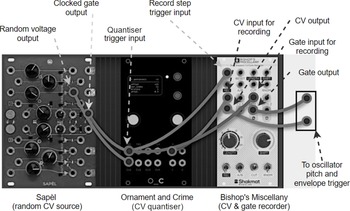
Wiffen described using a Sapèl Footnote 2 module by Frap Tools (Sapèl – Tamed Random Source n.d.) to produce two channels of random gates and two channels of random CV that are then fed via a quantiser (ornament & crime n.d.) into a Bishop’s Miscellany module by the Shakmat Modular (Shakmat Modular n.d.) that can record and play back up to two channels each of gates and CV into a maximum of 32 steps (Figure 1). The Sapèl is also used to provide a regular clock signal to the Bishop’s Miscellany so that the two devices are tightly synced together. The Bishop’s Miscellany is then able to play back these recordings of CV and gate signals through its own outputs, which Wiffen patches to control the pitch of two oscillators and trigger envelopes that shape the amplitude of each oscillator. This system enables Wiffen to capture and loop the random material generated by Sapèl, and then shift the section and length of the playback. New recorded material can be added incrementally by enabling ‘Record’ again, in the same way that ‘punch-in recording’ can be used in a DAW or tape recorder.
Detail of Wiffen’s indeterminacy strategy: in this patch the Bishop’s Miscellany module allows sequences of quantised CV and gate signals to be captured and replayed, thus allowing repetition of meso-scale musical structures.

In more complex patches Wiffen automates the selection of loop length, pattern start and pattern reset of the Bishop’s Miscellany using clock dividers, Euclidian clocks and low frequency oscillators (LFO) to create complex patterns that only repeat over a longer period of time but even morph slowly via automated control of the record function. This system enables Wiffen to quickly generate melodic and rhythmic structure that he can then manipulate, replace or mutate gradually.
Wiffen has little influence over the material generated by the Sapèl module but regains control as it is captured and played back by the Bishop’s Miscellany module. The repetition of the looping material enables more conventional conceptions of musical structure to be constructed in real time; Wiffen is able to improvise at this structural level, either through direct manipulation of the modules or through more complex systems of CV control.
3.3. Alex White: Transductions
My album Transductions (White Reference White2020) (Sound Example 1) was recorded in 2019 using a Disklavier Footnote 3 and a Eurorack modular synthesiser to produce the MIDI data. I undertook this approach in an attempt to reduce some of my approaches to electronic music down to a simpler form, retaining the structures and systems but swapping the expansive tone colour possibilities of a synthesiser for the timbre range of an acoustic piano. The pieces are all single-take recordings of improvisations.
3.3.1. Technical description
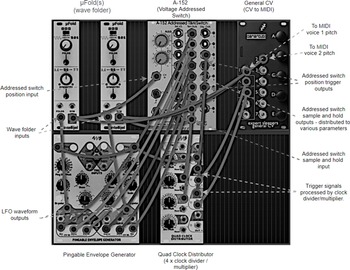
MIDI data was converted from CV using a General CV module by Expert Sleepers (Expert Sleepers n.d.). The patch used in the compositions is centred on two synced CV signals produced by a pingable envelope generator (PEG) designed by 4MS (4ms PEG n.d.), operating in a looping mode; the module essentially functions in this case as a dual complex LFO (Figure 2). The speed of each CV signal output is dependent upon clock signal inputs; using built-in clock dividers and trigger resets, the output signals can form phased or otherwise correlated relationships.
Detail of Transductions patch: in this patch synchronised looping envelopes (LFO) signals are distorted by wave folders and the resulting waveforms produce MIDI gate and pitch information, and are fed back to control the patch. The resulting unstable system enables perceptible melodic and rhythmic structures to be generated and then transitions into more chaotic behaviour.

Output signals from the PEG are then each fed to an Intellijel µFold (intellijel n.d.) module, which distorts the waveform of each signal by folding and skewing the waveform. Each of these distorted waveforms is then fed to a Doepfer A152 (A-152 Voltage Addressed Switch n.d.), an eight-stage switch linked to eight sample and hold circuits that will accept a CV signal to select the current stage. One of the PEG signals is used to feed the inputs of the sample and hold circuits, while the other controls the stage selection.
The eight sample and hold outputs from the A-152 are then used to control a range of parameters of the patch, including the shape of each of the waveforms produced by the PEG, the speed of other clock dividers that trigger or reset the PEG and the parameters of the wave folders. The inputs to the eight switches of the A-152 are then fed with the distorted and clean waveforms from the PEG. The resulting system is complex, essentially feeding back upon itself to create unpredictable and chaotic results (Slater Reference Slater1998: 12).
Two independent MIDI voices are generated by the General CV module; pitch is derived from the two distorted waveform signals originating from the two PEGs, note-on signals are sourced from gates produced by the A-152 and then processed by clock dividers (4ms QCD n.d.). A software-based MIDI pitch quantiser is then used to shift the resulting MIDI notes into various scales for each piece. The patch is then performed by interacting with various parameters, intervening between connected components to adjust the level of variation caused by the patch configuration.
3.3.2. Reflection and analysis
The patch used to create Transductions causes subtle variations to result in potentially drastic shifts in rhythm, melody and dynamics. No random voltage sources were used and so while the outcomes of any interventions were unpredictable and chaotic, once the change had occurred the system would settle into a sort of stability. Depending on the speed of the two waveforms driving the system, repetitions or partial repetitions would take up to 20 seconds or even several minutes if the two waveforms were phasing at odd or unsynced reset triggers. This stability enabled me to learn the resulting instrument, building a conceptual map of its possibilities so that I could interact and respond intentionally despite the complexity of the patch’s configuration.
On the Transductions album, the sixth track, titled ‘Palm Pushed Against Cold Metal Handrail on Stairway’ Footnote 4 (Sound Example 1), provides an example of repetition, partial repetition and various distortions and disintegrations of the piece’s motif. Over its length of almost 10 minutes, a pattern of roughly nine seconds is established and allowed to more or less repeat until about four minutes where a substantial shift occurs. The shift retains much of the dynamic and rhythmic elements and as a result does not seem incongruous with the earlier section. As the piece progresses, some lower notes are held for longer periods, and the staccato trills speed up, slow down and include differing ranges of notes. This process continues until the pattern is shortened and by the end bears little resemblance to the initial motif.
I chose to include this track on the album as I found that gradual shift from predictable motif to a chaotic mess a fascinating process; at no point is it jarring to my ear and even having listened to it many times I find it difficult to perceive and organise what is actually changing. The consistency of the timbre of the piano likely helps me to hear and accept the changes in musical structure, and the abundant reverb, both natural to the piano’s body and artificially applied, effectively blurs and softens these changes.
I was attracted to the processes I used to create Transductions because I was continually surprised by the outcomes, discovering melodic and dynamic structures rather than undertaking a process of preconception and deliberate specification. While the system was unpredictable, I was still able to refine and limit it, both via patching and performance processes, steering the system to aesthetic outcomes I found pleasing.
4. Improvisation of musical structure
The desire to improvise in real time with the burgeoning possibilities of electronic music as understood through the paradigm of tape-based practice was a key driver and design consideration for the earliest modular synthesiser designs. The contemporary resurgence of interest in modular synthesisers (Roads Reference Roads2015: 88) has widened the use of these approaches to electronic music performance and composition that operates in real time to create musical structure. Given the role of modular synthesisers in the historical development of electronic music, this resurgence represents a return to original conceptions of what a synthesiser might do and more generally of the role electronic music tools play in the creation of music.
While contemporary music-making tools such as the DAW and step-based sequencers have brought much convenience to the processes of constructing musical structure, it could be argued that they have also imposed a conservative grid-based approach to the creation of musical structure. The modular synthesiser’s resurgence shifts the possibilities of electronic music towards real-time, performative processes that can fluidly generate and arrange structure at the macro and meso scales of music composition, and this unique musical affordance goes some way to explain the renewed popularity of these instruments.
The three examples discussed represent approaches to using modular synthesisers that enable the performer to undertake improvised actions in real time that construct, influence and distort musical structure at the meso and macro scales (Roads Reference Roads2004: 3–5). This phenomenon illustrates a shift in the agency of the human performer: the direct connection between the performer’s moment-to-moment interactions and the resulting sound is lost as compared with improvisation with a more traditional instrument; in exchange the performer is able to remain in an improvised mode while operating across a broader time scale beyond the immediate now.
Wiffen describes a key attraction in undertaking these approaches as a process of discovery, allowing him to ‘pursue avenues that sometimes I never would have come across myself if I was purely trying to conceive something and then create that’ (Wiffen Reference Wiffen2020). This description is also accurate for my own experiences; encountering new structural forms that I can then shape and modify in the moment enables possibilities that I would not have generated working outside of the instrument patch.
The mediation of an electronic machine also brings forth possibilities that a human performer could not achieve. This was made starkly obvious when I worked with the acoustic piano to create Transductions; the speed and range of simultaneous notes would be an impossible undertaking for an unaugmented human performer. This inhuman aspect impacted on and changed the character of the piano, its timbre shifting due to the sheer mass of notes overlapping.
The time scale at which the performer is working also shifts, from the immediate moment-to-moment of action and gesture, correlating to the production of sound and modification of timbre, to a more zoomed-out perspective. Actions and interventions may still have an immediately perceptible effect when using these patches, but it is likely there will be further ramifications that impact on the musical structure on a larger timescale. These flow-on effects form possibilities and challenges that the performer will then need to work with and against later and so form part of a compositional framework for improvisation to operate within.
Improvisation itself is never entirely free; it struggles to surpass various contexts of physicality, habit and stylistic preconceptions (Toop Reference Toop2016: 20–1). Each instrument brings its own possibilities; expanded practices, while exactly that, cannot overcome all limitations inherent to an instrument. The expansion of the concept of a musical score in the twentieth century to include graphic scores or text instructions (Cage Reference Cage1969) blurred the roles of performer and the composer, requiring performers to make broader decisions, improvising in response to the score stimulus while operating within the limitations it imposes. The role of the modular synthesiser patch in processes of improvisation, whether the patch is pre-built or preconceived or if the patching process is considered part of an improvised performance, similarly defines possibilities and limitations for the performer. However, given the possibilities for musical structure to be embedded in a modular synthesiser patch, as illustrated in the preceding examples, any possibilities or limitations emphasised by the patch extend to form a sort of compositional framework or score that the improvisation must then operate within and around. This essentially forms a post-Cagean score where the instrument itself imposes restrictive limitations and indeterminate processes upon the performer (Holzer Reference Holzer2011; Magnusson Reference Magnusson2019). The existence of a substantial range of Eurorack modules dedicated to producing random, unpredictable or unstable sources of CV or gate signals further emphasises the score-like possibilities for a modular synthesiser patch (Holzer Reference Holzer2011).
5. Conclusion
A key intention driving the design of the first modular synthesisers in the 1960s was to enable the possibilities of a tape music studio in a real-time, live and improvised setting. As keyboard-based, fixed architecture synthesisers developed out of modular synthesisers in the 1970s, much of the possibility for manipulation and composition of musical structure in real time was lost. The resurgence of modular synthesisers over the past decade has seen a range of these older ideas and techniques revisited and developed further by both musicians and instrument designers.
I have sought to emphasise this aspect of the modular synthesiser because it challenges the normalised and popular understandings of what a synthesiser does, and why they are valued. Alongside attributes commonly assigned to synthesisers such as analogue warmth, complex timbres and innovative control interfaces, the real-time synthesis and co-creation of musical structure is a key characteristic of the modular synthesiser. The contemporary resurgence of modular synthesisers should draw our attention to the real-time generation of musical structure in electronic music, which should be considered a key aspect in the design of new electronic instruments, whether they be modular, fixed architecture, hardware or software.