I. INTRODUCTION
Metal matrix composites (MMCs) developed with reinforcement of aluminum metal by boron carbide and silicon carbide fibers from 60 to 70 s are a type of material in which other materials such as ceramics as reinforcement are located in a metal matrix. These composites have the desirable properties of metals along with the outstanding properties of the second phase (ceramics).Reference Mortensen and Llorca1–Reference Gautam, Ray, Sharma, Jain and Tyagi4 MMCs have many advantages and disadvantages compared with other materials, such as high mechanical properties, suitable electrical and thermal conductivity, machinability and possibility of welding as forte, and the difficulty of shaping as a drawback.Reference Miserez, Müller, Rossoll, Weber and Mortensen5–Reference Pedersen and Ramulu9
Different matrixes and second phases can be used in the production of MMCs. Aluminum, iron, titanium, nickel, and cobalt are mostly used in industries.Reference Evans, San Marchi and Mortensen6,Reference Miracle10–Reference Nam, Requena and Degischer12 Among common carbide reinforcement phases, tungsten carbide is well known. This material has good resistance to temperatures in the range of 500–600 °C and attack of acids, except for a mixture of nitric and hydrofluoric acids.Reference Ryu, Sohn, Hwang and Fang13,Reference Lu, Minarro, Su and Shemenski14 High hardness, retaining strength at elevated temperatures, high melting and boiling temperatures are other properties of tungsten carbide. Furthermore, due to the appropriate thermal conductivity along with a low thermal expansion coefficient, this carbide has good resistance against thermal shock.Reference Gao, Li, Li, Yang and Li15–Reference Gao, Li, Yang, Li and Li17 Unlike most common ceramics, tungsten carbide has high hardness with good toughness and bending strength, whereupon usage of this material is possible by itself.Reference Zhang, Zhang, Zhao and Song18–Reference You, Zhang, Song, Huang and Ma25 Although for sintering process a binder was generally used with this carbide. Since cobalt can wet tungsten carbide well, WC–Co cermet has been attracted. This cermet has noticeable mechanical properties, and it can be used in wear applications.Reference Marui, Endo and Ohira19–Reference Klünsner, Marsoner, Ebner, Pippan, Glätzle and Püschel22,Reference Fang, Wang, Ryu, Hwang and Sohn26 However, due to the high cost, toxicity, and weight of cobalt, an alternative binder is needed. This material can be iron. Iron is cheaper than cobalt with known properties that its sintering temperature is close to cermet.Reference Zhou and Dai23–Reference You, Zhang, Song, Huang and Ma25,27 The production methods of MMCs are varied to be used in each method depending on the needs and demand characteristics. Mechanical alloying (MA) is one of the attractive methods. In this technique, powder raw materials with a special ratio were mixed in a planetary ball mill at room temperature usually. MA produces ultra fine powders with extreme crystalline defects, leading to increasing mechanical properties of the last products. This method can synthesize different types of composites, complex oxides, powders with high resistance against wear and corrosion attack, intermetallic compounds, amorphous alloys, and nanostructural materials.Reference Ryu, Olivas-Martinez, Sohn, Fang and Ring28–Reference Razavi, Rahimipour and Yazdani-Rad31
Extending from our previous paper,Reference Razavi, Rahimipour and Yazdani-Rad32 this research after a brief explanation about the synthesis of Fe–WC composite by MA, the effect of the addition of primary tungsten carbide on the final properties of this composite has been investigated.
II. EXPERIMENTAL
In this paper, ferrotungsten and amorphous carbon black as tungsten and carbon sources, respectively, with 1 wt% tungsten carbide as nucleation were milled in a high energy ball mill and sampled at different times. An XRD instrument was used in the detection of the phases and estimation of their properties. Transmission electron microscopy (TEM) and scanning electron microscopy (SEM) were used for investigating the microstructure of milled materials. Details and characterization of the instruments used were mentioned in a previous paper completely.Reference Razavi, Rahimipour and Yazdani-Rad32 To assess the crystalline sizes and the mean strain of synthesized tungsten carbides, Rietveld method was used and the results compared with Williamson–Hall calculations. The Rietveld method is based on the equation,
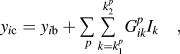 $${y_{i{\rm{c}}}} = {y_{i{\rm{b}}}} + \sum\limits_{\hskip -5pt\vskip 5pt p}\,\, \sum \limits_{\hskip -10pt\vskip 7pt{k = k_1^p}}^{\hskip -6.9pt\vskip -7pt{k_2^p}} G_{ik}^p{I_k}\quad ,$$
where y ic is the net intensity calculated at point i in the pattern, y ib is the background intensity, G ik is a normalized peak profile function, I k is the intensity of the kth Bragg reflection, k 1 … k 2 are the reflections contributing intensity to point i, and the superscript p corresponds to the possible phases present in the sample. Finally, the specific surface area and density of milled samples were estimated using BET (Fritsch model) and gas pycnometer (Micromeritics model), respectively, and apparent densities calculated according to ASTM B527-85.Reference Standard33
III. RESULTS AND DISCUSSION
X-ray patterns of milled samples without and with primary tungsten carbide as system 1 and 2, respectively, are shown in Fig. 1. As shown in this figure, x-ray patterns confirmed that the raw materials had W and Fe3W3C (η) phases, and because carbon used was in the amorphous form, no peaks of carbon were visible. According to the chemical composition of the ferrotungsten used, the amount of mole percent of Fe, W, and C elements was 33.20, 36.35, and 11.11, respectively. Hence, as shown in x-ray patterns, free tungsten can be present in raw materials, whereas all carbon was in a lattice of iron tungsten carbide. The amount of free tungsten in this compound is 3.15 mole percent theoretically. According to the Rietveld method, the relative percent of the amount of visible phases in the x-ray pattern can be calculated. Accordingly, the amount of free tungsten is 6.42 wt%, which is in good agreement with the theoretical calculations.
X-ray patterns of milled samples at different times: (a) system 1 (b) system 2; (*) Fe3W3C, (+) W, (^) WC, (\/) Fe.

According to x-ray patterns, milling even in high times could not affect the type of compounds and phases of raw materials, and finally only visible peaks in 200 h of milling times corresponded to η phase in the first system. However, in the second system, in 75 h of milling, very weak peaks of WC appeared and intensified by an increase in the milling, so that in 125 h all peaks of raw materials disappear and iron phase in ferrite form can be seen. Fe and WC phases remained in the compound at high milling time. Suggestion mechanisms containing mechanical, physical, and thermodynamic phenomena were explained in previous papers completely.Reference Razavi, Rahimipour and Yazdani-Rad31,Reference Razavi, Rahimipour and Yazdani-Rad32
The formation of Fe–WC composite from ferrotungsten can be studied thermodynamically. A suggestion chemical reaction for the second system is according to reaction 1:
 $${\rm{F}}{{\rm{e}}_{\rm{3}}}{{\rm{W}}_{\rm{3}}}{\rm{C}} + {\rm{0}}{\rm{.3W}} + {\rm{2}}{\rm{.2C}} + {\rm{0}}{\rm{.04WC}} = {\rm{3Fe}} + {\rm{3}}{\rm{.34WC}} {\rm{.}}$$
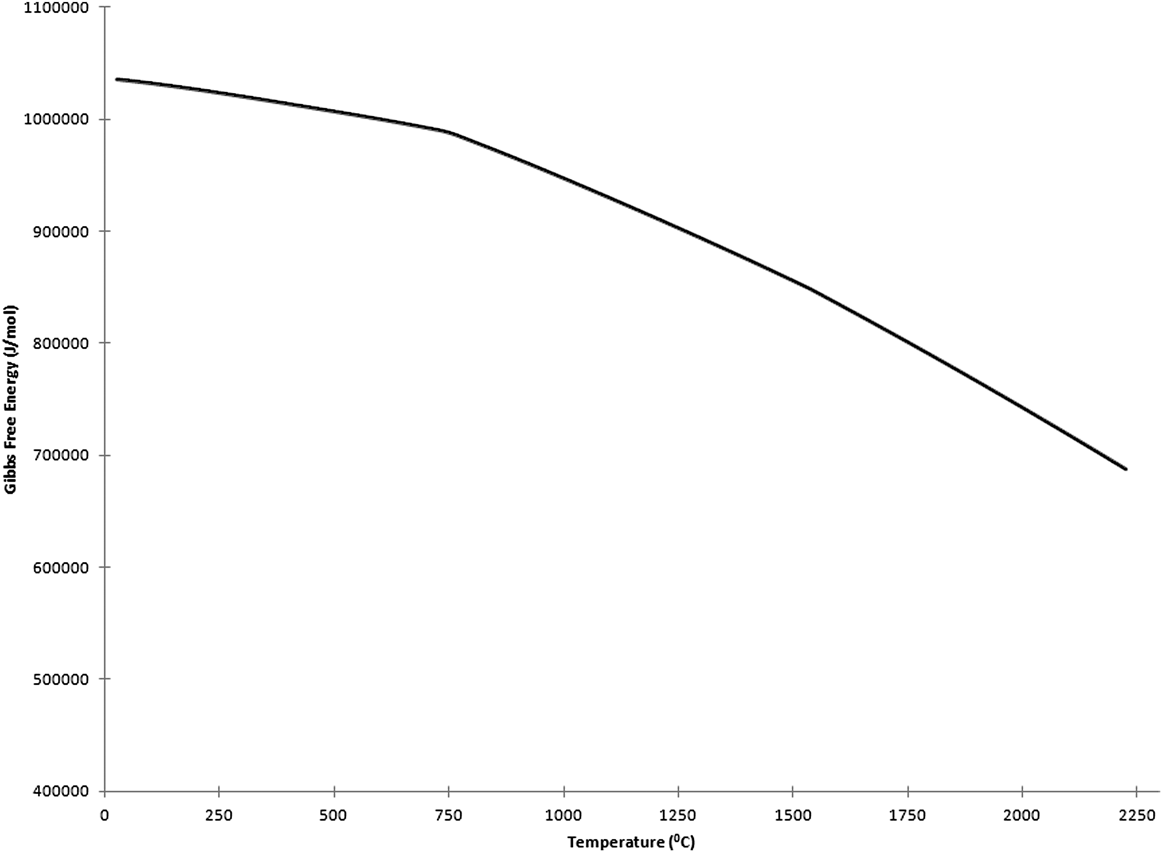
Based on the above reactions, the change of formation energy of Fe–WC at different temperatures was calculated. As shown in Fig. 2, at temperatures lower than 2300 °C, Gibbs free energies are positive indicating that the iron tungsten carbide phase has a very high stability. From the thermodynamic viewpoint mentioned, reactions reach equilibrium at about 4000 °C and free energy became zero. Therefore, Fe–WC cannot be synthesized from ferrotungsten by the conventional method practically. But it was shown that by adding a little amount of primary tungsten carbide into raw materials as nucleation and milling process, it has been realized.
Ellingham–Richardson diagram for production of Fe–WC from ferrotungsten and carbon.
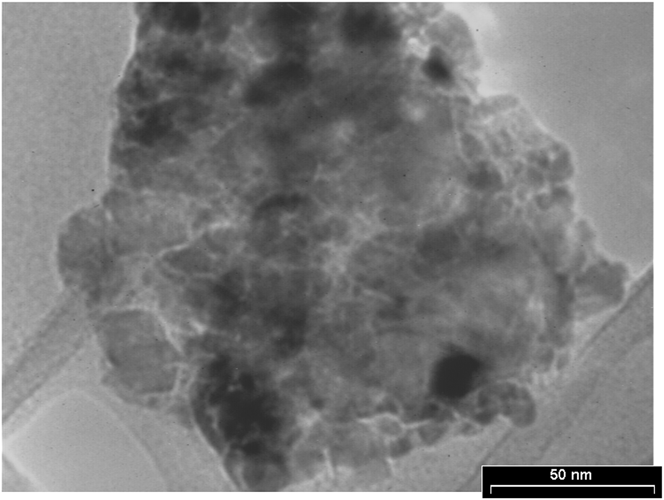
By using Rietveld method, crystalline sizes and mean strains of synthesized tungsten carbide in system 2 were calculated. Crystalline sizes were 32 and 10 nm and mean strains were 2.22 and 2.80% at milling times of 125 and 200 h, respectively, which had a good agreement with Williamson–Hall method.Reference Razavi, Rahimipour and Yazdani-Rad32 TEM image from a sample milled for 200 h in system 2 is confirmed to be a nanometer scale of crystals (Fig. 3).
TEM image of a milled sample for 200 h in the second system.
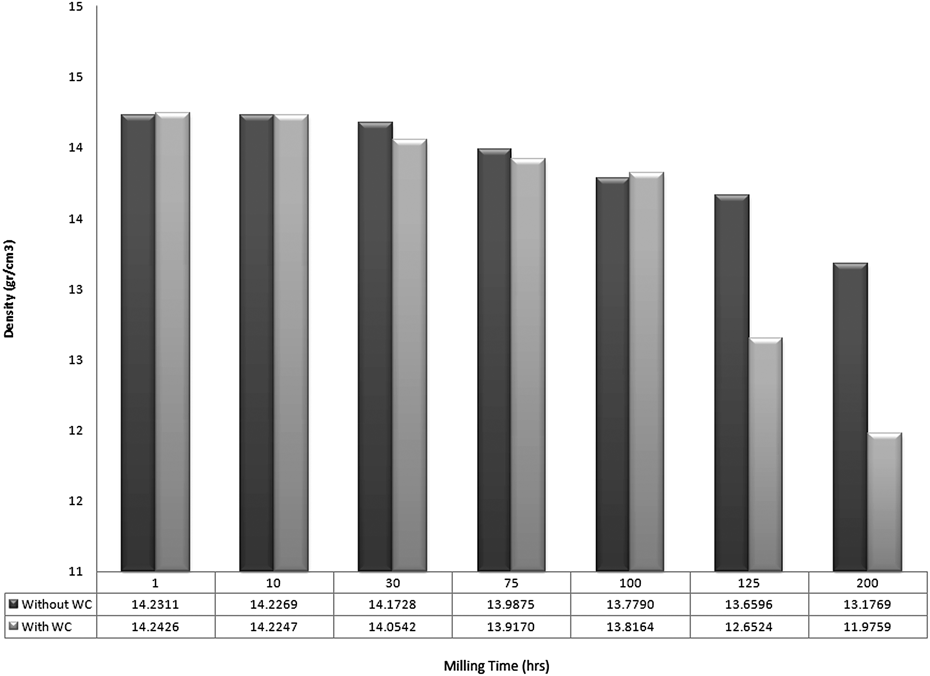
Changes in the density of milled samples are illustrated in Fig. 4. Density variations of the powder mixture containing ferrotungsten and carbon are on the downside perpetually. This behavior is attributed to the entry of worn iron with lower density from raw materials (density of iron, iron tungsten carbide, tungsten, and tungsten carbide are 7.78, 14.16, 19.32, and 15.66 g/cm3, respectively). Also, in the mixture with primary WC (second system), densities were decreased by increasing the milling time for the same reason. In a milling time of 75 h, a competition between the increasing and decreasing density due to the production of carbide and worn iron, respectively, can be seen and the effect of worn iron is higher than the production of carbide. When carbide with high hardness was more synthesized during milling, wear intensified extremely and after 100 h of milling, densities were decreased again. Decrease in densities continued in higher times so that density in 200 h of milling became about 12 g/cm3 in the second system. Although in the second system, primary WC was present in the mixture with higher density than eta and carbon phases, but due to the entery of worn iron, densities in the second system were lower than the first system (except 100 h).
Changes in the density of milled samples at different times.
Size, distribution, and morphology of milled particles were investigated using SEM. These images with a mean area of particles, which were calculated by Clemex software, are illustrated in Fig. 5. Since ferrotungsten has a brittle principle and therefore was broken by starting of milling. When milling increased (due to mechanical work), the local temperature also increased, and hence some agglomerations were created in the mixture consequently. These agglomerations were broken by hard synthesized tungsten carbide, so that no agglomerations cannot be seen in the mixture in 100 h of milling. At final milling time (200 h), a good distribution of particles was apparent. As shown in Fig. 5, it seems that the particle sizes of the sample milled at 100 h are higher than that milled at 30 h, which can be attributed to the existence of a soft iron phase and cold welding of particles. By increasing the milling time, the iron phase was hard worked and brittle and hence was broken. In this stage, failure of particles and agglomerations defeated the cold welding process.
SEM images of milled samples in the second system, which were milled for (a) 1 h, (b) 10 h, (c) 30 h, (d) 100 h, and (e) 200 h.
Specific surface areas of milled powders estimated by BET are presented in Fig. 6. By increasing the milling time, specific surface areas were increased in two systems. Although according to Fig. 5, particle size at a time of 30 h was lower than 100 h, but due to high existence agglomerations in the mixture milled for 30 h, the specific surface area is lower than the 100-h sample slightly. In these mixtures, the highest surface area corresponded to samples that were milled for 200 h. Because of the existence of hard primary tungsten carbide in the second system, specific surface areas in the first system were lower than the amounts of the second system.
Changes in specific surface area versus milling time.
The changes of apparent densities of milled samples versus different milling times are shown in Fig. 7. By increasing the milling time, created agglomerations were broken and fluid ability increased and then apparent density increased consequently. Furthermore, because of the presence of primary tungsten carbide in system 2, apparent density in the second system is higher than the first system.
Changes in apparent density versus milling time.
IV. CONCLUSION
(1) By adding 1 wt% tungsten carbide into raw materials containing industrial ferrotungsten and carbon black, Fe–WC composite was synthesized via MA at times more than 75 h by a gradual mechanism.
(2) Crystalline sizes of the synthesized tungsten carbide were in nanometer scale, which were decreased by increasing the milling time while mean strains increased.
(3) Due to entranced worn iron in the mixture, densities and specific surface areas decreased by increasing the milling time while apparent density increased.