INTRODUCTION
The Mediterranean Sea is one of the regions most severely affected by alien marine invasions, fostered by the opening of the Suez Canal, intense shipping (resulting in the transportation of species by fouling and ballast waters), aquaculture, and aquarium trade (Streftaris et al., Reference Streftaris, Zenetos and Papathanassiou2005; Galil, Reference Galil2009). At least 947 alien taxa have been reported in the Mediterranean Sea until October 2009, of which 521 are considered to be established and spreading (Zenetos et al., Reference Zenetos, Streftaris, Micu, Todorova, Gollasch, Joseffson, Zaiko and Olenin2009a). Many of the marine alien species exhibit aggressive invasive behaviour, leading to alterations in ecosystem functioning, biodiversity loss, and negative impact to human activities such as fisheries, tourism and aquaculture (Streftaris & Zenetos, Reference Streftaris and Zenetos2006).
In the Aegean and Ionian Seas, there is an uncontested increase of alien marine species during the last decades (Çinar et al., Reference Çinar, Bilecenoglu, Öztürk, Katagan and Aysel2006; Pancucci-Papadopoulou et al., Reference Pancucci-Papadopoulou, Zenetos, Corsini-Foka and Politou2006). For most of them the geographical range keeps expanding: this phenomenon could be attributed both to the presence of empty ecological niches and to global warming (tropicalization scenario: Bianchi, Reference Bianchi2007; Occhipinti-Ambrogi, Reference Occhipinti-Ambrogi2007). Twenty-two alien marine crustaceans have been reported in the Greek waters of the Aegean and Ionian Seas, of which seventeen are decapods; among them 9 species (53%) can be considered as established in the Greek Seas (Zenetos et al., Reference Zenetos, Pancucci-Papadopoulou, Zogaris, Papastergiadou, Vardakas, Aligizaki and Economou2009b). Most of the alien decapods in Greece have been encountered only in the south-eastern part of the Aegean Sea, their occurrence decreasing substantially northwards and westwards (Pancucci-Papadopoulou et al., Reference Pancucci-Papadopoulou, Kevrekidis, Corsini-Foka, Simboura, Papathanassiou and Zenetos2005; ELNAIS, 2009).
Percnon gibbesi (H. Milne-Edwards, Reference Edwards1853) is a primarily algivorous crab of the shallow infra-littoral rocky shores. It is a widely distributed species, its range extending from California to Chile, Florida to Brazil, and Madeira to the Gulf of Guinea (Manning & Holthuis, Reference Manning and Holthuis1981). It was first observed in the Mediterranean Sea in 1999 in Linosa Island, Sicily Strait (Relini et al., Reference Relini, Orsi, Puccio and Azzuro2000). Since then its population in the Mediterranean Sea has expanded rapidly and is now considered as the most invasive decapod species introduced into the Mediterranean basin (Thessalou-Legaki et al., Reference Thessalou-Legaki, Zenetos, Kambouroglou, Corsini-Foka, Kouraklis, Dounas and Nicolaidou2006; Yokes & Galil, Reference Yokes and Galil2006). It has the ability to get established in large numbers in both anthropogenically impacted areas, e.g. close to ports, and in natural habitats (Cannicci et al., Reference Cannicci, Garcia and Galil2006; Thessalou-Legaki et al., Reference Thessalou-Legaki, Zenetos, Kambouroglou, Corsini-Foka, Kouraklis, Dounas and Nicolaidou2006).
In Greece, it was first observed (in March 2004) on the north-eastern coast of Messiniakos Gulf (south Ionian Sea) (Thessalou-Legaki et al., Reference Thessalou-Legaki, Zenetos, Kambouroglou, Corsini-Foka, Kouraklis, Dounas and Nicolaidou2006) and was subsequently (in 2005) found in Crete, Antikythira and Rhodes Island (Cannicci et al., Reference Cannicci, Garcia and Galil2006; Thessalou-Legaki et al., Reference Thessalou-Legaki, Zenetos, Kambouroglou, Corsini-Foka, Kouraklis, Dounas and Nicolaidou2006). The present study records the subsequent range expansion of this species in the Aegean and Ionian Seas and provides evidence of its further establishment in Greek waters.
MATERIALS AND METHODS
Presence/absence surveys were conducted at a large number of coastal sites in the Saronikos Gulf (central Aegean; 54 sites), National Marine Park of Zakynthos Island (central Ionian; 40 sites), and Chios Island (central Aegean; 14 sites) (Figure 1). The sampling sites were randomly distributed in each sub-area after excluding sandy coasts. In the Saronikos Gulf and Zakynthos Island, transects of 200 m length were defined along the coastline with the use of a diving reel and were surveyed with snorkelling during standardized 20-minute dives. In Chios Island, standardized one-hour transects (of various lengths) along the coastline were surveyed. The surveys were conducted during July–August 2009 in the Saronikos Gulf, in August 2009 in Chios Island, and during September–October 2009 in Zakynthos Island. During these surveys, the presence/absence of Percnon gibbesi was recorded.
Records of Percnon gibbesi presence in the Greek waters of the Aegean and Ionian Seas. In the cases of the Saronikos Gulf and the south Zakynthos Island, the size of the bullet indicates relative abundance, i.e. recorded individuals during standardized 200-m transects.

Further to these surveys, other observations not published in the scientific literature (personal observations by the authors, personal communications, and information available in grey literature or websites and documented by photographs or specimens) of P. gibbesi in other sites of Greece were compiled. The personal observations by the authors were made by chance during surveys for other purposes in the last two years.
RESULTS
Percnon gibbesi was found in four sites in the Saronikos Gulf (7.4% of the surveyed sites), in two sites in Chios Island (14% of the surveyed sites) and in 27 sites in Zakynthos Island (67.5% of the surveyed sites). The species seemed to be very well established in the National Marine Park of Zakynthos Island as it was highly abundant, widely spread throughout the study area, and represented by a noticeable number of ovigerous females and juveniles. Percnon gibbesi was also observed by the authors in three sites in Rhodes (March 2009), two sites in Crete (June–July 2008), and one site on the north-eastern coast of the Ionian Sea (Syvota) (October 2008). Furthermore, its presence was documented in Milos Island (central Aegean) (Th. Balaskas, personal communication) and from additional sites in the Messiniakos Gulf and adjacent areas (G. Psaltis, personal communication) in respect to those previously reported in Thessalou-Legaki et al. (Reference Thessalou-Legaki, Zenetos, Kambouroglou, Corsini-Foka, Kouraklis, Dounas and Nicolaidou2006).
Percnon gibbesi was observed in many different types of rocky substrate, varying from straight cliffs on the sea side to gentle sloped pebble coasts. The highest densities were generally observed in areas with boulders, either natural or artificial near marinas. For example, its abundance was extremely high in some of the sites of south Zakynthos Island, at shallow rocky coasts with gentle slopes paved with boulders and medium size stones. Vegetation coverage of occupied habitats was generally poor. However, it included both early successional filamentous green and brown algae such as Cladophora and Sphacelaria, as well as late successional species such as Corallina, Lithophullym and Palmophyllum crassum (Naccari) Rabenhorst. Most individuals were found at depths between 0.5 and 2 m, although a maximum depth of occurrence of 8.5 m was observed in Zakynthos Island.
The species presented a highly cryptic behaviour hiding under cracks and crevices, in either artificial or natural hard substrates. In the presence of the observers the crabs quickly retreated into their crevice. Only occasionally, specimens were observed feeding close to the indigenous grapsid crab Pachygrapsus marmoratus (Fabricius, Reference Fabricius1787).
In general, Percnon gibbesi tended to exhibit a very patchy distribution and aggregated in groups of more than two individuals. In most of the surveyed locations, groups of individuals were observed close together, grazing tufted and crustose algae that grow on the rocks. However, in Chios Island only one individual was found in each of two sites. The scarcity of the species in Chios Island probably indicates a quite recent arrival of the species in the island, which is the northernmost site of presence of the species in the Aegean Sea as recently suggested also by Crocetta & Colamonaco (Reference Crocetta and Colamonaco2008) for the northern Gulf of Taranto.
DISCUSSION
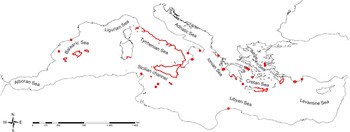
After its first record in Linosa Island (Sicily) in 1999 (Relini et al., Reference Relini, Orsi, Puccio and Azzuro2000), Percnon gibbesi was observed in several central and western Mediterranean sites, rapidly reaching part of the eastern Mediterranean too (Garcia & Reviriego, Reference Garcia and Reviriego2000; Müller, Reference Müller2001; Pipitone et al., Reference Pipitone, Badalamenti and Sparrow2001; Bellantoni & Corazza, Reference Bellantoni and Corazza2002; Borg & Attard-Montalto, Reference Borg and Attard-Montalto2002; Galil et al., Reference Galil, Froglia and Noel2002; Mori & Vacchi, Reference Mori and Vacchi2002; Cannicci et al., Reference Cannicci, Badalamenti, Milazzo, Gomei, Baccarella and Vannini2004; Catalano, Reference Catalano2004; Deudero et al., Reference Deudero, Frau, Cedra and Hampel2005; Russo & Villani, Reference Russo and Villani2005; Cannicci et al., Reference Cannicci, Garcia and Galil2006; Thessalou-Legaki et al., Reference Thessalou-Legaki, Zenetos, Kambouroglou, Corsini-Foka, Kouraklis, Dounas and Nicolaidou2006; Yokes & Galil, Reference Yokes and Galil2006; Faccia & Bianchi, Reference Faccia and Bianchi2007; Sciberras & Schembri, Reference Sciberras and Schembri2007; Crocetta & Colamonaco, Reference Crocetta and Colamonaco2008; Elkrwe et al., Reference Elkrwe, Elkawaj, Galil and ben Abdallah2008; present study). Thus, the present occurrence in the Mediterranean seems to extend in a geographical zone of middle latitudes leaving out the Adriatic Sea (Kirinčić & Stevčić, Reference Kirinčić and Stevčić2008; C. Froglia, personal communication), the Ligurian Sea, the Corsica Island, the Alboran Sea, and most of the African coasts (with the exception of its finding in Al Haniyah, Lybia (Elkrwe et al., Reference Elkrwe, Elkawaj, Galil and ben Abdallah2008) and in Zembra and Zembretta Islands in Tunisia (MedMPA, 2004)), and the far eastern Mediterranean shores (Figure 2). Nevertheless, its absence from these areas cannot be definitive, as it is suggested that many other invaded locations still remain unreported, and with such an expansion rate, the species outruns the reports.
The distribution of Percnon gibbesi in the Mediterranean Sea based on published records until October 2009.

It is difficult to reach definite conclusions on the means of initial arrival of Percon gibbesi in the Mediterranean Sea since different authors speculate different vectors. It could be either through shipping (Galil et al., Reference Galil, Froglia and Noel2002) or by larval drift by currents (Pipitone et al., Reference Pipitone, Badalamenti and Sparrow2001; Abelló et al., Reference Abelló, Visauta, Buci and Demestre2003). However, its further spreading in the Mediterranean basin seems to be primarily via larval transport by currents, although fishing and recreational vessels may also contribute to its dispersal (Cannicci et al., Reference Cannicci, Garcia and Galil2006; Thessalou-Legaki et al., Reference Thessalou-Legaki, Zenetos, Kambouroglou, Corsini-Foka, Kouraklis, Dounas and Nicolaidou2006; Crocetta & Colamonaco, Reference Crocetta and Colamonaco2008). Ovigerous females have been observed in most sites of the species occurrence in the Mediterranean Sea (e.g. Balearic Islands: Deudero et al., Reference Deudero, Frau, Cedra and Hampel2005; Sicily: Deudero et al., Reference Deudero, Frau, Cedra and Hampel2005; Rhodes: Thessalou-Legaki et al., Reference Thessalou-Legaki, Zenetos, Kambouroglou, Corsini-Foka, Kouraklis, Dounas and Nicolaidou2006; southern Turkey: Yokes & Galil, Reference Yokes and Galil2006; Malta: Sciberras & Schembri, Reference Sciberras and Schembri2007; Libyan coast: Elkrwe et al., Reference Elkrwe, Elkawaj, Galil and ben Abdallah2008; Zakynthos: present study). The wide distribution of breeding populations in the Mediterranean Sea suggests that the prevailing environmental conditions favour its reproduction, settlement and establishment, and that the species is currently expanding its range in the Mediterranean Sea by natural dispersal.
Percnon gibbesi appears to be an opportunistic feeder, feeding primarily on algae, including a wide variety of algal meals, such as filamentous algae, calcareous algae, corticated macrophytes, and foliose algae (Puccio et al., Reference Puccio, Relini, Azzuro and Relini2006), but also on animal food such as pagurids, polychaetes, gastropods, crustaceans and jellyfish (Cannicci et al., 2004; Deudero et al., Reference Deudero, Frau, Cedra and Hampel2005; Sciberras & Schembri, Reference Sciberras and Schembri2008). The vast availability of food in the upper infralittoral zone and the flexibility of P. gibbesi in feeding, the high fecundity of the species, the large duration of the larval phase (Paula & Hartnoll, Reference Paula and Hartnoll1989), and the exceptionally large megalopa from which a robust first crab stage is produced (Hartnoll, Reference Hartnoll1992) are some of the reasons explaining the rapid spreading of the species in the Mediterranean Sea.
According to the present study, the species has already reached the central parts of the Aegean Sea and the entire Ionian Sea. The species is expected to keep spreading in the Mediterranean Sea, and if the current rate of expansion continues, it will soon be abundant throughout this area.
ACKNOWLEDGEMENTS
Data from Zakynthos were collected during the project ‘Survey of the Marine Benthic Fauna in the National Marine Park of Zakynthos’, funded by the EU and national sources (coordinator: M.T.-L.). An anonymous referee made useful comments that helped to improve the quality of this manuscript.