Implications
This study suggests that inclusion of cellulose, an insoluble fibre, in the supplemental diet of suckling piglets affects behaviour before weaning, with no deleterious effects on performance. Further research is needed to determine whether and how these behavioural changes affect the capacity of piglets to adapt to solid feed at weaning.
Introduction
In modern swine production systems, dietary fibres are commonly used as alternative feed ingredients to stimulate profitability, whereas promoting animal health and welfare. For example, fermentable (soluble) dietary fibres have been found to reduce behavioural problems caused by insufficient satiety, for example high levels of aggression, stereotypies and damaging oral manipulation of pen mates, in restrictedly fed animals (Ramonet et al., Reference Ramonet, Meunier-Salaun and Dourmad1999). Insoluble fibres, like cellulose, may also affect behaviour of pigs via their effect on gut/stomach fill and/or mastication time (de Leeuw et al., Reference de Leeuw, Bolhuis, Bosch and Gerrits2008) because more chewing is needed to break down and swallow indigestible, bulky fibres (Ramonet et al., Reference Ramonet, Meunier-Salaun and Dourmad1999; Whittemore et al., Reference Whittemore, Kyriazakis, Tolkamp and Emmans2002; Bakare et al., Reference Bakare, Ndou and Chimonyo2013). Feral pigs can spend up to 75% of their active time in foraging-related activities, including chewing and rooting, and pigs are highly motivated to display these behaviours, even when fed a concentrated diet. Bulky diets enriched with insoluble fibres that stimulate chewing may thus meet pigs’ behavioural needs.
Although extensive research has been done in adult non-lactating sows (Ramonet et al., Reference Ramonet, Meunier-Salaun and Dourmad1999), finishing pigs (Bakare et al., Reference Bakare, Ndou, Madzimure and Chimonyo2015) and weaned/growing piglets (Bakare et al., Reference Bakare, Ndou and Chimonyo2013), to our best knowledge, no studies have investigated the effect of dietary fibres on the performance of suckling piglets. Suckling piglets are commonly offered supplemental milk and ‘creep feeds’ with low-fibre (LF) content to facilitate the transition from milk to solid feed at weaning. From an evolutionary perspective, such diets may not be the most optimal for piglet development. In the wild, pigs start to leave the nest and explore their environment within the 2nd week of life (D’Eath and Turner, Reference D’Eath and Turner2009). This exploration includes the sampling of novel nutrient sources, which are mainly of vegetable origin, thus forming a relatively high bulk regimen. Fibrous feed sources in early life may be essential for maturation of the digestive tract or jaw musculature, bones and teeth, which is needed to properly adapt to solid feed around weaning (Herring, Reference Herring1985).
We investigated, for the first time, the effects of a supplemental diet enriched with cellulose, a natural insoluble fibre, offered in addition to maternal milk, on piglet behaviour, growth and feed intake before weaning.
Material and methods
In all, 10 multiparous (parity: 4.7±0.6; range: 2 to 7) sows and their litters (Hypor Libra×Hypor Maxter) from the Swine Research Centre of Trouw Nutrition (Sint Anthonis, the Netherlands) were used. Sows and piglets were housed in farrowing pens (1.95×2.60 m) with a slatted floor and no bedding material. Upon arrival, sows had access to a plastic ball and a jute bag as nesting material. Piglets were weighed, ear-tagged, tail-docked within 24 h after birth and, when necessary, cross-fostered to standardise litter size (median: 13 piglets; range: 12 to 15 piglets). Piglets were weaned 23 days after the expected farrowing date. Sows and piglets had ad libitum access to water. Sows were fed a commercial lactation diet. Lights were on from 0600 to 2200 h.
From 5 days of age, half of the litters (n=5) were allocated to a high-fibre diet (HF), and the other half (n=5) to a standard LF diet (i.e. control diet). The HF diet consisted of the standard LF diet, in which 5% of corn starch extract was replaced by 5% Arbocel® BWW 40 natural cellulose fibres (J. Rettenmaier & Söhne GmbH + Co. KG, Rosenberg, Germany). Allocation of litters to the diet was balanced for sow parity (HF: 4.0±0.7; LF: 5.4±0.9), average litter birth weight (HF: 1.42±0.13 kg; LF: 1.41±0.08 kg) and litter size (HF: 13.2±0.58; LF: 13.0±0.32 piglets/litter), and dietary treatments were randomly distributed between pens.
From 5 to 11 days of age, piglets were given ad libitum access to a HF or LF milk (milk powder:water ratio, 1:2.5). Transition from the milk to a dry meal was made over a 3-day period (milk:dry meal ratio, 75% to 25%, 50% to 50%, 25% to 75%) from 12 to 14 days of age. Piglets were then offered 100% of the HF or LF dry meal (as a powder) from 15 to 22 days of age. The HF and LF milk and dry meal were formulated to meet the NRC (2012) requirements (Supplementary Table S1). Fresh milk and dry meal were distributed twice a day in a round feeding bowl with partitions allowing six piglets to eat simultaneously.
From 5 to 23 days of age, milk or feed refusals were weighed daily to assess feed intake at pen level. All piglets were weighed at 5, 15 and 20 days of age. Six piglets per litter were selected for behavioural observations based on their BW at 5 days of age (the three biggest and the three smallest of the litter). At 6, 16 and 21 days of age, behaviours (Supplementary Table S2) of the focal piglets were scored live using 30-s instantaneous scan sampling for three 10-min sessions of observations per pen per day (i.e. 60 scans/piglet per day). Observations were done between 0700 and 1600 h, with at least a 45-min break between sessions. Before starting the observations, the observer stood still in front of the pen for at least 2 min to ensure that piglets resumed their normal activities after arrival of the observer.
Data were analysed with SAS 9.3. Behaviours were pooled into eight categories: ‘being inactive’; ‘interacting’, ‘exploring’, ‘playing’; ‘walking’; ‘suckling (and massaging the udder)’; ‘eating’; and ‘drinking’ (Supplemental Table S2) and arcsine square root transformed to meet the assumption of normality. Performance and behavioural data were analysed using repeated-measure mixed models which included the fixed effects of diet, age and their interactions, with farrowing pen nested within diet as experimental unit. Litter size at the time of measurements and parity of the sow had no effect on BW, feed intake and most of the behaviours, and were thus excluded from the final models. Litter size at the time of measurements had a significant effect on time spent suckling (P=0.003) and inactive (P=0.05) and was kept in the final model for these variables. Body weight class at 5 days of age (large v. small piglets), and its interaction with diet, had no significant effect on any behaviours and was thus excluded from the final models. Significant effects were further analysed using differences of least squares means with Tukey’s adjustment. (Untransformed) data are presented as means±SEM.
Results
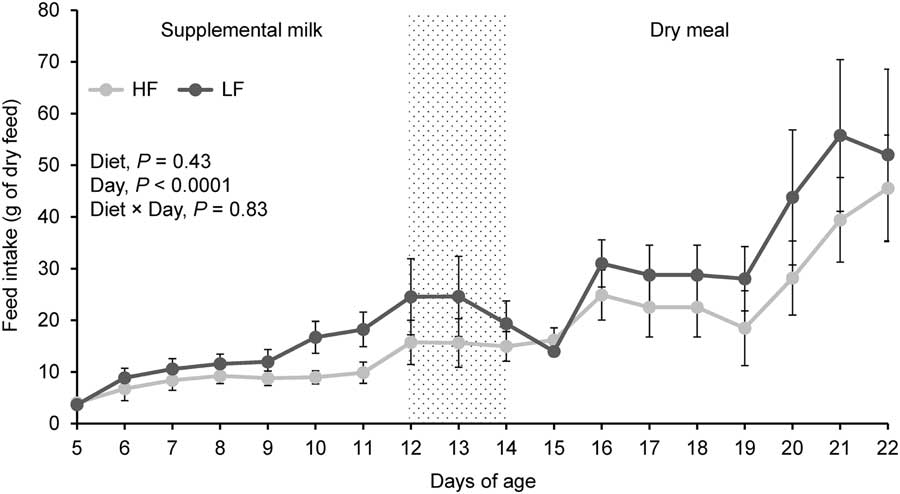
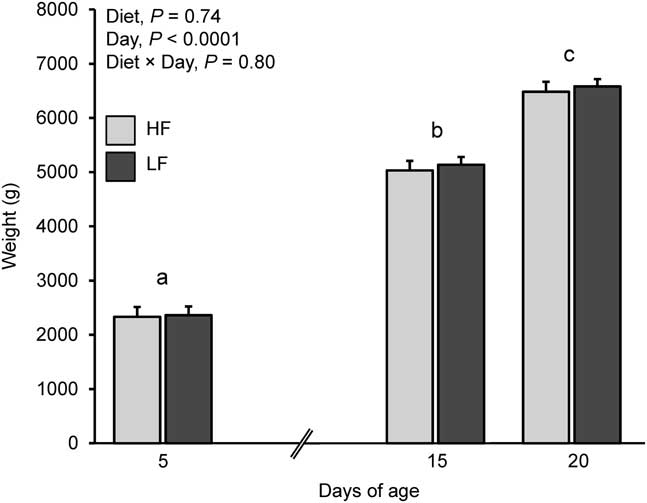
Feed intake (P<0.0001; Figure 1) and BW (P<0.0001; Figure 2) increased with age. Diet or diet×age interactions did not affect feed intake (diet: P=0.43; diet×age: P=0.83) or BW (diet: P=0.74; diet×age: P=0.80).
Individual daily feed intake (g of milk powder or feed powder/day) of piglets offered a high-fibre (HF) or control low-fibre (LF) diet from 5 days of age until weaning (23 days of age). Experimental unit was the pen (n=5). Data are means±SEM. The dotted area represents the 3-day transition period from milk to dry meal.

Body weight (g) of piglets offered a high-fibre (HF) or a control low-fibre (LF) diet from 5 days of age until weaning (23 days of age). Experimental unit was the pen (n=5). Data are means±SEM. a,b,cDifferent letters indicate a significant effect of day (P<0.01).

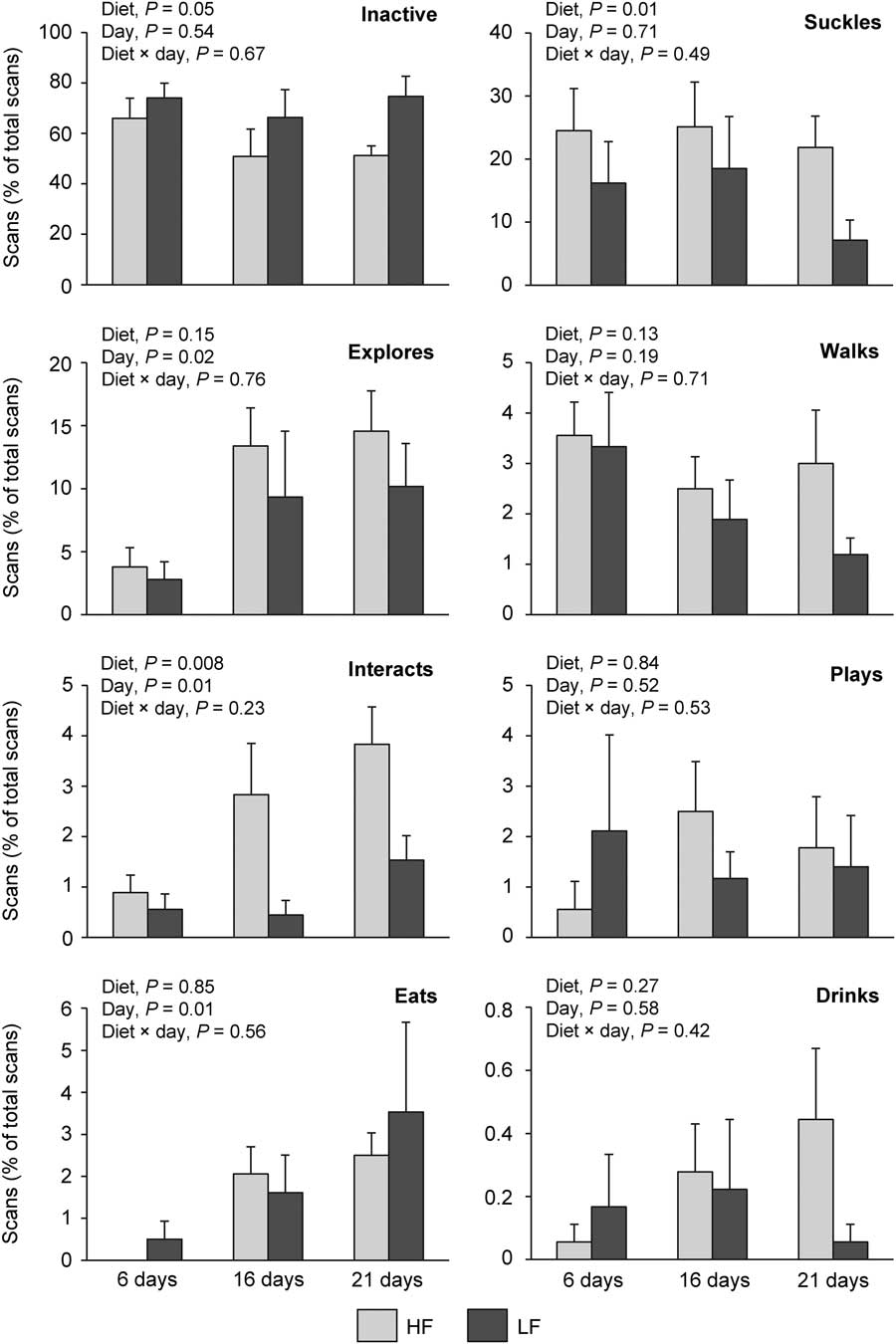
Piglets’ behaviours were affected by age (Figure 3). Piglets, 6-day-old, spent less time exploring the pen and eating than 16-day-old (P=0.08 and P=0.05) and 21-day-old piglets (P=0.02 and P=0.01). Time spent interacting with pen mates (manipulating pen mates, aggressing, mounting, belly nosing) was lower at day 6 than at day 21 (P=0.01).
Behavioural activities (% of total scans) at 6, 16 and 21 days of age of piglets offered a high-fibre (HF) or a control low-fibre (LF) diet from 5 days of age until weaning (23 days of age). Experimental unit was the pen (n=5). Data are means±SEM.

Piglets on the HF diet spent less time inactive (lying, sitting or standing) than controls (HF: 56±4.7% v. LF: 72±4.7%; P=0.05), with time spent lying accounting for 91% and 94% of the time spent inactive in HF and LF piglets, respectively (i.e. HF: 51±5.0% v. LF: 68±4.9% of total time, P=0.05). Compared with controls, HF piglets spent more time suckling or massaging the udder (HF: 24±3.4% v. LF: 14±3.6%; P=0.01) and more time interacting with pen mates (HF: 2.52±0.05% v. LF: 0.84±0.24%; P=0.008). Time manipulating pen mates (e.g. ear and tail biting, belly nosing) accounted for most of the time spent interacting with pen mates (>73% of total time spent interacting; that is HF: 1.85±0.49% v. LF: 0.73±0.23% of total time). When behaviours were expressed relative to time spent active, however, no significant effect of diet remained (data not shown). No other effects of diet, age or diet×age interactions were found.
Discussion
Our study shows, for the first time, that inclusion of cellulose, an insoluble fibre, in the supplemental diet of suckling piglets from 5 to 22 days of age had no evident effect on weight gain and feed intake, but affected behaviour before weaning. Notably, piglets offered the HF diet spent less time (lying) inactive than controls. In line with this, Bakare et al. (Reference Bakare, Ndou and Chimonyo2013 and Reference Bakare, Ndou, Madzimure and Chimonyo2015) found that weaned piglets and finishing pigs spent less time lying when fed increasing levels of dietary ADFs (cellulose, lignin). This decrease in time spent lying was regarded as either a consequence of unfulfilled satiety due to low nutrient/energy intake or of more time spent eating and chewing the diet (Bakare et al., Reference Bakare, Ndou and Chimonyo2013 and Reference Bakare, Ndou, Madzimure and Chimonyo2015).
In our study, the HF diet did not affect the time spent eating and exploring the pen, that is foraging-related activities, suggesting no or little effects of the fibrous diet on satiety. Furthermore, although the intake of piglets offered the HF diet was, numerically, consistently lower than that of piglets fed the LF diet, we found no significant differences in the absolute amount of feed consumed. At 21 days of age, however, piglets offered the HF diet had a 30% reduction in net individual energy intake (resulting from feed consumption) compared with controls (0.41 v. 0.59 MJ/piglet per day). A 21-day-old suckling piglet can drink up to 1 l of sow milk daily, which represents about 5 MJ (Quesnel et al., Reference Quesnel, Farmer and Theil2015). Under these conditions, the energy intake resulting for feed consumption accounts for only a small percentage of total energy intake. The lack of difference in BW between groups suggests that, if anything, piglets fed the HF diet may have compensated the slight reduction in feed-based energy intake by drinking more maternal milk than controls, which seems to be supported by behavioural data. Compared with controls, piglets offered the HF diet spent more time suckling (and massaging the udder), notably at 21 days of age, which may be regarded as an increase motivation to obtain milk and reflect the attempts of piglets offered the HF diet to compensate for their lower energy intake.
Another postulate would be that the effects of the fibrous diet on behaviour are independent from satiety signals, and are a direct consequence of more time spent chewing the diet (Bakare et al., Reference Bakare, Ndou and Chimonyo2013 and Reference Bakare, Ndou, Madzimure and Chimonyo2015). Cellulose is a bulky fibre that, as shown in growing and adult pigs, increases stomach fill and gut distension, decreases transit time of digesta in the gut (Montagne et al., Reference Montagne, Pluske and Hampson2003) and stimulates mastication (Ramonet et al., Reference Ramonet, Meunier-Salaun and Dourmad1999; Whittemore et al., Reference Whittemore, Kyriazakis, Tolkamp and Emmans2002; Bakare et al., Reference Bakare, Ndou and Chimonyo2013). Although processes related to gut wall distention are likely mainly mediated by milk intake in suckling piglets – thus leaving little room for additional effects of fibres – fibrous diets may increase mastication because pigs need more time to break down and swallow the indigestible fibres (Ramonet et al., Reference Ramonet, Meunier-Salaun and Dourmad1999; Whittemore et al., Reference Whittemore, Kyriazakis, Tolkamp and Emmans2002; Bakare et al., Reference Bakare, Ndou and Chimonyo2013). An increase in mastication time might have enhanced the need for water/fluid to facilitate swallowing, thus increasing the piglets’ motivation to ingest more fluids. This may partly explain why piglets offered the HF diet spent more time suckling and massaging the udder. Interestingly, although the difference did not reach threshold for significance, piglets offered the HF diet also seemed to spend, on average, more time drinking than controls at 21 days of age (0.44% v. 0.06% of total observations). The stimulating effect of fibres on mastication time, by increasing salivation and jaw movements, may stimulate the early maturation of jaw musculature, bones and teeth, thus enhancing the capacity of piglets to properly adapt to solid feed (Herring, Reference Herring1985). As chewing activity was, however, not measured per se in our study, further investigations are warranted to confirm these effects.
Piglets on the HF diet spent more time interacting with pen mates, with oral manipulative behaviours (e.g. chewing tail and ears, belly nosing) accounting for most of the time spent interacting. Oral manipulative behaviours are thought to be re-directed exploratory behaviours reflecting frustration due to unsatisfied foraging opportunities, especially in barren housing (Beattie et al., Reference Beattie, O’Connell, Kilpatrick and Moss2000). As piglets were housed without bedding, the increase in oral manipulative behaviours may thus reflect an increase in foraging activities in the absence of substrate in piglets offered the HF diet. The stimulating effect of cellulose on mastication possibly increased the piglets’ motivation to find chewable objects, hence the increased activity levels. Dietary cellulose may thus represent a bulky ‘chewing material’, meeting the behavioural needs related to foraging behaviours, like chewing, but may also increase the risk of damaging manipulative behaviours in barren housing where ‘normal’ foraging is frustrated by the absence of suitable substrate.
In conclusion, this preliminary study shows that the inclusion of cellulose in the supplemental diet of suckling piglets affects behaviour before weaning, with no evident deleterious effects on performance. Replication studies on a higher number of animals are warranted to confirm these effects and determine the physiological causes (e.g. satiety, mastication) underlying these behavioural changes. Further research should also consider assessing the performance and behaviour of piglets at and after weaning to determine whether these pre-weaning changes warrant a better adaptive capacity at weaning.
Acknowledgements
The authors thank the personnel from the Swine Research Centre of Trouw Nutrition for taking care of the animals and their technical assistance, and Dr Inonge Reimert for useful comments on the manuscript.
Supplementary material
To view supplementary material for this article, please visit https://doi.org/10.1017/S1751731117001501