Introduction
Spinal compression lesions occur in about 5% of patients with metastatic cancer,Reference Rades, Stalpers and Hulshof1 usually with breast, prostate, lung or kidney cancer as a primary diagnosis. Treatment in the form of surgery, radiation therapy or chemotherapy, aims at restoring (or maintaining) functional capacity as well as providing pain relief and improving quality of life. Radiation therapy is a main component of treatment for many of these patients. Fractionation schedules vary (from 8 Gy in a single fraction to up to 30 Gy in 10 fractions).Reference Rades, Stalpers and Hulshof1–Reference Maranzano, Latini and Checcaglini3 Preservation of motor function does not depend on fractionation; however, in-field recurrences occur more frequently in patients treated with a single fraction.Reference Rades, Stalpers and Hulshof1
Delivery techniques have evolved dramatically over the past decades, with intensity-modulated radiation therapy and image-guided radiation therapy gaining wide acceptance. Most of the reports indicate the benefit in curatively intended treatments; however, in palliative-intended treatments improved techniques also seem to be increasingly warranted. The potential of better local control and reduced toxicity have consistently justified the allocation of additional resources.Reference Nutting, Dearnaley and Webb4
Typical radiation therapy techniques in cancer patients with spinal cord compression (SCC) have used weighted anterior–posterior (APPA) fields (where the APPA field may have zero weight). An alternative technique consists of three fields: one posterior and two lateral fields, reducing the dose to anterior structures like the intestines.
At our institution, we introduced volumetric-modulated arc therapy (VMAT) in 2008Reference Kjaer-Kristoffersen, Ohlhues and Medin5 and today we offer this treatment modality to >50% of our cancer patients coupled with daily image guidance. VMAT allows for a far more conformal dose delivery than what can be achieved with APPA or three-field techniques. With VMAT, the dose to organs at risk (e.g., intestines and kidneys) can be reduced. Since 2012, VMAT has been the standard delivery technique of radiation therapy for SCC at our institution.
SCC patients may develop acute toxicity in the kidneys and the small bowel following radiation therapy.Reference Maranzano, Bellavita and Rossi6, Reference Maranzano, Latini and Perrucci7 Dose limits for the small bowel are specified by QUANTEC.Reference Kavanagh, Pan and Dawson8 The dose limit for the average kidney dose at our institution is 10 Gy.
In this study, we investigate how well the plans generated with APPA, three-field and VMAT techniques comply with these dose limits. Compliance could contribute to improved treatment outcomes for cancer patients with SCC in terms of less organ toxicity.
The use of the VMAT technique may require more time for contouring and planning compared with the APPA and three-field techniques. Any potential dosimetric benefit of VMAT must not be outweighed by large amounts of extra time spent by oncologists and dosimetrists.
Thus, the aim of the study was to investigate the doses given to the kidneys and the small intestines for three radiation therapy techniques (APPA fields, three fields and VMAT) for SCC in patients with metastatic disease in the lower thoracic or lumbar spine and to monitor the time spent by clinicians and dosimetrists.
Materials and Methods
Patients
In total, 20 patients with a single to multiple spinal metastases in the lower thoracic or lumbar region were selected from the cohort of patients treated at our clinic. Their primary diagnoses were lung (seven patients), breast (six patients), prostate (two patients), kidney (one patient), cholangiocarcinoma (one patient), oesophagus (one patient) cancer and unknown primary tumour (two patients). The patients were scanned on a Siemens Sensation Open CT scanner (Siemens Healthcare, Erlangen. Germany), with 2·5 mm slices in a supine position, using a knee cushion and foot support.
For each patient, the vertebrae requiring treatment were evaluated by an oncologist and radiologist. The gross tumour volume (GTV) was then delineated by the oncologist. A 5 mm planning target volume (PTV) margin was added to all GTVs to account for daily variations in patient positioning. Image guidance in the form of cone-beam computed tomography was performed daily in order to position the patients as accurately as possible on the treatment couch. All patients were treated with VMAT to a total dose of 30 Gy delivered in 10 fractions (5 fractions/week).
Planning study
APPA as well as three-field plans were generated retrospectively for this analysis. The bowel and kidneys were also contoured retrospectively. All contouring and planning was performed in Eclipse (Varian Medical Systems, Palo Alto, CA, USA).
APPA plans
APPA plans were retrospectively generated following our former clinical guidelines. According to these, the GTV contours were not used in the APPA planning, but the field edges were positioned such that the treatment field included the processus spinosi laterally; and one additional vertebrae cranially and caudally (see Figure 1).
A beam’s eye view of a posterior field in a typical anterior–posterior treatment.

The beam energy (6 or 18 MV) was chosen in order to provide the best coverage of the vertebrae. The fields were weighted to ensure that the maximum dose was <114% of the total prescribed dose and the vertebrae requiring treatment were covered by the 95% isodose contour. In the planning, the anterior fields were given as low a weight as possible in order to comply with the hot spot dose limit to avoid unnecessary exposure of the bowels.
Three-field plans
For the three-field plan, two lateral fields and one posterior field were used. Multileaf collimators (MLCs) were positioned with a 7 mm distance to the GTV at the isocentre. The beam energy was chosen to provide the best coverage of the PTV. MLCs defined the field with a 7 mm margin to the PTV edge. The treatment fields were weighted such that the maximum dose was <114% and the PTV was covered at the 95% isodose line.
VMAT plans
The VMAT plans we evaluated were those used for treatment of patients at our clinic and 6 MV was used for all plans. For most plans, only one arc was required; however, when the PTV could not be adequately covered by the 95% isodose in these plans, two arcs were used. In the plan optimisation, constraints were used to ensure adequate coverage of the PTV and to reduce the dose to a ring structure defined around the PTV.
Comparison of plans
All plans were calculated using an anisotropic analytical algorithm (Eclipse v. 11.0.31) with a calculation grid of 2·5 mm.
For each plan, the following parameters were extracted: the mean dose to the left and right kidney were extracted. Our institutional dose limit to the kidneys is that the mean kidney dose should be <10 Gy whenever possible.
The QUANTECReference Kavanagh, Pan and Dawson8 recommendation is that for a 3–5 fraction treatment, a maximum 15 Gy should be delivered to 120 cc. Using an α/β ratio of 8,Reference Joiner and van der Kogel9 and comparing with a 4-fraction treatment, this corresponds to a dose limit of 20 Gy when delivered in 10 fractions.
For each plan, we determined whether the mean kidney dose was <10 Gy, and whether a volume of the small intestine >120 cc received more than 20 Gy.
The two-tailed p value for correlations between parameters for three techniques was determined (ref http://vassarstats.net/) for correlated datasets.
Time required for contouring and planning
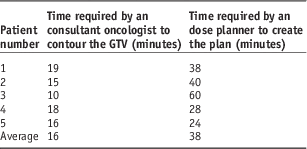
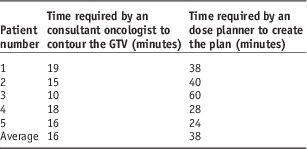
In a separate investigation, the time spent by the oncologist consultant contouring the GTV in five SCC patients, and the time spent by a dose planner creating VMAT plans for five patients, were recorded (Figure 2).
Mean left (a) and right (b) kidney dose, and the volume of bower receiving ≥20 Gy (c), for the anterior–posterior (APPA), the three-field and the volumetric-modulated arc therapy techniques.
Results
The mean doses to the kidneys, and the volume of bowel which received at least 20 Gy, are shown in Figure 2. An example of the resulting plans are presented in Figure 3. VMAT lead to the most conformal distributions: the high-dose areas (represented as the red overlay) were restricted to the target volume, whereas the healthy tissue, especially the bowel, received a lower dose (green–blue overlay). In contrast, the APPA plan lead to a larger volume of bowel being irradiation, whereas the three-field technique spared the bowel at the expense of a higher dose to the kidneys.
Dose ‘colour wash’ overlay for volumetric-modulated arc therapy (VMAT), anterior–posterior (APPA) and three-field plans for one of the 20 patients. Notes: The minimum dose shown is 33%, the maximum 110% of the prescribed dose. The planning target volume is contoured in light blue, the bowel in purple and the kidneys in yellow and orange.
At least one of the kidneys received >10 Gy on average for four patients (APPA technique), 15 patients (three-field technique) and one patient (VMAT technique).
In the small bowel, >120 cm3 received 20 Gy for 18 patients (APPA technique), nine patients (three-field technique) and one patient (VMAT technique).
The mean kidney doses were significantly higher with the three-field techniques than the other techniques (p=0·0002–0·008); however, there is no significant difference between the APPA and VMAT techniques (p=0·138–0·775).
D_20 Gy_bowel was significantly lower with VMAT than with each of the other two techniques (p<0·0001 and 0·017), and significantly lower with the three-field technique than APPA (p<0·001), respectively.
The time spent contouring and planning is shown in Table 1. The average contouring time was 16 minutes, the average planning time was 38 minutes.
The times required for GTV contouring, and planning, for 5 patients.
Abbreviations: GTV, gross tumour volume.
Discussion
Patients with malignant SCC have limited life expectancies and are in the palliative care phase of their diseases. Metastatic lung cancer has a mean survival time of 6 months. The mean survival after metastasis of breast, renal or prostate carcinoma is longer, averaging approximately 1·5–2 years. Less than 10% of patients with metastatic renal cancer survive>2 years.Reference Ferlay, Steliarova-Foucher and Lortet-Tieulent10 However, owing to recent advances in antineoplastic treatments, especially in breast and prostate cancer, longer survival periods are continuously being achieved. Thus, a reduction of early toxicity in SCC patients is justified and likely to bring benefit to at least some patients in the palliative phase of the disease.
Early toxicity in SCC patients receiving radiation therapy includes nausea and vomiting,Reference Maranzano, Bellavita and Rossi6, Reference Maranzano, Latini and Beneventi11 diarrhoea,Reference Maranzano, Bellavita and Rossi6, Reference Maranzano, Latini and Perrucci7 esophagitis, pharyngitisReference Maranzano, Bellavita and Rossi6 and dysphagia.Reference Maranzano, Bellavita and Rossi6 In many reports, late toxicity has not been well documented.Reference Maranzano, Bellavita and Rossi6, Reference Maranzano, Latini and Perrucci7, Reference Maranzano, Latini and Beneventi11 Interestingly, Maranzano et al.Reference Maranzano, Latini and Perrucci7 reported that dysphagia for solid foods in one-third of patients irradiated on the thoracic spine may be owing to radiation-induced toxicity. This suggests that reducing the dose to healthy tissue in patients with SCC could result in an increased quality of life.
For SCC patients with disease in the lower thoracic or lumbar spine, the small intestine and the kidneys should therefore be treated as organs at risk and the irradiation dose delivered to them should be carefully considered.
We have shown that the doses to the kidneys and the small intestine can be reduced to what is probably a clinically meaningful level using VMAT instead of an APPA or three-field technique in patients with advanced cancer. Similarly, encouraging results indicating sparing of organs at risk with VMAT rather than APPA and three-field techniques have been reported for curative treatments in the literature.Reference Shaffer, Nichol and Vollans12–Reference Wolff, Stieler and Welzel14
When VMAT plans are made, additional steps are necessary in the planning process. However, these are relatively few: we generate a PTV margin automatically and generate a ring around the PTV as a soft tissue surrogate. We do not consider these procedures prohibitively time consuming and demanding in the workflow of our clinic.
The time required to contour the target—16 minutes on average—seems short enough that the contouring required for VMAT plans is clinically feasible.
The time required to plan is not inconsiderable, but should be comparable with other reported treatment times.Reference Oliver, Ansbacher and Beckham15, Reference Craft, Hong and Shih16
This study has several limitation: the patient cohort is limited to 20 patients, and for the sake of homogeneity, we focussed on a specific tumour location (lower thoracic and lumbar region). Hence, we cannot report dose reductions to other potentially relevant organs at risk, such as the lungs or the oesophagus. It should also be noted that our institution has many years of experience with VMAT; hence, the time evaluations reported here might not apply to institutions where VMAT has recently been implemented. The main limitation is the retrospective nature of this study and the fact that no direct patient outcome was reported. The evaluation of the clinical impact of VMAT would require a randomised setting and is well beyond the scope of this work.
In spite of these limitations, the data from this study will hopefully encourage institutions to consider offering advanced radiotherapy treatments to cancer patients in the palliative phase of their cancer diseases if these therapies are already available standard practice for curatively intended treatments. However, clinical studies of acute and long-term efficacy as well as toxicity studies in patients with advanced cancer are highly warranted.
Conclusion
Patients treated for SCC in the lower thoracic or lumbar region may benefit from VMAT treatment, as it considerably reduces the dose to the bowel and kidneys in a clinically meaningful way compared with APPA or three-field treatments. In clinics where VMAT is already implemented and widely available for curatively intended treatments, the extension of this treatment modality to cancer patients with SCC is feasible with only a modest increase in the consumption of resources and time and—most important—with a likely benefit to patients in palliative care owing to reduced organ toxicity. Future clinical studies should assess organ toxicities related to the various radiation therapy regimens in patients with malignant SCC.
Acknowledgements
The authors are grateful to Dr Anders Pedersen and Mr Lars Ohlhues for their assistance in timing the time required to contour and plan.
Financial Support
This work was done as part of our clinical work and did not receive external funding.
Ethical Standards
The authors assert that all procedures contributing to this work comply with the ethical standards of the relevant national guides on the care and use of laboratory animals and has been approved by the radiation therapy management group.