A daily challenge in the practice of paediatric critical care is the selection and appropriate utilization of sedative and analgesic medications. Children in the intensive care unit are subject to a host of noxious and irritating stimuluses, and maintaining an adequate level of sedation while minimizing medication-related complications, including respiratory inhibition, cardiovascular depression, and excessive or prolonged neurologic compromise, is paramount. The common array of agents available to intensivists for the prolonged sedation of the child includes opiates and benzodiazepines. The side effects of these agents, including respiratory and cardiovascular depression, are significant. Thus, the search continues for a more efficacious and safer sedative and analgesic drug.
Dexmedetomidine is an α2-adrenergic agonist of the imidazole subclass, similar in structure to clonidine, but with α2: α1 specificity of nearly 1600 to 1.Reference Tobias1 It acts as a sedative, anxiolytic, and analgesic agent through α2-agonism in the locus caeruleus.Reference Tobias1 Approved in 1999 by the Food and Drug Administration for the sedation of mechanically ventilated adults for less than 24 hours in an intensive care setting, many studies have documented its effective sedative and analgesic effects.Reference Shehabi, Ruettimann, Adamson, Innes and Ickeringill2–Reference Venn, Newman and Grounds4 Interestingly, the drug provides sedation and mild analgesia without narcosis, inducing a state of natural sleep-like sedation, while allowing patients to respond to external stimuluses in a manner no different from placebo-treated controls.Reference Shehabi, Ruettimann, Adamson, Innes and Ickeringill2, Reference Venn, Newman and Grounds4 It also decreases adjunctive use of narcotics, potentially limiting the neurologic and systemic complications associated with excessive administration of opiates.Reference Shehabi, Ruettimann, Adamson, Innes and Ickeringill2, Reference Venn and Grounds5 While it is relatively stable from a cardiovascular standpoint, dexmedetomidine does have some cardiovascular side effects, including bradycardia and hypotension, mediated through central α2-agonism-induced sympatholysis that occurs mainly during its administration as a bolus.Reference Tobias1, Reference Venn, Newman and Grounds4, Reference Venn, Bryant, Hall and Grounds6 Most importantly, however, dexmedetomidine induces almost no respiratory depression, even in large doses.Reference Shehabi, Ruettimann, Adamson, Innes and Ickeringill2–Reference Venn, Newman and Grounds4 Together, the combined data in adults suggests dexmedetomidine may be an extremely useful agent in the management of the patient in paediatric intensive care.
A few recent studies have documented its use in children,Reference Buck and Willson7–Reference Tobias and Berkenbosch10 and have determined that consistent, predictable, concentrations are easily achievable, with pharmacokinetics not significantly different from adults.Reference Petroz, Sikich and James11 Its safety and efficacy has also been demonstrated for short-term use in children after cardiothoracic surgery.Reference Chrysostomou, Di Filippo and Manrique8 Another study demonstrated its utility and safety when used for more prolonged sedation in a small number of children during their intensive care.Reference Buck and Willson7 Additional studies are clearly needed to determine its overall safety and efficacy in children. We recently began using the agent for the prolonged sedation of our children after cardiothoracic surgery, having noted the highly favourable neurologic, haemodynamic, and respiratory features discussed above. In this report, we review our experience, emphasizing its safety and efficacy.
Methods
We conducted a retrospective review of the charts of all patients who received dexmedetomidine in our paediatric cardiothoracic intensive care unit between July, 2007, and January, 2008. The study was reviewed and approved by the investigational review board at our institution. We identified all patients who were admitted to the cardiothoracic intensive care unit. Utilizing the records from pharmacy, we identified all patients who received dexmedetomidine. A control group was selected from patients who did not receive dexmedetomidine during the same period. Prior to the utilization of dexmedetomidine in our unit, it was our standard practice to use a continuous infusion of fentanyl and midazolam, in conjunction with rescue doses of morphine and midazolam. The decision to use dexmedetomidine instead of the standard approach was at the discretion of the individual physician. Patients who received dexmedetomidine also received low doses of fentanyl as an infusion for analgesia, as well as boluses of morphine and midazolam as needed. All sedation was titrated based on the response of the patient, and was delivered to maintain appropriate comfort.
From the medical records, we collected demographic data, including age, weight, diagnosis, co-diagnoses and surgical procedure. We also collected detailed information of the dosage of dexmedetomidine, which included the initial, maximal, and cumulative doses, along with the total duration of the infusion. In addition, we recorded the duration of infusion prior to endotracheal intubation, and after extubation. Clinical outcomes were evaluated, including days of mechanical ventilation, length of stay, and mortality.
To evaluate the safety of the drug, we collected physiologic data, including heart rate, mean arterial pressure, respiratory rate, and saturations of oxygen. Mean values over 1 hour were collected 2 hours prior to the initiation of dosage, for the first 2 hours after initiation, and 15 minutes and 2 hours after discontinuing the infusion. The occurrence of potential adverse effects, such as clinically significant ileus, difficulties in feeding, and the need for administration of hydrocortisone, were also evaluated. To assess the impact of use on requirements for narcotics and sedatives, we also examined a control group of 20 patients who did not receive dexmedetomidine. The control patients were admitted concurrently with those receiving the drug, and were cared for by the same physicians. Use or lack of use of dexmedetomidine was determined entirely on the basis of the preference of the attending physician. Total cumulative doses of opiates and benzodiazepines during the hospitalization, as well as the scores noted using the COMFORT behavioural scale,Reference Ista, van Dijk, Tibboel and de Hoog12 were documented for both groups of patients.
Statistical analysis
Demographic and outcome data was summarized by descriptive statistics. Physiologic parameters were compared using repeated measures ANOVA with Neuman-Keuls post-test to compare individual groups. Data with only two groups were compared using an unpaired two-tailed t-test. A p-value of 0.05 or less was considered statistically significant.
Results
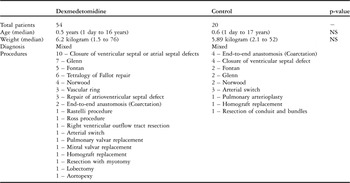
A total of 54 patients received dexmedetomidine during the period of study, and were compared with 20 control patients hospitalized during the same period. There was no difference in age or weight between the two groups, and both groups had a variety of cardiac diagnoses and surgical procedures (Table 1). In those receiving dexmedetomidine, the median age was 0.5 years, with a range from 1 day to 16 years, with 8 patients being less than 1 month of age. The median weight was 6.2 kilograms, with a range from 1.5 to 76 kilograms. All the patients had congenitally malformed hearts, with 50 of those receiving dexmedetomidine, and all the controls, undergoing cardiac surgery during the reviewed hospitalization. Among those receiving dexmedetomidine, 5 had a co-diagnosis of Trisomy 21. The median length of stay for both groups was similar, at 6.2 days and 7 days, as was, overall mortality, with 1 patient dying amongst those receiving the drug, and none of the controls.
Demographic and diagnostic characteristics of the patients and their controls.

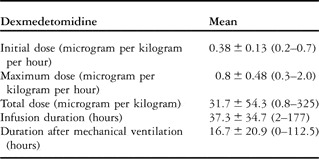
Dexmedetomidine was initiated in the immediate postoperative period in the majority of the patients. The mean starting dose was 0.4 micrograms per kilogram per hour, with a range from 0.2 to 0.7. The mean maximum dose was 0.8 micrograms per kilogram per hour, ranging from range 0.3 to 2 (Table 2). All patients received continuous infusions, with no loading doses or boluses given. Doses were titrated to achieve an adequate level of sedation and behavioural scores were documented using the COMFORT scale. Patients remained on infusions from 2 hours to 177 hours, with a mean duration of 37.3 hours. Dexmedetomidine was discontinued when continuous sedation was no longer needed. No discontinuation occurred secondary to ineffectiveness or adverse effects. It was necessary in 22 (40%) of our patients to extend the duration of infusion beyond a maximum of 24 hours, thus exceeding the recommendations of the manufacturer. It proved possible to extubate 40 of our patients (75%) while they were receiving infusions of the drug, these patients remaining on the drug for a mean of 16.7 hours, with a range from zero to 112.5 hours subsequent to extubation (Table 2).
Dosage of dexmedetomidine.

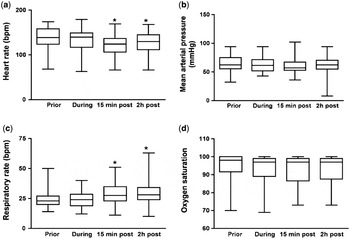
We noted no clinically significant changes in physiologic parameters within the group receiving the drug at any time point evaluated (Fig. 1). Mean heart rates were statistically lower after the discontinuation of the infusion compared to prior to or during the infusion, at 120 and 124 beats per minute as opposed to 138 and 133 beats per minute, respectively (p < 0.05). These differences were not clinically significant. Respiratory rates were also statistically higher 15 minutes and 2 hours after the infusion compared to prior to or during the infusion, at 29 breaths per minute as opposed to 24 breaths per minute (p < 0.05), again without clinical significance. There was no difference in mean arterial pressure or saturations of oxygen at any time point evaluated (Fig. 1). No clinically significant changes in physiologic parameters requiring additional intervention were noted at any time during the infusions. Of note, many of the patients were on infusions of dopamine and milrinone at low doses immediately after the operation, albeit that there was no increase in the need for inotropic support in any of the reviewed patients.
Physiologic parameters prior to, during and after infusion of dexmedetomidine. Dexmedetomidine does not result in clinically significant changes in physiologic parameters during the initiation, maintenance, or discontinuation of the infusion. Haemodynamic and respiratory parameters (heart rate (a), mean arterial pressure (b), Sp02 (c), and respiratory rate (d); minimum, lower quartile, median, upper quartile, and maximum) are shown from 2 hr prior to the initiation, 2 hr after the initiation, the first 15 minutes after the discontinuation, and 2 hr after the discontinuation of the dexmedetomidine infusion. * = significantly different from values prior to and during the infusion.

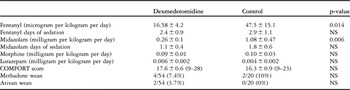
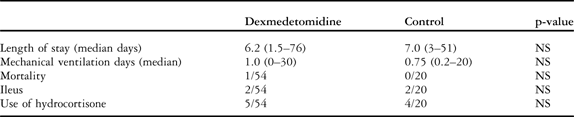
Patients who received dexmedetomidine received significantly less fentanyl and midazolam compared to their controls (Table 3). The mean total dose of fentanyl over the stay in hospital decreased from 47.5 micrograms per kilogram per day of drug use in the control group to 16.58 micrograms per kilogram per day in those patients receiving dexmedetomidine (p = 0.014). The mean total dose of midazolam was 0.26 milligrams per kilogram per day in those receiving dexmedetomidine compared to 1.08 milligrams per kilogram per day in the controls (p = 0.006). The durations of the infusions of fentanyl and midazolam were not significantly different between those receiving dexmedetomidine and their controls, although a trend was noted toward earlier termination of the infusions of narcotics in those receiving dexmedetomidine. Throughout management, sedation was assessed by nurses trained in paediatric intensive care, and medications were titrated to achieve clinically acceptable levels of sedation. Scores using the COMFORT scale were recorded every 2 hours during their stay. Despite the decrease in additional requirements for narcotics and sedatives in those receiving dexmedetomidine, the average scores were not significantly different between the 2 groups, at 17.6 versus 16.3. As shown in Table 4, there was no difference in any clinical outcome between the two groups, including length of stay, days of mechanical ventilation, and mortality. There was also no noted difference between the two groups in secondary clinical outcomes, such as the need for hydrocortisone, the need for a wean from narcotics using ativan or methadone, or gastrointestinal complications.
Comparative use of narcotics and opioids with or without dexmedetomidine.

Clinical outcomes.

Discussion
Dexmedetomidine has a mechanism of action and profile that make it a potentially useful sedative and analgesic agent for patients in paediatric intensive care.Reference Tobias1, Reference Phan and Nahata9 Given the relative dearth of clinical information on its use in children, we have described here our own recent experience. We found the agent to be safe from the stance of both the physiology and outcomes achieved. We used the drug over an extended period of time, exceeding 24 hours in two-fifths of the patients, also using it through extubation in three-quarters, suggesting the relative lack of respiratory depression noted in previous studies. We also somewhat unexpectedly found that the use of dexmedetomidine reduced the total use of opiates and benzodiazepines by up to three-quarters, while providing equivalent sedation. Together, our results support the idea that dexmedetomidine may be a safe and efficacious agent for use in the paediatric intensive care unit.
The agent exerts its physiologic effects primarily through agonism of α2 adrenergic receptors in the central nervous system.Reference Doze, Chen and Maze13 Resultant increased firing of inhibitogy GABA-nergic neurons mediate its sedative effects, while spinal cord α2-receptors mediate its major analgesic effects.Reference Phan and Nahata9, Reference Petroz, Sikich and James11 The drug has a number of features that recommend its use as a sedative in patients requiring intensive care. It provides natural, sleep-like, sedation,Reference Nelson, Lu, Guo, Saper, Franks and Maze14 allowing for rapid wakening and accurate neurologic assessments and preventing delirium and narcosis.Reference Tobias1, Reference Shehabi, Ruettimann, Adamson, Innes and Ickeringill2 It has a distribution half-life of approximately 6 minutes, and a short half-life of approximately 2 to 3 hours, even shorter in infants, thus providing a rapid onset of effect and a rapid recovery.Reference Petroz, Sikich and James11 It undergoes hepatic metabolism, has no toxic metabolites, and levels are largely unaffected by renal impairment.Reference Venn, Newman and Grounds4, Reference Petroz, Sikich and James11 It also has an apparently large therapeutic window, demonstrating few adverse effects at doses of up to 6 micrograms per kilogram per hour, or even at inadvertently high doses of micrograms per minute, instead of micrograms per kilogram per hour.Reference Petroz, Sikich and James11, Reference Rosen and Daume15 Physiologically, it has been demonstrated to decrease myocardial demand for oxygen,Reference Willigers, Prinzen, Roekaerts, de Lange and Durieux16 to prevent arrhythmias,Reference Kamibayashi, Hayashi, Mammoto, Yamatodani, Sumikawa and Yoshiya17 reduce cardiac ischaemia,Reference Roekaerts, Prinzen and De Lange18 to reduce ischaemic neurologic injury and infarcted volume in animal models,Reference Hoffman, Kochs, Werner, Thomas and Albrecht19, Reference Kuhmonen, Pokorny and Miettinen20 to attenuate opioid-induced muscle rigidity, shivering, and withdrawal,Reference Furst and Weinger21 and to reduce the systemic inflammatory response to endotoxin.Reference Taniguchi, Kidani, Kanakura, Takemoto and Yamamoto22 It also has no effect on intracranial pressure,Reference Talke, Tong, Lee, Caldwell, Eisenach and Richardson23 has no consistent effect on the threshold for seizures,Reference Miyazaki, Adachi, Kurata, Utsumi, Shichino and Segawa24, Reference Mirski, Rossell, McPherson and Traystman25 does not affect steroidogenesis,Reference Maze, Virtanen, Daunt, Banks, Stover and Feldman26 and has significantly less effect on gastrointestinal motility than opiates such as morphine.Reference Asai, Mapleson and Power27 Overall, therefore, dexmedetomidine has an extremely favorable physiologic and therapeutic profile when considered for use in the setting of intensive care.
We used the agent frequently. Our chosen population, the largest number of children reported to date, was made up of pre- and post-operative patients in cardiothoracic intensive care. A similar, but smaller, population of children had previously been studied, these earlier workers showing dexmedetomidine to be well-tolerated and effective.Reference Chrysostomou, Di Filippo and Manrique8 We were able to attain adequate sedation in our patients, albeit requiring higher doses of infusions than previously reported in children.Reference Buck and Willson7, Reference Chrysostomou, Di Filippo and Manrique8 Previous studies, nonetheless, have also demonstrated that patients less than 1 year of age require higher doses of dexmedetomidine.Reference Chrysostomou, Di Filippo and Manrique8 Over half of our patients were aged less than 1 year, which could explain the need for higher doses we required to achieve similar sedation. Even at higher doses, our findings confirmed that dexmedetomidine is well tolerated and does not induce significant physiologic changes when used as a continuous infusion.
Perhaps most importantly, dexmedetomidine does not induce respiratory depression, even in large doses. Although not addressed by our data, overdoses have been found to have minimal respiratory effects.Reference Petroz, Sikich and James11, Reference Rosen and Daume15 We found that infusions of dexmedetomidine were continued through extubation in three-quarters of our patients, potentially easing the process and reducing failure to extubate. Patients receiving dexmedetomidine are able to maintain adequate levels of sedation, as measured by scores on the COMFORT scale, while avoiding hypopnea, bradypnea or apnea, and narcosis, commonly a frustrating balance, especially in neonates and infants. Not only does this allow its use through extubation, easing the transition, it may allow for more rapid ventilator weaning.
Most cardiovascular adverse effects of dexmedetomidine have been noted to arise when the drug is given as a bolus.Reference Bloor, Ward, Belleville and Maze28 The lack of cardiovascular effects that we noted may have resulted from the lack of such dosing. We were able to achieve adequate sedation in all our patients when using dexmedetomidine as a continuous infusion. A recent study in adults examining the extended use of dexmedetomidine also found that using the drug as an infusion, and avoiding boluses, eliminated significant haemodynamic effects.Reference Shehabi, Ruettimann, Adamson, Innes and Ickeringill2 We did not, however, specifically evaluate points of titration of the medication during the infusion. It is possible that increases or decreases in the rate of infusion resulted in fluctuations in physiologic parameters that were not captured by our broad analysis. Also, since infusions of dopamine at low doses are routinely used postoperatively in our unit, this also could have had a minor effect on cardiovascular parameters. In almost all cases, we also terminated the infusion abruptly, and found no significant change in haemodynamic variables after cessation of the infusion. Overall, we found dexmedetomidine to be safe and well-tolerated physiologically.
Our finding that dexmedetomidine significantly reduced the total doses of opiates and benzodizepines used is also consistent with a recent smaller series of children investigated in the setting of medical paediatric intensive care.Reference Buck and Willson7 Considering the fact that dexmedetomidine does not result in significant withdrawal upon discontinuation,Reference Shehabi, Ruettimann, Adamson, Innes and Ickeringill2, Reference Venn, Newman and Grounds4 such a reduction in the use of narcotics could have significant effects on length of stay and clinical outcome. While we found no difference in length of stay, days of mechanical ventilation, or mortality, a controlled trial examining the potential benefits of dexmedetomidine on these outcome variables seems justified.
A detailed cost analysis was not conducted in our study. The higher cost of dexmedetomidine compared to fentanyl and midazolam will increase expenditure to some degree. As an example, for a hypothetical 4 kg neonate using dexmedetomidine at a dose of 1 microgram per kilogram per hour in place of an approximately equipotent dose of midazolam for the mean duration of 37 hours that we found in our study, an excess cost of approximately $86.12 per patient for the stay in hospital would be incurred. If the safety and effectiveness of dexmedetomidine as a sedative truly reduces narcotic and benzodiazepine usage and their side effects, however, it may also reduce the time of intubation, the length of stay in intensive care and hospital, and the total healthcare costs. Further controlled cost-effectiveness studies need to be conducted.
Our study suffers from several limitations. It is a retrospective review without controlled randomization. The use of the agent was decided entirely on the basis of the preference of the physician, allowing for potential inherent differences between those who did or did not receive the drug. In addition, dosing and the evaluation of the level of sedation was not confirmed by multiple observers. With our small population, an adverse side effect that may occur at a low incidence would not be identified. Further large scale trials are needed to definitively examine the safety and efficacy of dexmedetomidine in children.
In nearly half our patients, we continued the infusions for longer than 24 hours, with no noted adverse effects. Studies in adultsReference Shehabi, Ruettimann, Adamson, Innes and Ickeringill2 and childrenReference Buck and Willson7 have also reported use of dexmedetomidine for more than 24 hours. As with our experience, these studies found the drug to be well-tolerated and without significant adverse effects. Adding to these findings, our data represents the largest description of the extended use of dexmedetomidine in children. We found no adverse effect of the drug on any clinical outcome examined.
Thus, in this limited and retrospective review, dexmedetomidine was found to be safe and efficacious. It reduced requirements for narcotics and sedatives, while providing adequate sedation. It had no noticeable adverse effects, despite its use significantly beyond the recommendations of the manufacturer for dosing and duration of use. Its use as a sedative agent for extended periods of time in children deserves further prospective, randomized controlled trials.
Acknowledgements
We thank the staff of the Eller Congenital Heart Center and the Pediatric Cardiothoracic Intensive Care Unit at St. Joseph’s Hospital in Phoenix for their enthusiastic support of our efforts. We also thank Edward Rhee, MD, and Eunice Yoon Willis, MD, for critical review of the manuscript. No one involved with the study has any commercial interests or ties related to the subject of the report. Some of the results of this study were reported, in abstract form, at the 2008 Cardiology in the Young conference.