INTRODUCTION
A well-known feature of French grammar is the obligatory replacement of the complementiser que by the form qui in contexts of subject extraction, as in examples (1) and (2) below, illustrating interrogative and relative structures respectively.
-
(1) Et qui croyez-vous qui ___ paie le déficit ? (Below the line comment, Le Figaro.fr Economie, 19.04.2016)
-
(2) J'employais les expressions que je savais qui ___ le choqueraient le moins [. . .] (Françoise Chandernagor, L'Allée du Roi)
Adopting the terminology of Koopman and Sportiche (Reference Koopman, Sportiche and Svenonius2014), the use of qui illustrated above will be referred to here as ‘special qui’, in order to distinguish it from the type of use in which qui is uncontroversially a wh-pronoun.Footnote 1 The latter use is discussed in 2.1 below.
According to what is arguably the dominant school of thought (see among others Kayne, Reference Kayne, Hensey and Luján1976; Chomsky and Lasnik, Reference Chomsky and Lasnik1977; Pesetsky, Reference Pesetsky1982; Rizzi, Reference Rizzi1990; Rooryck, Reference Rooryck and Rooryck2000; Taraldsen, Reference Taraldsen, Hulk and Pollock2001; Rizzi and Shlonsky, Reference Rizzi, Shlonsky, Sauerland and Gärtner2007, Branigan, Reference Branigan2011; Epstein et al., Reference Epstein, Kitahara, Seely, Epstein, Kitahara and Seely2015), special qui realises C0 within the embedded CP and hence is analogous to the complementiser que. That C0 is manifested as qui rather than que in the specific context of subject extraction is attributed to an apparent constraint affecting the subject position of the embedded clause. The exact nature of this constraint varies from author to author, but in one way or another qui has been claimed to obviate it.
In contrast, Sportiche (Reference Sportiche2011) and Koopman and Sportiche (Reference Koopman, Sportiche and Svenonius2014) have revived the traditional notion that special qui is a relative pronoun. According to these two authors, special qui-clauses are defective (specifically, Pseudo-Relative Small Clauses) and hence lack C0 altogether. By the same token, the wh-subject of a special qui-clause is not Case-marked clause-internally but has its Case valued by a higher probe, namely matrix V. Koopman and Sportiche's analysis thus implies a partial analogy between the subject of a special qui-clause and the embedded subject of an English ECM structure such as Caesar believed him to be loyal. In both instances, the Case-marking of the embedded subject is ‘exceptional’, in the sense that Case is assigned/valued from outside the clause in which the subject originates.
While the present article rejects the view that special qui is a relative pronoun, it builds on the idea that qui-clauses exhibit exceptional Case-marking, and argues that this directly explains why subjects necessarily raise from such clauses. Conversely, developing Chomsky's (Reference Chomsky2013: 47–48) proposal that T–Subject agreement may act as a barrier to subject extraction, it is argued that clauses headed by que disallow subject extraction precisely because they evince a ‘strong’, i.e. Case-inclusive, T–Subject agreement relation. Both lines of argument imply that the ultimate source of (nominative) Case is the phase head C, a finding which offers a new type of empirical support for the emergent view that Agree heads ‘inherit’ their uninterpretable features from phase heads.
Section 1 of the article highlights the relevance of the proposed analysis of the que–qui alternation to the theory of Feature Inheritance. Section 2 critiques the claim that special qui is a relative pronoun. Sections 3 and 4 present and motivate the main analysis. Section 5 offers concluding remarks.
1. FEATURE INHERITANCE AND CASE
One of the most significant recent developments in minimalist theory has been the emergence of the view that Agree heads such as T and V do not enter the derivation bearing their agreement features but ‘inherit’ them from the relevant phase head (Chomsky, Reference Chomsky, Sauerland and Gärtner2007, Reference Chomsky, Freidin, Otero and Zubizarreta2008; Richards, Reference Richards2007; Miyagawa, Reference Miyagawa2005, Reference Miyagawa2006). Empirical evidence for the primacy of the phase head in this regard comes from phenomena such as Complementiser Agreement in certain West Germanic dialects, which can be illustrated by the West Flemish example below (originally from Haegeman, Reference Haegeman1992):
-
(3) Kvinden dan die boeken te diere zyn.
I-find that.3.pl the books too expensive are
‘I find those books too expensive.’
Here it can be seen the complementiser dan agrees in person and number with the subject of the embedded clause, suggesting that the locus of the relevant φ-features is C0 rather T. Phase theory assumes that φ-features are deleted from C0 before completion of the phase in order to prevent the derivation crashing at the next phase (Richards, Reference Richards2007). Overt spellout of C’s φ-features, as in (3), is claimed to render them invisible at the next phase (Chomsky, Reference Chomsky2013: 47), while in languages like English and French an equivalent effect is achieved by transferring them to the lower head T, which subsequently agrees with the subject.Footnote 2
Given that Case-marking/valuation is standardly assumed to correlate with φ-feature agreement, a natural extension of the foregoing model would involve positing that C0 enters the derivation with an abstract Case feature which subsequently percolates down to T, along with C0’s φ-features. An analogue of this assumption, but specific to v*, is supported by salient facts concerning past participle agreement in French. Consider Ruwet's (Reference Ruwet1982: 150) well-known example shown as (4) below:
-
(4) une femme qu'on aurait dit/dite* ne pas être belle
The fact that the participle must be spelled out in a non-agreeing form indicates that there is no Agree relation between matrix V and the relative operator, but the latter nevertheless has its Case valued, presumably by matrix v*. This suggests that the ultimate locus of accusative Case is the phase head v* rather than the corresponding Agree head V. A plausible assumption would thus be that v* enters the derivation bearing an accusative Case feature (which may or may not be inherited by V). Mutatis mutandis, this type of analysis should be applicable to the C-T system as well, as Radford (Reference Radford2004) and Radford and Vincent (Reference Radford, Vincent, Bisetto and Barbieri2007) have proposed. However, according to Chomsky (Reference Chomsky, Freidin, Otero and Zubizarreta2008: 142), in standard probe–goal Agree relations, the structural Case of the goal is valued by ‘intrinsic features of the goal’, a formulation which does not appear to recognise the involvement of the phase head.
It is certainly true that examples of direct Case-marking by finite complementisers have yet to be unearthed. However, matters are different in respect of non-finite complementisers. Thus English for is known to value accusative Case, while in colloquial Spanish the preposition para may be used as a complementiser that values nominative Case:
-
(5) It's too hot for me/*I to drink it.
-
(6) pero está muy caliente para yo/*mí tomarlo (Habla Culta: Caracas: M25)
but is very hot for I/*me to-drink-it
‘but it's too hot for me to drink it’
Similarly, Latin examples such as (7) below appear to have a silent infinitival complementiser that determines accusative Case on the embedded subject, given that the matrix clause is passive:
-
(7) Nam [CP Galbam Africanum Laelium doctos fuisse] traditum est (Cic. Tusc. 1.3)
for Galba.acc Africanus.acc Laelius.acc learned.acc.pl be.inf.past said is ‘For it is reported that Galba, Africanus and Laelius were men of learning’
What is missing, then, is evidence that finite C can determine Case on the subject, on a par with infinitival C. The contention here is that the que–qui alternation provides support for precisely this hypothesis. One type of evidence motivating this view is the striking parallel that exists between qui-clauses and infinitival complements of the type illustrated in the paradigm below (from Koopman and Sportiche, Reference Koopman, Sportiche and Svenonius2014: 53–54):
-
(8)
-
(a) *On croit cet homme être malade
-
(b) L'homme qu'on croit t être malade.
-
(c) Qui croyait-on t être malade?
-
As was first noticed by Godard (Reference Godard1986: 53ff), the class of verbs that select the above type of infinitival complement is very nearly identical with the class of qui-selecting verbs.Footnote 3 Furthermore, both constructions have the singular property of requiring the embedded subject to undergo wh-movement to the matrix clause.
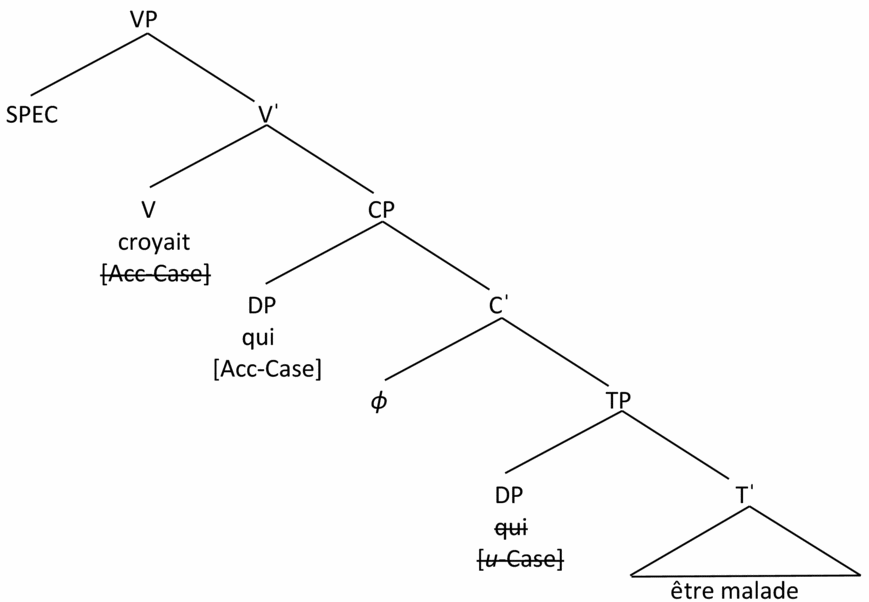
In the case of qui-clauses, this latter property has never been properly explained, whereas for the corresponding infinitival complements a very neat explanation exists in the form of what Kayne (Reference Kayne1981: 356) referred to as ‘Case from above’. Building on Ruwet's (Reference Ruwet1979) and Chomsky's (Reference Chomsky1980) claim that this type of infinitival clause is an instance of CP, Kayne proposed that such clauses are headed by a null preposition ϕ, which lacks the ability to assign Case. The embedded subject thus requires a clause-external Case marker and so must raise out of the embedded subject position. This is shown in Figure 1, which depicts the matrix VP of (8c) – under Kayne's analysis – after the first cycle of wh-movement.
Subject extraction from infinitival CP (Kayne's analysis)

With the notable exception of Koopman and Sportiche (Reference Koopman, Sportiche and Svenonius2014), researchers generally have not entertained the possibility that special qui-clauses might also involve external Case-marking, presumably because there is a tendency to assume that such Case-marking is limited to the subjects of infinitival clauses. However, data from the Turkic language Sakha cited by Baker (Reference Baker2015: 197) and by Baker and Vinokurova (Reference Baker and Vinokurova2010: 615–616) call this assumption into question. Embedded finite subjects in Sakha exhibit a Case alternation whereby they are assigned nominative Case if they follow a clause-internal adverb, as in (9) below, but they must have accusative Case if they precede such an adverb, as in (10).
-
(9) Sardaana [CP bügün Aisen kel-er dien] ihit-te.
Sardaana today Aisen.nom come-aor.3.sing that hear-past.3.sing
‘Sardaana heard that Aisen is coming today.’
-
(10) Min ehigi-ni bügün kyaj-yax-xyt dien erem-mit-im.
I you-acc today win-fut-2.plu that hope-past-1.sing
‘I hoped that you would win today.’
Baker and Vinokurova (ibid., p. 616) take the adverb to occupy a high position in the embedded clause and hence analyse the accusative subject as raising ‘(at least) to the edge of the CP in order to receive this case, probably to a position adjoined to the embedded CP’. They also assume that Sakha is a ‘dependent Case’ language, implying that Case is assigned as a by-product of a specific syntactic configuration rather than through agreement with a functional head. Abstracting away from the manner of the Case assignment, it seems clear that the raised accusative subject in (10) fails to be Case-marked inside the embedded CP, given that in situ embedded subjects receive nominative Case in Sakha. From that perspective, the contrast between (9) and (10) appears to indicate that one mechanism for finite subject extraction involves interrupting the usual pattern of clause-internal Case assignment. This is exactly the suggestion that is being advanced here for subjects that are raised from special qui-clauses.
The precise details of the proposed analysis are specified in Sections 3 and 4. For the moment it suffices to note that within the proposed framework the opposition between qui and que reduces to Case-marking, in the sense that while the presence of qui appears to correlate with the subject failing to receive any Case at all within the embedded clause, the normal assumption that finite subjects receive nominative Case continues to apply in respect of que-clauses. It can be inferred from this state of affairs that nominative Case does indeed originate on the complementiser, rather than on the Agree head T.
2. THE SYNTACTIC STATUS OF SPECIAL QUI
Before detailing the proposed model, we address Koopman and Sportiche's claim that special qui is a relative pronoun rather than a complementiser.
2.1 Qui as a weak relative pronoun
Special qui contrasts with what might be termed ‘regular qui’, i.e. the use of qui as a clearcut wh-pronoun. Regular qui may be either an interrogative pronoun, as in (11), or a postprepositional relative, as in (12):
-
(11) À qui veux-tu que je le dise ?
-
(12) un collègue avec qui je m'entends bien
According to the traditional view, special qui is simply a nominative counterpart to the postprepositional relative illustrated in (12). The opposing view, according to which special qui is a complementiser, rests on two types of evidence, which can broadly be categorised as distributional and semantic. At the heart of the distributional argument is the fact that the distribution of special qui parallels that of the subordinating complementiser que, albeit the former is used in contexts of subject extraction (13a), whereas the latter is used in contexts in which an item other than the subject is extracted, such as the object in (13b), or if no extraction takes place (13c):
-
(13)
-
(a) J'employais les expressions que je savais [qui ___ le choqueraient le moins].
-
(b) J'employais les expressions que je savais [qu'il avait déjà écoutées ___ ].
-
(c) Je savais [qu'il avait déjà écouté ces expressions].
-
The verbs which select special qui (see Footnote note 3) are a subset of the class of bridge verbs, which are known to select complement clauses rather than relative clauses. The latter in principle require an antecedent and, on the face of it at least, bridge verbs fail to make an antecedent available. Thus the type of context in which special qui occurs is not one in which a relative pronoun would normally be expected to occur.
The semantic argument for drawing a distinction between special qui and regular qui is that the latter but not the former is marked as [+human]. As a relative pronoun, regular qui requires a [+human] antecedent – witness the ungrammaticality of (14) – and, as an interrogative, it can only mean ‘who(m)’.
-
(14) *la clé avec qui on ouvre cette porte
Special qui, in contrast, is completely insensitive to the distinction between [+human] and [-human], as is illustrated by its indiscriminate occurrence in the two examples below (both from Koopman and Sportiche, Reference Koopman, Sportiche and Svenonius2014: 46):
-
(15) le type que tu dis qui va gagner
-
(16) la chaise que je pense qui est tombée
Note that the qui of short subject relatives is also insensitive to the [+/-human] distinction, as is shown by (17) and (18) below:
-
(17) un enfant qui joue au tennis
-
(18) une nouvelle qui va faire du bruit
In fact, from Kayne Reference Kayne, Hensey and Luján1976 onwards, the qui of short subject relatives has normally been assumed to be an instance of ‘special qui’, implying that the relative clauses in (17) and (18) are complementiser relatives in which qui is simply a variant of que, exactly as is claimed in relation to the qui of long subject extraction.
As regards the semantic contrast between special qui and regular qui, Sportiche (Reference Sportiche2011: 92–94) has argued that it falls out naturally from the assumption that both types of qui are wh-pronouns but differ in terms of the ‘deficient’ (i.e. weak) versus ‘strong’ dichotomy proposed for pronouns generally by Cardinaletti and Starke (Reference Cardinaletti, Starke and van Riemsdijk1999). According to these latter authors, one element of this dichotomy is that ‘only strong pronouns bear their own [semantic] range-restriction’ (ibid., p. 160), which would immediately account for the fact that special qui – by hypothesis a deficient or weak pronoun – is insensitive to [+/- human]. Cardinaletti and Starke also propose that only deficient/weak pronouns may undergo prosodic restructuring processes such as reduction. Sportiche relates this to the fact that the final /i/ of special qui but not that of regular qui may reduce to a glide in front of a vowel, as is shown in (19) below (from Sportiche, Reference Sportiche2011: 94):
-
(19)
-
a. l'homme qui ouvre la porte ([kyuvR . . .] acceptable)
-
b. Qui ouvre la porte ? (*[kyuvR . . .] not acceptable)
-
Sportiche's analysis is plausible in terms of accounting for the semantic and phonological properties of special qui, but it has little to say about the distributional argument alluded to at the beginning of this section. This issue is addressed in Koopman and Sportiche's Reference Koopman, Sportiche and Svenonius2014 article, which is discussed in 2.2 below. One point that should be borne in mind is that the distributional argument is relevant primarily to the ‘long extraction’ context illustrated by the earlier examples (1) and (2). For it is only in those kinds of example that qui occurs in a syntactic context in which a relative pronoun is unexpected. In contrast, in short subject relatives like (17) and (18), qui occurs in exactly the position in which a relative pronoun would be expected to occur, viz. inside a DP and immediately after a nominal antecedent. Therefore, given that Sportiche's analysis accounts neatly for the semantic and phonological differences between special qui and regular qui, there is no obvious impediment to deeming the special qui of short subject extraction to be simply a weak counterpart to regular qui, specifically a weak relative pronoun.Footnote 4
2.2. The qui of long subject extraction
The central argument in Koopman and Sportiche Reference Koopman, Sportiche and Svenonius2014 (henceforth ‘K&S’) is that the special qui of long extraction can be identified with the relative pronoun qui that occurs in pseudo-relative small clauses (PRSC), as in (20) below:
-
(20) J'ai entendu [PRSC Jean qui se faisait chahuter].
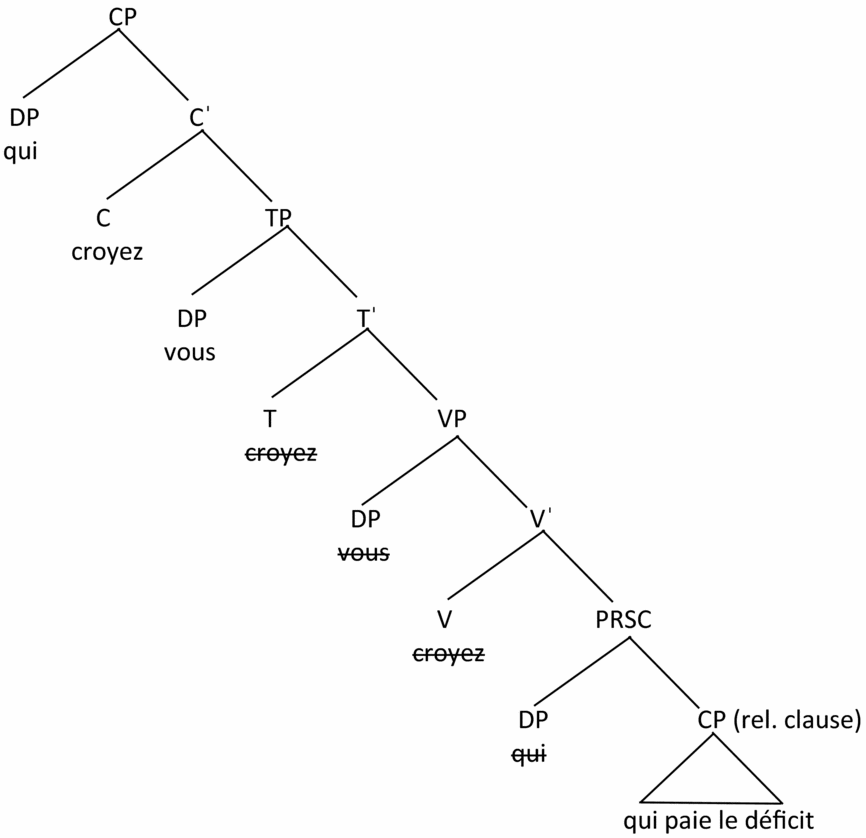
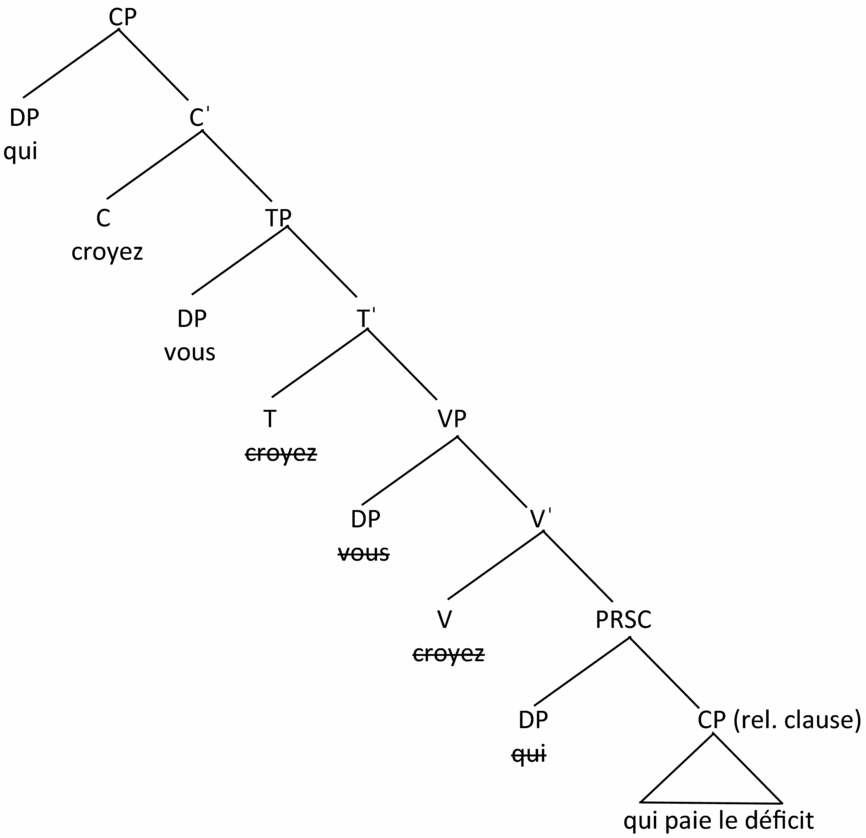
On this view, apparent long subject extraction in French is actually short extraction, in the sense that the structure out of which the subject raises is a small (i.e. defective) clause rather than CP. For example, the sentence Qui croyez-vous qui paie le déficit ? would be analysed as in Figure 2 below, which shows the higher (interrogative) qui originating as the subject of the PRSC and a lower (relative) qui heading a relative clause (CP) predicated of that subject. In this way, K&S appear to provide an answer to the distributional argument against treating special qui as a relative pronoun.
Special qui as a pseudo-relative pronoun (Koopman and Sportiche Reference Koopman, Sportiche and Svenonius2014)
However, the proposed assimilation of special qui-clauses to the PRSC paradigm faces a number of objections. In the first place, the subject of a French PRSC can undergo A-movement out of its containing clause (see Hoekstra, Reference Hoekstra, Sybesma, Barbiers, Den Dikken, Doetjes, Postma and Vanden Wyngaerd2004; Muller, Reference Muller, Shyldkrot and Kupferman1995; and Guasti, Reference Guasti1988), whereas the subject of a special qui-clause cannot. In (21) below, for example, the subject of the PRSC undergoes passive movement to subject position in the matrix clause:
-
(21) Paul a été vu [PRSC Paul qui réparait son vélo]. (Based on Muller, Reference Muller, Shyldkrot and Kupferman1995: 312)
In contrast, A-movement out of a clause introduced by special qui is never possible. For example, although (22a) below, from Koopman and Sportiche, Reference Koopman, Sportiche and Svenonius2014 (p. 46), is grammatical, the corresponding passive formulation in (22b) is not:
-
(22)
-
(a) le type que tu dis qui va gagner
-
(b) *le type qui est dit qui va gagner
-
This pattern of data suggests that while the complement of voir in (21) is a small clause, as K&S assume, the complement of dire in (22) is actually a phase, specifically CP. According to the Phase Impenetrability Condition (Chomsky, Reference Chomsky and Kenstowicz2001), constituents must pass through spec-CP if they are to be extracted from CP. By definition, movement into spec-CP constitutes A-bar movement (Chomsky, Reference Chomsky, Freidin, Otero and Zubizarreta2008: 150) and hence any subsequent movement to an A-position would violate Chomsky's No Mixed Chains theorem (ibid., p. 152). Therefore A-movement out of CP is not in principle possible, whence the exclusion of (22b). Conversely, the non-phasal status of the PRSC in (21) enables the embedded subject to raise directly to the matrix subject position.
An analogue of the contrast just described is also apparent in terms of past participle agreement. The latter phenomenon is known to be sensitive to the distinction between phases and non-phases (see e.g. Radford and Vincent, Reference Radford, Vincent, Bisetto and Barbieri2007), in the sense that an expression extracted from CP does not trigger participle agreement on matrix V, whereas an expression extracted from a defective clause (e.g. a small clause) does trigger such agreement. It is therefore significant that, according to Grevisse (Reference Grevisse1986: 1374), there can be no participle agreement between matrix V and the raised subject of a qui-clause:
-
(23) Nous subissons les malheurs qu'on avait prévu qui arriveraient.Footnote 5
Conversely, in the second sentence of (24) below, matrix V agrees with the subject of the embedded PRSC and hence is spelled out in the feminine as vue:
-
(24) Elle pris [sic] le cabas et elle a gagné la kitchenette. Je l'ai vue qui sortait du sac un paquet de café moulu. (Jean-Patrick Manchette, Que d'os !)
The facts pertaining to past participle agreement thus complement the facts pertaining to A-movement, both suggesting that special qui should not be identified with pseudo-relative qui.
A second reason for querying K&S's analysis is that while the subject of PRSC may remain in situ – see example (20) above – there is no equivalent ‘subject in situ’ structure with special qui, as is shown by the ungrammaticality of (25):
-
(25) *J'ai dit [PRSC Jean qui se faisait chahuter].
According to K&S, formulations like (25) are ruled out due to a Case-marking failure. This assertion is based on the fact that verbs which select special qui are systematically capable of appearing in the prolepsis structure involving dont illustrated by (26) below, in which K&S analyse matrix V as assigning structural accusative Case to the embedded CP and a ‘proleptic’ genitive Case to the relativised argument expressed by dont:
-
(26) l'homme dont Marie croit qu'il est honnête.
(Koopman and Sportiche, Reference Koopman, Sportiche and Svenonius2014: 61)
K&S propose that this analysis of the dont structure carries over to special qui, modulo the difference that, in the latter structure, the proleptic Case assigned by matrix V is accusative rather than genitive. They further claim (ibid. p. 86) that proleptic accusative Case is licensed ‘very high in the spine of the clause structure’, meaning that if the structural or ‘low’ accusative Case is used up to Case-mark the embedded PRSC, the embedded subject must raise in order to receive (‘high’) proleptic accusative Case. Examples like (25) are thus ruled out because the embedded subject fails to receive any Case at all.
However, K&S's account appears to rely on at least two stipulations. In the first place, there does not appear to be any independent justification for the proviso that the proleptic Case of matrix V in the context of special qui must be accusative rather than genitive (as it is in the prolepsis structure on which K&S's analysis is based). Without that proviso, K&S's model would over-generate, as there would then be nothing to rule out a structure such as (27) below, where the subject of the PRSC receives genitive proleptic Case rather than accusative proleptic Case and hence is spelled out as dont:
-
(27) *l'homme dont i Marie croit [PRSC t i qui est honnête]
The second stipulation is a consequence of the fact that small clauses – including PRSCs – do not actually require Case at all, a principle which K&S readily accept (ibid., p. 63). If such clauses do not need Case, then the notion that matrix V in special qui contexts uses up its structural/low accusative Case to license the embedded clause (by hypothesis a PRSC) needs to be stipulated. Without that stipulation, matrix V can simply assign its low accusative Case to the embedded subject, which could thus remain in situ, producing the illicit structure shown in (25).
As an anonymous referee points out, there is an additional argument against K&S's Case-based explanation for the exclusion of (25). This stems from the ungrammaticality of passive structures such as (28) below:
-
(28) *Jean a été dit [PRSC Jean qui se faisait chahuter].
Here the embedded subject should be able to receive nominative Case from matrix T, thus overcoming the alleged cause of the ungrammaticality in examples like (25). Nevertheless, the sentence is still ungrammatical, suggesting that the problem affecting (25) does not reduce to a failure of the embedded subject Jean to have its Case valued.
Summing up this section so far, the following arguments can be made against K&S's proposed identification of the special qui of long extraction with pseudo-relative qui:
-
(i) A-movement out of a special qui-clause is prohibited, whereas A-movement out of PRSC is permitted;
-
(ii) Past participle agreement between matrix V and the raised subject of a special qui-clause is disallowed, whereas such agreement is possible between matrix V and the raised subject of PRSC;
-
(iii) In special-qui clauses the subject must raise, whereas in PRSCs the subject can remain in situ.
The evidence thus suggests that special qui – in contexts of long subject extraction at least – is not a relative pronoun.Footnote 6 Accordingly, there does not seem to be any overriding reason to reject the common assumption that long extraction qui is a complementiser. On the other hand, as was stated at the end of 2.1, it seems reasonable to analyse the qui which occurs in short subject extraction as a (weak) relative pronoun, as is proposed by Sportiche (Reference Sportiche2011). This separation of short extraction qui from long extraction qui appears moreover to be reflected in speaker attitudes, given that short extraction qui is uniformly accepted whereas long extraction qui is known to be disfavoured or even rejected by some native speakers (see Adli, Reference Adli, Kepser and Reis2005: 13; Rizzi and Shlonsky, Reference Rizzi, Shlonsky, Sauerland and Gärtner2007: 131; Posner, Reference Posner1996: 307; Le Flem, Reference Le Flem1992: 163; Grevisse, Reference Grevisse1986: §1062).
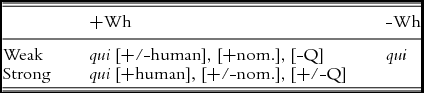
Table 1 above summarises the tripartite taxonomy of qui’s that has emerged from the preceding discussion.
Summary of ‘types’ of qui
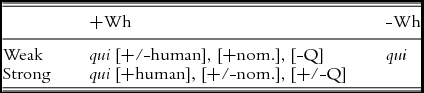
In what follows, the term ‘special qui’ will be reserved exclusively for the [-wh] category.
3. DECOMPOSING SPECIAL QUI
We now turn to the technical details of how, if special qui is a complementiser, the subject of a qui-clause ends up being externally Case-marked. The key to solving this puzzle, it will be argued, lies in the morphology of special qui.
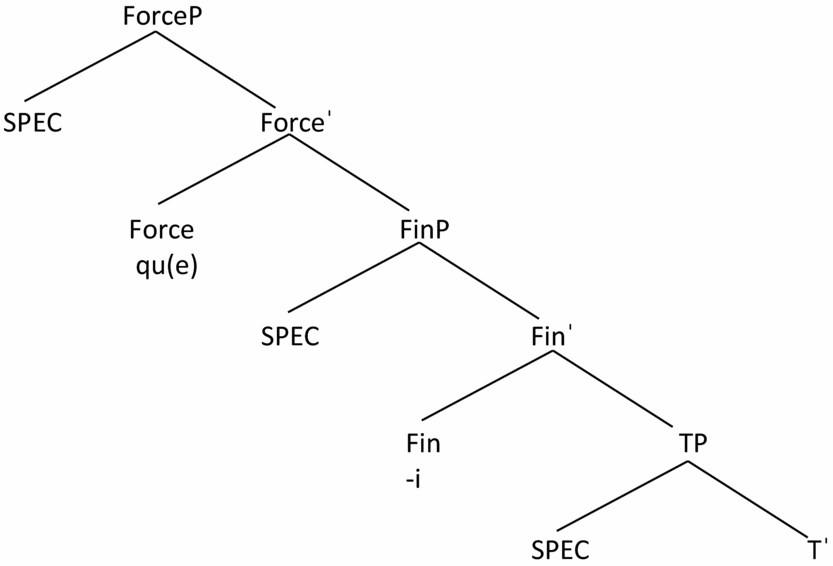
While earlier analyses took this item to be an allomorph of que, more recent analyses (Rooryck, Reference Rooryck and Rooryck2000; Taraldsen, Reference Taraldsen, Hulk and Pollock2001; Rizzi and Shlonsky, Reference Rizzi, Shlonsky, Sauerland and Gärtner2007; and Epstein et al., Reference Epstein, Kitahara, Seely, Epstein, Kitahara and Seely2015) tend towards a decomposition of special qui into a lexical root qu(e) and a nominal suffix -i, understood as a reduced form of il. This synchronic approach dovetails straightforwardly with diachronic proposals such as Posner's (Reference Posner1996: 307), according to which special qui may have originated from a fusion of que and an immediately following il, the latter occurring as a resumptive subject in contexts of subject extraction. Tobler (Reference Tobler and Kuttner1905: 161) provides examples such as (29) and (30) below, which indicate that resumptive structures of the kind envisaged did indeed occur in Old French:
-
(29) uns freres Qu'ele disoit qu'il ert ses peres (Roman de la rose, 8131)
‘un frère qu'elle disait qu'il était son père’
-
(30) Aucunes fois seult l'en baisier Tel main qu'en vodroit qu'el fust arse (ibid., 12991)
‘parfois on baise telle main qu'on voudrait qu'elle soit brûlée’
An implicit assumption of the view just outlined is that resumptive il – pronounced [i] – was reanalysed out of subject position and in the process lost its person and number features. Such an assumption would be entirely consistent with Roberts and Roussou's (Reference Roberts and Roussou2003) hypothesis, according to which grammaticalisation equates to upward reanalysis. In this case, the pronoun il, a spec-TP element, is grammaticalised as a C0 suffix and thus comes to occupy a higher position in the syntactic tree.
An obvious question, therefore, is where -i has come to be located within the C-system. As an affix, -i is required to be linearly adjacent to its lexical host, viz. the complementiser qu(e), but that condition does not entirely determine its structural locus. The null assumption concerning the host qu(e) would be that it occupies Force0, given that this particular complementiser is known to be an exponent of declarative force, standing in opposition to interrogative si, for example. In contrast, the suffix -i plays no role in the marking of force, as can be seen from the fact that standard examples of declarative complement embedding, as in (31), involve just que:
-
(31) François Hollande savait que les pièges étaient nombreux. (LeMonde.fr, 15/10/2012)
Indeed, the sole context in which the -i suffix occurs is that in which an embedded wh-subject is extracted from a finite embedded clause and then raised to a higher clause. The distribution of -i is thus complementary to that of Kayne's null preposition ϕ (see section 1 above), which occurs in the non-finite analogue of the -i context, giving rise to paradigms such as (32) below:
-
(32)
-
(a) un homme que je crois [ϕ t être malade]
-
(b) un homme que je crois [qu+i t est malade]
-
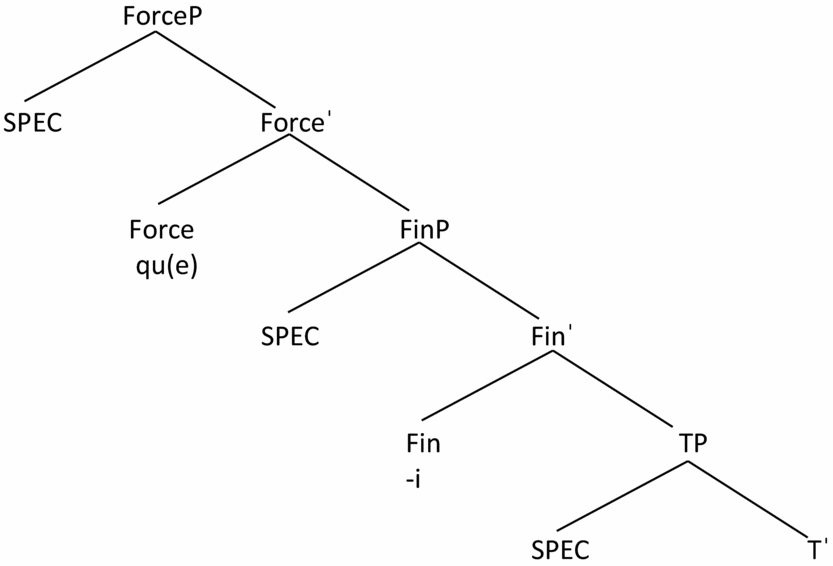
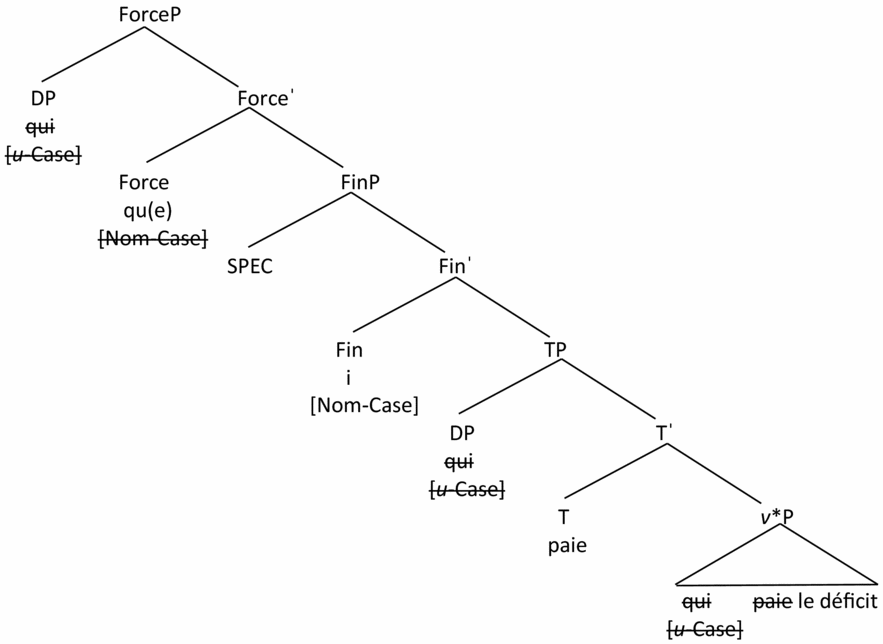
Given that its presence correlates with finiteness, the suffix -i is most plausibly assigned to Fin0, the head of the projection regulating the finiteness of the clause. We thus arrive at the structural model shown in Figure 3.
Proposed analysis: the structure of the ‘qu(e) + -i’ complex
A further question that arises from the view that -i was originally a spec-TP element is whether this item retains its ability to satisfy the EPP or whether this capability has been lost. For Taralsden (Reference Taraldsen, Hulk and Pollock2001) and Rizzi and Shlonsky (Reference Rizzi, Shlonsky, Sauerland and Gärtner2007), the possibility for -i to satsify EPP is central to their account of why qui replaces que in contexts of subject extraction. However, if qui is merely a complementiser plus an EPP satisfier, then, given (33a) below, one would also expect (33b) to be possible, with -i compensating for the missing expletive subject:
-
(33)
-
(a) Je crois qu'il reste beaucoup de choses à faire.
-
(b) *Je crois qui reste beaucoup de choses à faire.
-
Rizzi and Shlonsky (Reference Rizzi, Shlonsky, Sauerland and Gärtner2007: 137) implicitly rule out formulations such as (33b) by positing a number feature on -i which can only be valued by the subject raising to spec-Fin. However, such a requirement appears to be stipulative, given that agreement phenomena are now regarded as involving closest c-command rather than specifier-head relations (cf. Chomsky, Reference Chomsky and Kenstowicz2001, Reference Chomsky, Freidin, Otero and Zubizarreta2008, Reference Chomsky2013). A particularly relevant example is West Flemish complementizer agreement, which, as noted by Carstens (Reference Carstens2003: 394), appears to involve nothing more complex than c-command between C0 and the subject in the TP edge:
-
(34) Kvinden [CP [C dan] [TP die boeken te diere zyn]]. (Originally from Haegeman Reference Haegeman1992)
I-find that-pl the books too expensive are
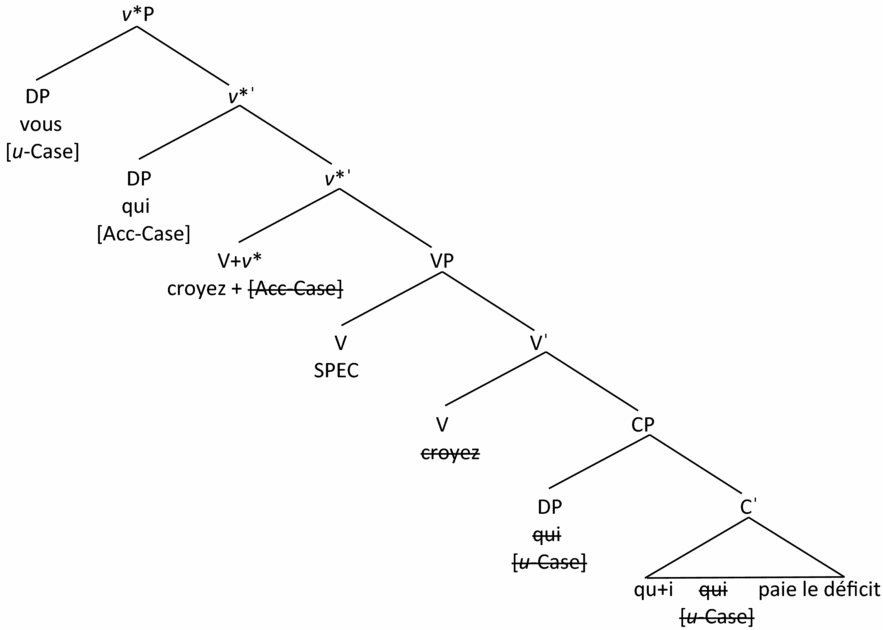
The view that -i satisfies EPP is thus difficult to sustain. An alternative assumption, and one that is rendered plausible by the status of -i as a nominal, is that the suffix enters the numeration bearing an unvalued Case feature. This Case feature cannot be valued as part of an Agree relation with T, given that Agree requires c-command and T does not c-command Fin0. However, as the occupant of Force0, the complementiser qu(e) does c-command -i and hence can value the latter's Case, if, as is being proposed, phase heads are the locus of Case. In this scenario, qu(e)’s Case feature is discharged into -i before it can be transferred to T, entailing that T cannot Case-mark the subject. The latter therefore needs to be Case-marked by an external probe and hence must raise. This analysis is illustrated in Figures 4 and 5 below, which depict the matrix v*P phase of the example Qui croyez-vous qui paie le déficit ?, with Figure 5 providing a fine-grained diagram of the embedded CP, split into its constituent functional layers.
Proposed analysis: matrix v*P

Proposed analysis: embedded CP

The foregoing model leads to an interesting prediction concerning passive clauses, where v* is not projected and hence the only available Case is nominative, assigned by T (by hypothesis inheriting its Case from C0). According to the ‘no mixed chains’ theorem of Chomsky Reference Chomsky, Freidin, Otero and Zubizarreta2008, a non-phasal head such as T cannot probe into an A-bar position such as spec-CP. One would thus expect extraction from a qui-clause into a passive clause to be problematic. According to the judgement in (35) reported by Kayne, this prediction appears to be fulfilled.
-
(35) *les tables qu'il a été dit [CP qui __ seraient repeintes les premières]
(Kayne, Reference Kayne2000: 15)
However, for at least some speakers, including a reviewer of this article, formulations such as (35) are acceptable. Kayne himself (e-mail correspondence) suggests that variation in this area might reflect a parametric difference which splits French speakers into two or more subsets. Pursuing the view that nominative Case originates on the phase head C, one possibility would be that some speakers allow direct nominative Case-marking by C, analogously to the way in which φ-features can be directly valued by C in West Flemish. The raised relative operator in (35) could thus have its Case valued by matrix C with no violation of the ‘no mixed chains’ theorem.
4. SUBJECT-EXTRACTION FAILURE FROM QUE-CLAUSES AND DYNAMIC ANTISYMMETRY
The previous section provides a plausible account of the way in which embedded clauses introduced by special qui work and of why the subjects of such clauses undergo obligatory wh-movement. However, it did not address the question of why subject extraction is prohibited in the corresponding clauses introduced by que, an issue which in fact has never been satisfactorily explained. Given what has been said so far about qui, the expectation would be that Case should hold the solution to this puzzle. It is thus instructive to return to the earlier example (10) from Sakha, which is reproduced below:
-
(10) Min ehigi-ni bügün kyaj-yax-xyt dien erem-mit-im.
I you-acc today win-fut-2.plu that hope-past-1.sing
‘I hoped that you would win today.’
As was observed previously, a condition for the extraction of the embedded subject ehigi is that it is spelled out with accusative Case, rather than the nominative Case that it would have if it remained in situ. This implies that, in some instances at least, nominative Case may block subject extraction. In light of this, and bearing in mind that Case-marking and agreement are operations which have long been assumed to be related, it is significant that Chomsky has recently linked subject extraction failures to agreement within the inflectional domain.
Chomsky's linkage is made within the context of a reinterpretation of Moro's (Reference Moro2000) principle of ‘dynamic antisymmetry’ in terms of labelling. Generalising Moro's analysis of copular small clauses, Chomsky posits that phrase-level constituent raise whenever the immediately dominating structure has ‘an inherent instability’ (Chomsky, Reference Chomsky, Freidin, Otero and Zubizarreta2008: 160, n.34). If no such instability exists, raising is prevented. In the theory advanced in Chomsky Reference Chomsky2013, the relevant instability is cast as a failure to receive a label, with only syntactic atoms, i.e. heads, analysed as entering the derivation bearing a pre-assigned label. Under the assumption that non-atomic constituents inherit the label of their structurally least embedded head, symmetric structures of the form {XP, YP} fail to acquire a label unless the heads X and Y deliver the same label, either because X and Y are actually identical or because they agree in terms of what Chomsky calls a ‘prominent feature’ (ibid., p. 45). A paradigm instance of the latter scenario arises in embedded interrogative clauses, such as (36) below (Chomsky's example (22)):
-
(36) they wondered [α in which Texas city [β C [JFK was assassinated]]]
Here the unit α has the structure {XP, YP}, with the two heads X and Y agreeing in terms of the interrogative feature [Q]. Accordingly, α receives the label ‘Q’ and raising of the wh-phrase is prevented.
The case, which is relevant to the present article, is when XP is the subject and YP is a projection of T (informally T-bar). For this case, Chomsky proposes that φ-feature agreement between X and Y enables the containing unit – informally TP – to receive a label, thus preventing further raising of the subject. Built into this analysis is the notion that C transfers its Force feature to T, and that it is this feature which mediates the φ-feature agreement between T and the subject (ibid., pp. 47–48). The possibility of subject extraction in English under that-deletion then follows if such deletion is analysed as resulting in a weakened C system, lacking Force. Without the presence of Force, φ-feature agreement between T and the subject is insufficient to induce labelling of TP and hence the subject is free to raise.
Turning to the French que–qui alternation, an appeal to Force deletion would obviously be implausible, given that qui is not a reduced form of que, but actually builds on it morphologically. Indeed, the tenor of the article so far has been that the additional morphology manifested by qui results ultimately in the subjects of qui-clauses failing to have their Case valued clause-internally. It seems clear, however, that the absence of a nominative feature on T in French qui-clauses has an analogous effect to the absence of Force on T in English clauses which exhibit that-deletion, in the sense that both types of deficiency pave the way for subject extraction from the embedded clause. This suggests that agreement between T and the subject cannot induce labelling unless such agreement results in both matching φ-features and a matching Case feature. A requirement to this effect would pass unnoticed in English, given that neither that nor its phonologically null counterpart that fails to transfer its Case feature to T. We submit that the requirement is rendered transparent in French, owing to the fact that only que, and not qui, transmits a Case feature to T.
Therefore, adopting the framework of dynamic antisymmetry, the proposal is that formulations such as (37) below are ruled out because of the Case-matching between embedded T (inheriting nominative Case from its complementiser) and the embedded subject. The labelling algorithm identifies this ‘shared prominent feature’ and uses it to label the containing unit, conventionally known as ‘TP’.Footnote 7
-
(37) *Qui croyez-vous que paie le déficit ?
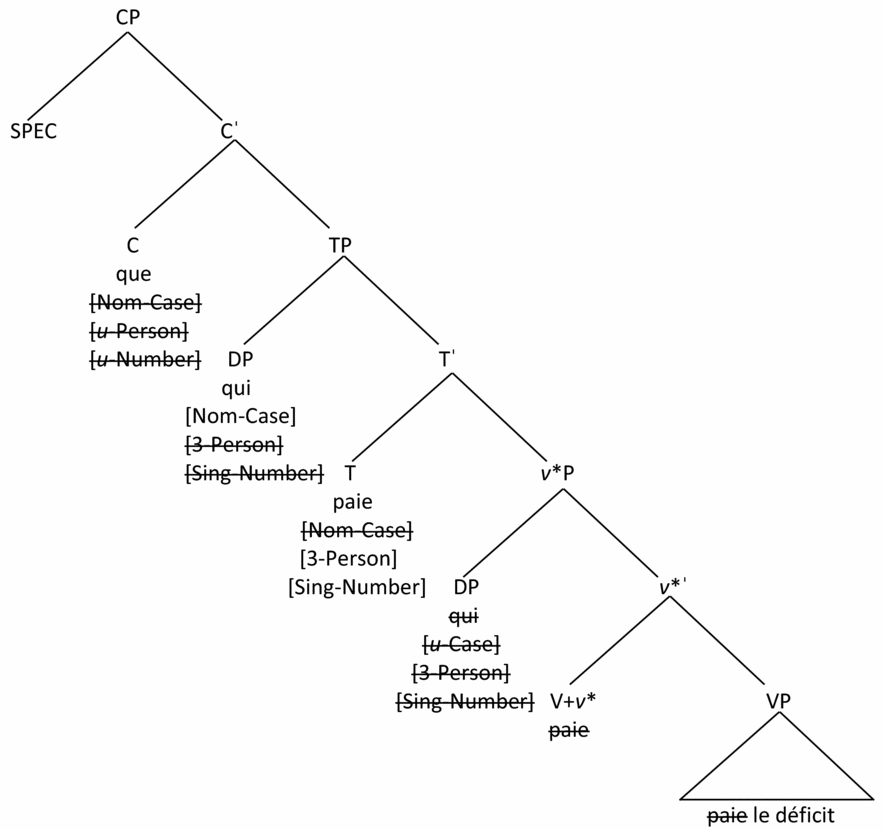
Figure 6 diagrammatises the embedded CP of (37), retaining the label ‘TP’ for expository purposes.
Matching of Case (and φ-features) between T and the Subject in a que-clause

As with the proposed analysis of qui, the model depends crucially on Case originating on the phase head, providing further support for the general approach to Case advanced in this article.
5. CONCLUSION
It has been argued in the present article that the que–qui alternation offers empirical support for the view that nominative Case originates on the phase head C and is then (in the normal course of events) transferred to the Agree head T, analogously to what is assumed to happen to φ-features under Feature Inheritance. In the analysis proposed, the nominal suffix -i on qui absorbs nominative Case, causing the subject to have to raise in order to have its Case valued. Conversely, adopting the dynamic antisymmetry model advanced in Chomsky Reference Chomsky2013, extraction failure with que is analysed as being due to Case-matching between T and the subject, which enables TP to receive a label, thereby forestalling raising of the subject. The que–qui alternation can thus be viewed as being the locus of a Case opposition, implying that C rather than T is the ultimate source for nominative Case.
Cross-linguistically, extraction phenomena appear to intersect with Case in subtly different ways. The findings here may be related to the well-known English “hypercorrection”, whereby extracted wh-subjects often surface as whom (as in the man whom he said he had seen) and, as was observed earlier, accusative Case-marking in languages like Sakha appears to offer a pathway for subject extraction that is analogous in key respects to the one proposed here for subjects of qui-clauses. The Sakha example is also reminiscent of the ‘proleptic accusative’ of colloquial Latin, which for a long time has represented a challenge to orthodox assumptions about Case assignment. A detailed analysis of these and other similar phenomena has not been attempted in the present article, but the Case-based model of subject extraction advanced here may offer a basis for unifying them within a common framework.