Introduction
Approximately 1.7 million people are affected by traumatic brain injury (TBI) annually in the United States (cdc.gov). Mild TBI (mTBI) is the most common form of TBI, defined by a Glasgow Coma Scale (GCS) score of 13–15 and an altered mental state or loss of consciousness lasting fewer than 30 min following a head injury (Teasdale & Jennett, Reference Teasdale and Jennett1974). While there are phenomenological and etiological differences between sports-related concussion and mild TBI, these milder forms of TBI are distinguished from moderate and severe TBI based upon the range and severity of acute symptoms as well as the recovery trajectory. For our purposes, we combine the mTBI and concussion literatures to investigate the effects of milder forms of TBI on brain functioning.
Functional Imaging and mTBI
There is an ever-growing literature using blood oxygen level dependent functional magnetic resonance imaging (BOLD fMRI, or fMRI) to examine brain alterations associated with brain injury and disease. fMRI provides noninvasive means to examine the secondary effects of neuronal activity by examining relative changes in the hemodynamic response during experimental manipulation. Since the seminal work by McAllister and colleagues (Reference McAllister, Saykin, Flashman, Sparling, Johnson, Guerin and Weaver1999) was published over a decade ago, dozens of fMRI studies investigating the consequences of TBI on cognitive, sensory, and motor functioning have been conducted. Many of these studies have focused on deficits in working memory (WM) and cognitive control (CC) due to the commonly observed deficits in basic information processing after mTBI. WM can be defined as the ability to maintain information “in mind” for online manipulation and use (Baddeley & Hitch, Reference Baddeley and Hitch1994) and CC has been conceptualized as an emergent property of WM, permitting instantiation of goal states and allocation of resources to carry-out goal-directed behavior (Courtney, Reference Courtney2004; Goldman-Rakic, Reference Goldman-Rakic1987; Miller & Cohen Reference Miller and Cohen2001). These two fundamental cognitive capacities are often disrupted following TBI (DeLuca, Schultheis, Madigan, Christodoulou, & Averill, Reference DeLuca, Schultheis, Madigan, Christodoulou and Averill2000; McDowell, Whyte, & D'Esposito, Reference McDowell, Whyte and D'Esposito1997) and, therefore, have been a primary focus in the functional imaging literature.
The results of functional imaging work in TBI have been largely consistent in moderate to severe TBI with the clinical sample often demonstrating increased BOLD signal relative to controls (neural recruitment or “hyperactivation”) in areas of prefrontal cortex (PFC), parietal, and temporal regions. In fMRI studies, decreased neural resource use (or “hypoactivation”) has been rarely observed in moderate and severe TBI (Sanchez-Carrion, Gomez et al., Reference Sanchez-Carrion, Fernandez-Espejo, Junque, Falcon, Bargallo, Roig, Bernabeu, Tormos and Vendrell2008). However, in WM studies comparing mTBI and healthy control (HC) samples, the findings have been less consistent; investigators have alternately reported hyperactivation (Jantzen, Anderson, Steinberg, & Kelso, Reference Jantzen, Anderson, Steinberg and Kelso2004; Lovell et al., Reference Lovell, Pardini, Welling, Collins, Bakal, Lazar and Eddy2007; McAllister et al. 1999; McAllister, Sparling, Flashman, & Saykin, 2001; Slobounov et al., Reference Slobounov, Zhang, Pennell, Ray, Johnson and Sebastianelli2010; Zhang et al., Reference Zhang, Johnson, Pennell, Ray, Sebastianelli and Slobounov2010), hypoactivation (Chen, Johnston, Collie, McCrory, & Ptito, Reference Chen, Johnston, Collie, McCrory and Ptito2007; Gosselin et al., Reference Gosselin, Bottari, Chen, Petrides, Tinawi, de Guise and Ptito2011; Mayer et al., Reference Kim, Yoo, Ko, Park, Kim and Na2009), and occasionally some combination of these effects (Chen et al., Reference Chen, Johnston, Frey, Petrides, Worsley and Ptito2004; Chen, Johnston, Petrides, & Ptito, 2008; McAllister, Flashman, McDonald, & Saykin, Reference McAllister, Flashman, McDonald and Saykin2006; Pardini et al., Reference Pardini, Pardini, Becker, Dunfee, Eddy, Lovell and Welling2010; Witt, Lovejoy, Pearlson, & Stevens, Reference Witt, Lovejoy, Pearlson and Stevens2010).
The interpretations for these differences have varied with authors attributing hypoactivation to damaged neural capacity or failure to engage compensatory mechanisms (Chen et al., 2004, Reference Chen, Johnston, Petrides and Ptito2008). Hyperactivation following TBI has been explained as brain reorganization (Sanchez-Carrion, Fernandez-Espejo, et al., Reference Sanchez-Carrion, Gomez, Junque, Fernandez-Espejo, Falcon, Bargallo, Roig-Rovira, Enseñat-Cantallops and Bernabeu2008; Sanchez-Carrion, Gomez, et al., 2008), neural compensation (McAllister et al., 1999, Reference McAllister, Sparling, Flashman and Saykin2001; Scheibel et al., Reference Scheibel, Newsome, Troyanskaya, Steinberg, Goldstein, Mao and Levin2009), degeneracy and poor regulation of neural resources (Turner & Levine, Reference Turner and Levine2008; Turner, McIntosh, & Levine, Reference Turner, McIntosh and Levine2011), or due to increased demand on available but previously unengaged “latent support” (e.g., CC) (Hillary, Genova, Chiaravalloti, Rypma, & Deluca, Reference Hillary, Genova, Chiaravalloti, Rypma and DeLuca2006; Hillary, Reference Hillary2008; Hillary et al., Reference Hillary, Genova, Medaglia, Fitzpatrick, Chiou, Wardecker and Wang2010; Medaglia et al., Reference Medaglia, Chiou, Slocomb, Fitzpatrick, Wardecker, Ramanathan and Good2011).
The distinctions between explanations for observable hyperactivation have important implications for how we understand the role of neural activity in performance and recovery after TBI. For example, explanations that interpret hyperactivation as brain reorganization or “poor regulation” of resources suggest that hyperactivation is irregular or aberrant. Alternatively, while the commonly used term “compensation” has several possible implications, it typically assumes that hyperactivation operates to facilitate task performance—that is, in the absence of compensatory neural recruitment, there would be a failure to perform or poorer performance of the task. Finally, the notion that increased resources use after TBI may be directly related to inhibition of pre-potent responses and reallocation of attentional resources was first noted in a case study by Scheibel and colleagues (Reference Scheibel, Pearson, Faria, Kotrla, Aylward, Bachevalier and Levin2003); this position was later formally presented as the latent support hypothesis, which proposes that neural recruitment represents the enrollment of readily available, but unengaged, neural resources to manage novel task demands (Hillary et al., 2006, 2008, 2010; Medaglia et al., Reference Medaglia, Chiou, Slocomb, Fitzpatrick, Wardecker, Ramanathan and Hillary2012). According to this position, the transient involvement of additional neural resources is viewed as neither abnormal nor permanent, but rather necessary for task performance. Support for this comes from the finding that the most common site for neural recruitment, the dorsolateral prefrontal cortex, holds a relationship with task reaction time (Hillary et al., 2010) and task novelty and load (Hillary et al., Reference Hillary, Medaglia, Gates, Molenaar, Slocomb, Peechatka and Good2011; Kim et al., 2009; Medaglia et al., 2012; Perlstein et al., Reference Perlstein, Cole, Demery, Seignourel, Dixit, Larson and Briggs2004) in both TBI and matched HC subjects. Cognitive load manipulations frequently increase the complexity of the task or amount of information that an individual must hold in WM. Therefore, PFC recruitment, irrespective of group membership, appears to indicate the natural allocation of CC resources as performance and/or task demand changes. Consistent with this, one of the more common sites for hyperactivation in neurological samples has been in right PFC (Hillary et al., 2006, 2011), which has been shown to be differentially involved in attentional control and developing routines for novel stimuli (Pardo, Fox, & Raichle, Reference Pardo, Fox and Raichle1991). Given this background, we anticipate that the relative degree of cognitive challenge between tasks may be an important determinant of functional brain activation results observed in mTBI.
If it is the case that hyperactivation in mTBI is tied to task load and demand on CC resources as observed in moderate to severe TBI, then we would predict that the relative cognitive load during WM tasks should account for observed activation differences. Specifically, high cognitive load should be associated with hyperactivation, whereas low cognitive load should be associated with hypoactivation. However, only a handful of existing studies of MTBI have explicitly examined the effect of task load on functional activation in mTBI (McAllister et al., 1999, 2001; Pardini et al., 2010). Therefore, as a meta-analytic strategy to examine the hypotheses, we used an alternate way to examine the effects of load across studies. To achieve this, we separated WM tasks into two major categories based on the persistence of attentional engagement throughout the tasks. The goal of this separation was to establish variance in cognitive control/attentional demand across studies and their respective WM tasks. To represent lower cognitive demand, WM tasks were classified as “discrete” in nature if they involved periods of attentional disengagement from stimulation, e.g., during a WM maintenance or “rehearsal” phase. To represent higher cognitive demand, WM tasks were classified as “continuous” in nature if they involved sustained attention to external stimuli with simultaneous WM manipulation. We examined the latent support hypothesis in mTBI as follows:
Hypothesis 1: Task Type
As a result of varying task demands on executive control, we anticipate that task load will influence hyperactivation after mTBI. We hypothesize that continuous tasks will require greater executive control than discrete tasks; therefore, mTBI samples will show hyperactivation compared to HCs during these tasks. We also anticipate that tasks revealing hypoactivation in the mTBI sample will be associated with discrete tasks or tasks with little executive control demand.
Hypothesis 2: Functional Specificity During Hyperactivation
We hypothesize that the functional neuroanatomy associated with distinct task demands may predict hyperactivation.
Hypothesis 2a
Tasks that are continuous in nature will require higher demand on sustained attentional resources resulting in hyperactivation of the right prefrontal cortex.
Hypothesis 2b
Tasks that are continuous in nature will also require greater hippocampal involvement, so hyperactivation will be observed during these tasks.
Methods
Data Collection
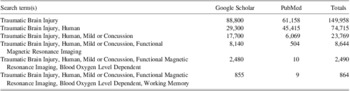
For the current meta-analysis, PubMed (http://www.ncbi.nlm.nih.gov/pubmed/) and Google Scholar (http://scholar.google.com/) were used to build a database of current mTBI research on working memory and cognitive control. The Google Scholar search was restricted to the subject areas “Biological Life Sciences and Environmental” and “Medicine, Pharmacology, and Veterinary Sciences.” Permutations of the following seven search terms were used to generate articles: “Traumatic brain injury,” “Concussion or Mild,” “Human,” “Functional magnetic resonance imaging,” “Blood oxygen level dependent,” and “Working memory.” The results of this search are made available in Table 1. Searching Google Scholar and PubMed with the first search string “Traumatic brain injury” yielded 149,958 articles. Following subsequent filters listed above, respectively, 2490 articles remained.
Study Inclusion Criteria
The above search terms generated 864 articles consistent with all inclusionary criteria. Of the 9 articles generated from the PubMed search, 8 of them overlapped with articles generated from the Google Scholar search. Therefore, 856 unique articles were generated from both searches.
The remaining 856 papers were screened to determine study inclusion. First, articles that examined solely neuropsychological outcomes following mTBI and did not present functional neuroimaging data were excluded. To maintain consistent dependent variables, studies were also excluded if they used functional measures other than fMRI such as EEG, MEG, SPECT, MRS, fNIRS, and PET (n = 173). Anatomical imaging studies where no functional imaging data were presented were also excluded (n = 39) as well as studies that assessed episodic memory (n = 9). Studies that used any model other than humans (n = 70) were also excluded. Because the focus was to determine the nature of inconsistent findings in the concussion/mTBI literature, articles were excluded if the study sample had a GCS < 13; that is, samples that solely assessed WM and CC in moderate or severe TBI were excluded (n = 40). Papers that discussed techniques and methodology for assessing executive function were excluded (n = 173) as well as articles that studied the pediatric TBI (n = 36). Other excluded articles explored TBI with neurodegenerative diseases, rehabilitation strategies, neuropathology, pharmacological manipulations, and treatment options (n = 84). Search results also yielded articles that were not related to TBI (n = 162) as well as articles that did not assess WM (n = 53) or did not use the BOLD contrast (n = 3).
For our purposes, we focused solely on studies using BOLD fMRI as the primary imaging method. Other methods have certainly been applied to this population, including an extensive PET literature examining mild TBI deficit, but we did not include these studies for several reasons. The primary reason for excluding alternative methods was that the nature of the signal is quite distinct. For example, we had concern that “hyperactivation” in fMRI and PET studies could be interpreted as identical phenomenon. On the basis of a recent review of this literature (see Lin et al., Reference Lin, Liao, Merugumala, Prabhu, Meehan and Ross2012), there are two additional considerations: (1) a majority of the early PET studies focused on baseline or resting glucose or O-15 metabolism, (2) in those few papers that used a task (e.g., Chen, Kareken, Fastenau, Trexler, & Hutchins, Reference Chen, Kareken, Fastenau, Trexler and Hutchins2003; Ruff et al., 1994), there were very limited results reported as “peak” data. For example, in Chen et al., only two coordinates are provided. Therefore, because of inconsistencies in the signal measured and also how data are reported between literatures, we include only fMRI studies in this meta-analysis.
For the included studies, all used fMRI methods to assess CC during executive WM tasks performed by individuals with mTBI. The results of this search were 14 peer-reviewed journal articles published between 1999 and 2011. These studies included a total of 389 subjects (215 mTBI and 174 HC), and all studies included a HC sample matched for age, education, and handedness.
Task Categorization
Studies included in this meta-analysis were organized according to the type of WM task used to assess cognitive function to examine the influence of task type on the use of neural resources. With the goal of capturing distinct CC demands, all tasks were grouped into one of two categories to observe potential differences in activation patterns; (1) discrete/discontinuous tasks and (2) continuous tasks. Tasks were classified as discrete in nature if they involved periods of attentional disengagement from stimulation—e.g., during a WM maintenance or “rehearsal” phase. Discrete tasks include both bottom-up orienting tasks (Mayer et al., Reference Kim, Yoo, Ko, Park, Kim and Na2009) and externally ordered tasks (Gosselin, 2011; Chen et al., 2004). Bottom-up tasks involved the interpretation and organization of an auditory task component and externally ordered tasks require participants to maintain stimuli in mind for manipulation that is presented by the experimenter (Petrides, Alivisatos, Meyer, & Evans, Reference Petrides, Alivisatos, Meyer and Evans1993). Tasks were classified as continuous if they involved sustained attention to external stimuli with simultaneous working memory manipulation. These tasks included virtual reality paradigms requiring learning and memory for route navigation in a “virtual corridor” (Slobounov et al., 2010; Zhang et al., 2010, respectively), three-stimulus auditory oddball detection tests (Witt et al., 2010), a finger-sequencing task requiring the subject to successively tap each finger to the thumb in a fixed sequence (index, middle, ring, little) alternating between the right or left hand or rest (Jantzen et al., 2004), serial calculation tests requiring rehearsal and mental arithmetic (Jantzen et al., 2004), and the n-back task requiring maintenance and updating the WM buffer to make decisions about the order of simple stimuli (Lovell et al., 2007; McAllister et al., Reference Kosslyn1999, 2001, 2006; Pardini, 2010).
GingerAle Contrast Inclusion
Coordinates were available for 9 of the 14 studies fulfilling the exclusionary criteria. We separated all collected contrasts into two sets of analyses: load effects and persistence of attentional engagement (“discrete” vs. “continuous”). To isolate the influence of load effects without distinct task demands, we focused on the most common task, the n-back. For load effect analyses, we examined the following conditions: (1) TBI load effect during the n-back (3 > 2, 2 > 1), 3 contrasts, 48 total participants (McAllister, 1999, 2001); (2) TBI activation during the n-back (1 > 0), 1 contrast, 12 total participants (McAllister, 1999); and (3) Control n-back activation during n-back (1 > 0), 1 contrast, 12 total participants (McAllister, 1999).
To examine task the effect of task type (discrete vs. continuous), we examined the following contrasts: (1) mTBI activation during discrete tasks relative to controls (five contrasts, 104 total participants): the visual externally ordered task (Gosselin et al., 2011), the auditory orienting task (Mayer et al., Reference Kim, Yoo, Ko, Park, Kim and Na2009), the auditory oddball task (Witt et al., 2010), the externally ordered task (Chen et al., 2007, 2008). (2) mTBI activation during continuous tasks relative to controls (four studies, 66 total participants): the n-back (Pardini et al., 2010), the virtual reality paradigm (Slobounov et al., 2010), and the n-back (McAllister et al., 1999). (3) Healthy control activation during discrete tasks (three studies, 69 total participants): the visual externally ordered task (Gosselin et al., 2011), the auditory oddball task (Witt, 2010), and the Petrides externally ordered task (Chen et al., 2008). (4) Healthy control activation during continuous tasks (one study, 15 total participants); the encoding and retrieving phases of a continuous virtual reality paradigm (Slobounov et al., 2010).
The XYZ coordinates for peak voxels of contrasts of interest were tabulated for GingerALE analysis. If peak voxels were not presented and/or if data was not available, authors were contacted and the data were requested. Data were not available for five of the studies that fit the inclusionary criteria (Chen et al., 2004; Jantzen et al., 2004; Lovell et al., 2007; McAllister et al., 2006; Zhang et al., 2010).
GingerALE Analysis
There is often a general lack of information included in imaging studies (e.g., the variance around the mean signal change) that would allow for traditional meta-analysis. Because of this, methods have been devised based upon a priori distributions of the fMRI signal to aggregate findings between studies. For our purposes, individual studies were compiled and analyzed via the ALE meta-analysis method for fMRI studies (GingerALE software 1.2 beta version, www.brainmap.org/ale; see Laird et al., 2005; Eichoff et al., 2009). The GingerALE meta-analysis treats functional foci as the centers of probability distributions in the analysis (Eickhoff et al., Reference Eickhoff, Laird, Grefkes, Wang, Zilles and Fox2009), which allows for interstudy differences in analysis and scanning acquisition parameters (Turkeltaub, Eden, Jones, & Zeffiro, Reference Turkeltaub, Eden, Jones and Zeffiro2002). GingerALE generates ALE values that represent the most probable voxel locations of functional activation. For each study entered for the meta-analysis, GingerALE adjusts the confidence estimate of the peak's location based upon the study sample size (see Turkeltaub et al., Reference Turkeltaub, Eickhoff, Laird, Fox, Wiener and Fox2012). Text files for each category were generated that contained the foci of BOLD signal activity reported in each study within each category. Foci that were reported in Talairach space were converted to MNI space using GingerALE's algorithm. The null distribution of the ALE statistic at each voxel was determined with a permutation test (10,000 permutations); these p values were then used to compute the threshold for the ALE map (False Discovery Rate, p = .01). In addition to this statistical correction, a cluster analysis with a minimum cluster volume of 5 mm3 was performed on the final thresholded map. The GingerALE program outputs the size, extent, weighted center, peak coordinates, and ALE values for each cluster.
Results
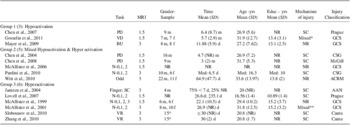
Fourteen articles in this meta-analysis reveal that 21% of current mTBI research reports strictly hypoactivation during working memory tasks (Chen et al., 2007; Gosselin et al., 2011; Mayer et al., Reference Mayer, Mannell, Ling, Gasparovic and Yeo2011), 43% report some degree of hyperactivation and hypoactivation (Chen et al., 2007, 2008; McAllister et al., 2006; Pardini et al., 2010; Witt et al., 2010), and 36% report hyperactivation (Jantzen et al., 2004; Lovell et al., 2007; McAllister et al., 1999, 2001; Slobounov et al., 2010; Zhang et al., 2010). See Tables 1 and 2 for details of the overall search and the included studies.
Search terms for articles and resulting search engine output

Demographic, injury and task variables for the TBI samples included in the analysis

Task = Discrete tasks include: PD = Petrides ordering task, VD = Visual externally ordered task, BU = Bottom-up auditory orienting task, Continuous tasks include: n-# = n-back + load, Odd = oddball task, Finger = Finger sequencing, SC = serial calculation, VR = virtual reality paradigm.
AAN = American Academy of Neurology definition for concussion; American Congress of Rehabilitation Medicines Guidelines for mTBI; Cantu = Grade 1 MTBI using the Cantu Data Driven Revised Concussion Grading Guideline; CSG = 2002 Concussion in Sport Group Definition; d = days; f = female; GCS = Glasgow Coma Scale; m = male; MV = Motor Vehicle; McGill = McGill Sports Medicine Clinic Concussion Definition, Med = median; Mixed* = Recreational (71%), Work (7%), bicycle 7%, MV 14%; Mixed** = 7 MV, 3 Falls, 8 SC, NR = Not Reported; Prague = Prague Conference on Concussion in Sport's definition of a “complex concussion”; SC = sports concussion; ‡Two Time points: Time 1: 6.6 days, Time 2: 35.1 days; SD = Standard Deviation; yrs = years.
^ Gender distribution was not reported separately for mTBI or control, sample = 30% female.
Importantly, task type was related to whether hypoactivation or hyperactivation was observed in the mTBI samples. All studies that implemented discrete tasks demonstrated some degree of hypoactivation. Conversely, all studies that implemented continuous tasks demonstrated some degree of hyperactivation. For continuous studies with mixed hypoactivation and hyperactivation findings (McAllister et al., 2006; Pardini et al., 2010), hyperactivation was characteristic of increased load (i.e., activation during the 2-back condition as compared to the 1-back or 0-back condition) and hypoactivation was observed at low task loads (0-back and 1-back).
GingerAle Result
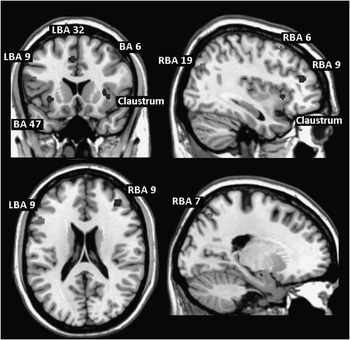
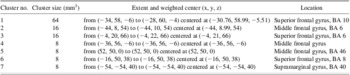
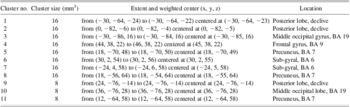
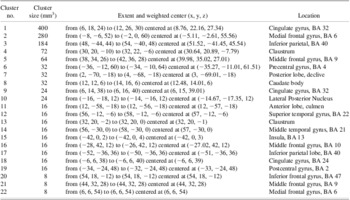
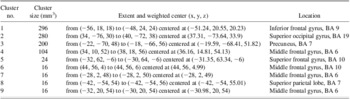
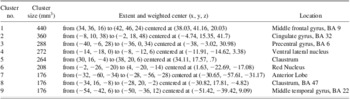
The primary results for the hypoactivation and hyperactivation contrasts between TBI and HC samples are illustrated in Figure 1 using Mango Software (Research Imaging Institute, 2012). See Tables 3a–h for an exhaustive list of peaks of activation for each contrast.
Primary findings for cortical peaks of activation from the GingerALE meta-analytic contrasts of interest. Red indicates hyperactivation during continuous tasks, and blue indicates hypoactivation during discrete tasks. Note: For these contrasts, all continuous data resulted in hyperactivation and discrete tasks resulted in hypoactivation. In the atypical cases where low task load during continuous task resulted in hypoactivation and discrete tasks resulted in hyperactivation, the data were not available for GingerAle analysis (see the Discussion section for greater detail regarding this issue).

mTBI load effects n-back (3 > 2, 2 > 1)

mTBI ACTIVATION N-BACK (1 > 0)

Control activation n-back (1 > 0)

Control activation during continuous tasks

Control activation during discrete tasks

TBI activation relative to controls during continuous tasks (all hyperactivation)

TBI activation relative to controls during discrete tasks (all hypoactivation)

Discussion
The goal of this meta-analysis was to summarize the BOLD fMRI findings in studies examining task-related brain activation during WM and CC tasks after mTBI. To date, this literature has produced divergent findings with several studies demonstrating increased involvement of relevant network regions (e.g., PFC, anterior cingulate cortex, parietal lobe) and others showing diminished responsivity in the same network regions. The aim here was to examine the nature of these findings based upon the task and load demands to determine if these distinct findings were reconcilable. The results reveal that two important determinants, task and load, may serve to explain several inconsistencies in the literature and findings. These results are elaborated upon here.
The primary finding in this meta-analysis is that task demand may contribute meaningfully to differential observations of hypoactivation and hyperactivation in mTBI samples. We anticipate that at least part of this effect is attributable to the relative cognitive load demands between tasks and resulting demand upon cognitive control resources. Consistent with Hypothesis 1, hypoactivation was reported in mTBI during discrete tasks and easier portions of continuous tasks where hyperactivation was primarily observed during continuous tasks and primarily higher load tasks with greater cognitive demand. These tasks include the higher n-back intervals such as the 2-back and the 3-back and virtual reality paradigms. Although the higher n-back intervals resulted in neural recruitment of regions (hyperactivation) for all studies (Lovell et al., 2007; McAllister et al., Reference Kosslyn1999, 2001, 2006; Pardini et al., 2010), there were three studies also reporting hyperactivation during the lower n-back intervals (Lovell et al., 2007; McAllister et al., 1999, 2001), which may be due to relatively greater impairment in these mTBI groups or greater skill in the HC sample in these studies. The only examples of hypoactivation at higher task loads (McAllister et al., 2001) were the result of contrasting two higher task loads (e.g., 3-back minus 2-back). In this case, we anticipate that the effects were largely due to an “over subtraction:” The mTBI sample showed hyperactivation during the 2-back, and this neural recruitment observed at a lower task load in the mTBI sample was essentially eliminated when creating the 3-back minus 2-back contrast resulting in relatively little remaining BOLD signal for the mTBI sample in the 3-back contrast. Similar contrast effects have been observed in the study of neural resource use in multiple sclerosis during tasks of WM (see Sweet, Rao, Primeau, Durgerian, & Cohen, Reference Sweet, Rao, Primeau, Durgerian and Cohen2006).
Hypoactivation was only observed during discrete tasks or during lower cognitive loads of continuous tasks. These tasks included the Petrides ordering task (Chen et al., 2004, 2007, 2008), visual externally ordering tasks (Gosselin et al., 2011), bottom-up orienting tasks (Mayer et al., Reference Mayer, Mannell, Ling, Elgie, Gasparovic, Phillips and Yeo2009), tasks requiring the identification of novel stimuli (Witt et al., 2010), and lower n-back intervals such as the 0-back and the 1-back (McAllister et al., 2006, Pardini et al., 2010). In addition to the n-back, tasks such as the Petrides ordering task (Chen et al., 2004, 2008) and the 3-stimulus auditory oddball (Witt et al., 2010) were associated with both hyperactivation and hypoactivation. The reason for the mixed findings in the latter case is not entirely clear, but may be attributable to varying load on CC over the course of the task. Future work might make this determination by examining components of these tasks to determine the nature of these distinct results over the course of the task.
Although the differential hyperactivation observable after mTBI during high load tasks has some intuitive appeal, the finding that individuals with mTBI use fewer resources during discrete and lower demand tasks remains a bit perplexing. That is, if it is the case that hyperactivation is specifically tied to task load and CC demands, it remains unclear why HCs demonstrate greater engagement of these resources at lower demands when these tasks should be even less challenging in an uninjured sample. There are two possible explanations for this finding. The first is that during discrete or discontinuous tasks where external stimulation is not constant (e.g., WM rehearsal), individuals with mTBI are less consistently and rigorously engaged by the task throughout the entire “on-task” epoch. This might occur as a function of variable attention during prolonged delays in the task in mTBI group while maintaining minimal task processing required for adequate task performance. If so, a block-design, which most of these studies used here (13/14), would include greater off-task averaging, resulting in reduced BOLD signal over the course of the block and diminished mean signal change. Second, there may be greater heterogeneity in how the mTBI sample engaged the task; mTBI is associated with greater intra-individual variability during task performance and during periods of low cognitive demand—the heterogeneity in this response could appear as hypoactivation compared to a more consistent response in the HC sample. One could speculate that the heterogeneous effects disappear at higher loads, where degrading performance and an overwhelming need for increased resource use is paramount, resulting in hyperactivation at lower loads. These explanations are speculative, but irrespective of the mechanism, the findings here do lend some support to the hypothesis that hypo- and hyperactivation may be at least partially attributable to task nature and demand.
In Hypothesis 2, we anticipated that specific task demands would have implications for the between-group differences in neural involvement for this literature. The support for this hypothesis was rather mixed, with some regions demonstrating both hyperactivation and hypoactivation between studies. For example, right PFC was one of the most consistent sites of hyperactivation (Chen et al., 2008; McAllister et al., 1999, 2001; Slobounov et al., 2010) but paradoxically, hypoactivation also occurred in right PFC (Chen et al., 2004; Gosselin et al., 2011). These inconsistent findings were accounted for by task demands, with tasks of lower continual working memory demand showing hypoactivation in mTBI, but the result did not support the anatomical specificity we anticipated. Separately, continuous tasks were more likely to bring about hippocampal recruitment, consistent with the notion that uninterrupted task processing over the course of the task results in greater elaboration of the stimuli and consolidation into memorial systems. Thus, there was reasonable consistency in the basic network components observed between studies (e.g., PFC, parietal lobe), but functional brain specificity was not a consistent predictor of hypo- or hyperactivation in the mTBI sample.
Summary and Interpretation
In summary, the wide range of brain activity patterns observed during executive WM tasks in individuals with mTBI appears to be at least partially due to varying types and difficulties of WM tasks. When the mTBI studies are re-examined and classified by task type, all examples of hypoactivation were observed during discrete tasks or low load continuous tasks and most of the findings revealing hyperactivation occurred during continuous tasks or at higher task loads. We anticipate that the tasks eliciting both hypoactivation and hyperactivation do so for one of two reasons: (1) the task contains both discrete and continuous task components, or, (2) there is a gradual increase in cognitive demand throughout the duration of the task. With respect to the latter, time dependent analyses could help to decouple these effects in the future.
There was evidence in this study that either hypoactivation or hyperactivation may occur in the same brain regions and within the same sample depending upon the task demands. In several studies where both relative hyperactivation and hypoactivation were evident (Chen et al., 2008; Pardini et al., 2010; Witt et al., 2010), task load was demonstrated to predict activation patterns—with increased load incrementally predicting hyperactivation. We anticipate that this is the most compelling evidence that involvement of task-relevant regions after mTBI is at least partially determined by the type and demand of the task involved and may be less related to pathophysiology or specific nature of the injury (Hillary, 2008; Hillary et al., 2010). Instead, neural recruitment is the natural allocation of available network components based upon task demands and performance and these effects appear almost identical to what is seen in healthy adults.
Finally, we anticipate that these findings hold important implications for how we might study the neural correlates of cognitive dysfunction using functional imaging approaches. Simple interpretation of “hypo” or “hyper” activation without also considering the context of the nature of the task demands may result in findings that are difficult to reconcile with a larger literature. Moreover, designs that rely on simple cognitive subtraction and “topographic” maps consisting of mean signal differences between groups are fraught with significant oversimplifications of the neural dynamics involved in task processing (for review of these pitfalls, see Friston et al., Reference Friston, Price, Fletcher, Moore, Frackowiak and Dolan1996; Kosslyn, 1999; Price, Crinion, & Friston, Reference Price, Crinion and Friston2006). To understand the nature of neural network changes after injury, future work will require designs that permit observation of network level alterations brought about through parametric modulation or other task manipulation (see Friston et al., 1996; Hillary, 2008), examination of the reciprocal interaction between task-related and the intrinsic brain responses (see Bonneville et al., 2011; Hillary et al., 2011; Sharp et al., 2012), and local and whole-brain connectivity changes via effective connectivity modeling (see Hillary et al., 2011 Reference Hillary, Medaglia, Gates, Molenaar and Good2013; Turner, McIntosh, & Levine, 2011) and graph theoretical approaches (see Caeyenberghs et al., Reference Caeyenberghs, Leemans, Heitger, Leunissen, Dhollander, Sunaert, Dupont and Swinnen2012; Nakamura et al., Reference Nakamura, Hillary and Biswal2009). Even with the tightest methodological control, between-group comparisons have significant limitations, so future work must also include within-subject components that permit isolation of changes in individual networks due to changing demands in the perturbation (task) or changes associated with time (recovery).
Study Limitations and Future Directions
The current findings consistently demonstrate that the nature of the WM task used to examine BOLD response has important influence on the observed between-group differences. One future direction for combining functional imaging findings would be to focus on additional indices of activation, including the extent of activation as opposed to the peak activation which is the standard to date. An important shortcoming in meta-analyses in the functional imaging literature to date is that reports of effect sizes in the source studies is rare, making a traditional meta-analysis nearly impossible. For the sake of understanding the magnitude of the effects in individual studies as well as for aggregating data such as we have done here, this literature would benefit from making effect size reporting a standard requirement (Poldrack et al., Reference Poldrack, Fletcher, Henson, Worsley, Brett and Nichols2008). Also, this study did not have the opportunity to integrate important information such as task reaction time, which has been shown to be a predictor of neural recruitment in TBI (Hillary et al., 2010); many of the early studies did not report task reaction time with their findings. To date, executive functioning following mTBI has been primarily evaluated using fMRI—if steps can be taken to calibrate the differences in the measured signals, future directions may involve the integration of other types of functional imaging data (e.g., PET, near infrared spectroscopy). Finally, it was a primary goal as a first step to examine common sites of neural recruitment in this literature with the goal of reconciling distinct findings (i.e., hypoactivation vs. hyperactivation); however, it will be important to examine possibly nuanced differences occurring at the network level. There is increasing emphasis in the cognitive neurosciences in examining systems level connectivity between network nodes and further aggregation of this literature might take a connectivity approach to better understand how mTBI is altering distributed networks. These methodological approaches may also help to further clarify the reasons for the inconsistent results observed in this literature.
Acknowledgments
Dr. Jen-Khai Chen (cf., Chen et al., 2008) provided data upon request. The authors declare that there are no conflicts of interest, either financial or otherwise, associated with this study and the resulting manuscript. This study was funded in part by a grant from the New Jersey Commission on Brain Injury Research (grant number 0120090178).