INTRODUCTION
Moray eels, the apex nocturnal predators of the fish family Muraenidae, are distributed globally in tropical and temperate seas, primarily inhabiting rocky areas and coral reefs (Briggs, Reference Briggs1999). Muraenidae contains about 200 species described under 15 genera inhabiting all tropical ocean basins (Nelson, Reference Nelson2006; Froese & Pauly, Reference Froese and Pauly2011). The cryptic habitats and aggressive behaviours make these fish highly understudied (Reece et al., Reference Reece, Bowen, Smith and Larson2010). Muraenid taxonomy was first reviewed by Günther (Reference Günther1870) and subsequent regional taxonomic reviews are available for the Atlantic (Böhlke et al., Reference Böhlke, McCosker, Böhlke and Böhlke1989), Hawaii (Böhlke & Randall, Reference Böhlke and Randall2000), Indo-Pacific (Böhlke & Smith, Reference Böhlke and Smith2002), the Red Sea (Randall & Golani, Reference Randall and Golani1995) and Australia (Böhlke & McCosker, Reference Böhlke and McCosker2001).
Out of 200 species of moray eels, 47 species under 13 genera have already been recorded from Indian waters (www.bioSearch.in); Bijukumar et al. (Reference Bijukumar, Sirajudheen, Rajesh, Tresa, Sonnenschein and Benziger2010) listed the occurrence of 11 species of moray eels from the Kerala, south-west coast of India. This paper records the occurrence of reticulated moray Muraena retifera Goode & Bean, Reference Goode and Bean1882 (family: Muraenidae) for the first time from the Indian coast.
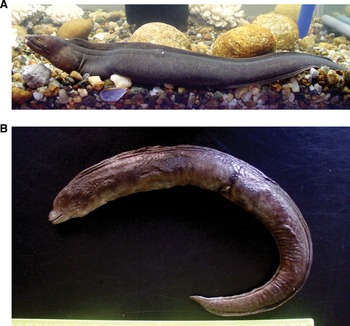
Muraena retifera Goode & Bean, Reference Goode and Bean1882 (total length 415 mm), collected from Vizhinjam Bay, south-west coast of India. (A) Live specimen; specimen preserved in formaldehyde.

MATERIAL EXAMINED
One live specimen (total length 415 mm), was collected from Vizhinjam Bay (longitude 76°15′E; latitude 8°22′33″W), Kerala, south-west coast of India using a specially designed fish trap. The specimen was deposited in the Museum collections of the Department of Aquatic Biology and Fisheries, University of Kerala, India (Accession No. AQB FV176).
DIAGNOSIS
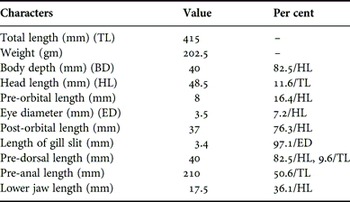
Body moderately stout and laterally compressed. The mouth does not close completely, jaws sub-equal. Two series of backwardly directed teeth in upper jaw, the outer series short and inner long and compressed with larger middle teeth. Teeth on lower jaw almost similar to those of upper jaw. The nostril tubes on snout slightly shorter than eye. The eye over middle of mouth cleft. Dorsal fin beginning above the head on the middle point between eye and gill opening; and anal fin origin at the middle point of body. Gill-opening small rounded slit, its length is sub-equal to eye diameter. Table 1 presents the data on morphometric characters of the species.
Morphometric characters of Muraena retifera.

COLOUR
Greyish-black, regularly reticulated with black and white spots. These inconspicuous spots cover entire body; smallest and most numerous anteriorly; almost absent on the belly; present on the inside of the mouth. Gill-opening surrounded by a small blackish blotch, angle of the mouth black. Dorsal with five longitudinal blackish lines, which become obsolete posteriorly. Anal with a single narrow blackish stripe extending along its whole length.
REMARKS
The species was originally recorded from Charleston, southern United States by Goode & Bean (Reference Goode and Bean1882). Subsequently it has been reported from the USA, Mexico, Venezuela (Froese & Pauly, Reference Froese and Pauly2011) and Brazil (Barneche et al., Reference Barneche, Anderson, Floeter, Silveira, Dinslaken and Carvalho-Filho2009) representing the north-western, western central and south-west Atlantic. The present record of this species from the Arabian Sea shows the extended range of occurrence of this species towards the western Indian Ocean.
ACKNOWLEDGEMENT
The authors thank the Kerala State Council for Science, Technology and Environment for the financial support of the project.