At a large bioethics conference in the early 1990s, the International Bioethics Institute presented a panel discussion on the newly-hot issue of “medical futility.” Erudite experts held forth from various perspectives, with convincing if conflicting arguments. During the question-and-answer session that followed, however, one attendee gently offered the one remark most recalled from that session. He was, if memory serves, a Latino physician working near the Mexico/USA border. “Thank you for your presentations,” he said, apparently with great sincerity. “I learned a lot. But on behalf of my own patients, I would ask that before you give them the right to say ‘no’ to medical treatment, we first give them the option of saying ‘yes’.”
A vigorous nodding of heads ensued, followed by what seemed an uncomfortable silence (a brief one, of course—silence at bioethics gathering being quite rare). A world of concern, often unvoiced, lay behind that remark. How often do even our most agreed-upon ethical imperatives become wobbly when viewed from another cultural or national viewpoint? We are still only just beginning to learn the lessons of what has come to be called “multiculturalism.” As humanity becomes ever more mobile and national borders more permeable, more challenges to bioethics understanding and practice ensue. It is not uncommon now for a major American hospital in a large urban area to require the services of at least two dozen language translators. One can help but wonder how much nuance in clinical decisions, and especially those involving ethical complexity, is often lost or neglected in such translations. And, as the physician's comment above highlighted, the socioeconomic hurdles, especially those related to financial barriers and inequities in access to healthcare, remain immense and are even increasing in some areas.
In the broader sense, though, some positive trends may be noted. Travel and the internet, and, we might add, the advent of quality journals in the bioethics fields are leading to more understanding and knowledge across borders. The diverse origins and perspectives in this issue of CQ hint at the tip of the iceberg of international issues. One conundrum here, as in other arenas related to “diversity,” will continue to be how to preserve that diversity while nurturing the common values that unite us as homo sapiens. Cultural and bioethical blending can, hopefully, be achieved without undue “blanding.” Basic human rights underlie, or should underlie, bioethics in every region or nation, but as for some of the other distinct cultural aspects of life, as somebody remarked in a different context, vive le difference.
***
In Memoriam: William Atchley, MD, 1922–2007
It is with both sadness and gratitude that we note here the death of Dr. William Atchley. As a prominent physician in San Francisco, he served as chief of the medical staff at the University of California, San Francisco, and chairman of the ethics committee there. A happy coincidence of meetings with various interested people, including the future editors of this journal, resulted in the founding of the International Bioethics Institute, of which “Dr. Bill” served as founding President. When the late David Thomasma joined the IBI as well, elements were in place to launch this journal. CQ was the official journal of the IBI for years and Dr. Bill served on the Editorial Board for our first decade. Atchley presided over numerous international meetings with his renowned grace and expertise. After he retired, environmentalism became his passion, and he drove a (high gas-mileage) car with the license plate “CPR”—which in this case stood for “Conservation, Preservation, and Restoration.” He was a revered clinician and teacher and generations of physicians, ethicists, and others learned much from him. He was committed to crossing, if not melting, borders of all kind and we gratefully dedicate this issue of CQ to him.
For those who knew Dr. Bill and wish to read his final interview, with incisive and emotional comments on a number of topics, go to http://www.sfmjs.org and select the archives for the journal San Francisco Medicine, the June 2007 issue.
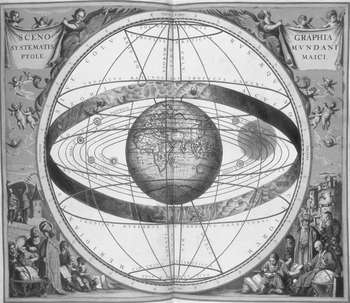
Globe of the Earth circled by a band containing signs of the Zodiac, 1660. Photo credit: HIP/Art Resource, NY British Library, London.