Legal doctrine is one way the Supreme Court can ensure lower court compliance (Smith and Todd Reference Smith and James2015; Epstein Reference Epstein2016). Legal doctrine is the guideline contained in Court opinions that determines the future resolution of cases and provides guidance to lower courts and other political actors (Tiller and Cross Reference Tiller and Frank2006; Wofford Reference Wofford2015; Hollis-Brusky and Wilson Reference Hollis-Brusky and Joshua2017). Generally conceptualizing doctrine as either “rules”—rigid guidelines that leave little room for lower court maneuvering—or vaguer “standards” that allow more leeway in implementation, political scientists have developed sophisticated models that predict how the high court will structure legal doctrine to ensure a lower court complies with the higher court’s preferences (see, e.g., Jacobi and Tiller Reference Jacobi and Emerson2007; Lax Reference Lax2012; Clark Reference Clark2015).
Legal scholars have also devoted a great deal of analysis to the structure of legal doctrine. Building off the work of Kennedy (Reference Kennedy1976) and Kaplow (Reference Kaplow1992), they too have compared the reasons for, and impacts of, doctrinal rigidity (see, e.g., Sullivan Reference Sullivan1992; Korobkin Reference Korobkin2000; Crane Reference Crane2007). This version of the “rules versus standards” debate is less often about the influence of the judicial hierarchy and more focused on how the nature of the legal issue, the amount of predictability needed, and the potential impact on litigants or private citizens can influence the type of guideline issued by courts.
Much of the scholarship on rules and standards in both disciplines rests on two fundamental assumptions. First is the presumption that it is jurists who control the structure of legal doctrine. This control can be direct, as when a jurist writes the guideline, or more indirect, as when the litigants or amici formulate a doctrine specifically designed to match the jurist’s preferences. Second is the assumption, particularly prevalent in the works with empirical predictions, that legal doctrine varies in the amount of discretion it provides to lower courts.
In this article, I revisit the rules-versus-standards debate and offer a preliminary empirical evaluation of these assumptions. I use a new measure of “rule flexibility” and a new data set of rules offered to, and adopted by, the justices in 500 cases to examine whether and how the rules and standards framework applies to doctrinal choice on the US Supreme Court. The findings reveal that the justices themselves do not craft the doctrine they adopt in each case but instead almost always select from the options presented to them by case participants. These options, moreover, usually vary relatively little in the amount of leeway they provide to lower courts.
Rules and Standards in a Judicial System
Political scientists interested in the structure of legal doctrine have been especially attuned to how it is affected by the judicial hierarchy. The issue is generally framed as whether a higher court will issue a rule or a standard (Tiller and Cross Reference Tiller and Frank2006; Jacobi and Tiller Reference Jacobi and Emerson2007; Heytens Reference Heytens2008; Cross, Jacobi, and Tiller Reference Cross, Tonja and Emerson2012; Lax Reference Lax2012).Footnote 1 As first defined by legal scholars (Radin Reference Radin1991; Kaplow Reference Kaplow1992), both rules and standards explicate the law, providing information and guidance to other legal and political actors, but they differ in the rigidity of that guidance.
Rules are precise and specific, leaving little room for subsequent interpretation, while standards are more amorphous and place greater discretion in the hands of the subsequent adjudicator. Rules contain explicit categories or factors against which particular facts are measured; standards require nuanced balancing of various elements by the jurist charged with implementation. To borrow the classic example, a rule for speeding would be that no driver may drive over 55 miles per hour. A standard might simply say that the speed should be “reasonable and prudent” (Sullivan Reference Sullivan1992; Lax Reference Lax2012).
When considering how the judicial hierarchy might affect the structure of legal doctrine, most scholars take a principal-agent approach: the higher court is the principal that must rely on its agent—the lower court—to implement its rulings (Carrubba and Clark Reference Carrubba and Tom2012; Hansford, Spriggs, and Stenger Reference Hansford and Anthony2013; Kastellec Reference Kastellec2017).Footnote 2 Given that its preferences may not align with the higher court, the lower court can attempt to resist the wishes of the higher court and follow its own predilections.
Legal doctrine is one tool the higher court uses to ensure compliance (Cross et al. Reference Cross, Tonja and Emerson2012; Lax Reference Lax2012; Smith and Todd Reference Smith and James2015). If the lower court is likely to shirk, the higher court can issue restrictive rules; as shirking becomes less likely, the higher court may lean toward the vaguer standard. The propensity for shirking depends primarily on the ideological alignment between higher and lower courts. If the higher court faces an ideologically distant lower court, it will promulgate a rule. If the lower court is more ideologically aligned with the higher court, the guideline can be the more ambiguous standard (Spiller and Spitzer Reference Spiller and Matthew1992; Jacobi and Tiller Reference Jacobi and Emerson2007; Baker and Kim Reference Baker and Pauline2012; Smith and Todd Reference Smith and James2015).Footnote 3
Legal scholars have engaged more normatively in the rules-versus-standards debate, arguing about which type of legal guideline a court should promulgate and why. Sometimes, the claim has been that one structure is inherently inferior to the other: rules are faulted for being overly restrictive and difficult to apply to new factual situations; standards are said to place too much discretion in those charged with implementation of the rule and are criticized for failing to provide sufficient guidance for citizens to resolve their own conflicts (Schauer Reference Schauer1991; Korobkin Reference Korobkin2000; Nance Reference Nance2006; see also Schlag Reference Schlag1985). For others, the trade-off is more complex, with each form generating its own costs and benefits that vary with the legal and political context (Schlag Reference Schlag1985; Korobkin Reference Korobkin2000). Most frequently, scholars’ normative preference for rules or standards depends on the legal area under study; works analyzing the dichotomy across a vast range of doctrinal arenas continue to appear in the legal literature (Diver Reference Diver1983; Lee Reference Lee2002; Overton Reference Overton2002; Crane Reference Crane2007; Phillips Reference Phillips2010).
Beyond Rules versus Standards: Rule Selection and Rule Flexibility
All of these works rest on presumptions about the sources and shape of legal doctrine. They assume that justices ultimately control doctrinal content and that doctrine actually is structured with varying degrees of fluidity. I first question the notion that Supreme Court justices develop whatever legal guideline they wish (cf. Hammond, Bonneau, and Sheehan Reference Hammond, Chris and Reginald2005; Baker and Kim Reference Baker and Pauline2012; Lax Reference Lax2012; Smith and Todd Reference Smith and James2015). The justices certainly can control opinion content, but we do not know for sure that they write legal rules in particular. It may be that to save time and resources, or to fulfill any professional obligation they feel to resolve the dispute at hand, they draw instead from the rules in the briefs submitted by case participants (Corley Reference Corley2008; Collins, Corley, and Hamner Reference Collins, Pamela and Jesse2014; Wofford Reference Wofford2015). Because these proffered guidelines constitute the set of available choices, any study of rules and standards should examine what is offered to, not just formulated by, the justices.
Second, even among the guidelines presented to them, the justices may not confront two dichotomous options. The relevant literature has often labeled doctrinal development as a choice between a (judicially created) precise rule or a vague standard. However, I posit that the Supreme Court almost never faces this type of decision but instead chooses between versions of the same type—rules that are more or less rule-like and standards that are more or less standard-like (Kaplow Reference Kaplow1992).
As a result, rather than study whether the Court issues rules or standards, this study employs a more general concept of rule flexibility. Drawing from the legal literature (Radin Reference Radin1991; Sullivan Reference Sullivan1992; Sunstein Reference Sunstein1995; Korobkin Reference Korobkin2000), I suggest that all legal guidelines—which I term “rules”—exist on a continuum of flexibility. Rules, therefore, can be extremely rigid, extremely ambiguous, or somewhere in between. Rule flexibility is the extent of discretion the rule imparts to lower courts—that is, the amount of leeway that lower court judges have to use and implement the rule. The more flexible a rule, the more discretion it offers, and the greater the freedom lower court judges have to apply the rule; the less flexible a rule, the less discretion it offers, and the more constrained lower court judges are in implementation.
Rule flexibility is shaped by several factors. To begin, there is the precise language that constitutes the rule (Cross et al. Reference Cross, Tonja and Emerson2012). Certain words such as “reasonable,” “equitable,” or “substantial” produce rules that offer lower court judges more discretion. Rules with absolute words such as “never” or “always” or that set specific guidelines for time or amount (i.e., a reply must be filed within 60 days or an individual under the age of 16 cannot be executed) do not allow a lower court judge much leeway.
The grammatical complexity of a rule also can affect its flexibility. Certain rules have a very simple structure, with straightforward explanations for implementation written as declarative sentences (e.g., the lower court must “determine if the amount of work leave requested falls within the statutory time period of thirty days”).Footnote 4 Other rules, however, are more complex, involving multiple phrases, subclauses, or factors for a judge to consider (e.g., the judge must “balance the reasonableness of the work leave request with the needs of the employer, attending to the facts and circumstances of each case”).Footnote 5
Lastly, the content of a rule can affect the discretion given to lower courts. For instance, rules that grant (or deny) jurisdiction to a lower court, grant (or deny) the lower court the capacity to issue a legal remedy, or determine which statutory or constitutional provision a lower court should apply shape what the lower court can or cannot do in the immediate case.
With justices potentially selecting from a set of rules presented to them, rules that vary in their flexibility, the key question then becomes not whether a justice will formulate a rule or standard but how, given the Court’s position at the apex of the judicial hierarchy, the flexibility of a proffered rule might influence whether it is favored by the justices. It is this query to which this preliminary study is directed.
Data: Legal Rules and the Justices’ Votes
To explore this question, I gathered all the legal rules suggested to and adopted by the justices in 500 randomly selected Supreme Court cases from 1954 to 2000, drawn from the Spaeth et al. (Reference Spaeth, Lee, Andrew, Jeffrey, Theodore and Sara2018) data set. To ensure that the justices were faced with a choice of competing legal rules, I used only cases Spaeth et al. identify as involving intercircuit conflict among the lower courts.Footnote 6
To gather all the legal rules suggested by all case participants, I consulted every brief submitted to the justices by litigants and amici, using both Lexis and Westlaw. From these briefs, I then identified and extracted every legal rule suggested to the justices.Footnote 7 Any case without briefs was dropped and replaced with the next case in the list.Footnote 8
Who suggested the rule to the justices was then recorded, including all petitioners, respondents, and amici.Footnote 9 Amici had to express explicit support for a particular legal rule to be counted as supporting that rule; general claims about what outcome the court should reach or why were not sufficient.
I next read all the court opinions (majority, concurring, and dissenting), coding whether each justice supported a particular rule. If a justice wrote or joined the majority opinion, that justice was presumed to support the rule favored by the majority opinion; if a justice wrote or joined a dissenting opinion that supported another rule, that justice was presumed to support that other rule. For concurring justices, the justice was coded as supporting the majority rule unless the justice explicitly rejected the rule, refused to join that portion of the majority opinion that contained the rule, or endorsed a competing rule.
Occasionally, I had to code a justice’s vote as missing. In general, if a justice did not express or join an opinion that explicitly expressed support for a particular rule, that justice was coded as missing. Dissenting or concurring justices, for example, were coded as missing if they rejected the majority’s rule but did not clearly adopt a rule of their own; they were also coded as missing if their decision was based on a different legal question.Footnote 10 Justices who did not participate in the case also were coded as missing. When complete, this process produced a data set of 4,449 individual judicial votes, with 91 coded as missing.Footnote 11
Measuring Rule Flexibility
Evaluating rule flexibility requires the creation of a novel measure. I developed a four-point scale that ranges from 1 (very flexible; gives a lot of leeway), 2 (flexible; gives a fair amount of leeway), 3 (somewhat flexible; gives a bit of leeway), to 4 (not at all flexible; gives no leeway). Two third-year law students were hired for their legal expertise as coders. They were provided with the legal rules offered by the petitioner and the respondent in 500 randomly selected Supreme Court cases (1954–2000) drawn from the Spaeth et al. (Reference Spaeth, Lee, Andrew, Jeffrey, Theodore and Sara2018) data set, and they were instructed on how to code the flexibility variable.Footnote 12
To highlight the facial validity of this measure, consider the following two cases from the data set. In Business Electronics Corp. v. Sharp Electronics Corp. (485 U.S. 717 [1988]), the Court had to decide whether a certain type of agreement between a manufacturer and distributor violated antitrust law. One party suggested that the Court adopt the “rule of reason,” in which “the factfinder weighs all of the circumstances of a case in deciding whether a restrictive practice should be prohibited as imposing an unreasonable restraint on competition.” The other proffered rule simply stated that the type of agreement at issue “constitute[d] a per se violation” of the applicable statute. Both coders gave the first rule a score of 1 (highly flexible) and the second rule a score of 4 (highly inflexible).
In Pioneer Investment Services Co. v. Brunswick Associates Ltd. Partnership (507 U.S. 380 [1992]), the Court confronted a statute that required courts to accept late filings by litigants if the delay was caused by “excusable neglect.” The petitioner suggested that excusable neglect existed when “failure to file timely [was] due to circumstances beyond [the litigant’s] reasonable control.” The respondent argued that determinations of excusable neglect should be made by evaluating a late filer’s conduct against “several factors, including: (1) whether granting the delay will prejudice the [other party]; (2) the length of the delay and its impact on efficient court administration; (3) whether the delay was beyond the reasonable control of the person whose duty it was to perform; (4) whether the [litigant] acted in good faith; and (5) whether clients should be penalized for their counsel’s mistake or neglect.” Here, the rules had similar levels of flexibility, with scores from both coders of 3 and 2, respectively
In terms of intercoder reliability, there was an extremely high level of intercoder agreement: 90.55% for petitioner’s rule and 87.43% for respondent’s rule (Freelon Reference Freelon2010). To account for expected agreement, I also calculated intercoder reliability statistics. In terms of coding petitioner’s rule, the bivariate weighted Kappa value was .52; for respondent’s rule, it was .47. Both values indicate “moderate” agreement (Landis and Koch Reference Landis and Koch.1977). The intercoder reliability score (Kappa) on which rule was more flexible was .68, indicating “substantial” agreement (Landis and Koch Reference Landis and Koch.1977).
In an ideal world, there would be a more objective measure of rule flexibility. One option would be to measure the length of the legal rule by counting the number of words. Scholars have used the length of texts as a proxy for the complexity of Court opinions and congressional statutes (Huber and Shipan Reference Huber and Charles2002; Randazzo, Waterman, and Fine Reference Randazzo and Jeffrey2006; Black and Spriggs Reference Black2008). Others have used “readability” scores (Coleman Reference Coleman2001; Law and Zaring Reference Law and David2010). There also are content-analysis software programs, which offer more sophisticated measures of linguistic clarity and complexity and are becoming increasingly popular (see, e.g., Law and Zaring 2010; Owens and Wedeking Reference Owens and Justin2011; Owens, Wedeking, and Wohlfarth Reference Owens, Justin and Patrick2013).
The problem with all these approaches, however, is that they measure complexity, not flexibility, concepts that are not interchangeable. The more complex a rule, the more difficult it may be to understand and apply, but this does not mean that it will necessarily give a lower court judge more discretion. A more complex rule might be more flexible: a rule with more words or a greater number of clauses, for example, might give judges more “wiggle room” by providing additional language the lower court judge could interpret at will. At the same time, a longer or more grammatically intricate rule could just as easily restrict a judge’s discretion by providing more language that limits how a judge should apply the rule. Simpler and shorter rules work the same way, potentially providing more or less discretion depending on the nature of the words themselves. Viewed this way, the amount of discretion turns as much on the content of the words as the complexity or clarity of the rule. Extant approaches to complexity unfortunately do not capture this distinction.
Other scholars have used the Linguistic Inquiry and Word Count (LIWC) program to study other aspects of Court opinions (Cross and Pennebaker Reference Cross and James2012; Collins et al. Reference Collins, Pamela and Jesse2014; Corley and Wedeking Reference Corley and Justin2014). Originally developed by psychologists, LIWC is a dictionary-based program that can assess documents for the use of certain types of words. Unfortunately, while LIWC can, for instance, determine how much “certainty” or “negative emotion” exists in a document or how many times a speaker uses a “big word” (more than six letters), it contains no dictionary that maps to flexibility or ambiguity, even under the most generous definitions of those terms.
The software does permit the user to build an original dictionary, but it is unclear what words would need to be included in such a dictionary for this study. Words such as “reasonable” or “equitable” would be obvious candidates, but including every word or phrase that could render a rule more flexible is likely to be vastly overinclusive (including many words that might never appear in legal doctrine) and underinclusive (missing words that only generate flexibility when used in the context of a specific legal issue). At the very least, constructing such a dictionary is beyond the scope of this project. Until technology advances sufficiently, employing human coders seems the best approach to measuring the precise concept I study here.
Two additional factors mitigate the subjectivity of the measure. Others have used similar measures of related concepts with success (Spriggs Reference Spriggs1997; Breitmeier, Young, and Zürn Reference Breitmeier and Michael2006). The process undertaken by coders also replicates what the justices themselves likely do: use their legal training to assess how much discretion the rule provides to lower court judges. Law students are not justices, of course, and would lack the latter’s experience with promulgating rules for lower courts, but the ultimate task of reading, interpreting, and evaluating a legal rule in light of the judicial hierarchy should be quite similar.
Results
For purposes of this preliminary study, the descriptive data alone provide valuable information about the structure of legal doctrine and the US Supreme Court. Given the level of intercoder reliability on the four-point measure, some of the results should be interpreted with caution. There are, however, striking findings about doctrinal development and the nature of legal rules, several of which run counter to presumptions of the literature.
The data indicate first that at least in Supreme Court cases of intercircuit conflict, the justices seem to rely on the doctrinal suggestions of case participants. To generate the 500 cases employed in this project, I examined 575 cases. Recall that in each of these, I compared the legal rule favored by the justice with the rules suggested in case briefs and recorded whether a justice wrote or joined an opinion that contained a guideline not mentioned in the case briefs.
Again, this part of the coding was usually straightforward, as the justices often specifically referenced a brief filed in the case or the rule offered by a particular party or amici. To ensure reliability of the data, another coder coded 10% of the cases (N = 58). The process produced 89.8% pairwise agreement. The Kappa and Alpha statistics were low (0 and −0.052), but this is owing to the “paradox” that the coding of rare events involving a binary variable can produce high agreement but low values on statistical indices of reliability (Feinstein and Cicchetti Reference Feinstein and Domenic1990; Feng Reference Feng2014). In data such as these, the literature suggests reliance on a percentage agreement (Zhao, Liu, and Deng Reference Zhao and Ke2013; Feng Reference Feng2015).
Of the 575 cases, 41 (or 7.1%) were set aside for this project because they involved instances in which the justice adopted a rule that was not suggested to the Court. In other words, in approximately 93% of the cases, the justices favored a legal rule that was suggested by litigants or amici. Wofford (Reference Wofford2018) offers further analysis of this result.
The “bright line” rules or vague standards frame also is not particularly well reflected in the cases studied here. In the measure of which rule was more flexible than the other, coders said “neither” in 106 (21%) of the 500 cases. While this means, of course, that close to 80% of the cases involved doctrines that did differ at least somewhat in their flexibility, nearly one-quarter of the time the justices are looking at rules that offer the same amount of discretion to lower courts.
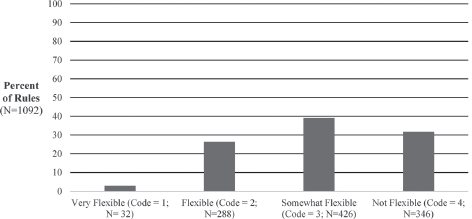
The results using the four-point flexibility scale provide additional evidence of the inapplicability of the rule or standard dichotomy. As seen in figure 1, out of the 1,092 rules coded,Footnote 13 only 32 (2.9%) were coded as 1 (very flexible; gives a lot of leeway). In other words, the justices are almost never presented with a true standard. Three hundred forty-six rules (31.68%) were coded as 4 (not at all flexible; gives no leeway), indicating that the justices are presented with a relatively significant (and greater) number of bright- line rules. Most rules fell in the middle of the flexibility scale: 288 (26.37%) were coded as 2, and 426 (39.01%) were coded as 3.
Flexibility of legal rules

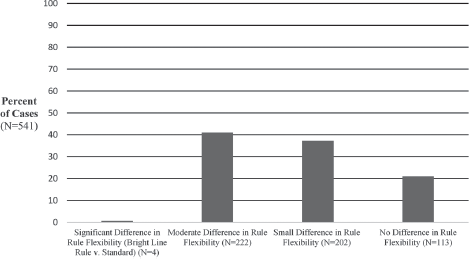
There also does not appear to be much difference between the flexibility of petitioner’s and respondent’s rules. Figure 2 displays their relative flexibility.
Flexibility of petitioner’s and respondent’s rules
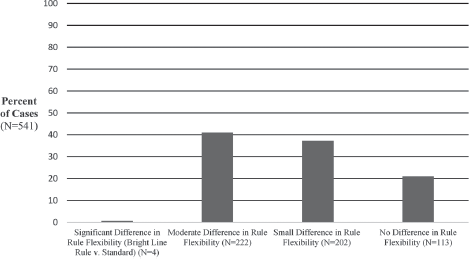
As seen, in only four cases did one party present a rule coded as 1(4) and the other present a rule coded as 4(1). In other words, in only four cases was one rule given a 1 and the other rule a 4 or one rule given a 4 and the other rule a 1. This means that in only a minute fraction of cases (.7%) did the Court confront the rules-versus-standards dichotomy.
Under a more generous conception of a bright-line rule and standard, somewhat more variation emerges. To be sure, many scholars acknowledge that doctrines can fall on a continuum of flexibility and may be more or less rule-like or standard-like (Kaplow Reference Kaplow1992; Korobkin Reference Korobkin2000). Even they, however, seem to assume that a good deal of variation actually exists in practice. I find, however, that the legal doctrines presented to the Court simply do not differ all that much in their flexibility. Moderate differences appeared in 222 (41.03%) of the cases.Footnote 14 Nearly identical levels of flexibility occurred in 202 cases (37.3%),Footnote 15 and in 113 cases (20.98%) the rules had identical levels of flexibility. Taken together, the data indicate that in over half of the cases they decided, the justices confronted rules that differed only a little bit, if at all, in how much discretion they would have given lower court judges. Large differences in their relative flexibility were extraordinarily rare.
Discussion
What should be made of these initial results? Although preliminary, the findings raise questions about the literature’s conception of how the judicial hierarchy might shape legal doctrine. Contrary to assumptions in legal and political science scholarship, the justices almost never seem to generate their own rules, instead choosing from among those doctrines offered to them by case participants.
To be sure, the cases under study here—in which the lower courts are divided—are those in which at least two rules already exist. As such, it may make little sense for the justices to depart from the suggested doctrinal options and devote the time and resources necessary to generate novel rules, no matter how strong their preferences for flexible or rigid doctrine. However, in cases in which extant law is less developed, the justices could be taking full advantage of their institutional resources and directly producing legal rules of their own accord. The data here nonetheless suggest that presumptions about the judicial authorship of doctrine may not always be warranted.
When the justices do make the choice between proffered legal rules, the options from which they select vary little in how much discretion they give to lower courts. In a substantial minority of cases, one rule simply does not offer more (or less) discretion to a lower court. Although given the measure’s reliability, the result is somewhat more tenuous, it also seems that a majority of rule choices made by the justices involve rules with very similar (or even identical) levels of flexibility.
Among those in which rule flexibility does differ, moreover, the difference is not especially great. Indeed, the choice between a rule and a standard is the least common type, constituting only a tiny fraction of all cases. The justices confront the rules-versus-standards dichotomy very rarely and even the dichotomy of rule-like versus standard-like not that much more often. What the Court most often faces is better conceptualized as a choice between similar types: rule-like versus rule-like, or standard-like versus standard-like.
In most instances, therefore, because the options so rarely reflect meaningful differences in rigidity, rule rigidity cannot have much of an effect on which rule a justice might prefer. The justices apparently often do not consider which doctrine gives more or less discretion to a lower court: not necessarily because they do not want to but simply because that choice is not available.
For extant models of doctrinal development, the findings here provide some direction for refinement. Political scientists could move away from the rules-versus-standards debate. Instead, models could be formulated to better reflect the very narrow range of choices the justices face and the role of case participants in presenting those doctrinal options. The conception of a two-option decision (a rule or a standard) is not itself inaccurate. What this study suggests is that it is the nature of those options that needs revisiting. Moreover, if doctrinal flexibility is not a major factor in judicial choice over doctrine, then other factors, such as the litigants, the justices, or the case itself, must have more influence on legal development than we have realized.
There is clearly much more to explore about rules and standards on the high court. Among the project’s limits is the reliability of the four-point flexibility measure, and we should work to develop new, more rigorous means to capture the concept. The coders “moderate” agreement here was not especially high, but this does not totally undermine the study’s findings. It could instead indicate the difficulty with reaching consensus on just how flexible rules are, a challenge that would confront the justices as well. In fact, if the justices are unable to agree on how much discretion a rule provides, then it is unclear how the Court could actually employ doctrine to manage lower courts.
It is also important to emphasize the limits of the sample. In order to ensure greater accuracy in the coding of legal rules, I chose to include only cases of intercircuit conflict, which are more likely to involve well-developed and coherent doctrines. Because I relied on the Spaeth coding of this variable (which in turn relies on the Court itself to identify a case as involving a conflict), there is a chance that there are cases involving intercircuit conflict not captured by the coding.
In terms of the origin of rules, nonconflict cases could have a greater frequency of judicially generated doctrine. Extant rules in those cases may be less well developed or of lesser quality because there has been less struggle in the lower courts about the best rule. The justices therefore may have a greater incentive to step away from the menu of rules presented to them. More variation in doctrinal structure may also appear in nonconflict cases. As cases move through various circuit courts, there may be a tendency for rules to converge on the similar structures documented here. If the high court takes up a case before any such convergence has occurred, then greater differences in rule flexibility may emerge.
Despite these limitations, the study makes several important contributions. It draws out key assumptions in the literature about the nature of judicial doctrine and evaluates them empirically with a novel measure of the amount of discretion those rules generate in lower courts. The results of the analysis are notable. Not only do justices rarely seem to develop doctrine with an eye toward lower court compliance; the doctrines from which they select often do not offer much variation on this dimension in the first place. The relevant question therefore may not be how the judicial hierarchy shapes legal doctrine but whether and when it does so at all.
Appendix
Introduction
As you probably know, when the Supreme Court issues a decision, it must decide not only who wins or loses, but what legal rule justifies that result. I define a legal rule as the language in the Court’s opinion that defines legal and illegal conduct and provides guidelines for the subsequent behavior of other actors, particularly lower courts.
My project explores why the justices select the legal rules they do. I argue first that the justices choose their rule from among a set of options presented to them by litigants and amici, rather than develop whatever legal rule they deem appropriate. My initial research has shown, moreover, that the justices generally chose a rule offered by one of the litigants—the justices’ choice, in other words, is simply a choice between two competing legal rules suggested by the parties. I use certain aspects of those rules—their ideological bent, their flexibility, and how lower courts have responded—to predict which rule a justice will select.
I have collected the legal rules suggested to and chosen by the justices in 500 Supreme Court cases from 1956–2000. Your job is to “code”—assign numerical values to—these rules, based on their “flexibility.” I describe each of these concepts and give detailed instructions for the work below.
Thank you very much for agreeing to participate. You have been hired for your legal expertise and I look forward to the results you produce.
Rule Flexibility
The Concept of Rule Flexibility
As employed in this project, the concept of flexibility captures the amount of discretion the rule imparts to lower courts—how much leeway a judge has when implementing or using the rule. This variable is measured for each rule on a 4 category scale: each rule will be coded as:
-
1. (very flexible; gives a lot of leeway)
-
2. (flexible; gives a fair amount of leeway)
-
3. (somewhat flexible; gives a bit of leeway)
-
4. (not at all flexible; gives no leeway).
The flexibility of the rule can come from three sources: the language of the rule, the structure of the rule, or the content of the rule.
In terms of language, the words used in a rule can increase or decrease the rule’s flexibility. For example, terms such as “reasonable” or “probable” provide a lot of flexibility in implementation—the judge is (relatively) free to interpret these terms and apply them to the instant case as he or she sees fit. In contrast, rules that use “bright line” terms such as “never” or “shall always” or “60 days after filing” provide much less flexibility to the judge.
By structure of the rule, I mean its grammatical complexity. For instance, certain rules have a very simple structure, with straightforward explanations for implementation written as declarative sentences (i.e., the court must use the foreclosure value of the property; or, the lower court must “determine if the amount of work leave requested is reasonable”). As this example illustrates, a rule may be simple in structure but have language that imparts more discretion. In such cases, it will be up to you the coders to focus on comparing the two rules to determine which of the two competing rules would offer a judge more or less leeway.
Other rules are more complex, involving multiple phrases, sub-clauses, or factors for a judge to consider (i.e., the judge must “balance the reasonableness of the work leave request with the needs of the employer, attending to the facts and circumstances of each case”). While a more complex rule may provide more discretion to the lower court, this is not always the case. Your job is, to the best of your ability, to determine how much leeway a subsequent judge would have in implementing that rule.
Lastly, the content of the rule can affect its flexibility. By this I mean that certain rules are actually about how much discretion (if any) should be given to a lower court judge. For example, a rule that requires certain types of actions (i.e., collateral appeals) to be heard by a district or lower court provides that lower court judge with more discretion than a rule that denies them the ability to hear the case. The key here is to think about whether one (or both) of the rules might provide a lower court judge with more control over a case than the alternative rule—if so, the former rule should be given a higher flexibility score. How much higher the score (i.e., a 4 or a 2) depends upon how much discretion you think that lower court judge would have—just make your best guess given the information you have.
Regardless of the source of the rule’s flexibility, the key is to imagine that you were a judge employing the rule and to ask yourself how much leeway you would have using that rule in a particular case. Would the rule prevent you from hearing the case at all? Would the rule bend easily to fit particular facts? Would you be able to consider the facts of the particular case or the context in which it arose? Would you be able to use your own sense of the “right” or “best” result?
How to Code Rule Flexibility
For each case, you will view the appropriate Word document (provided by me), read the issue of the case (at the top of the document), read each of the two rules, and place your flexibility code in the space provided under each rule. Occasionally, I have listed several articulations of the rule—where provided, please read each of these, assume they are the same rule, and provide one flexibility code only. There may also be several articulations of the issue—one that I have written and one provided by the Court and listed in parentheses. Feel free to use either of these as needed to grasp the legal issue in the case. The following examples should help clarify:
Example One Issue: Is a subsidiary railroad “substantially aligned” with the primary railroad as required by a labor statute?
Rule 1: A railroad is substantially aligned with the primary railroad “if it has an ownership interest in the primary railroad, or if it provides essential services or facilities to the primary railroad or otherwise shares with it a significant commonality of interest.” Flexibility Code: 2
Rule 2: A railroad is substantially aligned with a primary employer “only if the secondary employer has ‘joined the fray’ and thus, in effect, has assumed a role in the primary dispute.” Flexibility Code: 3
Example Two Issue: What is the proper method to value collateral used in a bankruptcy proceeding?
Rule 1: The value of the collateral shall be determined by “what the secured creditor could obtain through foreclosure sale of the property.” Flexibility Code: 4
Rule 2: The value of the collateral shall be determined by “what the debtor would have to pay for comparable property.” Flexibility Code: 4
Example Three Issue: Is the taxpayer’s home office his “principal place of business” as required by tax statute?
Rule 1: Whether the taxpayer’s home office is the “principal place of business depends upon the particular facts and circumstances of that home office.” Flexibility Code: 1
Rule 2: The taxpayer’s home office will be the “principal place of business … whenever the office is essential to the taxpayer’s business, no alternative office space is available, and the taxpayer spends a substantial amount of time there.” Flexibility Code: 2
Example Four: Issue: Is a “lockout” by an employer considered an “unfair labor practice?”
Rule 1: Yes, the lockout is an unfair labor practice. Flexibility Code: 3
Rule 2: No, the lockout is not an unfair labor practice. Flexibility Code: 3
Example Five: Issue: May the district court exercise jurisdiction over the case?
Rule 1: Yes, the court may exercise jurisdiction. Flexibility Code: 2
Rule 2: No, the court may not exercise jurisdiction: Flexibility Code: 4
Additional Coding Notes
Please note that the value given to each rule individually is not as important as the relative flexibility between them. Do not worry excessively about the code given to each rule; it is more important to ensure that they are ranked higher and lower than each other. In other words, don’t focus the bulk your time on whether Rule 1 should have a 3 or 2 and Rule 2 should have a 4 or 3—it is more important to ensure that Rule 2 gets the higher value. As all your codes are important, however, please do be at least reasonably thoughtful with the numbers you assign.
Also, please be aware that many rules may not differ at all from each other in terms of flexibility. If you feel that the two rules provide the lower court with the same level of leeway, it is completely appropriate (and desirable) to give them the same code.