Infection due to Clostridium difficile, a gram-positive anaerobe, is an epidemic public health problem.Reference Ananthakrishnan 1 – Reference Gerding 4 C. difficile infection (CDI) is one of the leading healthcare-associated infections and is associated with an estimated cost in excess of $1 billion annually in the United States.Reference Zimlichman, Henderson and Tamir 5 – Reference Dubberke and Wertheimer 7 It ranges in severity from asymptomatic colonization to mild diarrhea to severe pseudomembranous colitis resulting in death.Reference Bartlett 2 , Reference Bartlett and Gerding 8 CDI has a proclivity to affect older individuals with significant comorbidity although emerging data suggest community-acquired infections comprise a growing proportion of incident cases.Reference Bauer, Veenendaal and Verhoef 9 – Reference Khanna, Pardi and Aronson 11
Compounding the impact of CDI is its tendency to recur.Reference Bauer, van Dissel and Kuijper 12 – Reference Surawicz, McFarland and Greenberg 16 From 10% to 30% of patients will develop a symptomatic recurrence within 8 weeks of an initial infection.Reference Cohen, Gerding and Johnson 17 , Reference Surawicz, Brandt and Binion 18 Following the first recurrence, the likelihood of a second recurrence may be as high as 60%. Various strategies have been proposed for management of recurrent CDI.Reference Bauer, van Dissel and Kuijper 12 – Reference Surawicz, McFarland and Greenberg 16 , Reference Konijeti, Sauk and Shrime 19 , Reference Varier, Biltaji and Smith 20 Most of the existing pharmacologic treatments (metronidazole, vancomycin, fidaxomicin) demonstrate similar initial cure rates although metronidazole treatment failure is a growing problem.Reference Bartlett 21 , Reference Musher, Aslam and Logan 22 The choice of treatment is often guided by cost (ranging from $22 for a 10-day regimen of metronidazole to $2,800 for fidaxomicin).Reference Surawicz, Brandt and Binion 18 However, on a societal level, costs associated with CDI are not restricted to the index episode alone but also with that associated with subsequent recurrences. Thus cost-effectiveness studies and policy decisions regarding competing strategies to mange CDI necessarily require accurate estimates of ability of treatments to prevent recurrence as well as the healthcare burden posed by the episodes of recurrent disease itself.
Surveillance estimates regarding burden of CDI often use administrative data such as billing codes to estimate number of infections.Reference Dubberke, Butler and Yokoe 23 – Reference Welker and Bertumen 26 However, the magnitude of downstream costs associated with recurrent disease is restricted to carefully curated prospective or retrospective cohorts, in large part owing to the challenge in accurately identifying recurrence from administrative data. However, given that ability to prevent recurrence (and associated downstream costs) is likely to be an increasingly important distinguishing feature between various existing and emerging therapies for CDI, development and validation of a case-finding tool to identify recurrent disease in large datasets is an important unmet need. Consequently, we performed this study (1) to develop an algorithm using administrative codes, laboratory data, and medication data to identify recurrent CDI; and (2) to examine the sensitivity, specificity, positive and negative predictive values, and performance of this algorithm in a large cohort.
METHODS
Study Population
Our cohort consisted of patients seeking care at 1 of 2 tertiary referral hospitals (Massachusetts General Hospital and Brigham and Women’s Hospital) or affiliated practices and hospitals within the Partners Healthcare system. The practices serve a population of more than 3 million individuals in the Greater Boston metropolitan area and serve as a referral center for New England as well as the rest of the region. Potential cases of recurrent CDI were first selected on the basis of an initial cut-off of 2 or more distinct International Classification of Diseases, Ninth Revision, Clinical Modification (ICD-9-CM) codes for CDI (008.45) at least 4 days apart during the study period of January 1, 2013 through December 31, 2013. We selected a minimum interval between codes to reduce misclassification due to repeat billing for the same encounter by different providers. This ICD-9 code for C. difficile has demonstrated good accuracy for identifying CDIReference Dubberke, Reske and McDonald 24 , Reference Dubberke, Butler and Nyazee 27 – Reference Schmiedeskamp, Harpe and Polk 29 and is widely used for surveillance purposes to estimate burden of disease. Cases were identified from the Research Patient Data Registry, which is a clinical data warehouse initiated in 1996 that is continuously and automatically populated with data generated during routine clinical care from a number of sources, including inpatient stays, outpatient visits, laboratory tests, and radiologic and endoscopic procedures.Reference Nalichowski, Keogh and Chueh 30 This data source has been previously used to identify cases of CDI.Reference Sahay and Ananthakrishnan 31
Variables
For each potential patient, we extracted information on age, sex, and comorbidity using the Charlson comorbidity index, a validated and widely accepted measure of comorbidity.Reference Charlson, Pompei and Ales 32 We recorded information on the number of distinct codes for CDI as a continuous variable, including only distinct codes that were at least 4 days apart. We separately examined whether the number of inpatient or outpatient codes influenced the ability to identify recurrent disease. Stool testing for CDI was assessed using the Current Procedural Terminology (CPT) codes for C. difficile toxin assay (87230), C. difficile glutamate dehydrogenase antigen and toxins A&B by enzyme immunoassay (87324), or C. difficile toxin B gene by polymerase chain reaction (87493). We elected to use CPT codes for the tests rather than the microbiologic assay results because microbiologic data are often not part of administrative datasets that are useful to estimate burden of disease while also allowing for available information on clinically relevant covariates. Laboratory-based methods triggered by toxin positivity, although useful for surveillance, often lack associated clinical data. In addition, we extracted information on number of distinct prescriptions for oral or intravenous metronidazole, or oral vancomycin.
Outcomes and Development of the Case-Finding Algorithm
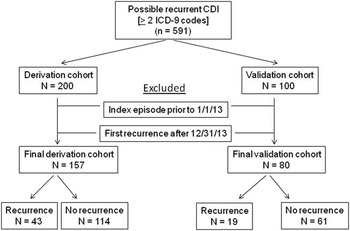
Our primary outcome was an episode of recurrent CDI determined on medical chart review by 1 of 2 authors (G.E.B. or A.N.A). Recurrent CDI was defined as recurrence of diarrhea after resolution of the initial episode and a repeat positive stool toxin assay, triggered by clinical suspicion for recurrent disease and usually accompanied by a new prescription for oral vancomycin or metronidazole.Reference McDonald, Coignard and Dubberke 33 Clinically suspected recurrences without microbiologic confirmation were not sufficient to meet our definition of recurrent disease. Two hundred patients selected at random from among those with 2 or more codes for CDI in 2013 formed our derivation cohort. On medical chart review, patients who had their index episode of CDI before January 1, 2013, were excluded as were those who developed their first recurrence after December 31, 2013 (Figure 1). Multivariable logistic regression was used to identify predictors that performed best in identifying recurrent CDI. A 2-sided P<.05 indicated independent statistical significance. Potential predictor variables were analyzed both as continuous variables (for example, number of ICD-9 codes) as well as when classified with dichotomous cut-offs (≥ or <3 codes). The performance of the model was evaluated by calculating the area under the receiver operating characteristic curve (AUROC).
Flowchart representing study procedures.

Validation
An independent cohort of 100 patients selected at random formed the validation cohort. Medical chart review identified those with recurrent CDI. The performance of the individual variables on regression as well as our final model was evaluated in this cohort and statistical significance and model performance were compared with the derivation cohort.
Statistical analysis was performed using Stata, version 13.1 (StataCorp) and the R software (R Foundation for Statistical Computing). The source of funding had no influence on design or execution of the study and was not involved in development of the manuscript. The study was approved by the institutional review board of Partners Healthcare.
RESULTS
Study Population
There were a total of 1,165 unique patients who had at least 1 ICD-9 code for CDI during the study period, among whom 591 (51%) had 2 or more codes and were included in this study. The median number of ICD-9 codes for CDI was 3 (interquartile range, 2–4) (Table 1). A total of 281 patients (48%) had 2 or more diagnostic tests for CDI. Metronidazole and vancomycin prescriptions were identified in 520 and 549 patients, with 377 (64%) and 472 (80%) having 2 or more individual prescriptions of each drug respectively. The mean (SD) age of the study population was 62 (20) years. The median Charlson comorbidity was 7 (interquartile range, 4–10).
Characteristics of the 591 Members of the Study Population

NOTE. Data are no. (%) unless otherwise indicated. CDI, Clostridium difficile infection; ICD-9, International Classification of Diseases, Ninth Revision; IQR, interquartile range.
Derivation of Case-Finding Tool
From the 200 patients selected as part of the derivation cohort, an index diagnosis of CDI was confirmed in 194 patients (97%). On medical chart review, 82 (42%) were confirmed to have more than 1 episode of CDI. After exclusion of patients with an index episode prior to January 1, 2013 (n=38), or recurrence after December 31, 2013 (n=5), our final population for derivation of prediction algorithm consisted of 157 patients, among whom 43 (27%) recurred (Figure 1).
Table 2 presents the results of the logistic regression model of predictors of recurrent CDI. Presence of at least 3 ICD-9 codes for CDI (odds ratio, 2.49), 2 or more diagnostic tests (odds ratio, 2.88), and 2 or more prescriptions for vancomycin (odds ratio, 5.87) were independently associated with confirmed recurrent CDI. The presence of inpatient (vs outpatient) codes did not significantly add to the model. Examining number of codes as a continuous variable revealed that each additional ICD-9 code increased likelihood of confirmed recurrence by 41%. The final model had moderate ability in predicting recurrent CDI with an AUROC of 0.77.
Predictors of Recurrent Clostridium difficile Infection on Multivariate Analysis

NOTE. ICD-9, International Classification of Diseases, Ninth Revision.
Table 3 compares the sensitivity, specificity, positive and negative predictive values, and AUROC of various criteria to identify recurrent CDI. Although the presence of at least 3 ICD-9-CM codes, 2 or more CPT codes, and 2 or more prescriptions for vancomycin were all independently associated with recurrent CDI, the sensitivity ranged from 56% for at least 2 CPT codes for tests to 95% for vancomycin whereas the specificity inversely ranged from 72% for 2 or more tests to 28% for vancomycin. The negative predictive values were acceptable in the range of 80%–95%, though the positive predictive value remained poor for each of the parameters (33%–43%). A classifier incorporating 2 or more distinct prescriptions for vancomycin and either 2 or more CPT or 3 or more ICD-9-CM codes had the best performance with a positive predictive value of 41% and negative predictive value of 90%. The AUROC for this combined classifier remained modest (0.69).
Sensitivity, Specificity, Predictive Values, and Accuracy of Various Classifiers for Recurrent Clostridium difficile Infection

NOTE. Combined classifier includes ≥2 prescriptions for vancomycin + (≥2 stool tests or ≥3 codes). AUROC, area under the receiver operating characteristic curve; ICD-9, International Classification of Diseases, Ninth Revision; NPV, negative predictive value; PPV, positive predictive value.
Validation
The performance of the predictive model was examined in an independent validation cohort (80 patients with 19 recurrences). The AUROC was similar to that in the derivation cohort (0.70) with a sensitivity of 84% and positive predictive value of 38%.
DISCUSSION
Ability to prevent recurrent disease is a key distinguishing feature between various treatments for CDI.Reference Konijeti, Sauk and Shrime 19 , Reference Lo Vecchio and Zacur 34 – Reference van Nood, Vrieze and Nieuwdorp 37 However, there are no national or regional surveillance estimates of the burden posed by recurrent CDI due to lack of a case-finding tool to accurately identify recurrent disease in the electronic health record or administrative data. From a large cohort of patients with an index episode of CDI, we demonstrate that the performance of even the most optimal predictive model in identifying recurrent CDI is at best modest, suggesting that accurate identification of recurrent episodes of CDI requires medical chart confirmation of individual cases. However, we were able to identify predictive variables that increase the pre-test probability, facilitating this confirmation process.
Several studies support the accuracy of administrative data–based definitions for CDI and such models have been valuable for estimation of regional and national healthcare burden as well as secular trends.Reference Dubberke, Reske and McDonald 24 , Reference Shaklee, Zerr and Elward 25 – Reference Schmiedeskamp, Harpe and Polk 29 Dubberke et alReference Dubberke, Reske and McDonald 24 studied all patients with a positive C. difficile–toxin assay or an ICD-9 code for CDI and demonstrated comparable accuracy between the 2 definitions, with a sensitivity of 78% and a specificity of 99.7%. Schmiedeskamp et alReference Schmiedeskamp, Harpe and Polk 29 found a similarly high sensitivity and specificity for ICD-9-CM codes in identifying nosocomial CDI but a poor positive predictive value. Addition of drug therapy for CDI increased the positive predictive value but reduced sensitivity. However, data exist to the contrary as well, suggesting significant variation between institutions and data sources in the performance of predictive models. Chan et alReference Chan, Lim and Chow 38 found that ICD-9 codes had poor sensitivity in identifying CDI in Singapore and underestimated cases compared to laboratory surveillance toxin assay results, a finding similar to that by Jones et alReference Jones, Taright and Boelle 39 using ICD-10 codes.
None of the previous studies examined accuracy of administrative data for recurrent CDI. This, as evidenced from our results, remains a uniquely difficult challenge compounded by 3 existing clinical practices. First, we found that the presence of 2 or more ICD-9 codes alone had poor positive predictive value in identifying recurrent disease owing to use of such codes to denote past infection. This is consistent with the findings of Dubberke et alReference Dubberke, Reske and McDonald 24 where 59% of patients who had an ICD-9 code for C. difficile without a positive toxin assay had only a previous history of CDI. Second, the presence of a repeat stool toxin test had low standalone predictive value because of the practice of ordering repeat stool toxin tests to confirm eradication of infection (“test of cure”), though expert society guidelines have issued strong recommendations against such repeat testing because molecular test results may remain positive for weeks after a cure.Reference Cohen, Gerding and Johnson 17 , Reference Surawicz, Brandt and Binion 18 , Reference Aichinger, Schleck and Harmsen 40 – Reference Luo and Banaei 42 Third, the presence of 2 or more prescriptions for vancomycin had high sensitivity in predicting recurrent disease but poor specificity. This was due to 2 reasons. First, oral vancomycin was sometimes used to treat diarrhea that recurred following an episode of CDI even in the absence of toxin confirmation of recurrent CDI. Second, some patients also received co-treatment with vancomycin to “prevent” recurrent CDI in patients with 1 or more prior episodes, although there are few objective data to support or refute the efficacy of this practice. In a small study presented in the abstract form, van Hise et alReference Van Hise, Bryant and Crannage 43 demonstrated a 1% risk of recurrent CDI in those co-treated with vancomycin compared with 37% among those without prophylaxis.
There are a few implications to our findings. Given the burden posed by recurrent CDI, and additionally, that the distinguishing features aiding selection among competing strategies for the management of CDI will be related to their ability to prevent recurrence, be it vancomycin, fidaxomicin, fecal microbiota transplantation (FMT), or emerging novel therapies,Reference Ananthakrishnan 1 , Reference Konijeti, Sauk and Shrime 19 , Reference Varier, Biltaji and Smith 20 , Reference Lo Vecchio and Zacur 34 there is an important unmet need for case-finding algorithms that can readily identify recurrent CDI. At this time, it appears that such surveillance continues to require individual case confirmation. Separate diagnosis subcodes for recurrent CDI may aid in specifically identifying recurrent disease. Although we relied on CPT procedure codes for toxin or polymerase chain reaction tests rather than actual microbiologic results in order to mimic data typically available in administrative datasets, analysis of laboratory data with toxin confirmation to identify recurrence may not significantly improve performance for a couple of reasons. First, the fragmentation of care between different hospitals, and indeed hospitals and outpatient practices using distinct labs, makes it likely that longitudinal tracking of CDI toxin will continue to be a challenge, particularly as the diagnosis of recurrent disease may occur at an institution separate from the index episode. A single uniform identification number that can track multiple C. difficile tests results across the same individual may be helpful in identifying recurrent disease but cannot overcome the practice of testing to confirm adequacy of treatment (“test for cure”), which increases the false positive rates of any algorithm.
We readily acknowledge several limitations to our study. First, our study comprised mostly patients managed at 1 of 2 tertiary referral hospitals and affiliated centers in the Greater Boston metropolitan area and as such may not reflect community-based practices. However, the fact that the rate of recurrence in our study is consistent with reported estimates supports the generalizability of our findings. Second, we restricted our analysis of laboratory tests to the CPT codes for testing rather than microbiologic toxin assay results. This was intentionally done because many administrative data sets contain only procedure charges indicating that the test was performed and not actual microbiologic results. In our analysis, we required a minimum interval of 4 days between ICD-9 codes for them to be counted as distinct numbers. In sensitivity analysis, increasing this minimum interval to 10–14 days modestly increased specificity but resulted in the exclusion of an additional 21% of potential cases and did not improve the AUROC. Depending on the intent of a case-defining algorithm (maximize sensitivity or specificity), future studies could vary this interval. Further, the range of interval between the first and last codes was slightly greater for those with recurrent CDI (median, 26 days) compared with those without recurrence (median, 12 days) and consistent with clinical experience on timing of recurrent CDI. Though other risk factors including age, comorbidity, and ongoing antibiotic or proton pump inhibitor use may also increase risk of (and thus, positive predictive value for) recurrent CDI,Reference Abou Chakra, Pepin and Sirard 44 we did not include them as covariates in our multivariable model because we wanted the algorithm to be independent of bias from the distribution of specific risk factors to ensure the model will perform similarly in the absence of such predisposing risk factors. This will provide a more generalizable population with recurrent CDI, particularly important with the changing epidemiology of CDI and occurrence of community-acquired disease in the absence of such risk factors.
In conclusion, our study highlights the challenges in accurately identifying recurrent CDI using administrative data. The number of ICD-9 codes, the number of stool toxin tests identified by CPT procedure codes, and distinct prescriptions for oral vancomycin all provide supporting information but the best performing algorithm still had a suboptimal positive predictive value. Thus, use of administrative data alone without individual case confirmation by chart review cannot be recommended for identifying recurrent CDI. Continued attempts to optimize case-finding are essential to facilitate monitoring and surveillance of recurrent infection due to C. difficile.
Acknowledgments
Financial support. Cubist; National Institutes of Health (grant DK097142 to A.N.A.).
Potential conflicts of interest. A.N.A. reports that he has served on the scientific advisory boards for Cubist and Abbvie. All other authors report no conflicts of interest relevant to this article.