Introduction
Innovation is essential for agricultural and economic development (Hayami and Ruttan, Reference Hayami and Ruttan1985; World Bank, 2011). The need to overcome challenges and harness opportunities has induced the development of several innovations in agriculture (Hayami and Ruttan, Reference Hayami and Ruttan1985; Goldman, Reference Goldman1993). However, the focus of research and development has mainly been on externally driven innovations, which are generated by universities and research institutions. There is a mounting body of evidence on the positive impacts of these innovations (Evenson and Gollin, Reference Evenson and Gollin2003). However, externally driven innovations are often promoted in Africa using the transfer-of-technology (ToT) model, which considers farmers as recipients of knowledge only. This has sometimes led to the development of technologies that are inappropriate for farmers' conditions (Reij and Waters-Bayer, Reference Reij and Waters-Bayer2001; Röling, Reference Röling2009a). Considering the limitations of the ToT model, such as little recognition of farmers' knowledge and of diversity of farming systems, there has been increasing calls for the adoption of participatory approaches to agricultural research and technology development (Reij and Waters-Bayer, Reference Reij and Waters-Bayer2001; Scoones and Thompson, Reference Scoones and Thompson2009).
Over the years, farmers have also been recognized as innovators (i.e. generators of new practices and tools) and experimenters, rather than mere adopters of introduced technologies. In fact, farmers have been innovating long before the emergence of formal research and development (Biggs and Clay, Reference Biggs and Clay1981), and there are even claims that some of the technologies developed by scientists were actually based on ideas and practices of local farmers (Rhoades, Reference Rhoades1989; Röling, Reference Röling2009b). In the face of increasing global challenges, rural farmers are becoming more innovative (Sanginga et al., Reference Sanginga, Waters Bayer, Kaaria, Njuki and Wettasinha2009). They engage in innovation-generating practices such as experimentation, modification of external innovations to suit their local environments, and development of new technologies (Reij and Waters-Bayer, Reference Reij and Waters-Bayer2001; Leitgeb et al., Reference Leitgeb, Kummer, Funes-Monzote and Vog2014). The process of implementing these innovation-generating activities by farmers is commonly referred to as farmer innovation [Farmer innovation, innovation-generating practices or activities, and innovation-generating capacity are used interchangeably in this paper.]. Following Waters-Bayer et al. (Reference Waters-Bayer, van Veldhuizen, Wongtschowski and Wettasinha2009), we define a farmer innovation to be a new or modified practice, technique or product that was developed by an individual farmer or a group of farmers without direct support from external agents or formal research. The term farmer innovation also goes beyond the final outcome and encompasses activities of the innovation process. These activities may be new to farmers in one community, but not necessarily new to farmers in other communities (Waters-Bayer and Bayer, Reference Waters-Bayer and Bayer2009). Farmer innovation practices are claimed to be relatively inexpensive, easily accessible, locally appropriate and easily scalable (Waters-Bayer and Bayer, Reference Waters-Bayer and Bayer2009). Thus, farmer innovation could complement the highly promoted external innovations in addressing the increasing challenges in agriculture.
There has been some attention on promoting farmer innovations in recent years. For instance, the establishment of Prolinnova—a global learning network seeking to promote local innovation in ecologically oriented agriculture and natural resource management—in 1999 has facilitated the identification and promotion of farmer innovations in several developing countries (Waters-Bayer et al., Reference Waters-Bayer, van Veldhuizen, Wongtschowski and Wettasinha2009). While there is increased interest in promoting farmer innovations, little attention has been paid to how to build the capacity of farmers to generate innovations. Most studies focus on farmers' adoption of externally driven technologies, while farmers' ability to generate innovations are rarely recognized (Macmillan and Benton, Reference Macmillan and Benton2014). In this study, we attempt to address this gap in the innovation literature using econometric techniques.
Enhancing farmers' efforts to implement innovation-generating practices may lead to the development of location-specific practices for a diverse range of farming systems and also ensure quick adaptation to constantly changing conditions (Reij and Waters-Bayer, Reference Reij and Waters-Bayer2001). Tambo and Wünscher (Reference Tambo and Wünscher2016) has also shown that farmers' innovation-generating practices contribute significantly to an increase in household income and consumption expenditure, and a reduction of household food insecurity. Thus, empowering farmers to generate more innovations will have important policy implications, and finding ways to achieve this outcome is the objective of the present study. The main aim of this paper is, therefore, to assess pathways to building innovation-generating capacity in farm households. In particular, we examine the effect of farm households' participation in farmer field fora (FFF), a participatory extension approach, on innovation-generating capacity. We expect FFF to enhance the innovation capacity of farmers through various means, including empowerment and improvement in problem-solving skills.
The contribution of this paper to the extant literature is mainly twofold. First, we focus on smallholders' innovation-generating decisions instead of innovation adoption, which has been studied extensively. Secondly, there are many studies looking at the impact of farmer field schools (FFS) on outcome variables such as empowerment, technology adoption, household income and food security but with inconclusive findings (for a review, see Davis et al., Reference Davis, Nkonya, Kato, Mekonnen, Odendo, Miiro and Nkuba2012, Table 1). Within this vast literature, however, there is little, if any, on the innovation-generating effects of FFS. This study provides empirical evidence on the potential of FFF, a variant of FFS, in stimulating innovation-generating behavior among farm households. To account for the possible selection bias from the non-random nature of FFF participation, we employ an instrumental variables technique, as well as other estimation methods for robustness checks. We also analyzed spillover effects of FFF participation on innovation generation.
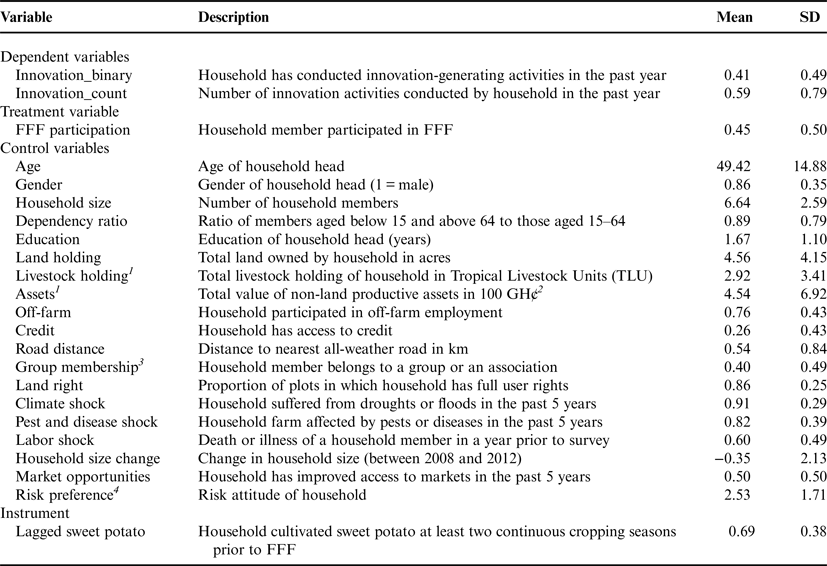
Definition and descriptive statistics of variables.

1 These variables exclude assets or livestock acquired during the 2011–2012 agricultural season to avoid problems of endogeneity.
2 The exchange rate at the time of the survey was US$1 = GH¢ 1.90.
3 We only include membership of a group prior to FFF to avoid problems of endogeneity.
4 This ranges from 1 (extremely risk averse) to 6 (neutral to risk preferring).
This study is inspired by the induced innovation and innovation systems theories. The theory of induced innovation considers challenges (such as factor scarcity and shocks) and opportunities (such as market opportunities) as key drivers of innovation (Hayami and Ruttan, Reference Hayami and Ruttan1985; Sunding and Zilberman, Reference Sunding, Zilberman, Gardner and Rausser2001), whereas the innovation systems perspective argues that innovations emerge through networks of actors and organizations (Spielman, Reference Spielman2005; World Bank, 2011), as is the case with FFF. Our empirical analysis is based on farm household data obtained from rural northern Ghana, which is an interesting case study. On one hand, FFF programs have been implemented in the region, and this allows us to study the potential role of FFF participation in building farmers' innovation capacity. On the other hand, northern Ghana is characterized by resource-poor farmers who face challenges of climate change, soil infertility, land degradation, pest and diseases, population pressure and food insecurity (Runge-Metzger and Diehl, Reference Runge-Metzger and Diehl1993), and thus serves as an appropriate example for analyzing some of the arguments of the induced innovation hypothesis.
The remainder of this paper is structured as follows. In the ‘Farmer Field Fora’ section, we give a brief overview of the FFF program in Ghana. In the ‘Methods’ section, we explain the methods including details of the estimation approaches, data and some descriptive statistics. The empirical results and robustness checks are presented and discussed in the ‘Results and Discussion’ section, and the last section concludes the paper.
Farmer Field Fora
Our empirical analysis of the potential role of FFF in building farmers' innovation-generating capacity is based on the FFF of the Root and Tuber Improvement and Marketing Program (RTIMP) in Ghana. The program was implemented between 2006 and 2014 by Ghana's Ministry of Food and Agriculture (MoFA) with funding from the International Fund for Agricultural Development (IFAD) and the Government of Ghana. The RTIMP used the FFF as a platform for mutual learning and knowledge sharing among stakeholders, particularly farmers, extension agents and researchers, in the root and tuber value chain. The aim of FFF is to ‘build the capacities of farmers to become experts in the development of technologies and managerial practices to solve specific problems within the agro-ecological context of farming’ (Gbadugui and Coulibaly, Reference Gbadugui and Coulibaly2013, p. 2). It is a variant of the well-known FFS, a participatory extension model. Unlike FFS which is claimed to give little or no attention to farmer-developed innovations (Reij and Waters-Bayer, Reference Reij and Waters-Bayer2001), FFF provides an opportunity for farmers to experiment with their own innovations, thereby strengthening their decision-making and innovation capacity.
The RTIMP–FFF aims at improving farmer innovation and productivity of root and tuber crops in major production districts of the country. In each participation district, the FFF was developed for the most important root or tuber crop. Sweet potato is the most significant root and tuber crop in the Upper East region of Ghana, where this study was conducted. Thus, our study is based on sweet potato FFF. The main actors involved in the FFF include researchers, extension agents, business advisors, farmers and processors, and they are all placed on an equal footing. During a participatory rural appraisal, the farmers determine the theme of the FFF, thereby ensuring that their priorities are addressed. The thematic areas normally selected by the farmers include improved crop varieties, IPM (integrated pest management), improved cultivation practices and integrated soil fertility management. There are also discussion sessions on non-farm topics. Each forum consists of a group of 30–40 farmers together with other key actors who meet regularly (usually weekly) in the field during a growing season. They engage in comparative experimentations using three plots: farmers practice (FP), integrated crop management (ICM) and participatory action research (PAR). The experiments are designed and carried out by the farmers with the assistance of a facilitator who stimulates critical thinking and discussions, and ensures active participation. Conventional and improved farming practices are implemented on the FP and ICM plots, respectively. On the PAR plots, the participating farmers conduct experiments to validate their own innovations or to test new ideas.
It should be stressed that FFF are not necessarily a place where innovations are birthed. Rather, it serves as a learning and capacity building environment.
Methods
Empirical strategy
We are interested in estimating the effect of FFF participation and other covariates of interest on innovation-generating capacity of farm households. This can be specified as:
 $${\rm FI}_{\rm i} = {\rm \beta} _{\rm 0} + {\rm \beta} _{\rm 1} X_{\rm i} + {\rm \beta} _{\rm 2} {\rm FFF}_{\rm i} + {\rm \beta} _3 R_{\rm i} + {\rm \beta} _4 V_{\rm i} + {\rm \varepsilon} _{\rm i} $$
where the dependent variable FI (farmer innovation) indicates innovation-generating activity of household i. We use two different measures of the dependent variable to check if the results are sensitive to the farmer innovation indicator employed. The first (innovation_binary) is a binary variable, which is equal to one if the household has implemented any innovation-generating activity in the past 12 months; and zero otherwise. The second (innovation_count) is a count variable that indicates the number of different innovation-generating activities implemented by a household in the past 12 months [The binary and count indicators regard all the farmer innovations to be of equal importance and do not distinguish between major and minor innovations. We tried to address this limitation and account for the varied importance of the various innovations by categorizing the innovations into four groups (that is, invention or major innovation, adaptation of exogenous ideas, modification of traditional practices and experimentation) and then constructed two household innovation indices using weights obtained through principal component analysis (PCA) and expert judgments. We followed Filmer and Pritchett (Reference Filmer and Pritchett2001) and used PCA to assign weights to each of the four innovation categories, and constructed a household innovation index. In the expert judgments, a stakeholder workshop was organized and 12 agricultural experts in the study region assigned weights to the four innovation categories based on their relative importance. They assigned weights of 0.4, 0.2, 0.3 and 0.1 for invention, adaptation of exogenous ideas, modification of traditional practices and experimentation, respectively. We do not report these results for brevity, but they are not very different from the binary and count dependent variables estimates. The results are available on request.]. The questions used to elicit the innovation-generating activities are presented in the Appendix 1.
Variable X i includes a vector of household socio-demographic and economic variables that are commonly found in the agricultural innovation literature (such as age, gender and education of the household head; household size and dependency ratio; access to services and the wealth position of the household). It also includes variables motivated by the induced innovation hypothesis such as shocks experienced by the household during the past 5 years (climatic stress, pests and diseases and labor shocks) and access to market opportunities. The variable FFF is equal to one if a household member participated in a FFF; and zero otherwise. This is our main variable of interest.
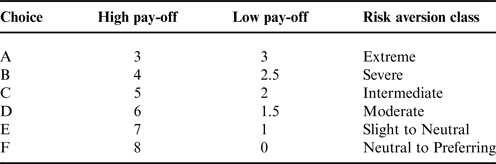
Variable R represents household risk behavior. Following the seminal study by Binswanger (Reference Binswanger1980), we conducted a simple experiment using the ordered lottery selection design with actual payments to elicit households' risk preferences. In the design, each respondent was presented with a choice of six lotteries (A–F), and was asked to select one. Once chosen, a coin was tossed to decide the payoff. A higher payoff could only be obtained at the cost of a higher variance. Table A1 in the Appendix 1 shows the structure of the experiment, but it was actually presented to respondents in the form of photographs of money. This design is most suitable and generates accurate result when the respondents are mostly illiterate or less skilled in mathematics, as in our case (Harrison and Rutström, Reference Harrison and Rutström2008). We also include village fixed effects (V) to control for unobserved heterogeneity in the sample villages. Finally, ε is the random error term.
A usual problem of estimating Equation (1) is the potential endogeneity of the FFF participation variable; hence, applying binary and count data regression models might yield biased estimates. There are two potential sources of endogeneity. First, there is placement endogeneity stemming from the non-random selection of FFF participating communities. Thus, if communities with more innovative farmers were selected to participate in the FFF, then the impact will be overestimated. Secondly, within the FFF communities, farmers self-select into participation in the program. Thus, participating farmers may differ systematically from non-participants in unobserved characteristics such as entrepreneurship and risk behavior, which might lead to biased estimates of the effect of FFF on innovation. Due to the endogeneity issues, participants and non-participants are, therefore, not directly comparable.
To deal with these problems, we exploited our sampling frame and also used two-stage regression and propensity score matching (PSM) approaches. First, in our sampling strategy, the non-participants sample was drawn from both FFF participating and non-participating villages, and this helps in reducing the problem of placement endogeneity. Though non-participants in FFF villages might potentially be affected by spillovers, we believe that participation enhances innovation-generating capacity and exposure alone does not confer this skill, and this is later proven to be true when we look at the spillover effects of FFF participation. The non-participation villages were also drawn from the same agro-ecological zone and districts as the participation villages and are likely to be the next group of FFF villages in any future scaling up. Secondly, we use village fixed effects to account for unobservable heterogeneity between villages. Furthermore, we control for risk attitude of farmers which is one of the key characteristics of innovative behavior which, however, is often not captured in agricultural innovation studies (Feder et al., Reference Feder, Just and Zilberman1985). Finally, we employ two-stage models [recursive bivariate probit (RBP) and endogenous switching Poisson (ESP)] to further remedy the endogeneity problems. In the RBP and ESP models, we first estimate a selection model, expressed as:
 $${\rm FFF}_{\rm i} = {\rm \delta} _0 + {\rm \delta} _1 X_{\rm i} + {\rm \delta} _2 R_{\rm i} + {\rm \delta} _{\rm 3} V_{\rm i} + {\rm \delta} _4 Z_{\rm i} + {\rm \mu} _{\rm i} $$
where FFF, X, R and V are defined as in Equation (1). The variable Z is the excluded instrument, and it denotes lagged sweet potato (that is, household cultivation of sweet potato at least two continuous cropping seasons prior to FFF). We argue that this variable affects FFF participation but does not directly affect innovation-generating behavior. As mentioned, the FFF program under study is sweet potato-based. Also, in the study region, sweet potato is a minor crop which is cultivated by almost every household, albeit irregularly and on a very small scale. Since participation in FFF is voluntary, every farmer could volunteer to join. However, we expect farmers who cultivate sweet potato regularly (that is, at least two continuous cropping seasons) prior to the FFF to show more interest in participating. Though the FFF is sweet potato-related, the knowledge gained from participating in the program is not crop-specific, but extendable to other farming activities. This was the case in our sample as almost all the innovation-generating activities observed are not connected to sweet potato production. Thus, the lagged sweet potato variable is only likely to have an effect on farmers' innovation-generating practices through FFF participation. We specifically use lagged measures of regular sweet potato cultivation because it is more likely to be exogenous to innovation-generating decisions than current situations.
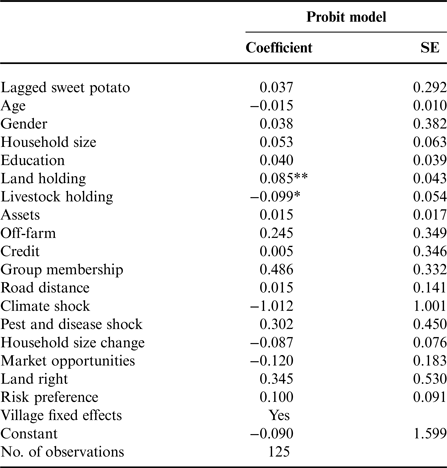
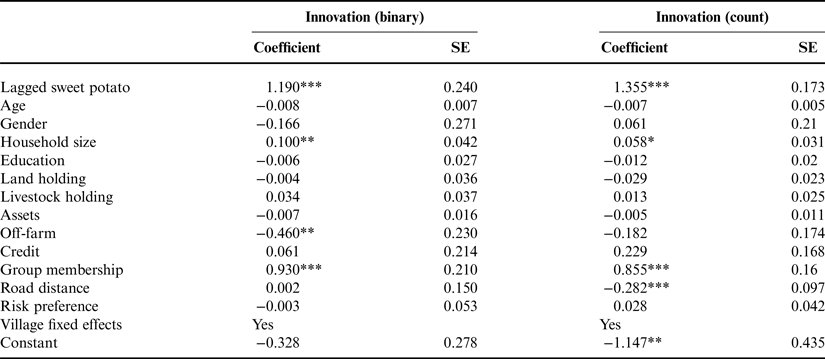
One could still argue that unobservable variables, such as motivation, that affect farmers' decision to cultivate sweet potato regularly prior to FFF may also affect the farmers' decision to innovate, which may lead to biased estimates of the effect of FFF on innovation capacity. Following Fischer and Qaim (Reference Fischer and Qaim2012), we conduct a placebo regression analysis to test whether there exist such alternative effects of the instrument on farmers' innovation-generating decision. Using data from only non-participating villages, we examine the effect of the instrument and other covariates on the innovation-generating decision of households not exposed to FFF. We expect significant effects of the lagged sweet potato variable if it is endogenous to the innovation-generating decision of households. The result (see Table A2 in the Appendix 1) indicates that there is no direct effect of the lagged sweet potato variable on the outcome variable, and this suggests that the instrument is valid. We will show in the results section that the lagged sweet potato variable significantly affects FFF participation, which also confirms the validity of the instrument.
As already indicated, we use two different measures of the dependent variable to check if the results are robust to different specifications of households' innovation-generating capacity. We therefore require estimation techniques that account for the different measures of the dependent variable and the endogeneity of the FFF participation variable. Consequently, we use two different econometric techniques that allow the estimation of non-continuous outcomes with an endogenous dummy variable. In the first model (innovation_binary), we estimate a maximum likelihood RBP because both the outcome and the endogenous FFF participation variables are binary. In the second model (innovation_count), the outcome is a count variable so we employ an ESP regression model (Miranda and Rabe-Hesketh, Reference Miranda and Rabe-Hesketh2006). For robustness checks, we compute naïve models of Equation (1) either by ignoring the potential endogeneity of FFF participation or by controlling for only one of the two potential sources of endogeneity indicated above. We also employ PSM estimation technique as an additional robustness check, which we present later in this paper.
Data and descriptive statistics
The empirical analysis is based on data for the 2011–2012 agricultural season obtained from a household survey in the districts of Bongo, Kassena Nankana east and Kassena Nankana west in the upper east region of Ghana. The districts fall within the Sudan savanna agro-ecological zone, which is characterized by systems of permanent cultivation on rain-fed land with high population density, small land holdings, soil degradation, low labor productivity, predominance of annual and biannual crops and increasing cash crop production (Ruthenberg, Reference Ruthenberg1971; Runge-Metzger and Diehl, Reference Runge-Metzger and Diehl1993). Agriculture is the main income source and a cereal–legume cropping system is predominant in the study region. The major crops are millet, sorghum, maize, cowpea, rice and groundnut. Most households also rear livestock. The area is characterized by a prolonged dry season and erratic rainfall; hence, many of the inhabitants migrate to southern Ghana to seek employment opportunities or engage in irrigated vegetable farming during the dry season.
The sample included FFF participants, non-participants from FFF communities (hereafter, exposed farmers) and non-participants from control communities (hereafter, control farmers). We interviewed 409 households from 17 villages using a stratified random sampling. We first obtained from the district RTIMP project officers, a list of all the 24 villages in the three districts where FFF has been implemented between 2008 and 2011. Then we randomly selected 10 participating villages across the three districts. We interviewed about 16–21 participants from each of these villages, resulting in a total of 185 FFF participants. We also obtained a list of all households in each participating village and randomly sampled and interviewed 99 farmers across the ten villages. Since these farmers are located in the same FFF villages, they may be potentially exposed to some of the effects of FFF. To obtain a group of control farmers devoid of potential spillovers, we randomly selected seven villages (from the same three districts) that have similar infrastructural services and socio-economic conditions but not in close proximities to the FFF communities. Out of these, we randomly selected 125 farm households from a household list obtained from the District Agricultural Offices. Thus, our final sample consists of 185 FFF participants and 224 non-participants (99 exposed and 125 control farmers), making a total of 409 sample farmers.
Interviews were conducted with the aid of pre-tested questionnaires and were supervised by the first author. The questionnaire captured data on household and plot characteristics, crop and livestock production, off-farm income earning activities, innovation-generating activities, and access to infrastructural services, information and social interventions. The respondents were FFF participants and the principal decision-maker on farming matters in the household.
Table 1 outlines the description of the variables used in the regression and their mean values. The table shows that in the past 12 months, about 41% of the sample households conducted at least one innovation-generating activity, and the average number of innovation-generating activities implemented is about 0.60. Among the innovators, it was found that about 27, 12, 2 and 0.2% of them have generated 1, 2, 3 and 4 innovations, respectively.
The table also shows that majority of the households are male-headed, household heads have very low level of education, and many households are affected by shocks.
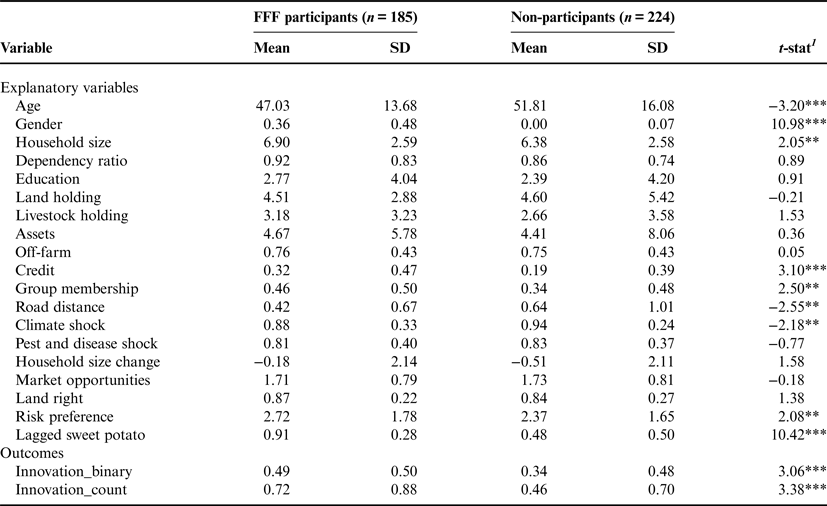
Table 2 presents the summary statistics of the variables in the regression, disaggregated by FFF participation status. The table shows that there are significant differences between FFF participants and non-participants with respect to some of the household characteristics. For instance, FFF participants are significantly more likely to be younger and to be member of an association, and less likely to be credit constrained than non-participants. The table also indicates that relative to non-participants, FFF participants implemented significantly more innovation-generating activities. In the ‘Results and Discussion’ section, we analyze this relationship using econometric techniques.
Comparison of characteristics of FFF participants and non-participants.

*** and ** represent 1 and 5% significance level, respectively.
1 Test of mean difference between FFF participants and non-participants.
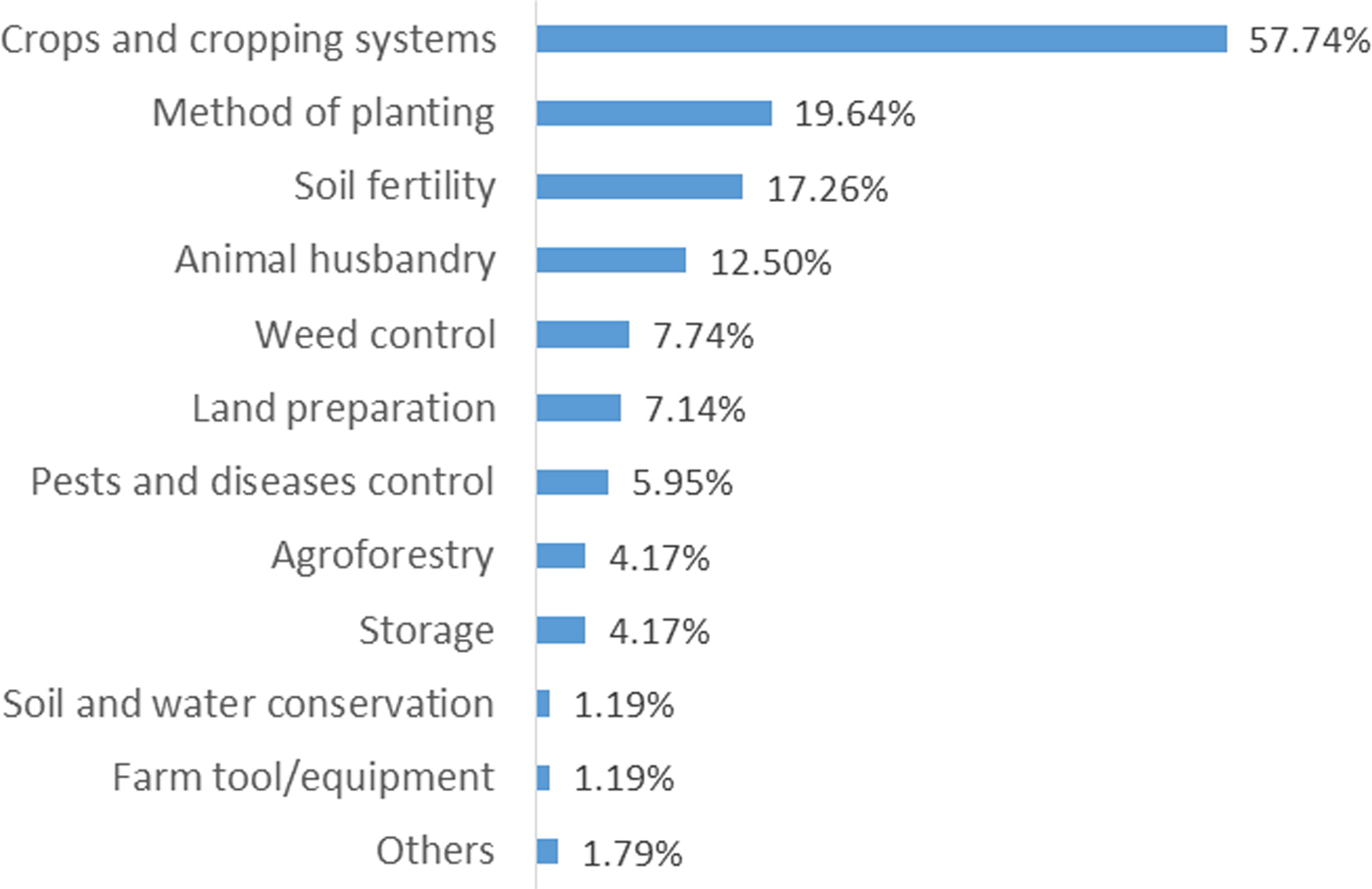
Figure 1 shows the different domains in which the farmers innovated. The main domain is related to crops and cropping systems. Land preparation, method of planting, soil fertility, weed, pest and disease control, and animal husbandry are the other important domains of the farmers' innovations. Examples of the farmers' innovation-generating practices include: testing and modification of cropping pattern; control of weeds, pests and diseases using biopesticides; new formulations of animal feed and new herbal remedies in the treatment of livestock diseases; developing and using new farming tools; and storage of farm products using plant extracts or local grasses. These domains of farmers' innovations relate to those obtained by other studies, such as Reij and Waters-Bayer (Reference Reij and Waters-Bayer2001), Bentley (Reference Bentley2006) and Leitgeb et al. (Reference Leitgeb, Kummer, Funes-Monzote and Vog2014). Some specific examples of the most promising farmers' innovations are presented in Tambo and Wünscher (Reference Tambo and Wünscher2015).
Domains of innovation-generating practices.

Results and Discussion
In this section, we look at the econometric results on the effect of FFF and other covariates on farmers' innovation-generating capacity. We check for robustness using alternative specifications and estimation methods. Finally, we analyze spillover effects of FFF participation.
The effect of FFF participation on farmers' innovation-generating capacity
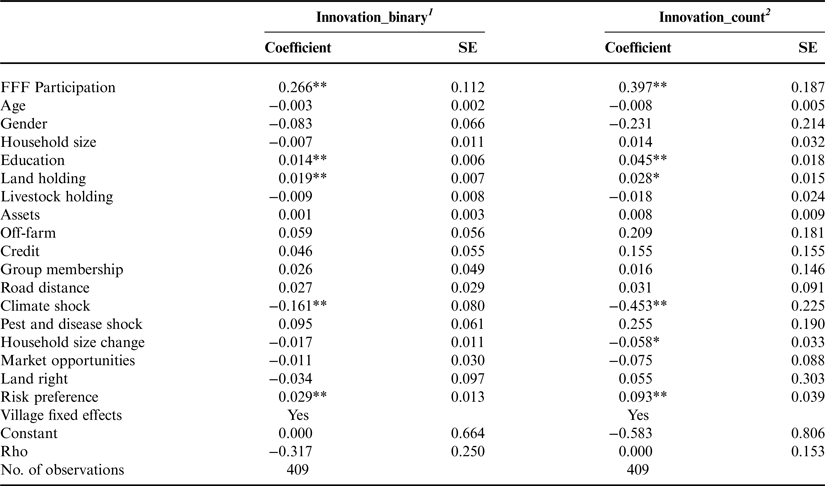
As already indicated, two different econometric models (RBP and ESP) are used to deal with the endogeneity problems and also to account for the nature of the two dependent variables. We instrument for FFF participation in the first-stage regression, which is on the determinants of FFF participation, and the results are reported in Table A3 in the Appendix 1. The excluded instrument (lagged sweet potato) is highly significant in all models, which suggests the relevance of the instrument. The results of the estimated models on the determinants of innovation generation are presented in Table 3. The rho values in the lower part of Table 3 indicate that there is no significant correlation between the error terms in Equations (1) and (2), suggesting that there is no selectivity bias.
Determinants of farmers' innovation-generating capacity.

** and * represent 5 and 10% significance level, respectively.
1 Recursive bivariate probit model. We report average marginal effects, which were obtained using the stata command, margins with the option predict (pmarg1) force.
2 Endogenous switching Poisson model. It was estimated using ssm command in stata 13.
The results show that our main variable of interest, FFF participation, has a positive and statistically significant effect on farmers' innovation-generating capacity irrespective of the outcome measure employed. However, the magnitude of the effect depends on the outcome measure used. The RBP estimation result indicates that FFF participants have a 26.6% higher probability of generating innovations than non-participants. Similarly, the ESP result shows that FFF participation seems to increase the number of innovation-generating activities by {exp(0.397) − 1} × 100 = 48.74%. There are a number of possible pathways through which FFF participation may influence innovation-generating capacity. First, FFF provides opportunity for farmers to test their innovations in the presence of other stakeholders, and this builds their self-esteem and empowers them to innovate due to the recognition and appreciation of their ideas by others. Secondly, FFF may enhance the analytical and problem-solving skills of participants, which are essential for innovation. Finally, the FFF graduates form vibrant farmer groups for continuous group discussion and learning, which may facilitate further innovative activities. This result suggests that the concept of innovation systems, which facilitates active interactions among key stakeholders, has a potential for strengthening farmers' innovation capacity. This finding also suggests that FFS programs do not only enhance the adoption of agricultural innovations (Erbaugh et al., Reference Erbaugh, Donnermeyer, Amujal and Kidoido2010; Friis-Hansen and Duveskog, Reference Friis-Hansen and Duveskog2012), but they can also contribute to building farmers' capacity to implement innovation-generating activities.
Other determinants of farmers’ innovation-generating capacity
The results in Table 3 indicate that beside FFF participation, the robust determinants of innovation-generating capacity, irrespective of the measure employed, are level of education of household head, size of land holding, household experience of climate shock and risk preferences. The results show that the total number of years of education completed by the household head is associated with a higher likelihood of carrying out innovation-generating practices. The significant and positive effects of FFF participation and education variables confirm the important role of human capital formation in innovation processes.
Climate shock, one of the variables motivated by the induced innovation theory is statistically significant, albeit with a sign contrary to our expectations. While arguments of the induced innovation hypothesis would predict households that are affected by climate-related shocks to be innovative and to overcome the adverse effects of the shock, our results suggest otherwise. This is, however, plausible as affected households may have lost their economic capabilities to implement innovations. Also, coping with such shocks may involve reallocating household resources (e.g., to non-farm employment), resulting in decreased agricultural production, hence, the less likelihood of generating innovations.
Among the four wealth-related factors (i.e., land holding, livestock holding, assets and off-farm activities) included in the models, only size of land holding is a significant determinant of innovation generation. Most large land holders have several plots; hence, have the leverage to carry out experiments on some of them. There is no active land market in the study region so it is possible that the statistical significance of the land holding variable may be related to the opportunity for experimentation, rather than wealth. Finally, the results show that risk preferring farmers are more likely to be innovative. This is expected since innovations generally involve risk (Feder et al., Reference Feder, Just and Zilberman1985).
Robustness checks
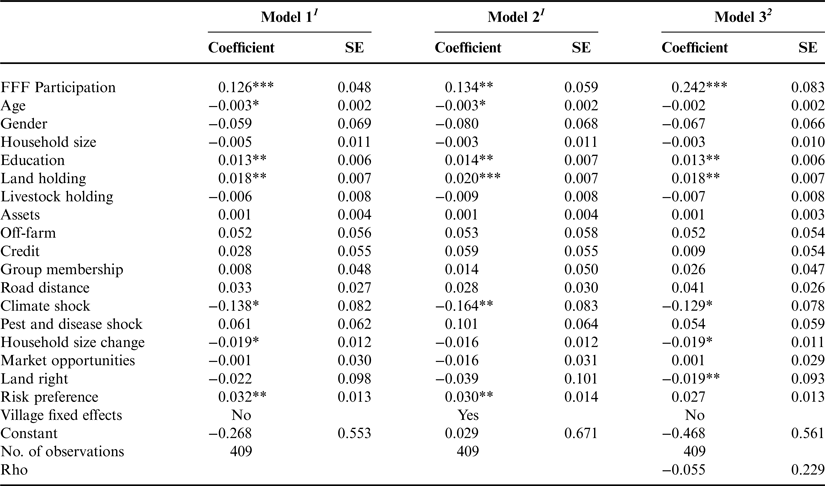
Given the absence of selection bias in the above results, we estimate three naïve models of the effect of FFF participation and other covariates on farmers' innovation-generating capacity by varying our assumptions about the endogeneity of FFF participation. We use the binary outcome (innovation_binary) for the estimations and compare the results (see Table 4) with our preferred model (the RBP result in Table 3). First, we estimate a probit model (model 1) which ignores both self-selection and placement biases. This is the preferred model if we assume that FFF participation is completely exogenous to innovation-generating capacity; hence, it allows us to examine if the two-stage approaches used above significantly change the result of other exogenous variables of interest. The result shows that FFF participants are 12.6% more likely to generate innovations than non-participants, thus indicating an upward bias if FFF participation is treated as endogenous. The direction and significance level of the other covariates, however, do not differ largely from those in Table 3.
Determinants of innovation generation, naïve estimates.

***, **, * represent 1, 5 and 10% significance level, respectively.
1 Estimated using probit regression. Average marginal effects are reported.
2 Estimated using RBP. Average marginal effects are reported. First-stage result is not shown but available on request.
In model 2, we control for placement bias but assume no self-selection into FFF. Here again, we find that the innovation-generating effect of FFF is positive and statistically significant, but the magnitude of the effect (13.4%) seems to suggest the effect may have been overestimated when we accounted for both potential sources of bias. Finally, in Model 3, we assume random village placement of FFF but account for potential self-selection into FFF. The result shows that FFF participants are 24.2% more likely to implement innovation-generating activities relative to non-participants. In summary, the results from these three models and those presented in Table 3 imply that the positive and significant effect of FFF on innovation-generating capacity is consistent and robust, but the magnitude of the effect appears to be sensitive to assumptions about the endogeneity of FFF participation and the measure of innovation-generating capacity employed (i.e., binary or count outcome).
Propensity score estimation
As already indicated, we also use an alternative estimation strategy, PSM, to examine the effect of FFF participation on innovation generation, as a further robustness check. PSM is a non-parametric technique that involves matching FFF participants with non-participants that are similar in terms of observable characteristics. Though it accounts for only observables, it is less restrictive as it does not impose functional form and weak instrument assumptions as is often the case with instrumental variables technique, particularly when used in cross-sectional data analysis (Jalan and Ravallion, Reference Jalan and Ravallion2003). We also try to minimize the bias stemming from unobserved heterogeneity by controlling for risk preference. In addition, we test whether our estimated results are sensitive to unobservables using the bounding approach suggested by Rosenbaum (Reference Rosenbaum2002).
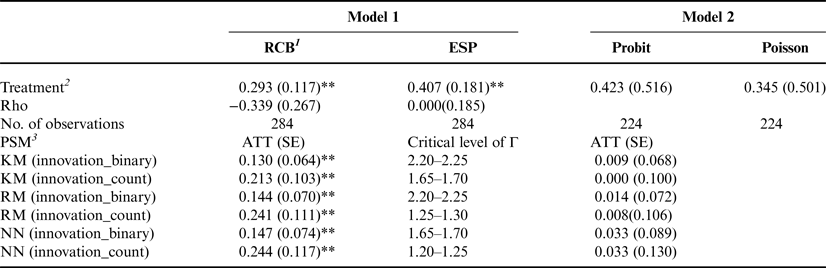
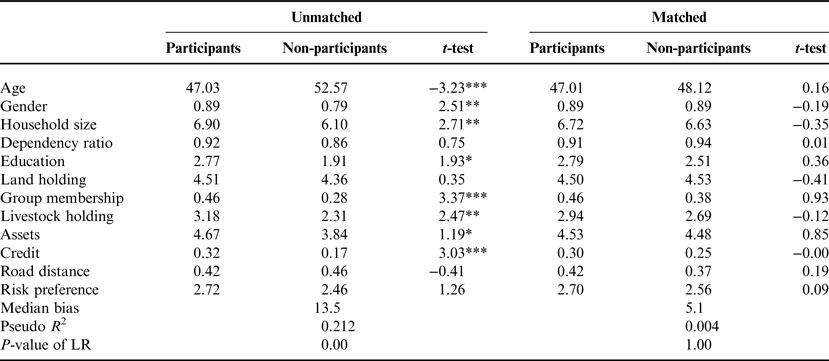
In the PSM approach, a probit regression was estimated using several covariates, which are similar to those in the first-stage regression of the RBP and ESP models, to obtain household's propensity to participate in FFF. We then use the propensity scores obtained in the first stage to match participants and non-participants of FFF. The matching algorithm used is kernel matching with a bandwidth of 0.3 but for robustness check, radius matching with a calliper of 0.05 and nearest-neighbor matching are also employed. A review of the different matching techniques can be found in Caliendo and Kopeinig (Reference Caliendo and Kopeinig2008). We conducted a matching quality test (Rosenbaum and Rubin, Reference Rosenbaum and Rubin1983) to check if the balancing property is satisfied. Based on the kernel matching, the test result (Table A4 in the Appendix 1) shows that in contrast to the unmatched sample, there are no statistically significant differences in covariates between participants and non-participants of FFF after matching. Thus, the balancing requirement is satisfied. Using the PSM, we compute the average treatment effect on the treated (ATT), which is average difference in innovation capacity between FFF participants and non-participants. Here again we find that the results (Table 5) are robust, irrespective of the matching algorithm or the outcome measure employed. Using the kernel matching, for instance, the results show that the rate of innovation generation by FFF participants is 14.1% higher relative to matched non-participants. Overall, the results confirm the positive and significant effect of FFF participation on innovation-generating capacity of farm households.
PSM estimation of the effect of FFF participation on innovation generation.

**Indicates 5% significance level.
1 ATT estimates were obtained by implementing ‘psmatch2’ command in stata. The condition of common support was achieved. Only 3, 6 and 3 households (out of 409) were not successfully matched in the kernel, radius and nearest-neighbor matchings, respectively.
The last column in Table 5 presents the results of the sensitivity of the ATT estimates to unobservable factors. The critical value of gamma, Γ = 2.15–2.20 for kernel matching, for example, indicates that the ATT of 0.141 would be questionable only, if matched pairs differ in their odds of FFF participation by a factor of 115–120%. Thus, the ATT estimates are not very sensitive to unobservables.
Spillover effect of FFF participation
In this section, we test whether FFF participation has spillover (i.e., knowledge diffusion) effects by comparing the innovation capacity of participants with that of the exposed group (Table 6, model 1) and the innovation capacity of the exposed group with the control group (Table 6, Model 2). The FFF program does not reach all farmers, but promoters of the program believe that knowledge gained will be transmitted from participants to other farmers. It is expected that if there is a strong spillover effect, there will be no significant effect of FFF participation on innovation capacity in model 1. Similarly, in model 2, we expect the exposed group to carry out significantly more innovative activities than the control group if there is a spillover effect. In each model, we use two dependent variables (that is, innovation_binary and innovation_count). We therefore estimate Probit and Poisson models for the binary and count outcomes, respectively. However, similar to the empirical approach in the ‘The effect of FFF participation on farmers' innovation-generating capacity’ section, we take the potential endogeneity of FFF participation in model 1 into consideration by estimating RCB and ESP models for the binary and count outcomes, respectively. The main variable of interest, Treatment, takes values of 1 and 0 if the household is a FFF participant or belongs to the exposed group, respectively (Model 1); and 1 and 0 if the household belongs to the exposed or control group, respectively (model 2). As an additional robustness check, we also employ PSM methods.
Spillover effect of FFF participation on innovation generation.

**Indicates 5% significance level. Values in parenthesis are SE.
1 Average marginal effect reported.
2 All models include controls for the same variables in Table 2. The full results are available upon request.
3 Matching was done using similar covariates in Table 4. KM, RM and NN refer to kernel matching, radius matching and nearest neighbor matching, respectively. The condition of common support was fulfilled as all households were successfully matched.
The statistical significance of the Treatment variable in model 1 indicates that relative to the exposed group, participating households are more likely to implement innovation-generating activities, implying that there is no strong spillover effect of FFF on innovation-generating capacity. Similarly, the result in model 2 shows that regardless of the dependent variable used, exposed farmers are not significantly more innovative than control farmers, which further suggests that there is no positive spillover from FFF participants to the exposed farmers. The PSM results in the lower part of Table 6 also confirm the finding that there is no significant knowledge diffusion effect of FFF on innovation-generating capacity.
Similar results were obtained in FFS studies by Rola et al. (Reference Rola, Jamais and Quizon2002), Feder et al. (Reference Feder, Murgai and Quizon2004a) and Tripp et al. (Reference Tripp, Wijeratne and Piyadasa2005) in Philippines, Indonesia and Sri Lanka, respectively. This finding is plausible because FFF strengthens the analytical and problem-solving skills of participants, and the mere location of non-participating households in FFF villages or interactions with other FFF graduates does not confer these skills. Another possible explanation is the low level of intensity of the program. Only one FFF with 30–40 participants (out of about 200 potential participants) was implemented in each participating village. This low intensity is argued to be an important determinant of successful application and dissemination of FFS principles (Feder et al., Reference Feder, Murgai and Quizon2004b).
This finding also validates the inclusion of the exposed group into the group of non-participants in our initial analyses as part of our attempt to minimize the endogeneity problems. Most interestingly, the results in Model 1 suggest that the significant effect of FFF on farmer' innovation-generating capacity persists even when we use only the sample of households from FFF communities. It should be stressed that our approach provides a crude estimation of the spillover effect of FFF participation; hence, further studies would be needed to confirm our findings. It is possible that FFF may have spillover effects on other farming strategies, but this is not the focus of this paper. For instance, the innovation effect of FFF appears to be independent of the crop it focuses on since most of the innovations reported by the farmers were unrelated to sweet potato production, and this is a potential spillover benefit from FFF participation.
Conclusion
While there is increased interest in promoting farmer innovations as a complement to externally driven technologies, little attention has been given to building the capacity of farmers to generate innovations. Using cross-sectional data from rural farm households and econometric techniques, this study analyzes the innovation-generating activities among rural farmers in northern Ghana. We specifically look the potential role of FFF participation in building farmers' innovation-generating capacity.
This study has shown that resource-poor farmers are capable of implementing innovation-generating activities. The innovations range from experimenting with new ideas, modifying or adding value to existing or external practices to complete discovery of better farming practices. Controlling for selection bias, we found that participation in FFF, a participatory extension approach with elements of the innovation systems concept, contributes significantly to enhancing the innovation-generating capacity in farm households. This is possible because participants are likely to be empowered and also gain problem-solving and analytical skills, which are essential for innovation. This result is robust to alternative specifications and estimation techniques. Innovation capacity also increases significantly with education level of household heads, another human capital-related determinant.
In contrast to the innovation adoption literature where poor farmers are often found to be significantly constrained in adopting new technologies (e.g., Tambo and Abdoulaye, Reference Tambo and Abdoulaye2012), our findings seem to suggest that wealth does not play a key role in innovation-generating decisions of farmers. We also found little evidence that shocks induce innovativeness. Climate shocks rather appear to reduce the probability of generating innovations. This study also attempted controlling for farmers' risk attitudes and found that it is a very important determinant of innovation capacity of farm households. There appears to be no spillover effect of FFF on innovation generation, and this has implications for the cost-effectiveness of the program. Farmers have, however, extended the knowledge acquired from participating in FFF to other farming activities and there is a possibility of positive spillover effects on other outcome indicators such as farm productivity. Therefore, further studies will be needed before a concrete conclusion on the cost-effectiveness of the FFF program can be drawn.
Policy efforts aiming at strengthening farmers' innovation capacity should provide platforms for active interaction between stakeholders as argued by the innovation systems theory. An innovation platform, which facilitates interactions between actors who have a common interest in innovation generation (Nederlof et al., Reference Nederlof, Wongtschowski and van der Lee2011), is a good example. This does not imply that promoting FFF or its variants will definitely induce innovation-generating behavior in farmers. There are reports that some FFSs have rather been used as means to facilitate the transfer of technologies to farmers or are rarely farmer-centered (Röling, Reference Röling2009a; Masset and Haddad, Reference Masset and Haddad2015). The innovation-generating potential of FFF, therefore, likely hinges on how it is implemented in the field.
There are increasing attempts to promote farmers' innovations, and this study has illustrated some useful pathways. Farmer innovation is, however, a continuous process, but this study is based on cross-sectional data which does not allow the analyses of these dynamics and is further challenged by endogeneity problems. While we have tried to address these issues by using robust estimation techniques, a more rigorous analysis will require the use of panel data; hence, future research in this direction will be useful in corroborating the findings of this study.
Acknowledgements
The financial support of the German Federal Ministry of Education and Research (BMBF) through the West African Science Service Center for Climate Change and Adapted Land Use (WASCAL) research program is gratefully acknowledged. We also thank two anonymous reviewers, seminar participants at ZEF, and conference participants at CSAE 2014 (Oxford), AES 2014 (Paris) and EAAE 2014 (Ljubljana) for comments on earlier drafts of this paper.
Appendix 1 Measuring farmers' innovation-generating practices
-
1. In the past year, did you develop or discover anything that is entirely new to your community or did you modify or make any changes to techniques, practices or technologies in your community, on your own or jointly with other farmers without direct external assistance (e.g., from extension agents, researchers, NGOs, etc.), within the areas in the table below?

-
2. If yes, please describe the practice(s):

Note: All the practices described by the farmers were verified by confirming if they can be considered as farmer innovations. With the assistance of extension agents who are knowledgeable about agricultural practices in the sample communities, we confirmed if a practice described by a farmer was not a common practice but rather a modified, an improved or a novel practice. We also randomly asked farmers in the sample communities to indicate and confirm the originator of an identified innovation.
Risk preference elicitation setup.

Estimation results of the placebo regression.

Estimation results of the first-stage regression.

Test of matching quality (kernel matching).