

1. Introduction
Economists have long been advocating the use of environmental policies that provide economic incentives on the basis of efficiency. More recently, it has been argued that the efficiency benefits of market-based policies that generate revenue, such as environmental taxation, may extend beyond the environmental area if revenues are used to decrease existing distortionary taxes, such as labour income taxes.
In this paper, we extend the literature on revenue neutral environmental tax shifts by introducing idiosyncratic uncertainty over income. Our analysis is founded on the results of both theoretical and empirical literature showing that labour supply decisions are affected quite strongly by the presence of uncertainty.Footnote 1 Based on this evidence, it has been argued that some positive level of labour income taxation is optimal since it reduces uncertainty.Footnote 2 Uncertainty about labour income is likely to be particularly significant in developing countries, especially where private insurance is unavailable, but it is not unimportant in developed ones.
Income fluctuations are more common and larger in developing relative to developed countries. Townsend (Reference Townsend1995) provides evidence from three developing economies, indicating that risks are mostly of the idiosyncratic nature and that only a few individuals are able to diversify this risk. Developing and low income nations cope with hardship mainly through the use of informal insurance systems (for example, households might take children out of school during bad economic times or depend on reciprocal gift giving arrangements). Recent evidence indicates that these informal insurance arrangements, although they provide some assistance, are in general weak and more formal insurance systems through either publicly managed programs or private markets can improve the social safety net of the economy (Townsend, Reference Townsend1994; Morduch, Reference Morduch1999a). Furthermore, financial markets are not well developed enough to allow individuals to access capital during bad economic times. Microfinance is a promising new institution that offers funding to low income people to undertake new entrepreneurial activity and reduce poverty, but this alternative also faces a number of problems (Morduch, Reference Morduch1999b, Reference Morduch, Banerjee, Benabou and Mookherjee2006). Chetty and Looney (Reference Chetty and Looney2006: 2352) show that even when we observe smooth consumption patterns in low income countries, social insurance could be beneficial since in many cases ‘the smoothness of consumption is the result of high risk aversion and not efficient private insurance markets’.
At the theoretical level, Varian (Reference Varian1980) views redistributive taxation as social insurance. Redistributive taxation does not only generate a more equitable income distribution, but it also improves the allocation of risk bearing. Taxing uncertain income transfers some of the risk to the budget constraint and when risks are idiosyncratic in nature, the aggregate tax revenue becomes certain, which can be re-distributed back to individuals in the form of lump-sum transfers. A green tax reform policy that uses pollution tax revenues to reduce further the labour tax could exacerbate the social insurance system, especially in developing nations where the role of labour taxes is limited.Footnote 3 Therefore, the analysis of green tax reforms under uncertainty could contribute to the debate on the double dividend hypothesis, especially in the case of developing countries where, apart from the high income uncertainty, policy makers have to address significant and growing environmental problems.
The interdependency of environmental taxes with other existing taxes was first examined by Sandmo (Reference Sandmo1975). However, it was not until the early 1990s, that the proposal to use environmental taxation revenues in reducing labour income taxes appeared in the literature. Since labour income taxation is distortionary under certainty, its reduction yields a positive welfare effect which has been termed the revenue recycling effect (see, for example, Oates, Reference Oates and Giersch1993, Reference Oates1995; Pearce, Reference Pearce1991; Repetto et al., Reference Repetto, Dower, Jenkins and Geoghegan1992). However, increases in environmental taxes lead to higher prices and thus to a reduction in real wages, yielding a negative welfare effect which has been termed as the tax-interaction term. Because of the increase in prices, the incentive to work may fall even though labour income taxation is reduced. The overall effect depends on the departure of the existing taxes from their optimum.Footnote 4 If the green tax reform moves existing taxes towards their optimum, there is a gross benefit and the green tax reform yields a double dividend; that is, there is a welfare benefit in addition to the expected environmental benefit which is termed as the Pigouvian effect. The Pigouvian effect measures the reduction in the consumption of the polluting good due to the marginal increase in the environmental tax, multiplied by the marginal social benefit (marginal environmental damage minus the tax). However, it has been shown that, under certain reasonable assumptions, the tax-interaction tends to dominate the revenue recycling effect, and, therefore, there is a ‘gross cost’.Footnote 5 In such cases, the sign of the total welfare effect depends on the magnitude of the Pigouvian effect relative to the gross cost. Regardless of whether a second dividend emerges or not, environmental taxes or auctioned permits have an advantage over grandfathered permits if the revenues are used to reduce distortionary taxes.Footnote 6
The green tax reform literature has also examined the effect of revenue recycling policies on equity and unemployment.Footnote 7 The literature indicates that green tax reform could possibly reduce involuntary unemployment.Footnote 8 In terms of equity, it has been shown that a green tax reform can adversely affect the income distribution, reducing the possibility of achieving a second dividend.Footnote 9 Apart from equity considerations, another reason that justifies labour income taxation is the provision of social insurance. Eaton and Rosen (Reference Eaton and Rosen1980a) have shown that, when there is uncertainty over labour income and individuals are risk averse, a tax on labour income is optimal, even in the presence of lump-sum taxation as it reduces uncertainty. Therefore, a combination of uniform lump-sum taxation and labour income taxation is optimal. Furthermore, Eaton and Rosen (Reference Eaton and Rosen1980b) find that under uncertainty it is optimal to increase the progressivity of the tax system. Despite the criticism that this line of work has received,Footnote 10 it is clear that labour income taxation is not completely distortionary under labour income uncertainty.
Although the literature has examined the effects of the green tax reform on equity and unemployment issues, to the best of our knowledge, there is no work examining the welfare effects of the green tax reform in the presence of labour income uncertainty. In the present paper, we undertake this task.
The introduction of labour income uncertainty in the model implies that the government has a role in correcting this distortion, especially when private insurance markets are not complete, or, as in some developing countries, not even present. Therefore, under uncertainty the tax system – labour income and environmental tax – can play a corrective role by reducing the dispersion of net income and consumption among individuals. In doing so, both taxes provide some type of insurance in addition to their respective primary roles (collecting revenues to finance the public good and reducing the environmental externality respectively).
When considering a green tax reform within this framework, one should take into account its effect on the insurance provision mechanism as well. In this paper, we mark this effect as the social insurance effect. In section 4, we decompose this effect into three components. First, the increase in the pollution tax (levied on polluting goods only) reduces consumption risk, and, thus, adds a positive welfare effect. Second, the balanced budget reduction of the labour income tax increases the risk, thus creating a negative welfare effect. The sum of the first two effects depends on the relative substitutability for leisure of the polluting and the non-polluting goods. It is positive if both types of goods are equal substitutes for leisure, or the polluting goods are stronger substitutes for leisure relative to the non-polluting goods. On the contrary, if the polluting goods are sufficiently weaker substitutes for leisure relative to the non-polluting goods, the aggregate effect on welfare is ambiguous and could be negative. Third, the reduction of labour income taxation increases income risk and, in doing so, affects the response of labour supply. When the insurance effect of labour income taxation is added to the income effect on labour supply, the wedge between the income and the substitution effect is shortened, and under certain conditions the response of labour supply to labour income taxation could even become positive. Thus, the marginal cost of labour taxation weakens or it could even become a marginal welfare benefit, yielding a shift in the signs of the revenue recycling and tax interaction effects.
The total, not including the Pigouvian, welfare effect of the green tax reform is ambiguous and depends on the relative substitutability of the dirty and clean good for leisure and the response of labour supply to a change in the tax mix. This, in turn, depends on the departure of the initial taxes from their second best optimum. In section 5, we show that under uncertainty the optimal value of labour income tax is positive even in the presence of lump-sum taxes, and that the optimal environmental tax exceeds marginal environmental damages. Optimal taxation is analyzed within a second-best framework. If before the green tax reform labour income tax is above its optimal level while the environmental tax is below its optimal level, then a green tax reform could increase welfare. However, the green tax reform could result in welfare losses if the labour income tax is below its first best and the environmental tax is close to its first best, assuming that lump-sum taxes/transfers are also available.Footnote 11
The rest of the paper is organized as follows. In the two sections that follow, we specify the model and the structure of households' decision making. In section 4, we examine the interaction between labour and environmental taxation under uncertainty. In section 5, we analyze optimal taxation within a second-best framework. Section 6 contains the discussion of results and concluding remarks.
2. The model
We assume that there are only two consumption goods. We normalize pollution levels so that one of the two goods, which we call clean good and denote it by C, does not generate emissions. Production and consumption of the other good, which we call dirty good and denote by D, generate emissions that adversely affect the quality of the environment, π, that is π = Π(D) with ΠD < 0, where D = ∑Di and Di is household i's consumption. On the production side, we assume that labour is the only input in the production process of both goods D and C. Both production processes exhibit constant returns to scale and the markets for both goods are competitive. We normalize units such that the pre-tax prices of both goods are unity. We further assume that, in the absence of regulation, firms do not internalize any part of the externality and that the marginal product of labour in both industries is independent of environmental quality.
We assume that households face uncertainty over their wages when they decide on their labour supply. Households face different risks, and, thus, ex-post earn different wages. The wage of household i is denoted by wi, with the mean wage rate  normalized to unity. Among the reasons explaining wage uncertainty are: households are searching for jobs but they are not sure which type of job and, thus, what wage they will get; households are uncertain about their productivity in the job that they will find, given their investment in human capital; households face the probability of losing their current jobs in which case there is uncertainty about their wage at the new job. Uncertainty over labour income may arise also due to productivity shocks as well as due to imperfect forecasts of inflation.Footnote 12 Our paper concentrates on purely idiosyncratic risks, assuming away aggregate risks.Footnote 13 We also assume that the market fails to provide insurance due to moral hazard considerations.Footnote 14
The government's function is threefold; to provide a certain amount of public good, a certain level of environmental quality, and insurance against wage uncertainty. To serve these functions, the government uses a proportional tax τL on income inclusive of lump-sum transfers, a per unit tax τD on D, and uniform lump-sum transfers/taxes Ω.Footnote 15 Government's budget constraint, expressed in per household terms isFootnote 16

where  is the public good per household, T − l is the household's labour supply, with l denoting leisure and T the time endowment.
 denotes the mean wage rate of the distribution and
 the mean consumption level of the dirty good. Although taxes paid by household i are stochastic,Footnote 17 the government's budget constraint is non-stochastic, since the government pools together idiosyncratic risks more efficiently.Footnote 18
3. Individual decision-making process
We assume the following structure regarding households' decision-making process. Before the realization of the state of nature, households are called to allocate their time endowment between labour and leisure. After uncertainty is resolved, households make their consumption choices. Households solve first the ex-post problem of demand derivation, and then, taking into account the demand for goods C and D, they solve their ex-ante labour supply problem. Allowing households to make their decisions in two stages eliminates the possibility of violating ex-post the budget constraint due to wage uncertainty.
3.1. Ex-post decisions
Given households ex-ante labour supply decision T − l, and the ex-post wage rate wi, the optimal choices of goods D and C are derived from the utility maximization problem. Assuming separability between public goods (environmental quality and consumption of the public good) and private choices (of D, C, and l), households' utility is

The assumption of separability between public goods and private choices allows us to derive the labour supply response to the change in the tax mix without considering changes in the environmental quality. If, however, environmental quality is not separable from leisure and an improvement in environmental quality stimulates labour supply, then a green tax reform is more likely to create a second dividend. On the other hand, if environmental quality and leisure are complements, then a green tax reform will have larger adverse effects on labour supply and the likelihood of a second dividend diminishes (see, for example, Schwartz and Repetto, Reference Schwartz and Repetto1997). Since the focus of this paper is to analyze the effects of uncertainty on the double dividend hypothesis, we adopt the separability assumption following the main body of the literature. We make the usual assumptions of a twice differentiable, strictly concave utility function U(.) exhibiting decreasing marginal utility of consumption so that households are risk averse. Each household is subject to the budget constraintFootnote 19

The first-order conditions of households' constrained utility maximization problem yield UD = (1 + τD)UC. The solution of the first-order conditions yields the optimal consumption choices as functions of the tax rate on labour income, the tax rate on D, the leisure choice and the observed wage rate, that is D = D(τD, τL, wi, l, Ω), and C = C(τD, τL, wi, l, Ω). Since the demand functions depend on the wage rate, they differ across individual households.
3.2. Ex-ante decisions
In the first stage of the game, that is before the realization of the state of nature, households derive their optimal choice of labour supply from the maximization of the expected utility function subject to the budget constraint C = (1 − τL)[w(T − l) − Ω] − (1 + τD)D. Substituting the two demand functions, derived in the second stage of the problem, into the expected utility yields

The solution of the constrained maximization problem yields the following first-order conditionsFootnote 20

The solution of the first-order conditions yields the optimal choice of leisure as a function of the tax rates, that is
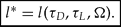
Finally, we return to the second stage of the game and substitute the optimal labour choice into the demand functions to derive the optimal choices of goods D and C as functions of the tax rates

Having determined the optimal choices of households as functions of the tax rates and the uncertain wage rate, we turn in the next section to derive the welfare effect of a revenue recycling policy.
4. Interaction of labour and environmental taxation under wage uncertainty
We assume that at some initial positive level of τL and τD the government considers a marginal increase in the environmental tax τD within a revenue-neutral policy. The environmental tax is a corrective tax, in the sense that it internalizes an existing externality. In the absence of uncertainty, the proportional labour income tax is distortionary, in the sense that it changes the shadow price of leisure. Under certainty, the literature has identified three effects of the revenue recycling policy. The effect of using the revenue from the corrective taxation to reduce the distortionary labour income tax within a revenue-neutral policy is positive and has been termed the revenue recycling effect. However, corrective taxation is not equivalent to lump-sum taxation since it results in price increases, and, thus, leads to distortions in the labour market, a negative effect that is termed the tax interaction effect. If the former effect outweighs the latter, environmental taxation generates a double dividend, that is an additional positive effect to the intended improvement in environmental quality, which is termed the Pigouvian effect. However, the opposite is more likely to be the case as we discussed in the introduction.
Consider now the case that households do not know with certainty the return to their labour effort when they make their labour–leisure decisions. It has been shown that in addition to the distortionary effect associated with revenue generation, taxation has the positive effect of lowering households' risks by pooling them across the economy. Thus, changing the tax structure has an additional effect, hereafter called the social insurance effect.
In order to evaluate the social insurance effect, we need to determine the total welfare effect of the revenue recycling policy; that is, we want to account for the direct effect that a change in the environmental tax has on households' optimal choices, as well as the indirect effect generated by the decrease in labour income tax implied by the revenue recycling policy. We proceed by deriving the total change in τL by totally differentiating government's budget constraint, equation (1). Since we consider a revenue neutral policy we set G = 0 and dΩ = 0 and we obtain
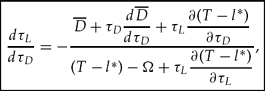
where  is the total balanced budget effect of the revenue recycling policy on the dirty good. Assuming that the direct dominates the indirect effect,
 . The sign of the relative marginal tax revenue from the environmental tax (numerator) to labour income tax (denominator) is positive, that is
 .
We combine the household's and government's budget constraints from equations (1) and (3), in which we substitute the household's optimal choices, D*, C*, and l* to obtain its resource constraint

The household's resource constraint is stochastic since it depends on w. The above resource constraint reveals that the government is capable of absorbing risk at less cost than the individual. Thus, households face less risk when making their labour decisions. Consider a household that gets a bad draw, that is w < 1. In the presence of labour taxation, the tax acts as an insurance mechanism in that the individual's income is more than it would be without the labour tax system in place, as the second term in the right-hand side of equation (8) indicates. In addition, the bad draw will also reduce consumption of the dirty good below the average consumption level, that is D < D, as the third term in the right-hand side of (8) indicates and the household will again be better off relative to the income level without the tax system. The opposite is true for the households that get a lucky draw. The tax structure reduces the dispersion of net income and consumption.Footnote 21
Households are assumed to maximize their expected utility. Substituting households' optimal choices into the expected utility yields households' expected indirect utility

We can now derive the total effect of the revenue recycling policy by differentiating the expected indirect utility function with respect to the environmental tax, that is by specifying the sign of the expression,  . We define
 as the marginal disutility from increasing the consumption of the dirty good per unit of expected marginal utility of the clean good, which for simplicity we term as the marginal external damage under uncertainty, and we deriveFootnote 22
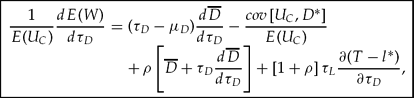
where ρ is the marginal welfare change due to labour taxation per dollar of revenue raised which is defined in the following equationFootnote 23
} \over {E(U_C)}}}}}{{(T - l^ *) - \Omega + \tau _L {\displaystyle{{\partial (T - l^ *)} \over {\partial \tau _L}}}}}}_{\displaystyle\rho _{_1}} + \underbrace {\frac{\displaystyle{- \tau _L {\displaystyle{{\displaystyle\partial (T - l^ *)} \over {\partial \tau _L}}}}}{{(T - l^ *) - \Omega + \tau _L {{{\displaystyle\partial (T - l^ *)} \displaystyle\over {\displaystyle\partial \tau _L}}}}}}_{\displaystyle\rho _2}.$}
\end{equation}](https://static.cambridge.org/binary/version/id/urn:cambridge.org:id:binary:20160202032458315-0147:S1355770X08005147_eqn10.gif?pub-status=live)
The denominator of (10) is the partial equilibrium change in government's revenue due to a marginal change in the labour wage tax rate.Footnote 24 The numerator is the welfare change from a marginal change in τL.Footnote 25
In the absence of uncertainty, welfare changes because labour–leisure decisions are affected and the labour income tax is distortionary. Under uncertainty, welfare also changes due to the impact of the policy on the insurance system. The welfare effect of the change in the social insurance system, arising from the change in labour taxation, is captured by the second term in equation (9) as well as by changes in ρ.
We examine first the effect that the induced changes of the insurance system have on ρ. First, since labour taxation falls as a result of the revenue recycling policy, the social insurance effect due to the absorption of income risk weakens. This is indicated by the covariance term in the numerator of ρ, which is negative, that is cov[UC, w] < 0, which implies that ρ1 < 0.
Second, the value of ρ2 depends on the response of labour supply to a change in τL, that is on the sign of  . Under certainty, the response of households' choice of leisure to a decrease in labour taxation can be decomposed into an income and a substitution effect. When labour taxation decreases, after-tax income increases and, thus, households move toward a higher level of leisure. At the same time, however, the shadow price of leisure increases, and, as a result, households substitute away from leisure. Thus, the overall effect depends on the relative strength of the income and substitution effects. Within a framework very similar to the one considered in the present paper, Bovenberg and de Mooij (Reference Bovenberg and De Mooij1994) show that the substitution dominates the income effect, that is
 , if the elasticity of substitution between leisure and consumption is greater than one.Footnote 26 Under this assumption, there is a marginal welfare cost due to labour income taxation, that is ρ2 > 0.
Under uncertainty, labour income taxation is not by definition sub-optimal and the effect of labour taxation on labour supply has been shown to critically depend on a number of parameters. A decrease in τL increases uncertainty, which may induce households to choose a higher level of leisure. When this insurance effect is added to the income effect, the likelihood that households increase their labour supply in response to an increase in τL is enhanced. The theoretical literature asserts that an increase in wage uncertainty reduces labour supply especially at low initial levels of taxation.Footnote 27 Eaton and Rosen (Reference Eaton and Rosen1980a, Reference Eaton and Rosen1980b) show that the labour supply response depends on the relative risk aversion and the share of labour income in consumption expenditure. When labour income is the main source of income, the assumption of moderate relative risk aversion just above unity suffices for labour taxation to stimulate labour supply. Within the framework of the present paper, we derive similar results. We show that, assuming separability between the choices of leisure and the consumption goods, the response of labour supply to an increase in the labour tax is positive if the household's relative risk aversion parameter exceeds unity, and the after tax income elasticity for good D is low.Footnote 28 In such cases, that is when  , an increase in τL unambiguously yields a marginal welfare benefit, i.e. ρ2 < 0.
Therefore, in the presence of uncertainty, ρ1 < 0, while  if
 . A sufficient condition for ρ = ρ1 + ρ2 < 0 is that and the necessary condition is that
} \over {E(U_C)}}}} |>| {\tau _L {\textstyle{{\partial (T\,{-}\,l^ *)} \over {\partial \tau _L}}}} |$](https://static.cambridge.org/binary/version/id/urn:cambridge.org:id:binary:20160202032458315-0147:S1355770X08005147_inline17.gif?pub-status=live) .
Note that under uncertainty, } \over {E(U_C)}}}} \over {(T\,{-}\,l^ *)\,{-}\,\Omega\,{+}\,\tau _L {\textstyle{{\partial (T\,{-}\,l^ *)} \over {\partial \tau _L}}}}}}$](https://static.cambridge.org/binary/version/id/urn:cambridge.org:id:binary:20160202032458315-0147:S1355770X08005147_inline18.gif?pub-status=live) equals the marginal cost of public funds (MCPF). Under certainty, in the absence of externalities (τ*D = 0), and assuming that lump-sum taxes are available, revenue raised for public good provision does not require distortionary taxation (τL = 0). In this case, the MCPF equals unity. In the case that labour income taxation is used to finance the public good (τL > 0) and assuming , then MCPF > 1. This result is supported by a large body of literature in public finance.Footnote 29
While the main body of literature assumes that labour income taxes are completely distortionary, some authors have incorporated into the analysis a measure of the distributional gains from labour income taxation.Footnote 30 Sandmo (Reference Sandmo1998) argued that the MCPF should not only reflect the efficiency losses of taxes due to the distortions they inflict on markets but also the distributional gains obtained. Sandmo showed, in a model with heterogeneous agents, that if the distributional gains are taken into account, the MCPF figure could be less than unity.
In a similar manner, the present paper shows that, in the presence of uncertainty, if the gains from providing insurance are considered, MCPF could also be less than unity. The sufficient and necessary conditions for MCPF < 1 are the same as those yielding ρ < 0.
The above discussion regarding the value of ρ has important implications on both the revenue recycling and the tax interaction effects, as is evident from equation (9). If ρ < 0, then, contrary to the case of certainty, the revenue recycling effect is negative (third term in equation (9)). However, the overall increase in revenue exceeds the marginal welfare benefit, implying that −1 < ρ < 0 and (1 + ρ) > 0. Furthermore, since the pollution tax also acts as an insurance device, labour supply might also be stimulated from the increase in the environmental tax, in which case the tax interaction term alternates in sign relative to the case of certainty.Footnote 31 Finally, the increase in the pollution tax generates a reduction in consumption risk and hence an additional positive welfare effect as we noted in discussing equation (8). This welfare effect is captured by the second term in equation (9). The covariance term cov[UC, (D* − D)] under risk aversion is negative and, thus, welfare increases as a result of increased environmental taxation.Footnote 32
The extent to which a second dividend is realized under uncertainty depends on the relative magnitude of the three effects we examined above. We now proceed to compare these effects. Substituting ρ = ρ1 + ρ2 and using the value of the total induced change in τL from equation (7), the sum of the tax interaction and revenue-raising effects (the last two terms in equation (9)) can be written
}}{{E(U_C)}}\frac{{d\tau _L}}{{d\tau _D}} + \rho _2 \left[\overline D + \tau _D \frac{{d\overline D}}{{d\tau _D}}\right] + \left[ {1 + \rho _2} \right]\tau _L \frac{{\partial (T - l^ *)}}{{\partial \tau _D}}.$}\nonumber\\\end{eqnarray}](https://static.cambridge.org/binary/version/id/urn:cambridge.org:id:binary:20160202032458315-0147:S1355770X08005147_eqn11.gif?pub-status=live)
The first term shows the decrease in insurance benefits arising from the labour income tax reduction. Since the variability of the consumption of the dirty good arises from the variability of the wage rate, the two covariance terms can be connected more closely. In order to get more insight into the covariance effects (first term in equation (11) and second term in equation (9)), assume that the consumption of the dirty good is a linear function of the individual's income level, namely D*i = β[wi(T − l*) − Ω], where β is the marginal propensity to consume the dirty good out of gross labour income.Footnote 33 Then
}}{{E(U_C)}}\frac{{d\tau _L}}{{d\tau _D}} = - \frac{{{\it cov}\left[ {U_C, w} \right](T - l^ *)}}{{E(U_C)}}\left({\beta + \frac{{d\tau _L}}{{d\tau _D}}} \right).$}}\nonumber\\\end{eqnarray}](https://static.cambridge.org/binary/version/id/urn:cambridge.org:id:binary:20160202032458315-0147:S1355770X08005147_eqn12.gif?pub-status=live)
The two covariance terms capture the social insurance effects resulting from the green tax reform under uncertainty, except from the effect on  . Therefore, these social insurance effects are positive if the propensity to consume the dirty good out of gross labour income is greater than the balanced budget reduction in the labour tax arising from a marginal increase in the Pigouvian tax, that is if and only if
 .
We can express the term  in elasticity form

where  is the compensated elasticity of demand for the dirty good with respect to the price of leisure,
 is similarly the elasticity of demand for the clean good with respect to the price of leisure.Footnote 34 Furthermore,
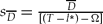 and
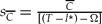 are the shares of the dirty and clean good respectively in income, including lump-sum transfers. Given that , a sufficient condition for the social insurance effect to be positive is that
 .Footnote 35 If G > Ω, that is if the public good is not financed entirely by lump-sum taxes, the social insurance effect is unambiguously positive if D is not a very weak substitute for leisure relative to C. In such cases, the social insurance effect from increased τD dominates the decrease in social insurance provision due to the balanced budget reduction in τL. If D is a sufficiently weak substitute for leisure, the social insurance effect could be negative depending on the magnitude of
 .
The last two terms in equation (11),  , present the sum of the tax interaction and revenue raising effects as in the case of certainty. Following similar steps as in Goulder et al. (Reference Goulder, Parry and Burtaw1997), we can write the tax interaction effect as
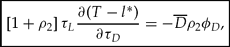
where
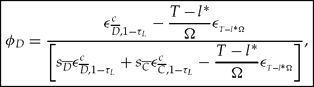
‘is a measure of the degree of substitutability between the dirty good and leisure relative to that between aggregate consumption and leisure’ (Goulder et al., Reference Goulder, Parry and Burtaw1997: 713). Substituting expressions (11), (12), (13), (14), and (15) into equation (9) yields
}}{{E(U_C)}}\left({\beta + \frac{{d\tau _L}}{{d\tau _D}}} \right)}}_{SI}}\\
&&{+}\, \mathop {\underbrace {{(1 - \phi _D)\rho _2 \overline D + \rho _2 \tau _D \frac{{d\overline D}}{{d\tau _D}}}}_{RR + TI}}.\end{array}$}\end{eqnarray*}](https://static.cambridge.org/binary/version/id/urn:cambridge.org:id:binary:20160202032458315-0147:S1355770X08005147_eqnU3.gif?pub-status=live)
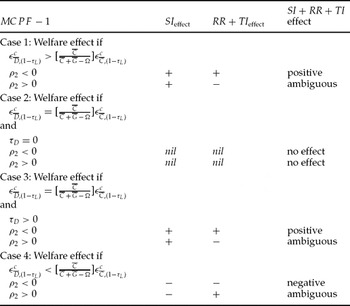
For  , from equations (13) and (15) we have
 and φD > 1. Therefore, if D is a stronger substitute for leisure relative to C, the social insurance effect is positive SI > 0 and the sum of the revenue recycling and tax interaction effects is negative, RR + TI < 0 (positive, RR + TI > 0), assuming ρ2 > 0 (ρ2 < 0).
If  , then
 and φD = 1. In this case and assuming we start with τD > 0, the social insurance effect is positive (SI > 0), while the sum of the revenue recycling and tax interaction effects is negative RR + TI < 0 (positive, RR + TI > 0) assuming ρ2 > 0 (ρ2 < 0). Therefore, if ρ2 < 0, there is a second dividend, while if ρ2 > 0, the existence of a second dividend requires
} \over {E(U_C)}}}} |>| {{\textstyle{{\partial (T\,{-}\,l^ *)} \over {\partial \tau _L}}}} |$](https://static.cambridge.org/binary/version/id/urn:cambridge.org:id:binary:20160202032458315-0147:S1355770X08005147_inline35.gif?pub-status=live) . Assuming τD = 0, the Pigouvian is the only welfare effect of the green tax reform, since RR + TI = SI = 0.
For  , we have
 and φD < 1. When D is ‘sufficiently’ weak substitute for leisure and τD = 0, the social insurance effect is negative SI < 0, and the sum of the revenue recycling and tax interaction effects is positive (RR + TI > 0) assuming ρ2 > 0, while it is negative (RR + TI < 0) assuming ρ2 < 0. For τD > 0 but relatively small, the signs of the three effects remain the same as long as the direct dominates the indirect effect in the numerator of equation (13) and in the RR + TI term.
Table 1 summarizes the above discussion. In summing up, we find that, in general, the SI effect is positive and moves in the same direction as the RR + TI effect if ρ2 < 0 and D is a relatively stronger (or equal) substitute for leisure relative to C, yielding a second dividend. The opposite is true if ρ2 < 0 but D is a relatively stronger complement with leisure relative to C. If ρ2 > 0 the SI effect and the RR + TI effect move in the opposite direction and therefore the overall effect is ambiguous.
Total welfare effect under different assumptions about the relative substitutability of the two goods for leisure

Our analysis contains the results derived under certainty. For example, Ballard et al. (Reference Ballard, Goddeeris and Kim2005: 119) concludes that ‘non-homotheticity creates the potential for a double dividend, or for the optimal tax to exceed the Pigouvian tax, if the dirty good is more complementary with leisure than is the clean good’. This result corresponds to the positive sign of the RR + TI effect under the assumptions ρ2 > 0 and . However, when uncertainty is taken into consideration the insurance effect works in the opposite direction and therefore the overall effect is ambiguous. Furthermore, under uncertainty the possibility that ρ2 < 0 is more pronounced and in that case (not considered in the literature) the potential for a double dividend exists if the dirty good is a stronger substitute for leisure than is the clean good. The intuition behind the reversal of the results concerning the existence of a second dividend is as follows. If the dirty good D is a stronger substitute for leisure relative to the clean good C, the increase in τD reduces the efficiency of the tax system under certainty (and, thus, the RR + TI effect is negative), and at the same time improves the overall provision of social insurance of the tax system under uncertainty (and, thus, the SI effect is positive).
The critical parameters determining the existence of a second dividend are the lump-sum transfers, the relative substitutability of the two goods for leisure, and the initial tax rates relative to their optimal values that determine also the response of labour supply to a change in the tax mix. In the next section, we undertake the task of deriving the optimal tax rates.
5. Optimal taxation
In the previous section, we show that, starting from some positive values of τL and τD, the welfare effect of a revenue recycling policy depends on the magnitude of the departure of the initial values of taxes from their optimal. The optimal taxes are determined ex-ante, that is before uncertainty is resolved. Due to the presence of two types of distortions (uncertainty and environmental externality), we analyze optimal taxation within a second-best framework.
Recall that, within the framework of our model, the government has three functions, namely to provide the public good, protect the environment, and provide insurance against wage uncertainty. The government has three instruments: labour income tax, environmental tax, and lump-sum transfers in order to achieve the above three goals. Thus, the government chooses τL, τD, and Ω to maximize the household's indirect expected utility subject to the revenue constraint. The Lagrangian corresponding to the government's constrained maximization problem is

Assuming an interior solution, the first-order conditions yieldFootnote 36


where  , and
 .Footnote 37R is defined as the average tax revenue per person, and the subscript v = c indicates compensated changes.
Using the above conditions, we can determine the government's optimal choices. As a benchmark case, we first consider the case of certainty. In this case, and assuming that government has access to lump-sum taxes/transfers, the environmental externality is optimally internalized by a Pigouvian tax. The revenues from the Pigouvian tax together with the lump-sum taxes support the provision of the public good; that is, the optimal tax structure is τ*D = μD, τ*L = 0 and τD D + Ω* = G.Footnote 38
We now return to the case of uncertainty over labour income. In this case, it is optimal to set both labour income and environmental taxes positive, that is τ*D > 0 and τ*L > 0, while raising any additional revenue from lump-sum taxes. Because of the existence of environmental externalities, the optimal environmental tax is positive,Footnote 39 and exceeds the marginal external damage, since the environmental tax is also part of the social insurance mechanism. Sandmo (Reference Sandmo1998) has shown that  in an optimal setting. This is also true in the current setting since the MCPF does not reflect only the efficiency loss but it accounts also for the social insurance gain. As shown in the previous section, MCPF < 1. Thus, when public investment is financed on the margin by uniform lump-sum taxes it causes labour supply to increase. This increase in labour effort creates an efficiency gain in terms of increased revenue to finance public goods given the existence of an optimal wage tax (see Sandmo, Reference Sandmo1998, for a similar analysis). Unfortunately, it is not possible to derive an analytical solution for the optimal tax rates.
After determining the optimal tax rates, the government should compare the existing tax rates to their optimal values before it decides whether and to what extent a revenue neutral policy should be implemented. If the initial tax rates are such that the labour income tax is below its optimal level, while the environmental tax is equal to its optimal level, a green tax reform policy will result in welfare losses. On the contrary, if the environmental tax is below its optimal value and the labour income tax exceeds its optimal value, a case which is more possible in reality, a green tax reform will improve welfare.
6. Conclusions
The present paper re-examines the double dividend hypothesis in the presence of labour income uncertainty. We find that starting from some positive level of environmental and labour income taxation and increasing the former while decreasing the latter within a revenue neutral policy has the following effects. First, the increase in environmental taxation yields a positive welfare effect since it reduces consumption risk, in addition to the Pigouvian effect. Second, the reduction in labour income taxation weakens social insurance provision, while at the same time alleviating some of the distortions in the labour market. The net effect depends on the relative substitutability of the dirty and clean good for leisure. If D is (not) a sufficiently weak substitute for leisure relative to C, the net effect is negative (positive). Third, the reduction of labour income taxation increases risk and in doing so it affects the response of labour supply, which could even become positive. Thus, the reduction in labour income tax could yield a marginal welfare benefit, reversing the signs of the revenue recycling and tax interaction effects. The total welfare effect of the green tax reform is ambiguous and depends on the relative substitutability of the dirty and clean good for leisure and the response of labour supply to a change in the tax mix. This, in turn, depends on the departure of the initial taxes from their second-best optimum. We determine that the optimal value of both environmental and labour taxation is positive. If the initial level of the labour income tax is above its optimum, that is there is overprovision of social insurance, and the environmental tax below its optimum, then a revenue recycling policy will yield a positive welfare effect. However, a revenue recycling policy will result in welfare losses if the initial level of labour tax is below its optimum, that is there is underprovision of social insurance, while the environmental tax is close to or above its optimum. The lower is labour income tax relative to its optimum, and the closer is the environmental tax to its optimum, the larger the welfare losses will be, assuming the availability of lump-sum taxes.
The analysis of the present paper could be extended in different directions. Given the ambiguity of the total welfare effect in a number of instances, it would be interesting to use empirical simulations to determine the sign and the size of the total effect under plausible parameter values. The literature under certainty shows that grandfathered emission permits policies yield lower welfare since they do not generate a revenue recycling effect. It would be interesting to check this result in the case of uncertainty. Finally, as mentioned in the introduction, recent empirical literature shows that it could be possible that higher uncertainty over income induces employees to work longer hours for self-insurance purposes (Low, Reference Low2005; Parker et al., Reference Parker, Belghitar and Barmby2005; Floden, Reference Floden2006). These longer work hours come at the expense of lower average wages. In this case, taxation can be seen as a substitute to self-insurance. Extending our analysis in this direction might provide some interesting intuition.
 as the number of households increases (n increases), the variance of
 where τ is a proportional tax on the two commodities at equal rates, it becomes equivalent to a general consumption tax. Substituting for τL yields (1 + τ)(1 + τD)D + (1 + τ)C = w(T − l) − Ω.
 .
 .