Until recently the failure of workers to bring in the revolution has occupied the centre-stage of labour historiography of south AsiaFootnote 1, although assumptions about workers' progressive rise towards class consciousness in Marxist accounts and their undifferentiated association with the nationalist movement in standard nationalist accounts, have given way to a more nuanced understanding of the dynamics of class with community, for example, or of multiple codes of mobilization within the nationalist movement. This paper uses a study of strikes of railway workers from 1918 to 1922 to set out and examine the complexities of workers' politics. Since railways in India were directly controlled by the state although usually managed by private companies, the industry provides a good opportunity to investigate various aspects of the colonial rule vis-à-vis working groups, such as racial discrimination, imposition of authority, disciplining the labour force, and the containment of strikes. The upsurge of the national movement in this period coupled with the rise of trade unionism allows us to investigate different layers of mobilization techniques at work.
This paper, thus, tries to cover three broad themes related with workers' politics, viz. racial ideology, actual ‘event’ of striking and the related activities of workers, and techniques of mobilization. In each of these cases, it has been argued that rigid categories like racialism or nationalism are of little help in unravelling the complexities of workers' choices and their politics. Their politics were more flexible than what meets the eye, and their choices were created through dialogue, if not determined by the various factors surrounding them.
Racial Discrimination
One crucial site of marking the colonial difference in labour politics was racial discrimination.Footnote 2 Jagga writing of the years after 1918, comments:
The British railways in colonial India had a two-fold contradictory identity: to the British they were a symbol of the Raj but to the Indian mind they had come to signify its opposite—the colonial reality, its exploitation, humiliation and the imperial arrogance of the frenghi.Footnote 3
In this account the key policies of the Raj are seen as racially determined, and railways are portrayed as an unproblematic site and source of a racial ideology. Yet other studies have shown that ambivalences remained both at the level of colonial representation and Indian perceptions of this new technological tool.Footnote 4 The economic and cultural roles assigned to British technology in the form of railways in modernizing Indian practices did reflect a sense of racial difference and hierarchy.Footnote 5 The claims of steam being the civilizing force for the east or many of the distinctions made during travel and in travel-provisions were racially informed. But the ‘Indian mind’ was varied. The Railways had many different meanings other than exploitation and humiliation. For Gandhi, the railways remained an ‘evil force’ but for the wives of Bhojpuri men going to work in Calcutta, the railways were a medium of fulfilment of desire, the desire to see the outside world, the desire to fulfil the urge for consumption (of material objects) and not the least an object of ‘surprise’, ‘speed’, and a ‘new change’.Footnote 6
The hierarchies of skills and labour practices employed on Indian railways in the 1920s seemed to demonstrate a simple racial model of differentiation. As Jagga has argued:
By 1919 the native workmen had to be alienated from their work by the tensions created due to the racial discrimination in the labour process. As the superior grades of the railway workmen were whites, it was left to the peripheral categories of Indian railwaymen—the drivers and guards of the goods trains, unimportant station masters of the small stations, the ‘native’ firemen travelling a lifetime on a British train in the shadow of a ‘ferenghi’ driver, the signallers and the workshop men—to assert their rights through varied forms of popular protests.Footnote 7
As far as grades of employment were concerned, racial favouritism on the part of Europeans and Anglo-Indians did exist.Footnote 8 The Royal Commission on Labour (1931) admitted that favouritism was a constant source of discontent and bitterness.Footnote 9 However, the actions of the workers show that racial categories alone did not always shape perceptions on the ground or determine events in industrial disputes. In October 1920 there was a persistent rumour that railway employees at Khurda road, Bengal Nagpur Railway (BNR) would stop all transport and traffic during the pujas if the BNR agent did not meet their demand for 75% wage-increase.Footnote 10 The immediate reason, however, was the dismissal of a man called Gibson, who induced the men to complain against an order passed a few days before, prohibiting the overtime work on Saturday afternoons. A deputation was organised, which made two demands, first, the reinstatement of Gibson, and second, the removal of Mr Hill, the acting Chief Mechanical Engineer from Kharagpur, on the grounds of his alleged stern disciplinary methods. This dispute also coincided with an attempt by the Company to transfer Mr Woodhouse, president of the Kharagpur Railwaymen Working Association (RWA). As a result, on October 8th, practically all the locomotive and traffic staff in Kharagpur and all the employees of the workshops went on strike.Footnote 11 The agent, who had earlier refused to cancel Woodhouse's transfer, later agreed to receive a deputation within ten days to discuss the matter. Only then did the locomotive and traffic staff return to work, and by the next day the employees of the workshops also returned, but only after receiving confirmation from Woodhouse that his transfer had been cancelled.
The sort of solidarity that Indian workers showed with European/Anglo-Indian workers, Gibson and Woodhouse, in this dispute was neither incidental nor occasional. In reality, the relationship between ‘colonizer’ and the ‘colonized’ was not as strict as Jagga has suggested. If workers' notions of politics and solidarity challenged the two-fold divide based on racial ideology, the practice of widespread bribery further limited and subverted that division. One of the key recommendations of the Royal Commission was that workers should be subjected to medical tests before employment. However, the enforcement of this measure was often vitiated by widespread corruption, which meant that such tests could be avoided in return for a bribe.Footnote 12 If medical examinations represented the disciplining exercise of the state, bribery symbolized the subversion of that disciplining procedure. Such practices were also prevalent amongst porters of Howrah station, who had to pay a certain monthly fee to private contractors to keep their employment secured. Such contractors were in effect running employment agencies for a profit, a practice that was well known to the Railway Company, which also had a share in it.Footnote 13 These practices not only show the limitations of ‘race’ as an analytical category, but also tell us about the nature of the managerial authority and its dislocations. While not denying the factor of racialism in the constitution of managerial discourse and in the politics, Chitra Joshi qualifies our understanding of how racial segregation was persistently being broken down or threatened by the politics of class. She says that distinctions were drawn within European inhabitants depending on the location of their residence. Europeans employed in the factories and working closely with native workers, drawing Rs 300–800, were described as ‘accustomed to noise, dirt and unpleasant accompaniments inseparable from native labour.’Footnote 14 For Joshi, the factor limiting racialism comes from outside—the class—and not from the practices of the colonial state/European managers. Nevertheless, corruption and the practice of bribery suggest that such factors could also have come from within the practice of managerial discourse, many a time due to the negotiatory limitations of the politics of the different groups involved.
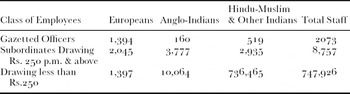
The presence of a considerable number of Anglo-Indians in railway services, as evident from Tables 1 and 2, made the racial issue more complex. Not only does Jagga ignore their ambiguous status, but others such as M. K. Mast have also overlooked the special status of this group when arguing that both Europeans and Anglo-Indians, received a ‘great deal of preference than Indians’, even when employed in the lower services.Footnote 15 In reality, Anglo-Indians themselves often felt discriminated against by white railway officials and were concerned that continued ‘Indianisation’ of the railways and other colonial services would further jeopardise their position. The eleven-point Memorandum submitted in 1923 by Colonel Gidney, representing the case of domiciled Europeans and Anglo-Indians, asked for a ‘serious and determined effect made by the government to stop the colour prejudice exhibited by some of the European Railway officials and subordinates, which is in some cases being practised on the unfortunate dark coloured Anglo-Indian railway subordinate employee.’Footnote 16 Gidney also pointed out discrimination in the leave rules existing between subordinates of European domicile (those recruited directly from England) and the domiciled Europeans and Anglo-Indian subordinates.Footnote 17 Here the boundaries of racial differences were transgressed by location; the direct recruits getting better leave rules than domiciled Europeans. While these examples do show that racial discrimination persisted, they also refute the notion of a simple two-fold divide between the whites who ‘dominated the supervisory grades’ and the ‘peripheral Indian railwaymen’ who were being discriminated against. The issue of Indianization evoked a widespread communitarian response, most prominently from Anglo-Indians. The underlying qualification for employment on all railways for Anglo-Indians was their enlistment in the Auxiliary Force, in which they were enlisted as European British subjects.Footnote 18 Their own desire to maintain their difference from Indians suited this. But following the state's initiatives to Indianize the services, Gidney asked for the abolition of conscription into the Auxiliary Force as the qualification for employment. He asked that ‘our future on the railways should be permanently safeguarded; all agents be informed that as “Statutory Natives of India”, we enter into all schemes of Indianisation.’Footnote 19 This again cuts across the boundaries of race, for if Anglo-Indians as members of supervisory grades also practised racial discrimination, their attempt to define themselves as ‘Natives’ of the country to secure their employment marked a significant compromise with the ideology of racialism.
Showing Strength of Different Groups of Employees on Twelve Class I Railways

Source: RCL, p. 142.
Showing Strength of Different Groups of Employees on Two Railways

Source: Railways in India: Report for the Year 1913–1914, Vol. II, Appendices.
Workers' Associations: The Language of Class, Race and Solidarity
The railway associations that were formed in the 1920s were also marked by racial divisions in Jagga's account. Thus the split of the Railwaymen Working Association (RWA) late in the 1920 has been explained by ‘disunity amongst its ranks, a disunity inbuilt in the colonial structure of the railway work force and continually fostered by the divisive racial policy of the Railway Board.’Footnote 20 Yet a study of the language used by the RWA to voice its concerns during its first great period of activity in mobilising railwaymen during the summer of 1920 tells a different story.
In the first instance, the radical activism that spread across the railways of eastern India in the summer of 1920 was directed at economic grievances. Thus at a meeting held at Sealdah on 4th July 1920, the General Secretary of the Association asked the Railway Board to make an early announcement for considering the appeal for substantial enhancement of wages.Footnote 21 On 25th July a branch of the RWA was established at KharagpurFootnote 22, and shortly afterwards almost 10,000 delegates from the Eastern Bengal Railway, East India Railway, and Bengal Nagpur Railway assembled there to pass resolutions demanding a 75% increase on the salaries paid on March 31st 1919, in addition to periodical increments; representation of railway labour in the Legislative Council; appointment of a conciliation board; and implementation of the Workmen's Compensation Act on the lines of one implemented in Britain.Footnote 23
Another meeting of the Adra Branch was held on 10th August 1920 that, apart from above demands, called for the abolition of racial favouritism. It demanded the same scale of gradation for Indian drivers as that used for Europeans and Anglo-Indians.Footnote 24 The RWA had a significant role in the proposed general strike of the BNR, EIR, EBR and Bengal and North Western Railways in support of these claims. The intelligence reports from various districts frequently refer to the perpetual rumour of a strike starting from 1st January 1920, in case the demand for 75% increase was not met. One of the reports even warned of the danger of all major lines of India going on strike on 25th November. The rumour persisted and so did the idea that the possibility of a strike could be used to exert pressure in the negotiations for a pay deal. The strike did not happen on 1st January, but ‘all Branch Secretaries of the Railwaymen Association wired to His Excellency, the Viceroy of India to settle their grievances by the 15th of the January otherwise they will not be responsible if anything went wrong.’ On the basis of a personal interview with Mr Woodhouse, the SP, BNR, informed that ‘nothing short of 75% increase over 1914 wages would do away with the discontent.’ On 15th February, guard Foster, Secretary, Dinapur Branch, RWA presided over a meeting ‘attended by about twenty Europeans (chiefly guards), fifty babus and Indian guards and about 125 illiterate menials of the traffic, locomotive, and carriage departments’ voicing their demand for an increase in pay and the provision of good quarters. The meeting dissolved with a message sent to the Secretary of the headquarters at Allahabad, “We stand firm”. The Allahabad CID added that ‘the All India RWA had issued a circular calling for a strike on 28th February at 5 p.m. if an unfavourable reply to their demands was received.’Footnote 25
Until now, the RWA was the sole union talking on behalf of all railway communities. However, a confidential letter of 28th February reported the possibility of a division in tactics: while the most recent meeting of the Association on the 26th, presided over by Sen and Haldar, of the Indian Labour Association, had demanded equality between Indians and Europeans in matters like pay, allowance, houses, admission into European institutes and so on,Footnote 26 Woodhouse held a separate meeting of Europeans and Anglo-Indians where he stated, “they feel deeply their sense of duty to the public and the administration they serve and are finally resolved to do all in their power to avoid the extreme measures of a general strike unless absolutely compelled to take such a step.”Footnote 27 The reason given was that such a strike “would probably give Gandhi another feather in his cap and [he] would tend to show that they also had been affected by his movement. It would certainly not be proper for them to be associated with the non-cooperationists.”Footnote 28 This may be read as a racially informed decision, or alternatively as contesting modes of controlling the workers. As we will see later, workers were always a site of control and discipline for the different parties involved in mobilizing them.
The full reasons for the eventual split in the RWA are not known. However, Jagga's contention that it was because of the inbuilt racial hierarchy in the RWA is untenable. Jagga argues that the alternative organization, the All India Railwaymen Federation had distinctly more radical goals and was ‘aimed at dismantling the colonial structure of the railway work force and establishing complete equality.’Footnote 29 This federation was formed in 1924 following an All India Railwaymen Conference (AIRC) held in Bombay on 4th February 1921.Footnote 30 Interestingly, this meeting took place in Bombay, whereas, as the above narrative of the possibility of the strike in 1920–21 shows, the centre of activities, meetings and the spread of rumours was in the eastern part of the country, involving mainly the EIR, BNR, B&NWR and ABR. The delegates from these railways did not participate in the meeting held in Bombay. And, if the RWA was to be blamed for harbouring racial feelings on the basis of its conciliatory language, then the AIRC's language was not very dissimilar. The chairman of the reception committee was himself either European or Anglo-Indian, Mr S. Titus of the Great Indian Peninsular Railway. While the key resolution of this meeting declared that ‘all racial discrimination in railway services should be entirely abolished on all state railways worked by state or companies’, the President, Rai Saheb Chnadrika Prasad, said that railway employees, when making representations, should do so in a reasonable spirit and to try their best to maintain harmonious relations with officials and as far as possible to settle the dispute amicably by negotiation and arbitration without resorting to direct action.Footnote 31
A more suitable way to read this language of amicability in the case of both the RWA and the AIRC, is to see them as exercising a disciplining and controlling mechanism on labour on the one hand, and as establishing a basis on which to negotiate with the state/company on the other. All the concerned parties, the state, the unions (here both RWA and AIRC) and the Congress were trying to discipline the workers; the state and the railway companies to manage the labour-force by making their authority felt, and the unions and Congress to mobilize them through disciplining their actions.
Representing 1919: The Fear, the Discipline, the Authority, and Negotiation
The Royal Commission noted:
Prior to winter of 1918–1919 a strike was a rare occurrence in Indian industry. The end of the war saw an immediate change. Important strikes in 1918–19; more numerous in the following winter and in the winter of 1920–21 industrial strife became almost general in organised industry. The main cause was the realisation of the potentialities of the strike in the existing situation, and this was assisted by the emergence of the trade union organisers, by the education which the war had given to the masses and by a scarcity of labour by the great epidemics of influenza.Footnote 32
The year 1919 has often been represented as a watershed in the politics of industrial labourers in general. In constructing this narrative, many earlier strikes, particularly during the Swadeshi Movement in Bengal during 1906–07, have been excised from the record and possibly from memory. At least five strikes were reported on Indian railways between 1897 and 1905.Footnote 33 Notwithstanding these, the President, Railway Board, also signified the special importance of 1919, “at present . . . it would be inadvisable to spread any suspicion or disaffection amongst railway staff by such a course as passing a rule or ordinance making a strike illegal.”Footnote 34 Though the state tried hard to maintain its authority over workers, that authority was often contested. This extended right from the work of information gathering to that of deployment of police, to that of passing of the law banning strikes. We have seen how rumours about the general strike persisted right from the middle of 1920 to 1921. The rumours made the work of the intelligence department very difficult. So, when there was the rumour of a general strike starting from 1st January 1921, the SP, EIR, Patna received a report from the Divisional Inspector, Jamalpur that ‘the staff of EIR intend going out on strike on 31st December with the apparent intention of causing trouble’.Footnote 35 The Inspector, however, confessed to not being confident about the information. The Inspector, Dinapur also reported a possible strike on 31st December, but even after ‘some inquiries he could not find out anything definite’.Footnote 36 The Intelligence Branch, CID, Bengal also echoed the same feeling, as having no definite information about a strike.
The breach in intelligence-gathering was coupled with a fear of ‘new industrial strikes’. The state had come up with a proper strike scheme, which was described as ‘an operation not involving more than making all necessary preparations to have troops and police ready for immediate action as soon as [an] emergency arises.’Footnote 37 The immediate actions were: first, to keep open the main lines of the railways and telegraphic communications; and second, to protect railway property, non-strikers and their families. The phrase ‘not more than’ highlights the uncertainty and limitation that state agencies felt on embarking upon any stern police action. The President of the Railway Board had made it clear in 1918 that penal measures would not be useful for strikers because they could not be generally enforced. He said that ‘it would not be possible to imprison any large number of men who refused to work, we (should) get back to ring leaders.’Footnote 38
The negotiation and display of authority had undefined trajectories, which is quite difficult to straightjacket into any one category of analysis. Generally, the state tried to resurrect its authority by appearing indifferent and paternalistic in its approach towards labour, while labour tried to force their terms of negotiation until such a point that they did not lose their jobs. Interestingly, the labourers and their associations, both appealed to this paternalistic magnanimity of the officials. Chandrika Babu, whom we have referred to above, in his presidential address appealed to the higher officials ‘to be reasonable in fixing their own emoluments and privileges, and to show magnanimity of their heart by self-sacrifice and contentment’.Footnote 39 Whether this appeal to colonial magnanimity was made strategically to secure benefits or was the result of an internalization of the colonial discourse of the benevolent rule is difficult to be decided with certain precision.
An account of the strike may provide an answer to such questions. The Bhojudih locomotive menials, a station on the BNR, struck work on 30th January 1921.Footnote 40 On the 19th they had sent a wire to the Chief Mechanical Engineer asking him to come to Bhojudih and enquire into their grievances. No action was taken of their request. When they received their pay for December and saw no increase they went on strike. The local officers present assured them that their grievances would be investigated and that no action would be taken against them if they resumed work. Assurances of leniency and threats of dismissal were complementary ways to control labour and resuscitate authority, since paternalism incorporated the idea of forgiving the ‘misdeeds’ of labour. But in this strike, the dismissal of six workers prevented others from returning to work. On 1st February however, the SP and Sub Divisional Officer of Purulia district met the strikers, but the threat to ‘settle up with all men who refuse to resume work’ continued and so did the workers' refusal to return to work. In the meantime two of the workers were accused and arrested for stone pelting, which further excited the workers, in accounts referred as ‘mobs’, to boycott work, who were then quietened by the police.
The narrative became further complicated because of the combined reporting on the Bhaga men who went on strike on 1st February, a day after the Bhojudih workers. The ‘confidential’ report on Bhojudih said that, ‘at the beginning of January as a result of a speech by Swami Bishwananda, the menials of the Locomotive Department at Bhaga sent a round robin to the agent demanding an increase of 75% increase in their wages.’Footnote 41 On 7th January the Agent refused to accede to this request and asked those who were dissatisfied to resign from work. This threat seems to have worked, for according to the Agent's report ‘no one put in the resignation, on the other hand many of them gave written statements to the effect that they had no hand in the petition and where satisfied with their present pay.’ However, on 29th the workers wired the Agent and Commissioner about their decision to go on strike, and did so the next day. In the meantime, one Ram Kumar Missir, reportedly a disciple of Gandhi who urged the workers to ‘remain on strike and ban all foreign goods’, visited the Bhaga workers. The other report, however says that R. K. Missir together with one Swami Satyanand came on 1st February and exhorted the men not to vacate their quarters, because ‘legally they could not be forced to do so.’ What led the workers to abandon their strike action is not known but by 3rd February they started resuming work unconditionally.
The story, though fractured, brings out the politics of negotiation quite well. The state won. In a self-congratulatory way it stated that workers returned unconditionally, thus fulfilling the very first premise of entering into any kind of negotiation and regaining the control and authority. But the politics of labour, contrary to what these reports point towards, was not based on ‘mobocracy’. Workers were quite well organized and more importantly, had a sophisticated practical understanding of the importance of not losing their jobs. The initial militant stand taken at Bhaga and Bhojudih, followed by the two refusals to accept any responsibility for the petitions, show their negiotiatory skills in turn.
While the state was trying to command and discipline them ‘by remedying any real grievances of workers’Footnote 42, the workers became a site over which disputes concerning the politics of discipline was fought between trade unions and the Congress. The Searchlight, a paper with nationalist leanings published from Bihar, said,
Labour in India is bound to attain to its full heights of its dignity when it is properly organised on the lines of its contemporaries in its Europe. What is wanted is a properly organised union in one of the large centres of the labour employment in the country to teach the labourers the importance of their class, if organised and united. The high intelligence of the class is a sure guarantee of a willing and hearty cooperation if properly approached.Footnote 43
In a similar vein S. Titus lamented the unorganized state of the Railwaymen that prevented them from achieving their goal.Footnote 44 The issue was not just of control and discipline but also of teaching them the ‘importance of class, organisation, and unity’. The case of the RWA and the AIRC has already shown that both organizations were anxious to impose discipline on their members. Both spoke a similar language of preventing workers from launching wildcat strikes and requiring them to resort to strike action only after exhausting all amicable ways of reaching a compromise. Mr Joseph Baptista in the second All-India Trade Union Congress identified the lack of Trade Unions which can ‘regulate the moral and material conditions of the workers’ as a reason for the unfavourable position of labour in India.Footnote 45 Some Bengali newspapers echoed the same feeling. The Nayak of 27th July 1921, commenting on the ABR strike said, “the bluff and wholesale arrests and imprisonments will do no good to government and as a matter of fact it is reducing the prestige of the government. What are the persons you are arresting? Are they not misguided men, agitators or persons of similar ilk? What do you hope to gain by punishing them?”Footnote 46 The Amrit Bazar Patrika went to the extent of saying that the ‘racial question had nothing to do in the strikes.’ Workers, it said, had no fixed antipathy and were always amenable to sympathy no matter whether Indians or Europeans render it.Footnote 47
Both these statements played up the paternalistic nature of the state. Why arrest the ‘misguided men’ which will undermine the prestige of the state or why be unsympathetic towards the workers who know no racial feelings? These comments also stressed the ‘misguidedness’ of the workers as a trait, which needed to be corrected. Gyan Pandey has shown how the nationalist leaders had created the category of ‘irresponsible’ and ‘ignorant’ masses, the remedies to which were ‘responsibility’ and ‘education’.Footnote 48 So argued Gandhi during his tour to Jharia on 5th February 1921 that ‘labourers had the strength to use their lathis, but that would harm them. They did not know when and against whom to use their sticks. . .’ He further advised them to make their hearts ‘pure’ and ‘not to strike in the first instance but to reason with their employers.’Footnote 49 Sabyasachi Bhattacharya has argued that the basic principles of Gandhian discourse on labour-employer relationship were two-fold. First was the mutuality of the interests, and second, the non-violent relationship between them.Footnote 50 He has also very correctly summed up the two-fold conclusions made by Gandhi: mass civil disobedience could not be started ‘until we have attained complete control over the masses’, and ‘the workers as a class must undergo political education for participation in the struggle he intended to conduct.’Footnote 51 This was equally true for trade unions. S. Titus had called for bridging the gulf between capital and labour on terms of equality and mutual self-respect. The managers and employers also used the same language of ‘treating labour with sympathy’. Mr J. H. Pattinson, M.L.C., and a representative of the employers of the collieries in the second All India Trade Union Congress held in Jharia, entirely supported the idea of a Trade Union for coal fields and exclaimed, ‘let us work together, Capital and Labour, and do not let us quarrel’.Footnote 52 The differentiation between ‘illiterate’ and ‘ignorant’ on the one side and ‘responsible’, and ‘correct’ on the other was also accompanied by the demarcation of ‘political’ from ‘socio-economic’. Paradoxically, this distinction overlapped with the definitions used by the colonial state. In the Home Department, the only worries voiced about the railway strike were concerns over its political aspect, and with its effect on law and order.Footnote 53 This view emerged largely because the state thought that, “the strikers as a body are peaceful; but there is an unruly element, which causes mischief”.Footnote 54 Apparently, these unruly elements were the leaders themselves or their emissaries. The opinion in official circles was that these politicians were leaders in search of followers, seeking to win support from the labouring classes. Mr C. A. Innes, MLC, made the following observation regarding the EIR strike that started on 2nd February 1922:
It is simply a case of mischievous men trying to exploit labour for their own purposes. The last thing they look at or think of is the interests of the labourers themselves. The whole thing is political and they are, I think, trying in this way to destroy the British government.Footnote 55
This politics of accusation which Innes' statement subscribes to was simultaneously accompanied by the politics of denial of any idea of resistance coming from within the ranks of the workers themselves. Notwithstanding economic hardships, the official line argued that workers resisted employers only under the influence of ‘outsiders’. Thus a clear attempt was made to draw a distinction between the economic causes of a strike and its political usage. As a senior official of the Bihar government noted, “the cause of the unrest on Indian railways is no doubt mainly economic and due mainly to a rise in prices. Again in the last two or three months the non-cooperators have no doubt been at work.”Footnote 56 The Royal Commission also regarded ‘economic causes’ as largely responsible for strikes and that ‘causes unconnected with industry play a much smaller part in strikes.’Footnote 57 The Commission, however added, that “the unrest during the 1920–21, . . . had political ramifications also . . . [and] more frequently opponents of government used their influence to intensify disputes which were economic in origin.”Footnote 58 Structurally, the argument of the state and the Congress remained the same though the terms differed. For the former, if a strike raised anything other than bread-and-butter issues, this was the result of the political exploitation of the workers by nationalist agitators; for latter this occurred when nationalists could provide political training to the ‘masses’. For both, the less the role of outsiders, the less the chance of strike-action or similar resistance being considered political. Thus the ‘political’ became the privileged activity of a select elite, either Congress or trade unions but not of the workers themselves. Second, and following on from this, the workers were seen as a passive force open to political training by different parties in different ways. Nehru's concern that “labour was becoming class conscious, militant and dangerous both in ideology and in organization”Footnote 59 signifies that workers were to be politically educated to meet the Congress point of view.
The trade unions also made this distinction, but for them Congress' variety of politics was to be avoided. As C. F. Andrews put it, “the men are easily carried away by the wild speeches and emotions take them off their feet. Workmen should run their own trade unions. The calling in of barristers and vakils to act as president appears to have been very unsatisfactory. There remains danger of money being made out or political influence being obtained.”Footnote 60
There certainly was, what D. A. Low has called, the process of nationalization of local agitations going on.Footnote 61 The workers of the Lilooah workshop went on strike in February 1921. The strike started on 28th of the month and at a subsequent meeting on 1st March the workers decided to wait until the 5th before ‘unleashing the violence’.Footnote 62 On the 3rd, a meeting was held, presided over by Saadat Ali, and according to the Amrit Bazar Patrika, was attended by other members of the Khilafat Committee. Attempts were made to take over the strike and it was claimed that Hakim Sadaat Ali, president of the Howrah Labour Union, was conducting the strike. Here, as Partha Datta has remarked, “[w]hatever the claims made by the union, it obviously stepped in only after the workers had decided to strike independently.”Footnote 63
This whole question of outsiders was very complex. We have seen the remarks of the Railway Board President in this regard, who proposed identifying and penalising ringleaders only. The Royal Commission in referring to the causes of the increased strikes, noted that ‘the employer who is faced with a strike and is uncertain as to the cause is inclined to lay the blame on “agitators”.’Footnote 64 Most of the time, even when there was outside interference or participation, this came, as Bhattacharya has noted, ‘ex-post facto after the workers had joined issue and gone on strike.’Footnote 65 The question then is not of strikers calling the barristers and leaders. In fact, in many cases, as we will see in next two sections, they did ask for ‘outside’ mediation. The issue that is important here is how workers perceived the messages conveyed to them from, what we may call in lack of a more suitable term, ‘above’, and how those messages, when widely circulated, acquired new meanings.
Strike-narratives and Strike Day Activities
Narrative accounts of the railway strikes informed by Marxist perspectives, written during the period and later, have stressed the significance of the events around 1919 signalling the arrival of a more mature phase of the labour movement in India, mirroring events in labour movements outside India. Commenting on the EIR strike of 1922, M. N. Roy noted, “about the same time that the German railway strike and the revolutionary action of the Rand miners were attracting the tense attention of the world, India was also visited by an industrial strike of quite a serious and extensive nature, the strike of the workers of the East India Railway.”Footnote 66 Mast defines this period, 1919–21, as ‘the period of genesis of the Railway labour movement’, precisely because ‘the period saw the birth of strong, well built unions in the Indian railways’.Footnote 67 The previous strikes and protests for him were spasmodic outbursts, which subsided as soon as some definite end was achieved. Sukomal Sen, in his account, follows the same line of argument. Chronologically, he regards the period 1901–1914 as the ‘formative process of trade unions’, inter-changeable with the growth of working class consciousness. In the succeeding period, 1914–1918, he says, that a world wide awakening following the first world war in 1914–1918, the impact of the Russian Socialist Revolution and the wave of the strike-struggles of the proletariat particularly in Europe as an aftermath of a devastating war created a favourable ground for the rise of a conscious and organized trade union movement in India.Footnote 68 Two ideas go together in these accounts. First, the greater the number of strikes, the more mature labour consciousness became. Second, the evolution and growth of this consciousness was related to larger world processes, the Russian Revolution and the strikes in Germany or England. This mode of explanation misses the discursive realm in which railway strikes in India occurred and the multiplicity of factors involved in them.
The strike-accounts we have seen above make it clear that wages were the primary reason for strikes. The post war surge in strikes was undeniably related to the rising prices of necessary commodities of life.Footnote 69 However, the claim, mostly in Marxist accounts like that of Sen, that the previous period was marked with ‘little class consciousness’ because they were not ‘organized’ is not a helpful way to understand the real politics of the workers of this period.Footnote 70 In the later period too, when unions like the RWA and others existed, only rumours of the strike persisted. The proposed general strike never happened. What happened in places like Bhojudih, and Bhaga were quite independent of union politics. And even when unions acted, as in the case of Lilooah strike, it was a delayed involvement, perhaps not very free from the charge levelled in colonial accounts, of reaping political benefits from the strikes.
The Jamalpur workshop strike that started on 2nd December 1919 brought out some interesting features of workers' politics.Footnote 71 That workers had some prior consideration of going on a strike before the 2nd is attested to by the fact that a few notices written in Kaithi were found pasted on the walls of workshops on 27th November. The notices mentioned workers' discontent regarding pay conditions and Sunday labour. The occupational differences amongst workers in terms of skilled and non-skilled initially obstructed a complete strike unity. On 3rd December, the piece-workers, numbering around 200 entered the workshop to resume work. These were the better-paid workers. The work manager however, on viewing the protests from other workers ordered these piece-workers to leave work. Though he asked for workers' delegates to be sent, no one was prepared to come forward. This reminds us of the Bhojudih instance when the workers denied doing anything by which they would be marked in the eyes of managers and hence might lose their jobs. The SP Monghyr, on 9th December noted three notices written in Hindi within the coolie yard. This makes it very clear that the workers started the strike by themselves, without any outside intervention, as even after a week police reports did not mention the mediation of any organizations or individuals. Moreover, the way the workers mobilized themselves in the initial days speaks of their independent action. The 10th December meeting, which was attended by at least two thousand men, brought in the first instance of outside mediation in the form of Bhagwan Singh, who was not a Railway workshop worker but a co-villager. If the police report is to be relied on, this leader was from the same socio-economic background as the striking workers; ‘he was literate only in Hindi, and little enough of that’, which runs counter to any idea of an established political leadership waiting to take up the cause. The demands put forward by Bhagwan Singh, and accepted by the workers, were for a 50% increase of pay; overtime wages, and concessions of free family passes as given to clerks; power of dismissal to be removed from the hands of the sergeants and kept by the Locomotive Superintendent; ten delegates to be chosen to represent workers' claims to the Agent and the District Magistrate; no mischief to be done either to public or private property; to act in conformity with the advice given by the ten men selected; none to resume work until their case had been favourably decided; and, a Barrister or Vakil to be briefed with the sum subscribed.
The last five points listed here bring out the desire of workers to organize themselves. Interestingly, the trope of peaceful representation stressed upon by all the parties, the colonial state, the trade unions and the Congress was accepted. It stands in contradiction to three anonymous letters found three days before the meeting. These letters ‘purported to urge the men to hold out and if necessary to commit mischief by destroying Railway property.’ This was not a change of stance by workers but deployment of varied tactics, both to attain a unity amongst them and to demonstrate their solidarity to the management. Workers used multiple modes to conduct their politics. Similarly, though any pleaders or Mukhtars did not attend the meeting, the decision by the strikers to hire a legal professional to represent them shows their desire, contrary to theories of subaltern autonomy, to secure the help of elites to further their case. The management/state in the meantime maintained their usual stance of resuscitating their authority by insisting that ‘grievances cannot be discussed till the men actually return to work’. The 17th December Report said that the men tried to contact one of the leading lawyers of Monghyr but he refused to take their case. Following this, a lawyer from Allahabad was asked to take up the matter. The District Magistrate of Monghyr also noted that ‘a wire was also sent to Gandhi to come and help the men but he regretted his inability to come.’ In the following meeting held on 27th December, the workers reiterated their decision not to return to work. However, the men addressing the meeting made a proposal to the Locomotive Superintendent not to send the coolie trains.Footnote 72 They were fearful that a few amongst them might go back to work. Once again, the language and use of violence surfaced, but anonymously. The SP noted that, “irresponsible murmurings were overheard amongst the men to the effect that the Locomotive Superintendent should be moved to pay them for the days on strike and, should he decline to do so, to molest him. This was not however spoken of in the meeting.”Footnote 73 The Work Manager instead posted a notice at the Workshop gate on 24th December giving them ‘one more opportunity to return to work unconditionally’. This was followed by an anonymous response found posted at the same gate on 29th December. The letter tried to invoke the qualities of forbearance and patience as the only ones through which success can be achieved in this strike.Footnote 74 The letter also said that an order granting the strikers' demands had already been passed in England. The author of that letter also assured the workers that Gandhiji would be coming to visit them in a few days. The workers again met on 1st January. The repeated calls to remain united and not to join work suggest that the feeling amongst the workers to get back to work was growing stronger. One Habib Mia who addressed the meeting accused the earlier selected delegates with not ‘doing anything’ to achieve the demands. He exhorted the workers to form a proper association for an organized representation, of which he was selected the Secretary on the spot. He again assured the workers about Gandhi's visit. He claimed to have sent no less than five telegrams to Gandhi and two to C. R. Das for their help.
The intra-subaltern nature of the politics must also be clarified. Workers politics were also mired in the contesting positionalities of gaining control over others. Habib, for instance, tried to take control of the situation by accusing those co-workers who earlier had formed the delegation. During the meeting a division occurred, one group came out in favour of resuming work from the next day, the other was in favour of going to the shops but not starting work unless assured of their demands, and the third resisting even going near the shops and wanting to forcibly detain any who wished to do so. Threats were used to gain strike-unity; the SP reported that one engraver, Bansi, had received a letter threatening him to refrain from working in the fitting shop, lest ‘he would be beaten up, his house looted and his females outraged’. On 2nd January, as earlier announced by the management, the coolie trains ran, bringing the workers in. The men however after coming to the workshop refused to join work and were sent back. Reportedly, Habib had wired Gandhi Rs 40 on 6th January for his expenses and pleaded with him to come immediately to Jamalpur. The next day Gandhi had replied expressing his inability to come to Jamalpur, and asked in turn to send a representative to explain the situation. On 27th December, Babu Tejashwar Prasad, a pleader of Monghyr wired to the Private Secretary of the Lieutenant Governor to intervene in the matter, as ‘local authorities are still unsympathetic’.Footnote 75 On 16th January Habib submitted a memorial to the Lieutenant Governor of Bihar and Orissa, mostly reiterating the earlier demands. However, the workers had started returning to work before the 16th. On the 12th over 5000 workers had resumed work and by the 16th almost the whole strength of approximately 16,300 had done so. If fulfilment of demands is the measure of the success of industrial action, this one and a half month long strike had ended in failure. On 15th January, a last meeting was organized, which was attended for the first time by a number of pleaders who ‘advised the men to go back to work and to form a Workmen's Association’.
The anonymosity, the fear of being identified and thus fired from work, and the hidden employment of the language of violence on the one hand and organizing delegations, calling for peaceful representations, securing the help of ‘outside’ leaders on the other, were multiple strands of workers' politics. At times they complemented each other; for instance, hidden violence aided in attaining strike unity, which in turn provided a show of solidarity to underpin peaceful representation. The workers were ready to come out in public but only as a group since they knew that it would be easier for the management to deal with them individually rather than collectively. This one and a half month strike in one of the oldest railway workshops in the country, which took place in the apparent watershed time zone of labour politics, late 1919 and early 1920, also fully exposes the actual, and not the attempted interface between the ‘subaltern’ and the ‘elite’ domains. Yet the state regarded the role of outsiders as one of the causes of the strike, ‘movement being fostered, if not actually engineered by educated persons of the agitator class working behind the scene.’Footnote 76
Economic considerations were not the only factors at work here. At Adra, BNR, the house-sweepers at the instigation of the traffic menials with a likelihood of khansamas and cooks joining them, went on strike on 2nd January 1921.Footnote 77 Their demands were for five bigha of land for a temple within the railway premises; annual whitewashing of their quarters; grazing ground for cows on the railway lands; and pay for the days they struck work. In the same month the EIR men, particularly cooks, butlers and sweepers, joined the strike of the railway menial staff in a demand for an end to cow-slaughter and for the closing down of the local slaughterhouse.Footnote 78 The demand for building religious shrines was not unusual. In 1913, Reverend A. T. Roberts, Pastor of the Union church was given, on demand, a piece of land at Jamalpur (in the compound of the company's station at Jamalpur) to erect a ‘church mainly for the benefit of the company's servants and for no other purpose’.Footnote 79 Similarly in 1915, the Muslim employees of the railway station at Bhojudih had applied for a free gift of land for a mosque, which was granted in the same year.Footnote 80 Elsewhere also, many of the demands put forward in the strikes in the 1920s had a cultural basis.Footnote 81
Coming back to the question of violence, we have seen that intimidation and threat were not unusual ways of achieving strike-unity. Industrial violence in the form of train burning or uprooting lines were common with strikers. In fact, the ‘crime’ on railways in the form of ‘train wreckage’ and dacoities had started much earlier.Footnote 82 Arnold has also pointed towards most of these features prevailing in the Madras presidency in the 1920s.Footnote 83 Most importantly, as both Arnold and Chakrabarty have argued, gangmen and platelayers who had access to the tools did this ‘crime’.Footnote 84 One other specific feature of this period was the theft of railway goods, mainly allegedly by members of railways staff. From the figures supplied by the police in Bengal, Bihar & Orissa, U.P, Punjab, Central Provinces, North Western Frontier Province, and Assam, in 11,265 cases of offences against property which resulted in conviction, no less than 2,030 servants were convicted. At Asansol, BNR, 25% of the watchmen were convicted of theft in 1920.Footnote 85 There was a categorical increase in instances of theft and pilferage since 1917, which the Committee explained in terms of the rise of the cost of living.Footnote 86
Showing Incidences of Crime on Railways

Source: Report of the Railway Police Committee, 1921.
Commodities ‘frequently’ pilfered can attest to the effect of the rising prices. These were fish, fruits and liquor, while the ‘infrequent’ pilfered commodities were arms and ammunition. Railway fittings, nuts and bolts of iron and electrical fittings were also among the pilfered goods. The case of the stress of rising prices seems tenable as the First World War caused a rise in the prices of metal. But the case of liquor presents an interesting anomaly. Moral persuasion against drinking was used by leaders of different shades. Gandhi advised workers to give up the bad habits of drinking, gambling, and smokingFootnote 87; Pattinson, whom we have encountered above, advised the workers to drink in ‘moderation’. Liquor pilfering suggests the limitation of Gandhian principles, as a considerable decline in liquor consumption in one part of the Jharia colliery was accompanied with an increase in illicit brewing.Footnote 88 We now turn to these limitations and other mobilization techniques adopted during this phase.
The Sadhus
The cry for pet ke waaste infuriated the local leader to shout back at the workers: “then don't say Gandhiji ki jai, but shout pet ki jai”.Footnote 89 The local leaders failed to realize that using Gandhi's name did not necessarily mean adherence to Gandhi's principles, but acted more as a legitimizing force. Even when popular movements had gone beyond the control of Gandhi in the first quarter of 1922,Footnote 90 the aura of his name prevailed. However, there were many layers through which his messages percolated and were understood.
At this period, sadhus played an important role in mobilizing the workers, which was not only limited to Bengal, Bihar and Orissa but extended southwards to the Madras Presidency.Footnote 91 The government feared sadhus as paid agitators ‘fomenting antagonism and discontent against government’, being recruited by various organizations with headquarters in Egypt, Afghanistan or in Bolshevik Russia.Footnote 92 The fear of the 1917 Revolution and the renewed advance of Russia through Afghanistan lay behind such colourful imaginings. This fear nonetheless made the state more watchful towards the activities of these sadhus.
Sadhus began to be linked explicitly with nationalist politics in 1920, when a group of 106 of them attended the Congress session at Nagpur. This session was also important as the place where the Congress publicly and for the first time made a pronouncement in favour of taking up the cause of workers. Gandhi thanked these sadhus for attending the session and for supporting the Non-cooperation Movement. During that session a Sadhu Sangha was formed, which was to be affiliated to the Congress and to work towards the fulfilment of the idea of Swaraj. Subsequently An All India Political Sadhu Sabha was formed in April 1921 at Hardwar, with Acharya as President and Munshi Ram (Swami Shraddhananda of Arya Samaj fame) and Satyadev as vice-presidents.Footnote 93 Earlier, the Larkana Gazette of 1st January 1921 had reported that a Committee of 15 members was appointed to frame rules and draw up a programme of work. Reportedly, such societies were to be organized in different parts of the country.Footnote 94 The exact date of the formation of the Provincial Sadhu Sabha in Bihar is not clear, but a major meeting took place on the 4th and 5th of December 1921. The logic of popular protests forced a mainstream party like the Congress to reckon with popular signs and symbols, and to ‘localize’ its universal messages of swadeshi and swaraj. It transcended the realm of ‘politics’ by bringing religious symbols into its ambit. Yet it must be stressed that these sabhas were actually political conglomerations, and not religious bodies. This should not be misconstrued as proposing the usual division of the political and the religious. In fact, as we will see below, the overlapping and shared discourses incorporated more than these two domains. The term political still remains valuable, at least on the basis of the stated claims of these organizations, and in pointing towards an affinity these organizations showed towards the larger stated goals of the national movement. The issues that this section tries to bring out are the language, signs and symbols used in the mobilization, which rather than dissolving, makes the whole field of ‘politics’ very discursive.
These sadhus were asked by Gandhi to go around and spread the message of non-cooperation and ahimsa. Their nexus with the Arya Samaj, an organization which was associated with activities that the Congress by the 1920s described as communally vitiating, again brings out the shared shades of different aspects of anti-colonial nationalisms.Footnote 95 This ‘religiosity’ could also have stemmed from the very base of the politics of the Non-cooperation Movement. The essence of the Khilafat movement was trans-national in cause, and religious in tone. Gandhi's genius was in bringing different issues, like the Rowlatt Act, the Jallianwala Bagh massacre, and most important of all the Khilafat issue under one banner, to be able to present a united base. The echoes and messages of this united base did percolate to the lower levels. As the resolutions and components of the Bihar Sadhu Sabha meeting show, the questions of swaraj and swadeshi became important for activists working at the lower levels of districts and villages. At this meeting there was an explicit association with the Congress, as among the promoters of the Bihar Provincial Sadhu Sabha meeting was Babu Narsingh Narain Singh, a Sub-Divisional Congress Secretary.Footnote 96 A number of key nationalist issues came up in speeches from the podium, including ‘necessity of spinning’, ‘beauty of non-violence’, and ‘swadeshi spirit’. Mahant Ishwar Dass of Chapra, however, asked the audience to awaken the swadeshi spirit and to throw off foreign clothes because ‘they were saturated with the fat of cows and swine and as such no true Muslim or a true Hindu could wear them at the time of prayers or puja etc.’ One Mr Ghulam Imam of Patna brought up the issue of the Khilafat, to make the point that freedom of religion was not respected in the colonial rule. He also referred to the erosion of authority, the weaning of the fear of the shots and bullets, of jail, and of government servants due to the on-going movement. Again however the twin causes for which people were to ‘be prepared to meet all sorts of anxieties and troubles’ were religion and country. The two had by this time become interchangeable; motherland was exalted as mother goddess, and simultaneously religion meant sacrificing every thing for the sake of country.
Proposals to raise some kind of Volunteer Army and funds for further activity always concluded such meetings. Here too, Mr Imam called on the audience to enlist ‘for the army of Gandhian men who were ready to work under the banner of Mr Gandhi.’ Almost 200 men from different villages instantly enlisted themselves. There is thus no denying that Gandhi's name carried a potent charge for all kinds of people. The sadhus themselves tried to fashion their image of renunciation on Gandhian lines, the difference lay in the degree of credibility. In a speech at Purulia on 12th February 1921, Swami Bishwananda said that ‘the jalims like D.C. passed illegal “injections” in the name of law and religion’.Footnote 97 According to the report, he asked, ‘why was not an “injection” issued on Mahatma Gandhi and why on Swami Bishwananda.’ On an earlier occasion while delivering a speech during the Adra strike, Swami said that ‘at Kulti a sahib had fired a revolver at him and the bullet hit his chest and at once turned back and killed the sahib.’ Reportedly, he also had said that ‘they threw him into a tank of boiling water but as soon as he touched the water, it turned icy cold.’Footnote 98 If we compare these examples with the rumours about the miraculous powers of Gandhi as presented by Shahid AminFootnote 99, it is clear that Swami did try to fashion his image along the lines of Gandhi. The difference lay in the fact that Gandhi himself never claimed to possess these powers, while Bishwananda did. This difference perhaps answers his question of why “injections” were issued against him and not Gandhi. A brief perusal of the activities and his speech would further tell us how the language of class, community and religion, and race, were all fused together.
Before going to Bhojudih in the month of January 1921, Bishwananda had gone to Adra on 30th December 1920 and had addressed the railway menials and the bazaar people.Footnote 100 The very next day the railway menials went on strike. The officials reported that the strike was because of Swami's speech. The strike was over by 3rd January, when S. L. Gupta, District Magistrate, Manbhum, personally met the menials. The “injection” which Swami referred to was actually an order passed by the Magistrate on the 3rd which prohibited railway menials from attending any meeting or speech delivered by Bishwananda and restraining him from making any ‘inflammatory or seditious speech at Adra’. Among the demands put forth on the next day of the strike were, stopping cow killing forever at Adra; provision for regular water supply; 75 per cent increase in menial's pay; and, abolishing ill treatment meted out by Europeans and Eurasians.
The demands were in accordance with what Swami had said a day before. He was an active person in the region of the BNR line, chiefly in and around Jherria coalmines during this period of time. The History Sheet prepared by the government said,
He has delivered many speeches against government and has tried to spread discontent among police and other Government servants. He has organised and instigated strikes amongst labour in the coal fields in 1919–20, was also at Chandpur, Goalunda, and Chittagong in connection with the Assam Tea Coolies' strike and the shipping strike.Footnote 101
Bishwananda's emphasis on having no sweepers at all or any such other degrading work in the long run marked the class aspect of his statements. In his meeting with S. L. Gupta, he clearly stated that ‘the European employees on railways, collieries and mills are enriching themselves by depriving the poor Indian employees of all their just dues.’Footnote 102 The poverty of Indians was ascribed to exploitation by Europeans, for which Swami called on the workers to boycott the services. In fact, for three days at Adra, sweepers and servants boycotted the services to Europeans and Anglo-Indians, cutting their supplies from the bazaar. He further said that all government officials as a class were corrupt and could not be trusted by the people. It appears that the reformist and conciliatory approaches taken by the lawyers in settling the strikes forced him to say that ‘all the lawyers are confirmed liars, and thrive on lies’. By ascribing the class poverty of menials and other lower grade workers to Europeans and their rule, he further gave it a racial tone by saying that ‘the whites were filling their bellies out of the earnings of poor Indians.’ This essentially social form of boycott was very different from the sort of political boycott that Gandhi had advised.Footnote 103 On the issue of violence too, Swami remarked that he would preach non-violence but that violence might ensue for which he would not be responsible. The Gandhian dictum of self-responsibility in cases of movements taking a violent turn was markedly missing. Most important was Bishwananda's stance on cow protection. The confidential report by Gupta said that ‘he impressed upon the people that there was no regeneration of the country possible until cow-killing is stopped.’ The blame of killing the cows, at least with this particular Swami, lay with the Europeans, who were therefore to be driven out of the country. For this the ‘first step would be the boycott by servants and shopkeepers, failing which “other methods” would be adopted’. The issue of cow-protection was surely not one amongst the official programme of the Non-cooperation Movement.
It was not Bishwananda alone who departed from the text-book of Gandhian agitation. Raghubir Kuer, of Muzaffarpur district, preached non-violence and race hatred in a notably violent manner.Footnote 104 Another sadhu, Swami Bidyananda, active among the kisans (peasants) of the eastern and northern region of Bihar followed a similar approach.Footnote 105 Like Bishwananda, he called for treating Chamars and sweepers on an equal basis and for solidarity against the oppression of the planters and zamindars. He forcefully called for Hindu Muslim unity, but for a unity premised on the consideration of Muslims giving up the practice of cow killing during Bakr-Id. Another sadhu, Swami Shahjananda lectured on the Vedas, the Gita, and the Ramayana at Hindu temples, commencing the lecture by illustrating the lives of the Pandavas and Sri Krishna from the Mahabharta and the Gita but gradually drifting to politics, advocating the use of swadeshi goods, and the establishment of a Panchayat system to settle disputes, which he claimed were ancient and religious practices.Footnote 106 Such religious motifs have their own politics and they cast a marked influence; although communal unity was stressed by all, the codes and symbols of nationalist mobilization with which we are dealing here remained largely Hindu. The Gandhian techniques of Non-cooperation, and the concern for the Khilafat movement may have brought about a tacit communal peace during these few years: for instance, following the speech of Bidyananda at a village named Jhajha, before the Bakr-Id, there were no cows sacrificed in that elaka (area). But this communal harmony began to dissipate as soon as the issue of Khilafat died. It is plausible that the widespread riots that occurred from 1924 onwards were related to these subterranean codes of mobilization.Footnote 107
What could be the reasons for employing sadhus or for increased activity on their part? The official explanation followed that “the experience of recent years has shown that political agitation has much more influence on the masses if it is given a religious tinge or is carried on by spiritual leaders or others who appeal to the religious feelings of the people and there is no doubt that from last two years at any rate sadhus and fakirs have been very largely used for the spread of discontent and antagonism to the government.”Footnote 108 However, if we keep in mind the nature of the strikes discussed above, the roles of these sadhus in mobilizing the workers appeared limited. They remained popular with the general mass, and particularly with the peasants but their language of race-hatred did not necessarily discourage the Indian workers from striking in support of Anglo-Indians or their preaching on the use of violence did not induce the workers to use it openly. In most of the cases violence remained a hidden script in the workers' course of action.Footnote 109 Also the assumption that nationalist leaders were simply using all activists operating at lower levels of society denies popular agency. Certainly as this paper shows, the ties of associations and ideology existed with the Congress, yet the issues and the languages used by individual activists were loosely knit and discrete. Sarkar offers a more plausible reason for this. He argues that the Gandhian cult employed the religious codes of ethical norms and ritual significance, the ideas of mood of renunciation and sacrifice, of simplicity and penance.Footnote 110 These virtues, he further argues, matched the ‘magico-religious character, natural and indeed inevitable in a peasant society’, which then became the cause of the success of the sadhus and swamis. This explanation bears two problems. First, is the magico-religious character of peasant society a pre-given trait of its existence? And second, was this character prevalent only amongst these peasant-subaltern groups and classes? The phenomenon of sadhus collectively organizing to achieve moral and political regeneration had pre-dated Gandhi's active role in the Indian political scene.Footnote 111 As Sarkar in his essay is aiming to unravel the politics and constituents of the ‘pre-existing structures’ of Subaltern militancy and mentalities, the argument of ‘inevitability’ of a magico-religious condition in peasant life appears obvious. Nonetheless, the political landscape of the period 1918–22 with the Non-cooperation Movement and its context occupying a centre-stage appears equally influential, if not more so. The Non-cooperation Movement had a sharp religious tone, which is not too surprising since one of its core issues was redressing the Khilafat issue, with leaders like Shaukat Ali, describing Satyagraha as ‘an act undertaken for the sake of religion’.Footnote 112
Conclusions
This paper has tried to situate workers' politics within the realm of the contested as well as shared forces, ideologies, and disciplinary modes of various factors and agencies. Our aim has been to examine the interfaces between workers through the study of events—the strikes—and the larger context provided by the ideologies and institutions of racialism, nationalism, and colonialism. In each of these cases the aim has remained to grasp the divergent modes in which workers reacted, accommodated, and struggled for their survival and betterment. These divergent modes taken together constitute the arena of ‘politics’ for workers in this paper.
By keeping this politics in the forefront of analysis, we have seen that many established notions about workers' resistance demand qualifications. Their ways of resistance were both limiting and being limited by their immediate contexts. In fact, these contexts were also continuously changing and finding new ways to come to terms with workers' politics. Thus, racial boundaries existed, but were transgressed on certain occasions. If there were instances when it was decreed that ‘Indian armed police as far as possible should be kept away from coming in contact with the European strikers unless such action is inevitable’ then, simultaneously it was also stressed that ‘loyal employees must be protected from molestation’.Footnote 113 This comprised of both Europeans and Indians whose services in time of a strike-emergency were to be utilised.Footnote 114 Such language was based more on the loyalty of the subject than on their racial difference.
The multiplicity of ways in which workers acted makes the task of generalization extremely difficult. We have seen how in one instance they refused to shout Gandhiji ki jai in favour of pet ki jai, but in another frustrated the attempts of trade unionists to unite them (by dissolving their caste-religious differences) by asking how could they give up their dharma. In fact, the act of industrial strike, as that anonymous letter purported, became a component of their dharma, which ought not to be confused with Religion, but should be seen as a socially sanctioned set of moral and ethical codes of behaviour.
But such expressions were also partially a re-casting of ideas that were in dialogue with processes affecting and influencing the workers' lives. Most important here is to recognize the role of European or Anglo-Indian organizations in the development of railway labour politics in India. In spite of harbouring racial feelings, these individuals and organizations through their own experience of English labour movements and reforms, introduced in India ideas such as sending representatives of Railwaymen to Parliament; introducing a Compensation Act on the lines of one in Great Britain; appointments of Conciliation Boards and so on. The state, while pondering the causes of ‘unrest’ in 1920, acknowledged the role and the extent to which the subordinate European and Anglo-Indian staff had imbibed modern labour ideas in India.Footnote 115 But by the late 1920s a subsequent proliferation of trade unions and the memory of dramatic agitations associated with the Non-cooperation Movement forced state officials to forget the role of Anglo-Indians or Europeans employed in railways, as the Royal Commission Report failed to mention this as one of the causes of ‘unrest’ in Indian railways.