Introduction
Many people worldwide speak more than one language (Grosjean, Reference Grosjean1992). For example, most young people in Guangzhou, in the south of China, speak both Cantonese and Mandarin fluently because they learned these two languages since they were born (i.e., as their first languages (L1); some of them learned Mandarin later as their second language (L2)). They also speak English as their third language (L3), which they learned since primary school. Many studies of multilinguals investigated whether the processing of one specific language is influenced by another language (e.g., Ito, Pickering, & Corley, Reference Ito, Pickering and Corley2018) and whether this influence becomes stronger when these two languages are more similar to each other (e.g., Huang, Pickering, Chen, Cai, Wang, & Branigan, Reference Huang, Pickering, Chen, Cai, Wang and Branigan2019). For example, Cantonese and Mandarin have many cognate words (e.g., “留(leave)”, pronounced “liu” in Mandarin and “lau” in Cantonese) and share many language properties (e.g., orthography, phonology, flexible word order), but English and Mandarin do not (Huang et al., Reference Huang, Pickering, Chen, Cai, Wang and Branigan2019; Li, Bates, & MacWhinney, Reference Li, Bates and MacWhinney1993). Here, we compared within-language structural priming with two types of between-language priming (i.e., related (Cantonese-to-Mandarin) and unrelated languages (English-to-Mandarin)) in comprehension. We aimed to test whether multilinguals rely on shared abstract representations or separate but interacting representations to predict structure in cross-linguistic processing.
In language processing, speakers and comprehenders predict many aspects of the upcoming words (Levy, Reference Levy2008), including meaning, form and, most importantly for our purposes, syntax. For example, during the processing of a dative verb (e.g., “show”), readers or listeners will predict an upcoming dative structure (e.g., double object (DO) “show the horse the book” or prepositional object (PO) “show the horn to the dog”) (Delong, Troyer, & Kutas, Reference Delong, Troyer and Kutas2014; Thothathiri & Snedeker, Reference Thothathiri and Snedeker2008a). Such structural prediction has been supported by several structural priming studies in comprehension (e.g., Arai, van Gompel, & Scheepers, Reference Arai, van Gompel and Scheepers2007 for English; Thothathiri & Snedeker, Reference Thothathiri and Snedeker2008a, Reference Thothathiri and Snedeker2008b for English; Chen, Wang, & Hartsuiker, Reference Chen, Wang and Hartsuiker2022 for Mandarin). These studies showed that comprehenders tend to re-activate the structure of the previous prime sentence in the processing of the target sentence. For instance, in a visual-world comprehension study, listeners looked more often at the recipient (predicting a DO structure) than at the theme (predicting a PO structure) when they heard the target verb (e.g., “show”) after a DO prime sentence, and vice versa after a PO prime (Thothathiri & Snedeker, Reference Thothathiri and Snedeker2008a). Structural priming has also been found in language production in many languages (e.g., English: Bock, Reference Bock1986a, Reference Bock1986b; Dutch: Hartsuiker & Kolk, Reference Hartsuiker and Kolk1998; Mandarin: Huang, Pickering, Yang, Wang, & Branigan, Reference Huang, Pickering, Yang, Wang and Branigan2016; German: Scheepers, Reference Scheepers2003). For instance, speakers produced more DO sentences when describing target pictures after a DO prime than after a PO prime (Bock, Reference Bock1986b). The structural priming paradigm is argued to be an implicit method to tap into linguistic representations at the syntactic level (Branigan & Pickering, Reference Branigan and Pickering2017). Therefore, we used this paradigm to investigate the syntactic representations underlying the mechanism of structure prediction in comprehension.
Structural priming also occurs between languages in production: participants tend to re-use the structure in the target sentence after processing the prime sentence in a different language. For example, Spanish–English bilinguals produced more active target sentences in English (e.g., “A bullet hits a bottle”) after comprehending an active prime sentence in Spanish (e.g., “El taxi persigue el camión (The taxi chases the truck)”) than after a Spanish passive prime sentence (e.g., “El camión es perseguido por el taxi (The truck is chased by the taxi)”) (Hartsuiker, Pickering, & Veltkamp, Reference Hartsuiker, Pickering and Veltkamp2004). Such cross-linguistic structural priming has been found in various structures (e.g., dative, transitive, and genitive structures and relative clause attachments) regardless of whether the prime and target languages are similar to each other (e.g., Cai, Pickering, Yan, & Branigan, Reference Cai, Pickering, Yan and Branigan2011 for Mandarin and Cantonese; Bernolet, Hartsuiker, & Pickering, Reference Bernolet, Hartsuiker and Pickering2009, Reference Bernolet, Hartsuiker and Pickering2013 for Dutch and English; Kidd, Tennant, & Nitschke, Reference Kidd, Tennant and Nitschke2015 for German and English) or dissimilar (e.g., Favier, Wright, Meyer, & Huettig, Reference Favier, Wright, Meyer and Huettig2019 for Irish and English; Huang et al., Reference Huang, Pickering, Chen, Cai, Wang and Branigan2019 for Mandarin and English; Hwang, Shin, & Hartsuiker, Reference Hwang, Shin and Hartsuiker2018 for Korean and English).
Importantly, how does cross-linguistic structural priming occur for multilinguals: do they rely on shared syntactic representations or separate but interacting syntactic representations to drive structure predictions among languages? One possibility is that multilinguals activate representations of structures that are shared across languages (shared-syntax account, see Schoonbaert, Hartsuiker, & Pickering, Reference Schoonbaert, Hartsuiker and Pickering2007). For instance, DO sentences in all of the multilingual's languages would involve a single, shared representation of the DO structure. How do these languages share such representation? Schoonbaert et al. (Reference Schoonbaert, Hartsuiker and Pickering2007) proposed a shared representation system for Dutch–English bilinguals, based on the residual activation account of lexical-syntactic processing (Pickering & Branigan, Reference Pickering and Branigan1998). In this account, both concepts and syntactic representations (e.g., combinatorial nodes representing DO) are shared between languages, but the lemmas that link to the combinatorial nodes are language-specific, irrespective of whether these lemmas represent noncognate (Schoonbaert et al., Reference Schoonbaert, Hartsuiker and Pickering2007) or cognate words (Cai et al., Reference Cai, Pickering, Yan and Branigan2011). Shared combinatorial nodes can be activated during both sentence production and comprehension in either language. Therefore, this model predicts similar structural priming in within-language and between-language processing (e.g., Mandarin-to-Mandarin vs. Cantonese-to-Mandarin vs. English-to-Mandarin), because all of these languages share a single DO node (this prediction does not apply for related verbs in prime and target, see below). Importantly, this account assumes that structural priming is not influenced by language similarity (Hartsuiker & Pickering, Reference Hartsuiker and Pickering2008).
An alternative account is the implicit learning model, which also proposes that syntactic operations can be shared between languages. This model does not view structural priming as the residual activation of localist lexical-syntactic nodes, but rather as a consequence of prediction of structure and prediction-error driven learning (Chang, Dell, & Bock, Reference Chang, Dell and Bock2006). According to this model, comprehenders build up a language system using implicit learning from the very start of first language learning (Peter, Chang, Pine, Blything, & Rowland, Reference Peter, Chang, Pine, Blything and Rowland2015). Prediction errors (e.g., when the English verb “leave”, with a preference for PO structure, is followed by an unexpected DO structure) accumulate. The accumulated errors gradually change the connection weights of the units that represent the experienced structure. Larger prediction errors will lead to larger weight changes, which causes stronger priming of unexpected structures (i.e., inverse preference priming, see Bernolet & Hartsuiker, Reference Bernolet and Hartsuiker2010; Fine & Jaeger, Reference Fine and Jaeger2013; Jaeger & Snider, Reference Jaeger and Snider2013). In the case of prediction errors, there would be a general inverse preference priming effect in both within- and between-language processing and such an effect would be related to the degree of prediction error rather than language similarity. Moreover, such inverse preference priming might be related to language development, with higher plasticity of the weights at the beginning of learning. Indeed, children show stronger inverse preference priming than adults (Peter et al., Reference Peter, Chang, Pine, Blything and Rowland2015). This suggests stronger weight changes in L2 (early learning stage like children) than in L1. In line with this, Nitschke, Kidd, and Serratrice (Reference Nitschke, Kidd and Serratrice2010) and Nitschke, Serratrice, and Kidd (Reference Nitschke, Serratrice and Kidd2014) found a long-term structural priming effect for L2 speakers, who were more easily primed than L1 speakers.
Another possibility is that comprehenders have separate, but interacting syntactic representations for each language (separate-syntax account, see Kantola & Van Gompel, Reference Kantola and Van Gompel2011; Van Gompel & Arai, Reference Van Gompel and Arai2018). Based on the processing levels of Levelt's (Reference Levelt1989) language production model, De Bot (Reference De Bot1992) suggested that multilinguals share the conceptual and lexical levels of their languages, but have separate and interacting formulators (e.g., syntactic or word-form processing) between languages. Because the formulators interact, the independent syntactic representation of a DO sentence in one language can still prime a DO sentence in another language. Importantly, this interaction becomes stronger, leading to stronger cross-linguistic priming, when the bilinguals are more proficient in these languages and when the languages are more closely related (e.g., Mandarin and Cantonese). In sum, the separate-syntax account predicts stronger within-language than between-language structural priming, and stronger priming between related languages (e.g., Mandarin and Cantonese) than between unrelated languages (e.g., Mandarin and English).
Importantly, it is also possible that a multilingual's syntactic representations can be characterized by either a separate-syntax account or by a shared-syntax account, depending on language proficiency (Hartsuiker & Bernolet, Reference Hartsuiker and Bernolet2017). Specifically, multilinguals would have a separate representation for L1 and L2 (or L3) structures if they are not proficient enough in their L2 (L3). Hartsuiker and Bernolet's developmental account of syntactic representations in L1 and L2 is based on the lexicalist residual activation account of Schoonbaert et al. (Reference Schoonbaert, Hartsuiker and Pickering2007), but views a shared-syntax system as an endpoint of learning trajectory. In an early stage of structure learning in L2, bilinguals construct new combinatorial nodes that are specific to the new L2 words that they just learned. For instance, Cantonese–English bilinguals would have separate nodes for the lemma “leave” and DO structure in L2 English from the nodes for “lau” and DO structure in L1 Cantonese. Representations in L2 would be item-specific, so that “leave” and “give” are not yet connected to a shared DO node. In a further stage of learning, learners will share the combinatorial nodes for a specific structure among different verbs within L2 (e.g., “leave” and “give” now link to a shared DO node), but those representations are still separate from L1. In this phase, multilinguals show abstract structural priming within L2 but not between languages. Finally, when the learners reach high proficiency in L2, they share combinatorial nodes between L1 and L2 and thus show comparable structural priming in within- and between-language processing. Thus, Hartsuiker and Bernolet's developmental account suggests an important role of proficiency and item-specific learning in the early stage of L2 (or L3) acquisition. It predicts cross-linguistic priming for second languages in which multilinguals have high proficiency but not for languages in which they are less proficient.
In order to distinguish between the shared and separate accounts of syntax, Hartsuiker, Beerts, Loncke, Desmet, and Bernolet (Reference Hartsuiker, Beerts, Loncke, Desmet and Bernolet2016) compared the priming effect of relative clause attachments between within-language priming (e.g., from L1 Dutch to L1 Dutch) and between-language priming (e.g., from L2 French or L2 English to L1 Dutch) in the production of relative clause attachment in multilinguals. They found comparable within-language and between-language priming. In the next experiments they kept the same prime manipulations but set the second languages (e.g., French, English) as targets and again found comparable priming within- and between-language. This pattern has also been found in datives for highly proficient Swedish–English bilinguals (Kantola & Van Gompel, Reference Kantola and Van Gompel2011). Furthermore, Huang et al. (Reference Huang, Pickering, Chen, Cai, Wang and Branigan2019) found that cross-linguistic priming of dative structures was comparable between related languages (from Cantonese-L3 to Mandarin-L2) and unrelated languages (from English-L4 to Mandarin-L2) when the verb was different between prime and target. These findings supported the shared-syntax account in multilinguals. However, Cai et al. (Reference Cai, Pickering, Yan and Branigan2011) observed stronger within- than between-language priming for highly proficient Cantonese–Mandarin bilinguals. Additionally, Huang et al. found that when there were translation-equivalent verbs between prime and target, cross-linguistic priming was stronger between related than unrelated languages, suggesting an influence of language similarity on cross-linguistic priming.
In sum, the comparable structural priming within- and between-languages and between related and unrelated languages in language production provide evidence for a shared-syntax account. However, in contrast to that account, some studies observed stronger within- than between-language priming (Cai et al., Reference Cai, Pickering, Yan and Branigan2011) or stronger priming in similar than dissimilar languages (Huang et al., Reference Huang, Pickering, Chen, Cai, Wang and Branigan2019). Furthermore, previous cross-languages studies in language production did not distinguish between the different mechanisms that could underlie a shared-syntax account: residual activation and implicit learning.
However, compared to the stable abstract structural priming within-language or between-languages in production, only few comprehension studies found abstract structural priming within a language (e.g., Thothathiri & Snedeker, Reference Thothathiri and Snedeker2008a, Reference Thothathiri and Snedeker2008b for English; Traxler, Reference Traxler2008 for English; Chen et al., Reference Chen, Wang and Hartsuiker2022 for Mandarin), whereas others did not (e.g., Arai et al., Reference Arai, van Gompel and Scheepers2007 for English; Ziegler & Snedeker, Reference Ziegler and Snedeker2019 for English). These findings might suggest a different mechanism between production and comprehension. For example, Arai et al. (Reference Arai, van Gompel and Scheepers2007) used a visual-world structural priming paradigm to investigate whether priming of dative structures (DO/PO) occurs in comprehension as in production (e.g., Bock, Reference Bock1986b). However, they only observed structural priming when the verb was repeated between the prime and target, but not when the verb was different. Such lexically-dependent priming suggests that comprehenders might exploit lexical cues to predict the structure in the comprehension of the target sentences. In contrast, Chen et al. (Reference Chen, Wang and Hartsuiker2022) used the same paradigm and found abstract structural priming in Mandarin comprehension when the verb was not repeated. Moreover, they observed an inverse preference priming effect (i.e., stronger priming with larger prediction errors; also see Fine & Jaeger's Reference Fine and Jaeger2013 study in English, which reanalyzed Thothathiri & Snedeker, Reference Thothathiri and Snedeker2008a), suggesting that structure prediction in comprehension is triggered by an error-based learning system.
These findings raise the question of whether comprehension shares sentence processing mechanisms with production, and whether such mechanisms also hold for multilingual language comprehension. However, few priming studies focused on comprehension from a cross-linguistic perspective. Therefore, it remains unclear whether a shared-syntax mechanism also holds for structure prediction between languages in comprehension and whether such prediction is influenced by language similarity.
Present Study
In this study, we aim to investigate whether multilinguals rely on shared or separate representations of syntax when predicting sentence structures in comprehension. Moreover, if syntactic representations are shared, which account provides the better explanation for how they are shared (i.e., residual activation or implicit learning)? To address these questions, we compare within-language structural priming with two types of between-languages priming (i.e., between related or unrelated languages) and further test whether there is inverse preference priming during cross-linguistic comprehension.
First, we tested for cross-linguistic structural priming in comprehension. If structure prediction in comprehension is lexically driven as assumed by Arai et al. (Reference Arai, van Gompel and Scheepers2007), and thus differs from the mechanisms driving priming in production, we expect priming only when the verb is repeated. In the case of between-languages processing, cross-linguistic priming should only occur with translation equivalent verbs. In contrast, if language production and comprehension rely on shared representations, as is the assumption of Levelt's lexical access model (Levelt, Reference Levelt1989; Levelt, Roelofs, & Meyer, Reference Levelt, Roelofs and Meyer1999), we expect abstract cross-linguistic structural priming with different verbs and a cognate boost with translation equivalent verbs in comprehension similar to that in production (see Huang et al., Reference Huang, Pickering, Chen, Cai, Wang and Branigan2019).
Second, we compared within-language structural priming (Mandarin-to-Mandarin) with two types of between-languages priming (Cantonese-to-Mandarin, English-to-Mandarin). Even though Hartsuiker et al. (Reference Hartsuiker, Beerts, Loncke, Desmet and Bernolet2016) showed comparable structural priming within- and between-languages, regardless of multilinguals’ proficiency and the similarity of their languages, some production studies found different results: 1) within-language priming was stronger than between-language priming (i.e., Mandarin-to-Mandarin vs. Cantonese-to-Mandarin, Cai et al., Reference Cai, Pickering, Yan and Branigan2011); 2) structural priming was stronger in related languages than unrelated languages (i.e., Cantonese-to-Mandarin vs. English-to-Mandarin, Huang et al., Reference Huang, Pickering, Chen, Cai, Wang and Branigan2019), which is not predicted by the shared-syntax account. Moreover, cross-linguistic priming seems related to proficiency, supporting the developmental account of shared syntax proposed by Hartsuiker and Bernolet (Reference Hartsuiker and Bernolet2017). For instance, Dutch-to-English priming was stronger for more proficient bilinguals (Bernolet et al., Reference Bernolet, Hartsuiker and Pickering2013). In order to distinguish the theories of syntactic representation for multilinguals, we investigated cross-linguistic priming effects not only between closely related languages the participants were proficient in (i.e., Cantonese and Mandarin), but also unrelated languages, one of which the participants were less proficient in (Mandarin and English). If a shared-syntax mechanism drives structure prediction in both comprehension and production, we expect comparable structural priming within- and between-languages and between related and unrelated languages regardless of language proficiency. If a shared-syntax representation develops only at or near the end point of a language learning trajectory, we only expect cross-linguistic priming for languages in which the participant is highly proficient (i.e., Cantonese and Mandarin).
Third, in order to test inverse preference priming between languages, our first experiment manipulated the structure preference of verbs (verb bias) between prime and target in the three languages. Inverse preference priming is predicted by implicit learning theory (Chang et al., Reference Chang, Dell and Bock2006), which assumes that structural priming is driven by prediction errors. Such an effect cannot be explained by the residual activation account (Pickering & Branigan, Reference Pickering and Branigan1998), which instead predicts a preference priming effect (i.e., stronger bias for a specific structure triggers stronger activation of the structure's representation in the primes) rather than the inverse preference priming effect. Therefore, the inverse preference priming effect is a useful tool to distinguish the residual activation and implicit learning accounts. Earlier studies tested inverse preference priming in within-language processing (e.g., Bernolet & Hartsuiker, Reference Bernolet and Hartsuiker2010; Chen et al., Reference Chen, Wang and Hartsuiker2022). Importantly, few studies tested whether the prediction errors in the prime language would generalize to the target language (i.e., cross-linguistic inverse preference priming). For instance, Muylle, Bernolet, and Hartsuiker, (Reference Muylle, Bernolet and Hartsuiker2021) found that immediate structural priming from an artificial language (AL) to Dutch was not influenced by the structure frequency in the AL, although there was an effect on the overall structural bias in the target language. However, Montero-Melis and Jaeger (Reference Montero-Melis and Jaeger2020) found that inverse preference priming within L2 (Spanish) was influenced by speakers’ proficiency and the structure bias in their L1 (Swedish). In particular, more proficient L2 speakers showed stronger priming for the structure that was unexpected in L2, but less proficient L2 speakers showed stronger priming for the structure that was unexpected in L1, suggesting an influence of L1 experience for less proficient L2 speakers. It is unclear whether prediction errors in one specific language can be generalized to another language. If syntactic representations for multilinguals are shared between languages and if such representations are the result of error-driven learning, we expect inverse preference priming in between-language processing. Moreover, the residual activation and implicit learning accounts predict different priming effects as a function of proficiency. The error-based learning account predicts both strong cross-linguistic structural priming and inverse preference priming from a prime language that is spoken with low proficiency (e.g., English to Mandarin). In contrast, the developmental account of Hartsuiker and Bernolet (Reference Hartsuiker and Bernolet2017) predicts stronger cross-linguistic structural priming from a prime language spoken with high proficiency (e.g., Cantonese to Mandarin).
Below we report two eye-tracking experiments that examined cross-linguistic structural priming in comprehension for multilinguals. We tested native Cantonese speakers (L1) in Guangzhou who had learned Mandarin (L2) at a very young age and are relatively proficient in English (L3). The result of their self-rating language questionnaire showed highest proficiency in Mandarin rather than Cantonese, because they primarily use Mandarin in daily life. Both experiments manipulated prime structure (DO or PO) and prime language (Cantonese, Mandarin, or English). The target language was always Mandarin. Thus, we had one within-language block (Mandarin-to-Mandarin) and two types of between-language blocks (related languages, Cantonese-to-Mandarin; unrelated languages, English-to-Mandarin). Prior to Experiment 1, we performed an online norming study to control the verb bias of the prime and target verbs in all three languages (for native Cantonese speakers and proficient Mandarin-English bilinguals). We then selected prime verbs for the eye-tracking task with comparable structure biases (e.g., “leave” is a PO-biased verb in Cantonese, Mandarin, and English). Following Chen et al. (Reference Chen, Wang and Hartsuiker2022), the Mandarin target verbs differed from the prime verbs and had no obvious bias for DO or PO. Experiment 1 tested abstract cross-linguistic priming and inverse preference priming without lexical overlap. Experiment 2 used identical (within-language) and translation-equivalent verbs (between-language) in prime and target. As it is not feasible to control verb bias when presenting identical or translation-equivalent verbs, this experiment did not test inverse preference priming.
We investigated cross-linguistic structural priming with a visual-world paradigm (Arai et al., Reference Arai, van Gompel and Scheepers2007; Chen et al., Reference Chen, Wang and Hartsuiker2022), which allows us to detect syntactic prediction effects in real time (Huettig, Rommers, & Meyer, Reference Huettig, Rommers and Meyer2011; Tanenhaus, Spivey-Knowlton, Eberhard, & Sedivy, Reference Tanenhaus, Spivey-Knowlton, Eberhard and Sedivy1995). Specifically, participants read the prime sentence aloud in Mandarin, Cantonese, or English and then listened to the target Mandarin sentence while they were looking at target pictures. If syntactic representations are shared among multilinguals’ languages in comprehension, we expect a comparable structural priming effect in the within-language block and the two between-language blocks regardless of language similarity. We expect structural priming to be stronger in Experiment 2, where the action was shared between prime and target, given that repeated or translation-equivalent verbs boost structural priming (e.g., Schoonbaert et al., Reference Schoonbaert, Hartsuiker and Pickering2007). If the cross-linguistic priming is driven by prediction errors, we expect an interaction between prime verb bias and prime structure and stronger priming when participants are relatively low proficient in the prime language (English-to-Mandarin) in Experiment 1. If the sharing of representations depends on language proficiencyFootnote 1, we expect stronger priming when participants are highly proficient in both the prime language and target language (i.e., Cantonese-to-Mandarin). If syntactic representations are separate but interacting between languages, we expect stronger priming within-language than between-languages. Moreover, such an account predicts stronger Cantonese-to-Mandarin than English-to-Mandarin priming for at least two reasons: Cantonese but not English is related to Mandarin, and the participants were more proficient in Cantonese than in English.
Experiment 1: different verbs
Method
Participants
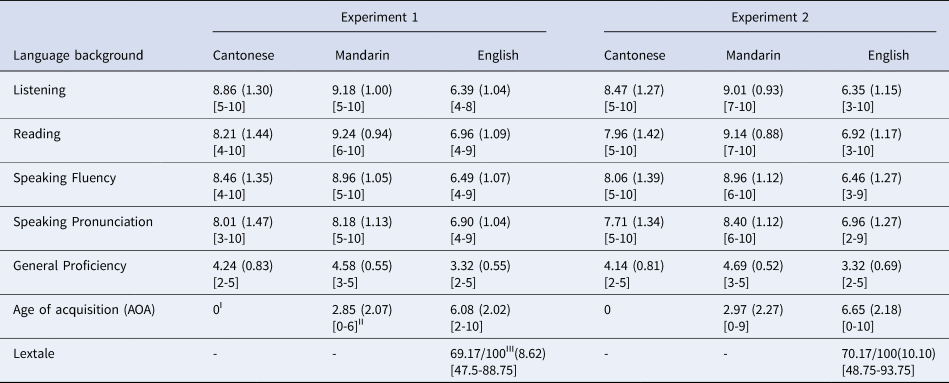
The participants were 72 trilinguals (2 males and 70 females, with an average age of 20.75([18-26], SD = 1.77)) who were paid 60 RMB. They reported to have normal or corrected-to-normal vision. The study was approved by the ethics committee of the School of Psychology, South China Normal University. The participants speak Cantonese as their native language but use Mandarin as their primary language in daily life (all of them acquired Mandarin at an early age). They were university students who had either majored in English for more than two years, stayed in English-speaking countries for more than 1 year, or had IELTS scores of at least 6.5 or TOEFL scores of at least 90. We tested participants’ language proficiency with both a self-rating language questionnaire (for Cantonese, Mandarin, and English, see Hartsuiker et al., Reference Hartsuiker, Beerts, Loncke, Desmet and Bernolet2016; Huang et al., Reference Huang, Pickering, Chen, Cai, Wang and Branigan2019) and a Lextale test (for English only, see Lemhöfer & Broersma, Reference Lemhöfer and Broersma2012) (Table 1). Given that participants acquired Cantonese as their mother tongue, their AOA of Cantonese was earlier than Mandarin and English. They acquired Mandarin much earlier than English (p< .001, see Appendix A). Moreover, their rating of listening, reading, speaking fluency, and general proficiency for Mandarin was higher than both Cantonese and English (p < .001), and Cantonese was higher than English (p < .001), except that their rating of speaking pronunciation for Mandarin was similar to Cantonese and both of them were higher than English (p < .001)Footnote 2. Participants’ average score on the Lextale test was 69.17, which was close to Dutch–English bilinguals with daily exposure of English (i.e., 75.5, see Lemhöfer & Broersma, Reference Lemhöfer and Broersma2012).
Language background self-ratings and Lextale scores of English in Experiments 1 and 2

Note. Participants rated their proficiency in several modalities for each of the three languages on a 10-point scale (1 = very poor, 10 = very proficient) and rated their general proficiency for each language on a 5-point scale (1 = very poor, 5 = very proficient). The mean value is followed by standard deviation between round brackets and the range of scores between square brackets. I) Cantonese is their mother tongue from birth and therefore its AOA is 0; II) “[0-6]” indicates the range of AOA for Mandarin in the experiment; III) ”100” indicates the maximum score of the Lextale test. There was no significant difference for most of the language rating scores and the Lextale scores of participants between Experiments 1 and 2, except for the marginally significant difference for listening (p = .07) and speaking fluency (p = .08) of Cantonese.
Materials
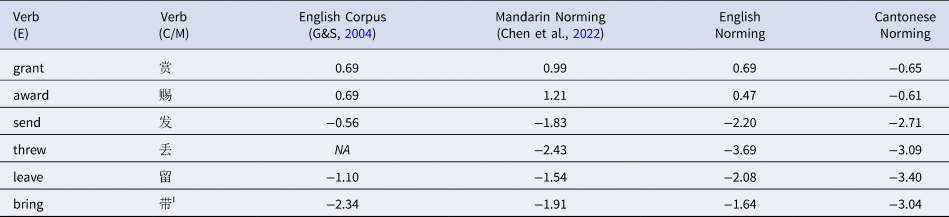
In order to balance the structure bias of the prime verbs (i.e., verb bias) among the three languages, we selected six verbs with a similar structure bias in Mandarin, Cantonese, and English. We measured verb bias with a picture description task (Table 2). Verb bias was calculated as the log-odds for the DO responses following the verb divided by the PO responses (i.e., “log[(#DO + 1)/(#PO + 1)], see Bernolet & Hartsuiker, Reference Bernolet and Hartsuiker2010). First, we chose 11 English dative verbs that had the same structure preference in a British English corpus (i.e., the International Corpus of English, see Gries & Stefanowitsch, Reference Gries and Stefanowitsch2004) as their Mandarin translation equivalents in a set of Mandarin norms (N = 367, Chen et al., Reference Chen, Wang and Hartsuiker2022). Second, we performed a norming study of the Cantonese translation equivalents of these verbs (40 native speakers of Cantonese) and a further norming study with the English verbs for L2 English speakers (51 high-proficient Mandarin-English bilinguals), none of whom participated in Experiments 1 or 2Footnote 3. All the dative verbs showed a preference for PO in Cantonese, so we selected two relatively less PO-biased verbs. Their translation equivalents were DO-biased in both Mandarin and English. The other four prime verbs were PO-biased in all three languages. For the target verbs, we used the same four neutral-biased verbs (i.e., “递(pass)”, “赠(gift)”, “还(return)”, and “赔(compensate)”) in Mandarin as Chen et al. (Reference Chen, Wang and Hartsuiker2022).
Structure bias of prime verb in Experiment 1

Note. Structure bias was calculated as the log-odds for the DO responses. Therefore, values larger than 0 indicate a DO-biased verb and values below 0 indicate a PO-biased verb. I) The verb ‘带(dai)’ was not included in the norming data of Mandarin by Chen et al. (Reference Chen, Wang and Hartsuiker2022), therefore we performed an online picture description experiment with 211 native Mandarin speakers to test its verb bias.
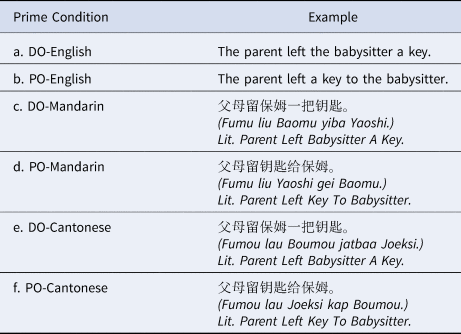
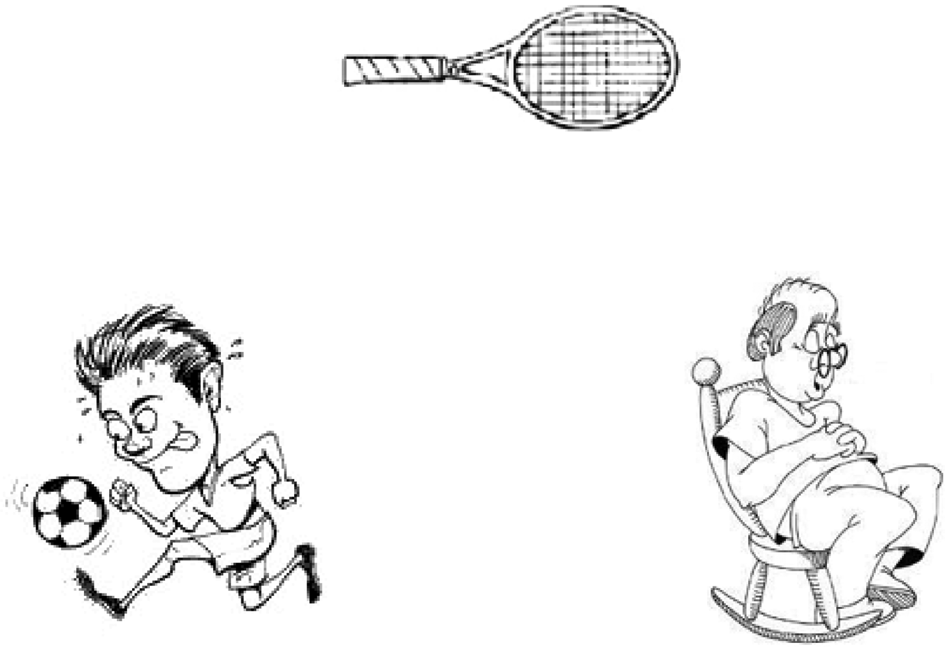
Similar to Chen et al. (Reference Chen, Wang and Hartsuiker2022), we constructed 48 sets of materials (Appendix S). Each set included six prime sentences involving dative structures (DO and PO) in three different languages (Cantonese, Mandarin, and English; Cantonese and Mandarin have the same orthographic system, Table 3), and two ditransitive target sentences (DO and PO) in Mandarin. Sometimes, the dative constructions in Chinese seem to differ from their counterparts in English. For instance, the preposition “给 (GEI, meaning “to”)” in a PO sentence (e.g., “Fumu liu yaoshi GEI baomu [Lit. parent left key to babysitter]”, see Table 3) can be also used as a verb marker in a DO sentence (e.g., “ Fumu liu-GEI baomu yiba yaoshi [Lit. parent left-GEI babysitter a key]”). Given that these verb markers in the DO sentences are argued to boost structural priming (Chen, Huang, Wang, Pickering, & Branigan, Reference Chen, Huang, Wang, Pickering and Branigan2016), we excluded them in the current study (also see Chen et al., Reference Chen, Wang and Hartsuiker2022). As in Chen et al. (Reference Chen, Wang and Hartsuiker2022), the target sentences contained a temporary ambiguity of the first syllable of the first noun phrase (NP1) (e.g., “Qiuyuan [football player]” and “Qiupai [racket]”, Figure 1). Therefore, the target sentences were ambiguous between a DO or a PO dative from the onset of the target verb to the onset of the second syllable of NP1. As a result, there were two ambiguous time windows: the target verb time window (1000 ms, from 200 ms after the onset of the target verb to 200 ms after the onset of the first syllable of NP1) and the first syllable of NP1 window (550 ms, from 200 ms after the onset of the first syllable of NP1 to 200 ms after the onset of the second syllable).
Sample stimuli of prime sentences in Experiment 1

Note. “给(GEI, means “to”)” in Chinese can be either a preposition in a PO sentence (e.g., “gei[to]” in the PP “gei baomu [to the babysitter]”) or a verb marker in a DO sentence (e.g., “liu-GEI” in the VP “liu-GEI baomu yiba yaoshi [left-GEI Babysitter A Key]”). Following Chen et al. (Reference Chen, Wang and Hartsuiker2022), we excluded the verb markers in the DO sentences.
Example target picture in Experiment 1.
Note. Participants saw the target picture when they heard the corresponding target sentence. The audio target sentence was a DO (e.g., “Yeye huan Qiuyuan yifu Qiupai [grandpa returns football player a racket]”, The grandpa returns the football player a racket) or PO (e.g., “Yeye huan Qiupai gei Qiuyuan [grandpa returns racket to football player]”, The grandpa returns a racket to the football player) sentence.

We divided the 48 sets of materials into 12 lists in a Latin Square design. Each list included three language blocks. Each block included eight prime sentences for each prime structure (DO or PO) with four prime sentences followed by DO target sentences and four prime sentences followed by PO target sentences. The experimental order of language blocks was balanced among lists. Moreover, in order to prevent any effects of the spatial collocation of the entities on the picture, each list had three versions so that each entity's position was balanced across versions. Additionally, there were 96 fillers, 32 per block (thus there were 32 fillers in each prime language). Half of the filler pairs had the same structure in the visual and audio sentences and half did not. Half of the filler audio sentences also involved homophonic syllables. Half of the filler audio sentences included one entity that mismatched the corresponding filler pictures. There were 48 trials for each language block, which were presented in a pseudo-random order. There were four practice trials for each block.
Procedure
We employed the visual-world structural priming paradigm (Arai et al., Reference Arai, van Gompel and Scheepers2007). Participants were first instructed to memorize all entities in the target pictures. Each trial in the experiment started with a fixation point on which participants needed to focus to trigger a drift-correction. Then, they read a prime sentence aloud in either Cantonese, Mandarin, or English and pressed the space bar to trigger a target picture. There was a 1500ms preview of the target picture. Next, they heard the Mandarin target sentence while looking at the picture at the same time. In 25% of the filler trials, the word ‘recall’ was presented after the filler picture. In such trials, participants were instructed to correctly describe the picture with one Mandarin sentence (i.e., they usually repeated the audio sentences or corrected one incongruent entity that mismatched the pictures). This recall task on a subset of the filler materials was implemented to mask the aim of the study and to keep participants’ attention. We used a SR-Research EyeLink-1000 (1000Hz sample rate) to record the movements of participants’ right eyes from the onset to 350ms post-offset of the audio sentences. The experiment took about 1 hour to complete.
Data analysis
We constructed three rectangular regions of interest for the entities on the target pictures (e.g., agent, recipient, theme). The temporarily ambiguous first post-verbal noun phrase (NP1) referred to either the animate recipient (e.g., “Qiuyuan [football player]”) or the inanimate theme (e.g., “Qiupai [racket]”). We calculated the proportion of looks to the recipient and theme in two critical ambiguous time windows: the verb window (1000ms) and the window of the first syllable of NP1 (550ms). After target verb onset, looks to the recipient suggested prediction of DO structure and looks to the theme suggested a PO structure. Therefore, the dependent variable was the different score of gaze probability between recipient and theme (Thothathiri & Snedeker, Reference Thothathiri and Snedeker2008a). The gaze probability data of these two entities was calculated with the empirical logit transformation (Barr, Reference Barr2008).
We analyzed the data with linear mixed models by using the “lme4” package in R (Bates & Maechler, Reference Bates and Maechler2009). We used mean-centered form for three predictors: prime structure (PO or DO), verb bias (as a continuous variable), and language block (Cantonese, Mandarin, and English). As for prime structure and verb bias, we had two fixed predictors in the model corresponding to their main effects. As for the language block, we had two variables representing two contrasts between the Mandarin block and the other two language blocks (i.e., Mandarin as a baseline: Mandarin-Cantonese contrast, and Mandarin-English contrast) (Scheepers, Raffray, & Myachykov, Reference Scheepers, Raffray and Myachykov2017). We analyzed the main effects and interactions of these predictors in LME models of the two critical time windows of the target verb and the first syllable of NP1. Because of model convergence issues (Barr, Levy, Scheepers, & Tily, Reference Barr, Levy, Scheepers and Tily2013), in the LME model of the time window of the target verb, we included a random intercept and a random slope of the Mandarin-English contrast for subjects, a random intercept and random slopes of prime structure and of the Mandarin-Cantonese contrast for items. In the LME model of the time window of the first syllable of NP1, we included a random intercept for both subjects and items, and a random slope of the Mandarin-Cantonese contrast for items. Next, we analyzed the predictors of prime structure and verb bias for the LME model of each language block separately, with the same random effect structure as the omnibus analysis (but of course without the random slopes of the contrasts between language blocks). If these models did not converge in the analysis of a specific language block, we then chose a secondary model with a simpler random effect structure (Barr et al., Reference Barr, Levy, Scheepers and Tily2013).
Furthermore, we implemented a cluster-based permutation analysis with the “permuco” package in R (Frossard & Renaud, Reference Frossard and Renaud2019) to analyze the time course of structure prediction in both ambiguous time windows. For the language block that showed a significant effect (i.e., main effect of prime structure or interaction effect of prime structure and verb bias), we tested the effect of the corresponding predictor (e.g., prime structure) with a full model of random effects for subjects (by-subject analysis) or items (by-item analysis) in each time bin (50ms) when controlling the family-wise error rate. In order to detect the beginning and end time point of structure prediction within these time windows, we employed F tests with a threshold of p < .05 (two sided), 5000 permutations, and the sum as a clustermass statistics (for data and scripts, see https://osf.io/dt5yw/ ; for the output of all LME models, see Appendix B). Compared to the bin-by-bin analysis, the permutation analysis can specify the time ranges that are significant for our predictors while controlling the family-wise error rate and avoiding the subjective choice of the bin size (Barr, Jackson, & Phillips, Reference Barr, Jackson and Phillips2014).
Results
Traditional Time-window Analysis
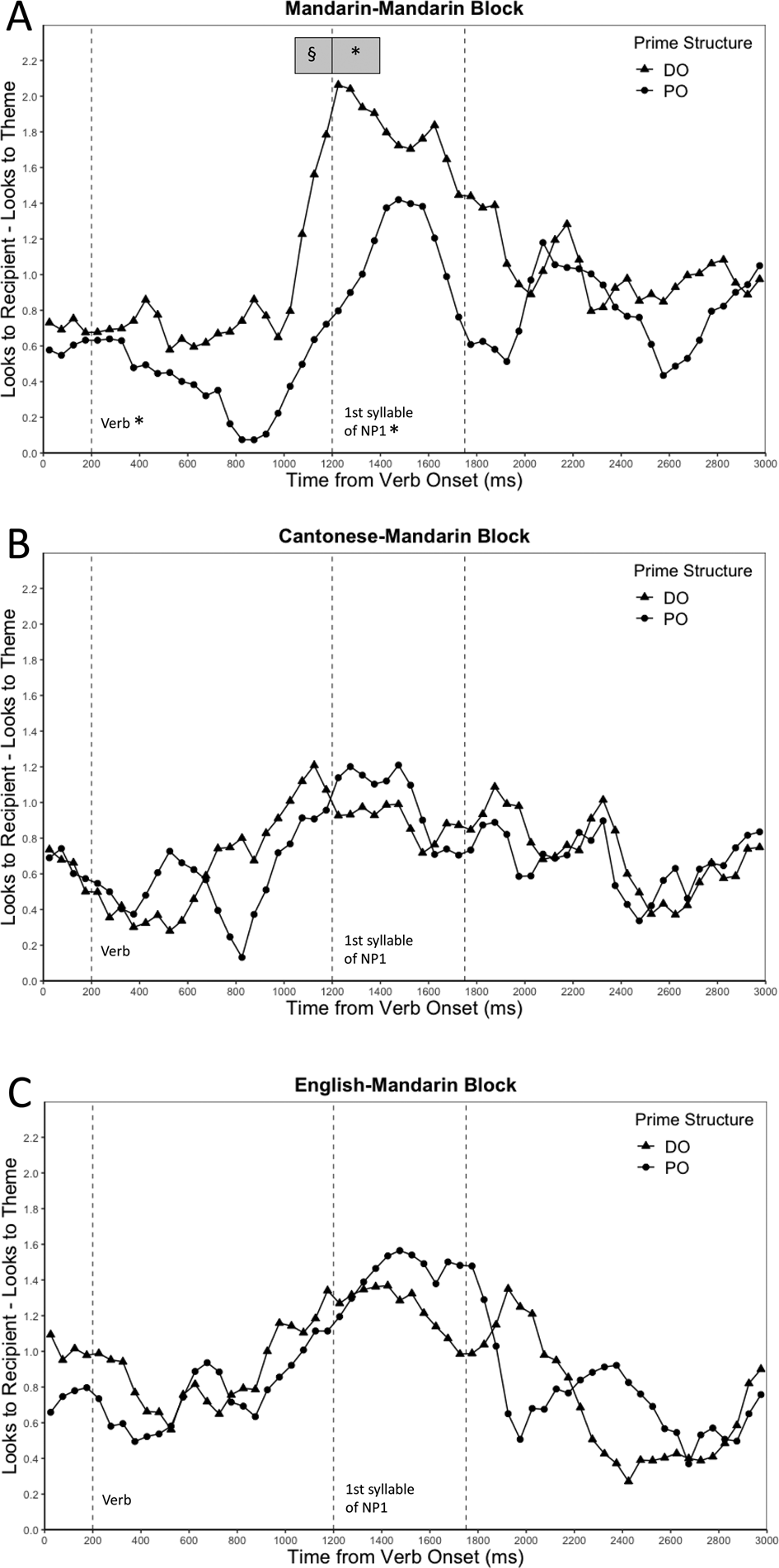
Figure 2 shows the time course of the proportion of looks to recipient and theme from the onset of the verb in the comprehension of audio target sentences as a function of prime condition per language block. The omnibus LME model showed a marginally significant main effect of prime structure in the time window of the first syllable of NP1 (β = .69, SE = .35, t = 1.95, p = .051), but not in the time window of the target verb (p >.1). Additionally, there was a marginally significant interaction between prime structure and the contrast between the English-to-Mandarin block and the Mandarin-to-Mandarin block in the time window of the target verb (β = -.93, SE = .54, t = -1.73, p = .08). There was no significant interaction between prime structure and verb bias or among prime structure, verb bias, and the contrasts of language blocks (p > .1).
Difference in Proportion of Looks to Recipient and Theme for Each Time Bin (50ms) from Onset of Target Verb in Experiment 1.
Note. The verb time window is from 200ms to 1200ms and the time window of the first syllable of NP1 is from 1200ms to 1750ms. Plot A shows data from the Mandarin-Mandarin block. The plot indicates the difference in the proportions of looks to the recipient (predicting DO structure) and to the theme (predicting PO structure) during comprehension of Mandarin sentences after Mandarin DO vs. PO prime sentences; the grey rectangles within the time windows indicate the clusters (by-subject) where the main effect of structure was significant. Plot B (the Cantonese–Mandarin block) and Plot C (the English-Mandarin block) indicate the difference in the proportions of looks to recipient and theme during comprehension of Mandarin sentences after DO vs. PO prime sentences in Cantonese and English respectively. §p <.1, *p < .05, **p < .01, ***p < .001.

For the within-language block (Mandarin-to-Mandarin, see Figure 2A), there was a significant main effect of prime structure in both the time windows of the target verb (β = .82, SE = .38, t = 2.14, p < .05) and of the first syllable of NP1 (β = 1.03, SE = .44, t = 2.34, p < .05). Figure 2A illustrates the within-language structural priming effect: participants looked more at the recipient after DO primes than PO primes in both ambiguous time windows. However, no such priming occurred for either of the between-language blocks (i.e., Cantonese-to-Mandarin (p > .1, Figure 2B); English-to-Mandarin (p > .1, Figure 2C))Footnote 4. Additionally, in none of these language blocks was there an interaction between prime structure and verb bias in any time window (all p > .1).
Cluster-based Permutation Analysis for Eye-tracking Data
As for the main effect of prime structure in the Mandarin-to-Mandarin block, the permutation analysis showed one marginally significant cluster in the time window of the target verb: from 1050ms to 1200ms (cluster-mass = 18.23, p = .095, for a by-subject analysis); and one significant cluster in the time window of the first syllable of NP1: from 1200ms to 1400ms (cluster-mass = 29.93, p < .05, for a by-subject analysis) or from 1200ms to 1350ms (cluster-mass = 25.51, p < .05, for a by-item analysis).
Discussion
The within-language condition (the Mandarin-to-Mandarin block) demonstrated abstract structural priming in comprehension. This result replicated earlier comprehension studies in Mandarin (Chen et al., Reference Chen, Wang and Hartsuiker2022) and English (Thothathiri & Snedeker, Reference Thothathiri and Snedeker2008a, 2008b). However, such abstract structural priming did not occur between-languages (i.e., Cantonese-to-Mandarin or English-to-Mandarin). Additionally, even though the contrast between Mandarin and English blocks was only marginally significant in the omnibus analysis, structural priming seemed to be stronger with Mandarin than English primes (Figure 2 clearly shows the difference visually).
Importantly, the lack of support for abstract cross-linguistic priming is inconsistent with previous findings in production (e.g., Hartsuiker et al., Reference Hartsuiker, Beerts, Loncke, Desmet and Bernolet2016; Huang et al., Reference Huang, Pickering, Chen, Cai, Wang and Branigan2019). For example, Huang et al. (Reference Huang, Pickering, Chen, Cai, Wang and Branigan2019) found stable between-language structural priming (i.e., Cantonese-to-Mandarin and English-to-Mandarin) regardless of verb repetition. One possibility is that cross-linguistic structural priming in comprehension is much weaker than that in production. Therefore, abstract structural priming is strong enough to survive in production while it is too weak to be detected in comprehension. Given that lexical overlap boosts structural priming in both modalities (e.g., Arai et al., Reference Arai, van Gompel and Scheepers2007; Pickering & Branigan, Reference Pickering and Branigan1998), we expect to observe cross-linguistic priming in comprehension with related verbs (i.e., identical verbs within-language and translation-equivalent verbs between-language) in Experiment 2.
There were no interactions between prime structure and verb bias in any language blocks. This argues against a language-general mechanism of error-based learning. In particular, the null-effect of verb bias during between-language processing suggests that the experience of prediction errors in one language does not affect another language. Furthermore, the null-effect of verb bias within-Mandarin is inconsistent with Chen et al. (Reference Chen, Wang and Hartsuiker2022)'s results and with other comprehension studies (Fine & Jaeger, Reference Fine and Jaeger2013). We return to these findings in the General Discussion.
Experiment 2: Related Verbs
Method
Participants
We recruited 72 further trilinguals (4 males and 68 females, with an average age of 21.39 ([18-30], SD = 2.42)) from the same population as Experiment 1. Again, participants acquired Cantonese as their mother tongue, which was earlier than Mandarin and English, and they acquired Mandarin much earlier than English (p < .001) (Table 1). Their rating of overall proficiency in Mandarin was higher than that in both Cantonese and English (p < .001), and ratings of Cantonese were higher than that of English (p < .001). The average Lextale score was 70.17.
Materials
The materials were the same as in Experiment 1, except that we created six triplets of translation-equivalent dative verbs in Cantonese, Mandarin, and English that were used as both prime and target verbs (i.e., give, hand, pass, bring, leave, rent).
Procedure
The procedure was the same as in Experiment 1. Additionally, we instructed participants to familiarize themselves with the verbs in all three languages and correctly translate them before they started the experiment.
Data analysis
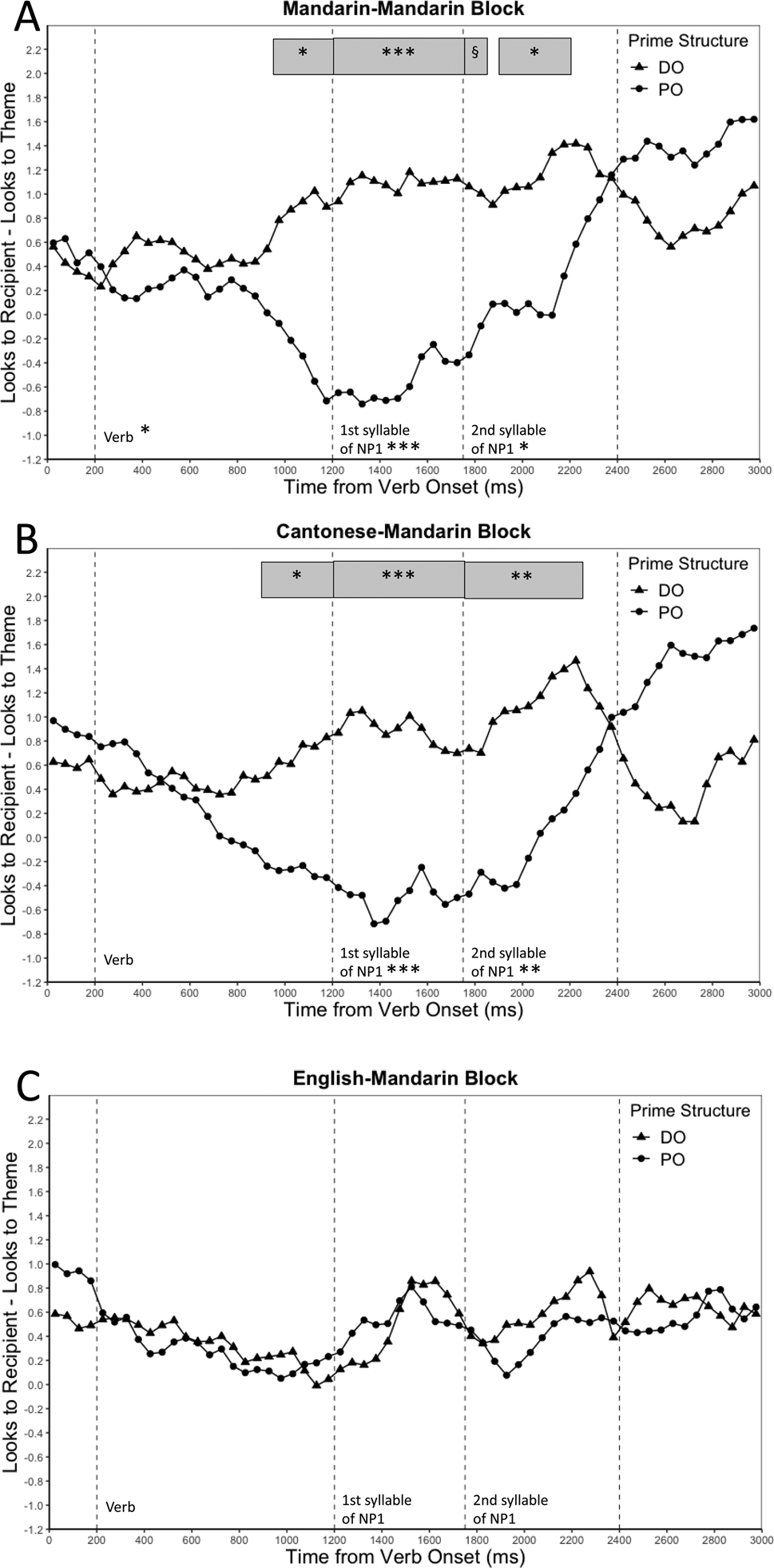
Again, we used both the traditional time window analysis and cluster-based permutation analysis in both ambiguous time windows (target verb and the first syllable of NP1). Visual inspection of the data (Figure 3) suggested that there was a structure prediction effect in the Mandarin block that extended until the onset of the next phrase (the preposition “gei (to)” for PO sentences or the determiner “yige (a)” for DO sentences after NP1). We therefore performed an additional post-hoc analysis for the (unambiguous) time window of the second syllable of NP1 (650ms, from 200ms after the onset of the second syllable of NP1 to the onset of the preposition or determiner). We again treated prime structure, the two language block contrasts (Mandarin as the baseline), and their interactions as predictors. Due to model convergence issues (Barr et al., Reference Barr, Levy, Scheepers and Tily2013), in the LME models of the time window of the target verb, we included a random intercept and random slopes of prime structure, the Mandarin-English contrast, and the interaction between prime structure and the Mandarin-Cantonese contrast for subjects, and a random intercept and random slope of the interaction between prime structure and the Mandarin-English contrast for items. In the time window of the first syllable of NP1, we included a random intercept and random slopes of prime structure, the Mandarin-English contrast, and the interaction between prime structure and the Mandarin-English contrast for subjects, and a random intercept and random slopes of prime structure and the Mandarin-Cantonese contrast for items. In the LME model of the time window of the second syllable of NP1, we included a random intercept and random slope of prime structure for subjects, and a random intercept and random slope of the Mandarin-English contrast for items. Next, in the analysis for each language block, we used the same random effect structure (without the slopes of language contrasts). Again, if these models did not converge, we chose a secondary model with a simpler random effect structure (Barr et al., Reference Barr, Levy, Scheepers and Tily2013).
Difference in Proportion of Looks to Recipient and Theme for Each Time Bin (50ms) from Onset of Target Verb in Experiment 2.
Note. The time window of the verb is from 200ms to 1200ms and the time window of the first syllable of NP1 is from 1200 ms to 1750 ms. The time window of the second syllable of NP1 is from 1750 ms to 2400 ms. Plot A (Mandarin-Mandarin), Plot B (Cantonese–Mandarin), and Plot C (English-Mandarin) indicate the difference in the proportions of looks to the recipient (predicting DO structure) and to the theme (predicting PO structure) during comprehension of Mandarin sentences after prime sentences in Mandarin, Cantonese, and English with a DO vs. PO structure. The grey rectangles within the time windows indicate the clusters (by-subject analysis) where the main effect of structure was significant. §p < .1, *p < .05, **p < .01, ***p < .001.

Results
Traditional Time-window Analysis
Figure 3 shows the time course of the proportion of looks to recipient and theme from the onset of the target verb during sentence comprehension after DO and PO primes for each language block. The omnibus LME model showed a significant main effect of prime structure in three time windows: target verb (β = .46, SE = .21, t = 2.16, p < .05), the first syllable of NP1 (β = 1.35, SE = .30, t = 4.47, p < .001), and the second syllable of NP1(β = .81, SE = .28, t = 2.94, p < .01). There was a significant interaction between prime structure and the contrast between English-to-Mandarin block and Mandarin-to-Mandarin block in both the time windows of the target verb (β = -.90, SE = .46, t = -1.95, p = .05) and the first syllable of NP1 (β = -2.10, SE = .60, t = -3.47, p < .001). The interaction between prime structure and the contrast between the Cantonese-to-Mandarin block and Mandarin-to-Mandarin block was not significant in any time window (p >.1).
In the Mandarin-to-Mandarin block, there was a significant main effect of prime structure in all three time windows: target verb (β = .89, SE = .31, t = 2.89, p < .01), first syllable of NP1 (β = 2.19, SE = .49, t = 4.50, p < .001), and second syllable of NP1 (β = 1.00, SE = .39, t = 2.55, p < .05). In the Cantonese-to-Mandarin block, there was no effect of prime structure in the time window of the target verb, but there was a significant main effect of prime structure in the time window of the first syllable of NP1 (β = 1.76, SE = .38, t = 4.64, p < .001) and of the second syllable of NP1 (β = 1.24, SE = .39, t = 3.18, p < .01). None of the time windows in the English-to-Mandarin block showed a significant main effect of prime structure (all p > .1).
Cluster-based Permutation Analysis for Eye-tracking Data
In the analysis of the Mandarin-to-Mandarin block (see Figure 3A), we found one cluster for the significant main effect of prime structure in both the time window of the target verb (from 950ms to 1200ms, cluster-mass = 42.81, p < .05, for a by-subject analysis; cluster-mass = 60.00, p < .05, for a by-item analysis) and of the first syllable of NP1 (from 1200ms to 1750ms, cluster-mass = 159.23, p < .001, for a by-subject analysis; cluster-mass = 222.28, p < .001, for a by-item analysis). In the time window of the second syllable of NP1, we found two clusters for a by-subject analysis (from 1750ms to 1850ms, cluster-mass = 17.76, p = .076, and from 1900ms to 2200ms, cluster-mass = 38.01, p < .05) and one cluster for a by-item analysis (from 1750ms to 2250ms, cluster-mass = 87.63, p < .01).
Similarly, in the analysis of the Cantonese-to-Mandarin block (see Figure 3B), we found one cluster for the significant main effect of prime structure in all three time windows, in particular the target verb (from 900ms to 1200ms, cluster-mass = 40.75, p < .05, for a by-subject analysis; from 950ms to 1200ms, cluster-mass = 50.05, p < .05, for a by-item analysis), the first syllable of NP1 (from 1200ms to 1750ms, cluster-mass = 136.29, p < .001, for a by-subject analysis; cluster-mass = 176.37, p < .001, for a by-item analysis), and the second syllable of NP1 (from 1750ms to 2250ms, cluster-mass = 83.06, p < .01, for a by-subject analysis; cluster-mass = 81.09, p < .01, for a by-item analysis).
Discussion
Experiment 2 showed clear structural priming during within-language processing (Mandarin-to-Mandarin, Figure 3A) when the verb was repeated between prime and target. As in Experiment 1 (Figure 2A), structural priming occurred in both ambiguous time windows of the target verb and the first syllable of NP1. Interestingly, there was also significant structural priming in the unambiguous time window of the second syllable of NP1, indicating a longer time course of structural priming in Experiment 2 than in Experiment 1.
Importantly, there was also between-language structural priming – namely, Cantonese-to-Mandarin priming (Figure 3B), languages that are related and have cognate verbs in the prime and target (e.g., “留[lau]” in Cantonese to “留[liu]” in Mandarin, leave). However, there was no cross-linguistic English-to-Mandarin structural priming (Figure 3C), languages that are unrelated and with non-cognate (translation-equivalent) verbs in prime and target (e.g., “leave” in English to “留[liu]” in Mandarin). The difference could be due to the properties of participants (i.e., proficiency, see General discussion) or language relatedness (in particular, as we argue below, the cognate status of the verbs in prime and target). Note that there was no cross-linguistic priming for related languages with different verbs (Experiment 1). This suggests that cross-linguistic priming was influenced by the overlap of the verbs in meaning and form, rather than an effect of language similarity in general (in which case one would also expect abstract priming). This lack of abstract cross-linguistic priming seems inconsistent with the finding of abstract cross-linguistic priming in production studies (e.g., Hartsuiker et al., Reference Hartsuiker, Beerts, Loncke, Desmet and Bernolet2016), although it is important to note that some of these studies show a translation-equivalent boost of priming (e.g., Schoonbaert et al., Reference Schoonbaert, Hartsuiker and Pickering2007) and in particular a cognate boost (compared to regular translation equivalence, Bernolet, Hartsuiker, & Pickering, Reference Bernolet, Hartsuiker and Pickering2012). A remaining question concerns the source of cross-linguistic structural priming between Cantonese and Mandarin: it is possible that this lexically-based structural priming was driven by feedback at the orthographic level (i.e., given that Cantonese and Mandarin share the same writing system) and the phonological level. Alternatively, the effect could be driven by the co-activation of lemmas in the two languages due to a link between the lemmas of cognate verbs in Cantonese and Mandarin, as proposed by Huang et al., Reference Huang, Pickering, Chen, Cai, Wang and Branigan2019). We return to this question in the General Discussion, but first report a direct statistical comparison between two experiments.
Combined analysis of Experiments 1 and 2
In order to investigate whether lexical overlap boosts structural priming, we combined the eye-movement data of Experiments 1 and 2, and compared the structural priming effects in the time windows of the target verb and the first syllable of NP1 for the Mandarin block and in the time window of the first syllable of NP1 for the Cantonese block. We treated prime structure (DO vs. PO), experiment (1 vs. 2), and their interaction as predictors in the linear mixed models. Because of model convergence issues (Barr et al., Reference Barr, Levy, Scheepers and Tily2013), we included random intercepts for both subjects and items in the LME models of the time window of the first syllable of NP1 for the Cantonese and Mandarin blocks; random slopes of prime structure and random intercepts for both subjects and items, and a random slope of experiment for items in the model of the time window of the target verb for the Mandarin block.
Results and discussion
The LME models of the Mandarin block showed significant main effects of prime structure and experiment in the ambiguous time windows of the target verb and the first syllable of NP1 (p < .05). Importantly, the interaction between prime structure and experiment was significant in the time window of the first syllable of NP1 (β = 1.10, SE = .54, t = 2.04, p < .05). Additionally, the LME models of the Cantonese block showed significant main effects of prime structure and experiment (p < .01) and a significant interaction between prime structure and experiment in the time window of the first syllable of NP1 (β = 1.78, SE = .53, t = 3.33, p < .001).
The within-language processing results (Mandarin-to-Mandarin) suggested that structural priming was stronger and longer lasting with identical verbs between prime and target in Experiment 2 than with different verbs in Experiment 1. This finding suggests a lexical boost of structural priming in comprehension, similar to the lexical boost in production (e.g., Hartsuiker, Bernolet, Schoonbaert, Speybroeck, & Vanderelst, Reference Hartsuiker, Bernolet, Schoonbaert, Speybroeck and Vanderelst2008). Additionally, the results of between-language processing (Cantonese-to-Mandarin) suggests stronger structural priming with (cognate) translation-equivalent verbs in Experiment 2 compared to different verbs in Experiment 1. This pattern is similar to the translation-equivalent boost observed by Schoonbaert et al. (Reference Schoonbaert, Hartsuiker and Pickering2007) and the cognate boost observed by Bernolet et al. (2012; also see Huang et al., Reference Huang, Pickering, Chen, Cai, Wang and Branigan2019).
General Discussion
In two eye-tracking experiments, we investigated whether structural priming in comprehension is modulated by verb bias, prime language, and lexical overlap. Experiment 1 presented different verbs in prime and target. There was clear within-language structural priming (i.e., Mandarin-to-Mandarin). In particular, participants looked more at the recipient than the theme during auditory comprehension of target sentences after reading a DO prime sentence, and looked more at the theme than the recipient after a PO prime sentence. However, there was no abstract between-language structural priming (i.e., Cantonese-to-Mandarin or English-to-Mandarin). Additionally, neither within-language nor between-language structural priming was modulated by verb bias. Experiment 2 presented identical or translation-equivalent verbs between prime and target. We now not only found clear within-language structural priming (i.e., Mandarin-to-Mandarin, same verbs) but also between-language priming (i.e., Cantonese-to-Mandarin, cognate verbs). However, this cross-linguistic structural priming seemed to be limited to highly related languages with cognate verbs; it did not occur between English and Mandarin, which are unrelated and do not have cognate verbs. Moreover, the combined analysis showed a lexical boost and translation-equivalent cognate boost in comprehension: structural priming was stronger and longer lasting when the action was repeated between prime and target (Experiment 1 vs. 2) in both within-language (Mandarin-to-Mandarin) and between-language (Cantonese-to-Mandarin) processing. Below, we discuss the critical findings further.
In contrast to the predictions of implicit learning accounts, there was no inverse preference priming effect either within- or between-languages. This result does not support the predictions of implicit learning theories that assume non-lexicalist shared syntax for multilinguals (Chang et al., Reference Chang, Dell and Bock2006). This is because such accounts assume that structural priming is driven by error-based learning and therefore predict an inverse preference priming effect. Importantly, such an effect did not occur between languages (i.e., neither between closely related nor unrelated languages). There is therefore no support for the hypothesis that prediction errors in a specific language generalize to another language (see Muylle et al., Reference Muylle, Bernolet and Hartsuiker2021 for a similar finding in an artificial language learning experiment). Additionally, we did not find an inverse preference priming effect for L2 Mandarin speakers in within-language processing, whereas Chen et al. (Reference Chen, Wang and Hartsuiker2022) did show such an effect for L1 Mandarin speakers (note that this effect also occurred in L1 Dutch and L1 English speakers in production, see Bernolet & Hartsuiker, Reference Bernolet and Hartsuiker2010; Fine & Jaeger, Reference Fine and Jaeger2013; Jaeger & Snider, Reference Jaeger and Snider2013). This finding also does not support the predictions of implicit learning theory, which assumes a faster learning rate and stronger inverse preference learning in lower proficient languages (L2/L3). There is however another possible interpretation: the learning rate for L2 in our study (i.e., the language our participants were more proficient in) may be comparable to L1 in Chen et al. (Reference Chen, Wang and Hartsuiker2022), whereas the manipulation of verb bias (as a continuous variable) may not have been strong enough to evoke inverse preference priming.
We found structural priming during within-language comprehension (Mandarin-to-Mandarin) when the verb was different between prime and target, which replicated the findings of comprehension studies (Chen et al., Reference Chen, Wang and Hartsuiker2022; Thothathiri & Snedeker, Reference Thothathiri and Snedeker2008a). Furthermore, we found a lexical boost in online comprehension: structural priming was enhanced when the verb was repeated (Experiment 2 vs. Experiment 1). These findings in comprehension are consistent with production studies (Carminati, van Gompel, & Wakeford, Reference Carminati, van Gompel and Wakeford2019; Hartsuiker et al., Reference Hartsuiker, Bernolet, Schoonbaert, Speybroeck and Vanderelst2008; Huang et al., Reference Huang, Pickering, Yang, Wang and Branigan2016; Pickering & Branigan, Reference Pickering and Branigan1998; Rowland, Chang, Ambridge, Pine, & Lieven, Reference Rowland, Chang, Ambridge, Pine and Lieven2012), suggesting a shared mechanism between production and comprehension, at least when staying within one language.
Importantly, we did find cross-linguistic structural priming in online comprehension, but only in the Cantonese-to-Mandarin condition and only when there were translation-equivalent verbs between prime and target rather than unrelated verbs. The lack of abstract between-language priming is inconsistent with the findings in production (e.g., Cai et al., Reference Cai, Pickering, Yan and Branigan2011; Hartsuiker et al., Reference Hartsuiker, Pickering and Veltkamp2004; Huang et al., Reference Huang, Pickering, Chen, Cai, Wang and Branigan2019). The production studies showed clear abstract cross-linguistic priming of dative structure between Cantonese and Mandarin (Cai et al., Reference Cai, Pickering, Yan and Branigan2011; Huang et al., Reference Huang, Pickering, Chen, Cai, Wang and Branigan2019) or between English and Mandarin (Huang et al., Reference Huang, Pickering, Chen, Cai, Wang and Branigan2019). One possibility to explain the lack of English-to-Mandarin priming was that English only shares the DO representations with Mandarin DO-GEI sentences (e.g., “Chushi song-GEI mushi yige qiu [The chef gives-GEI the priest a ball]”, see Huang et al., Reference Huang, Pickering, Chen, Cai, Wang and Branigan2019), but not with DO-nomarker sentences (e.g., Table 3 in our study). We therefore reanalyzed the production data from Huang et al. and confirmed that Mandarin DO-nomarker responses can be primed by English or Cantonese DO-sentences. These findings suggested that dative constructions in these three languages do share fundamental aspects of their representation (Branigan & Pickering, Reference Branigan and Pickering2017). In particular, some production studies showed comparable structural priming within and between languages when the verb was different (Hartsuiker et al., Reference Hartsuiker, Beerts, Loncke, Desmet and Bernolet2016; Kantola & Van Gompel, Reference Kantola and Van Gompel2011), in line with the shared-syntax account.
One possible explanation for the differences between priming in production and comprehension is that priming effects in different modalities are related to different dependent variables. It may just be harder to find an effect on online measures like eye movements or reaction times than on syntactic choices. In a picture description task for production, speakers need to select a specific syntactic structure during sentence construction, where the syntactic choice directly taps into the syntactic level. However, in an online visual-world comprehension task, the priming effect is estimated by fixation, which involves the processing of not only the syntactic level, but also other levels like concepts, phonology, or cognitive control (e.g., attention). A more interesting explanation for the lack of abstract cross-linguistic priming in comprehension is that there is a closer association between the verb and structure in comprehension than production (see discussion in Arai et al., Reference Arai, van Gompel and Scheepers2007). In particular, comprehenders access the properties of a dative verb before they merge it with the structure of the whole target sentence. Therefore, sometimes the retrieval of the structure may depend on the specific verb (subcategorization structure) and abstract structural priming may be harder to detect (Arai et al., Reference Arai, van Gompel and Scheepers2007; Pickering & Traxler, Reference Pickering and Traxler2004). In contrast, when the structure retrieval does not depend on the prior access of a specific verb during offline comprehension (e.g., object relative clauses, “where is the princess that the child is pushing”), sometimes abstract cross-linguistic priming can be detected (see Kidd et al., Reference Kidd, Tennant and Nitschke2015). In short, our finding is compatible with the hypothesis that cross-linguistic structural priming in online comprehension is at least partly based on lexical information.
One important further element to consider in the difference between the two between-language conditions is that the verbs in the Cantonese-to-Mandarin condition were not only translation equivalents but also cognates, overlapping fully in orthography and partly in phonology (e.g., “留(lau)” to “留(liu); the English-to-Mandarin equivalent is “leave” to “留(liu)”). The cognate facilitation effects in our study are consistent with the findings in production (e.g., stronger cross-linguistic priming for the Cantonese–Mandarin cognate verbs (“lau-liu”) than English-Mandarin non-cognate verbs (“leave-liu”, Huang et al., Reference Huang, Pickering, Chen, Cai, Wang and Branigan2019; also see Bernolet et al., Reference Bernolet, Hartsuiker and Pickering2012)). These findings are compatible with a lexicalist, shared syntactic representations account (Hartsuiker & Bernolet, Reference Hartsuiker and Bernolet2017; Hartsuiker & Pickering, Reference Hartsuiker and Pickering2008; Schoonbaert et al., Reference Schoonbaert, Hartsuiker and Pickering2007). In this model, the activation of the shared representation would benefit from the activation flow from other linguistic levels in the condition with cognate verbs between languages (e.g., the conceptual level, the lemma level or word-form (phonology and orthography) level). We further discuss the locus of cognate facilitation effect for structural priming below.
How did cognate verbs facilitate structure prediction during comprehension in our study? The lemma hypothesis proposes that the lemmas of Cantonese and Mandarin cognate verbs are connected to each other and so will be co-activated in processing (Huang et al., Reference Huang, Pickering, Chen, Cai, Wang and Branigan2019). This lemma link may come about by Hebbian learning (Munakata & Pfaffly, Reference Munakata and Pfaffly2004) because, for instance, the Cantonese verb lemma “lau” co-activates the lemma of its Mandarin cognate verb “liu” via shared meaning, orthography, and phonology every time it is used, eventually leading to a lexical link. Therefore, in the processing of a Cantonese DO prime, the lemmas “lau” and “liu”, and the DO combinatorial node structure are all activated. Then, in the target sentence, the target Mandarin verb lemma “liu” is accessed and selected again (similar to the lexical boost). This repeated lemma activation contributes to cross-linguistic structural priming, leading to the cognate boost. Note that this boost might also be explained by activation feedback from the other levels (conceptual or word-form) to the syntactic level, without the formation of a lemma link. However, boosts from semantic and word-form levels between two different verbs are usually much weaker (and sometimes absent) than the boost effect of a repeated verb (lexical boost) within a language. For instance, Zhang, Bernolet, and Hartsuiker (Reference Zhang, Bernolet and Hartsuiker2021) found a phonological boost that was considerably weaker than the lexical boost for Mandarin-to-Mandarin priming. Moreover, Cantonese–Mandarin bilingual studies showed that cross-linguistic priming was not influenced by the phonological similarityFootnote 5 or the orthographic overlap (written vs. auditory modality) of cognate verbs (Cai et al., Reference Cai, Pickering, Yan and Branigan2011; Huang et al., Reference Huang, Pickering, Chen, Cai, Wang and Branigan2019).Footnote 6 However, one possible limitation of our study is that the Cantonese and Mandarin primes involved full orthographic overlap (differently from Huang et al. who used auditory Cantonese primes). The orthographic overlap may have resulted in a need to strongly suppress the Mandarin language when producing a prime sentence in Cantonese, followed by an effortful language switch when processing the target sentence in Mandarin. It is possible that the cognitive resources involved in language switching contributed to the lack of Cantonese-to-Mandarin priming.
Our findings cannot be explained by the shared-syntax accounts (including the implicit learning theory) or by separate-syntax accounts with connected representations accounts that we mentioned in the introduction. First, there was no error-based learning effect (i.e., inverse preference priming), whereas the implicit learning theory predicts such an effect (Chang et al., Reference Chang, Dell and Bock2006). Second, there was no cross-linguistic priming between English and Mandarin with either different verbs or translation-equivalent verbs, which does not support the residual activation model (Hartsuiker et al., Reference Hartsuiker, Pickering and Veltkamp2004; Schoonbaert et al., Reference Schoonbaert, Hartsuiker and Pickering2007). Third, there was no cross-linguistic priming for either related (Cantonese-to-Mandarin) or unrelated (English-to-Mandarin) languages with different verbs, which does not support any of these accounts.
In contrast to these accounts, we interpret the findings in terms of the development account of shared-syntax for multilinguals (Hartsuiker & Bernolet, Reference Hartsuiker and Bernolet2017, that was based on the residual activation account from Pickering & Branigan, Reference Pickering and Branigan1998). That is, cross-linguistic structural priming is driven by the residual activation of the combinatorial node of a specific structure (e.g., DO) that is shared between languages. In particular, such shared representations are constructed when speakers are highly proficient in two languages (e.g., Cantonese and Mandarin in our study). One interesting possibility is that lexically-based cross-linguistic priming might occur in the early stage of development for Cantonese–Mandarin bilinguals, because they might develop the lemma link between cognate verbs during the early item-specific learning. Thus, language proficiency might not influence Cantonese–Mandarin priming once the learners have passed that stage. In contrast, in the non-cognate translation-equivalent verbs condition (i.e., English-to-Mandarin), the process of sharing syntactic representations might only be completed at a very late stage of language development, when learners have reached high proficiency. Therefore, it is interesting for future studies to investigate the role of proficiency for these two types of cross-linguistic priming (e.g., Cantonese-to-Mandarin vs. English-to-Mandarin). However, the fully shared model of Cantonese and Mandarin cannot explain the lack of abstract cross-linguistic priming. One explanation is that within-language priming is always stronger than between-language priming, because the lemma node of the prime verb might co-activate the lemma nodes of other verbs in that language which facilitates structural priming in target sentences with the same language (Cai et al., Reference Cai, Pickering, Yan and Branigan2011). Moreover, abstract structural priming is possibly hard to detect with online measures in comprehension compared to production (e.g., Arai et al., Reference Arai, van Gompel and Scheepers2007; Branigan, Pickering, & McLean, Reference Branigan, Pickering and McLean2005; Ziegler & Snedeker, Reference Ziegler and Snedeker2019), so that the abstract Cantonese-to-Mandarin priming did not survive but Mandarin-to-Mandarin priming did.
In conclusion, our eye-tracking experiments showed abstract structural priming in language comprehension in Mandarin as an L2 and cross-linguistic priming between a related language (L1 Cantonese) and L2 Mandarin, but not between an unrelated language (L3 English) and L2 Mandarin. Moreover, we did not find an inverse preference priming in within- or between-language processing. These findings suggest a lexicalist shared-syntax mechanism for multilinguals in comprehension, in which: 1) the prediction errors in a specific language do not generalize to another language; 2) cross-linguistic structure prediction is based on the lexical cue of cognate verbs.
Conflict of interest
We have no known conflict of interest to disclose.
Acknowledgments
This work was supported by grants from China Scholarship Council (CSC), the Faculty Mobility and Sabbatical Fund (FMS) from the Faculty of Psychology and Educational Sciences, Ghent University, and National Natural Science Foundation of China (No. 32171051). The experimental materials (Appendix S) are available in [OSF] at https://osf.io/dt5yw/.
Competing interests
The author(s) declare none.
Data availability
The data that support the findings of this study are openly available in [OSF] at https://osf.io/dt5yw/.
Supplementary Material
For supplementary material accompanying this paper, visit https://doi.org/10.1017/S1366728922000888
Appendix A: Results of T-test for the comparisons of rating scores between languages in Experiments 1 and 2

Appendix B: Fixed effects for all linear mixed model in Experiments 1 and 2, and their combined analysis