Introduction
Fat in milk is surrounded by the milk fat globule membrane (MFGM), which enables the solubilization of fat in the aqueous serum phase in droplets of 0.1–15 μm diameter. The MFGM is a complex construction of a three-fold phospholipid layer, into which are embedded proteins with varying degrees of affinity to the membrane (Mather, Reference Mather2000; Lopez, Reference Lopez2011). One of these is xanthine oxidase/reductase (XO), which in its native setting acts as an anchor point with butyrophilin and connects the inner monolayer with the outer bilayer of MFGM. As such, XO plays a pivotal role in the assembly and stability of MFGM (Mather, Reference Mather2000).
The MFGM is a promising food ingredient due to its health benefits and functional properties (Dewettinck et al., Reference Dewettinck, Rombaut, Thienpont, Le, Messens and Van Camp2008). Among the proteins, XO has exhibited anti-inflammatory and bactericidal effect, whereas lactadherin is known for its anti-adhesive properties (Rasmussen, Reference Rasmussen2009). The rich content of phospholipids in MFGM is also believed to be beneficial for neural development due to the supply of polyunsaturated fatty acids (Claumarchirant et al., Reference Claumarchirant, Cilla, Matencio, Sanchez-Siles, Castro-Gomez, Fontecha, Alegría and Jesús2016). Specific bioactivities have been ascribed to other lipid components of the MFGM, e.g. sphingomyelin which may play a crucial role in myelination of the central nervous system (Oshida et al., Reference Oshida, Shimizu, Takase, Tamura, Shimizu and Yamashiro2003). MFGM used as emulsifier stimulated pancreatic lipase activity more than a soy lecithin-based emulsion (Mathiassen et al., Reference Mathiassen, Nejrup, Frøkiær, Nilsson, Ohlsson and Hellgren2015). This might explain, why, when added to infant formula, an MFGM-protein enriched material has been shown to close the gap in cognitive performance in newborns between breast-feeding and regular infant formula (Timby et al., Reference Timby, Domellöf, Hernell, Lönnerdal and Domellöf2014) and to exert positive immunoregulatory effects (Timby et al., Reference Timby, Hernell, Vaarala, Melin, Lönnerdal and Domellöf2015).
Dairy side-streams from e.g. butter production have been shown to be source materials for MFGM isolation, because the membrane is released into buttermilk as a result of phase inversion during churning of cream. The processing pre-history of the MFGM source, however, plays a major role on MFGM quality and composition as reviewed by Jukkola and Rojas (Reference Jukkola and Rojas2017). Mechanical stress induced during pumping, homogenization and centrifugation of milk are known to induce damage to the MFGM (Wiking et al., Reference Wiking, Björck and Nielsen2003). Due to the smaller size and, hence, increased surface area of fat globules upon homogenization, the original MFGM material no longer suffices to cover the fat globules. As a result, large patches of fat globule surfaces are left uncovered by MFGM, and plasma proteins become incorporated into the MFGM to cover the fat globules (Michalski et al., Reference Michalski, Michel, Sainmont and Briard2002). Also, heat treatments of raw milk have been shown to alter the protein composition of MFGM. Kim and Jiménez-Flores (Reference Kim and Jiménez-Flores1995) demonstrated that especially β-lactoglobulin, upon heat-induced denaturation and subsequent exposure of internal thiol groups, formed disulphide bonds to indigenous MFGM proteins when heating raw milk above 72 °C for several minutes. Since β-lactoglobulin aggregates may also adduct to α-lactalbumin and bovine serum albumin (Havea et al., Reference Havea, Singh and Creamer2001), eventually large polymers can be found attached to the surface of MFGM. Denatured skim milk proteins may also bind hydrophobically to MFGM proteins (Corredig and Dalgleish, Reference Corredig and Dalgleish1998). Furthermore, the complexation between XO and butyrophilin has been found to increase upon heating (Ye et al., Reference Ye, Singh, Taylor and Anema2002).
These process-induced changes in the protein composition of MFMG may severely affect its functional properties. One study found that the heat treatment history was important to the functional properties of cream-derived MFGM, since MFGM-stabilized emulsions were impaired, if the cream had been heated to >65 °C for 10 min (Corredig and Dalgleish, Reference Corredig and Dalgleish1998). More recent studies have ascribed the main emulsifying capacity of MFGM on its proteins rather than its phospholipid fraction (Phan et al., Reference Phan, Le, Van der Meeren and Dewettinck2014; He et al., Reference He, Tang, Yi, Xu, Ma and Wang2017). Moreover, increasing β-lactoglobulin content in infant formula production can lead to problematic increases in viscosity in connection with when spray-drying as well as leading to reduced heat stability of the final product (Crowley et al., Reference Crowley, Dowling, Caldeo, Kelly and O'Mahony2016). Furthermore, the adsorption of β-lactoglobulin to the surface of fat droplets is known to impair pancreatic lipase activity (Bläckberg et al., Reference Bläckberg, Hernell, Bengtsson and Olivecrona1979).
Today, the cream fraction is often heat treated more than once. For example milk is firstly processed, including a heat treatment, at a cheese production plant, where the surplus cream is passed on to butter dairy. Here it is again heat treated at a high temperature. To our knowledge no previous study has investigated the effect of consecutive pasteurization steps on raw milk in an industrial setting. This study is based on MFGM isolated from cream samples from a Danish creamery at three different stages in the cream production process: (i) after centrifugation (ii) after first pasteurization and (iii) after second pasteurization. We hypothesized that the proportion of non-MFGM proteins associated with the MFGM preparations would increase with number of pasteurization steps, and that this in turn would affect the stability of the cream towards cream washing.
Materials and methods
Milk fat globule and milk fat globule membrane preparation
Milk fat globules were isolated from either fresh bulk milk from the experimental herd at the Department of Animal Science at Aarhus University, Denmark (‘native cream’) or kindly donated by Arla Foods butter dairy in Holstebro, Denmark (‘H cream’). Native cream from the fresh raw milk was obtained by centrifugation at 1000g and 4 °C for 20 m. Creams from the butter dairy were collected after cream separation (at 55 °C) and before pasteurization (H1), after first pasteurization (88 °C, 15 s; H2) and after a second pasteurization (93 °C, 15 s; H3). As such, native cream and H1 only differ in their origin of milk, exposure to pumping as well as heating to 55 °C during centrifugation.
The nomenclature was also applied to corresponding MFGM fractions, which were obtained as described below.
In an effort to remove milk serum proteins all creams were washed in five volumes of 50 mm phosphate buffer (pH = 6.8) with 150 mm NaCl, before centrifugation as above. This step was repeated for a total of two washes. All creams were then churned using a Kenwood Multipro compact blender (Kenwood, Havant, UK) equipped with a stainless steel blade for approximately one minute until phase inversion occurred. The butter was then kneaded while the buttermilk containing MFGM fragments was separated from the butter by filtering through two layers of cloth. Buttermilk was freeze-dried to obtain MFGM material and stored until further analysis. This procedure was carried out on two separate occasions for H cream as well as native cream.
A commercial MFGM fraction Lacprodan® PL-20 (PL-20) (Arla Foods Ingredients, Viby, Denmark) was included in the study. PL-20 is isolated at a later stage in the cream processing arm from beta serum, a by-product from butter oil production. In addition to initial cream pasteurization steps it has been subjected to evaporation and spray drying, which are known to modify the microstructure of MFGM (Morin et al., Reference Morin, Jiménez-Flores and Pouliot2007). Therefore it represents a more processed fraction than H1–3 and thus allows for comparison of the effect of processing beyond two heat treatments on MFGM protein composition.
Sodium dodecyl-sulphate polyacrylamide gel electrophoresis
MFGM material samples were mixed with Laemmli gel sample buffer in a 2 : 1 ratio (Laemmli, Reference Laemmli1970), with or without the presence of reducing agent (1 m dithioerythritol). Approximately 10 μg protein were loaded into each well on a Criterion TGX Stain-Free gel (4–15% acrylamide, Bio-Rad Laboratories, Hercules, CA, USA) as described by (Petrat-Melin et al., Reference Petrat-Melin, Andersen, Rasmussen, Poulsen, Larsen and Young2015). Proteins were visualized by UV radiation, which caused reaction between tryptophan residues of the proteins and gel material and a detectable fluorescent signal. Individual bands were identified based on their electrophoretic mobility.
To resolve the high molecular weight band present in non-reduced samples at the very top of the gel, the band was first cut out. Then each cut-out was incubated with lysis buffer (6 m urea, 2% SDS, 34.5 w/v glycerol, 0.05 m Tris-HCl) with 0.06 m dithioerythritol under gentle agitation for 15 min for reduction of disulphide bonds. Buffer was decanted, and fresh lysis buffer with 0.27 m iodoacetamide was added to inhibit the reformation of disulphide bonds. Finally, the cut-out bands containing the high molecular weight aggregates were carefully transferred into wells on fresh acrylamide gels, which was developed and visualized as described above.
Particle size analysis
The particle size distribution of the creams before and after washing was analysed by laser diffraction using a Mastersizer 2000 equipped with a Hydro 2000S wet sample dispersion unit (Malvern Instruments, Malvern, UK). Samples were added dropwise until a laser obscuration of between 10 and 20% was reached. All measurements were done in triplicate.
Results and discussion
In the present study, the protein composition of MFGM from four creams and one commercial MFGM powder was examined. One MFGM fraction (‘native’) was freshly isolated from native non-heated cream, another from cream after industrial centrifugation at a butter dairy, another from the following industrial pasteurization (88 °C, 15 s) and one from the second consecutive pasteurization (93 °C, 15 s). The commercial butter oil derived MFGM fraction (PL-20) was used to compare with a commercial ingredient with additional processing history.
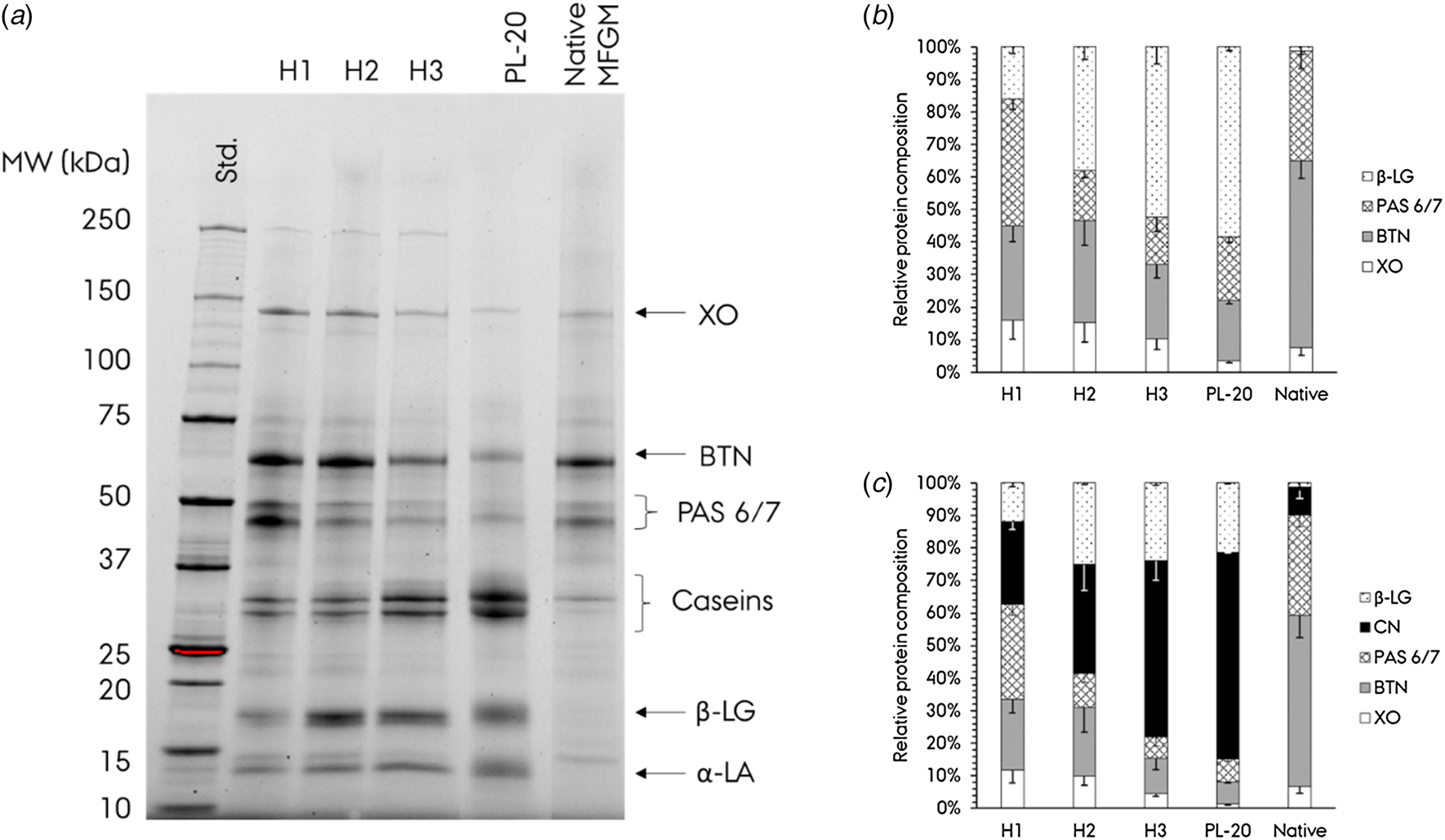
The five MFGM material fractions were subjected to protein compositional analysis by SDS-PAGE (Fig. 1a). Despite efforts to remove non-MFGM proteins by cream washing, Figure 1a revealed a progressively higher content of serum proteins (α-lactalbumin, β-LG and caseins) at the expense of indigenous MFGM proteins (XO, butyrophilin and PAS 6/7) in the protein profile, as creams were increasingly heat treated. The ‘native’ MFGM, by comparison, had close to no presence of β-lactoglobulin, whereas the PL-20 was heavily dominated by non-MFGM proteins.
Protein compositions of milk fat globule membrane material under reducing conditions (1 m dithioerythritol) isolated from the three cream fractions before pasteurization (H1), after first pasteurization (88 °C, 15 s; H2) and after second pasteurization (93 °C, 15 s; H3). A highly processed fraction, PL-20, and a gently-isolated fraction without any heat treatment, native MFGM, are included as a reference. (a) Representative SDS-PAGE gel and (b) densitometrically derived relative protein composition excl. casein, and (c) incl. casein. Identity of proteins was determined by their electrophoretic mobility after comparison to previously published gels (e.g. Gassi et al. (Reference Gassi, Blot, Beaucher, Robert, Leconte, Camier, Rousseau, Bourlieu, Jardin, Briard-Bion, Labert, Gésan-Guiziou, Lopez and Gaucheron2016)) Average of two biological replicates (each analysed in triplicate) are shown. PAS 6/7, periodic acid Schiff 6 and 7; BTN, butyrophilin; XO, xanthine oxidase; α-LA, α-lactalbumin; β-LG, β-lactoglobulin.

A semi-quantitative method was used to assess the relative protein composition of the MFGM fractions (Fig. 1b). The proportions of β-lactoglobulin increased with each consecutive step of pasteurization, and was highest for PL-20. Upon exposure to elevated temperatures, β-lactoglobulin denatures and exposes its internal sulphide groups, which are then free to cross-bind to MFGM proteins through disulphide bridges (Houlihan et al., Reference Houlihan, Goddard, Nottingham, Kitchen and Masters1992; Corredig and Dalgleish, Reference Corredig and Dalgleish1996). Moreover, the proportion of PAS 6/7 was markedly reduced already after the first heat treatment, whereas XO only decreased upon second heat treatment, as well as in PL-20. This observation was in accordance with the level of integration of these proteins; PAS 6/7 is known to be peripherally attached in the MFGM and hence more sensitive to processing (Hansen et al., Reference Hansen, Petrat-Melin, Rasmussen, Larsen, Ostenfeld and Wiking2018a). On the other hand XO is an integral MFGM protein located between the outer bilayer and inner monolayer of MFGM, thereby protecting it more towards processing (Rasmussen, Reference Rasmussen2009).
Inclusion of casein bands in the analysis revealed that also the presence of this protein group increased with the number of pasteurization steps (Fig. 1c). When fat globule triglyceride core is exposed as a result of mechanical stress (e.g. pumping), caseins are known to adhere hydrophobically and, hence, become incorporated in the MFGM (Michalski et al., Reference Michalski, Michel, Sainmont and Briard2002). This effect was accelerated by the introduction of pasteurization, which is known to increase the association of casein micelles to denatured β-lactoglobulin molecules already bound in the MFMG (Oldfield et al., Reference Oldfield, Singh, Taylor and Pearce2000). Hence, increasing the number of pasteurization steps probably explains the relative increase in caseins. In comparison, the ‘native’ MFGM fraction contained miniscule amounts of β-lactoglobulin and caseins due to its lacking exposure to heating.
The protein composition is of importance to the functional properties of MFGM material. Recent studies point to the fact that MFGM proteins, and not its phospholipids, may be the main force behind its emulsifying capacity (Phan et al., Reference Phan, Le, Van de Walle, Van der Meeren and Dewettinck2016; He et al., Reference He, Tang, Yi, Xu, Ma and Wang2017). Furthermore, increasing the β-lactoglobulin:α-lactalbumin ratio lead to problematic viscosity increases in infant formula production process (Crowley et al., Reference Crowley, Dowling, Caldeo, Kelly and O'Mahony2016). Thus, producers of MFGM powder should carefully consider the heat treatment history of cream in order to preserve functional properties.
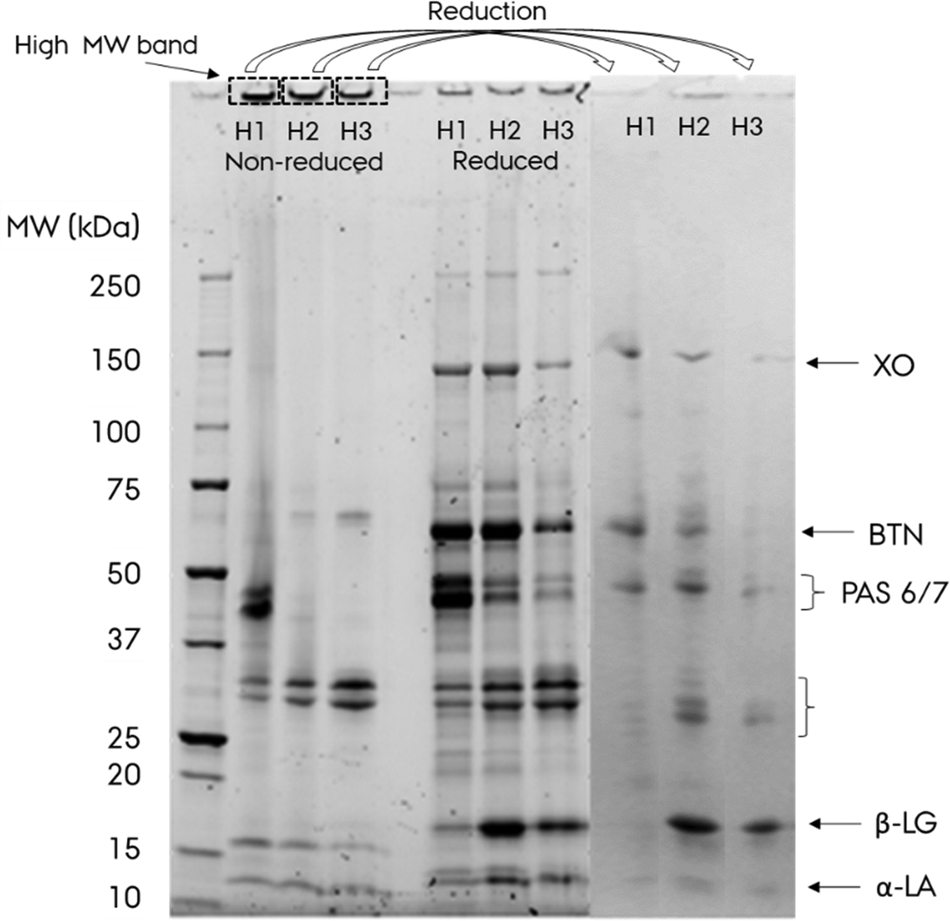
Running MFGM samples from the three creams under non-reducing conditions resulted in a dense band at the very top of the gel (Fig. 2, three first lanes). The molecular size of the material was too large to enter the polyacrylamide network of the gel and, thus, probably possessed an estimated molecular weight of over 10 000 kDa. In an attempt to assess the constituents of the high MW aggregate, the band was excised, reduced and separated in a new gel (Fig. 2, three rightmost lanes). MFGM material from un-heated cream dissolved into bands corresponding to XO, butyrophilin and PAS 6/7. This suggested the existence of an aggregate between the three proteins held together by covalent and reducible disulphide bonds (Ye et al., Reference Ye, Singh, Taylor and Anema2002). Considering the lack of heat treatment, the complex formation was probably a native phenomenon, which was also suggested by Ye et al. (Reference Ye, Singh, Taylor and Anema2002).
Resolution of the proteins of the high MW aggregate on SDS-PAGE. Unresolved high MW bands were cut out, reduced and re-run to reveal their constituents. Lane numbers refer to the respective cream sample obtained before pasteurization (H1), after first pasteurization (88 °C, 15 s; H2) and after second pasteurization (93 °C, 15 s; H3). A representative example is shown. PAS 6/7, periodic acid Schiff 6 and 7; BTN, butyrophilin; XO, xanthine oxidase; α-LA, α-lactalbumin; β-LG, β-lactoglobulin.

Upon consecutive pasteurizations of the cream the number of protein components of the high MW band was increased. For Cream H2 and H3 high MW bands resolved further into protein bands corresponding to β-lactoglobulin, αs1- and β-casein. Moreover, cream H3 aggregate composition contained very limited amounts of indigenous MFGM proteins compared to β-lactoglobulin. This solidified the already described pattern of increasing content of serum proteins as a result of crosslinking to MFGM proteins induced by one or more pasteurization steps. In addition to this, XO and PAS 6/7 could also have been removed from the MFGM as a result of extensive heat treatment.
Large polymers of β-lactoglobulin and α-lactalbumin can be induced upon heating (Havea et al., Reference Havea, Singh and Creamer2001), and whey protein aggregates alone can exceed 30 nm in size upon heat treatment (Alting et al., Reference Alting, Hamer, de Kruif, Paques and Visschers2003). In addition, these aggregates can further interact with casein micelles upon heat treatment (Oldfield et al., Reference Oldfield, Singh, Taylor and Pearce2000), thus explaining their presence in the aggregates. Therefore, further complexation with MFGM proteins could explain, why the high MW bands were too large to enter into the polyacrylamide matrix of the gel.
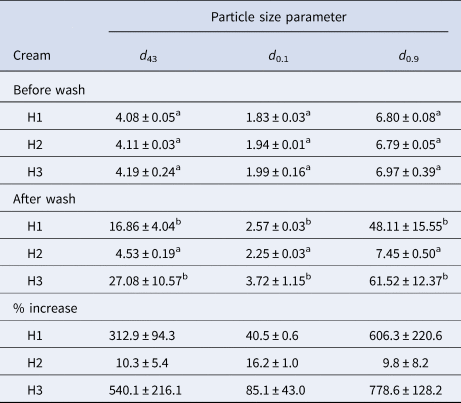
Unheated, single- and double-pasteurized creams (H1–3) were subjected to particle size analysis to evaluate their stability before and after a buffer washing step. An interesting pattern emerged (Table 1). Whilst all creams exhibited comparable, overlapping parameters before washing in a buffer, unheated (H1) and double-pasteurized (H3) cream experienced significant (P < 0.05) increases in all parameters after wash. d 43 increased by 312.9 ± 94.3, d 0.1 by 40.5 ± 0.6%, and d 0.9 by 606.3 ± 220.6% for unheated cream, which were matched by similar increases of 540.1 ± 216.1%, 85.1 ± 43.0%, and 778.6 ± 128.2%, respectively, for double-pasteurized cream.
Particle size analysis parameters of the three industrial cream fractions before and after washing with buffer

d 43, volumetric average diameter; d 0.1 and d 0.9, average diameter of fat globules at the 0.1st and 0.9th fractile, respectively. H1, unpasteurized cream; H2, single-pasteurized cream; H3, double-pasteurized cream. Mean values of two biological replicates ± standard deviation are shown. Different superscript letters indicate significant differences by Duncan's multiple range test (P < 0.05).
This indicated a destabilization and consequent flocculation/coalescence of the fat globules, possibly induced by the change in ionic composition induced by washing. Removal of ions is known to destabilize fat globules due to a reduction of the electrostatic double layer and, hence, colloidal repulsion between fat globules (Holzmüller et al., Reference Holzmüller, Müller, Himbert and Kulozik2016). Furthermore, changing ionic conditions was shown to induce flocculation of MFGM fragments (Damodaran, Reference Damodaran2010), which could also be the case here.
Surprisingly, single-pasteurized cream (H2) was much less sensitive to washing with moderate and insignificant increases in d 43, d 0.1 and d 0.9 of 10.3 ± 5.4%, 16.2 ± 1.0%, and 9.8 ± 8.2%, respectively. Suggestively, this could reflect that a single pasteurization inactivate the heat-labile agglutinin mechanism, which was previously shown to correlate with flocculation of fat globules in fresh milk (Honkanen-Buzalski and Sandholm, Reference Honkanen-Buzalski and Sandholm1981; Euber et al., Reference Euber, Brunner, Nilsson, Mattsson and Singher1984; D'Incecco et al., Reference D'Incecco, Ong, Pellegrino, Faoro, Barbiroli and Gras2018). This is supported by a previous study from our group, where a key component of the agglutinin mechanism, immunoglobulin M, was inactivated when heated to temperatures above 69 °C for 15 s (Hansen et al., Reference Hansen, Larsen and Wiking2018b). The inactivation of agglutination mechanism by a single pasteurization step thus had a stabilizing effect on the fat globules. This beneficial effect on fat globule stability was counteracted by the second pasteurization step. In accordance with a previous study by Bläckberg et al. (Reference Bläckberg, Hernell, Bengtsson and Olivecrona1979), it might be that the increased adsorption of denatured whey proteins to the MFGM will increase non-ionic interactions between fat globule surfaces and, hence, cause flocculation.
In conclusion, when investigating the effect of pasteurization during industrial cream production on fat globules and MFGM material we showed that the relative content of β-lactoglobulin and caseins in the fat globule membrane increased at the expense of indigenous MFGM proteins along with the number of pasteurization steps. Heat-induced, disulphide-bonded aggregates were found to consist of cross-linked MFGM proteins (XO, butyrophilin, PAS 6/7), as well as αs1- and β-casein and β-lactoglobulin. Finally, a single pasteurization step had a stabilizing effect on fat globules after cream washing, compared to non- and double-pasteurization. These results underline the importance of heat treatment history to the protein composition of MFGM material, which in turn greatly influences its functional properties and possibly also desirable bioactivities.
Acknowledgements
The authors wish to thank Arla Foods for Health, Arla Food Ingredients and the Innovation Fund Denmark (Project Infantbrain, Grant file 5158-00014B) for financing this study.