Recent decades have witnessed profound transformations in family composition, lifestyles, the workplace, and the public sphere. Accompanying these societal changes, public opinion surveys have revealed dramatic shifts on topics such as parental leave, day care, and women in the military (Conover Reference Conover1988; Conover and Sapiro Reference Conover and Sapiro1993; Shapiro and Majahan Reference Shapiro and Mahajan1986), women's familial roles (Brooks and Bolzendahl Reference Brooks and Bolzendahl2004; Kaufmann Reference Kaufmann2002), and on issues of gender equality and sexual harassment (Bolzendahl and Myers Reference Bolzendahl and Myers2004; Sapiro and Shames Reference Sapiro, Shames, Norrander and Wilcox2009). There is an undeniable gender component in issue preferences, but it remains unclear the extent to which the ideological polarization in domestic and social issues in U.S. society is influenced by men and women responding differently to the cultural agenda.
Indeed, persistent gender differences have been identified in several issue domains with most of the research commonly viewing political differences between men and women evolving from an increase in liberal political values and greater preference for the Democratic Party among women (Box-Steffensmeier, De Boef, and Lin Reference Box-Steffensmeier, De Boef and Lin2004; Huddy, Cassese, and Lizotte Reference Huddy, Cassese, Lizotte, Wolbrecht, Beckwith and Baldez2008; Poole and Zeigler Reference Poole and Zeigler1985; Shapiro and Mahajan Reference Shapiro and Mahajan1986). Conversely, the male-oriented explanation of the gender gap sees such differences stemming from a rapid and widespread movement among men to conservative values and the Republican Party (Kaufmann and Petrocik Reference Kaufmann and Petrocik1999; Miller Reference Miller1991; Wirls Reference Wirls1986). In short, scholars are increasingly using a longitudinal perspective to understand the origins of the gender gap, and these researchers are finding that the gender gap is the product of changing attitudes over time.
Thus, at the center of arguments about the evolution of gender differences in America is the finding that the gap can be explained by the partisan or ideological movement of women or men relative to each other over the past few decades (Inglehart and Norris Reference Inglehart and Norris2003; Kaufmann Reference Kaufmann2002; Kaufmann and Petrocik Reference Kaufmann and Petrocik1999; Wirls Reference Wirls1986). Missing from this particular body of research, however, is an account of the separate causal influences of generational and period effects that may manifest in opinion differences that set men and women apart. Consequently, explaining gender-specific trends confounds both mechanisms of social change. Moreover, compositional changes in the resources of men and women may also account for the emergence of, as well as fluctuations in, the gender gap. Such a failure leaves unanswered the crucial question of why the sexes diverge.
The purpose of this study is to provide a better understanding of the correlates and likely causes of issue opinion gaps on social and cultural matters (e.g., abortion, race, gender roles, sexuality, and crime) between men and women. To accomplish this goal, we simultaneously estimate period and cohort effects using a multilevel model approach where individual characteristics (i.e., compositional effects) can be entered as level-one fixed-effects variables, and birth cohort and year are treated as cross-classified level-two units (random effects). Since our research focus is on gender differences in social and cultural issues across generation and period and how structural factors might influence such differences, this analysis addresses the theoretical expectations regarding the sources of gendered cultural gaps that previous research has been largely unable to empirically verify.
GENDER AND ISSUE OPINION GAPS
Considerable debate has increased on social and cultural topics that point to the relevance of gender differences. The evidence indicates that on a number of these issues women are generally more liberal than men—for example, social welfare attitudes, affirmative action and racial attitudes, and legal protections for same-sex couples (Howell and Day Reference Howell and Day2000; Huddy, Cassese, and Lizotte Reference Huddy, Cassese, Lizotte, Wolbrecht, Beckwith and Baldez2008; Kaufmann Reference Kaufmann2002; Norrander Reference Norrander and Whitaker2008; Sapiro and Shames Reference Sapiro, Shames, Norrander and Wilcox2009; Shapiro and Majahan Reference Shapiro and Mahajan1986). By contrast, the gender gap is somewhat smaller or nonexistent on views related to abortion, gender-role attitudes, and attitudes toward “women's issues” related to support for the Equal Rights Amendment, gender equality, and other feminist concerns (Huddy, Cassese, and Lizotte Reference Huddy, Cassese, Lizotte, Wolbrecht, Beckwith and Baldez2008; Inglehart and Norris Reference Inglehart and Norris2003; Norrander Reference Norrander and Whitaker2008; Sanbonmatsu Reference Sanbonmatsu2002).
At the same time, there are within-group differences—gender effects are far from homogenous—leaving researchers to explain “gender gaps” (Carroll Reference Carroll and Mueller1988, Reference Carroll, Carroll and Fox2006; Huddy, Cassese, and Lizotte Reference Huddy, Cassese, Lizotte, Wolbrecht, Beckwith and Baldez2008; Inglehart and Norris Reference Inglehart and Norris2003; Norris Reference Norris and Carroll2000). Specifically, a number of studies have shown that men and women differ among themselves with much discussion noting subgroup gender gaps. These include the “marriage gap,” wherein married men and women have more in common than with their unmarried counterparts (Box-Steffensmeier, De Boef, and Lin Reference Brooks and Bolzendahl2004; Connelly Reference Connelly2000, Reference Connelly2004; Weisberg Reference Weisberg1987); and the “parental gap” that points to the presence, as well as the number, of minor children in the home as important for shaping the size of the gender gap (Box-Steffensmeier, De Boef, and Lin Reference Brooks and Bolzendahl2004; Howell and Day Reference Howell and Day2000). Similarly, others point to material circumstances such as the so called “working gap” wherein differences in economic vulnerability (Junn and Brown Reference Junn, Brown, Wolbrecht, Beckwith and Baldez2008) or economic autonomy (Carroll Reference Carroll and Mueller1988, Reference Carroll, Carroll and Fox2006) explain issue divergence between different groups of women and men. In sum, while issue gaps vary in size, direction, and significance, their existence suggests that gender plays an important role in shaping issue preferences between men and women, and within the sexes.
CULTURAL ISSUES AND THE GENDER GAP AS A CONSEQUENCE OF COHORT AND TIME EFFECTS
No single explanation can account for male/female differences in issue preferences—possibly because the sources of issue gaps do not have common origins. (On this point see Huddy, Cassese, and Lizotte Reference Huddy, Cassese, Lizotte, Wolbrecht, Beckwith and Baldez2008; Sapiro and Shames Reference Sapiro, Shames, Norrander and Wilcox2009). As a consequence, we confine our discussion to examining gendered cultural gaps. In particular, we rely on questions that are characteristic of sociocultural issues such as social service and safety net issues, abortion, sexuality attitudes, and the roles and status of men and women in society. From this vantage point, it is possible to compare the attitudes of today with those of the past, and as a result it is possible to speak confidently about gendered opinions and culture gaps as a consequence of generational and period effects. In this way, the study sheds light on the “culture war” discussion to the extent that we consider whether gendered attitudes have become more polarized with time.
Previous research has, in large part, identified gender differences as emerging in response to changes in gender-differentiated roles and identity. Much of this research has emphasized the importance of divergent economic positions and basic values of men and women for explaining differences on cultural issues (Edsall Reference Edsall and Shafer1997; Howell and Day Reference Howell and Day2000; Inglehart and Norris Reference Inglehart and Norris2003; Kaufmann Reference Kaufmann2002; Sapiro and Shames Reference Sapiro, Shames, Norrander and Wilcox2009). In this view, notable structural developments and cultural shifts taking place in American society have given rise to new social norms and value priorities that challenge the traditional social order. Indeed, women's changing roles and different experiences within the family, the labor market, the welfare state, and the community may have led women to speak “in a different voice” (Norris Reference Norris, Evans and Norris1999, 2) that is exhibited in distinct patterns of political participation, partisan loyalties, and political priorities on issues such as child care, family support, reproductive rights, welfare, education, and defense (Inglehart and Norris Reference Inglehart and Norris2003). This account emphasizes the influence of social, political, and economic forces in altering social roles, prompting the development of gendered issue gaps on cultural matters.
At the same time, the dismantling of sexist structural forces in society and changing gender roles has meant that the traditional behaviors expected of women and men are also becoming less emphasized so that contextual changes could easily influence attitudinal change in the whole population. This perspective argues that the new social context prompts changes in individual-level attitudes, which are then reflected in society-wide attitudinal shifts. In particular, recent scholarship finds that changes in family and social relationships remade American society with the result being a broad cultural shift and the rise of liberal attitudes throughout the 1970s and 1980s (Cotter, Hermsen, and Vanneman Reference Cotter, Hermsen and Vanneman2011). An extensive literature documents the remarkable liberalization of opinions about civil rights and minority issues, sexual permissiveness, and traditional values and family gender roles (Brewster and Padavic Reference Brewster and Padavic2000; Brooks and Bolzendahl Reference Brooks and Bolzendahl2004; Cotter, Hermsen, and Vanneman Reference Cotter, Hermsen and Vanneman2011; Crowder-Meyer Reference Crowder-Meyer2007; Page and Shapiro Reference Page and Shapiro1992; Schlesinger and Heldman Reference Schlesinger and Heldman2001; Shapiro and Mahajan Reference Shapiro and Mahajan1986). This trend toward greater liberalism is often discussed as the result of changing times—that is, the inevitable product of period events.
Still, gender differences in issue positions can also be due to cohort replacement. Indeed, gender differences vary not only across time, but also within subpopulations. In the cohort explanation, it may be that growing liberalization is the product of attitude change taking place among more recent birth cohorts. According to this perspective, as new birth cohorts enter the electorate with different life experiences, they may develop different political attitudes that influence them for a lifetime (Glenn Reference Glenn1977). Women (and men) of different age cohorts were socialized differently about women's roles in the world and, therefore, cohort effects related to the sociohistorical environment can also play a part in social change (Davis and Robinson Reference Davis and Robinson1991). As older cohorts die out and are replaced by younger cohorts, changes in cultural experience and ideologies at the population level occur (Firebaugh Reference Firebaugh and Clogg1989; Jennings and Niemi Reference Jennings and Niemi1981). Both Brewster and Padavic (Reference Brewster and Padavic2000) and Brooks and Bolzendahl (Reference Brooks and Bolzendahl2004) find evidence of attitude change in gender trends stemming from the replacement of earlier, more conservative, cohorts by more liberal recent cohorts (see also Inglehart and Norris Reference Inglehart and Norris2003).
Similar to the expectation that period effects may be stronger among women than men, it is likely that we will find gender-specific cohort effects as well. Since men and women are differentially positioned in society, it is expected that the trend toward more liberal views is stronger among women as revealed in a “gender-generation gap” (Howell and Day Reference Howell and Day2000; Inglehart and Norris Reference Inglehart and Norris2003; Jennings Reference Jennings2006; Norris Reference Norris, Evans and Norris1999). Despite the general liberalizing trend discovered in the 1970s, younger generations of women have a tendency to hold more left leaning (i.e., liberal) values than men (and older cohorts of women) on more than a few cultural matters (Inglehart and Norris Reference Inglehart and Norris2003; Mason and Lu Reference Mason and Lu1989; Mayer Reference Mayer1993). Gender expectations and gender experiences vary considerably over time, changing what it means to be a man or a woman in society. Recent cohorts of women have enjoyed better economic opportunities and gender equality in education (Buchmann, DiPrete and McDaniel Reference Buchmann, DiPrete and McDaniel2008; Fischer and Hout Reference Fischer and Hout2006), employment (Fischer and Hout Reference Fischer and Hout2006; Goldin, Reference Goldin2006), and personal relationships (Lichter and Qian Reference Lichter, Qian, Farley and Haaga2005; Thornton and Young-Demarco Reference Thornton and Young-DeMarco2001). Since women's experiences with these social developments are unalike, their viewpoints will reflect these differences, setting them apart from each other as well from cohorts before or after.
Likewise, in estimating the separate effects of cohort and period influences on social change, it is necessary to control for compositional effects across generations as well (Alwin and Krosnick Reference Alwin and Krosnick1991). Unlike the “political generations” model discussed above, the cohort succession model holds that attitudinal change largely stems from compositional differences across cohorts rather than reflecting the importance of socialization practices during the formative years (Alwin and Krosnick Reference Alwin and Krosnick1991; Jennings and Niemi Reference Jennings and Niemi1981). A compositional effect occurs when birth cohorts have different proportions of the characteristics associated with the dependent variable of interest. Population changes—such as the expansion of educational and employment opportunities, changes in marriage and family relationships—are expected to create compositional differences among birth cohorts. The emergent gender differences in issue opinions may also reflect changes in the macrosociodemographic and economic circumstances that affected women and, to a lesser extent, men.
Despite the contributions of prior work on gender differences in issue positions, there is limited empirical evidence that explains the extent to which gender gaps are a consequence of period and cohort effects simultaneously. Rather, empirical research on gendered issue positions mainly center on a description of time-period effects using repeated cross-sectional data (Eagly et al. Reference Eagly, Diekman, Johannesen-Schmidt and Koenig2004; Crowder-Meyer Reference Crowder-Meyer2007; Howell and Day Reference Howell and Day2000; Shapiro and Mahajan Reference Shapiro and Mahajan1986). As a result, we have considerable evidence from many snapshots in time that men and women differ on a number of political issues, but the source of these differences remains unclear. Specifically, there has been little attempt to test whether attitude change was owed to the unique influence of generational replacement stemming from compositional differences or socialization experiences; and/or shifts in attitudes among all individuals in society produced by time-period effects. Thus, while we have been cognizant of the existence of the gender gap in issue preferences, we know less about its source.
DATA AND MEASURES
The data employed here are based on responses to opinions about domestic and social issues contained in the General Social Survey (GSS) for 1972 through 2012. The long duration of the GSS and the use of consistent survey language make it well-suited for analyzing trends over time. Yet, the dataset is not without its challenges. Since the GSS employs a split-ballot procedure and/or contains questions of interest in different survey years, we could not scale some attractive items together because they were asked of only some respondents, or at different time points. As a consequence, the sample sizes and time periods vary contingent upon these two survey issues.
In order to facilitate direct comparisons and to speak confidently about the significance of results, we model the cultural issue opinions of men and women with items utilized in earlier studies (see DiMaggio, Evans, and Bryson Reference DiMaggio, Evans and Bryson1996; and also Kaufmann Reference Kaufmann2002). As shown in Table 1, we rely on seven simple additive scales that combine items tapping attitudes related to contemporary cultural issues (see the online supplementary materials for exact question wording of survey items). The social welfare measure includes three questions: government intervention to solve country's problems and the desirability of more services/more spending versus fewer services/less spending for the sick and poor. Views on abortion are tapped by an additive scale of six items, each specifying a condition under which “it should be possible for a pregnant woman to obtain a legal abortion.” A racism scale is based on answers to five questions tapping attitudes toward African-Americans. The questions asked about the willingness to vote for African-American presidential candidates and attributions of responsibility for African-Americans’ disadvantage in jobs, income, and housing. Another scale sums responses to two items about women's participation in the public sphere. A family gender roles scale is based on three items about the proper roles of men and women and the effects of women working outside the home. A sexuality scale is based on three items eliciting attitudes toward premarital sex, extramarital sex, and homosexuality. Finally, a crime and justice scale combines responses to questions about capital punishment, gun control, and courts’ treatment of criminals. All issue attitude items were scaled to assign conservative answers with higher scores. Cases coded “don't know” and “not applicable” were treated as missing on the grounds that lack of knowledge (or interest) does not represent a centrist or moderate position (on this point see DiMaggio, Evans, and Bryson Reference DiMaggio, Evans and Bryson1996, 700).
Variables from the GSS

Note: Values were recoded to scale conservative responses higher (e.g., bolded mean figures represent more conservative position). In constructing the various scales, where necessary, items were rescaled so that each contributed equally to the scale in which it was included.
1Social welfare scale = sum of responses to HELPSICK, HELPNOT, and HELPPOOR. (Higher values indicate more restrictive responses.)
2Abortion attitude scale = sum of responses to ABDEFECT, ABNOMORE, ABHLTH, ABPOOR, ABRAPE, and ABSINGLE. (Higher values indicate more restrictive responses.)
3Sexuality attitudes scale = sum of responses to PREMARSX, HOMOSEX, and XMARSEX. (Conservative responses are scaled higher.)
4Family gender roles scale = sum of responses to FECHLD, FEPRESCH, FEFAM. (Support for traditional roles are scaled higher.)
5Women's public roles scale = sum of responses to FEPRES and FEPOL. (More restrictive responses are scaled higher.)
6Racism scale = responses to RACPRES, RACDIF1, RACDIF2, RACDIF3, and RACDIF4.
7Crime and justice scale = sum of responses to CAPPUN, GUNLAW, and COURTS.
*p ≤ .05; **p ≤ .001 (two-tailed test).
Consistent with the literature, the aggregate data in Table 1 indicates that men are more conservative on social welfare and gender role issues, crime and race-related concerns, and quite comparable to women on abortion, sexuality attitudes, and support for women's public roles. In light of these results, we can conclude that aggregate gaps between men and women vary in magnitude, but we are unable to explain why such gendered cultural differences emerged and how they unfold over time or across cohort as a consequence of compositional or contextual factors.
With this goal in mind, separate models are used to distinguish between the sexes. In this way the figures illustrate not only the degree of differential effects of individual characteristics (e.g., educational attainment, income, religion, parenthood, etc.) for men and women, but also the variability across cohorts and periods for each gender. As will be clear in the methods section below, the level-two unit of analysis is cohort-by-period cells. On the basis of sample sizes and the goal of creating distinctions detailed enough to identify meaningful patterns of change we examine 5-year birth cohorts, resulting in 15 cohorts.Footnote 1 Each survey year is a separate period. Respondents’ ages in the data pooled across all surveys range from 18 to 89.Footnote 2 The GSS does not distinguish among respondents aged 89 and above and simply assigns these individuals an age score of 89. To avoid potential problems with pooling of data (Ploch and Hastings Reference Ploch and Hastings1994), respondents more than 88 years of age are deleted from the sample. To adjust for problems of collinearity between age and age-square, age is grand-mean centered.
In addition, we include a number of factors that have been shown to influence opinions on cultural issues as control variables in the models. The independent variables measure race, religious tradition, party identification, marital status, children in the home, geographic region, education, urbanity, and economic inequality. Race is coded as a dummy variable with African American as the reference category. Religious tradition is categorized using dummy variables for mainline Protestants, Catholics, and no religious tradition, with evangelical Protestant as the reference category. Party preference is coded as separate dummy variables to represent a Democrat or Independent preference with Republican partisanship omitted as the reference category. We measure region of residence with a dummy variable for the Southern region. The following dummy variables are also included as controls: married, minor child(ren) in the home, and urban residence (100 largest SMSAs). We include different indicators of success and well-being including education and income. Education is coded as years of education (zero to 20), and respondent's income is based on a continuous measure of self-reported family income (in 1986 dollars). All continuous variables in the model have been centered around the overall mean.
ANALYTIC METHODS
The aim of our approach is to investigate gender differences on social and cultural issues through a process of cohort replacement and time-period differences. The basic challenge in APC analysis is due to the “identification problem” arising from the linear dependency between age, year of survey (period), and year of birth (cohort): Period = Age + Cohort (Firebaugh Reference Firebaugh and Clogg1989; Glenn Reference Glenn1977). For precisely this reason, we rely on a new methodological approach that distinguishes between the individual and the contextual level (i.e., cohort and period effects) for decomposing trends in issue preferences.
The use of cross-classified random effects models (CCREM) adjusts for the linear relationship between age, period, and cohort (Yang Reference Yang2008; Yang and Land Reference Yang and Land2008). In this instance, individuals are the level-one unit of analysis nested within birth cohorts and within year, which is the level-two unit of analysis. The multilevel model is used to obtain the fixed effects estimates of age, and other individual-level covariates previously identified as important for contributing to differences in cultural opinions between men and women and the random effects of period and cohort.Footnote 3
We begin with the level-one “within-cell,” or individual, model that provides the separate intercepts for men and women, respectively:
 $$\eqalign{Issue\,Position_{{ijk}(men/women)} & = \beta_{0jk} + \beta_{1} A_{jk} + \beta_{2} A^2 jk + \beta_{3} W_{jk} + \beta_{4} D_{jk} \cr & \quad + \beta_{5} I_{jk} + \beta_{6} MP_{jk} + \beta_{7} C_{jk} + \beta_{8} N_{jk} + \beta_{9} E_{jk} \cr & \quad + \beta_{10} S_{jk} + \beta_{11} M_{jk} + \beta_{12} K_{jk} + \beta_{13} U_{jk} \cr & \quad+ \beta_{14} IN_{jk} + e_{ijk}}$$
In the above equation each individual (i = 1, 2, … njk ) is nested in both a birth cohort (j = 1,…,15 birth cohorts) and a period (k = 1, …, 28 survey years).Footnote 4 Where β 0 jk refers to the intercept or cell mean for respondents located in the jth cohort and kth period, β 1 through β 14 are the individual-level fixed effects for age (A), age-square (A2), whites (W), Democrats (D), Independents (I), Mainline Protestant (MP), Catholic affiliation (C), no religious affiliation (N), educational attainment (E), southern resident (S), married (M), minor kids in the home (K), urbanity (U), income (IN), and e ijk is the individual-level error term.
The level-two or “between cell” equation is:
 $$\beta_{{0jk}\,(men/women)} = \gamma_{0} + c_{0J} + t_{0k}$$
In this equation, β 0 jk refers to the cell mean, γ 0 is the overall mean/intercept of issue preferences for men and women, and c 0 j and t 0 k are the residual random effects of cohort and period, respectively. Using these residual random effects we examine the effect of each cohort (averaged across all periods), and the effect of each period (averaged across all cohorts) on men and women's cultural issue positions.
FINDINGS
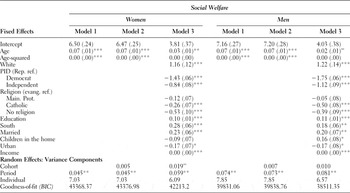
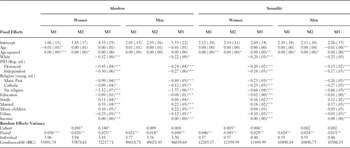
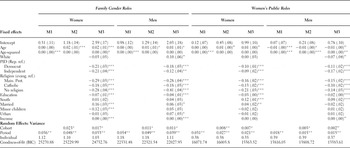
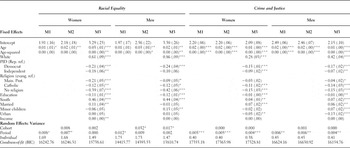
In this section, we examine the extent to which men and women hold dissimilar opinions on a number of cultural issues (even after controlling for other factors), as well as estimate the degree to which these differences stem from the replacement of individuals or because men and women are changing how they think. Estimates of the CCREM models for gender differences on social welfare opinions, views on gender roles, sexuality and abortion, racial equality, and crime and justice-related attitudes are given in Tables 2 through 5 (and visually depicted in Figures 1–4).Footnote 5 Model 1 contains the base model of age and period effects, Model 2 simultaneously estimates age, period, and cohort effects, and Model 3 introduces controls for the key explanatory variables (as fixed effects) that have been previously identified as important for the emergence of the gender gap in issue preferences. The intercepts in the models refer to the average level of support, with higher numbers representing more conservative issue positions across years (Model 1) and across years and cohorts (Models 2 and 3). The cohort and period variance components indicate the extent to which gender gap trends can be explained by generational replacement or represent shifts in response to changes in the larger economic and/or social context.
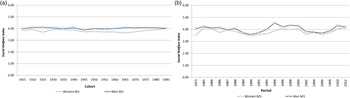
Social welfare by (a) cohort and (b) period.

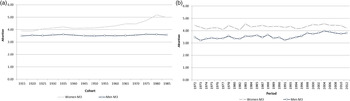
Abortion by (a) cohort and (b) period.

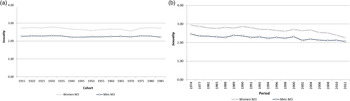
Sexuality by (a) cohort and (b) period.

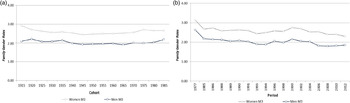
Family gender roles by (a) cohort and (b) period.

Social Welfare
Table 2 shows that men hold slightly more conservative opinions, but in general both men and women are supportive of more government services and spending, and government provided health insurance and jobs. The intercepts in the models refer to the average position on the 12-point social welfare scale and, once relevant control variables are included (Model 3), the average level of support for men is 4.03 as compared to 3.81 for women, indicating a generally favorable (i.e., liberal) stance for both. Moreover, the random-effects variance components from the models indicate significant changes in social welfare opinions by period but very little evidence of cohort effects.
Linear, cross-classified random-effects age-period-cohort models: Social welfare

Note: Standard errors in parentheses. Random-effects coefficients omitted in the interest of space. N = 9,361 (females), N = 7,890 (males); =p < .10; *p < .05; **p < .01; ***p < .001.
In the case of period shifts we find that the issue positions of both men and women shifted over time, but the effect was somewhat greater among men (see Figure 1). The fact that the period variance component increases regardless of gender, even after controlling for several sociodemographic factors, supports the claim that opinions and preferences are responsive to the political, economic, and social climate. Moreover, despite considerable variability over time, the trends are quite similar, with a minor gender gap emerging in the 1990s that had all but disappeared in the next decade. Consistent with previous studies, our results show that Americans are becoming more conservative on welfare spending. Yet, there is no evidence of a growing “opinion gap” between the sexes.
Abortion, Gender Roles, and Sexuality
Perhaps the most obvious topics we might expect the sexes to differ on are those related to cultural values that are seen as particularly relevant to women—such as the appropriate role of women in society and issues like abortion and sexual permissiveness. Several results stand out in Tables 3 and 4 (see also Figures 2–4). According to these analyses, attitudinal change stems directly from changing material conditions from year to year, and to a lesser extent, across cohorts. Likewise, the shifts in the period and cohort variance components from Models 1 and 2 to Model 3 make obvious that the failure to incorporate key predictors can lead to an undeveloped estimation of changes on attitudes toward abortion, sexuality, and gender roles. At the same time, the graphs demonstrate that while period and cohort changes are evident, the overall pattern is that men and women moved more or less in tandem. Therefore, period and cohort changes cannot explain the emergence of, or variations in, the gender gap.
Linear, cross-classified random-effects age-period-cohort models: Abortion and sexuality

Note: Standard errors in parentheses. Random-effects coefficients omitted in the interest of space. Abortion: N = 13,185 (females), N = 11,203 (males); Sexuality: N = 5,507 (females), N = 4,672 (males);
=p ≤ .10; *p ≤ .05; **p ≤ .01; ***p ≤ .001.
Linear, cross-classified random-effects age-period-cohort models: Family gender roles and women's public roles

Note: Standard errors in parentheses. Random-effects coefficients omitted in the interest of space. Family Gender Roles: N = 8,823 (females), N = 7,198 (males); Women's Public Roles: N = 8,771 (females), N = 6,930 (males); =p ≤ .10; *p ≤ .05; **p ≤ .01; ***p ≤ .001.
Specifically, although there is some variability by year, the time-period illustrations confirm a liberalizing trend since the 1970s—regardless of gender—depicted in growing approval for more egalitarian family responsibilities and sexual permissiveness (Bolzendahl and Myers Reference Bolzendahl and Myers2004; Kaufmann Reference Kaufmann2002). With few exceptions, men and women generally paralleled each other, and as a consequence the gender gap remained relatively constant. This finding is not completely unexpected given that the extant literature concludes that Americans have become more liberal on social and cultural issues that assess beliefs about gender role attitudes and other so-called women's issues (Brooks and Bolzendahl Reference Brooks and Bolzendahl2004; Kaufman 2002; Norrander Reference Norrander and Whitaker2008). Indeed, Kaufman's (Reference Kaufmann2002, 292) examination of trends in cultural attitudes between 1988 and 2000 shows that gender similarities and differences remained notably constant and, consequently, do not point toward increasing polarization between men and women.
Cohort differences on issues that relate specifically to gender identity and roles appear to be extremely modest, suggesting that generational replacement is relatively unimportant for explaining gender differences in these issue areas. Still, and perhaps most relevant to other gender-generation gap analyses is the finding that women of the “baby boomer” generation challenge traditional sex roles and the assumption that women are primarily responsible for making a comfortable home and providing care for children. This analysis confirms a growing belief in equal sex roles among the postwar generation of women—especially females born between 1940 and 1970. Interestingly, these generational differences in attitudes toward women's family roles and sexual permissiveness do not appear among males, and as a result there are no detectable cohort differences in the values held by men. To sum, although women are consistently to the right (or more conservative) of men, the consistency of the slope from older to younger male cohorts, combined with the gradual liberalizing shift among women of the baby boomer generation, temporarily reduced the gender gap between middle cohorts.
One possible standout comprises trends in support for abortion legality across several circumstances: pregnancy stemming from rape, fetal birth defect, health of mother is at risk, the woman is unmarried, the woman does not want more children, and financial hardship for family. Although research on gender differences in views on abortion provides contradictory findings, the results in Figure 2 show substantial opinion changes occurred over time and across cohorts. Since the early 1970s, men have consistently expressed more support for abortion than women, but the gender gap is actually becoming quite small in more recent time periods. Also evident is an intragenerational shift among women toward greater disapproval. Specifically, we find a diverging trend beginning with the female birth cohort born in the mid-1950s growing more restrictive in their opinions about abortion. The tendency toward a more restrictive view of abortion is accelerated in more recent cohorts—those who came of age during the mid-1970s and early 1980s—and, as a consequence, the gender gap has widened. Most important, if this trend continues we can expect, through the process of generational replacement, an increase in gender differences in opinions toward abortion.
Racial Attitudes
Considering racial attitudes trends, the variance components contained in Table 5 show very little evidence of across-time or cohort differences for both men and women in their willingness to vote for African-American presidential candidates and attributions of responsibility for African-Americans’ disadvantage in jobs, income, and housing. Importantly, there is no evidence of a growing gender gap as predicted by contemporary accounts of gendered differences in racial attitudes (Maxwell Reference Maxwell2015; Norrander Reference Norrander and Whitaker2008; Steeh and Schuman Reference Steeh and Schuman1992). Of note, separate analyses among white respondents only confirms that, despite excluding nonwhite respondents (which could potentially obscure black/white divisions in racial equality opinions), the trends remain unchanged (not shown, available upon request).Footnote 6 In light of DiMaggio, Evans, and Bryson's (Reference DiMaggio, Evans and Bryson1996) study, and the results of the follow-up research by Evans (Reference Evans2003), that corroborates decreasing polarization regardless of gender and race on feelings toward racial equality and views on aid for minorities, this outcome is not entirely unexpected (see also Page and Shapiro Reference Page and Shapiro1992).
Linear, cross-classified random-effects age-period-cohort models: Racial equality and crime and justice

Note: Standard errors in parentheses. Random-effects coefficients omitted in the interest of space. Racial equality: N = 4,964 (females), N = 4,074 (males); Crime and justice: N = 8,944 (females), N = 8,152 (males); =p ≤ .10; *p ≤ .05; **p ≤ .01; ***p ≤ .001.
Crime and Justice
A common thread within studies that focuses on differences in the social and domestic attitudes of women and men is the consistent gap in issues relating to the use of force and violence, including the approval of gun control and capital punishment (Poole and Zeigler Reference Poole and Zeigler1985; Sapiro and Shames Reference Sapiro, Shames, Norrander and Wilcox2009; Shapiro and Majahan Reference Shapiro and Mahajan1986; Smith Reference Smith1984). Still, others confirm that even on crime and justice issues, where gender differences are expected to be the greatest, the degree of overlap between women and men's attitudes is much greater than the difference (on this point, see Sapiro Reference Sapiro, Norrander and Wilcox2002 and Sapiro and Shames Reference Sapiro, Shames, Norrander and Wilcox2009). Further, DiMaggio, Evans, and Bryson's (Reference DiMaggio, Evans and Bryson1996) investigation of trends in social attitudes polarization demonstrates that men and women agree on matters related to capital punishment, gun control, and the courts’ treatment of criminals. The findings in Table 5 indicate that gender differences fail to materialize, and there is no evidence of across-cohort or period differences. Separate analyses reveal that, despite the exclusion of black responses that could potentially bias crime and justice opinions, the results remain unchanged (not shown, available upon request). In short, our results provide little evidence of change or increasing gender polarization, and thus point to the ineffectiveness of crime and justice concerns as a “wedge” issue in political campaigns—at least as far as men and women are concerned.
Explanatory Variables and Implications
While the focus is not on explaining “why” attitudes vary across individuals, it is worth pointing out that the results illustrate the importance of including factors related to men's and women's locations within the social structure—as well as accounting for changes in the larger social and economic context when assessing gendered differences on cultural issues over time and across cohorts. Once relevant social structural factors and demographic controls are included in the models, the shifts in the variance components indicate that much of the cohort and period effects observed for men and women are largely a consequence of situational circumstances. In fact, most of the variance in the models, irrespective of issue domain, is attributable to individual differences.
These results support the contention that describing the gender gap as if it were a single, coherent construct fails to recognize important intra-gender differences such as the “marriage gap” (Connelly Reference Connelly2000, Reference Connelly2004; Weisberg Reference Weisberg1987) or “working gap” (Carroll Reference Carroll and Mueller1988; Schlesinger and Heldman Reference Schlesinger and Heldman2001). Neither men nor women comprise anything like a homogenous group, and future research can offer insights into subgroup gender gaps in issue domains that emerge among different types of women and men as a consequence of their relative position to members of the same sex—a point we return to below.
DISCUSSION AND CONCLUSION
Despite the extensive body of existing research, many aspects of the gender gap remain a mystery. This article addresses the issue of changing opinions and preferences for men and women as a consequence of cohort and period effects. At the same time, we are able to provide a better understanding of the theoretical explanations for the development of, and variations in, gender differences on a number of social and cultural issues that previous research has been largely unable to empirically verify. Further, while we focus on gendered attitudes toward social and cultural issues and preferences, the approach used here could easily be extended to the study of other kinds of gendered attitudes, values, and behaviors.
In line with earlier studies, we find that women express slightly more liberal opinions on social welfare, even after controlling for party identification and other sociodemographic differences (Crowder-Meyer Reference Crowder-Meyer2007; Howell and Day Reference Howell and Day2000; Shapiro and Majahan Reference Shapiro and Mahajan1986). Men and women also differ on abortion, gender, and sexuality issues, with women more likely to embrace a conservative orientation (Crowder-Meyer Reference Crowder-Meyer2007; Eagly et al. Reference Eagly, Diekman, Johannesen-Schmidt and Koenig2004). Extant research suggests that men and women differ on issues related to the use of force and crime, such as gun control and capital punishment (Crowder-Meyer Reference Crowder-Meyer2007; Shapiro and Mahajan Reference Shapiro and Mahajan1986; Smith Reference Smith1984), as well as race and racial equality issues (Maxwell Reference Maxwell2015; Norrander Reference Norrander and Whitaker2008). However, when employing a more appropriate modeling specification that makes possible separating attitudinal change into its cohort and period components, we find there is actually little evidence of a gender gap with respect to these issues.
This brings us to the main contribution of this study: How have men and women's social and domestic attitudes changed across cohorts and time? And, what are the consequences of these shifts for the gender gap? The possible role of cohort as a source of the gender gap in issue preferences appears to be extremely modest. The plots show little variability on opinions about sexuality, women's gender and public roles, and crime and justice, suggesting that cohort replacement is relatively unimportant. As indicated above, the sole exception for cohort-based changes in the cultural opinion gap is found in responses to abortion rights. The gender-generation differences imply that, through the process of generational replacement, we can expect a shift toward conservativism—with women generally less supportive of abortion.
In contrast, the results indicate a much stronger case can be made for period-based changes in issue preferences. In general, public attitudes on cultural issues have become more liberal, and gender preferences on sexual behavior and women's family and public roles have become slightly less polarized over time. Most of the time-period illustrations indicate a movement away from conservative values for both men and women, signaling growing approval for more egalitarian family responsibilities and sexual permissiveness since the 1970s. However, the liberal movement among men and women generally paralleled each other, and, as a consequence, the gender gap remained relatively constant.Footnote 7 In sum, although important gender differences exist, the above results provide empirical corroboration that cohort- and period-based accounts are largely inconsequential for explaining trends or shifts in the degree of difference in men and women's cultural beliefs.
Instead, the results point to the importance of changing situational circumstances of both women and men in society as contributors to intragender gaps. The results for the various social structure factors and demographic controls indicate that the influence of many of these individual features are consistent across different sociocultural domains (abortion, sexuality, family and public roles, etc.), and while some predictors differ for men and women, there are also substantial similarities that work to differentiate members of the same sex. Among the major determinants of cultural attitudes for both men and women, partisan affiliation, religion, race, and marital status appear to be the most influential.
Aside from the foreseeable partisan rift, with Democrats and Independents (regardless of gender) holding more left-oriented values than their Republican counterparts, of particular importance is the “marriage gap” that appears between married men and married women on the one hand, and single men and single women on the other. Even if the marriage gap is slightly less dramatic among men, differences in marital status are shown to influence attitudes toward social and cultural matters. While these findings are consistent with the social structural account of opinion formation, future research can build on these findings by exploring the possibility of culture gaps among certain types of men and women, and how these trends are rooted in cohort-specific experiences, or in response to changes in the larger social and cultural environment.
In light of prior research, some of our results may well be surprising—for example, the finding that women are more conservative on abortion and the proper role of women in the home and society. Yet, scholarly findings regarding gendered opinion differences on so-called “women's issues” have been mixed. Specifically, extant studies have found that gender differences do not always appear, that men are more supportive (Bolzendahl and Myers Reference Bolzendahl and Myers2004; Eagly et al. Reference Eagly, Diekman, Johannesen-Schmidt and Koenig2004; Shapiro and Mahajan Reference Shapiro and Mahajan1986), or that women are more supportive (Combs and Welch Reference Combs and Welch1982; Jelen and Wilcox Reference Jelen and Wilcox2005). The inconsistencies among these findings appear to be connected to differences in model specification, samples, question wording, trend durations, and the exclusion of theoretically relevant explanatory measures that are found to be causally related to gender differences in issue opinions.Footnote 8
This study addresses limitations of previous research and more appropriately explores whether gender differences toward social and cultural issues have changed as a result of historical events and cohort processes. Our analyses replicate and extend previous research with more up-to-date data, an improved modeling method that overcomes major obstacles to simultaneously estimating age, period, and cohort effects and also includes a wide range of cultural issue measures. Additionally, we incorporate a number of theoretically relevant individual-level covariates that are found to be causally related to gendered issue preferences.Footnote 9 While the sources of such attitudes cannot be fully determined by this study, our analyses do offer insights into our understanding of the gender basis of cultural opinions and theoretical explanations for gender cleavages in the electorate. With this in mind, we believe that our approach affords us greater confidence in the reported findings and makes important contributions to current debates. That is, while our study does not fully resolve the question of what explains gendered differences on cultural issues, we can, in large part, exclude cohort and period effects as determinants of the gap.
Finally, and in a broader sense, our results shed light on the “culture war” discussion to the extent that we consider whether gendered attitudes have become more polarized with time. Our findings suggest that the gender gap remains a salient feature on a number of contemporary cultural issues. In particular, with the exception of the highly polarized issue of abortion, temporal trends in men and women's cultural issue preferences in large part reflect broader structural and cultural trends occurring in American society. Likewise, as a consequence of men and women's original positions on these issues and the fact that the gender preferences generally paralleled each other during cycles of liberal (or conservative) swings, the size of the gap barely changes, if at all. Importantly, while gender differences on culture attitudes are small they are still meaningful, since men and women are roughly equally divided in the U.S. population.
Furthermore, the study offers little support to arguments that the “culture war” has eroded the common ground necessary for debate and compromise. On the contrary, the results lend weight to the view that recent concerns over polarization, at least as gender is concerned, are overstated. More accurately, the results point to an enduring gender cleavage in the United States, suggesting we can expect the political parties to continue to appeal to the gendered aspects of cultural matters to maintain current coalitions of electoral support. Still, the results regarding the gender-generation gap on abortion attitudes point to the possibility of an “issue realignment” among the American electorate.Footnote 10 The impact of which will depend on the political parties’ abilities to exploit value shifts occurring among female voters in particular.
SUPPLEMENTARY MATERIAL
To view supplementary material for this article, please visit http://dx.doi.org/10.1017/S1743923X16000520