Introduction
Seed germination and seedling establishment are the most critical phases in the life cycle of many species regarding success in their natural range (Fenner & Thompson Reference Fenner and Thompson2005). In order to maximize offspring survival, plants invest in strategies such as dormancy, which synchronizes germination with the growing season, thereby avoiding post-germination risks under unfavourable conditions (Willis et al. Reference Willis, Baskin, Baskin, Auld, Venable, Cavender-Bares, Donohue and Rubio de Casas2014). In species producing impermeable seed/fruit coats i.e. physical dormancy (PY) (sensu Baskin & Baskin Reference Baskin and Baskin2004) germination is inhibited immediately after dispersal due to the inability of water to reach internal structures. Seeds are made permeable to water by a range of environmental cues including seasonal temperature fluctuations (Jaganathan & Liu Reference Jaganathan and Liu2014 b, Jaganathan et al., Reference Jaganathan, Wu, Han and Liu2017 b, Reference Jaganathan2018; Van Assche et al., Reference Van Assche, Debucquoy and Rommens2003), passage through an animal gut, fire, and freeze-thaw cycles (Busse Reference Busse1930), which in most cases create a ‘water-gap’ in the seed coat. Seeds can then germinate immediately, given the embryo does not possess additional physiological dormancy (PD), i.e. combinational dormancy (PY+PD) (sensu Baskin & Baskin Reference Baskin and Baskin2004), in which case seeds require additional dormancy-breaking cues to break dormancy and germinate.
Maternal environment – the microclimate of the mother plant – influences a variety of seed traits including mass, dormancy, germination timing and persistence (see Baskin & Baskin Reference Baskin and Baskin2014, Fenner & Thompson Reference Fenner and Thompson2005). The position of seeds on the mother plant can affect seed development through a difference in either resource allocation, or the climatic conditions experienced by maturing seeds (Baskin & Baskin Reference Baskin and Baskin2014). Thus, a species with PY may produce a cohort of permeable and impermeable seeds, the ratio of which might vary at both the population and individual level (D’hondt et al. Reference D’hondt, Brys and Hoffmann2010, Tozer & Ooi Reference Tozer and Ooi2014). Although such variation may have a genetic component, maternal environment is known to play a crucial role in seed development (Gutterman Reference Gutterman2000). The onset of seed impermeability is determined by a threshold moisture content that varies between species, from values as high as 15% in Peltophorum pterocarpum (Mai-Hong et al. Reference Mai-Hong, Hong, Hien and Ellis2003) and 12% in Gleditsia triacanthos (Geneve Reference Geneve2009), G. aquatica (Geneve Reference Geneve2009), Gymnocladus dioicus (Geneve Reference Geneve2009), Lupinus arboreus (Hyde Reference Hyde1954), Trifolium ambiguum (Hay et al. Reference Hay, Smith, Ellis and Butler2010), T. pratense (Hyde Reference Hyde1954) and T. repens (Hyde Reference Hyde1954), to values as low as 11% in L. digitatus (Gladstones Reference Gladstones1958) and Geranium carolinianum (Gama-Arachchige et al. Reference Gama-Arachchige, Baskin, Geneve and Baskin2011) and 8% in Nelumbo nucifera (Jaganathan et al. Reference Jaganathan, Song, Liu, Han and Liu2017 a). Accordingly, the environmental conditions in which mother plants grow – particularly temperature, rainfall and relative humidity – can determine the ratio of permeable : impermeable seeds before dispersal (Jaganathan Reference Jaganathan2016). Seeds can also dry below threshold levels in the soil after dispersal (Quinlivan Reference Quinlivan1967); a phenomenon known as secondary dormancy.
Whilst age of the mother plant is known to not only affect the total number of seeds produced in a particular year, but also the percentage of impermeable seeds, numerous studies have established that maternal environment affects the development of seed coat impermeability (see Jaganathan Reference Jaganathan2016). Thus the same species growing in a wet and moderate climate may produce no impermeable seeds, but in a drier and hotter site might have all seeds with an impermeable coat (Argel & Humphreys Reference Argel and Humphreys1983). Unfortunately, variation in the ratio of permeable : impermeable seeds produced by a plant has received only little attention (Burrows et al. Reference Burrows, Alden and Robinson2018, Lute Reference Lute1928, Michael et al. Reference Michael, Steadman and Plummer2006, Ooi et al. Reference Ooi, Denham, Santana and Auld2014, Quinlivan Reference Quinlivan1961, Reference Quinlivan1965, Reference Quinlivan1967, Reference Quinlivan1968; Quinlivan & Millington Reference Quinlivan and Millington1962, Rodrigues-Junior et al. Reference Rodrigues-Junior, Mello, Baskin, Baskin, Oliveira and Garcia2018, Rolston Reference Rolston1978). Lute (Reference Lute1928) described that Medicago sativa (alfalfa) seeds from 12 stems of the same plant produced variable proportions of impermeable seeds, ranging from 14–91%, and that variation even existed within one stem. In Trifolium subterraneum, Taylor & Palmer (Reference Taylor and Palmer1979) observed variation in impermeability of seeds growing from different burrs of the same plant. Likewise, Pérez-García (Reference Pérez-García1997) showed that seeds of Cistus ladanifer collected from 10 different capsules from a single mother plant growing in Central Spain varied in germination rates (due to PY) from 5–47%. Using Trifolium ambiguum as a model species, Hay et al. (Reference Hay, Smith, Ellis and Butler2010) demonstrated seed-to-seed variation in impermeability within a single crop. Seeds of Astragalus nitidiflorus also show considerable variation in impermeability depending on the position of the fruit or seed on the mother plant. Despite these observations, the role maternal microclimates play in the onset of PY is yet to be empirically established.
In this study, we hypothesized that seeds growing in different parts of the same plant differ in their likelihood to develop PY due to difference in the environmental conditions experienced. Because moisture content determines the onset of seed impermeability, seeds exposed to direct sunlight should exhibit a lower moisture content than seeds matured in the shade. Using Albizia julibrissin as a study species, we asked (i) whether seeds growing at the outer branches of trees are more likely to be impermeable than seeds growing under canopy cover; (ii) whether this variation can be explained by the maternal environment in which the seeds mature; and (iii) which conditions induce secondary dormancy post-dispersal?
Materials and methods
Study site
This study was carried out in the Annaikati Hills, in Tamil Nadu, India (11.1048°N, 76.7683°E). The study site is located at the base of the Western Ghats and has a dry, tropical climate with a mean annual temperature of 26.6ºC, ranging from 23.9ºC in December to 29.7ºC in May. The rainy season is cool and occurs between October and November, with a mean annual rainfall of 53.9 mm.
Study species
We chose Albizia julibrissin Durazz, also known as ‘silk tree’ or ‘mimosa’ as the study species because of its wide distribution in tropical and sub-tropical climates of Asia and Africa. It is a small, multi-purpose, long-lived deciduous tree growing to 16 m. It is naturally distributed in several countries from Iran through China to Japan (Chang et al. Reference Chang, Gonzales, Pardini and Hamrick2011; Merou et al. Reference Merou, Takos, Konstantinidou, Galatsidas and Varsamis2011; Temim et al. Reference Temim, Leto, Hadziabulic, Hadziabulic and Dorbic2016). In India, it occurs throughout the country and several parts of the plant are widely used in traditional ‘Ayurveda medicine’.
Seed collection
Previous field visits indicated that A. julibrissin pods complete their maturation drying in mid-February and begin to disperse at the end of the month, with few pods remaining on the plant by mid-March. As such, pods maturing in shade or directly exposed to sunlight were collected from 18 plants growing in the Annaikati Hills by covering the respective branches with plastic bags containing holes (for air and moisture exchange) on 21 February 2018. Bags were tied tightly using a thread to the base of the branches and pods that had fallen into the bags were considered naturally dispersed. All the bags were removed on 27 February 2018 and the pods present in the bags were kept separated and brought back to the lab on the same day. Pods matured in shade or directly exposed to sunlight were kept at room conditions (20°C, 50–60% RH) until use. Each pod contained 6–11 seeds and they were extracted by tearing open the pod edges with a knife. Seeds extracted were either kept separated or pooled for use in later experiments. All the seeds were kept in glass jars at room temperature until used in further experiments. The time between pod collection and seed extraction was 3 days and the time between seed collection and experiments was 5 days.
Seed maturation temperature measurements
To explore if temperatures that seeds experienced during maturation play a role in contributing to the variation in general characteristics of seeds including mass, moisture content and permeability, temperatures of seed environment at sun-exposed and shaded branches were recorded from November 2017 to February 2018 using a data-logger (Rotronic, UK) with the thermocouples firmly attached to the branches with the tips touching the pod surface. Data-loggers were set to record temperatures every 5 minutes and the results are presented as the mean of the highest and lowest temperature on a daily basis.
Determination of seed coat impermeability by imbibition
Seeds collected from pods matured in shade or exposed to direct sunlight were placed in 9 mm Petri dishes with wet filter paper. The weight of the seeds was determined before and after 8, 16, 24, 36, 48, 72 and 96 h using three replicates of 15 seeds by removing the seeds from Petri dishes, blotting them dry using cotton towels, weighing them on a digital balance (to a precision of 0.01 g) and returned to the Petri dishes. Seeds with increased water content were considered as permeable and not physically dormant.
Seed mass and moisture content
The mass of seeds matured under shade and sun-exposed groups (pooled) was measured using five replicates of 100 randomly selected seeds and weighing them on a digital balance (to a precision of 0.001 g). Moisture content of seeds was determined by oven-drying method using three replicates of 20 seeds each dried at 103°C for 17 h (ISTA 2015). The difference between fresh and dry weight was expressed on a percentage of fresh weight basis.
Mimicking dispersal to a new environment
A total of 120 pods either matured in shade or exposed to sunlight were spread on the soil surface (5 × 5 ft plots cleared for top vegetation), shielded with steel mesh covers screwed to the soil surface to avoid disturbance or secondary movement, either under plant canopy cover or in the open with no canopy cover on 2 March 2018. Thirty pods per treatment were removed every month for 4 months. Seeds were extracted from pods and randomly assigned to three replicates of 75 seeds and tested for imbibition as described above. The moisture content of the seeds was also determined using three replicates of 15 seeds following the aforementioned procedure.
Measurement of soil temperature
The temperature that pods experienced in both shaded and open sites was determined using data-loggers containing thermocouples held touching the pods for 4 months from 2 March to 5 July 2018. Temperature was recorded at hourly intervals and mean values are presented on a daily basis.
Statistical analysis
The results of seed mass, percentage of impermeable seed proportions and moisture content of the seeds collected from pods matured in shade or exposed to direct sunlight were analysed using an independent t-test. The proportion of impermeable seeds found in pods after different periods in the soil was analysed using a Generalized Linear Model (GLM) in the SPSS (v.21) environment.
Results
General characteristics of seeds and permeability at the time of collection
The position of seeds on the mother plant significantly affected mass and moisture content at the time of collection (Table 1). Seeds matured on shaded branches had greater mass and moisture content than those matured on branches exposed to direct sunlight. Pods matured in shade produced significantly fewer impermeable seeds than pods matured in areas of the tree that were exposed to direct sunlight (Table 1).
Mass, percentage of impermeable seeds and moisture content (f.wb) of the Albizia julibrissin seeds matured on branches in the shade or exposed to direct sunlight throughout the maturation period. Different lower-case letters indicate significant differences between groups (independent t-test, P < 0.05).

Seed maturation temperature
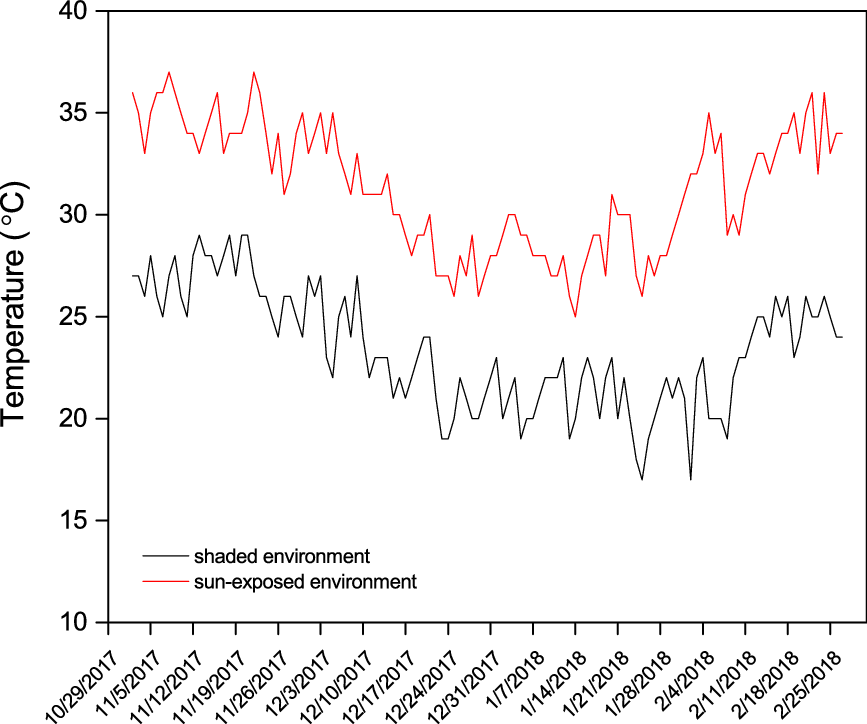
The temperature at which seeds matured varied noticeably between shaded and sun-exposed branches. Shaded regions experienced 7–10°C lower temperatures compared with sun-exposed locations throughout the seed maturation period (Figure 1). The temperature remained under 30°C for seeds matured in the shaded region of the trees (Figure 1).
Average daily temperatures of Albizia julibrissin seed pods maturing on shaded and sun-exposed branches in the Annaikati Hills recorded between 2 November 2017 and 28 February 2018.

Changes in seeds observed during mimicking dispersal to a new environment
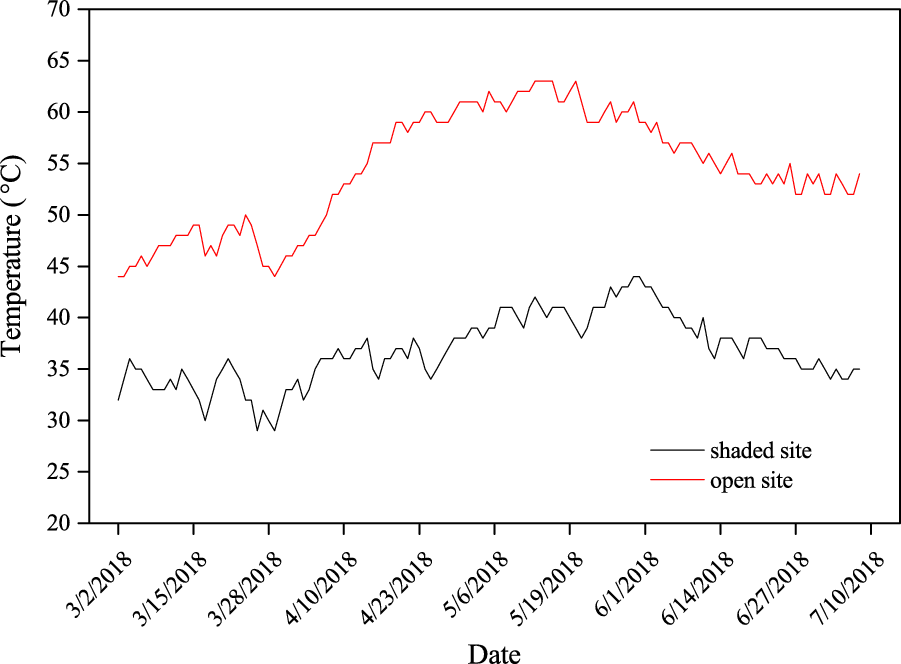
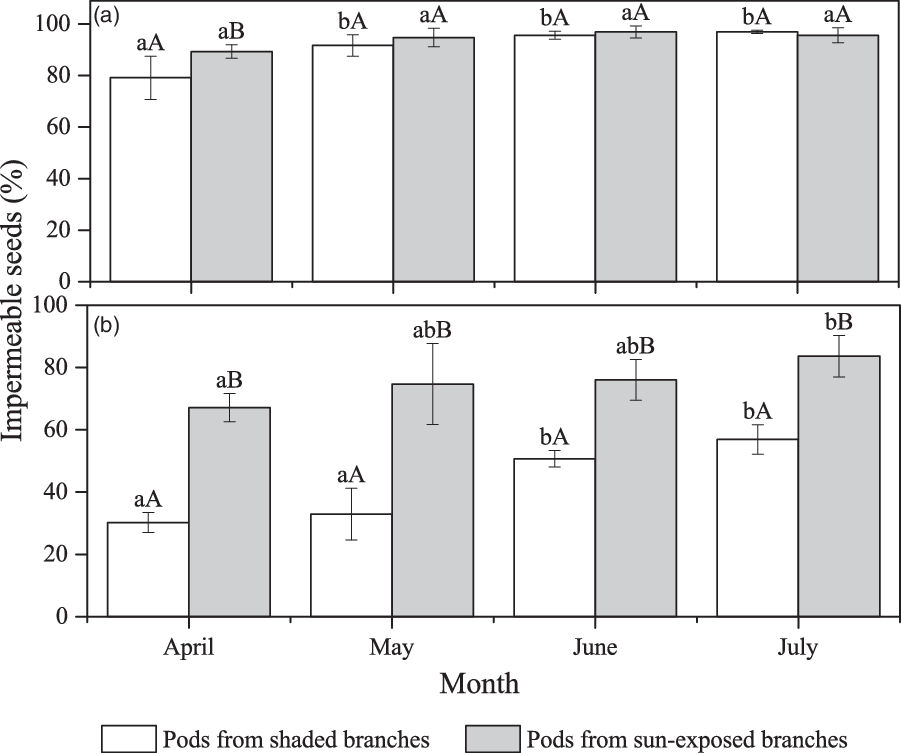
Pods showed significant variation in the proportion of impermeable seeds depending on the location in which they underwent maturation. When buried in the soil at two different dispersal sites, i.e. shade and exposed sites which differ in their temperature range (Figure 2), pods collected from sun-exposed branches and buried at the open site increased their proportion of impermeable seeds over time (F(3,16) = 13.98, P <0.05; Figure 3). The opposite trend was found for seeds matured in pods in shade and buried at the canopy-covered site (Figure 3). There was a significant interaction between the position of seeds on the plant, burial site and burial duration in determining the development of impermeability (F(3,16) = 9.47, P <0.05). Moisture content of the seeds collected from outer branches and buried in an open site after 4 months was 6.76 ± 0.48%, which was the lowest amongst the groups and thus exhibited a significantly higher proportion of impermeable seeds (Figure 3). In contrast, the moisture content of the seeds collected from shaded branches and buried under canopy cover remained higher throughout the burial period (9.16 ± 0.82% at the end of the fourth month), thereby producing dormancy in only a small proportion of seeds that were dried below threshold levels.
Discussion
Fabaceae is one of the largest families containing numerous species with impermeable seed coats and thereby physical dormancy. Understanding the conditions behind the onset of dormancy during maturation, in addition to the development of secondary dormancy post-dispersal, will advance our knowledge on the ecological importance of PY. Thus, our first objective was to determine whether Albizia julibrissin seeds produced at different locations on the same tree differ in their likelihood of developing impermeability. The occurrence of physical dormancy in seeds of A. julibrissin has been reported by many authors (Geneve et al. Reference Geneve, Baskin, Baskin, Jayasuriya and Gama-Arachchige2018, Gogue & Emino Reference Gogue and Emino1979, Xu & Gu Reference Xu and Gu1985). In the present study, we found that there is a striking relationship between the position of pods on a tree and the number of impermeable seeds that are produced. That is, pods matured in shade developed fewer impermeable seeds compared with those matured on branches that were exposed to direct sunlight (Table 1); a finding that is in agreement with studies conducted on other PY species (see Martinez-Fernandez et al. Reference Martinez-Fernandez, Martinez-Garcia and Garcia2014; Smýkal et al. Reference Smýkal, Vernoud, Blair, Soukup and Thompson2014 and references therein).
We suggest that variation in the development of impermeable seed coats within a single plant crop is a result of the temperatures that seeds experience during maturation. To the best of our knowledge, this is the first study that documents the differences in seed dormancy within a plant explicitly from a maternal environment standpoint. Branches on the outer edges of the trees that were directly exposed to sunlight experienced higher temperatures throughout the maturation drying (Figure 1). In contrast, the branches which were shaded by the leaf canopy experienced ~8–10°C lower temperatures. The moisture content of the seeds from pods matured under shaded or sun-exposed branches were 7 and 11%, respectively, suggesting that the difference in temperature between branch types resulted in different levels of drying and thereby to different proportions of impermeable seeds. Our unpublished results indicate that the critical moisture content for A. julibrissin, below which seeds become impermeable, is ~7.4–8.1% on a fresh weight basis. Clearly, pods matured in shade had higher moisture content and the standard deviation of 3.3% indicates that seed-to-seed variation might exist with some seeds dried to critical levels, thus dormant and failed to imbibe water, whereas others are still above this critical range, therefore permeable to water and non-dormant. This observation is in line with previous studies such as Hay et al. (Reference Hay, Smith, Ellis and Butler2010), who found that variation in the number of impermeable seeds produced by Trifolium ambiguum plants was strongly associated with moisture content.
It has been suggested that temperature, rainfall and relative humidity may all influence the number of impermeable seeds produced by plants (Barrett-Lennard & Gladstones Reference Barrett-Lennard and Gladstones1964, Corner Reference Corner1951, Hopkins et al. Reference Hopkins, Silva, Pagan and Villafane1947, Tozer & Ooi Reference Tozer and Ooi2014). We did not measure the relative humidity of the maturation environment, however, this should be investigated further in future studies. Rainfall data available at a meteorological centre located about 20 km away from the study site (Tamil Nadu Agricultural University, Coimbatore) indicate that on days when rain fell, temperature at the study site was reduced and relative humidity increased. Considering this, all three factors may act together, rather than separately, in their effect on the development of maturing seeds. Further work is needed to disentangle the effects of different environmental variables.
To further our understanding on seed persistence, naturally dispersed pods were placed on soil surfaces at two sites, an open site with the soil surface exposed to direct sunlight, and a canopy-covered site where sunlight does not penetrate. Prior studies have demonstrated that temperature and solar radiation on the soil surface vary substantially between open and canopy-covered sites (Jaganathan & Liu Reference Jaganathan and Liu2014 a; Suzaki et al. Reference Suzaki, Kume and Ino2005). In accordance with this finding, we found that soil temperatures at our open site remained high before the beginning of the rainy season in July, while temperatures under canopy cover were comparatively low (Figure 2). This difference in temperature post-dispersal could induce secondary dormancy in seeds that have not yet germinated. Given the fact that germination of many (non-dormant) seeds is delayed until the rainy season, i.e. June–August (Jaganathan & Liu Reference Jaganathan and Liu2014 b, Jaganathan et al. Reference Jaganathan, Wu, Han and Liu2017 b, Reference Jaganathan2018), there is an increased chance for the non-dormant seeds developed both on sun-exposed and shaded branches to undergo secondary dispersal and land on open sites. As a result, the temperature in the open sites could dry the seeds and trigger onset of dormancy in the seeds that were shed in a non-dormant state. These dormant seeds might enter soil seed banks and persist for many years, thereby spreading the chance of germination to later years. The importance of secondary dispersal in the onset of PY requires further study.
Average daily temperatures experienced by pods buried in shaded and open post-dispersal sites recorded between 3 March and 8 July 2018.

To date, most studies have focused on the development of seed impermeability in plants from different locales with contrasting climates and how their persistence ability differs (Jaganathan Reference Jaganathan2018, Michael et al. Reference Michael, Steadman and Plummer2006, Norman et al. Reference Norman, Cocks and Galwey2002, Taylor Reference Taylor1996). However, our results suggest that the environmental conditions experienced by the seeds during maturation on the mother plant, and the post-dispersal environment, determine seed persistence in the soil via the induction of physical dormancy. Seeds from pods matured on branches exposed to direct sunlight had not only a higher proportion of impermeable seeds at the time of maturity but also when buried both in open and shaded post-dispersal sites; although, the shaded post-dispersal site had fewer impermeable seeds after burial than the open site (compare Table 1 and Figure 3). This is in contrast with seeds matured on shaded branches and subsequently buried in the shaded site, where only 58% of seeds became impermeable after 4 months compared with 24% at the point of dispersal. Quinlivan (Reference Quinlivan1965) similarly observed that Trifolium subterraneum L. seeds become dormant after persisting in the soil. Likewise, seeds of Lupinus varius develop dormancy within just a few days of dispersal into the soil, which is presumably due to the reduction in moisture content below the threshold required to induce dormancy (Quinlivan Reference Quinlivan1967). The reduction of moisture content in seeds buried at both open and shaded dispersal sites supports the notion that seed persistence in the soil can dry them below threshold levels required to induce dormancy. More complementary studies involving mimicking the conditions in laboratory and subjecting the seeds to various natural environmental conditions will shed more light on this critical subject.
Percentage of impermeable Albizia julibrissin seeds collected from pods matured under shade and sun-exposed branches and buried at (a) open site and (b) canopy-covered site for 4 months before the germination season. Seeds were retrieved and tested for permeability every month (n = 75 × 3 replicates). Different lower-case letters indicate a significant difference between months, whereas different upper-case letters indicate a significant difference between branch types.

In conclusion, we show that the proportion of impermeable seeds produced by Albizia julibrissin varies significantly between branches and that this difference is due to the difference in temperature experienced by sun-exposed and shaded branches during the maturation period. Further, seeds reach different microsites following dispersal, the climate of which will determine whether the seed enters dormancy or remains permeable and germinates in the rainy season. Further studies investigating the germination ecology of PY species are needed to better understand the importance of this phenomenon.
Acknowledgements
Funding support for this and other long-term work was provided by the National Science Foundation of China (NSFC) (grant number 31750110474) and post-doctoral funding by the Shanghai government (grant number 2016M601620). We are thankful for the help of several researchers during fieldwork. There is no conflict of interest to declare.