Introduction
Sugarcane (Saccharum spp., 2n = 100–130) belongs to the Poaceae family and to the subtribe Saccharinae (Daniels and Roach, Reference Daniels, Roach and Heinz1987), which comprises the ‘Saccharum complex’, a subset of closely related genera (Erianthus, Miscanthus, Narenga, Saccharum and Sclerostachya) that has contributed to the cultivated sugarcane species’ genetic background (Mukherjee, Reference Mukherjee1950, Reference Mukherjee1957). The Saccharum genus itself includes two wild species, Saccharum spontaneum L. and S. robustum Brandes & Jesw. ex Grassl and three groups of early cultivated species, S. officinarum L., S. barberi Jeswiet and S. sinense Roxb. (Daniels and Roach, Reference Daniels, Roach and Heinz1987; Sreenivasan, Reference Sreenivasan and Heinz1987). For centuries, naturally occurring sugarcane genotypes of the species S. officinarum (2n = 80), or ‘noble canes’, have been collected from its centre of origin (Papua New Guinea) and exploited industrially (Stevenson, Reference Stevenson1965). The indigenous sugarcanes of North India (S. barberi) and China (S. sinense), considered as natural hybrids between nobles and wild canes, were cultivated in those countries from prehistoric times (Daniels and Roach, Reference Daniels, Roach and Heinz1987). Most of the sugarcane crop wild relatives (CWRs) are regarded as highly fibrous plants with significant geographic distributions and capable to survive a wide range of abiotic stresses, including droughts, floods, saline conditions and freezing temperatures (Mukherjee, Reference Mukherjee1950).
Improvement of sugarcane through hybridization began in 1888 and the use of CWR started in the early 20th century as an introgression breeding process called ‘nobilization’ (Bremer, Reference Bremer1961). The early introgression activities resulted in a few disease resistant ‘wonder canes’ with spectacular increases in cane and sugar yields, improved ratooning ability and adaptability to various abiotic stresses (Roach, Reference Roach1972). Altogether, it is estimated that 19 S. officinarum clones, a few S. spontaneum clones and one S. barberi clone were involved in those inter-specific crosses (Arceneaux, Reference Arceneaux1967). Those wonder canes have formed the genetic foundation of modern sugarcane varieties, which are grouped within S. officinarum.
The achievements with introgression breeding in recent decades has not been clearly established and, time and limited success have clearly acted to reduce the level of resources devoted to the activity in most sugarcane breeding programmes (Wang et al., Reference Wang, Jackson, Lu, Fan, Foreman, Chen, Deng, Fu, Ma and Aitken2008). Nowadays a new sugarcane genotype paradigm is emerging, focusing on the fibre yield potential of the crop for bioenergy production. Existing sugarcane crop is recognized as a dedicated bioenergy crop and ‘energy canes’, characterized as varieties containing high fibre and low sucrose (Chong and O'Shea, Reference Chong and O'Shea2012), are expected to ensure two- to three-fold gain in total aboveground biomass productivity (Giamalva et al., Reference Giamalva, Clark and Stein1985; Bischoff et al., Reference Bischoff, Gravois, Reagan and Hawkins2008). High fibre, vigour and biomass are known major components of hybrids having S. spontaneum as genitors, thereby confirming the interest among breeders in exploiting these wild species (Matsuoka et al., Reference Matsuoka, Kennedy, Santos, Tomazela and Rubio2014). Successful hybridization with related genera, mainly Erianthus, is also a major research thrust among contemporary sugarcane scientists (Shen et al., Reference Shen, Deng, Li, Yang and Jiang2014; Gao et al., Reference Gao, Liu, Zhang, Zhou, Liao, Duan and Zhang2015). Other studies in more temperate countries involve the creation of ‘Miscanes’ between sugarcane and Miscanthus species (Jessup, Reference Jessup2009; Głowacka et al., Reference Głowacka, Ahmed, Sharma, Abbott, Comstock, Long and Sacks2016) to develop frost resistant energy canes.
Sugarcane was introduced in Mauritius in 1639 and noble canes were cultivated to around 1950s. Sugarcane hybrids have become the dominant varieties, with more than 90% of agricultural land in 1970s and the sole major cash crop of the island for decades. The history of exchange and utilization of sugarcane germplasm in Mauritius dates back to the 17th century. By the end of 19th century, it was doubtful that any country in the world had a wider and more representative collection of sugarcane varieties than Mauritius (Stevenson, Reference Stevenson1965). The sugarcane germplasm collection has been preserved ex situ and was enlarged with time. Breeding of sugarcane in the island started in 1891. Introgression breeding, generally constituting 10% of resources devoted to the local sugarcane breeding programme in the past decades, was initiated in 1930s and has been maintained till today, with the main objective of broadening the genetic base. In recent years, the objective has also been geared towards developing high fibre energy canes (Ramdoyal and Badaloo, Reference Ramdoyal and Badaloo2007).
Although the local introgression breeding has been an ongoing process for nearly a century, the contribution of specific sugarcane CWR and their effectiveness in the generation of recent improved varieties have not been investigated. The objectives of this study were to determine the contribution of specific clones of wild relatives of sugarcane and their derived early generation hybrids in the creation of improved varieties and the prevalence of specific wonder canes involved in the local breeding programme.
Materials and methods
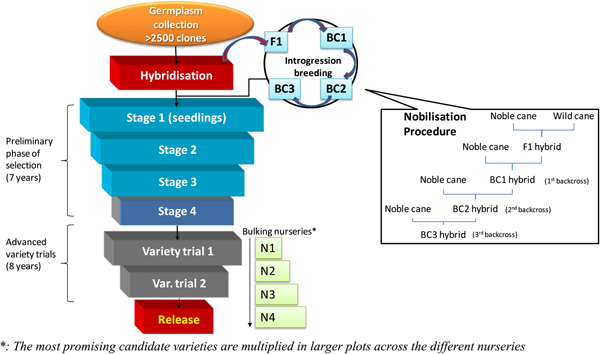
The involvement of specific sugarcane CWR in the Crop Improvement Programme of the Mauritius Sugarcane Industry Research Institute (MSIRI) can be gauged by assessing the number of inter-specific derived progenies reaching the advanced variety trials and nursery stages. The breeding method used in Mauritius spans 12–16 years and comprises a hybridization process and six selection stages from the first sowing of seedlings (derived from seeds) to the release of the best candidate variety (Fig. 1). The introgression breeding programme starts by crossing sugarcane CWR with noble canes. The F1 hybrids are backcrossed (three generations, i.e. BC1, BC2 and BC3) to noble canes to retain sufficiently high sugar content and to dilute the negative side-effects of wild canes. Desirable characteristics sought from noble canes are high sucrose, thick cane diameter, easy trashing, low flowering and attractive appearance. Stalk height, cane density per unit area that contribute to high cane yield as well as adaptation to diverse environments, good ratooning ability and resistance to pest and diseases are the major traits of interest from the wild canes. Generally, two to three successive backcrosses are sufficient to attain acceptable levels of sucrose content. The whole process requires a minimum of 4 additional years to generate BC3 clones (Fig. 1). In the past few decades, noble canes have been replaced by sucrose rich commercial varieties.
Sugarcane breeding, introgression procedure and selection stages at MSIRI.

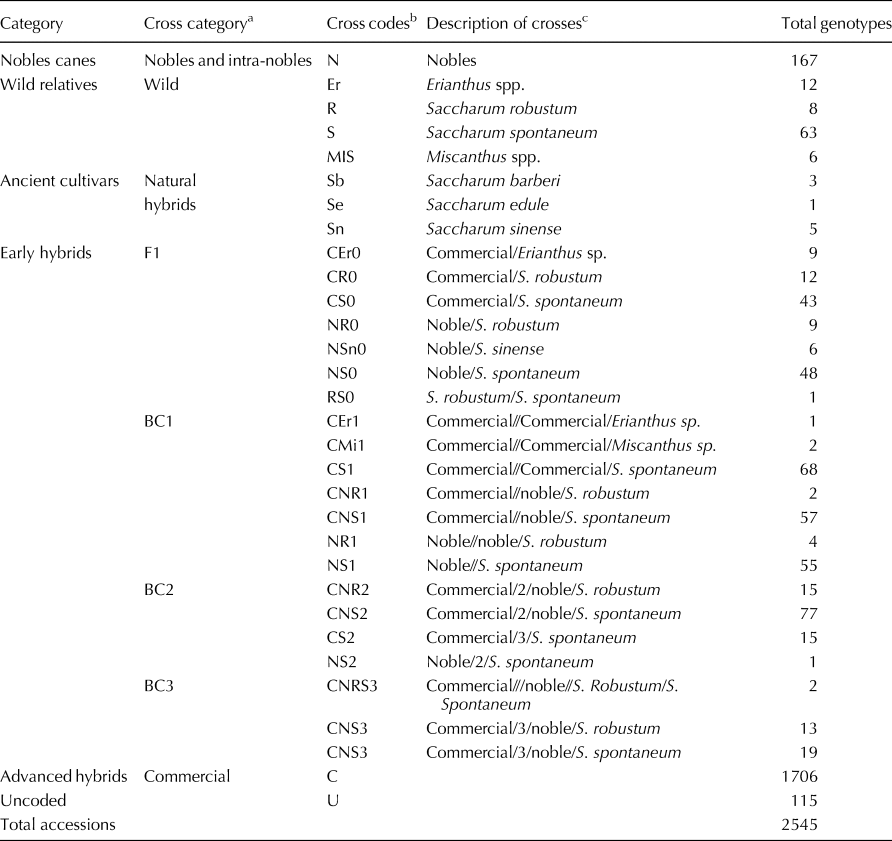
By end 2017, the MSIRI had a germplasm collection of 2545 accessions of diverse origin and comprised 167 noble and intra-noble (progenies derived from crosses among noble canes) varieties, 89 sugarcane wild relatives, nine ancient cultivars of S. barberi, S. sinense and S. edule species, 128 F1, 129 BC1, 108 BC2, 34 BC3 clones and 1706 imported and locally bred commercial type varieties (Table 1). In this study, ‘early generation hybrids’ are referred to the F1, BC1, BC2 and BC3 clones, while higher order crosses (>BC3) and crosses among commercial type varieties with unspecified cross category are termed ‘advanced generation hybrids’ with code ‘C’.
The MSIRI germplasm collection, 2017

a F1: first cross involving a wild relative; BC1, BC2 and BC3: first, second and third successive backcrosses of inter-specific progenies with noble canes or with high sucrose commercial varieties.
b C = complex hybrids; U = codes not available.
c Crosses: / = first cross; // = second cross with progenies of first cross; /n/ = nth cross with progenies of previous cross.
Each clone in the local collection is coded with respect to its nobilization status (cross category – F1, BC1, BC2, etc.) and within each cross category, to the species involved (cross code: CS0, CNS1, CNS2, etc.) to help in decision making during crossing. As an example, within a BC1 category, a cross code of CNS1 means that, reading from right to left, the number represents the backcross generation, a S. spontaneum (S) clone was first crossed with a noble cane (N) and the progeny was further backcrossed with a commercial variety (C) (see Table 1 for further details). Around 50,000 to 100,000 seedlings (each representing a potential variety) produced annually from different genetic combinations are evaluated in the field and the best ones are propagated through stem cuttings in successive selection stages (Fig. 1). Broadly, a 10–15% selection rate is adopted at each selection stage. The screening process comprises four preliminary selection stages (7 years evaluation) and two ‘advanced stage’ final phase variety trials (8 years evaluation), where the most promising genotypes are evaluated in several locations and four crop years (plant cane and three ratoons). The germplasm collection, hybridization and final phase variety trials data, stored electronically in specific databases at the MSIRI since 1970, were retrieved for this study.
In parallel with the final phase of selection, the MSIRI has four nursery stages (N1–N4) where the most promising varieties are progressively propagated in larger land areas so that when a new variety is released to the planting community, there is enough healthy and good quality planting material for rapid industrial exploitation (Fig. 1). Annually around 30–40 genotypes enter the advanced stages of selection and the first nursery (N1), and only a few best candidates reach the final nursery stage (N4). The latter candidates are assessed thoroughly by a ‘Cane Release Committee’ and one or two may be approved for commercial exploitation as new varieties. The information on the elite genotypes reaching the different nursery stages since 1970s were also retrieved from specific databases.
All the data-mining process resulted in the creation of a new database that included the clones evaluated at advanced variety trials and nursery stages since 1970, their cross codes, their cross categories (Table 1) and the parents involved during hybridization. In the endeavour to retrace the contribution of specific CWR in the local breeding programme, pedigrees of elite varieties were constructed back to the fifth generation based on information available on each clone. The parentages of the genotypes were retraceable for both parents in ‘bi-parental’ crosses, where one female parent and one male parent are used in individual crosses. In ‘polycrosses’, where several male varieties (2–10) are concurrently used as pollen donors to fertilize one female inflorescence, a strategy common in sugarcane breeding programmes to ensure increased seed setting, only the female parent could be retraced.
Results
Genealogy of inter-specific derived elite genotypes
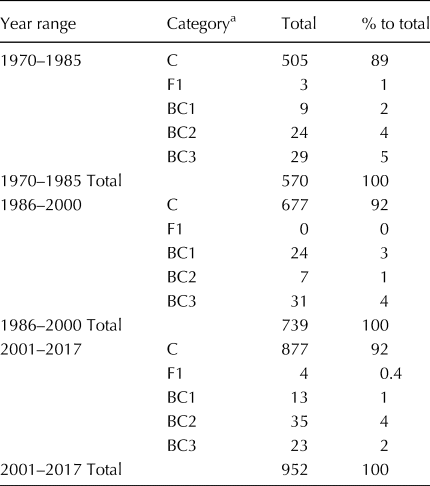
In the period of 1970–2017, a total of 2261 clones were evaluated at the advanced variety trial selection stages (Table 2). The majority of these clones, i.e. 91%, were obtained from crosses involving commercial type complex hybrids (coded C). The remaining 9% (202 clones) were progenies derived from different nobilized groups. Of these, 83 clones were of the BC3 type, followed by 66 BC2, 46 BC1 and seven F1 categories.
Category of clones tested in the final phase trials between 1970 and 2017

aF1: first cross involving a wild relative; BC1, BC2 and BC3: first, second and third successive backcrosses of inter-specific progenies with noble canes or with high sucrose commercial varieties; C: complex hybrids.
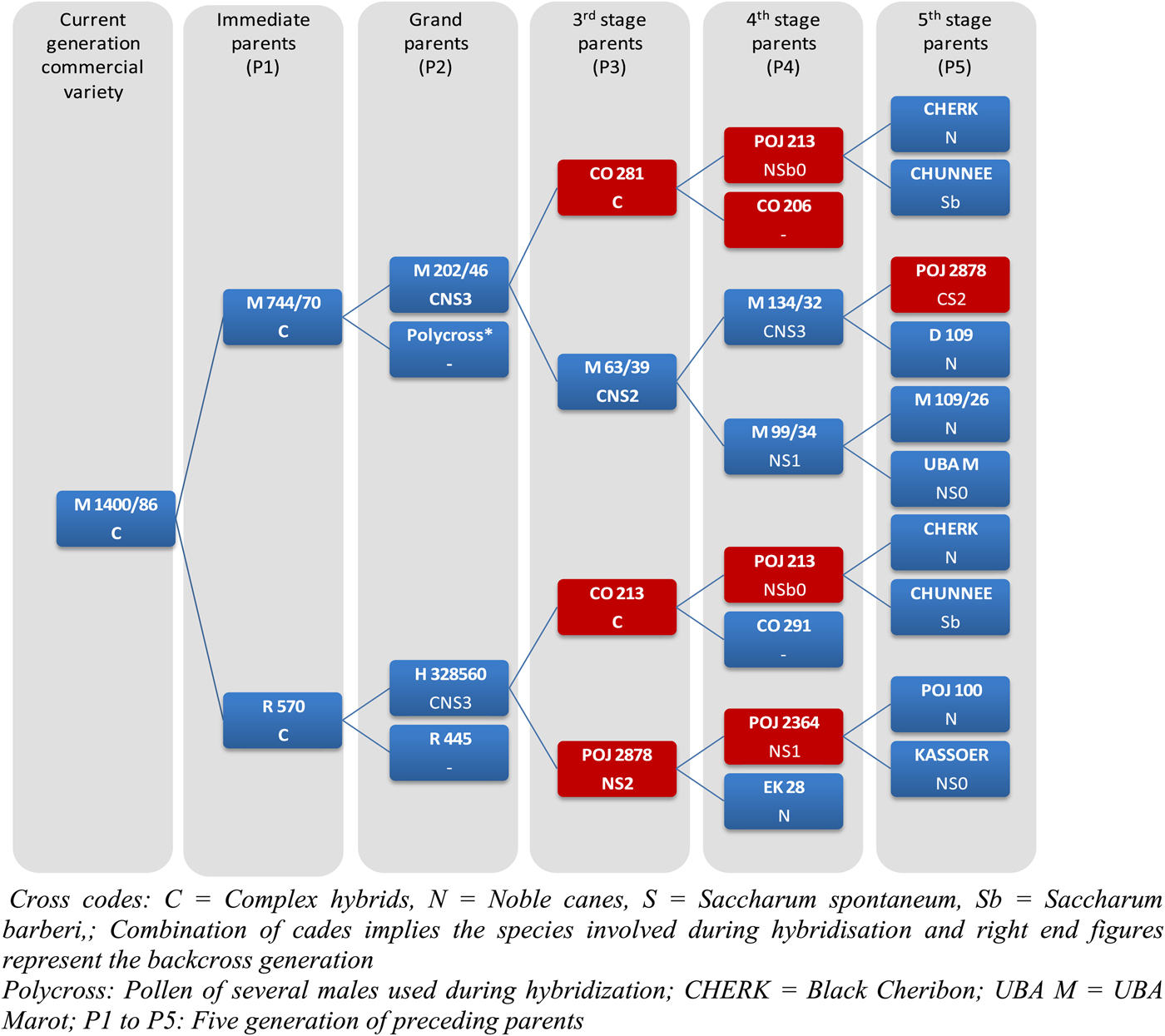
The use of sugarcane CWR in the generation of elite genotypes requires a closer analysis of the corresponding parents and grandparents. Figure 2 illustrates a pedigree of a widely cultivated commercial variety M 1400/86 as well as the abbreviated cross codes of the different clones involved. Each generation of parent is designated by P1 to P5, where P1 represents the most recent parents and P5 the parents of five preceding generations. The most recent parents, P1, of M 1400/86 are M 744/70 and R 570, both commercial type hybrids released in the past for industrial exploitation. The wonder canes (POJ 2878, Co 281 and Co 213) were used as parents in the third preceding generation (P3 parents) and downwards. The ancient sugarcane cultivars and nobles (Chunnee, EK 28, Cheribon, D 109, POJ 100) and Kassoer (a natural hybrid) were used as parents in the fifth preceding generation. As such, this five-generation-pedigree represents a century of breeding activities that began in early 20th century and not all crosses were made in Mauritius. Clones with prefix ‘M’ were bred in Mauritius, ‘R’ in Reunion Island, ‘H’ in Hawaii, ‘POJ’ in Java (Indonesia) and ‘Co’ in Coimbatore, India.
Pedigree with cross codes of commercial variety, M 1400/86. Wonder canes in red boxes.

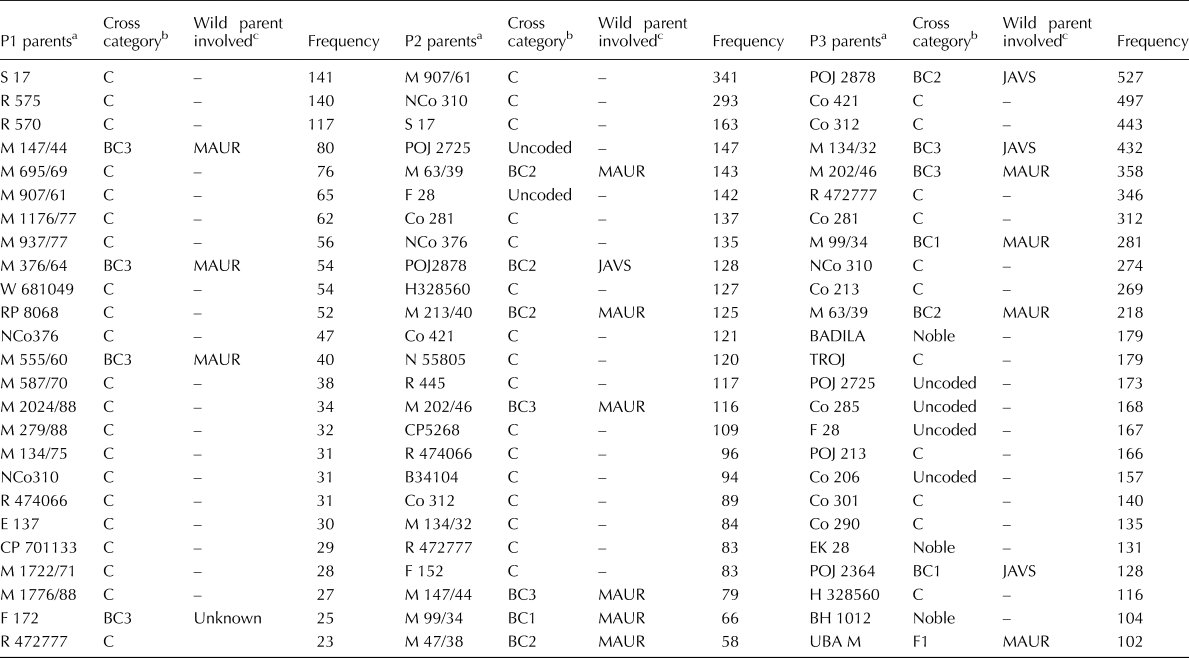
Table 3 summarizes the 25 highest frequencies of clones observed as parents of elite genotypes that reached the final stages of the MSIRI selection programme since 1970. The first three generations (i.e. P1–P3) of parents are included. Among the P1 parents, a high proportion of complex commercial type hybrids are predominant. Commercial varieties S 17, R 575 and R 570 appear with the highest frequencies. A few early hybrid clones (M 147/44, M 376/64, M 555/60, M 2077/78 and F 172) also generated progenies evaluated at the advanced selection stages. Among the grandparents (P2), commercial-type advanced hybrids M 907/61, NCo 310 and S 17 are the most prevalent. The wonder canes (POJ 2725, POJ 2878, Co 281, Co 312 and Co 421) make their appearances with high frequencies. The great grandparents (P3) include a high proportion of early generation inter-specific hybrids. The wonder canes, POJ 2878, Co 421 and Co 312, are top ranking followed by M 134/32 and M 202/46, two locally bred BC3 clones. Other parents produced locally and observed with relatively high frequencies include M 99/34 (BC1), M 63/39 (BC2) and UBA Marot (UBA M) (F1).
The 25 highest frequencies of parents of elite genotypes that reached the final stage of the selection programme since 1970 for three breeding generations

a P1: parents, P2: grandparents; P3: great grandparents.
b BC1, BC2 and BC3: first, second and third successive backcrosses of inter-specific progenies with noble canes or with high sucrose commercial varieties; C = complex hybrids.
c JAVS and MAUR: two S. spontaneum clones from JAVA and Mauritius respectively involved in the generation of two natural hybrids (Kassoer and UBA Marot) with S. officinarum.
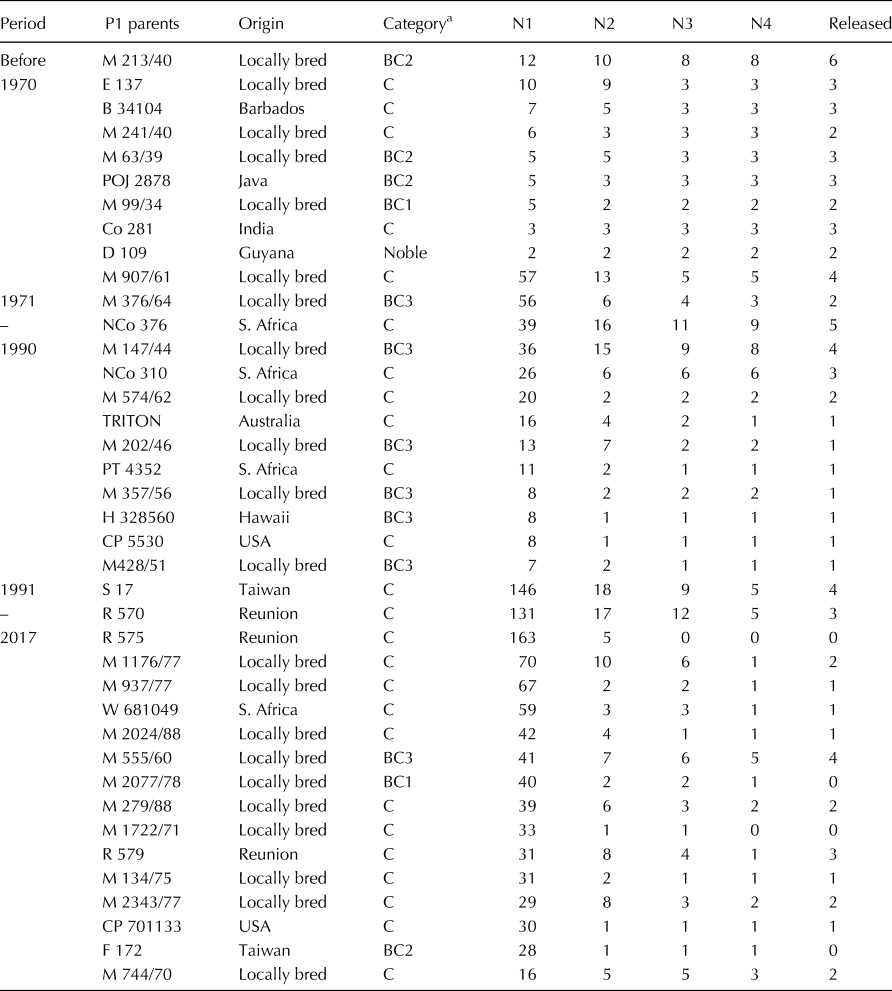
Table 4 highlights the frequency of parents of elite varieties advanced across the N1–N4 nurseries. The pedigree information allowed retracing parents involved in crosses earlier than 1970s. Among the crosses made before the 1970s, leading to varieties released for commercial exploitation, mostly inter-specific derived parents were observed with high frequencies. Three BC2 clones, M 213/40, M 63/39 and POJ 2878, produced 22 clones that attained the N1 nurseries and 12 were exploited industrially. One BC1 parent, M 99/34, is observed among five progenies, of which two, M 31/45 and M 351/57, were commercialized. In the 1970s to 1990, commercial type complex hybrids and BC3 clones were observed as P1 parents. The BC3 category generated 128 clones that were tested at variety trial stage and 10 were released for industrial exploitation.
Highest frequency of P1 parent varieties of elite clones in nurseries across time

a BC1, BC2 and BC3: first, second and third successive backcrosses of inter-specific progenies with noble canes or with high sucrose commercial varieties; C = complex hybrids.
N1 to N4: nurseries for bulking of elite genotypes.
From 1990 to date, mostly commercial type hybrids are observed among parents. One BC3 clone, M 555/60, generated 41 progenies reaching the nurseries and four were released to farmers. One BC2 clone, F 172, is found among the parents of 28 progenies in the N1 nurseries and merely one, M 1222/00, attained the N4 nurseries in 2015. One BC1 clone, M 2077/78, is involved in the generation of 40 BC2 clones attaining the nurseries. Of these, one genotype, M 1954/91, which possesses resistance to all major sugarcane diseases that occur on the island, recently attained the last nursery N4 stage. Whether such resistances come from the CWR, however, need further genetic analyses involving all the parents from the initial inter-specific cross to the third generation BC2 progeny. Such a study has not been done yet.
Contribution of specific early hybrids and sugarcane wild relatives as breeding parents
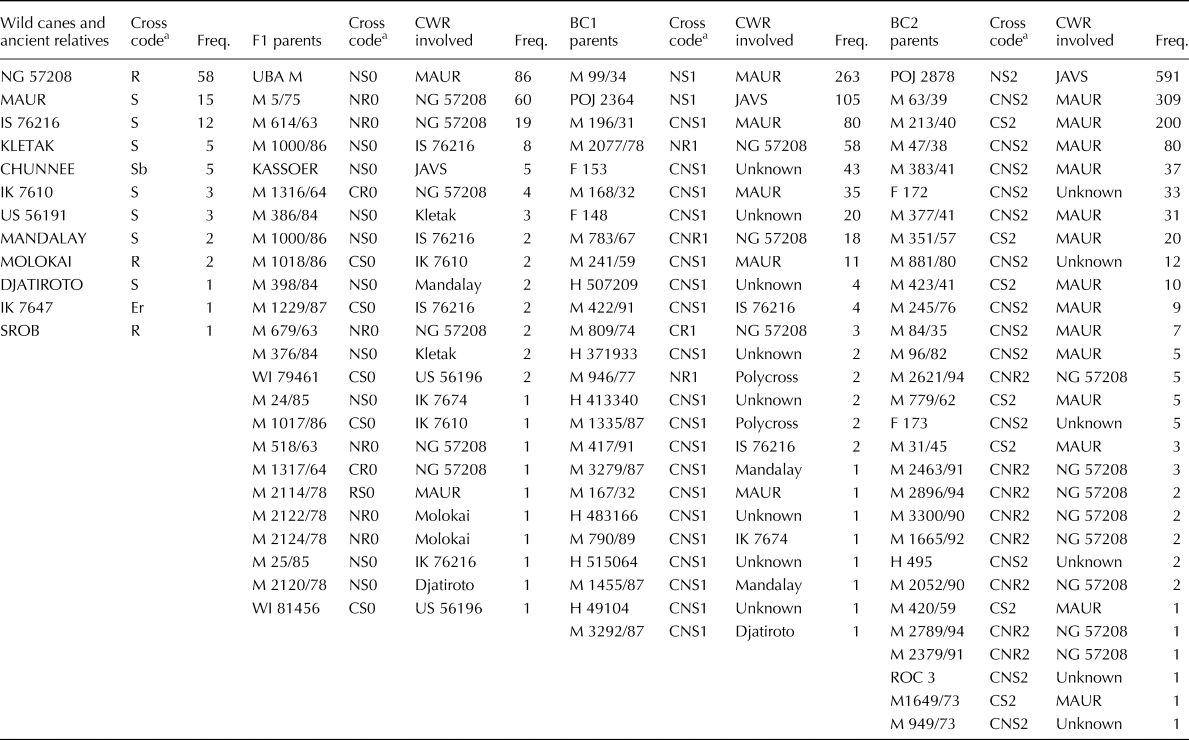
This section and Table 5 refer to the frequency of wild clones and early hybrids (F1, BC1 and BC2) among the last three generations of parents of genotypes reaching the final phase of selection. Among the F1 parents, four locally bred clones, namely UBA M (86 progenies), M 5/75 (60 progenies), M 614/63 (19 progenies) and M 1000/86 (8 progenies) appear with high frequencies. UBA M and M 1000/86 have S. spontaneum wild canes MAUR and IS 76216, respectively, among the parents while the other two, M 5/75 and M 614/63, are progenies involving a S. robustum clone (NG 57208).
Frequency of wild and early nobilized clones found among three generations of parents of varieties reaching final phase trials (1970−2017)

a Er = Erianthus arundinaceous, N = noble canes, R = S. robustum, S = S. spontaneum, Sb = S. barberi, C = complex hybrids. Combination of codes implies the species involved during hybridization and right end figures represent the backcross generation.
One inter-specific variety, M 99/34 (NS1), produced in 1934 from a S. spontaneum grandparent (MAUR), appears with the highest frequency among the BC1 parents. It is involved in the creation of 263 high yielding clones, of which 23 have been released for commercial exploitation (representing 34% of the total locally bred and released by the MSIRI). Its success as a good breeding parent is associated with the generation of two BC2 clones, M 63/39 and M 213/40 and two BC3 varieties, M 202/46 and M 147/44, that have been involved in the production of good offspring worth testing at the final phase of selection.
The majority of BC2 progenies that reached the final variety trials since 1970 had S. spontaneum clones at their origin. Wonder cane POJ 2878 appears with the highest frequency. It is followed by a series of Mauritian bred BC2 parents that were mostly produced before the 1950s and involved the wild cane MAUR. A few foreign BC2 parents (F 172, F 173, H 495 and ROC 3) appear with lower frequencies. One S. robustum wild cane, NG 57208, is involved in the generation of few BC2 parents in 1990s and whose progenies reached the final selection stages in 2000s. BC3 parents have been ignored as their progenies are considered as advanced generation commercial type hybrids.
Among the sugarcane ancestors, one S. barberi clone (variety ‘Chunnee’), one S. robustum (NG 57208) and three S. spontaneum (MAUR, IS 76216 and Kletak) clones appear with high frequencies (⩾5), followed by a few others with lower incidences and include an Erianthus arundinaceous clone (IK 7647). Their involvements in the sugarcane breeding programme in Mauritius are retraced below:
S. barberi contribution
Variety ‘Chunnee’ (origin: India), belonging to the S. barberi species group, was involved in the early 1890s in the generation of POJ 213 in Java that, in turn, gave rise to the wonder canes Co 281 and Co 213 in India. Crosses with Co 281 in Mauritius led to the production of several genotypes of which five reached the final selection stages and two attained cultivar status (M 147/44 and M 202/46) in the 1940s and 1950s.
S. robustum contribution
The robustum clone NG 57208 (origin: New Guinea) was the progenitor of one genotype in Mauritius in 1975, M 5/75 (F1), that was further backcrossed with a noble cane. One of the corresponding offspring, M 2077/78 (BC1), produced in 1978, is involved in the generation of 58 clones that attained the final variety trial stage in the last three decades. Another robustum clone, Molokai 5843 (origin: Hawaii), recently managed to have two BC1 progenies (M 467/84 and M 816/86) evaluated at the variety trial stages. For diverse reasons, but mainly because of their unsatisfactory agronomic performances, none of the robustum derived clones in Mauritius have attained cultivar status so far.
S. spontaneum contribution
Wild spontaneum clone, MAUR (origin: Mauritius, but may not be endemic), was the progenitor of UBA M (a natural hybrid identified in Mauritius) that was involved in the generation of 13 elite BC2 genotypes evaluated at the final phase of selection. Three of them, M 31/45, M 351/57 and M 96/82, were exploited industrially as well. Extending the pedigree to BC3 and BC4 cross categories, MAUR and UBA M are retraceable in 27 out of 59 varieties (46%) bred in Mauritius and exploited commercially since 1950s. UBA M was mostly recognized and used in the past as a parent with good breeding value and to convey resistance to a major bacterial pathogen, Xanthomonas campestris pv. vasculorum (Cobb.), causing gumming disease in sugarcane (Stevenson, Reference Stevenson1965). Today, the disease in Mauritius has become of historic interest only and efforts are still being maintained to select varieties resistant to the pathogen.
Another spontaneum clone Kletak (origin: Indonesia) was crossed locally with a noble cane in the early 1980s. Two of the F1 progenies, M 376/84 and M 386/84, were further backcrossed with commercial varieties, which led to the creation of five BC1 genotypes (M 1303/87, M 1384/87, M 1395/87, M 1748/88 and M 3305/87) that reached the advanced selection stages in 2009. They were essentially evaluated for their biomass potential as energy canes. One high fibre clone, M 1395/87, has given good aboveground biomass yield with good ratooning ability in the cold high rainfall areas of the island. It is also resistant to the well-known fungal pathogen Mycovellosiella koepkei (Kruger) causing ‘yellow spot’ disease in the region.
The spontaneum clone IS 76216 (origin: Indonesia) was crossed with a noble cane in the early 1980s and produced an important F1 clone, M 1000/86. Backcrossing of M 1000/86 gave rise to M 422/91 (BC1). These two hybrid clones have been involved in the generation of eight genotypes that have reached the advanced variety trials since year 2000. One high yielding variety, M 1002/02, released commercially in 2016, is the latest example of the successful use of CWR of sugarcane in Mauritius. In general, M 1002/02 is a high cane and sugar yielder with good ratooning ability and is resistant to diseases of economic importance that prevail in its recommended zone of cultivation.
The contribution of two other spontaneum clones, IK 7610 (origin: Indonesia-Kalimantan) and Mandalay (origin: Indonesia), in the MSIRI sugarcane improvement programme are relatively recent. In 2007, IK 7610 was involved in the generation of three BC1 clones (M 196/07, M 202/07 and M 339/07) that attained the final phase trials in 2014. M 196/07 is showing very good potential as an energy cane with two-fold gain in fibre yield (a contribution of the wild spontaneum clone) and is resistant to the major sugarcane diseases that prevail in the island. Mandalay produced two BC2 clones, M 1815/00 and M 640/04 that entered the final phase trials in 2008 and 2011, respectively, but were eventually discarded because of their relatively poor agronomic performance.
Genus Erianthus contribution
Several crosses were attempted in the late 1990s between commercial sugarcane varieties and E. arundinaceous clone IK 7647 (origin: Indonesia-Kalimantan). One F1 progeny, M 1156/00, was outstanding as a very high fibre energy cane at early selection stages and entered the final phase trials in late 2000s. However, its poor germinating buds (most probably transmitted from the wild cane parent) need to be circumvented through tissue-cultured plantlets, and requires further investigations for successful propagation and exploitation.
Discussion
As stated earlier, the objective of introgression breeding in the recent past was to broaden the genetic base of the crop so as to increase the chances of creating new high cane and sugar yielding varieties with good ratooning ability, resistant to major pest and diseases and adapted to the different agro-climatic zones of the island. In consequence, the focus with wild canes was not on individual traits of interest but a collection of traits that altogether would contribute towards developing more productive and resilient varieties in order to meet the challenges of the industry. The first nobilization work in Mauritius that started in 1931 resulted in the creation of the well-known BC3 hybrid, M 134/32, from a cross between the BC2 wonder cane, POJ 2878, and a noble cane, D 109. Within 10 years, M 134/32 was the major estate variety of the island, serving a wide range of environmental conditions and almost to the exclusion of all other varieties. UBA M (UBA Marot), a natural local hybrid between the wild cane MAUR and a noble cane M 131/00 (Stevenson, Reference Stevenson1965), was used to produce M 147/44, M 202/46 and other disease resistant commercial varieties, which later replaced much of the acreage under M 134/32. Since 1970s, a multitude of early and advanced generation hybrids have been exploited in different regions of the island. Among the early generation high cane yielding hybrids that were released for commercial exploitation, M 555/60 (BC3), M 96/82 (BC2) and M 1246/84 (BC4) showed adaptation to the dry low-lands while M 3035/66 (BC4) was widely exploited in the 1990s in the cold humid uplands. The most recently released variety M 1002/02 (BC2) is showing wide adaptation and is expected to play a significant role in the near future with sugar as the main output.
In this study, most of the clones observed as parents with high frequencies are interrelated. Starting from the wild clones to the most advanced commercial hybrids, MAUR (S. spontaneum), UBA M (F1), M 99/34 (BC1), M 63/39 (BC2), M 202/46 (BC3) and M 907/61 (C) (Table 5) are all directly related parents and progenies and were successful in the generation of commercial varieties. Similarly, NG 57208 (S. robustum), M 5/75 (F1) and M 2077/78 (BC1) are related parents and offspring, the latter progeny being highly successful in producing genotypes reaching the final stages of selection. Genetically, the most recent parents attract the greatest attention as they may have accumulated the maximum amount of genes for a particular trait of interest. Legendre and Burner (Reference Legendre and Burner1995) found that first generation hybrids (F1) involving sugarcane wild relatives are best suited for energy cane, pointing out that backcrosses reduced biomass yield components and that the higher the number of backcrosses the more biomass was reduced.
Overall, 12 wild canes, mainly S. spontaneum clones (Table 5), are involved in the generation of elite genotypes worth testing at the final variety trials in the recent decades. Of these, two sugarcane CWR, namely JAVS (progenitor of Kassoer and wonder cane POJ 2878 in Java) and MAUR (progenitor of UBA M in Mauritius), predominate among the ancestors of commercial varieties exploited in Mauritius. Hence, only a small fraction of genetic variability within the sugarcane CWR in Mauritius has contributed to the generation of elite varieties. Similar situations have been noted elsewhere as Matsuoka et al. (Reference Matsuoka, Kennedy, Santos, Tomazela and Rubio2014) reported that with all the variabilities still available in wild species, there are immense possibilities of new potentially useful gene arrangements. In addition, most of the crosses were made in the past with the main objective of maximizing sugar yield. The total dry matter yield of the inter-specific progenies were not investigated for using sugarcane as a dedicated bioenergy crop. Initial studies made since last decade on the biomass potential of early generation hybrids (M 1156/00, M 1395/87, M 196/07) involving new sugarcane CWR (Kletak, IS76216, IK7610, IK 7647) are giving good results in terms of total fibre and biomass yields (Santchurn et al., Reference Santchurn, Ramdoyal, Badaloo and Labuschagne2012, Reference Santchurn, Ramdoyal, Badaloo and Labuschagne2014; Santchurn and Badaloo, Reference Santchurn and Badaloo2017).
The use of sugarcane CWR at the beginning of the last century largely contributed to a green revolution in sugarcane with sugar as the main output. The renewed interest in introgression breeding for bioenergy production should lead to the creation of new types of varieties with higher fibre and aboveground biomass that can be grown under a wider range of environments for increased sugar and bioenergy production. However, sugarcane breeding is a lengthy process and depends largely on how fast potential parents are identified, successful crosses are made and exploitable progenies are selected. It took around 30 years of investigations to produce the POJ varieties (POJ 2878, POJ 2725) forming part of the wonder canes. In contrast, the variety Co 205 that changed the Indian sugarcane industry, was found in the first 40 seedlings from the first deliberate inter-specific cross (Annicchino et al., Reference Annicchino, Ometto, Coury, Jacob, Brunelli, Zillo, Balbo and Neto1987). Constant efforts in increasing the number of sugarcane CWR accessions in local germplasm collections, making a maximum of genetic combinations through hybridization and precisely evaluating the derived progenies for multiple traits remain fundamental for successful breeding for higher biomass energy canes.
In this study, we demonstrated that the MSIRI inter-specific programme has been effective in producing elite varieties in recent decades although only about 10% of resources of the sugarcane breeding programme have been devoted to introgression breeding. New inter-specific derived clones are reaching the last variety trial stages. Like any other test candidate they need to compete with the existing high yielding commercial varieties before being adopted. The newly released variety M 1002/02, a BC2 clone, is a good example of the dedicated effort made in the recent past in the use of sugarcane CWR. In the new context of breeding for high biomass, not only new inter-specific derived clones, but all elite genotypes need to be gauged for their total energy potential in the endeavour to create new varieties with the main output being sugar, fibre or both.
Conclusions
Modern sugarcane varieties are complex hybrids where initial hybridizations with sugarcane wild relatives at the beginning of the 20th century have contributed worldwide to increasing cane and sugar yields, adaptation to diverse environments, stability across ratoons and resistance to major pests and diseases. This study established the status of the use of sugarcane CWR in Mauritius through a retrospective analysis of breeding data at the MSIRI and the number of progenies attaining the most advanced stages of the selection programme in recent decades.
The majority of the genotypes evaluated at the variety trial stages were obtained from crosses involving commercial type parents and 9% were early generation hybrids, mainly BC2 and BC3 cross categories. Genealogy studies confirmed the high prevalence of wonder canes, POJ 2878, POJ 2725, Co 421, Co 312 and Co 281 among the ancestors of Mauritian varieties. A few early generation hybrid clones were released and commercially adopted in the past. The wild sugarcane relatives involved in sugarcane hybridization in Mauritius and creation of progenies reaching the final phase selection trials in the last five decades were mostly S. spontaneum clones, namely MAUR, Kletak, IS 76216, IK 7610 and Mandalay. One S. robustum clone, NG 57208, has been successful in generating elite varieties in recent years. Another robustum clone, Molokai 5843, managed to produce two genotypes that attained the final variety trial stages in the 1990s. One clone, IK 7647, from the genus Erianthus has been able to produce progenies showing high fibre and biomass potentials. Most of these CWR are either grandparents or further away in the pedigree. Their achievements are closely associated with the production of specific hybrid clones that became potential parents exploited judiciously across time.
The very early generation hybrid clones tend to resemble their wild relatives in many aspects. Of particular interest today is their biomass yield through high fibre canes as a feedstock for bioenergy production and other uses. Conscious of the enormous potential that remains untapped from available sugarcane CWR, the MSIRI Crop Improvement Programme is making judicious use of newly developed inter-specific derived parent varieties in generating a set of different types of cane for various end uses in an attempt to meet the objectives and challenges of the industry. With the re-engineering of the Mauritian sugar industry into a sugarcane industry, the opportunities are good to achieve further progress with new crop ideotypes with higher biomass through hybridization with genetically compatible sugarcane CWR.
Acknowledgements
We are thankful to the retired and existing personnel of the MSIRI who were directly or indirectly involved in the trials. We are much grateful to Dr Salem Saumtally and Dr Asha Dookun-Saumtally, Director and Principal Research Manager of MSIRI, respectively, for their constant support, reviews and encouragements to get the research findings published.