The secret ballot was introduced in the Roman assemblies in the second century as a way of ‘lessening the control of the upper classes over the electorate, and enhancing the voters’ effective freedom of choice’.Footnote 1 Reformers cited a similar rationale in pushing for the adoption of the secret ballot in the United States in the second half of the nineteenth century, hoping a secret ballot would reduce bribery and coercion by employers and party officials.Footnote 2 Ballot secrecy is now a common and unquestioned component of virtually all legitimate democratic contests. Indeed, Article 25 of the United Nations’ Civil and Political Covenant lists the secret ballot as a crucial component of a fair electoral process.Footnote 3
In the United States the secret ballot is well established, having been in place for over a century.Footnote 4 Even if the formal process of voting is in fact perfectly secret, however, it does not necessarily follow that the voting decision should be understood as a secret, private act. Whatever the truth is regarding actual ballot secrecy, what is crucial for understanding political behaviour is whether people think their voting decisions are secret. Indeed, when weighed against the vanishingly small chance of casting a ballot that decides an election, if a citizen believes that there is even a very slight chance of his or her choices being disclosed and that this disclosure may have personal repercussions, concerns about secrecy can affect his or her voting behaviour in a way that easily overwhelms his or her own preferences over which candidate should hold office.
We distinguish two forms of ballot secrecy. First, the ballot is psychologically secret when the voter believes that election administration is such that her ballot choices are secret. Strong formal protections notwithstanding, if people do not believe that the confidentiality of their choices is well protected, either because they are ill informed about the voting processFootnote 5 or because they do not believe the institution works properly,Footnote 6 the potential benefits of the secret ballot are undermined. Consequently, choices in the voting booth may reflect not just personal preferences, but also fears about going against the wishes of people who may learn of one's vote choices. Thus, in contrast to the formal legal secrecy protections that may be in place, we refer to whether people believe that their choices are held secret as the psychological secrecy of the ballot.Footnote 7
Secondly, social factors play an important role in the functional secrecy of the ballot. Presidential elections are national events that create conditions where people may feel socially obligated to discuss their vote choices with others. Anticipation of the possibility that one will be expected to reveal one's vote to others may cast a shadow over choices made in the voting booth, opening these choices to the influence of social pressures. Of course, revealing one's vote choice is not compulsory, but in an environment where there is a norm of sharing political views, the freedom to refuse to discuss one's vote may be pointless – failing to disclose your vote may effectively reveal it. Similarly, lying about one's choice or refusing to participate openly in a conversation about the election are always options, but individuals typically experience discomfort when lying or keeping secrets. In situations where that discomfort is anticipated, voting the ‘right’ way is perhaps the easiest way to avoid having to be secretive or deceptive.Footnote 8
It is important to emphasize that our main focus is on the consequences of beliefs regarding ballot secrecy, and that we are not claiming that all discussions about one's vote choice constitute threats to the normative standard of ballot secrecy. Furthermore, some anticipated interactions will not alter behaviour. For example, expectations that one's vote will be revealed to like-minded individuals are unlikely to prompt people to change their choices. Similarly, some people may lie about their vote choices without discomfort and can, therefore, avoid the social consequences of their true choices.Footnote 9 However, in cases where people feel obligated to discuss their choices with those they disagree with, they may change their choices to avoid conflict, rather than vote for the candidate whom they would otherwise prefer. We refer to individuals’ beliefs about whether they will reveal their choices to others as the social secrecy of the ballot.
In this study we report evidence from three data sources. The first and primary data source is a nationally representative internet survey fielded in the fall of 2008 by YouGov/Polimetrix. We asked a series of questions which measure respondents’ perceptions about the extent to which voting administrators keep their vote choices confidential and whether respondents share their voting decisions with others, in particular close friends and family members. These data are supplemented with shorter surveys from a random digit dial (RDD) sample of Michigan registered voters conducted in the spring of 2005 and a nationally representative RDD telephone survey conducted by Princeton Survey Research in the fall of 2010.
Our analysis makes two important contributions to our understanding of ballot secrecy. First, we measure the psychological and social secrecy of the ballot. Our results show that while the formal voting process in the United States is premised on a secret ballot, many people (25 per cent of our sample in our primary data source) do not believe that their ballots are kept secret. Furthermore, the vast majority of respondents (about 73 per cent) report sharing their vote choices with close friends or family members ‘most’ or ‘all of the time’ – substantially more than the 10 per cent of people in recent years who report sharing their vote preferences by wearing a button or displaying a bumper sticker.Footnote 10 Overall, over 80 per cent of the population believes that either someone will learn of their choices without their permission or that they will reveal them, suggesting that the highest level of ballot secrecy is confined to a relatively small proportion of the population. Far from casting private, secret ballots, most voters cast ballots either believing that their choices may be shared without their consent or knowing that they will reveal their choices to others either voluntarily or out of a sense of social obligation.
Secondly, we examine the implications of social and psychological secrecy for individual political behaviour by analysing the relationships between these concepts and vote choice. This initial analysis suggests that beliefs about ballot secrecy affect voting decisions. We find that those in union households who are concerned that their ballot choices are not formally well protected (low psychological secrecy) were substantially less likely to vote for the Republican presidential candidate in 2008 than union members who thought their choices were protected. We also find evidence that ‘weak’ partisan identifiers who anticipate sharing their choices with others (low social secrecy) were less likely to deviate from their party's nominee when voting than weak partisans who thought they would keep their choices private.
Our findings have broader implications for understanding the nature of mass behaviour both within and outside of the United States. Perhaps our most important contribution is to highlight the importance of distinguishing between formal/informal institutionsFootnote 11 and people's perceptions of how those institutions truly operate. In the case of ballot secrecy, the effects of the formal system of election rules and administrative practices depend crucially on whether individuals believe that their choices are psychologically and/or socially secret.Footnote 12 Our emphasis on the perceptions and beliefs of the political actor (here, the voter) is in contrast to the common practice of analysing the behavioural effects of institutional features by proceeding directly from the formal characteristics of a set of rules to a calculation of how the rules as written affect individual incentives. A more accurate account of the effect of institutions on choice would add an additional stage whereby the formal properties first alter the individual's beliefs about the consequences of various choices. It is then the change in beliefs induced by the rule change, rather than the change in the rules themselves, which affects choice behaviour.
Secondly, our findings contribute to a growing resurgence in understanding individual political behaviour as a social act.Footnote 13 Although scholars across the social sciences have long highlighted the influence of social pressures and expectationsFootnote 14 and power relationsFootnote 15 on individual decisions, ballot secrecy is often thought to be a remedy for these peer and hierarchical pressures. We identify an important reason for the persistence of both peer relations and power relations – individual-level differences in perceptions of operative ballot secrecy.
Thirdly, demonstrating that individuals reveal their decisions, even those as private as voting decisions, provides a micro-level explanation for the persistent power of group affiliations on a broad range of behaviours and attitudes.Footnote 16 Our analysis suggests that individuals do not anticipate keeping their opinions to themselves, which may enhance group homogeneity by discouraging deviations that will subsequently be made public. Such homogeneity also has implications for understanding the relative importance of efforts to ‘buy’ turnout or persuade voters in models of campaign resource allocation by affecting the ability of groups to promise credibly to deliver blocks of votes.Footnote 17
The remainder of the article proceeds as follows. In the next section we consider how the psychological and social secrecy of the ballot can affect the costs and benefits of voting for particular candidates and propose a model of how lack of secrecy may affect vote choices. Then we describe our data sources and summarize our findings regarding public perceptions of ballot secrecy. Next, we present analysis that tests our model of how secrecy perceptions affect vote choice. Finally, we discuss the implications of our findings as well as the methodological limitations of our analysis. We also suggest several directions for future research.
Ballot Secrecy and Voting Decisions
There is little evidence that the formal secrecy of the ballot is not maintained in the contemporary United States. One possibility, therefore, is that only a small percentage of the population believes that choices in the voting booth are anything other than confidential. However, little scholarly work has examined beliefs about the extent and consequences of psychological secrecy empirically.Footnote 18 Similarly, little is known about the degree to which individuals anticipate sharing their vote choices with others and whether this affects the decisions they make. Overall, we lack clear evidence regarding whether the population has faith in the formal and social secrecy of the voting process, and what types of people are most likely to have doubts about formal ballot secrecy (psychological secrecy) or their ability to avoid revealing their choices to others (social secrecy).
As we noted above, the findings from our surveys (described in greater detail below) suggest that doubts about formal ballot secrecy are quite prevalent (i.e., many people lack a sense of psychological secrecy) and that most individuals report sharing their candidate choices with close friends and family members (i.e., most people lack social secrecy). Given this, we consider how perceived threats to ballot secrecy may affect voting decisions by adjusting the standard basic expected utility model of candidate choice. Following Downs,Footnote 19 the expected reward, R, from voting for Candidate 1 rather than Candidate 2 equals:
 $$R\,{\rm{ = }}\,{{p}_p}{\rm{(}}{{B}_{\rm{1}}}{\rm{ - }}{{B}_{\rm{2}}}{\rm{),}}$$
where pp is the probability the voter's ballot is pivotal and Bi is the voter's utility when Candidate i wins. Whether or not the utility level B 1 or B 2 is realized depends on the outcome of the election, rather than the act of casting the ballot. The voter's rule is to vote for Candidate 1 if R > 0. A key feature of this model is that the sole motivation for vote choice is to affect the election result, even though the probability the voter's ballot is pivotal, p, is essentially zero in all but the most trivial elections.Footnote 20
We extend the Downsian framework to the case where the voter's choice may be observed by others by expanding the expected utility calculation to include the possible economic and social rewards from voting for a particular candidate regardless of whether he or she wins the election. For those citizens who believe that their vote choice is not secret, we account for these additional returns by writing the expected utility of voting for Candidate 1 versus Candidate 2 as:
 $$R\,{\rm{ = }}\,{{p}_p}{\rm{(}}{{B}_{\rm{1}}}{\rm{ - }}{{B}_{\rm{2}}}{\rm{)}}\,{\rm{ + }}\,{{p}_r}{\rm{(}}{{X}_{\rm{1}}}{\rm{ - }}{{X}_{\rm{2}}}{\rm{),}}$$
where Xi corresponds to the additional (net) rewards (economic or social) associated with voting for Candidate i if the vote choice is made known, which occurs with probability pr (the r subscript is for revealed). Social costs and benefits may include positive feelings of solidarity or, conversely, the social discomfort and sanctions that accompany disagreeing with friends. Economic costs and benefits may include being passed over for a promotion, being assigned to undesirable shifts, or other workplace punishments.
The probability a vote is pivotal, pp , is a function of how evenly divided voter preferences are and the size of the electorate. Tie votes are empirically very rare and estimates for the odds a vote is pivotal are extremely low.Footnote 21 If pp is near zero and pr is not, then the vote choice decision rule can be approximated by the rule: vote for Candidate 1 if (X 1−X 2) > 0. For this reason, only the ‘social’ or ‘economic’ consequences of the vote choice matter to citizens for whom pr is anything other than as vanishingly small as pp .
Some earlier studies have noted that ballot secrecy may have an important effect on voting behaviour by freeing voters from fears of retaliation. For example, Rusk finds that the introduction of the Australian ballot was associated with an increase in split-ticket voting and argues that this was, at least in part, because secret voting made voters more comfortable with expressing cross-party preferences without fear of reprisals from party leaders.Footnote 22 Riker and Ordeshook use the example of a farm labourer who votes for a candidate opposed by his employer, noting that without a secret ballot, his vote might entail additional costs in the form of reprisals from the employer.Footnote 23
As we noted earlier, one rationale for the adoption of the secret ballot was to remove some of the social costs associated with citizens’ choices. We expect people who are confident that their choices are private (pr is small) will be willing to cast ballots that stray from the preferences of others who could conceivably reward or punish them if they learned about their choices. However, if a voter anticipates being asked about and revealing his or her choices in social situations or has doubts about whether election administrators effectively ensure the secrecy of the ballot, the formal secrecy of the ballot may be irrelevant. For this reason, we expect that people who believe that either of these types of revelations are likely to occur will be less willing to ‘break ranks’ and make choices that conflict with the choices made by their friends, family, employers and others.
Public Perceptions of Ballot Secrecy
We designed a battery of questions to empirically measure respondents’ psychological secrecy (i.e., perceptions about the extent to which voting administrators keep choices confidential) and social secrecy (i.e., whether respondents share their voting decisions with others). In the next section we test our revised model of candidate choice empirically. Prior to doing so, in this section we describe the questions we asked and the distribution of responses to them among the population.
The data for our primary analysis are drawn from the 2008 Cooperative Congressional Election Study (CCES). The CCES is an internet-based survey fielded by YouGov/Polimetrix that uses a combination of sampling and matching techniques to account for the fact that opt-in internet survey respondents may differ from the general population on factors such as political interest. This process is designed to approximate an RDD sample.Footnote 24 All of the analysis using these data employs the analytical weights provided with the dataset in an effort to represent a national sample. Although there is no way to determine whether participants in the survey are completely representative of the national public, we do not find notable differences between the weighted CCES data and other weighted national surveys that employ random sampling techniques. For example, we find similar distributions of responses to questions about reported interest in politics and presidential vote choice in the 2008 CCES and the 2008 ANES.Footnote 25 These data are supplemented by two other shorter surveys: (1) an RDD sample of Michigan (MI) registered voters fielded in the spring of 2005 and (2) a nationally representative RDD telephone survey fielded by Princeton Survey Research (PSR) in the fall of 2010.
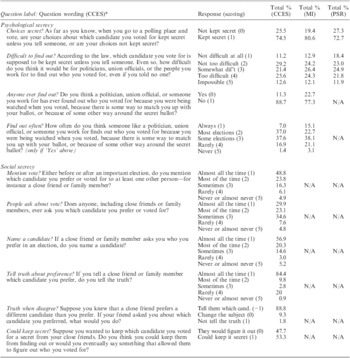
Ten items from the CCES form the core of the analysis that follows. These are questions about ballot secrecy, which were fielded as part of the pre-election wave of the survey in October 2008. Full question wording is provided in Table 1.Footnote 26 The first four items focus on the formal secrecy of the voting process and asked respondents whether their vote choices are kept secret. The remaining six questions focused on the social privacy of vote choice. Principal components analysis of the items listed in Table 1 (excluding ‘Find out often?’, which was only asked to individuals who responded that someone had found out who they voted for) supports the claim that this set of questions taps different beliefs and attitudes. This analysis yielded two distinct factors (loadings, using varimax rotation, shown in online Appendix Table A2), one for psychological (eigenvalue of 1.57) and one for social (eigenvalue of 3.08) secrecy. The next factor had an eigenvalue of 0.97, with a scree plot showing a clear ‘elbow’ after the second factor.Footnote 27 In the MI and PSR surveys we asked subsets of the psychological secrecy questions using similar wordings (differences are noted in the online Appendix).
Psychological and Social Secrecy Question Wording, Scoring and Marginal Responses

Note: N/A = Not asked. All responses are weighted. 2008 CCES (Cooperative Congressional Election Study, Internet national sample), N = 804. 2005 MI (Michigan Study, RDD of MI registered voters), N = 573. 2010 PSR (Princeton Survey Research, RDD national sample), N = 903. * Variations in question wording across surveys are noted in the online Appendix.
The distributions of responses to the questions about whether or not one's vote choices are kept secret (the top half of Table 1) suggest that, from a psychological perspective, many people do not believe that their ballots are kept secret. In the CCES, just over 25 per cent of people believed that the votes they cast are not kept secret. Even in the context of a subsequent question that explicitly states that ‘according to the law, which candidate you vote for is supposed to be kept secret unless you tell someone’, 40 per cent of respondents thought that it would either be ‘not difficult at all’ or ‘not too difficult’ for ‘politicians, union officials, or the people you work for’ to find out who they voted for. The results from the other two surveys indicate that these beliefs are not confined to CCES participants or participants in internet surveys. Nineteen per cent of respondents in the MI survey (N = 573) and 27 per cent of respondents in the PSR survey (N = 903) thought their choices were not secret and 37 per cent (of MI respondents) and 41 per cent (of PSR respondents) thought that it would be ‘not too difficult’ or ‘not difficult at all’ for someone to find out which candidate they had chosen. Finally, among the 11 per cent (22 per cent) of the CCES (MI) sample who thought that someone had actually found out about their vote, 44 per cent (38 per cent) thought this violation of secrecy was pervasive (happening ‘always’ or ‘in most elections’). Overall, these responses suggest widespread doubt about ballot secrecy.
We also find that although doubts about the psychological secrecy of the ballot vary across demographic groups, they are not confined to the subsets of the population for which we might expect this misinformation to be most prevalent (such as among those with low socioeconomic status) given their relative lack of participation.Footnote 28 For example, although there is a 16 percentage point difference in beliefs that choices are not kept secret between those with a high school diploma or less and those with a college degree, even among those with a college degree, 18 per cent did not think their ballot choices were kept secret.Footnote 29 Similarly, although Black and Hispanic respondents were more likely to say they thought it would be ‘not too difficult’ or ‘not difficult at all’ for someone to find out which candidate they had chosen (54.0 per cent and 48.8 per cent, respectively), a large number of White respondents (36.2 per cent) also reported these doubts about the secrecy of their choices. In short, doubts about formal ballot secrecy are common, even among those for whom we might not expect them to be.
In terms of the social dimension of secrecy, it appears that very few people treat their vote choice as a strictly private decision. To the contrary, vote choice appears to be something that is often shared. Almost 73 per cent of people say that they mention who they vote for in an important election either ‘almost all the time’ or ‘most of the time’. Fewer than 5 per cent said that they ‘never or almost never’ mention their vote. It is also clear that asking questions about vote choices are far from taboo – just over 12 per cent of respondents said that they are ‘rarely’ or ‘never or almost never’ asked about those choices. Furthermore, when asked, 77 per cent say that they are willing to provide an answer either ‘almost all the time’ or ‘most of the time’. Moreover, they overwhelmingly say that they respond honestly to these queries. Ninety-four per cent say they tell the truth about their preference to ‘a close friend or family member’ either ‘almost all the time’ or ‘most of the time’ and 89 per cent say they tell the truth even when they think the person asking (‘a close friend’) may disagree with their choice. Forty-eight per cent say that even if they wanted to keep their vote choice secret from ‘close friends’, they would not be able to do so (a measure that may reflect both an ability to avoid answering a question or a willingness to lie). Finally, as with psychological secrecy, we find that although social secrecy varies somewhat across demographic groups, the practice of discussing one's choices is common across a wide variety of groups.Footnote 30 For example, over 60 per cent of respondents in each of the subgroups we examined reported mentioning their vote choice to someone either ‘almost all the time’ or ‘most of the time.’Footnote 31
Considering these two dimensions of ballot secrecy together, we find that 82.6 per cent of the population believes either that their choices are not kept secret (25.5 per cent) or that they will reveal their choices ‘almost all the time’ or ‘most of the time’ (72.6 per cent). Quite apart from the actual secrecy of the ballot then, for a substantial proportion of the population a vote choice is to a large extent not a private decision. Having established this, we next test empirically whether ballot secrecy perceptions affect the decision-making calculus of which candidate to choose.
Secrecy Perceptions and Voting Behaviour
The expanded vote choice model we proposed above posits that voting decisions are a function of not only the benefit of casting the decisive ballot for one's preferred candidate pp (B 1−B 2), but also of the expected costs associated with one's vote choice being revealed to others weighted by secrecy perceptions (the perceived probability of disclosure) pr (X 1−X 2). To test the claim that variation in secrecy perceptions (pr ) affects vote choice requires identifying both a respondent's preferred winning candidate (B 1−B 2) and the costs associated with having one's vote choice revealed to others (X 1−X 2). We focus on the case of the 2008 US Presidential election and assume Candidate 1 is the Democrat (Obama) and Candidate 2 is the Republican (McCain). Although we cannot measure either the Bi or Xi terms directly, the CCES provides several variables useful as proxies. For example, to explain a voter's candidate preferences on policy grounds (B 1−B 2), we can include measures of whether a respondent is a member of a union household, their partisanship, ideology, issue preferences, race, gender, age, income, education, frequency of religious services attendance and political interest. To calculate the relative social and economic costs of having been revealed as supporting one candidate over the other (X 1−X 2) we identify two scenarios in which those factors are unambiguously defined.Footnote 32
First, consider union members, a group for which we have a clear sense of the potential conflict between an organization's formal electoral goals – supporting Barack Obama – and individual union members’ preferences. In the 2008 general election Barack Obama was endorsed by the AFL–CIO, UAW, International Brotherhood of Teamsters, and dozens of other labour unions. To the best of our knowledge, however, John McCain was not endorsed by a single major union. Given this, among union members, the expected net benefits of being found out as having voted for Obama rather than McCain were likely positive (X 1−X 2 > 0). Therefore, we predict that those union members who expected their vote choice to be revealed (pr > 0) – either by themselves or by election administrators – should be less likely to buck the union endorsement by voting for John McCain than those who believed their vote would be kept secret and for whom voting against Obama would not entail expected repercussions.
We note that in the case of union members we expect a lack of psychological secrecy to be particularly relevant. Doubts about the formal secrecy of the ballot suggest a concern that other individuals or groups will surreptitiously monitor or access one's ballot choices. Unions are well-organized, have substantial resources, and devote a substantial proportion of these resources to affecting election outcomes. Thus, union members who are not confident that their choices are well-protected may believe that union leaders have both the power and motivation to access their ballots. Because of this, they may decide to vote for the union-endorsed candidate rather than risk exposure and possible professional sanctions. Although lack of social secrecy may also affect union members’ choices, we view this as less likely. This is because, as Finifter finds, individual union members can choose which other union members they associate with and are likely to seek out politically like-minded discussants.Footnote 33 Put another way, union membership is unlikely to be a clear-cut proxy for the political preferences of the people with whom union members expect to discuss their vote choices.
The second case we examine is that of partisans. We base our hypotheses about how partisans respond to varying levels of secrecy on prior research showing that people have greater interaction with those who share their political outlookFootnote 34 and that stronger partisans hold policy opinions more congruent with their party's candidate. Thus, partisan affiliation has two dimensions that are likely to affect vote choices. First, partisanship indicates the strength and direction of one's political preferences (B 1−B 2). Secondly, it is an identity that is likely to proxy the preferences of others in an individual's discussion network and, therefore, the social costs associated with one's vote being revealed to these discussants (X 1−X 2).Footnote 35 Because public deviation from the preferences of one's peers may entail costs, it follows that for partisans the expected net social benefit of being revealed as having voted for their party's candidate rather than the opposition are positive (X 1−X 2 > 0 for Democrats and X 1−X 2 < 0 for Republicans). Thus, we predict that after accounting for individuals’ policy preferences, partisans who expect their vote choices to be revealed (pr > 0) are less likely to deviate from their partisan affiliation than those who do not. For example, because of the (avoided) potential social costs of admitting to other Republicans that they supported Obama, we anticipate that Republicans who expect to be asked to share their vote choice will be more likely to vote for McCain than those who expect to keep their choices secret.
Importantly, we hypothesize that the effect of social pressure on voting will vary across different types of partisans. Although ‘strong’ partisans may face the largest social sanctions if they deviate from their party's candidate, they typically also strongly prefer their party's candidate (|B 1−B 2| is relatively large). ‘Weak’ partisans, by contrast, may feel social pressure to vote with their party, but may have weaker policy preferences about which candidate wins in a particular election (|B 1−B 2| is smaller than for strong partisans). These voters may be the most likely to allow potential social costs to trump their preferences regarding which candidate wins. Finally, if independents (including partisan ‘leaners’) are commonly exposed to a mix of partisans, this suggests that their vote choice may be unaffected by expected secrecy.Footnote 36
In contrast to the psychological secrecy effects for union membership discussed above, our expectations regarding the consequences of the intersection between ballot secrecy perceptions and partisanship are not premised on the notion that people worry that their acquaintances will attempt to find out their vote choices without their permission. Indeed, few individuals are likely to think that their friends are powerful or motivated enough to surreptitiously find out about their ballot choices. Instead, these effects are likely to be associated with a perceived lack of social secrecy – i.e., an expectation that one will disclose one's choices to the co-partisans in one's social network.
Empirical Findings Concerning Secrecy and Voting Behaviour
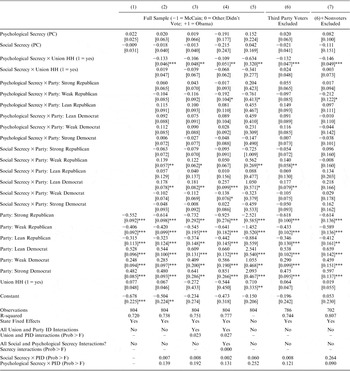
We report tests of these hypotheses in Table 2, where we present a series of models predicting reported vote choice in the 2008 election. Because doubts about secrecy may prompt some people to abstain, rather than change their vote choice, in our primary analysis we specify abstention as the midpoint on the vote choice scale.Footnote 37 This specification allows deviations from privately preferred candidates in the face of employer or social pressure to take two forms: abstention or, in a more extreme move, defection. We also repeat our primary analysis (reported in Columns 1–5) by excluding minor party voters in Column 6 and then excluding both minor party voters and those who abstain in Column 7. These alternative model specifications allow us to assess whether our results are sensitive to the inclusion of these respondents.
Ballot Secrecy and Presidential Vote Choice (CCES)

Note: Weighted analysis. OLS in columns (1)–(4) and (6)–(7); ordered logit in column (5). Robust standard errors in brackets. *** p < .01; ** p < .05 ; * p < .10 (two-tailed). Summary statistics for CCES variables presented in Online Appendix Table A1. See Online Appendix Table A2 for principle component loadings used to construct psychological and social secrecy scales. All columns include controls for: race (black), race (Hispanic), race (other), gender, age, age-squared, married/domestic partnership, religious attendance, education (five indicator variables), income (linear scale with separate indicator for income missing), interest in politics, ideology, and an index of four standardized issue attitudes. These coefficients are not shown. In columns (3) and (4), thirteen union and twelve party ID interactions interact the union and party identification measures individually with: race (black), race (Hispanic), race (other), gender, age, age-squared, married/domestic partnership, religious attendance, education, income, income missing, interest in politics, ideology (union only), and the issue attitude index (union only). In column (4), thirteen Social and thirteen Psychological Secrecy interactions interact each of the secrecy measures with: race (black), race (Hispanic), race (other), gender, age, age-squared, married/domestic partnership, religious attendance, education, income, income missing, interest in politics, ideology, and the issue attitude index. Coefficients not shown. (Full results presented in Online Appendix Table A4).
In order to simplify the analysis of the relationships between psychological and social secrecy and voting, as well as to reduce measurement error for the two dimensions of secrecy, we used the component loadings from the principal components analysis reported in online Appendix Table A2 to calculate standardized scores for each type of secrecy (M = 0, SD = 1).Footnote 38 We also include state fixed effects as well as a set of demographic and political control variables: race, gender, age, age-squared, marital status, religious attendance, education (entered as a series of indicators for each response category), income (linear scale with a separate indicator for income missing), interest in politics, ideology, and an index of four standardized issue attitudes. We note that the last two controls (ideology and issue attitudes) are particularly important in accounting for individuals’ preferences regarding which candidate wins the election (B 1−B 2).
The results in the Table 2, Column 1 specification are a baseline vote choice model that establishes that there is no direct relationship between either secrecy scale and vote choice. These results suggest that in 2008, on average, there was no incentive to conceal a Republican vote more than a Democratic vote. Beginning with the Column 2 specification, we present a series of models that tests our predictions about how variation in secrecy beliefs moderates the effects of union membership and party affiliation. We do so by including (a) interactions between the union membership variable and each of the secrecy scales, and (b) interactions between indicators for each partisanship response category (excluding pure independents) and each of the secrecy scales.
If secrecy beliefs condition the influence of union membership, then we should observe a negative coefficient on the interactions between the secrecy scales and union membership. This would mean that union members who believe their choices are secret are more likely to vote for McCain. Turning next to the relationship between voting, secrecy and partisanship, we expect the signs on the interactions between the secrecy measures and the party identification indicators to vary in a particular way. Strong partisan identifiers are likely to be firmly committed to their party's candidate and vote for that candidate regardless of whether or not they expect to reveal their choices. By contrast, weak identifiers may be less committed to their party's candidate and may sometimes be inclined to vote for the opposing candidate. Among these less committed partisans we expect those who anticipate sharing their vote choices with others (who are likely to be co-partisans) to be more likely to conform to the common choice of those in their social environment and, thus, avoid the (social) costs associated with disagreement. If this is the case, the interaction between the indicator for weak Democrats and social secrecy should be negative and the interaction between the indicator for weak Republicans and social secrecy should be positive. Finally, although partisan leaners, like weak partisans, are likely to be less committed to their party's candidate than strong identifiers, they are different from weak identifiers in two respects. First, they are more likely than leaners to be exposed to a mix of partisans. Secondly, they do not identify with the party in the same way as strong and weak partisans do (by definition: partisan leaners do not say they are a partisan in response to the stem of the standard party identification measure). Given these two differences, we might expect partisan leaners to vote for their preferred candidate regardless of whether or not they expect to reveal their choices.
These predictions are largely confirmed. Focusing on the Column 2 specification, which includes these interactions as well as all of the covariates included in the Column 1 specification, we find that the interaction between psychological secrecy and union status is negative and statistically significant.Footnote 39 This means that union members who believed that their choices are formally kept secret were less likely to vote for Obama than those who believed their choices might be revealed. The magnitude of this conditioning effect is quite large. The outcome variable ranges from −1 (vote for McCain) to +1 (vote for Obama). Among independents (the excluded partisanship category) not living in union households, there is no statistically significant relationship between psychological secrecy and vote choice (b = 0.20, p = 0.747). In contrast, among those in union households a two standard deviation increase in the scale measuring beliefs that ballot choices are kept secret is associated with a 0.226 unit decrease in the outcome or an 11.3 percentage point increase in the likelihood of voting for John McCain.Footnote 40
Turning next to the empirical findings regarding the partisan identification interactions, we find that the interactions between the six party identification indicators and the social secrecy measure are jointly statistically significant (p < 0.01).Footnote 41 The coefficient on the social secrecy variable (b = −0.018, p = 0.649) indicates that there is no relationship between this measure and vote choice among pure independents. We find that the coefficients on the interactions between the indicators for strong party identifiers and social secrecy are statistically and substantively insignificant. In contrast, the interaction between social secrecy and the weak Republican indicator is statistically significant and in the expected direction; the coefficient on the interaction between social secrecy and the weak Democrat indicator is in the expected direction, but falls short of conventional levels of statistical significance (p = 0.170). These findings suggest that the relationship between social secrecy and vote choice is different for weak identifiers (compared to pure independents). Calculations of the linear combination of the coefficients on the social secrecy measure and each of the weak identifier interactions indicate that among weak Republicans a two standard deviation increase in social secrecy was associated with a 24.1 percentage point increase in the likelihood of voting for Obama (p < 0.01). Among weak Democrats the same increase in social secrecy was associated with a 24.1 percentage point increase in the likelihood of voting for McCain (p < 0.10).Footnote 42
Although we have restricted our hypotheses to strong and weak partisans and pure independents, Table 2 also reports results for independents who lean towards one party or the other. We find that among partisan leaners from both parties, those who said they were less likely to share their vote choice were more likely to vote for Obama. This moderating effect is statistically significant among leaning Democrats (p < 0.05). Given the ambiguity associated with the meaning of the ‘leaning’ partisan categorization,Footnote 43 we simply note that the finding concerning partisan leaners, while not explained by our theoretical account, may be of interest to other scholars and should be replicated in other contexts because it was not expected a priori.
In Columns 3 and 4 of Table 2 we consider the robustness of these findings. A first concern is whether the moderation analysis we conduct is a reliable test of our hypotheses. By interacting union membership and partisanship with secrecy perceptions, we are assuming that there is no interaction between the other covariates (such as ideology) and those factors that proxy (X 1−X 2) (union membership and partisanship). This assumption may be unfounded. The model presented in Column 3 addresses this concern by including twenty-six interactions between (a) a linear (7-point) measure of partisanship and (b) union membership and the other covariates.Footnote 44 The results with regard to the effect of union membership and psychological secrecy and partisanship and social secrecy from Column 2 persist and are similar in magnitude.
The model presented in Column 4 goes even further, adding an additional twenty-eight interactions – each of the other original covariates interacted with the social secrecy and psychological secrecy scales. Although the coefficient on the interaction between the weak Republican indicator and social secrecy falls below conventional levels of statistical significance in this model, for the most part the results discussed above are substantively similar. This analysis demonstrates that our results are not driven by the interaction between some other variable and secrecy perceptions.
A second concern is that our results are an artefact of model specification such as the use of ordinary least squares (OLS) or coding of the dependent variables. In Column 5 we estimate the same model as in Column 2, but using ordered logit instead of OLS.Footnote 45 The interaction between union household and psychological secrecy remains negative and statistically significant. The signs on the weak partisan identifiers x social secrecy interactions remain the same, but the weak Democrat interaction is not statistically significant (p = 0.394, two-tailed). In Column 6 we again repeat the Column 2 specification (including the use of OLS), but exclude third-party voters and in Column 7 we exclude both third-party voters and non-voters. Again, in these two models the interaction between union household and psychological secrecy is negative and statistically significant, and similar in magnitude to the coefficient in Column 2. However, the interactions between social secrecy and weak partisan identifiers, although largely the same when third-party voters are excluded in Column 6, are statistically insignificant and substantively small when non-voters are also excluded in Column 7. This suggests that a lack of social secrecy may affect whether people abstain, rather than affecting which candidate an individual votes for (a potential avenue for future work, but beyond the scope of this article),Footnote 46 a finding that is consistent with work by Mutz, who finds that, compared to discussion of politics between politically homogeneous interlocutors, discussion of politics between politically heterogeneous interlocutors results in lower participation rates.Footnote 47
A third concern we address is whether our findings about secrecy perceptions instead reflect another omitted variable. In particular, one plausible candidate is trust in governmentFootnote 48 – those low in trust may have doubts about formal ballot secrecy or their ability to keep their decisions private and low trust may simultaneously affect candidate preferences. However, to explain the results we find with regard to union membership, it would have to be the case that union members low in trust had greater doubts about psychological secrecy and were more likely to support Obama than those high in trust, but that these associations did not exist for non-union members.Footnote 49 One could also imagine similar scenarios explaining our finding about the interaction between social secrecy and partisanship.
Unfortunately, the CCES data we analyse lacks a trust in government measure. This forces us to consider alternative approaches for ruling out a trust-based explanation. We begin by noting that our results are robust to controlling for the direct effects of both ideology and issue positions that are likely to be associated with trust in government, as well as interactions between these measures and union membership and each of the secrecy measures. If (less trusting) union members or partisans were ideologically distinct from their more trusting counterparts then these controls would address this concern.Footnote 50
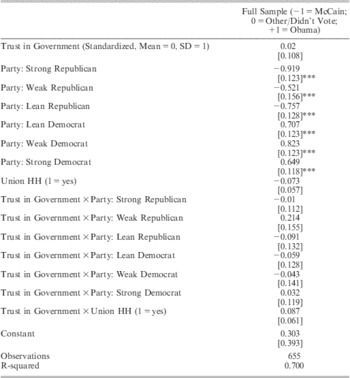
Additionally, we turned to another 2008 election survey, the Cooperative Campaign Analysis Project (CCAP),Footnote 51 which does include a measure of trust in government, to directly examine the effect of trust perceptions on voting decisions.Footnote 52 Using these alternative data, we present in Table 3 a model that includes the same covariates presented in the Table 2, Column 2 specification, but with the secrecy interactions replaced by trust in government interactions. We find that those high in trust are slightly more likely to support Obama, but that there is no evidence that variation in trust affects the relationship between either union membership or partisanship and vote choice. Thus, we believe it is unlikely that our results originate in an omitted trust variable being proxied by secrecy perceptions.
Robustness: Trust in Government and Presidential Vote Choice (CCAP)

Note: Weighted OLS analysis. Robust standard errors in brackets. *** p < .01; ** p < .05 ; * p < .10 (two-tailed). Data source is 2008 CCAP (see text for details). Includes controls for: race (black), race (Hispanic), race (other), gender, age, age-squared, married/domestic partnership, religious attendance, education (five indicator variables), income (linear scale with separate indicator for income missing), interest in politics, ideology, and state fixed effects. These coefficients are not shown.
Overall, our results demonstrate that beliefs about the secrecy of the ballot have important implications for our understanding of voting decisions. The more doubts individuals from union households had about whether or not their vote choices would be kept secret, the more likely they were to adopt the union position in their vote choice. We also find that weak partisans are more likely to toe the party line if they expect to discuss their voting decisions with others, though we note that the finding that independents who lean Democratic are more likely to vote Democratic when they believe there is greater secrecy was not predicted by our theoretical account of how partisanship and secrecy interact. This dissonant note notwithstanding, the weight of the findings is consistent with the view that beliefs about ballot secrecy play an important role in voter choice. More generally, these findings highlight the extent to which social pressures – the very pressures the secret ballot is designed to eliminate – can continue to affect decisions about which candidate to support.
Discussion and Conclusion
Advocates of the secret ballot argued that ballot secrecy would free citizens to express their preferences in the voting booth without fear of repercussions for a particular vote choice. We show, however, that this institutional reform is not sufficient to transform voting into an entirely private act. Although the ballot is formally secret and reformers may have achieved a great deal of what they desired (for example, elite mobilization efforts have shifted away from outright intimidation and vote buying), large swaths of the public either have doubts about how well their choices are protected or expect to share their choices with others. We suggest that these psychological and social dimensions of the secret ballot have the potential to alter the costs and benefits people weigh when deciding which candidate to vote for.
The psychological and social aspects of ballot secrecy each seem to affect vote choices in distinct ways. Union membership conditioned the effects of psychological secrecy but not social secrecy; partisanship conditioned the effects of social secrecy but not psychological secrecy. It appears that beliefs about the formal secrecy of the ballot are particularly relevant when a voter fears formal sanctions from a third party – such as an employer or the leader of an organization. In contrast, the effects of social secrecy appear to be more closely tied to concerns about social sanctions, such as the discomfort of disagreeing with friends and family.
The effects we observe here on vote choice could also influence citizen behaviour in other types of political activity, such as how one participates in political discussions. Individuals who find themselves in a social, professional or familial environment may voice opinions that they do not agree with in order to avoid potential social and economic costs. For example, an individual working at a business with many wealthy clients may oppose the estate tax (also referred to as the death tax) even in non-work contexts, because of the risk that his or her employer or clients would disapprove of his or her support for the tax if they found out; someone in a particularly liberal work environment (or other social context) may say they support abortion rights in order to avoid the social costs associated with disagreement on such a high-interest issue, particularly if they are otherwise ambivalent about the issue. These dynamics could have important implications in that they may create a false sense of consensus about policies when in fact many people are either ambivalent or part of a (quiet) opposition.
Our analysis relies solely on conscious, self-reported perceptions about secrecy. The act of asking these questions may have raised doubts in respondents’ minds about the secrecy of the ballot, which raises the question of whether these responses are meaningful or reflect non-attitudes. We think there are two reasons to believe the responses are meaningful. First, the fact that such a large percentage of the respondents were willing to voice concerns on multiple items, including items asking if they themselves had experienced a violation of the secrecy of their own ballot, suggests widespread doubts about ballot secrecy. Secondly, we find evidence that perceptions of ballot secrecy affect voting behaviour. If people's responses to the secrecy questions were largely random, we would not expect to find the associations between these measures and vote choice. The fact that we find these relationships suggests that the secrecy perception measures are meaningful.
Moreover, even if the survey items exaggerate the absolute level of doubt but accurately identify those members of the public who have greater levels of doubt, the measure is extremely useful in understanding the consequences of doubts about ballot secrecy. As we note when discussing our model of vote choice, even if an individual thinks it is highly unlikely that her choice will be revealed, if the perceived likelihood of disclosure is still larger than the perceived likelihood of being pivotal, these inklings of doubt may affect vote choices. Additionally, it is possible we are underestimating the total consequences of lack of secrecy on vote shares. The effects we discuss here could have cascading effects. Voting preferences held by one person in a social network might spill over, exerting pressure on others to conform to that preference. As more people are affected by this social pressure, the breadth of its influence may grow exponentially.
These findings about how people decide who to vote for have important consequences for institutional design and practices.Footnote 53 For example, in many states, primary elections are conducted via a caucus system where one's vote choices are revealed to others. The relatively low turnout in these caucuses may, in part, be a function of people being unwilling to bear the potential costs associated with revealing one's political preferences in a public forum. Perhaps more troubling, given the decision to vote in a caucus, people may feel obligated to cast votes designed to avoid social or substantive repercussions from neighborhood organizations, union leaders or even employers who attend the caucus.Footnote 54 The recent shift to mail-in (postal) ballots, with the concomitant increase in voting parties and other social gatherings to fill out these ballots, raises similar concerns.Footnote 55 Voting technology also varies across states and districts. These technologies, as well as other seemingly benign aspects of the voting process (such as how much space there is between voting booths), may affect perceptions of secrecy. For example, if voters do not have a clear sense of how electronic voting machines work, they may suspect that these machines provide a way of matching their identity with their ballot choices and may alter their choices in anticipation of their votes being revealed to employers, government or party officials, or others.
The findings we present here also have implications that extend far beyond the decisions citizens make in presidential elections. Each year citizens are called upon to vote in a vast array of governmental elections that may range from local city council to US Senator. In most of these elections, votes are cast through a formalized secret ballot process administered by election administrators, whom most (but, as we show, not all) voters presumably have little reason to think would inappropriately reveal their choices. However, consider the case of a less formal election process – such as Parent Teacher Association (PTA) or union officer elections. In these cases, those casting ballots may (rightly or wrongly) have serious doubts about the trustworthiness of the people collecting and tallying the ballots. In those cases, these doubts about the secrecy of the ballot may substantially affect the outcomes by changing who votes and the choices of those who do.
The larger point made in this article is that the case of the secret ballot suggests the relationship between election (or other) rules and citizen beliefs may not be straightforward or constant across population subgroups. That is to say, institutions shape voter beliefs, which in turn affect voter behaviour. Consequently, the intermediate step in the analysis that flows from rules to behaviour might deserve more attention than it often receives. It may be worth asking as a matter of course: How does this intervention/institution shape voter beliefs about how alternative actions produce costs and benefits? Explicitly considering how an institution or an intervention shapes beliefs, which in turn affects behaviour, may be crucial to accurately assessing the consequences of an intervention. In many cases, elaborating this intermediate step between institutions and choice may be unnecessary because the effects of a rule change on beliefs about the consequences of choosing among alternatives is clear and uncomplicated. However, our investigation of ballot secrecy beliefs, an area that would seem a priori like a ‘hard case’ for finding an important role for beliefs apart from the formal rules themselves, suggests that overlooking the role of beliefs in the mapping from institutions to behaviour may be inadvisable.
The results point to a link between beliefs regarding ballot secrecy and voting behaviour,Footnote 56 but for familiar reasons we cannot make definitive claims about the causal nature of these associations based on the naturally occurring variation in respondent beliefs about ballot secrecy. For example, our analysis is based on self-reported discussion habits and vote choices. Thus, our estimates may be biased by unmeasured characteristics that affect how people respond to survey items. Similarly, there may be omitted variables correlated with secrecy and vote choice. We attempt to reduce this vulnerability by including a collection of standard control variables that explain vote choice and also by examining the robustness of the findings across model specifications. For example, the finding that those in union households who doubt ballot secrecy are more likely to vote Democratic holds after controlling for race, education and other variables, as well as interaction terms that permit the relationship between those variables to differ for those in and not in union households.
An additional potential threat to our analysis is that we are unable to determine the direction of the causal relationship between voting and secrecy perceptions with certainty. An alternative explanation for the fact that party identification conditions the relationship between social secrecy and vote choice is that people choose who to vote for and then make a decision as to whether they discuss their choice with others. For example, an individual who chooses to vote for Obama may decide not to discuss this choice with others if she anticipates that they will disagree with her choice. Despite the fact that our questions are intended to measure whether people generally discuss their vote choices with others, rather than whether they specifically intended to share their 2008 presidential vote choice, given the context of the survey, responses may have been coloured by respondents’ expectations about their discussions about the upcoming presidential election.
Ultimately, future research should examine natural, field or laboratory experiments that produce exogenous variation in social and psychological secrecy. This type of research design could address these questions related to the direction of causality as well as concerns about omitted variable bias. Additionally, in the analysis presented here we relied on batteries of questions that yielded measures of individual perceptions about the general secrecy of the ballot and social secrecy related to close friends and family members. These measures do not allow us to pinpoint individual level sources of social pressure and, therefore, may underestimate the consequences of perceptions of ballot secrecy. Questions that ask people to state with exactly whom they typically discuss political matters (for example, whether they are asked about their choices at work) and whether they tend to agree with these discussants on political matters would provide a richer understanding of how the dynamics suggested by our analysis work and allow for more precise estimates of the relationships between social and psychological ballot secrecy and voting behaviour. Beyond these potential refinements, our findings point to three promising avenues for further research on the nature and consequences of ballot secrecy perceptions.
First, our results show widespread doubt about the secrecy of the ballot in the United States. In addition to their effects on voting decisions, these doubts may decrease perceptions of institutional fairness and legitimacy. Future research should investigate what types of institutional changes might mitigate these doubts. As suggested above, some types of voting technology may give people greater confidence that their choices are kept secret (just as some technologies appear to affect beliefs that votes are fairly counted).Footnote 57 These mass beliefs may or may not comport with the opinions of experts on the relative secrecy and reliability of different balloting technologies.
Secondly, beyond formal changes to the structure of the voting process, researchers should consider how somewhat more peripheral aspects of the voting process affect perceptions of secrecy. Partisan poll watchers (tellers), for example, may lead people to believe that party officials are monitoring their choices and, perhaps, sharing this information with others. In contrast, non-partisan election observers may not have this effect. Another possibility is that any election monitor – partisan or not – erodes voters’ confidence that their choices are kept secret. As our findings show, factors that affect whether or not people believe their choices are kept confidential may have substantial implications for voting decisions. Understanding these differences is important, particularly in light of efforts to reduce fraud and abuse through the deployment of international election monitors during elections in many developing countries.Footnote 58
Finally, researchers should examine how the relative importance of ballot secrecy varies across individuals and contexts. Our results show that the effects of social and psychological ballot secrecy vary across individuals (such as by union membership). However, these findings may only be the tip of the iceberg. An array of other individual characteristics and contextual factors may moderate the relationships between ballot secrecy and voting behaviour. For example, people who live in relatively homogeneous communities and share their neighbours’ political preferences may be more likely to vote if they believe their choices will be revealed, whereas those in heterogeneous communities with similar beliefs may be less likely to turn out.Footnote 59
Overall, understanding the way in which citizens perceive the voting process as either a more secret or more social act provides important insights for understanding citizen participation. We show that which candidates citizens choose to support is not only tied to personal and private concerns, but also to social and formal pressures that are realized when individuals anticipate others monitor or will learn of their behaviour.